
Old English Words give us a fascinating look at how the English language has changed over time. Some words come from true Anglo-Saxon English, while others are old-fashioned terms found in literature, poetry, and historical writing. Words such as cild, hūs, cyning, thou, thee, hither, and prithee may look unusual today, but many have clear modern meanings. Learning this old vocabulary can improve reading skills and make classic English texts easier to understand. It can also help learners discover the roots of many words still used in modern English.
What Are Old English Words?
Old English words are words from the earliest recorded stage of the English language, commonly called Anglo-Saxon. The language looks quite different from the English we speak today.
The Bosworth-Toller Anglo-Saxon Dictionary records English vocabulary used roughly between 700 and 1100, including words that later developed into many familiar modern English forms.
For example:
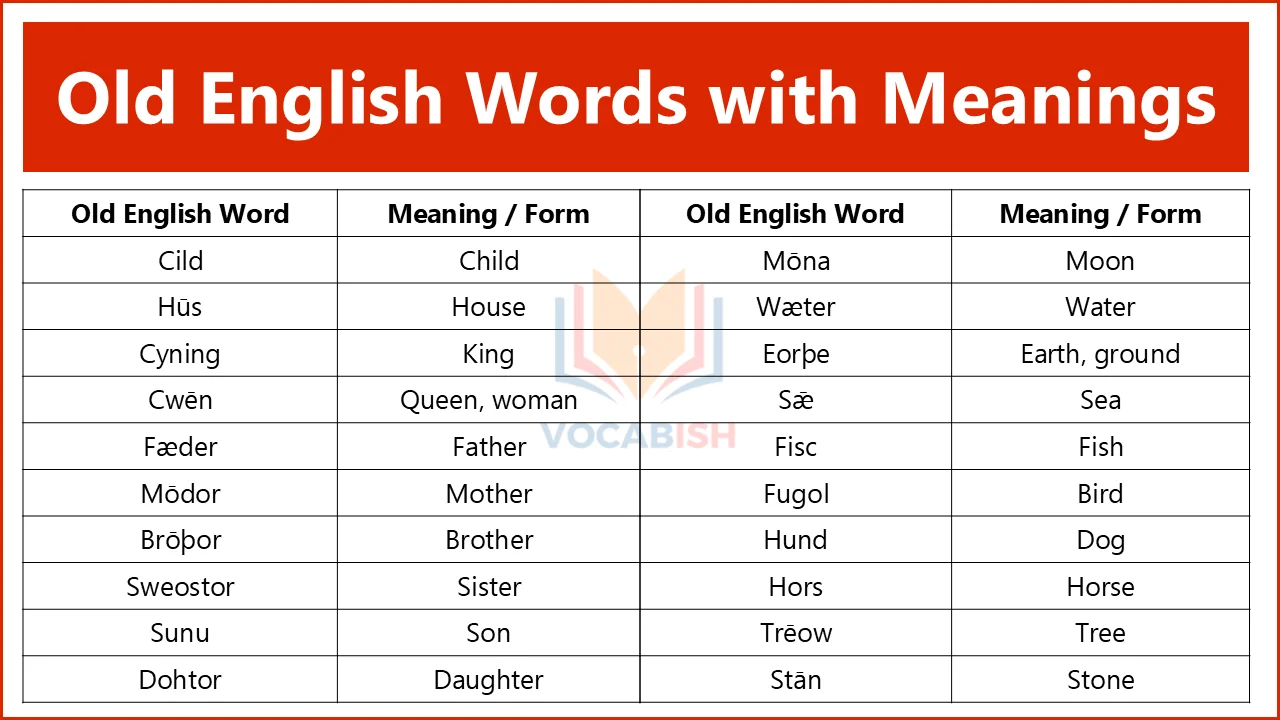
Old English | Modern English | Meaning |
|---|---|---|
cild | child | a young person |
hūs | house | a building where people live |
cyning | king | a male ruler |
wæter | water | the liquid we drink |
fæder | father | a male parent |
mōdor | mother | a female parent |
brōþor | brother | a male sibling |
nama | name | a word used to identify someone |
word | word | a unit of language |
hand | hand | part of the body |
Words such as cild, hūs, cyning, and wæter are documented Old English forms and clearly show how some basic English vocabulary survived through centuries of language change.
Old English vs Old-Fashioned English
These terms are often confused.
Type | Period or Use | Example |
|---|---|---|
Old English | Anglo-Saxon period | cild, cyning, wæter |
Middle English | Later medieval English | knight, swich, hath |
Early Modern English | Shakespeare and King James Bible era | thou, thee, dost |
Archaic English | Old forms rarely used today | betwixt, hither, whence |
Modern English | English used today | child, king, water |
So, “Thou art welcome” sounds old, but it is much closer to Shakespearean or Early Modern English than to genuine Anglo-Saxon Old English.
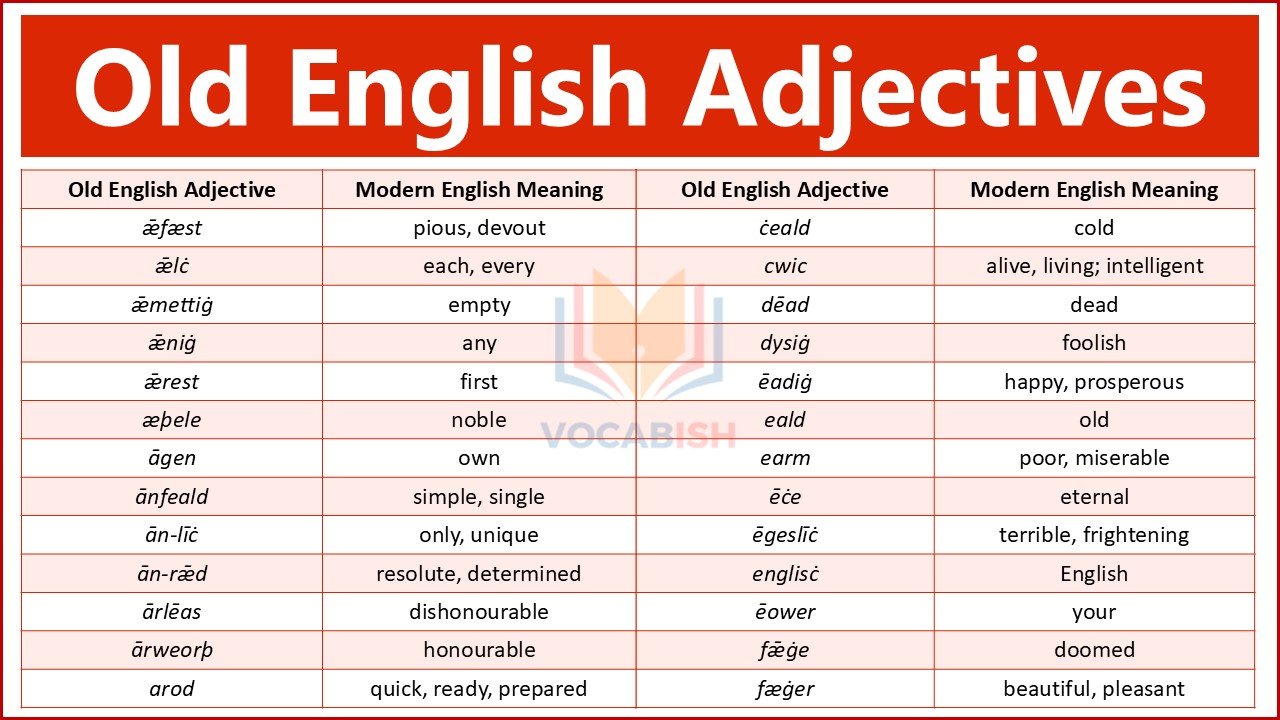
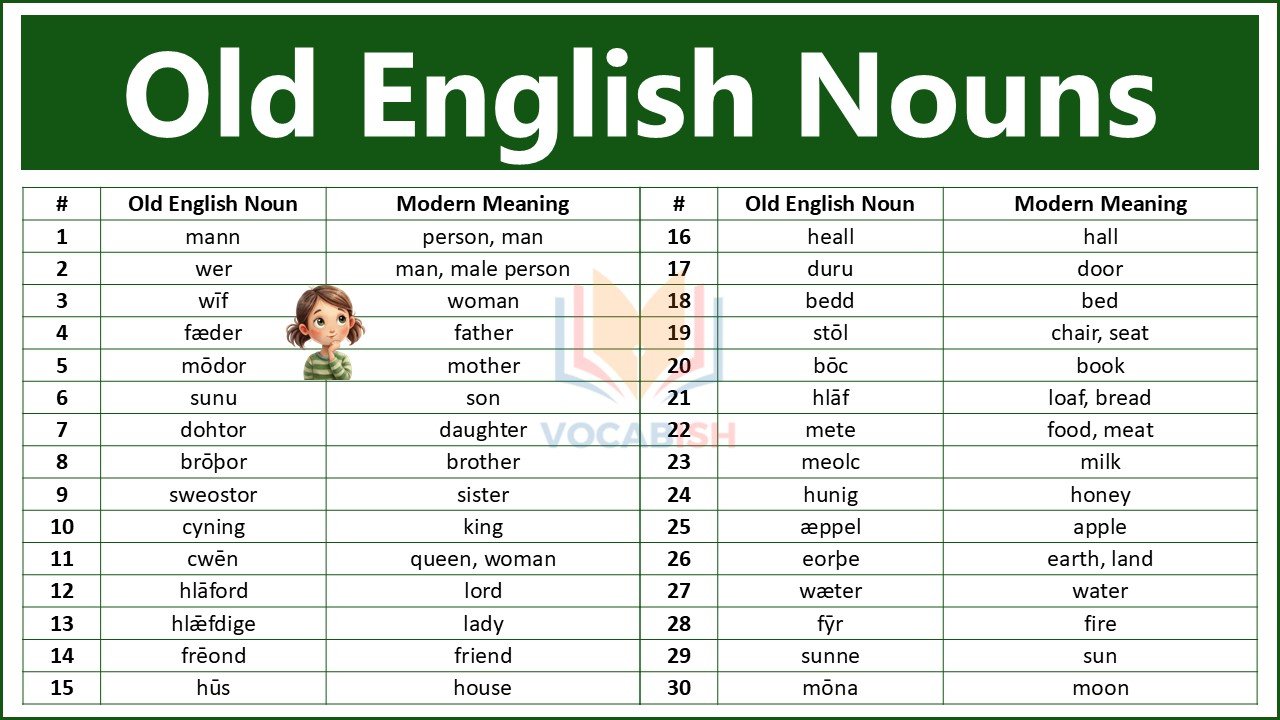
True Old English Vocabulary and Modern Meanings
A surprising number of everyday English words have ancestors that were already being used a thousand years ago.
The spelling and pronunciation have changed, but many Old English vocabulary items remain recognizable.
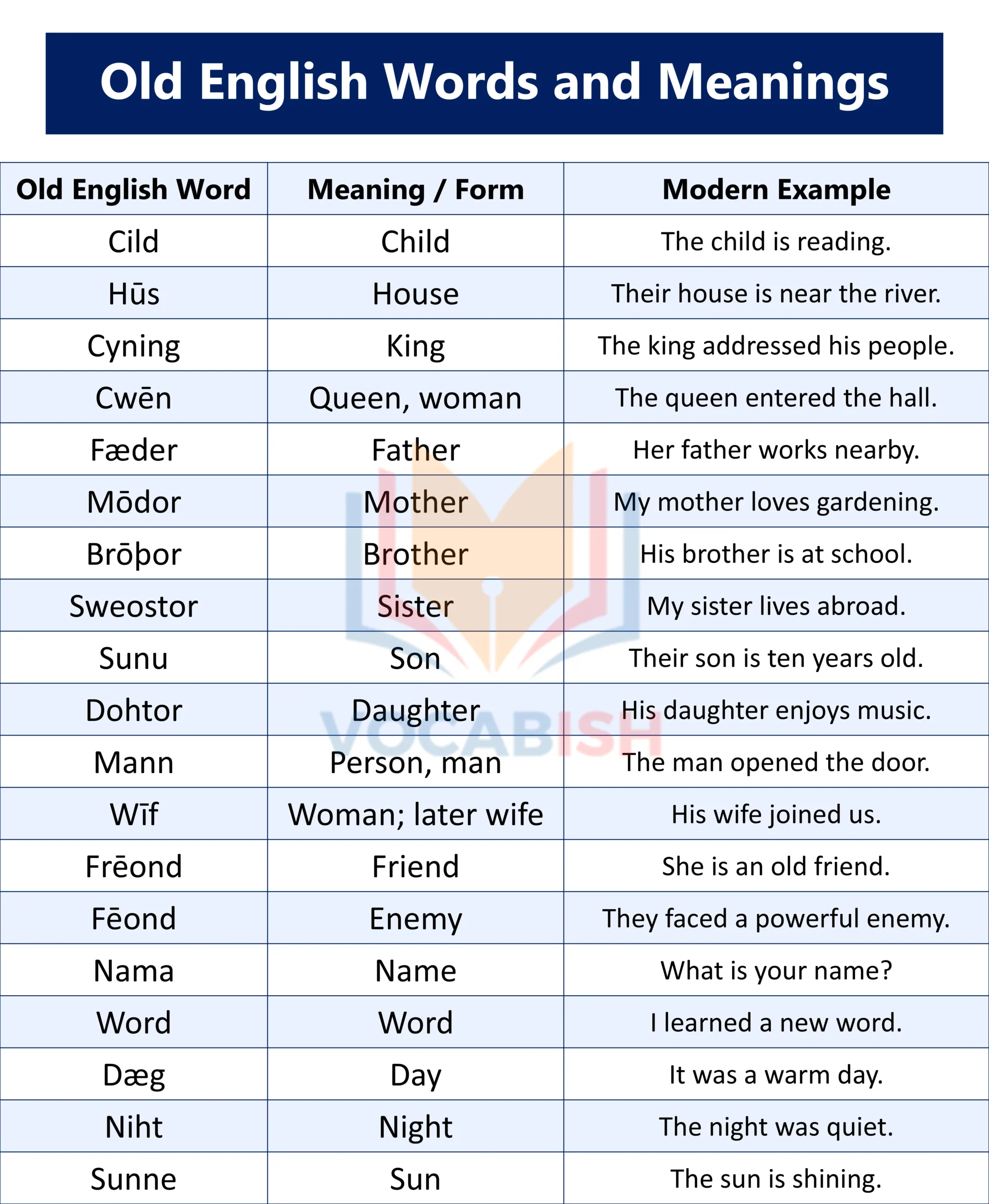
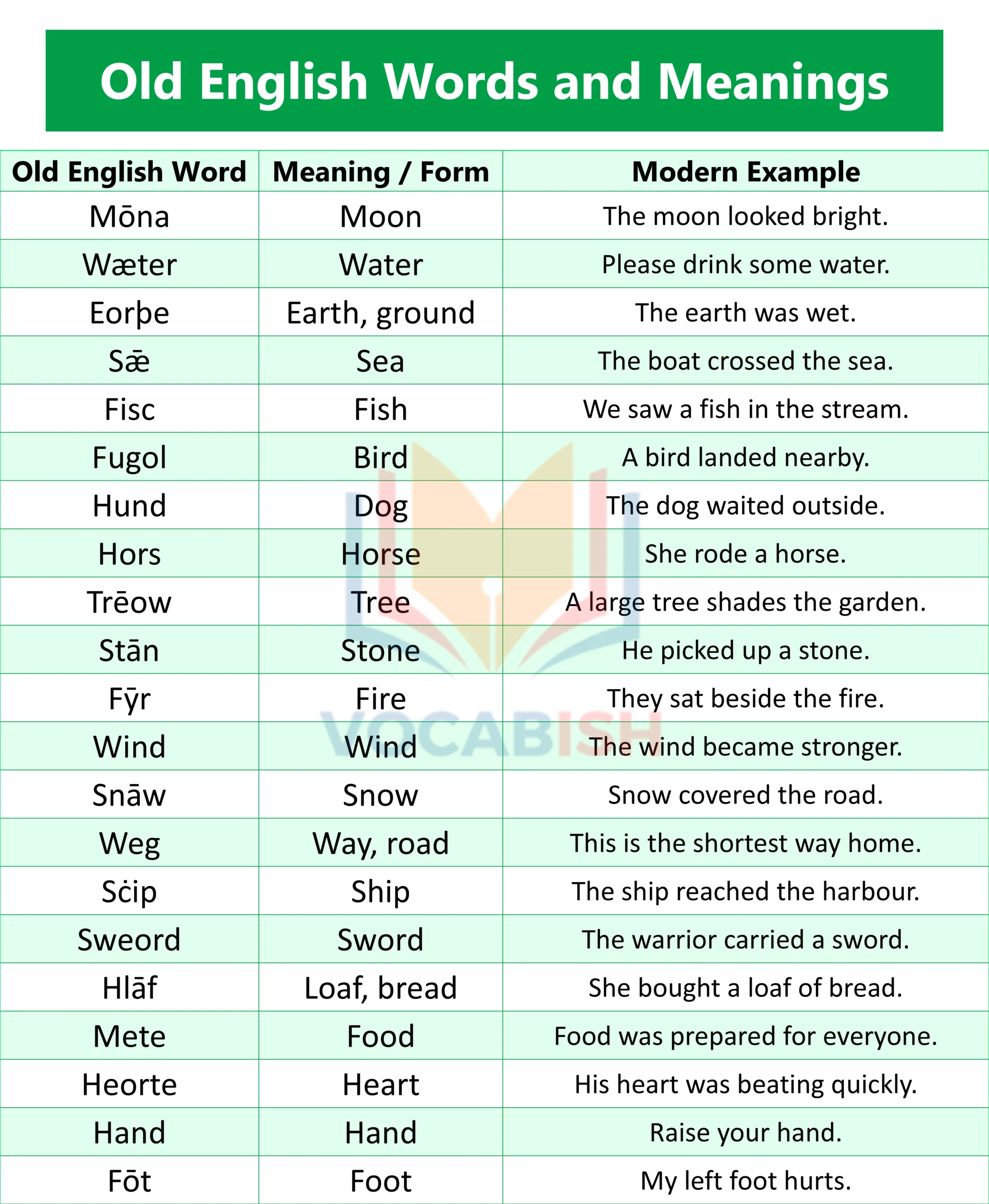
Old English Word | Meaning / Modern Form | Modern Example |
|---|---|---|
cild | child | The child is reading. |
hūs | house | Their house is near the river. |
cyning | king | The king addressed his people. |
cwēn | queen, woman | The queen entered the hall. |
fæder | father | Her father works nearby. |
mōdor | mother | My mother loves gardening. |
brōþor | brother | His brother is at school. |
sweostor | sister | My sister lives abroad. |
sunu | son | Their son is ten years old. |
dohtor | daughter | His daughter enjoys music. |
mann | person, man | The man opened the door. |
wīf | woman; later wife | His wife joined us. |
frēond | friend | She is an old friend. |
fēond | enemy | They faced a powerful enemy. |
nama | name | What is your name? |
word | word | I learned a new word. |
dæg | day | It was a warm day. |
niht | night | The night was quiet. |
sunne | sun | The sun is shining. |
mōna | moon | The moon looked bright. |
wæter | water | Please drink some water. |
eorþe | earth, ground | The earth was wet. |
sǣ | sea | The boat crossed the sea. |
fisc | fish | We saw a fish in the stream. |
fugol | bird | A bird landed nearby. |
hund | dog | The dog waited outside. |
hors | horse | She rode a horse. |
trēow | tree | A large tree shades the garden. |
stān | stone | He picked up a stone. |
fȳr | fire | They sat beside the fire. |
wind | wind | The wind became stronger. |
snāw | snow | Snow covered the road. |
weg | way, road | This is the shortest way home. |
sċip | ship | The ship reached the harbour. |
sweord | sword | The warrior carried a sword. |
hlāf | loaf, bread | She bought a loaf of bread. |
mete | food | Food was prepared for everyone. |
heorte | heart | His heart was beating quickly. |
hand | hand | Raise your hand. |
fōt | foot | My left foot hurts. |
Old English was a Germanic language with grammatical forms and spelling conventions quite different from present-day English. Modern readers normally need training or a translation to read an original Old English text comfortably.
Common Old English Words Still Easy to Recognize
Some of the easiest Common Old English Words are those whose descendants remain part of everyday vocabulary.
These examples show how English changed gradually rather than replacing all its older words.
- cild → child
- hūs → house
- wæter → water
- cyning → king
- fæder → father
- mōdor → mother
- brōþor → brother
- dohtor → daughter
- nama → name
- dæg → day
- niht → night
- stān → stone
- fisc → fish
- hund → hound
- sċip → ship
- sweord → sword
- heorte → heart
- fōt → foot
- word → word
- wind → wind
This is one reason basic Modern English can sometimes show its Germanic roots more clearly than formal vocabulary borrowed later from French, Latin, and other languages.
A Few Old English Letters
Original Old English writing may contain letters that ESL learners rarely see today.
Letter | Name | Rough Sound |
|---|---|---|
þ | thorn | “th” |
ð | eth | “th” |
æ | ash | a vowel similar to the sound in “cat” in many contexts |
ƿ | wynn | “w” |
These letters help explain spellings such as brōþor and eorþe. Learn more about the Old English Letters.
Old-Fashioned English Words You May Meet in Books
When most readers search for Old English Words, they are often looking for vocabulary found in Shakespeare, older poems, historical novels, prayers, and fantasy stories.
These words are usually archaic English rather than Old English in the strict linguistic sense. Merriam-Webster describes an archaic word or meaning as one that was formerly common but is now found mainly occasionally or in special contexts.
Old-Fashioned Word | Modern Meaning | Example |
|---|---|---|
thou | you, as subject | Thou art welcome here. |
thee | you, as object | I shall follow thee. |
thy | your | Take thy coat. |
thine | yours | The choice is thine. |
ye | you | Hear ye the news. |
art | are | Thou art kind. |
hast | have | Thou hast returned. |
hath | has | She hath spoken. |
dost | do | Dost thou understand? |
doth | does | He doth protest. |
wilt | will | Thou wilt learn. |
shalt | shall | Thou shalt return. |
aye | yes | Aye, I agree. |
nay | no | Nay, I cannot accept. |
alas | sadly; unfortunately | Alas, we arrived too late. |
behold | look; see | Behold the rising sun. |
ere | before | Return ere night falls. |
anon | soon; shortly | I shall return anon. |
hither | to this place | Come hither. |
thither | to that place | They travelled thither. |
hence | from here; therefore | We must depart hence. |
whence | from where | Whence did he come? |
wherefore | why | Wherefore did you leave? |
betwixt | between | A river runs betwixt the hills. |
perchance | perhaps | Perchance we shall meet again. |
prithee | please; I ask you | Prithee, tell me the truth. |
oft | often | We oft walked there. |
naught | nothing | Their efforts came to naught. |
aught | anything | Do you know aught of this? |
yonder | over there | Look at yonder hill. |
Thou is an old singular form of “you,” while dost and wilt were forms used with thou. Cambridge and Merriam-Webster both mark these usages as old or archaic.
How to Use Thou, Thee, Thy, and Thine
These four words are closely related, but they do different grammatical jobs.
Learning the pattern makes old literature much easier to understand.
Thou = You as the Subject
Use thou when the person performs the action.
Modern: You are brave.
Old-fashioned: Thou art brave.
Modern: You know the answer.
Old-fashioned: Thou knowest the answer.
Thee = You as the Object
Use thee when something is done to or for the person.
Modern: I saw you.
Old-fashioned: I saw thee.
Modern: I give this to you.
Old-fashioned: I give this to thee.
Thy = Your
Thy normally comes before a noun.
- thy book
- thy house
- thy friend
- thy sword
- thy promise
Example: Keep thy word.
Thine = Yours
Thine can work as an independent possessive form.
Modern: The book is yours.
Old-fashioned: The book is thine.
A useful learner pattern is:
Old Form | Modern Form | Grammar |
|---|---|---|
thou | you | subject |
thee | you | object |
thy | your | possessive determiner |
thine | yours | possessive pronoun |
Modern English normally uses you for both subject and object, which is why thou and thee may initially seem confusing.
Fancy Old English Words
Some older words have an elegant, dramatic, or literary feeling. These are often what readers mean when searching for Fancy Old English Words.
Most belong to later historical or literary English rather than the Anglo-Saxon language itself.
Word | Meaning | Example |
|---|---|---|
beseech | ask urgently | I beseech you to reconsider. |
comely | attractive or pleasant-looking | He was a comely young man. |
forlorn | lonely and unhappy | The cottage looked forlorn. |
gallant | brave or noble | The gallant knight stepped forward. |
hitherto | until this time | The plan had hitherto succeeded. |
henceforth | from now onward | Henceforth, the gate will remain closed. |
visage | face or appearance | A smile crossed her visage. |
fain | gladly; willingly | I would fain remain here. |
methinks | it seems to me | Methinks a storm is coming. |
betide | happen to | Whatever may betide, stay calm. |
sojourn | temporary stay | Their sojourn lasted a week. |
erstwhile | former | He greeted his erstwhile companion. |
aforetime | in earlier times | A castle stood here aforetime. |
haply | perhaps; by chance | Haply, we shall meet again. |
whereupon | immediately after which | He nodded, whereupon they departed. |
Short Fancy Phrases
Older vocabulary can also create memorable phrases:
- at eventide — in the evening
- ere long — before much time passes
- by my troth — truly; on my word
- forsooth — indeed
- woe betide — trouble may come to
- henceforth and forever — from now onward
- till the morrow — until tomorrow
These expressions work well in historical fiction, fantasy dialogue, poetry, or playful writing but can sound unnatural in normal everyday conversation.
Funny Old English Words
English history contains plenty of words that sound amusing to modern ears.
Many Funny Old English Words are actually old slang, dialect words, humorous coinages, or archaic vocabulary rather than genuine Anglo-Saxon forms.
Funny Old Word | Meaning |
|---|---|
fopdoodle | a foolish person |
nincompoop | a foolish or silly person |
popinjay | a vain, talkative person |
lickspittle | a person who behaves too obediently toward someone powerful |
flapdoodle | nonsense |
ragamuffin | a poorly dressed or untidy person |
mooncalf | a foolish or strange person |
coxcomb | a vain, foolish man |
scallywag | a mischievous or dishonest person |
hornswoggle | trick or deceive |
absquatulate | leave suddenly |
skedaddle | run away quickly |
highfalutin | pompous or pretentious |
slumgullion | an unappetizing mixture or stew |
sockdolager | something especially impressive or decisive |
Some of the strangest-looking words came from nineteenth-century American speech. Hornswoggle, for example, is recorded as an American slang term meaning to trick or deceive, while absquatulate appeared around 1830 with the sense of leaving or absconding.
Funny Examples
Hornswoggle:
The trader tried to hornswoggle him into paying twice the price.
Skedaddle:
When the rain started, everyone skedaddled indoors.
Nincompoop:
I felt like a nincompoop after forgetting my own password.
Flapdoodle:
Ignore that story; it is complete flapdoodle.
Popinjay:
The arrogant popinjay talked about himself all evening.
These words are especially useful when you want humorous, colourful, or old-fashioned language.
Old British English Words
The phrase Old British English Words usually refers to words once common in Britain or words that now feel literary, regional, historical, or distinctly British.
Some remain normal in British English today, while others mostly appear in older books.
Word | Meaning |
|---|---|
fortnight | two weeks |
whilst | while |
amongst | among |
reckon | think or suppose |
chap | man or boy |
lad | boy or young man |
lass | girl or young woman |
bloke | man |
cheerio | goodbye |
blimey | expression of surprise |
bother | mild expression of annoyance |
crikey | expression of surprise |
jolly | very; cheerful |
daft | foolish |
queue | line of people |
shan’t | shall not |
ought | should |
aye | yes |
nay | no |
afore | before |
Not every word in this group is obsolete. Fortnight, for example, remains ordinary British English even though it may sound unusual to some learners accustomed to American English.
Older Literary British Expressions
You may also meet:
- good morrow — good morning
- fare thee well — goodbye
- what ho! — old greeting or exclamation
- by Jove! — expression of surprise
- zounds! — old exclamation
- egad! — old expression of surprise
- gramercy — thanks
- marry! — an old exclamation
- forsooth — indeed
- pray tell — please tell me
These are best understood as historical or literary expressions rather than vocabulary required for ordinary modern British conversation.
Old American English Words
There was no “American Old English” during the Anglo-Saxon period because Old English developed in medieval Britain centuries before English-speaking settlements were established in North America.
When people search for Old American English Words, they usually want historical American expressions, frontier vocabulary, nineteenth-century slang, or words strongly associated with older American speech.
Old American Word | Meaning | Example |
|---|---|---|
absquatulate | leave suddenly | He absquatulated before sunrise. |
hornswoggle | deceive | Do not let them hornswoggle you. |
skedaddle | leave quickly | We had better skedaddle. |
highfalutin | pretentious | Ignore his highfalutin speech. |
tarnation | mild expression of anger or surprise | What in tarnation happened? |
lickety-split | very quickly | She ran home lickety-split. |
rambunctious | energetic and difficult to control | The children became rambunctious. |
jim-dandy | an excellent example | That bicycle is a jim-dandy. |
sockdolager | a powerful or decisive thing | His final argument was a sockdolager. |
slumgullion | thin stew or unpleasant mixture | They cooked a pot of slumgullion. |
cattywampus | crooked or out of position | The picture looks cattywampus. |
hornswoggled | tricked | We realized that we had been hornswoggled. |
Skedaddle is first recorded in the nineteenth century and became strongly associated with American Civil War usage, while hornswoggle appears in records of nineteenth-century American slang.
Another amusing survivor is discombobulate, meaning to confuse or disorient. Merriam-Webster records its first known use in 1879.
Beautiful Old Words Worth Learning
Not every old word needs to return to everyday conversation, but some remain expressive and easy to understand.
These words can add character to stories, poems, historical writing, and vocabulary lessons.
Words About Time
ere — before
anon — soon
hitherto — until now
henceforth — from now onward
aforetime — formerly
morrow — the next day
eventide — evening
oft — often
Words About Place
hither — toward here
thither — toward there
yonder — over there
hence — away from here
whence — from where
wherein — in which
therein — in that place or thing
betwixt — between
Words About Feelings and Character
forlorn — lonely and sad
gallant — brave
comely — attractive
woeful — very sad
mirthful — cheerful
lovelorn — unhappy because of love
steadfast — loyal and firm
wayward — difficult to control or unpredictable
Words for Speaking
beseech — ask urgently
prithee — please
proclaim — announce publicly
utter — say
hark — listen
behold — look
nay — no
aye — yes
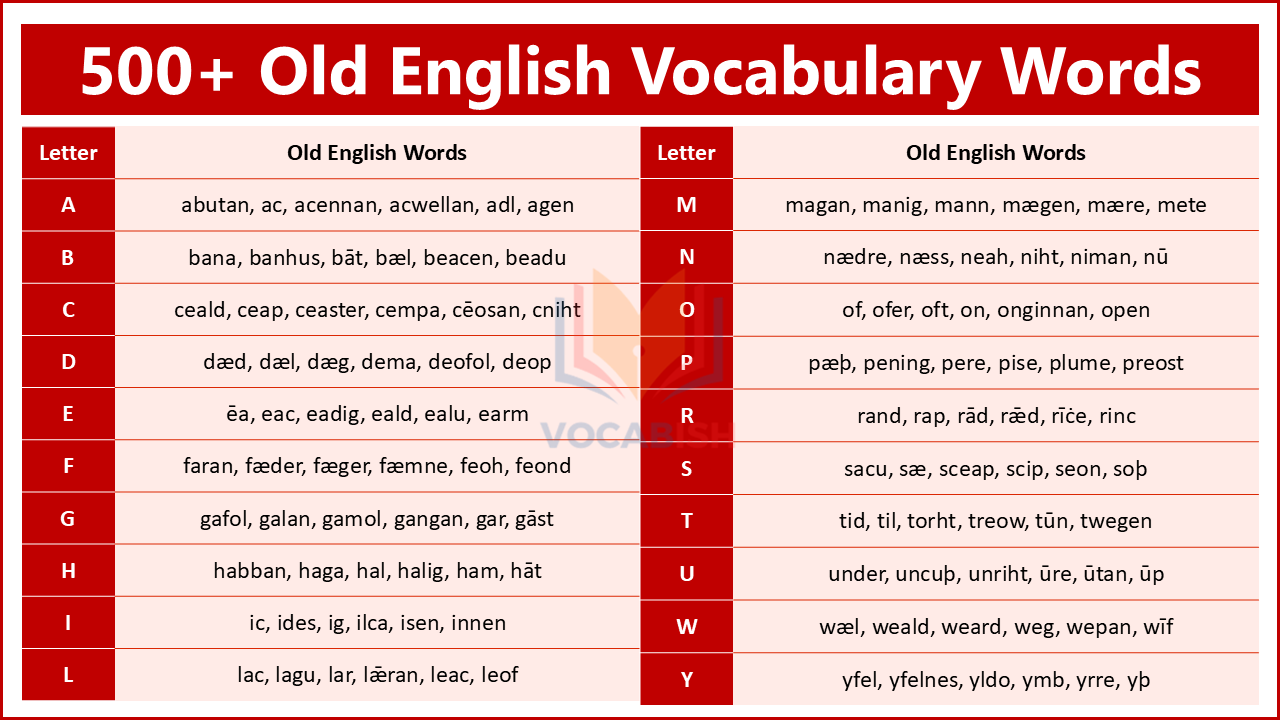
List of All Old English Words
Here is a complete list of Old English Words containing true Old English forms, archaic vocabulary, literary words, and popular historical expressions covered in this article.
cild | hūs | cyning |
cwēn | fæder | mōdor |
brōþor | sweostor | sunu |
dohtor | mann | wīf |
frēond | fēond | nama |
word | dæg | niht |
sunne | mōna | wæter |
eorþe | sǣ | fisc |
fugol | hund | hors |
trēow | stān | fȳr |
wind | snāw | weg |
sċip | sweord | hlāf |
mete | heorte | hand |
fōt | thou | thee |
thy | thine | ye |
art | hast | hath |
dost | doth | wilt |
shalt | aye | nay |
alas | behold | ere |
anon | hither | thither |
hence | whence | wherefore |
betwixt | perchance | prithee |
oft | naught | aught |
yonder | beseech | comely |
forlorn | gallant | hitherto |
henceforth | visage | fain |
methinks | betide | sojourn |
erstwhile | aforetime | haply |
whereupon | forsooth | morrow |
eventide | hark | woeful |
mirthful | lovelorn | steadfast |
wayward | popinjay | nincompoop |
lickspittle | flapdoodle | ragamuffin |
mooncalf | coxcomb | fopdoodle |
scallywag | hornswoggle | absquatulate |
skedaddle | highfalutin | slumgullion |
sockdolager | fortnight | whilst |
amongst | chap | lad |
lass | bloke | cheerio |
blimey | crikey | daft |
afore | tarnation | lickety-split |
rambunctious | jim-dandy | cattywampus |
discombobulate | wherein | therein |
Common Confusions with Old English Words
Historical vocabulary becomes much easier once a few common misunderstandings are cleared up.
- Thou and thee are not interchangeable: thou is usually the subject, while thee is the object.
- Wherefore means “why,” not “where”: “Wherefore art thou Romeo?” asks why he is Romeo.
- Old English and Shakespearean English are different: Shakespeare wrote mainly in Early Modern English, centuries after Anglo-Saxon Old English.
- Old British does not always mean obsolete: words such as fortnight are still widely used in Britain.
- Old American English is a convenient search phrase, not a historical language period: terms such as hornswoggle and skedaddle belong to later American English.
FAQs About Old English Words
Old English words come from the Anglo-Saxon form of English used in medieval Britain. Examples include cild, hūs, cyning, wæter, and fæder.
Common recognizable examples include cild for child, hūs for house, wæter for water, cyning for king, and stān for stone.
Forms related to thou have ancient roots, but the familiar thou, thee, and thy found in Shakespeare are usually associated with later historical English.
Thou acts mainly as the subject of a sentence, while thee acts as an object. Compare “Thou art kind” and “I thank thee.”
Popular fancy old-fashioned words include beseech, forlorn, gallant, hitherto, henceforth, visage, fain, methinks, sojourn, and erstwhile.
Funny historical words include fopdoodle, nincompoop, popinjay, flapdoodle, mooncalf, hornswoggle, absquatulate, and skedaddle, although many are later than true Old English.
Historical American vocabulary includes hornswoggle, absquatulate, skedaddle, highfalutin, tarnation, and lickety-split. Many became popular during the eighteenth or nineteenth centuries.
Yes. Old-fashioned words work well in poetry, fantasy, historical fiction, humour, and quotations, but many may sound unusual in everyday modern conversation.
Conclusion
Old English Words show how much English has changed while also revealing how much has survived. Genuine Anglo-Saxon vocabulary such as cild, hūs, cyning, and wæter connects directly with words that English speakers still use every day.
Later expressions such as thou, thee, prithee, betwixt, and hither give older literature its distinctive sound, while fancy, funny, British, and historical American words add even more variety. Learning their meanings does more than expand your vocabulary—it makes old books, poems, plays, historical dialogue, and the story of the English language much easier to understand.
You May Also Like