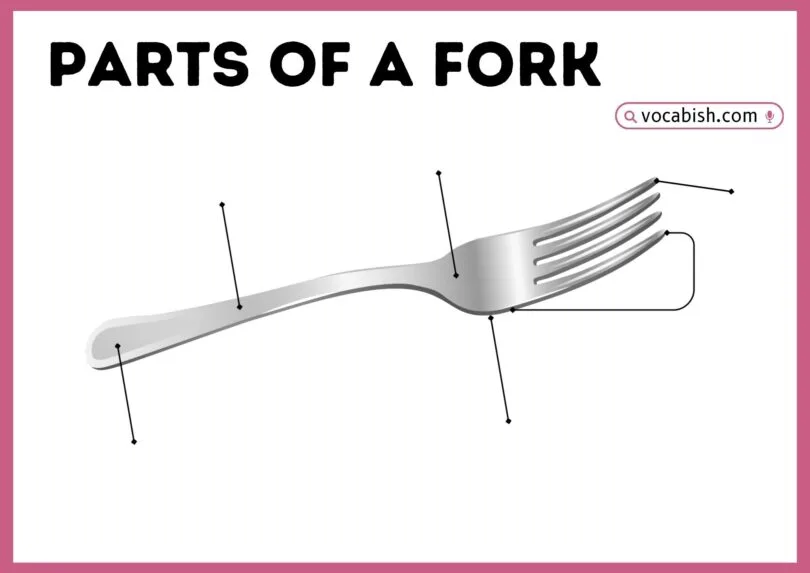

The parts of a fork include the handle, neck, and tines, which work together to make eating and serving food easier. A typical fork has a long handle for gripping and several pointed tines for picking up food. Some forks also have a shoulder or decorative details, depending on their design and purpose.
In this article, you will discover the names of fork parts with a labeled diagram and their functions. We explain the structure of a fork from the handle to the tines, helping you identify each component and build your everyday English vocabulary related to kitchen utensils.
What is a Fork?
A fork is a tool for eating and serving food. It usually has pointed tips and a handle. Forks are used to pick up food, hold it while cutting, and sometimes stir or serve food.
Example:
- Use a fork to eat salad.
- Use a fork to hold meat while cutting.
7 Main Parts of a Fork
A fork has 7 important parts, each with a name and a function.
Part Name | Description | Function |
|---|---|---|
Tines | The pointed prongs at the top | Pierce, hold, and lift food |
Tip | The very end of each tine | Helps pick up small pieces of food |
Neck | Narrow part connecting tines to handle | Provides strength and balance |
Handle | The long part you hold | Gives comfort and control |
Shoulder | Area where neck meets handle | Supports the fork’s structure |
Base | Bottom end of handle | Prevents slipping and adds stability |
Back | The flat opposite side of tines | Helps guide and support food |
1. Tines
- The pointy parts of a fork are called tines.
- These are the sharp points at the top of the fork.
- Most forks have 3 or 4 tines.
- They are used to pierce, hold, and lift food.
2. Tip
- The tip is the very end of each tine.
- It is used to pick up small food pieces like peas or diced vegetables.
3. Neck
- The neck is the narrow part between tines and handle.
- It connects the tines and handle and gives strength to the fork.
4. Handle
- The handle is the long part you hold in your hand.
- Handles can be made of metal, wood, or plastic.
- They make the fork comfortable and easy to control.
5. Shoulder
- The shoulder is the wider area where the neck joins the handle.
- It adds support and stability to the fork.
6. Base
- The base is the bottom end of the handle.
- It prevents the fork from slipping out of your hand.
7. Back
- The back is the flat side opposite the tines.
- It helps guide food onto the fork and provides extra support.
Parts of a Fork Diagram

Types of Forks
Fork Type | Description | Common Use |
|---|---|---|
Dinner Fork | Standard fork with 4 tines | Main meals |
Salad Fork | Smaller than dinner fork | Eating salad |
Dessert Fork | Small and light | Cakes and pastries |
Seafood Fork | Narrow with 3 tines | Eating seafood like shrimp |
Functions of Each Part
- Tines: Hold, lift, and pierce food
- Tip: Pick up small pieces
- Neck: Connects tines and handle, adds strength
- Handle: Comfort and control
- Shoulder: Supports the fork’s structure
- Base: Provides stability and prevents slipping
- Back: Guides and supports food
Fork in Daily Life
Forks are not only for eating. They are also used to cook, stir, and serve food.
- Stir pasta in a pot
- Hold meat while cutting
- Pick small vegetables or fruits
A fork has 7 main parts: tines, tip, neck, handle, shoulder, base, and back. Each part has a special function to make eating comfortable and easy. Knowing these words helps improve your English vocabulary and makes using a fork simpler.
FAQs
The 7 main parts of a fork are tines, tip, neck, handle, shoulder, base, and back, each with a specific function.
The tines are the pointed tips used to pierce, hold, and lift food.
The tip is the very end of the tines and is used to pick up small pieces of food.
The neck connects the tines and handle, providing strength and balance to the fork.
The handle is the long part you hold, giving comfort and control while eating.
Read More