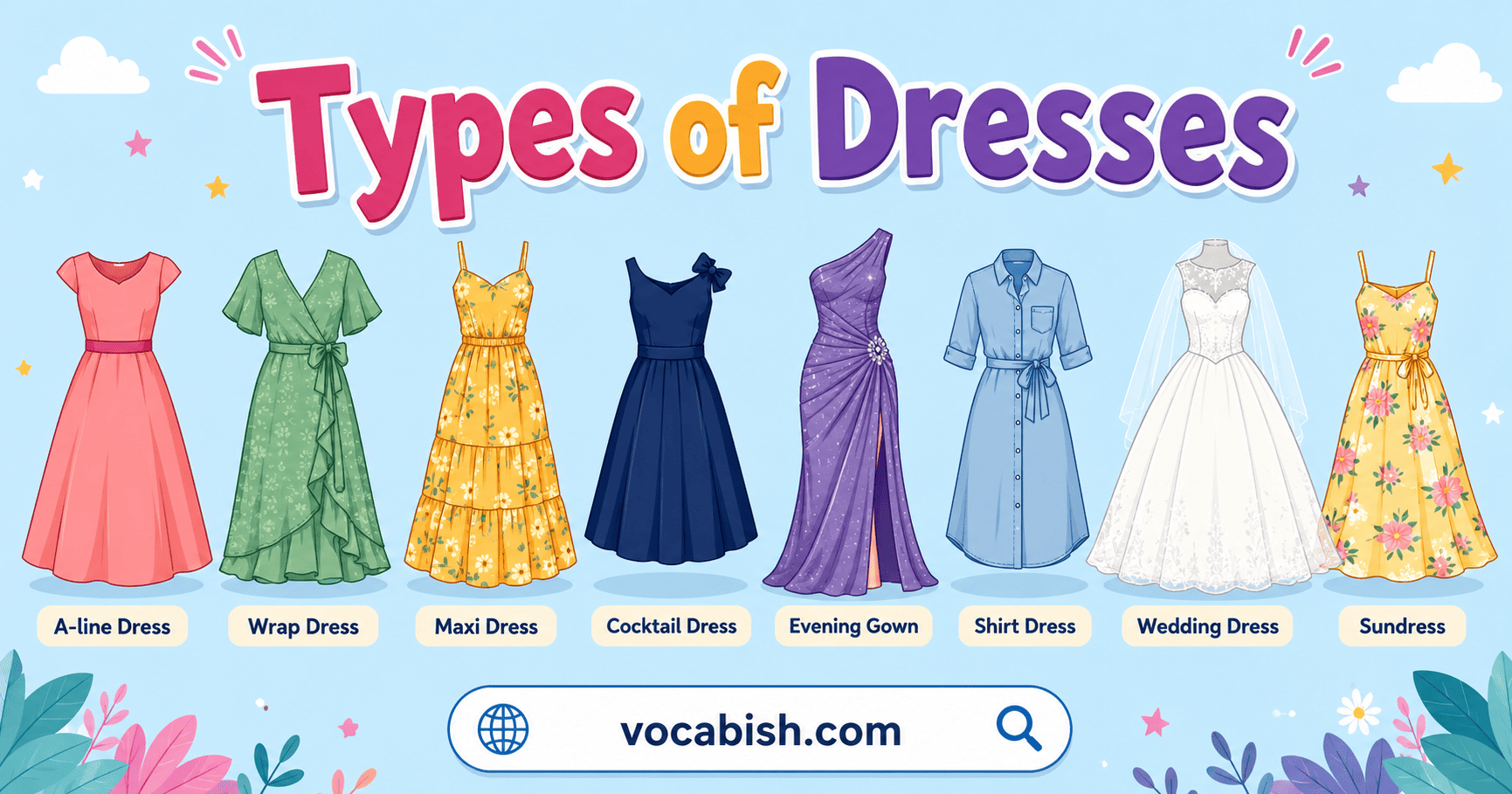

Types of dresses come in many shapes, lengths, fabrics, and designs. Some styles get their names from their silhouette, such as the A-line dress, while others are named after their length, neckline, fabric, or purpose.
The main types of dresses include A-line, shift, sheath, bodycon, wrap, maxi, midi, cocktail, evening, shirt, slip, and sundresses. A single dress can belong to several categories. For example, it may be a cotton wrap dress with a midi length.
Learning common dress names helps you describe clothing accurately, understand fashion vocabulary, and choose suitable outfits for different occasions.
What Is a Dress?
A dress is a one-piece garment that usually covers the upper body and extends over part or all of the legs. It may be loose, fitted, sleeveless, long-sleeved, casual, or formal.
The word dress covers many everyday and formal styles. A gown is usually a long, elegant dress worn at formal events. A frock is another word for a dress, although it is now more commonly used for children’s clothing or traditional styles in some regions.
Types of Dresses at a Glance
The following table gives a quick overview of popular dress styles and their main features.
Dress Type | Main Feature | Common Use |
|---|---|---|
A-Line Dress | Narrow at the top and wider at the hem | Everyday and semi-formal wear |
Shift Dress | Straight and loose-fitting | Casual and office wear |
Sheath Dress | Narrow and shaped close to the body | Business and formal events |
Bodycon Dress | Tight and stretchy | Parties and evening events |
Wrap Dress | Fabric crosses at the front and ties at the waist | Work, casual outings, and dinners |
Fit-and-Flare Dress | Fitted top with a clearly flared skirt | Parties and special occasions |
Empire Waist Dress | Waistline sits below the bust | Summer and occasion wear |
Mini Dress | Hemline above the knee | Casual and party wear |
Midi Dress | Hemline between the knee and ankle | Work and social events |
Maxi Dress | Ankle-length or floor-length | Summer, travel, and evening wear |
Cocktail Dress | Polished short or midi-length design | Semi-formal events |
Evening Gown | Long and highly formal | Galas, weddings, and ceremonies |
Shirt Dress | Designed like a long shirt | Everyday and office wear |
Slip Dress | Simple shape with thin straps | Layered, casual, or evening wear |
Sundress | Lightweight warm-weather dress | Summer and holidays |
List of All Types of Dresses and Their Names
- A-Line Dress
- Shift Dress
- Sheath Dress
- Bodycon Dress
- Fit-and-Flare Dress
- Wrap Dress
- Empire Waist Dress
- Drop-Waist Dress
- Peplum Dress
- Tent Dress
- Trapeze Dress
- Mini Dress
- Midi Dress
- Maxi Dress
- Tea-Length Dress
- Floor-Length Dress
- Casual Dress
- Cocktail Dress
- Evening Gown
- Party Dress
- Wedding Dress
- Prom Dress
- Office Dress
- Sundress
- Ball Gown
- Mermaid Dress
- Trumpet Dress
- Pencil Dress
- Bubble Dress
- Handkerchief-Hem Dress
- High-Low Dress
- Off-Shoulder Dress
- One-Shoulder Dress
- Halter Dress
- Strapless Dress
- Cowl-Neck Dress
- V-Neck Dress
- Shirt Dress
- Sweater Dress
- Slip Dress
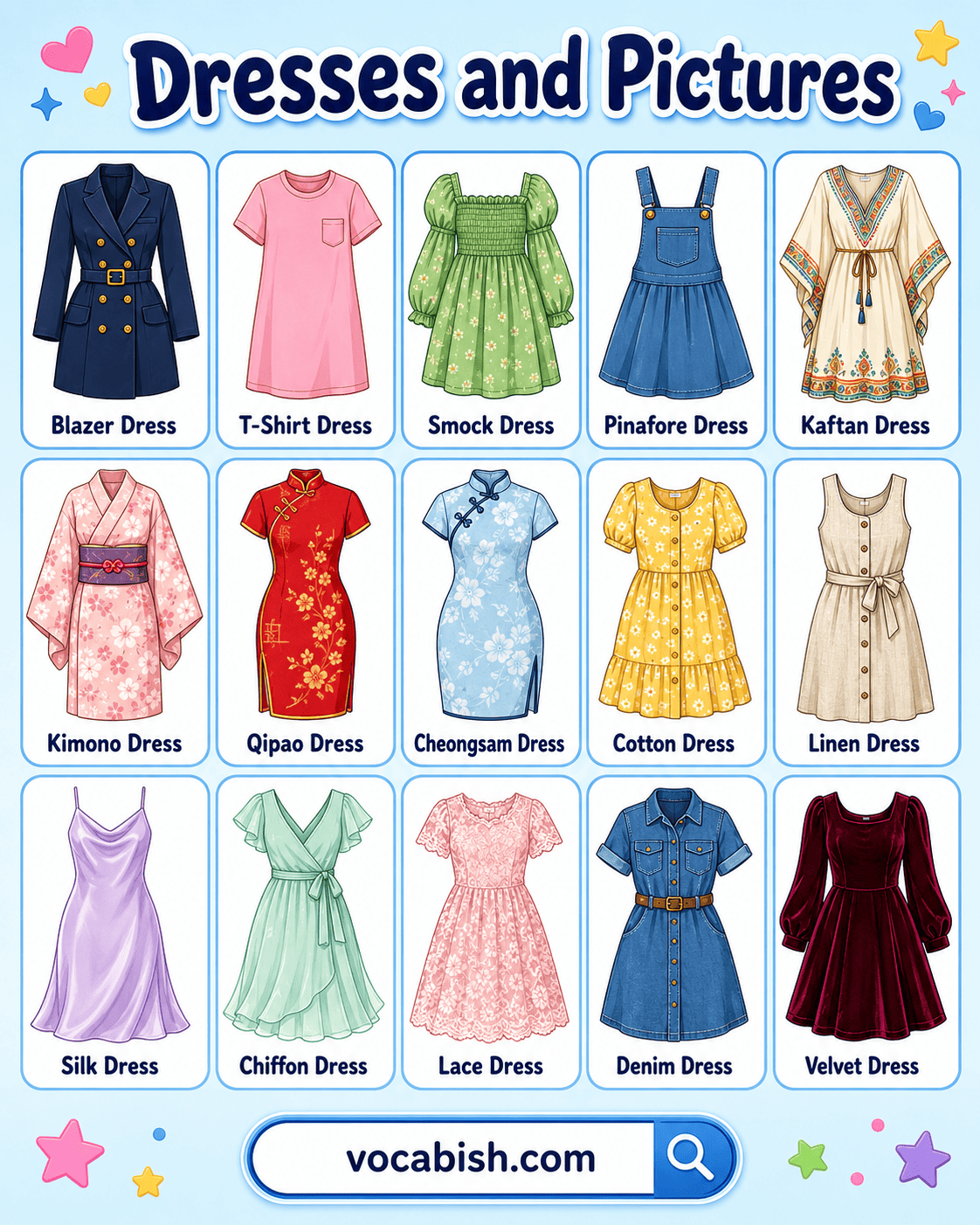
- Blazer Dress
- T-Shirt Dress
- Smock Dress
- Pinafore Dress
- Kaftan Dress
- Kimono Dress
- Qipao Dress
- Cheongsam Dress
- Cotton Dress
- Linen Dress
- Silk Dress
- Chiffon Dress
- Lace Dress
- Denim Dress
- Velvet Dress
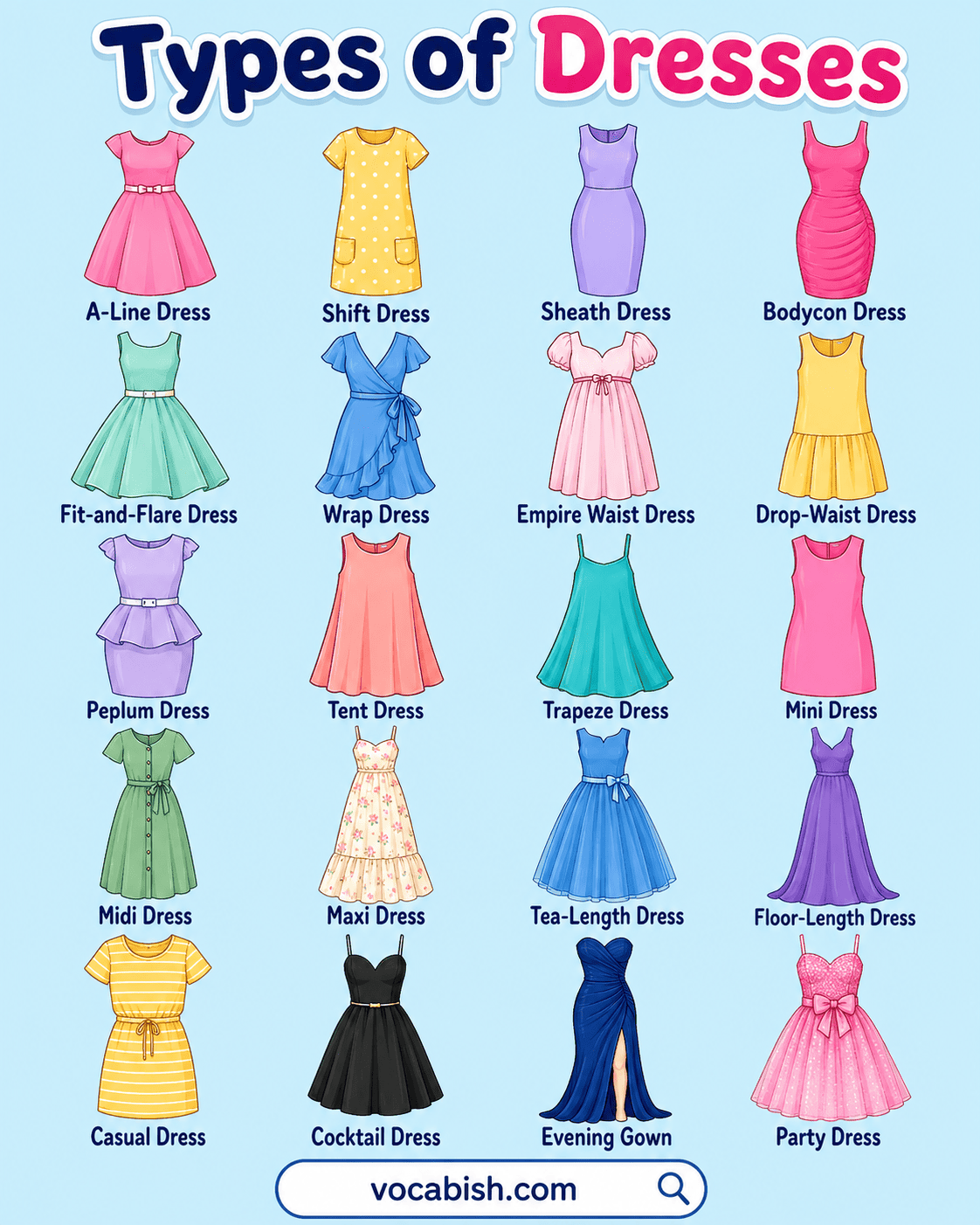
Popular Types of Dresses by Shape and Silhouette
A dress silhouette describes its overall shape when worn. It is one of the easiest ways to identify and compare different dress styles.
A-Line Dress
An A-line dress is fitted around the shoulders or waist and gradually becomes wider toward the hem. Its shape resembles the capital letter “A.”
This balanced silhouette works for casual, professional, and semi-formal outfits. A-line dresses may be mini, midi, or full length.
Shift Dress
A shift dress falls almost straight from the shoulders and does not fit tightly around the waist. It usually has a simple, clean shape that allows comfortable movement.
Shift dresses are common in casual and office wardrobes. They can be worn alone in warm weather or layered with a jacket or cardigan.
Sheath Dress
A sheath dress follows the natural outline of the body without being as tight as a typical bodycon dress. It normally has a defined waist and a narrow skirt.
This structured style is often worn in offices, at business events, and during formal daytime occasions.
Bodycon Dress
A bodycon dress fits closely around the bust, waist, hips, and legs. It is usually made from stretchy fabric that follows the body’s shape.
Bodycon styles are popular for parties, dinners, and evening events. They are available in mini, midi, and long lengths.
Fit-and-Flare Dress
A fit-and-flare dress has a fitted upper section and a skirt that widens clearly from the waist. The contrast between the fitted bodice and fuller skirt gives it a defined shape.
Unlike many A-line dresses, the flare usually begins more noticeably at the waist. This style is common for parties, weddings, and daytime events.
Wrap Dress
A wrap dress has one front panel that crosses over another. It usually fastens with a tie at the side or around the waist.
The overlapping front often creates a V-shaped neckline. Because the waist can be adjusted, this dress offers a flexible and comfortable fit.
Empire Waist Dress
An empire waist dress has a raised waistline positioned just below the bust. The rest of the fabric falls loosely from that point.
This high-waisted shape creates a long, flowing appearance. It is often used for summer dresses, maternity styles, and formal gowns.
Drop-Waist Dress
A drop-waist dress has a waist seam placed below the natural waist, usually near the upper hips. The lower section may be straight, pleated, or flared.
This silhouette creates a longer-looking upper body. It is strongly associated with 1920s-inspired fashion but also appears in modern casual designs.
Peplum Dress
A peplum dress includes a short, flared piece of fabric attached around the waist. This extra layer may be soft and flowing or firm and structured.
The peplum adds shape and visual detail to an otherwise fitted dress. It is often seen in office, cocktail, and occasion wear.
Tent Dress
A tent dress is narrow around the shoulders and becomes very wide toward the bottom. It has no fitted waist and usually hangs freely around the body.
Its loose construction makes it comfortable and easy to move in. A similar style may also be called a trapeze dress.
Dress Styles Based on Length
Dress length describes where the hemline falls on the legs. The same silhouette can appear in several lengths, so an A-line dress, for example, may be mini, midi, or maxi.
Mini Dress
A mini dress ends above the knee, usually around the mid-thigh area. The exact length can vary depending on the design and the wearer’s height.
Mini dresses are commonly worn for casual outings, parties, and warm-weather events. They may be loose, fitted, or flared.
Midi Dress
A midi dress falls below the knee but above the ankle. Many midi styles end around the middle of the calf.
This practical length works well for offices, dinners, weddings, and everyday outfits. It offers more coverage than a mini dress without reaching the floor.
Maxi Dress
A maxi dress extends to the ankle or close to the floor. It can have a loose, relaxed design or a more fitted and elegant shape.
Casual maxi dresses are popular in summer, while formal versions may be worn at weddings, dinners, and evening events.
Tea-Length Dress
A tea-length dress usually ends between the knee and ankle, often around the lower calf. It is slightly longer than many standard midi dresses.
The style has a classic, polished appearance and is often chosen for garden parties, daytime weddings, and vintage-inspired occasions.
Floor-Length Dress
A floor-length dress reaches the feet and may lightly touch the floor. It creates a long and formal appearance, especially when made from silk, satin, chiffon, or velvet.
Not every floor-length dress is a gown. Some maxi dresses also reach the floor but have a simpler and more casual design.
Types of Dresses for Different Occasions
The purpose of a dress often affects its fabric, length, fit, and level of decoration. Some styles suit relaxed settings, while others follow formal dress codes.
Casual Dress
A casual dress is designed for everyday activities such as shopping, meeting friends, travelling, or relaxing. It often uses comfortable fabrics such as cotton, jersey, denim, or linen.
T-shirt dresses, sundresses, shirt dresses, and simple maxi dresses are common casual options.
Cocktail Dress
A cocktail dress is worn at semi-formal parties, receptions, and evening gatherings. It is usually shorter than an evening gown and commonly falls above, at, or below the knee.
Cocktail dresses often feature polished fabrics, fitted shapes, decorative necklines, or subtle embellishments.
Evening Gown
An evening gown is a long, elegant dress designed for formal occasions. It may have a fitted, flowing, mermaid, or ball-gown silhouette.
These gowns are commonly made from refined fabrics such as satin, silk, chiffon, lace, or velvet. They are worn at galas, formal weddings, award ceremonies, and similar events.
Party Dress
A party dress is designed for celebrations and social gatherings. Its style depends on the event and may range from a simple mini dress to a glittering midi or fitted evening design.
Sequins, bright colours, statement sleeves, decorative fabrics, and unusual cuts often appear in party dresses.
Wedding Dress
A wedding dress is worn by a bride during a wedding ceremony. Common silhouettes include A-line, ball gown, sheath, empire waist, and mermaid.
Wedding dresses may be simple or highly decorated. Lace, satin, tulle, embroidery, beads, and trains are frequently used, depending on cultural traditions and personal style.
Prom Dress
A prom dress is a formal or semi-formal dress worn to a school prom. It may be short, tea-length, ankle-length, or floor-length.
Popular prom styles include A-line dresses, ball gowns, fitted dresses, and two-piece-inspired designs. The choice often reflects the event’s dress code and the wearer’s preference.
Office Dress
An office dress has a neat and professional appearance. It commonly features a comfortable fit, a modest neckline, and a knee-length or midi hem.
Sheath, shift, wrap, and shirt dresses are popular workplace choices. Structured fabrics and simple patterns help create a polished look.
Sundress
A sundress is a lightweight dress designed for warm weather. It often has thin straps, short sleeves, or a sleeveless upper section.
Cotton, linen, and other breathable fabrics are commonly used. Sundresses usually have relaxed shapes and bright colours, prints, or floral patterns.
Dresses Classified by Skirt Style
Some dress names come mainly from the shape of their skirt. The lower part may be narrow, rounded, uneven, or dramatically flared.
Ball Gown
A ball gown has a fitted bodice and a large, full skirt. Layers of fabric or a structured underskirt may create its dramatic volume.
This highly formal style is worn at grand celebrations, formal weddings, balls, and ceremonial events.
Mermaid Dress
A mermaid dress fits closely from the chest through the hips and thighs. It begins to flare around the knees or lower legs.
The lower flare resembles a mermaid’s tail, which gives the style its name. It is common in bridal and formal evening fashion.
Trumpet Dress
A trumpet dress has a fitted upper section and a skirt that begins to widen around the mid-thigh area. Its flare is usually softer and starts higher than that of a mermaid dress.
The shape resembles the opening of a trumpet. It is popular for weddings, formal dinners, and evening celebrations.
Pencil Dress
A pencil dress has a narrow skirt that falls straight from the hips and usually ends around the knee or calf. It may have a small back or side slit to make walking easier.
This sleek shape is often worn in professional and semi-formal settings.
Bubble Dress
A bubble dress has a rounded skirt with a hem that folds inward. This construction creates a soft, inflated appearance around the lower body.
Bubble dresses are often short and playful, although longer and more structured versions also exist.
Handkerchief-Hem Dress
A handkerchief-hem dress has an uneven hem with several pointed sections. The points hang at different lengths and move freely as the wearer walks.
This detail is common in flowing summer dresses, dance-inspired outfits, and bohemian styles.
High-Low Dress
A high-low dress is shorter at the front and longer at the back. The difference may be subtle or dramatic.
This hemline gives the movement of a long dress while keeping the legs more visible at the front. It is used for party dresses, summer styles, and formal gowns.
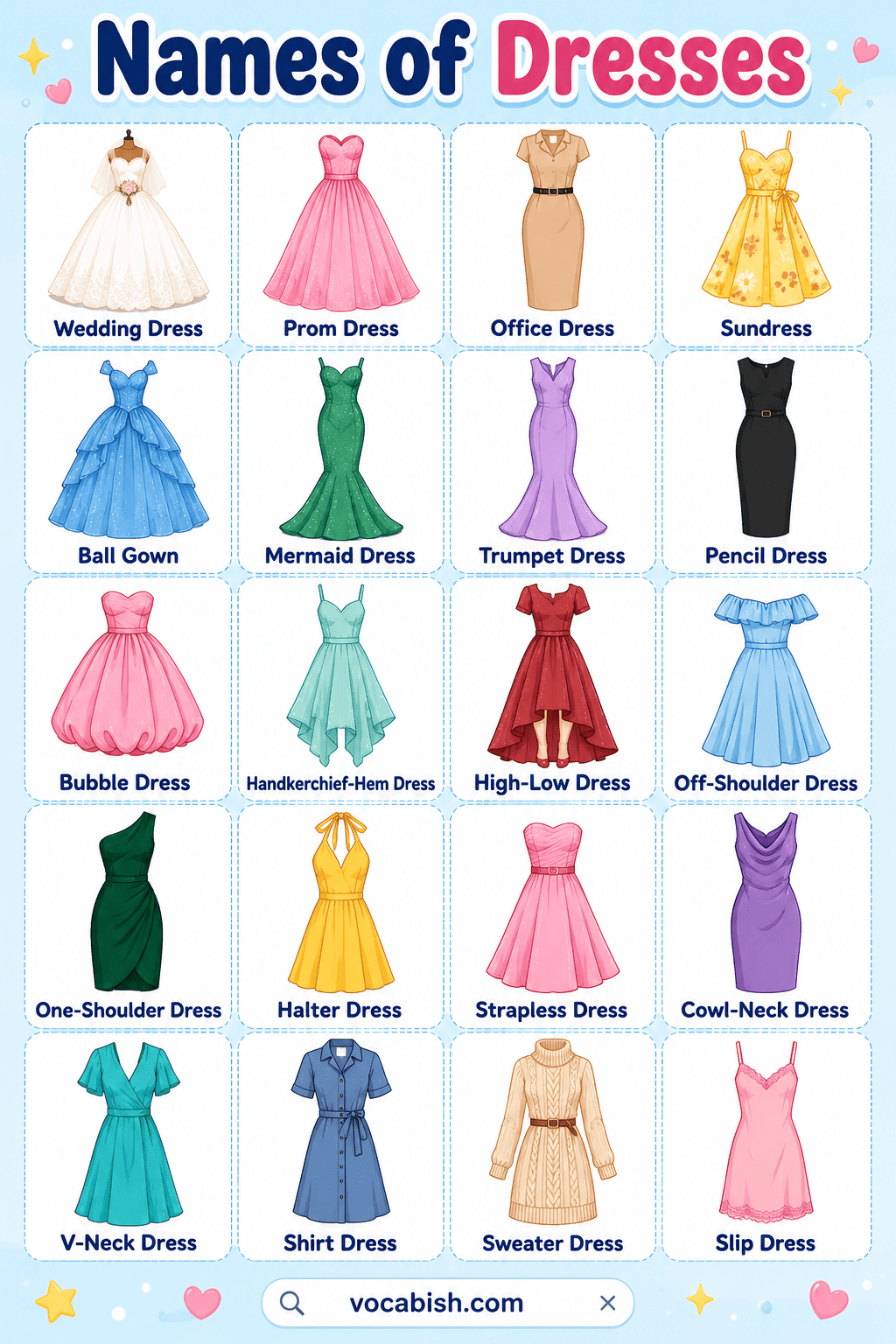
Dress Types by Neckline and Shoulder Design
Necklines and shoulder details can completely change the appearance of a dress. These features may also give a dress its main name.
Off-Shoulder Dress
An off-shoulder dress has a neckline that sits below the shoulders. It leaves the shoulders and upper chest uncovered while the sleeves rest around the upper arms.
The style may look relaxed, romantic, or formal depending on its fabric and length.
One-Shoulder Dress
A one-shoulder dress covers one shoulder and leaves the other uncovered. Its asymmetrical neckline creates a strong visual feature.
One-shoulder designs appear in fitted cocktail dresses, flowing maxi styles, and formal evening gowns.
Halter Dress
A halter dress has straps or fabric that fasten behind or around the neck. The shoulders and much of the upper back usually remain uncovered.
Halter necklines are common in summer dresses, party outfits, and formal gowns.
Strapless Dress
A strapless dress has no shoulder straps or sleeves. Its bodice is shaped or supported so that it stays in place around the upper body.
This neckline is common in cocktail dresses, wedding dresses, ball gowns, and summer styles.
Cowl-Neck Dress
A cowl-neck dress has loose fabric that folds or drapes around the neckline. The folds create a soft, rounded appearance rather than a fixed shape.
Cowl necks are often used on knitted dresses, slip dresses, and elegant evening styles.
V-Neck Dress
A V-neck dress has a neckline that forms the shape of the letter “V.” It may be shallow, deep, narrow, or wide.
This versatile neckline appears in casual, professional, wrap, and formal dresses.
Distinctive and Fashion-Specific Dress Styles
Some dress styles are recognized by a particular construction, fabric, cultural influence, or connection to another type of clothing.
Shirt Dress
A shirt dress combines the features of a shirt with the length of a dress. It commonly includes a collar, front buttons, cuffs, and a straight or belted waist.
It can be worn casually or styled for the office with a belt, jacket, or structured shoes.
Sweater Dress
A sweater dress is a knitted garment long enough to be worn as a dress. It may be loose, fitted, ribbed, belted, or shaped like an oversized sweater.
This warm style is usually worn during autumn and winter, often with boots, tights, or a coat.
Slip Dress
A slip dress has a simple, lightly fitted shape with narrow shoulder straps. It is often made from smooth fabrics such as satin or silk.
The design was inspired by traditional undergarments, but modern slip dresses are worn alone, layered over tops, or paired with jackets.
Blazer Dress
A blazer dress looks like an extended tailored jacket. It usually includes lapels, buttons, structured shoulders, and a fitted or belted waist.
It creates a sharp, modern appearance and is commonly worn for business events, dinners, and parties.
T-Shirt Dress
A T-shirt dress is shaped like a long T-shirt. It normally has short sleeves, a round or V-shaped neckline, and a relaxed fit.
This simple dress is comfortable for everyday wear and can be styled with trainers, sandals, jackets, or belts.
Smock Dress
A smock dress has a loose shape with gathered or pleated fabric. Gathering may appear around the chest, shoulders, waist, or sleeves.
Its roomy design provides comfort and movement. Smock dresses are popular for casual wear and may feature embroidery, prints, or puffed sleeves.
Pinafore Dress
A pinafore dress is a sleeveless dress designed to be worn over a shirt, blouse, or sweater. It often has wide shoulder straps and a square or bib-style front.
Denim, corduroy, wool, and cotton are common materials for this layered style.
Kaftan Dress
A kaftan dress is a loose, flowing garment with wide sleeves and a long body. Modern versions may be casual beachwear, decorative occasion dresses, or designs influenced by traditional kaftans.
Traditional kaftans have deep cultural histories across several regions, so they should not be treated as only a modern fashion trend.
Kimono Dress
A kimono dress is a modern dress inspired by features such as wide sleeves, a wrap front, and a tied waist. It may be short, midi, or long.
It is different from an authentic Japanese kimono, which is a traditional garment with its own construction, meaning, and cultural practices.
Qipao or Cheongsam
The qipao, also called the cheongsam, is a traditional Chinese dress known for its high collar and close-fitting shape. Many designs include side openings, decorative fastenings, and detailed fabrics.
Modern versions vary in length and fit, but the style remains connected to Chinese culture and history.
Types of Dresses by Fabric
Fabric affects how a dress looks, feels, hangs, and moves. However, fabric describes the material rather than the silhouette, so a cotton dress may also be an A-line, shirt, maxi, or sundress.
Cotton Dress
A cotton dress is soft, breathable, and comfortable in warm conditions. It can absorb moisture and usually feels light against the skin.
Cotton is used for casual dresses, sundresses, shirt dresses, and many everyday styles.
Linen Dress
A linen dress is made from a lightweight, breathable fabric with a naturally textured appearance. Linen allows air to move easily, making it suitable for hot weather.
It is commonly used for loose summer dresses, shirt dresses, and relaxed midi styles.
Silk Dress
A silk dress has a smooth surface and a soft, natural shine. The fabric falls gracefully and can create an elegant, flowing shape.
Silk is often used for slip dresses, evening gowns, formal dresses, and luxury occasion wear.
Chiffon Dress
A chiffon dress is made from a light, thin, and slightly transparent fabric. Designers often use several layers or add a lining for coverage.
Its flowing movement makes chiffon popular for maxi dresses, bridesmaid dresses, evening gowns, and summer styles.
Lace Dress
A lace dress includes fabric with decorative open patterns. Lace may cover the whole dress or appear only on the sleeves, neckline, bodice, or skirt.
It is widely used in wedding dresses, cocktail dresses, evening wear, and classic daytime outfits.
Denim Dress
A denim dress is made from the same strong cotton-based fabric commonly used for jeans. It may have a soft, lightweight feel or a heavier, more structured shape.
Shirt dresses, pinafore dresses, mini dresses, and fitted button-front styles are often made from denim.
Velvet Dress
A velvet dress has a soft surface with a rich texture and subtle shine. The fabric usually feels heavier than cotton, chiffon, or linen.
Velvet is popular for winter parties, formal dinners, holiday events, and long evening dresses.
How to Identify Different Dress Types
You can identify most dress styles by looking at a few visible features:
- Observe the overall silhouette. Decide whether the dress is straight, fitted, flared, loose, or full.
- Find the waistline. Check whether it sits at the natural waist, below the bust, around the hips, or is not defined.
- Check the hemline. Notice whether the dress is mini, knee-length, midi, ankle-length, or floor-length.
- Look at the neckline. Identify features such as a V-neck, halter neck, cowl neck, or strapless design.
- Examine the sleeves and shoulders. The dress may have long sleeves, short sleeves, straps, one shoulder, or exposed shoulders.
- Consider the fabric. Cotton often looks casual, while satin, lace, chiffon, and velvet may create a more formal appearance.
- Think about its purpose. Some dresses are designed mainly for work, parties, weddings, summer weather, or formal evenings.
A dress may fit more than one description. A single item could be a sleeveless, cotton, A-line midi dress.
How to Choose the Right Dress Style
The right dress should suit the occasion, weather, dress code, and your personal comfort. Fashion rules can offer ideas, but they should not replace individual preference.
Consider the Occasion
Start by checking where you plan to wear the dress. A T-shirt dress may suit a relaxed day out, while a sheath dress works better in a professional setting.
Cocktail dresses fit semi-formal events, and evening gowns are generally reserved for formal celebrations.
Check the Fit and Comfort
Make sure you can sit, walk, bend, and move comfortably. A beautiful dress may not be practical when the waist feels too tight, the straps keep falling, or the skirt limits movement.
Also consider whether the fabric stretches, wrinkles easily, or requires special care.
Select a Suitable Length
Mini dresses create a short and lively look, while midi dresses offer a balance between coverage and movement. Maxi and floor-length dresses create a longer silhouette and may suit both relaxed and formal settings.
Choose a length that feels appropriate for the activity and comfortable for you.
Choose According to the Season
Lightweight cotton, linen, and chiffon dresses work well in warm weather. Sleeveless and loose-fitting designs can also improve comfort during summer.
Knitted, wool-blend, long-sleeved, and velvet dresses provide more warmth in cooler weather. Layering with tights, boots, jackets, or coats can make lighter dresses suitable for different seasons.
Commonly Confused Dress Styles
Several dress types look similar at first. Their differences usually become clearer when you compare the fit, waist, fabric, or point where the skirt begins to widen.
A-Line Dress vs Fit-and-Flare Dress
An A-line dress gradually becomes wider from the upper body or waist toward the hem. Its shape may look smooth and gently structured.
A fit-and-flare dress has a more noticeable contrast between the fitted bodice and the wider skirt. The flare usually begins clearly at the waist.
Sheath Dress vs Bodycon Dress
A sheath dress follows the body’s natural outline but often uses firmer fabric and has a structured shape. It may fit closely without stretching tightly around every curve.
A bodycon dress usually uses elastic fabric and fits very closely around the body.
Maxi Dress vs Gown
A maxi dress is defined mainly by its length. It reaches the ankles or floor and may be casual or formal.
A gown is defined more by its formal purpose and elegant construction. Most evening gowns are long, but not every long maxi dress is a gown.
Mermaid Dress vs Trumpet Dress
A mermaid dress stays fitted through the thighs and usually begins to flare around the knees or lower legs.
A trumpet dress starts widening higher, commonly around the mid-thigh. Its transition from fitted to flared is often softer.
Shift Dress vs Sheath Dress
A shift dress hangs straight from the shoulders and usually has little or no waist definition. It provides a loose and comfortable fit.
A sheath dress has a narrower shape and follows the waist and hips more closely.
Quick Dress Style Glossary
Dress Style | Simple Meaning |
|---|---|
A-Line Dress | A dress that becomes gradually wider toward the hem |
Ball Gown | A formal dress with a fitted top and very full skirt |
Bodycon Dress | A tight, stretchy dress that follows the body |
Cocktail Dress | A polished dress worn at semi-formal events |
Empire Waist Dress | A dress with a waistline directly below the bust |
Fit-and-Flare Dress | A dress with a fitted top and flared skirt |
Maxi Dress | A dress that reaches the ankles or floor |
Mermaid Dress | A fitted dress that flares around the knees |
Midi Dress | A dress that ends between the knee and ankle |
Sheath Dress | A narrow, structured dress that follows the body |
Shift Dress | A loose dress that falls straight from the shoulders |
Shirt Dress | A dress with shirt-like details such as buttons and a collar |
Slip Dress | A simple dress with thin straps and smooth fabric |
Sundress | A lightweight dress made for warm weather |
Wrap Dress | A dress with overlapping front panels and a waist tie |
FAQs About Types of Dresses
Common types of dresses include A-line, shift, sheath, bodycon, wrap, fit-and-flare, empire waist, mini, midi, maxi, cocktail, evening, shirt, slip, and sundresses. Dresses can also be grouped by their neckline, fabric, skirt shape, and purpose.
A-line, wrap, shirt, and midi dresses are considered versatile because they can work in casual, professional, and semi-formal settings. Their appearance can be changed easily with different shoes, jackets, belts, and accessories.
A dress is any one-piece garment that covers the upper body and extends over the legs. A gown is usually a long, formal, and more elaborate type of dress worn at ceremonies, galas, weddings, or other important events.
Evening gowns, ball gowns, cocktail dresses, sheath dresses, floor-length dresses, mermaid dresses, and trumpet dresses can suit formal occasions. The correct choice depends on the event’s dress code, time, location, and level of formality.
Dresses can be classified by silhouette, length, waist position, neckline, sleeves, skirt shape, fabric, cultural design, and occasion. Because these categories overlap, one dress may belong to several groups at the same time.
Shift, tent, smock, kaftan, and T-shirt dresses are common loose-fitting styles. They are not identical: a shift dress falls straight, a tent dress becomes wider, and a smock dress often includes gathered fabric.
A fit-and-flare dress has a fitted bodice and a skirt that widens clearly from the waist. An A-line dress also becomes wider toward the hem, but its flare is usually more gradual.
Final Thoughts on Different Dress Styles
The many types of dresses become easier to understand when you examine their shape, length, neckline, fabric, and purpose. An A-line dress gets its name from its silhouette, while a maxi dress is identified by length and a cocktail dress by occasion.
These classifications often overlap. A dress may be a floral cotton sundress, a long velvet evening gown, or a sleeveless wrap midi dress. Learning these common names makes it easier to describe clothing, understand fashion vocabulary, and recognize different styles.
Explore More Related Resources