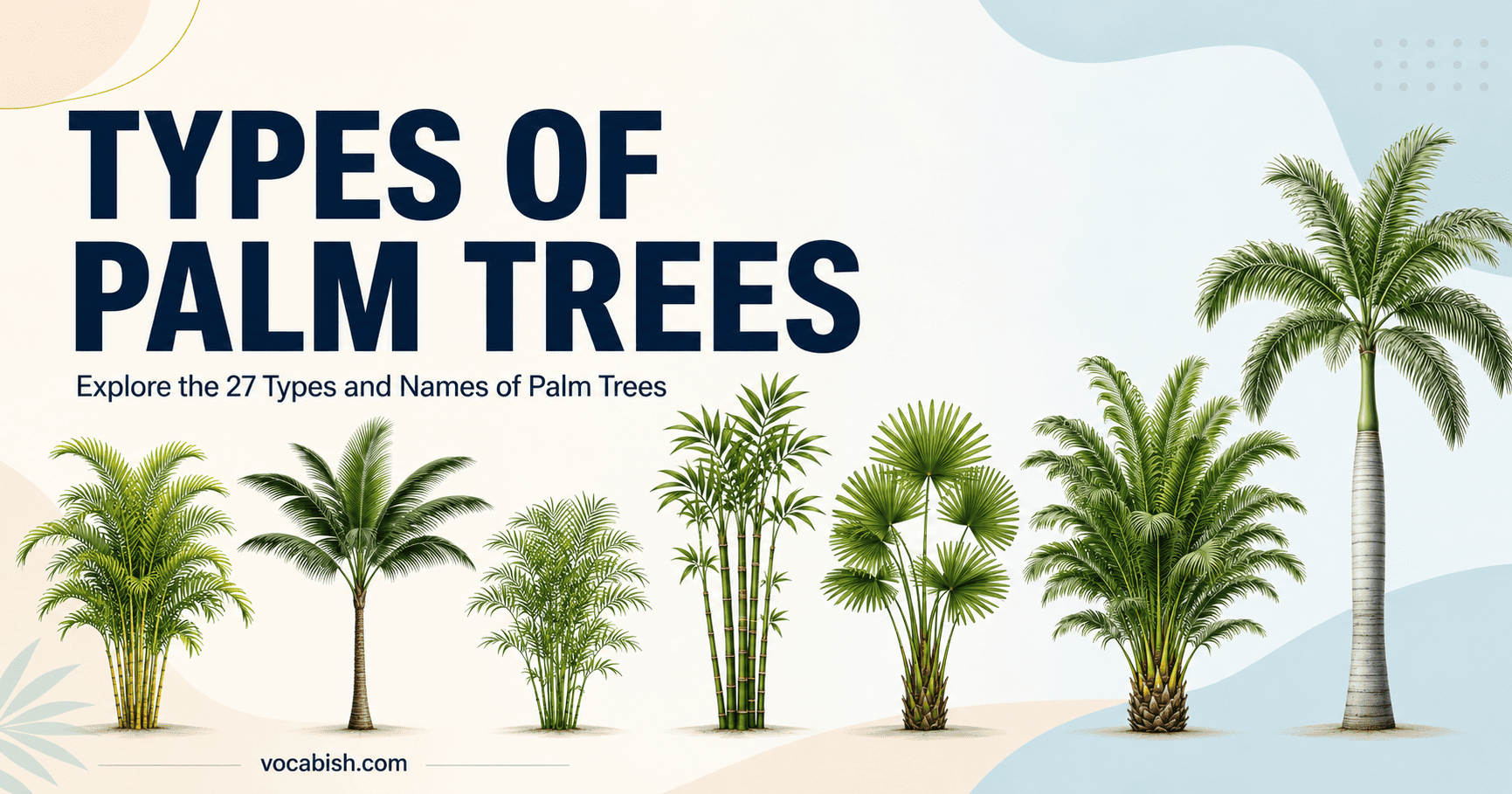

Types of palm trees belong to the flowering plant family Arecaceae, which includes more than 2,500 species. However, these plants do not all look like the tall coconut palms that grow along tropical beaches. Some palms form shrubs, while others develop climbing stems, multiple trunks, underground stems, or compact shapes suitable for containers.
This guide explains 27 common types of palm trees and organizes them by growth habit, leaf shape, appearance, and use. You will learn how to identify indoor palms, fan palms, feather-leaved palms, ornamental species, and commercially important palms. In addition, each entry includes a scientific name, key features, alternative names where appropriate, and a natural example sentence.
What Is a Palm Tree?
A palm is a perennial flowering plant that belongs to the family Arecaceae. Most palms grow in tropical or subtropical climates, although several species also tolerate cooler conditions.
The word type can have several meanings when people discuss palm trees. In this guide, it mainly refers to individual palm species that gardeners, landscapers, farmers, and houseplant owners commonly recognize. However, the article also groups these species according to practical features such as leaf shape, trunk structure, growth habit, and commercial use.
Palm leaves usually follow three main patterns:
- Pinnate leaves resemble feathers because individual leaflets grow along both sides of a central stalk.
- Palmate leaves resemble open hands or folding fans because their segments spread from one central point.
- Costapalmate leaves resemble fans but contain a strong central rib that extends into the leaf blade.
In addition, fishtail palms produce bipinnate leaves, which divide twice. Because common names often overlap, scientific names provide the most reliable way to distinguish one species from another.
Complete List of Palm Tree Types
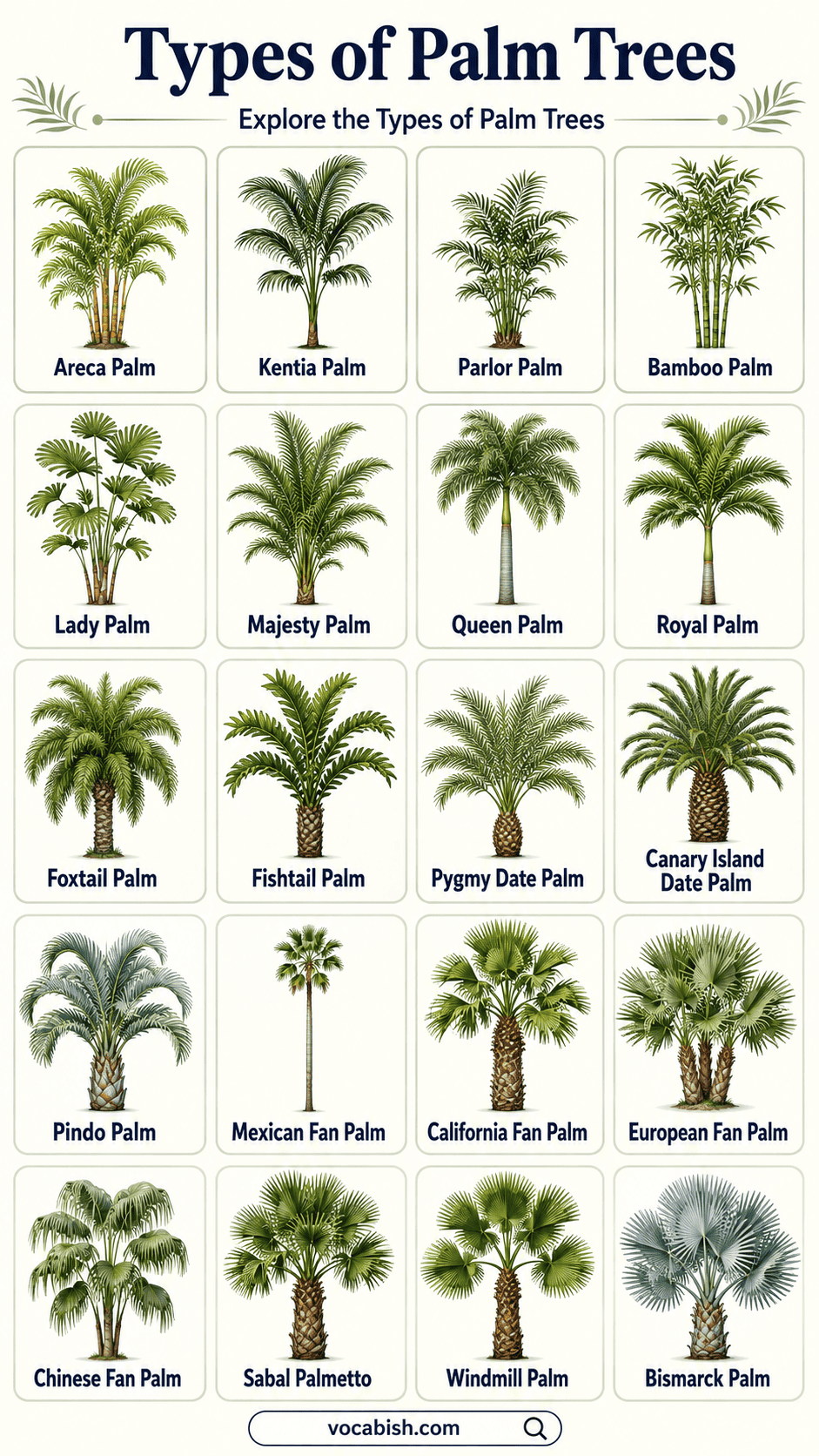
Areca Palm | Kentia Palm | Parlor Palm |
|---|---|---|
Bamboo Palm | Lady Palm | Majesty Palm |
Queen Palm | Royal Palm | Foxtail Palm |
Fishtail Palm | Pygmy Date Palm | Canary Island Date Palm |
Pindo Palm | Mexican Fan Palm | California Fan Palm |
European Fan Palm | Chinese Fan Palm | Sabal Palmetto |
Windmill Palm | Bismarck Palm | Bottle Palm |
Triangle Palm | Lipstick Palm | Coconut Palm |
Date Palm | African Oil Palm | Betel Nut Palm |
Main Categories of Palm Trees
The palm family contains many species, so practical categories make the names easier to understand. However, these groups do not represent formal botanical ranks.
Indoor and Small Ornamental Palms
These palms usually grow well in containers, shaded courtyards, conservatories, offices, or homes. Some remain naturally compact, while others eventually need outdoor space.
Feather-Leaved Landscape Palms
These species produce pinnate or bipinnate leaves. As a result, their crowns often appear soft, flowing, feathery, or plume-like.
Fan-Leaved Palms
These palms produce palmate or costapalmate leaves. Their broad leaves often resemble open fans, folded paper, or outstretched hands.
Distinctive Ornamental Palms
Some palms attract attention because of unusual trunks, bright stem colors, geometric growth patterns, or exceptionally large leaves.
Food and Commercial Palms
These species provide fruits, seeds, oils, fibers, drinks, or other useful materials. Nevertheless, landscapers also plant many of them for decoration.
Indoor and Small Ornamental Palms
Indoor palms add greenery and tropical texture to rooms. However, each species needs different levels of light, humidity, water, and space.
1. Areca Palm
The areca palm has several smooth, yellow-green stems and long, arching, feather-shaped fronds. Its accepted scientific name is Chrysalidocarpus lutescens, although nurseries and older books often use Dypsis lutescens.
This palm comes from Madagascar. Gardeners frequently place it in containers, use it as a privacy screen, or grow it outdoors in warm climates. Moreover, its many stems create a fuller and bushier appearance than a single-trunked palm.
The name can cause confusion because the true betel nut palm belongs to the genus Areca. Therefore, golden cane palm often provides a clearer name for this species.
Example: Several areca palms created a green screen around the patio.
Also called: Golden cane palm, butterfly palm, yellow palm
2. Kentia Palm
The Kentia palm (Howea forsteriana) produces dark green, arching fronds with widely spaced leaflets. It naturally develops a single trunk, although nurseries often place several young plants in one container to create a fuller display.
This elegant palm comes from Lord Howe Island in Australia. Because it tolerates moderate shade and indoor conditions better than many tropical species, hotels, offices, and homeowners often choose it for interior decoration.
In contrast, an areca palm produces multiple stems from its base and usually looks denser. A Kentia palm has a calmer, more open shape.
Example: A tall Kentia palm stood beside the hotel reception desk.
Also called: Sentry palm, thatch palm
3. Parlor Palm
The parlor palm (Chamaedorea elegans) is a small, slow-growing palm with slender stems and delicate, feather-shaped leaves. It comes from parts of Mexico and Central America.
Because this palm tolerates lower light levels, people often grow it in living rooms, offices, and shaded indoor spaces. Furthermore, it normally remains manageable in a container for many years.
Nurseries frequently place several seedlings in one pot. Consequently, a potted parlor palm may look like a naturally clustering plant. British English usually uses the spelling parlour palm.
Example: She placed a parlor palm near the shaded living-room window.
Also called: Parlour palm, neanthe bella palm
4. Bamboo Palm
The bamboo palm (Chamaedorea seifrizii) produces thin, upright stems with visible rings. These stems resemble bamboo canes, although the plant belongs to the palm family rather than the grass family.
Its arching leaves carry narrow leaflets that create a soft tropical appearance. Gardeners often use bamboo palms as indoor plants, shaded outdoor screens, or natural room dividers.
Compared with the parlor palm, the bamboo palm usually grows taller and develops more noticeable cane-like stems. Therefore, stem height and ring patterns provide useful identification clues.
Example: The bamboo palms formed a natural divider between the seating areas.
Also called: Reed palm
5. Lady Palm
The lady palm (Rhapis excelsa) grows in clusters of slender stems covered with coarse brown fibers. Unlike the bamboo palm, it produces fan-shaped leaves rather than feather-shaped fronds.
Each dark green leaf divides into several broad, finger-like sections. As a result, the plant creates a dense and orderly appearance. People often grow lady palms in offices, shaded courtyards, conservatories, and large containers.
In addition, the plant’s compact growth makes it suitable for low screens or informal hedges. Some sellers use the name bamboo palm for this species, but lady palm offers greater clarity.
Example: A row of lady palms softened the building’s shaded entrance.
Also called: Broadleaf lady palm
6. Majesty Palm
The majesty palm (Ravenea rivularis) has a full crown of long, upward-curving, feather-shaped fronds. Young plants commonly appear in garden centers as indoor palms.
This species comes from Madagascar and can eventually become a large outdoor palm in a suitable tropical climate. Therefore, buyers should not assume that it will always remain compact.
Majesty palms generally need brighter light, steady moisture, and higher humidity than parlor or Kentia palms. Consequently, dry rooms and dark corners may weaken them over time.
Example: The young majesty palm filled an empty corner of the sunroom.
Also called: Majestic palm
Feather-Leaved Landscape Palms
Feather-leaved palms produce pinnate leaves with leaflets along a central stalk. Although the species share a general leaf form, their trunks, crownshafts, sizes, and leaflet arrangements differ considerably.
7. Queen Palm
The queen palm (Syagrus romanzoffiana) develops a tall, smooth gray trunk and a loose crown of long, feather-shaped fronds. Its leaflets grow at slightly different angles, which gives the crown a soft and flowing appearance.
Landscapers frequently plant queen palms along roads, beside driveways, and across large lawns in warm climates. In addition, the palm produces clusters of orange fruit below its crown.
Unlike the royal palm, the queen palm does not develop a long, smooth green crownshaft. Therefore, the crown area provides one of the easiest ways to separate the two species.
Example: Queen palms moved gently in the afternoon breeze.
8. Royal Palm
The royal palm (Roystonea regia) grows into a tall and impressive tree with a smooth, pale gray trunk. A long green crownshaft sits directly below its large feather-shaped leaves.
Because of its formal shape, landscapers often plant royal palms along wide avenues, public roads, parks, and estate entrances. However, the species needs plenty of space because mature leaves can become large and heavy.
The green crownshaft, smooth trunk, and balanced crown help distinguish the royal palm from queen and coconut palms.
Example: Two rows of royal palms marked the entrance to the estate.
Also called: Cuban royal palm
9. Foxtail Palm
The foxtail palm (Wodyetia bifurcata) produces thick, bushy fronds that resemble fox tails. Its narrow leaflets grow around the central stalk in several directions instead of forming one flat row.
This Australian palm also develops a smooth gray trunk and a green crownshaft. Consequently, people sometimes confuse it with the royal palm.
However, the foxtail palm usually remains smaller, and its fluffy fronds provide an obvious identification feature. Landscapers often use it as a specimen tree or plant several in a formal row.
Example: The foxtail palm’s bushy fronds stood out against the blue sky.
10. Fishtail Palm
The fishtail palm (Caryota mitis) has bipinnate leaves with wedge-shaped leaflets. Each leaflet ends in an uneven, jagged edge that resembles a fish’s tail.
Unlike many single-trunked palms, this species usually produces several stems and forms a dense cluster. Therefore, gardeners often use it as a tropical screen.
Other species in the genus Caryota also carry the name fishtail palm. For this reason, the scientific name helps readers identify the clustering species accurately.
Example: The gardener recognized the fishtail palm by its jagged leaflets.
Also called: Clustering fishtail palm, Burmese fishtail palm
11. Pygmy Date Palm
The pygmy date palm (Phoenix roebelenii) is a small palm with a slender trunk and arching feather-shaped fronds. Sharp spines grow near the bases of its leaves, so people should handle the crown carefully.
This palm naturally produces one trunk. However, nurseries often plant three or more specimens together to create a fuller arrangement.
Because of its compact form, the pygmy date palm suits courtyards, entrances, patios, and containers. Although it produces small date-like fruits, growers do not raise it for commercial date production.
Example: Two pygmy date palms framed the doorway without covering the windows.
Also called: Dwarf date palm, miniature date palm, robellini palm
12. Canary Island Date Palm
The Canary Island date palm (Phoenix canariensis) develops a thick trunk and a huge, rounded crown of stiff, arching fronds. Landscapers sometimes trim the old leaf bases into a decorative diamond pattern.
This palm comes from the Canary Islands. People mainly plant it as a dramatic ornamental tree in Mediterranean and subtropical regions.
In comparison, the pygmy date palm remains much smaller and has a slender trunk. The Canary Island date palm also produces orange fruit, although growers do not usually cultivate it as a commercial fruit tree.
Example: An old Canary Island date palm dominated the center of the garden.
Also called: Canary date palm
13. Pindo Palm
The pindo palm (Butia odorata) produces strongly arching fronds with blue-green or gray-green leaflets. These leaves often bend back toward the trunk and create a rounded, slightly weeping crown.
The palm also produces fragrant yellow or orange fruit. People sometimes use this fruit to prepare jelly, which explains the name jelly palm.
Older references often use the scientific name Butia capitata for this cultivated palm. However, modern botanical treatments generally apply the name Butia odorata to the commonly grown southern form.
Example: Ripe fruit beneath the pindo palm filled the air with a sweet scent.
Also called: Jelly palm
Fan-Leaved Palm Trees
Fan palms produce broad leaves that spread outward from a central point. However, their trunk shapes, leaf textures, colors, and growth habits vary widely.
14. Mexican Fan Palm
The Mexican fan palm commonly carries the scientific name Washingtonia robusta in horticulture. Some modern botanical treatments classify it as Washingtonia filifera var. robusta.
This palm develops an exceptionally tall and narrow trunk with a relatively small crown of fan-shaped leaves. In addition, dead leaves may remain below the crown and form a brown skirt when no one removes them.
Compared with the California fan palm, the Mexican species generally grows taller and develops a much slimmer trunk.
Example: Mexican fan palms formed a dramatic line beside the boulevard.
Also called: Mexican Washington palm
15. California Fan Palm
The California fan palm (Washingtonia filifera) has a thick trunk and a heavy crown of broad, gray-green leaves. Fine, thread-like fibers often curl from the edges of younger leaf segments.
This species grows naturally around desert oases in the southwestern United States and northwestern Mexico. Therefore, groups of these palms may indicate a dependable source of underground water.
Compared with the Mexican fan palm, the California fan palm usually has a broader trunk, a larger crown, and a shorter mature profile. However, the two species can hybridize and produce intermediate forms.
Example: California fan palms marked the desert oasis from a distance.
Also called: Desert fan palm, desert palm
16. European Fan Palm
The European fan palm (Chamaerops humilis) forms a compact cluster of several trunks. Its stiff leaves divide into narrow fan-shaped segments, while sharp teeth line the leaf stalks.
This species comes from the Mediterranean region and represents one of the few palms that grow naturally in continental Europe. Gardeners grow both green and silver forms.
Because it remains relatively compact, the European fan palm works well in containers, small gardens, and low landscape borders. Moreover, its clustering habit separates it from many single-trunked fan palms.
Example: A European fan palm grew beside the Mediterranean stone wall.
Also called: Mediterranean fan palm, dwarf palm
17. Chinese Fan Palm
The Chinese fan palm (Livistona chinensis) produces large, nearly circular leaves. The ends of its leaf segments hang downward and create a graceful, fountain-like crown.
Young plants often appear in patio containers or indoor displays. Nevertheless, mature specimens can become substantial outdoor trees in warm climates.
The drooping leaflet tips provide the best identification clue. In contrast, many other fan palms produce stiff segments that remain upright or extend horizontally.
Example: The curved tips of the Chinese fan palm moved gently in the rain.
Also called: Chinese fountain palm
18. Sabal Palmetto
The Sabal palmetto (Sabal palmetto) produces costapalmate leaves with a strong central rib. This rib bends the leaf into a folded, three-dimensional shape.
The palm grows naturally across parts of the southeastern United States, the Bahamas, and Cuba. In addition, it tolerates coastal wind, salt, and sandy soil better than many ornamental palms.
Its trunk may look smooth, or it may retain crossed sections of old leaf bases. Because the word palmetto can describe several species, the name cabbage palm often provides greater clarity.
Example: Sabal palmettos grew along the windswept coast.
Also called: Cabbage palm, cabbage palmetto
19. Windmill Palm
The windmill palm (Trachycarpus fortunei) develops a slender trunk covered with coarse brown fibers. Rounded fan-shaped leaves spread from the crown like the blades of a windmill.
This palm comes from temperate and subtropical mountain regions of China. Unlike strongly tropical palms, it can tolerate relatively cool winters when gardeners provide suitable conditions.
Therefore, people often grow windmill palms in parts of Europe, the United Kingdom, the Pacific Northwest, and other mild regions. Its rough, fibrous trunk makes identification relatively easy.
Example: A windmill palm added tropical texture to the sheltered city garden.
Also called: Chinese windmill palm, Chusan palm
20. Bismarck Palm
The Bismarck palm (Bismarckia nobilis) produces enormous, stiff fan leaves that often display a silver-blue color. A thick solitary trunk supports its broad and symmetrical crown.
This palm comes from Madagascar. Because mature specimens occupy considerable space, landscapers usually place them in open lawns, large gardens, and spacious public areas.
The leaf color and powerful crown make the Bismarck palm easy to distinguish from smaller fan palms. However, some forms develop greener foliage instead of the familiar silver shade.
Example: The silver leaves of the Bismarck palm reflected the midday sunlight.
Distinctive Ornamental Palms
The following types of palm trees stand out because of unusual trunks, geometric leaf arrangements, or bright stem colors.
21. Bottle Palm
The bottle palm (Hyophorbe lagenicaulis) has a swollen lower trunk that narrows sharply below the crownshaft. As a result, the trunk resembles a bottle.
This slow-growing palm produces a relatively small crown of arching feather-shaped leaves. Gardeners often use it as a focal point in frost-free landscapes or grow young specimens in large containers.
The bottle palm differs from the related spindle palm because its trunk expands close to the ground. In contrast, the spindle palm usually becomes widest around the middle.
Example: The swollen trunk gave the bottle palm a sculpted appearance.
22. Triangle Palm
The triangle palm (Chrysalidocarpus decaryi) arranges its leaf bases in three vertical rows around the trunk. When people view the crown from above, these rows form a triangular pattern.
Its blue-green feather-shaped leaves rise at strong angles and create an open, architectural shape. Therefore, landscape designers often use it as a focal point.
Many nurseries and older references still use the name Dypsis decaryi. However, current botanical classifications place the species in the genus Chrysalidocarpus.
Example: The designer placed a triangle palm at the center of the garden.
Previously called: Dypsis decaryi
23. Lipstick Palm
The lipstick palm (Cyrtostachys renda) grows in clusters and produces vivid red crownshafts and leaf sheaths. These bright stems create a strong contrast with the plant’s green, feather-shaped leaves.
This palm naturally grows in warm, humid, lowland habitats in Southeast Asia. Consequently, it needs tropical conditions and does not perform well in cold or dry landscapes.
Its intense red coloring provides an unmistakable identification feature. Furthermore, the color explains alternative names such as red sealing-wax palm.
Example: The red stems of the lipstick palm added color to the tropical garden.
Also called: Red sealing-wax palm, sealing-wax palm
Food and Commercial Palms
Several palm species support agriculture and industry. They provide fruits, oils, fibers, seeds, sweeteners, construction materials, and other products.
24. Coconut Palm
The coconut palm (Cocos nucifera) has a slender, often curved trunk and a crown of very large feather-shaped leaves. It produces coconuts with fibrous outer husks, hard shells, white flesh, and coconut water.
People grow coconut palms throughout tropical coastal regions. Moreover, they use different parts of the fruit to make coconut milk, oil, flour, coir fiber, and copra.
A coconut palm represents only one species within the palm family. Therefore, every coconut tree is a palm, but most types of palm trees do not produce coconuts.
Example: Coconut palms leaned toward the sea above the sandy beach.
25. Date Palm
The date palm (Phoenix dactylifera) produces the sweet fruits that people commonly call dates. It has a thick, textured trunk, blue-green feather-shaped fronds, and sharp spines near the leaf bases.
Young palms may produce offshoots around the base. In addition, male and female flowers grow on separate plants, so commercial growers manage pollination carefully.
Farmers mainly cultivate date palms in hot, dry regions of North Africa, the Middle East, and neighboring areas. Unlike the Canary Island date palm, this species has major agricultural importance.
Example: Workers harvested ripe dates from the palm grove in early autumn.
Also called: True date palm
26. African Oil Palm
The African oil palm (Elaeis guineensis) produces dense bunches of orange, red, and dark-colored fruits. These heavy fruit clusters grow among the lower leaves of the crown.
Producers extract palm oil from the fruit’s fleshy outer layer. In contrast, they obtain palm kernel oil from the seed inside the fruit.
This palm comes from tropical Africa, although farmers now grow it in several humid tropical regions. It differs from the coconut palm because the two species produce different fruits and commercial oils.
Example: The plantation grew African oil palms for their oil-rich fruit.
Also called: Oil palm
27. Betel Nut Palm
The betel nut palm (Areca catechu) develops a tall, slender, ringed trunk and a smooth green crownshaft. Clusters of oval fruits turn orange or red as they mature.
The seed inside each fruit has the correct name areca nut. However, people often call it betel nut because some traditions combine the seed with leaves from the betel vine.
Therefore, the palm itself does not produce a true botanical nut called betel. This species grows widely across tropical Asia and the Pacific.
Example: Orange fruit hung beneath the crown of the betel nut palm.
Also called: Areca nut palm, betel palm, catechu palm
Important Differences Between Similar Palm Trees
Compared Types | Main Difference | Best Identification Clue |
|---|---|---|
Areca Palm vs. Betel Nut Palm | Areca palm forms several yellow-green canes, whereas betel nut palm develops a tall ringed trunk | Multiple canes versus one main trunk |
Kentia Palm vs. Areca Palm | Kentia has an open crown, while areca appears denser and bushier | Widely spaced fronds versus clustered canes |
Parlor Palm vs. Bamboo Palm | Parlor palm remains smaller, whereas bamboo palm develops taller cane-like stems | Fine compact growth versus ringed stems |
Pygmy Date vs. Canary Island Date Palm | Pygmy date palm stays compact, while Canary Island date palm becomes massive | Slender trunk versus thick trunk |
Date Palm vs. Canary Island Date Palm | Farmers grow date palms for fruit, while landscapers mainly use Canary Island date palms as ornamentals | Commercial dates versus decorative crown |
Mexican vs. California Fan Palm | Mexican fan palm usually grows taller and slimmer | Narrow trunk versus broad trunk |
Lady Palm vs. Bamboo Palm | Lady palm produces fan leaves, while bamboo palm produces feather-shaped leaves | Fan segments versus narrow leaflets |
Queen Palm vs. Royal Palm | Royal palm has a prominent green crownshaft | Loose crown versus smooth crownshaft |
Foxtail Palm vs. Queen Palm | Foxtail leaflets surround the stalk and create a bushy shape | Cylindrical fronds versus flowing fronds |
Bottle Palm vs. Triangle Palm | Bottle palm has a swollen trunk, while triangle palm arranges leaves in three rows | Bottle-shaped base versus triangular crown |
How to Identify Different Palm Trees
- Start with the leaf shape. First, decide whether the palm has feather-shaped, fan-shaped, costapalmate, or twice-divided leaves.
- Check the number of stems. Some palms grow from one trunk, while others form clusters of several trunks or thin canes.
- Study the trunk texture. For example, windmill palms have fibrous trunks, whereas royal palms develop smooth gray trunks.
- Look for a crownshaft. Royal, foxtail, lipstick, and betel nut palms produce a clear crownshaft beneath the leaves.
- Notice unusual trunk shapes. A swollen base suggests a bottle palm, while an exceptionally narrow trunk may indicate a Mexican fan palm.
- Observe the leaflet arrangement. Foxtail palm leaflets surround the stalk, while queen palm leaflets create a looser and flatter pattern.
- Consider leaf color. Bismarck palms often have silver-blue leaves, while lipstick palms display bright red crownshafts.
- Estimate the mature size. A small nursery plant may eventually develop into a large outdoor tree.
- Check flowers and fruits. Dates, coconuts, orange queen palm fruits, and dark oil palm fruit bunches can provide useful clues.
- Confirm the scientific name. Common names often overlap, so the botanical name can prevent mistakes.
Confusions and Misconceptions About Palm Trees
- Not every palm grows as a tree. Some species form shrubs, climbing stems, compact clusters, or mostly underground trunks.
- Cycads are not palms. Sago palms, cardboard palms, and coonties belong to a different group of seed plants.
- The traveler’s palm is not a true palm. It belongs to the bird-of-paradise plant family.
- A coconut tree is one kind of palm. However, most palm species do not produce coconuts.
- Areca palm may refer to different plants. Houseplant sellers usually mean Chrysalidocarpus lutescens, while Areca catechu produces areca nuts.
- Bamboo palm is an overlapping common name. Most nurseries use it for Chamaedorea seifrizii, although some sources apply it to other cane-like palms.
- Fan palm does not describe one species. Instead, it refers broadly to palms with fan-shaped leaves.
- Scientific names can change. For example, botanists now place several former Dypsis species in Chrysalidocarpus.
- The pindo palm often carries an outdated label. Many older sources call it Butia capitata rather than Butia odorata.
- Young palms may look unlike mature palms. Therefore, size alone does not always provide reliable identification.
Summary of the Main Palm Tree Types
Common Name | Scientific Name | Category | Main Identifying Feature |
|---|---|---|---|
Areca Palm | Chrysalidocarpus lutescens | Indoor ornamental | Yellow-green clustering canes |
Kentia Palm | Howea forsteriana | Indoor ornamental | Open crown of dark arching fronds |
Parlor Palm | Chamaedorea elegans | Indoor ornamental | Small size and fine leaflets |
Bamboo Palm | Chamaedorea seifrizii | Indoor ornamental | Ringed cane-like stems |
Lady Palm | Rhapis excelsa | Indoor fan palm | Clusters of finger-like fan leaves |
Majesty Palm | Ravenea rivularis | Indoor or landscape | Full crown of upright fronds |
Queen Palm | Syagrus romanzoffiana | Landscape palm | Loose feathery foliage |
Royal Palm | Roystonea regia | Landscape palm | Smooth trunk and green crownshaft |
Foxtail Palm | Wodyetia bifurcata | Landscape palm | Bushy fox-tail-shaped fronds |
Fishtail Palm | Caryota mitis | Landscape palm | Jagged triangular leaflets |
Pygmy Date Palm | Phoenix roebelenii | Small landscape palm | Compact size and slender trunk |
Canary Island Date Palm | Phoenix canariensis | Landscape palm | Massive crown and thick trunk |
Pindo Palm | Butia odorata | Landscape palm | Curving blue-green fronds |
Mexican Fan Palm | Washingtonia robusta | Fan palm | Extremely tall narrow trunk |
California Fan Palm | Washingtonia filifera | Fan palm | Thick trunk and fibrous leaves |
European Fan Palm | Chamaerops humilis | Fan palm | Compact multi-trunked growth |
Chinese Fan Palm | Livistona chinensis | Fan palm | Drooping leaf-segment tips |
Sabal Palmetto | Sabal palmetto | Fan palm | Folded costapalmate leaves |
Windmill Palm | Trachycarpus fortunei | Fan palm | Fibrous brown trunk |
Bismarck Palm | Bismarckia nobilis | Fan palm | Huge silver-blue leaves |
Bottle Palm | Hyophorbe lagenicaulis | Ornamental palm | Swollen lower trunk |
Triangle Palm | Chrysalidocarpus decaryi | Ornamental palm | Leaves in three vertical rows |
Lipstick Palm | Cyrtostachys renda | Ornamental palm | Bright red crownshafts |
Coconut Palm | Cocos nucifera | Food and commercial | Large fibrous coconuts |
Date Palm | Phoenix dactylifera | Food and commercial | Clusters of edible dates |
African Oil Palm | Elaeis guineensis | Food and commercial | Oil-rich fruit bunches |
Betel Nut Palm | Areca catechu | Food and commercial | Ringed trunk and orange fruit |
Frequently Asked Questions About Palm Trees
The palm family contains more than 2,500 species in over 180 genera. However, botanical totals can change when researchers describe new species or revise existing classifications. This article focuses on 27 commonly recognized palm trees rather than every known species.
The three main leaf forms are pinnate, palmate, and costapalmate. Pinnate leaves look like feathers, while palmate leaves resemble open fans. Costapalmate leaves also look like fans, but a strong central rib gives them a folded shape. In addition, fishtail palms produce bipinnate leaves.
Parlor, Kentia, lady, bamboo, and areca palms commonly grow indoors. However, each species has different light, water, humidity, and space requirements. Parlor and Kentia palms usually adapt more easily to indoor conditions than majesty palms.
A coconut tree is one specific palm species called Cocos nucifera. In contrast, the term palm tree covers thousands of different species. Therefore, every coconut tree belongs to the palm family, but most palm trees do not produce coconuts.
The true date palm, Phoenix dactylifera, produces the familiar edible dates sold in shops. Other species in the genus Phoenix produce date-like fruits, but farmers do not normally grow them as major commercial fruit crops.
Start by examining the leaf shape and number of trunks. Next, check the crownshaft, trunk fibers, leaf-base pattern, color, spines, fruits, and mature size. Finally, use the scientific name to confirm the identification.
The lipstick palm, Cyrtostachys renda, produces bright red crownshafts and leaf sheaths. Consequently, it also carries names such as red sealing-wax palm and sealing-wax palm.
Key Takeaways
- The palm family includes more than 2,500 species with tree-like, shrubby, clustering, and climbing growth habits.
- Leaf shape offers the fastest identification clue because palms produce pinnate, palmate, costapalmate, or bipinnate leaves.
- Indoor palms include parlor, Kentia, bamboo, lady, areca, and young majesty palms.
- Fan palm describes a broad leaf form rather than one specific species.
- Common names often overlap, so scientific names provide greater accuracy.
- Coconut, date, oil, and betel nut palms produce different fruits, seeds, oils, and commercial products.
Conclusion
The many types of palm trees differ in their leaves, trunks, growth habits, mature sizes, climate needs, and practical uses. For example, parlor, Kentia, bamboo, and lady palms suit indoor spaces, while queen, royal, foxtail, and Canary Island date palms create impressive outdoor landscapes. Meanwhile, windmill, Bismarck, Sabal, and European fan palms represent several important fan-leaved forms.
Commercial palms also play major roles in agriculture. Coconut palms provide coconuts and coir, date palms produce edible dates, and African oil palms supply palm and palm-kernel oils.
Most importantly, readers should compare leaf shape, trunk structure, crownshaft, color, fruit, and growth habit when identifying different types of palm trees. Learning both the common and scientific names also strengthens vocabulary and prevents confusion between similar or overlapping terms.
You May Also Like