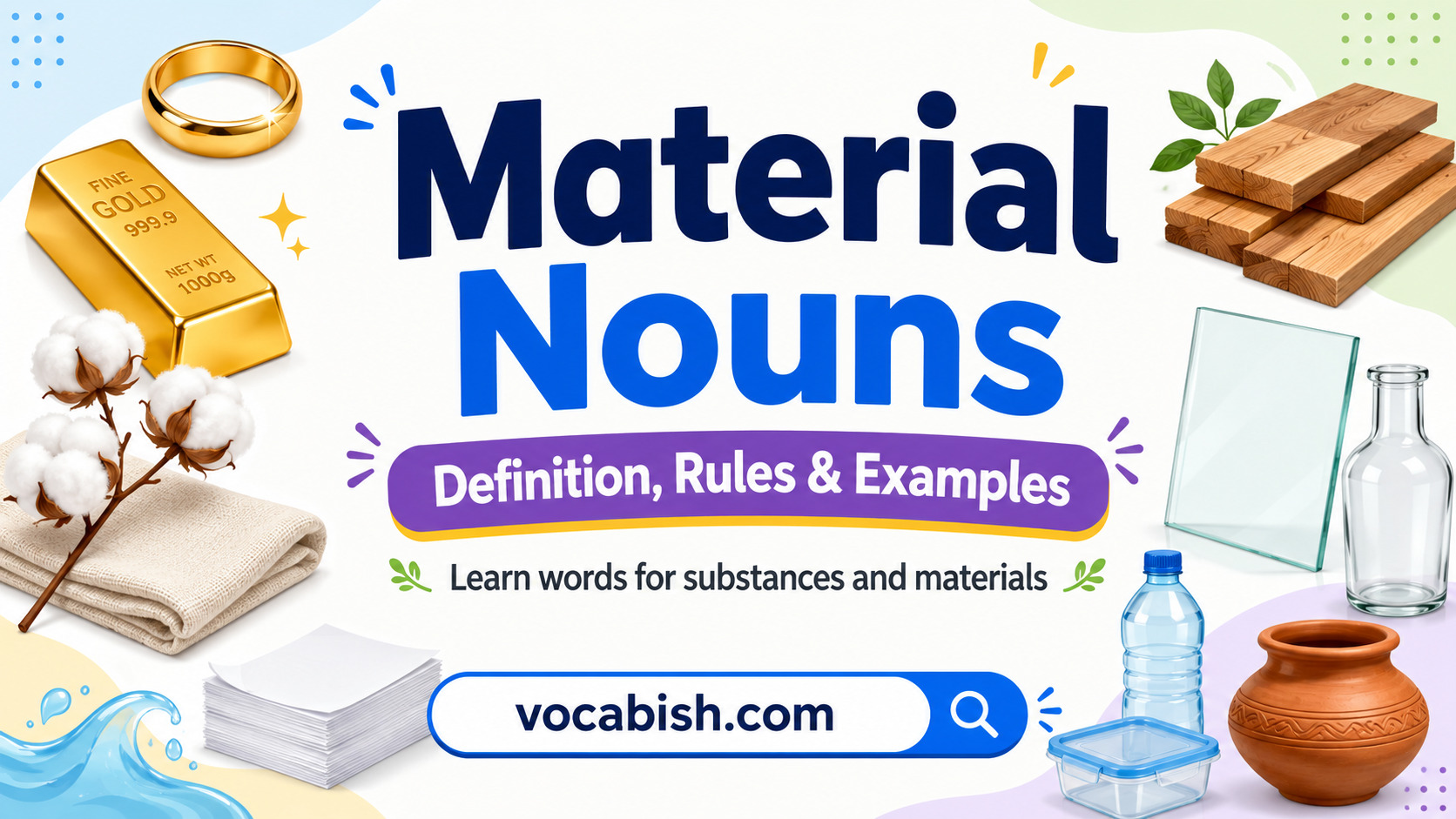

Gold, cotton, water, wood, and plastic are all names of materials. They do not usually name separate objects. Instead, they name the substances from which objects are made.
These words are called material nouns. Learning how they work helps English learners choose correct articles, quantity expressions, singular forms, and plural forms.
This article explains the meaning, categories, uses, and grammar rules of material nouns through practical examples.
What Is a Material Noun?
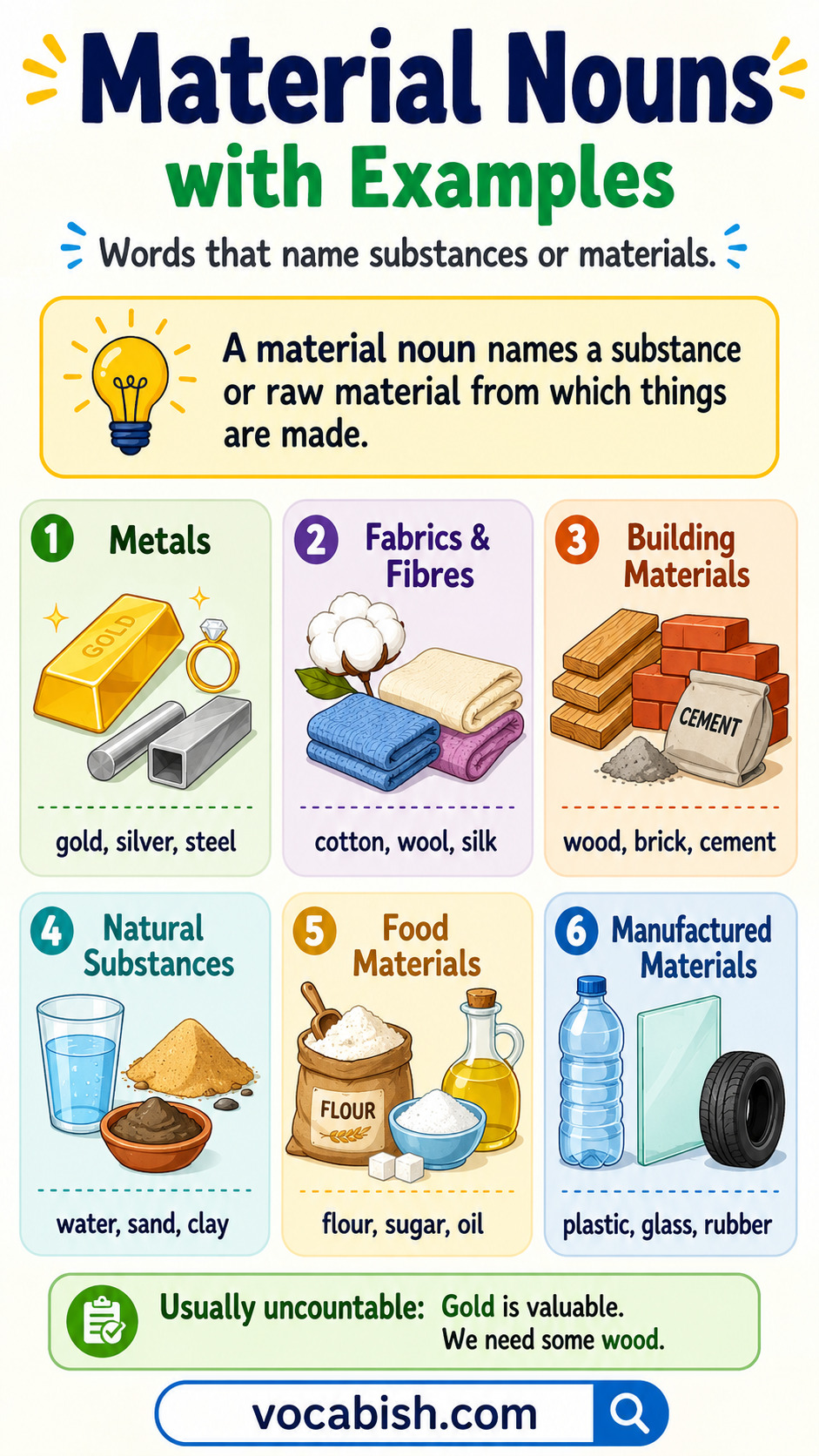
A material noun is a noun that names a substance, material, or raw product from which something can be made.
Examples include:
- gold
- silver
- wood
- cotton
- glass
- leather
- plastic
- steel
- water
- clay
In the sentence below, wood names the material rather than an individual object:
- The table is made of wood.
Material nouns usually answer this question:
What material or substance is it made from?
- The ring is made of gold.
- The shirt is made of cotton.
- The bottle contains glass and plastic parts.
- The wall was built with brick and cement.
Main Categories of Material Nouns
Material nouns can be grouped according to their source, structure, or use.
Category | Common examples |
|---|---|
Metals | gold, silver, iron, steel, copper |
Fabrics and fibres | cotton, wool, silk, nylon |
Building materials | brick, cement, stone, marble |
Natural substances | water, air, clay, sand |
Food materials | flour, sugar, rice, oil |
Manufactured materials | plastic, rubber, paper, glass |
Metals
Metals are hard substances used to make tools, jewellery, machines, buildings, and household products.
Common metal material nouns include:
- gold
- silver
- iron
- steel
- copper
- aluminium
- bronze
- brass
Examples:
- The necklace is made of silver.
- Steel is widely used in construction.
- These electrical wires contain copper.
- The statue was made from bronze.
Fabrics and Fibres
These material nouns name substances used to produce clothing, carpets, ropes, curtains, and other textile products.
Common examples are:
- cotton
- wool
- silk
- linen
- nylon
- polyester
- denim
- leather
Examples:
- This jacket is made of leather.
- Cotton feels comfortable in warm weather.
- She bought a dress made from silk.
- The sweater contains natural wool.
Building Materials
Building materials are substances used to construct houses, roads, bridges, walls, and other structures.
Examples include:
- cement
- concrete
- brick
- stone
- marble
- wood
- glass
- steel
Examples in sentences:
- The workers mixed cement with sand.
- The floor is covered with marble.
- The bridge contains a large amount of steel.
- The cottage was built from stone and wood.
Natural Substances
Natural substances come directly from nature or are found in the natural environment.
Examples include:
- water
- air
- soil
- sand
- clay
- coal
- salt
- oil
Examples:
- The potter shaped the bowl from clay.
- Plants need water, air, and sunlight.
- The children played in the sand.
- The country exports large quantities of coal.
Food Materials
Some nouns name food substances rather than separate food items.
Common examples are:
- flour
- sugar
- salt
- rice
- butter
- cheese
- oil
- chocolate
Examples:
- Add some flour to the mixture.
- This recipe requires a little butter.
- The bowl contains cooked rice.
- Dark chocolate has a rich taste.
Manufactured Materials
Manufactured materials are produced or processed by people, factories, or machines.
Examples include:
- plastic
- rubber
- paper
- glass
- nylon
- polyester
- concrete
- cardboard
Examples:
- Many containers are made of plastic.
- The tyres contain strong rubber.
- The package is wrapped in paper.
- The windows are made of thick glass.
Common Material Noun Examples
Material noun | Common use |
|---|---|
Gold | jewellery and electronics |
Silver | jewellery and household objects |
Iron | tools, machines, and construction |
Steel | buildings, vehicles, and equipment |
Copper | electrical wiring |
Cotton | clothing and bedding |
Wool | sweaters, coats, and blankets |
Silk | clothing and decoration |
Leather | shoes, bags, and furniture |
Wood | furniture and buildings |
Glass | windows, bottles, and screens |
Plastic | containers and household products |
Rubber | tyres, gloves, and seals |
Paper | books, documents, and packaging |
Clay | pots, bricks, and artwork |
Stone | walls, floors, and monuments |
Cement | construction |
Sand | building and glass production |
Flour | bread and cakes |
Sugar | food and drinks |
Material Nouns in Sentences
- The bracelet is made of gold.
- We need more wood for the shelves.
- This scarf is made from soft silk.
- The factory produces recycled paper.
- He poured some water into the glass.
- The roof is supported by steel.
- These shoes are made of genuine leather.
- The workers carried bags of cement.
- She added a little sugar to her tea.
- The artist created the figure from clay.
- The windows use specially treated glass.
- This blanket contains natural wool.
- Most toys were once made from wood.
- The road was covered with sand.
- The company is reducing its use of plastic.
Are Material Nouns Countable or Uncountable?
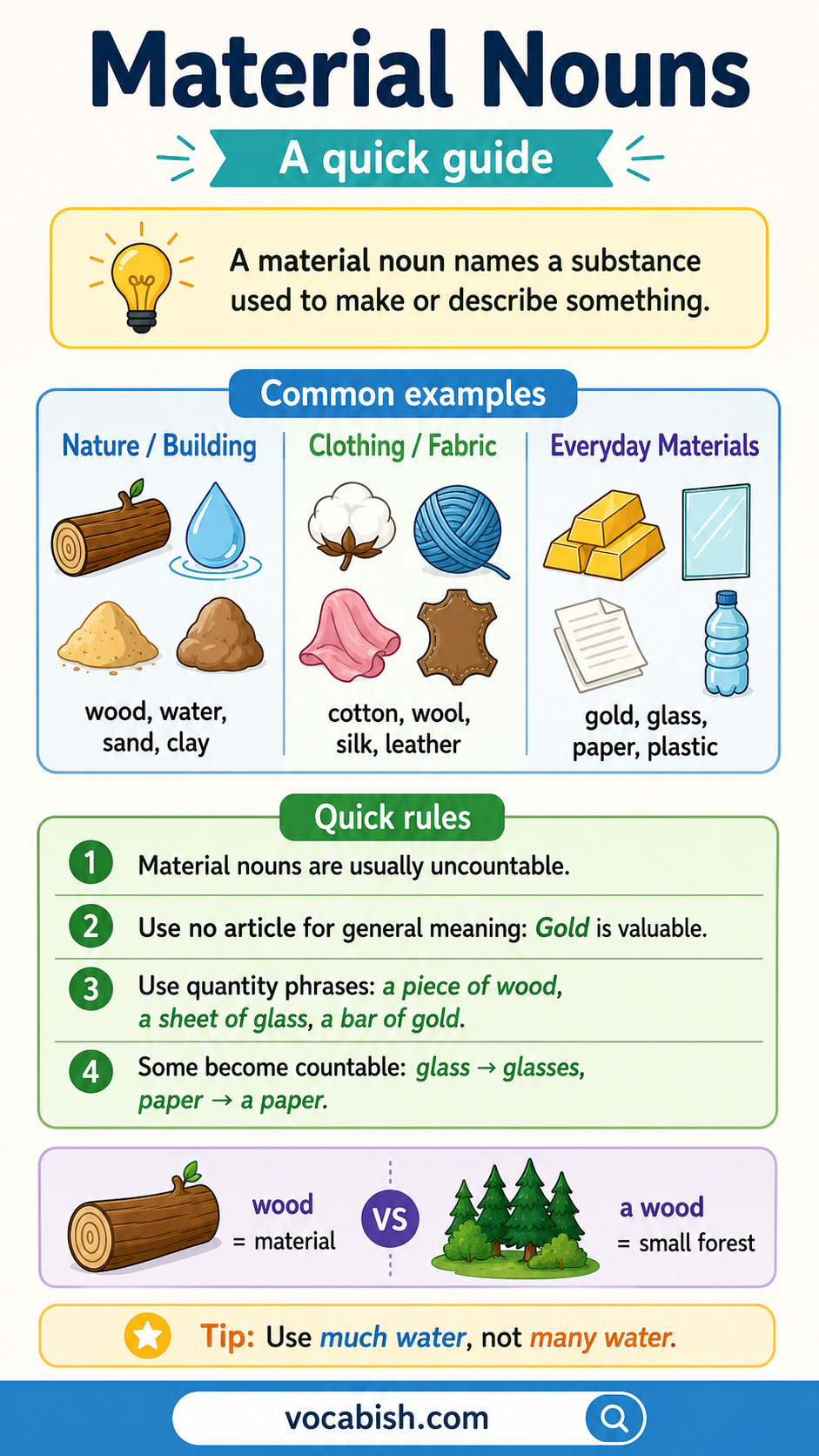
Material nouns are usually uncountable when they name a substance in a general sense.
Uncountable use | Meaning |
|---|---|
Gold is expensive. | the material generally |
We need some wood. | an unspecified amount |
Glass breaks easily. | the substance generally |
Cotton grows in warm regions. | the material or crop generally |
We normally do not say:
- a gold
- three woods
- many cottons
- two steels
Instead, use a unit, container, quantity, or measurement:
- a piece of gold
- three pieces of wood
- two rolls of cotton
- several sheets of steel
Some material nouns become countable when they refer to:
- individual objects
- different varieties
- separate products
- particular types
- portions or servings
Articles Used with Material Nouns
No article
Use no article when speaking about a material generally.
- Gold is valuable.
- Cotton is a natural fibre.
- Water is necessary for life.
- Plastic creates environmental problems.
The
Use the when referring to specific material already identified or understood.
- The wood in this cupboard is damaged.
- The gold from that mine is very pure.
- The water in the bottle is cold.
- The glass used in these windows is unusually strong.
A or an
Do not normally use a or an directly before an uncountable material noun.
Incorrect:
- She bought a gold.
- We need a wood.
- He used an iron for the gate.
Correct:
- She bought a piece of gold.
- We need a piece of wood.
- He used iron for the gate.
However, a or an is possible when the noun has a countable meaning:
- Please bring me a glass.
- She bought an iron.
- He published a paper.
- They walked through a wood.
Quantity Expressions for Material Nouns
Because most material nouns are uncountable, they commonly appear with quantity expressions.
Quantity expression | Example |
|---|---|
some | some cotton |
much | much water |
a little | a little sugar |
plenty of | plenty of wood |
a lot of | a lot of steel |
enough | enough cement |
a piece of | a piece of leather |
a sheet of | a sheet of glass |
a bar of | a bar of gold |
a roll of | a roll of cotton fabric |
a block of | a block of stone |
a bag of | a bag of flour |
a kilogram of | a kilogram of copper |
a litre of | a litre of oil |
Use much and little with uncountable materials:
- We do not have much wood.
- Add a little oil.
Use many and few only when the noun has a countable meaning:
- The gallery displayed many fine woods.
- She washed a few drinking glasses.
A Piece of Wood
Use a piece of wood when referring to one separate part of the material.
- He placed a piece of wood on the fire.
- I found two pieces of wood near the door.
- She used a small piece of wood to support the shelf.
The plural marker is added to piece, not wood:
- one piece of wood
- three pieces of wood
A Sheet of Glass
Use a sheet of glass for a flat, thin section of glass.
- The worker carried a sheet of glass.
- We ordered four sheets of glass for the windows.
- One sheet of glass was damaged during delivery.
Other useful expressions include:
- a pane of glass
- a fragment of glass
- a piece of glass
A Bar of Gold
Use a bar of gold for a solid, usually rectangular amount of gold.
- The museum displayed a bar of gold.
- The vault contained several bars of gold.
- Each bar of gold was carefully weighed.
Other measurements may include:
- a gram of gold
- an ounce of gold
- a kilogram of gold
A Roll of Cotton
Use a roll of cotton when cotton fabric, cotton wool, or processed cotton is stored in a rolled form.
- She bought a roll of cotton fabric.
- The nurse opened a roll of cotton wool.
- The shop sells several rolls of printed cotton.
In many situations, a more specific expression sounds clearer:
- a roll of cotton fabric
- a roll of cotton wool
- a bale of cotton
- a piece of cotton cloth
Material Nouns That Can Become Countable
A material noun can become countable when its meaning changes.
Uncountable meaning | Countable meaning |
|---|---|
a substance | an object |
material in general | a particular type |
raw material | a product made from it |
an unspecified amount | an individual portion |
Compare:
- Glass is fragile.
- I washed three glasses.
The first sentence names a material. The second names drinking containers.
Glass and Glasses
Glass is uncountable when it means the transparent material.
- The door is made of glass.
- Broken glass covered the floor.
- This glass is heat-resistant.
A glass is a drinking container.
- She filled a glass with water.
- We need six clean glasses.
Glasses can also mean spectacles.
- He wears glasses while reading.
- Her glasses are on the table.
Iron and Irons
Iron is uncountable when it names the metal.
- The gate is made of iron.
- Iron is used in many industries.
- This food contains iron.
An iron is an appliance used to remove wrinkles from clothes.
- I bought a new iron.
- Two irons were displayed in the shop.
The plural irons may also refer to golf clubs or metal restraints, depending on context.
Paper and Papers
Paper is usually uncountable when it names the material.
- The box is made of paper.
- We need more paper for the printer.
- The gift was wrapped in coloured paper.
A paper can mean:
- an academic article
- a school assignment
- a newspaper
- an official document
Examples:
- She published a research paper.
- The students submitted their papers.
- I bought a morning paper.
Wood and Woods
Wood is uncountable when it names the material taken from trees.
- The chair is made of wood.
- We need some dry wood.
- This type of wood is very strong.
A wood can mean a small forested area.
- We walked through a quiet wood.
Woods usually means a larger area filled with trees.
- They live near the woods.
- The children disappeared into the woods.
The plural woods may also describe different varieties of wood:
- The carpenter works with several tropical woods.
Material Nouns vs Concrete Nouns
Material nouns | Concrete nouns |
|---|---|
Name substances or materials | Name anything physically experienced |
Usually uncountable | May be countable or uncountable |
Often used to make objects | May name objects, people, animals, or substances |
Examples: wood, gold, cotton | Examples: chair, teacher, dog, wood |
Material nouns are a type of concrete noun because they name substances that can be seen, touched, measured, or physically used.
However, not every concrete noun is a material noun.
- Wood is both a material noun and a concrete noun.
- Chair is a concrete noun but not a material noun.
- Cotton is a material noun.
- Shirt is a concrete countable noun made from a material.
Material Nouns vs Common Nouns
Material nouns | Common nouns |
|---|---|
Name substances and materials | Give general names to people, places, animals, objects, or substances |
Commonly uncountable | Can be countable or uncountable |
Examples: steel, silk, clay | Examples: teacher, city, bottle, steel |
Form a smaller noun group | Form a broad grammatical category |
A material noun is normally also a common noun because it gives a general name rather than a specific name.
For example:
- Gold is a material noun and a common noun.
- Cotton is a material noun and a common noun.
- London is a proper noun, not a material noun.
- Table is a common noun, but it is not a material noun.
Common Errors with Material Nouns
- Using a or an directlyIncorrect: We need a wood.
Correct: We need a piece of wood. - Adding unnecessary plural endingsIncorrect: The factory produces many steels.
Correct: The factory produces a lot of steel. - Using many instead of muchIncorrect: How many gold did they find?
Correct: How much gold did they find? - Using the for a general meaningIncorrect: The cotton is a natural fibre.
Correct: Cotton is a natural fibre. - Confusing the material with the objectMaterial: Glass is recyclable.
Object: A glass is on the table. - Forgetting the changed meaningPaper means a material, but a paper may mean a document, newspaper, assignment, or academic article.
Material Noun Exercise
Identify the material noun in each sentence. Some sentences may contain more than one.
- The necklace was made of silver.
- We need more cement for the wall.
- Her dress is made from silk.
- The children built a castle from sand.
- These bottles contain recycled plastic.
- He added sugar and milk to his coffee.
- The artist shaped the figure from clay.
- Steel supports the roof of the building.
- The carpenter cut several pieces of wood.
- She wrapped the parcel in paper.
- The workers installed a sheet of glass.
- The boots are made of leather.
Answers with Explanations
- Silver — It names the metal used to make the necklace.
- Cement — It names the building material needed for the wall.
- Silk — It names the fabric used to make the dress.
- Sand — It names the natural substance used to build the castle.
- Plastic — It names the manufactured material used in the bottles.
- Sugar and milk — Both name food substances rather than separate objects.
- Clay — It names the natural material shaped by the artist.
- Steel — It names the metal used to support the roof.
- Wood — It names the material. Pieces is the countable quantity word.
- Paper — It names the material used to wrap the parcel.
- Glass — It names the material. Sheet shows its countable unit.
- Leather — It names the material used to make the boots.
FAQs About Material Nouns
A material noun names a substance from which things are made, such as gold, cotton, wood, glass, plastic, or steel.
Most material nouns are uncountable when they name a substance generally, but they may become countable when referring to objects, types, or portions.
Usually, no. Use a or an only when the noun has a countable meaning, such as a glass or an iron.
Yes. Wood is a material noun when it names the substance used for furniture, buildings, tools, paper, and many other products.
Material nouns name substances, while concrete nouns name anything physical. Every material noun is concrete, but many concrete nouns name separate objects.
Yes, but plural forms usually refer to different varieties, products, documents, or separate objects rather than the material in a general sense.
Ask whether the word names a substance that can form, cover, fill, or make something. Examples include leather, water, clay, and silver.
Short Summary on Material Nouns
- Material nouns name substances such as gold, wood, cotton, glass, and plastic.
- They are usually uncountable when used in a general sense.
- Quantity phrases include a piece of wood, a sheet of glass, and a bar of gold.
- Use no article for materials generally and the for specific materials.
- Some material nouns become countable when they name objects, documents, varieties, or places.
- Material nouns are usually both concrete nouns and common nouns.
You May Also Like