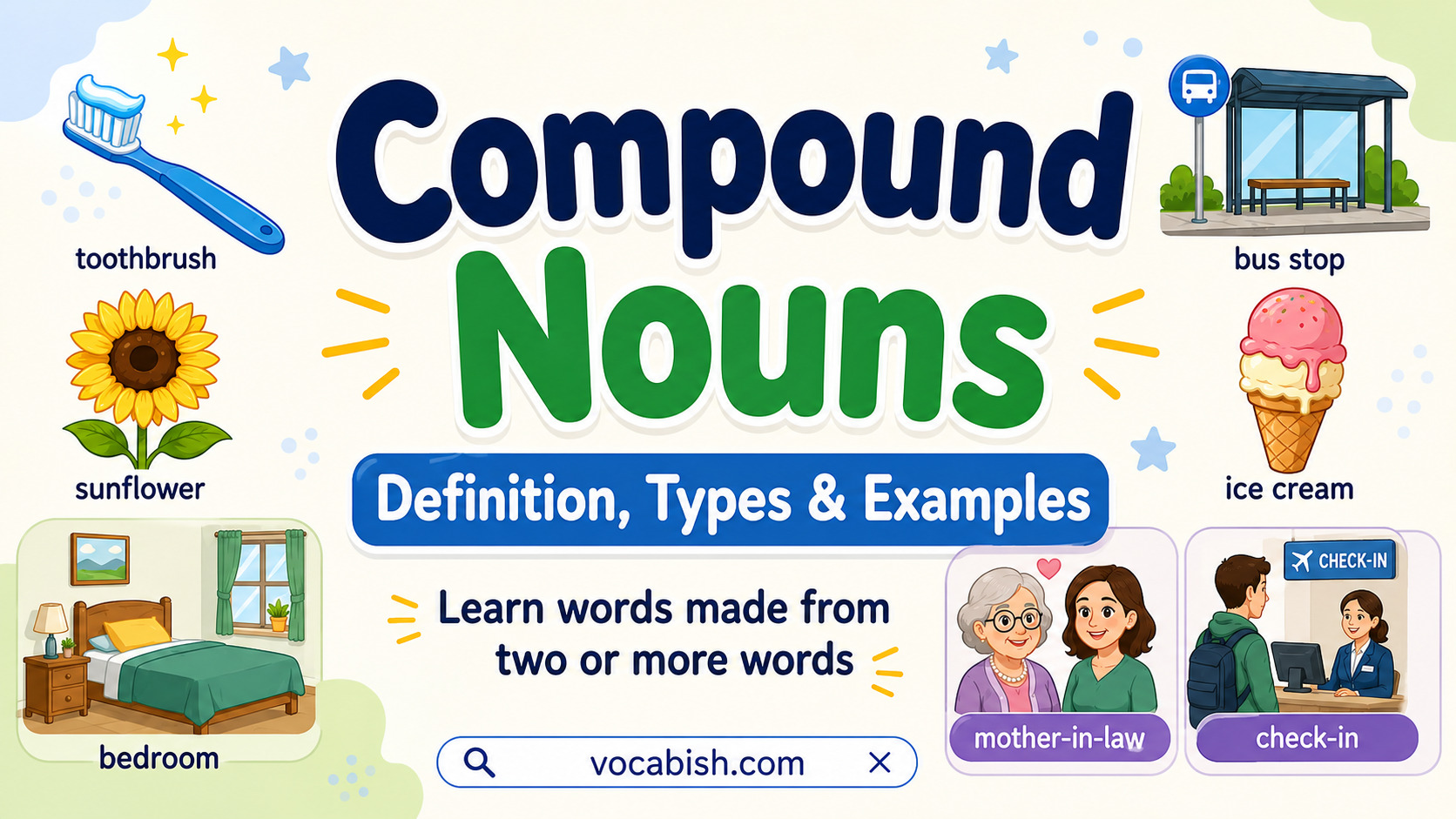

English often joins two or more words to name one person, place, object, activity, or idea. For example, bed and room become bedroom, while bus and stop form bus stop.
These combinations are called compound nouns. Some are written as one word, some remain separate, and others require hyphens. This article explains how compound nouns are formed, spelled, pronounced, pluralized, and used in sentences.
What Is a Compound Noun?
A compound noun is a noun made from two or more words that work together as one naming unit.
- tooth + brush = toothbrush
- coffee + shop = coffee shop
- mother + in + law = mother-in-law
Although a compound noun may contain several words, it normally refers to one person, object, place, or idea.
Compound Noun | Meaning |
|---|---|
classroom | a room used for classes |
football | a particular sport or its ball |
bus driver | a person who drives a bus |
rainfall | rain that falls during a period |
check-in | the process of registering |
Related Resources: 1000 Examples of Compound Words
How Compound Nouns Are Formed
Compound nouns can be created by combining different parts of speech. The meaning of the complete compound is often more specific than the meanings of its individual words.
Noun + Noun
Two nouns commonly join to name a particular person, object, or place.
- toothbrush
- school bus
- coffee shop
- football
- bookcase
In coffee shop, the first noun describes the type of shop.
Adjective + Noun
An adjective and a noun may combine to form an established name.
- blackboard
- greenhouse
- software
- full moon
- high school
Not every adjective followed by a noun is a compound. The combination must represent a recognized unit or category.
Verb + Noun
A verb may appear before a noun to describe an object, person, or function.
- breakwater
- pickpocket
- swimsuit
- cutthroat
- drawbridge
For example, a pickpocket is a person who steals items from someone’s pocket.
Noun + Verb
A noun can combine with a verb to describe an event, process, or result.
- sunrise
- rainfall
- snowfall
- haircut
- heartbeat
The compound sunrise refers to the time when the sun appears above the horizon.
Gerund + Noun
An -ing form can combine with a noun to name an activity, place, or object.
- swimming pool
- washing machine
- driving licence
- dining room
- sleeping bag
The first word usually describes the purpose of the second word. A sleeping bag, for example, is a bag designed for sleeping.
Preposition-Based Compounds
Some compound nouns begin with a preposition or contain one between other words.
- underpass
- overcoat
- bystander
- afterthought
- mother-in-law
- passer-by
Their spelling must usually be learned from a dictionary because no single spelling rule applies to every example.
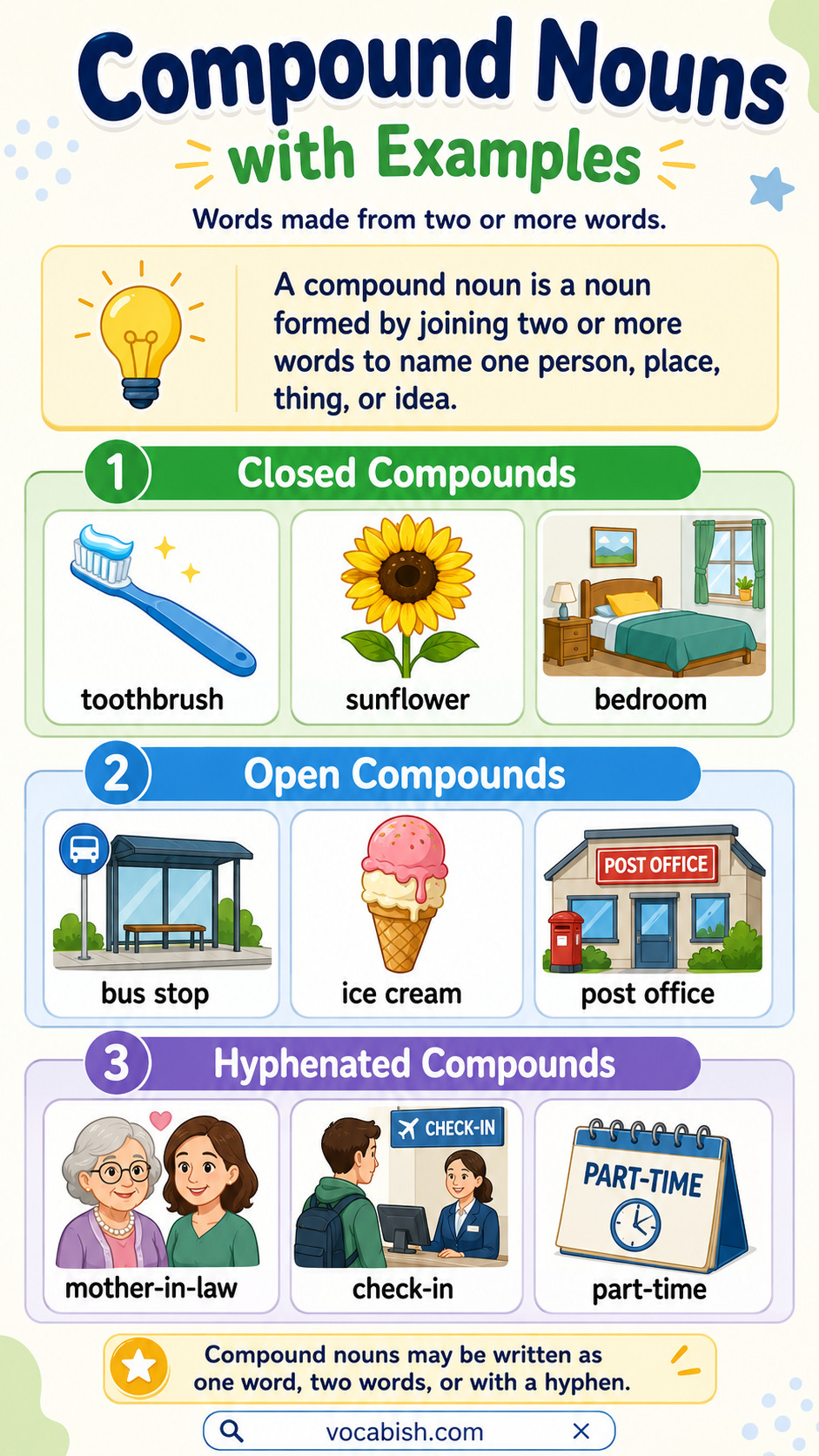
Three Types of Compound Nouns
Compound nouns are classified according to how they are written.
Type | Spelling | Examples |
|---|---|---|
Closed | written as one word | bedroom, football |
Open | written as separate words | bus stop, post office |
Hyphenated | joined with hyphens | mother-in-law, check-in |
Closed Compound Nouns
Closed compound nouns are written as one complete word.
- bedroom
- football
- notebook
- toothpaste
- raincoat
- airport
bedroom
- The children share a bedroom.
football
- We played football after school.
notebook
- She wrote the new vocabulary in her notebook.
Open Compound Nouns
Open compound nouns contain separate words, but those words express one meaning.
- bus stop
- dining room
- post office
- coffee shop
- swimming pool
- traffic light
bus stop
- Several passengers were waiting at the bus stop.
dining room
- Dinner is being served in the dining room.
post office
- I went to the post office to send a parcel.
Hyphenated Compound Nouns
Hyphenated compound nouns are connected with one or more hyphens.
- mother-in-law
- passer-by
- check-in
- editor-in-chief
- runner-up
- dry-cleaning
mother-in-law
- My mother-in-law lives nearby.
passer-by
- A passer-by helped the injured cyclist.
check-in
- Hotel check-in begins at 2 p.m.
Examples of Compound Nouns in Sentences
Compound nouns function like ordinary nouns. They may be subjects, objects, complements, or possessive forms.
- The school bus arrives at seven.
- My toothbrush is in the bathroom.
- We bought two train tickets.
- Her brother works as a software engineer.
- The children played in the swimming pool.
- A passer-by returned my wallet.
- Their washing machine has stopped working.
- Please leave your bag at the check-in desk.
Stress and Pronunciation in Compound Nouns
In many compound nouns, the first word receives the strongest stress.
- GREENhouse
- BLACKbird
- BUS stop
- TOOTHbrush
- FOOTball
This stress can separate a compound noun from an ordinary noun phrase.
Compound Noun | Noun Phrase |
|---|---|
GREENhouse: a glass building for plants | green HOUSE: a house painted green |
BLACKbird: a type of bird | black BIRD: any bird that is black |
DARKroom: a room for developing photographs | dark ROOM: any room without much light |
Stress patterns can vary, especially with open compounds. Listening to reliable recordings helps learners develop natural pronunciation.
How to Form Plural Compound Nouns
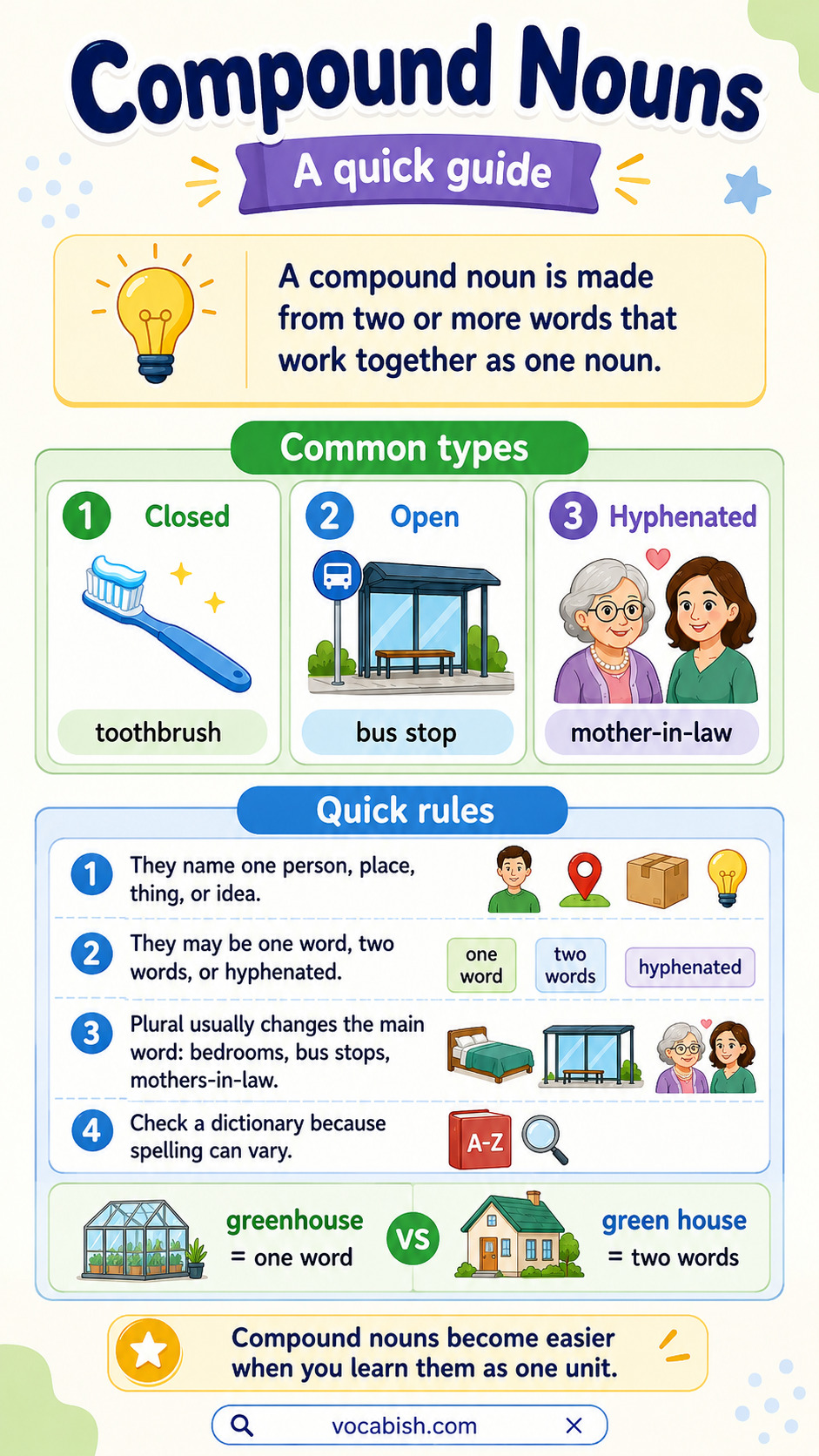
The plural form depends on which word carries the main meaning.
Plurals Added to the Final Word
Most compound nouns form their plurals by changing the final word.
Singular | Plural |
|---|---|
bedroom | bedrooms |
notebook | notebooks |
bus stop | bus stops |
coffee shop | coffee shops |
washing machine | washing machines |
toothbrush | toothbrushes |
- The house has four bedrooms.
- Two bus stops were closed.
- We need new toothbrushes.
Plurals Added to the Main Noun
When the main noun comes before another word or phrase, pluralize the main noun.
Singular | Plural |
|---|---|
mother-in-law | mothers-in-law |
passer-by | passers-by |
editor-in-chief | editors-in-chief |
runner-up | runners-up |
sister-in-law | sisters-in-law |
- Both mothers-in-law attended the wedding.
- Several passers-by saw the incident.
- The magazine has had three editors-in-chief.
Irregular Compound Plurals
Some compounds contain a word with an irregular plural form.
Singular | Plural |
|---|---|
manservant | menservants |
woman doctor | women doctors |
man-of-war | men-of-war |
child actor | child actors |
tooth mark | tooth marks |
Use a dictionary when the correct plural is unclear. Compound plurals do not all follow one fixed pattern.
Compound Nouns vs Noun Phrases
A compound noun names one established concept. A noun phrase gives information about a noun but may not form a recognized naming unit.
Compound Noun | Ordinary Noun Phrase |
|---|---|
greenhouse: a building for plants | green house: a house that is green |
blackboard: a board used for writing | black board: any board that is black |
hot dog: a particular food | hot dog: a dog feeling hot |
darkroom: a photography room | dark room: a room with little light |
school teacher: a recognized occupation | helpful teacher: a teacher described as helpful |
Three clues can help identify a compound noun:
- It names one recognized person, place, object, or idea.
- Its meaning may be more specific than the meanings of its separate words.
- It often places stronger spoken stress on the first element.
Possessive Forms of Compound Nouns
Make the entire compound possessive by adding the apostrophe to the end of the complete expression.
- my brother-in-law’s car
- the post office’s entrance
- the football team’s coach
- the editor-in-chief’s decision
- the coffee shop’s opening hours
For plural compounds, form the plural first and then add the possessive ending.
- the mothers-in-law’s meeting
- the passers-by’s statements
- the editors-in-chief’s conference
Do not place the apostrophe inside the compound:
- Incorrect: mother’s-in-law car
- Correct: mother-in-law’s car
Common Spelling Mistakes
- Joining every compound: Write bus stop, not busstop.
- Separating closed compounds: Write bedroom, not bed room.
- Removing required hyphens: Write mother-in-law, not mother in law.
- Using adjective spelling for a noun: Write check-in as a noun but check in as a verb.
- Guessing from pronunciation: Similar pronunciation does not guarantee similar spelling.
- Ignoring dictionary changes: Some compounds gradually change from open to hyphenated or closed forms.
Incorrect | Correct |
|---|---|
note book | notebook |
postoffice | post office |
passer by | passer-by |
mother in law | mother-in-law |
bed-room | bedroom |
checkin desk | check-in desk |
Compound Noun Practice Exercise
Choose or write the correct compound noun.
- We waited at the busstop / bus stop.
- Her sister-in-law has two children. Write the plural of sister-in-law.
- I left my bag in the bed room / bedroom.
- Write the plural of passer-by.
- The hotel’s check in / check-in begins at three.
- Complete the compound: tooth + brush = ______
- Choose the compound noun: greenhouse / green house for a glass building used to grow plants.
- Write the possessive form of editor-in-chief.
- Complete the sentence: Two ______ stopped to help us. (passer-by)
- Is black bird always the same as blackbird?
Answers and Explanations
- bus stop — It is an open compound noun.
- sisters-in-law — The main noun, sister, becomes plural.
- bedroom — It is a closed compound noun.
- passers-by — The main noun, passer, takes the plural ending.
- check-in — A hyphen is used when it functions as a noun.
- toothbrush — The two nouns form one closed compound.
- greenhouse — It names a special building used for growing plants.
- editor-in-chief’s — Add the possessive ending after the complete compound.
- passers-by — The main noun becomes plural.
- No. A blackbird is a particular bird, while a black bird can be any bird with black colouring.
FAQs About Compound Nouns
A compound noun is a single naming unit made from two or more words, such as toothbrush, bus stop, or mother-in-law.
Yes. Open compound nouns are written as separate words, but together they express one specific idea, such as post office or bus stop.
Check a reliable dictionary because compound spelling is not always predictable. The same expression may be closed, open, or hyphenated by convention.
In many noun-plus-noun compounds, the first word receives stronger stress, as in GREENhouse. Ordinary noun phrases usually stress the second word.
Usually, make the final word plural, as in notebooks. When the main noun appears earlier, pluralize that noun, as in mothers-in-law.
Yes. Add the apostrophe to the end of the complete compound: my brother-in-law’s car, the post office’s entrance, or the editor-in-chief’s decision.
No. Two nouns form a compound only when they work together as one established naming unit, not merely as temporary descriptive words.
Short Summary on Compound Nouns
Compound nouns combine two or more words to name one thing. They may be closed, open, or hyphenated. Their spelling, stress, plural form, and possessive form depend on their structure and established English usage.
You May Also Like