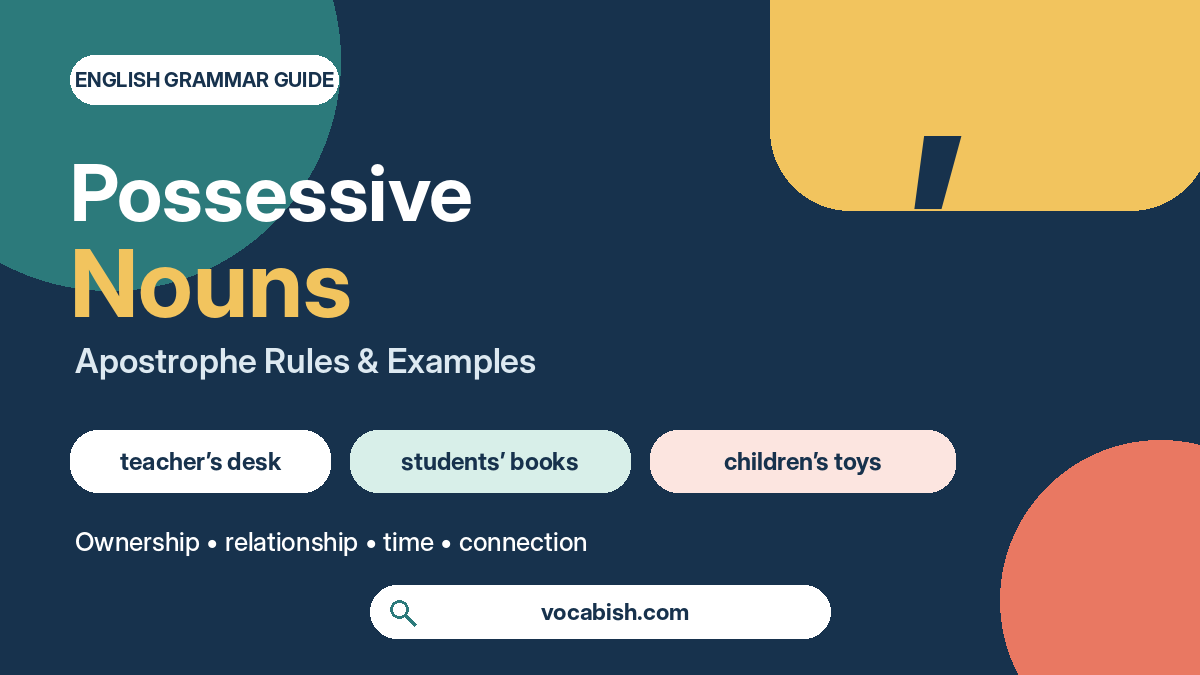

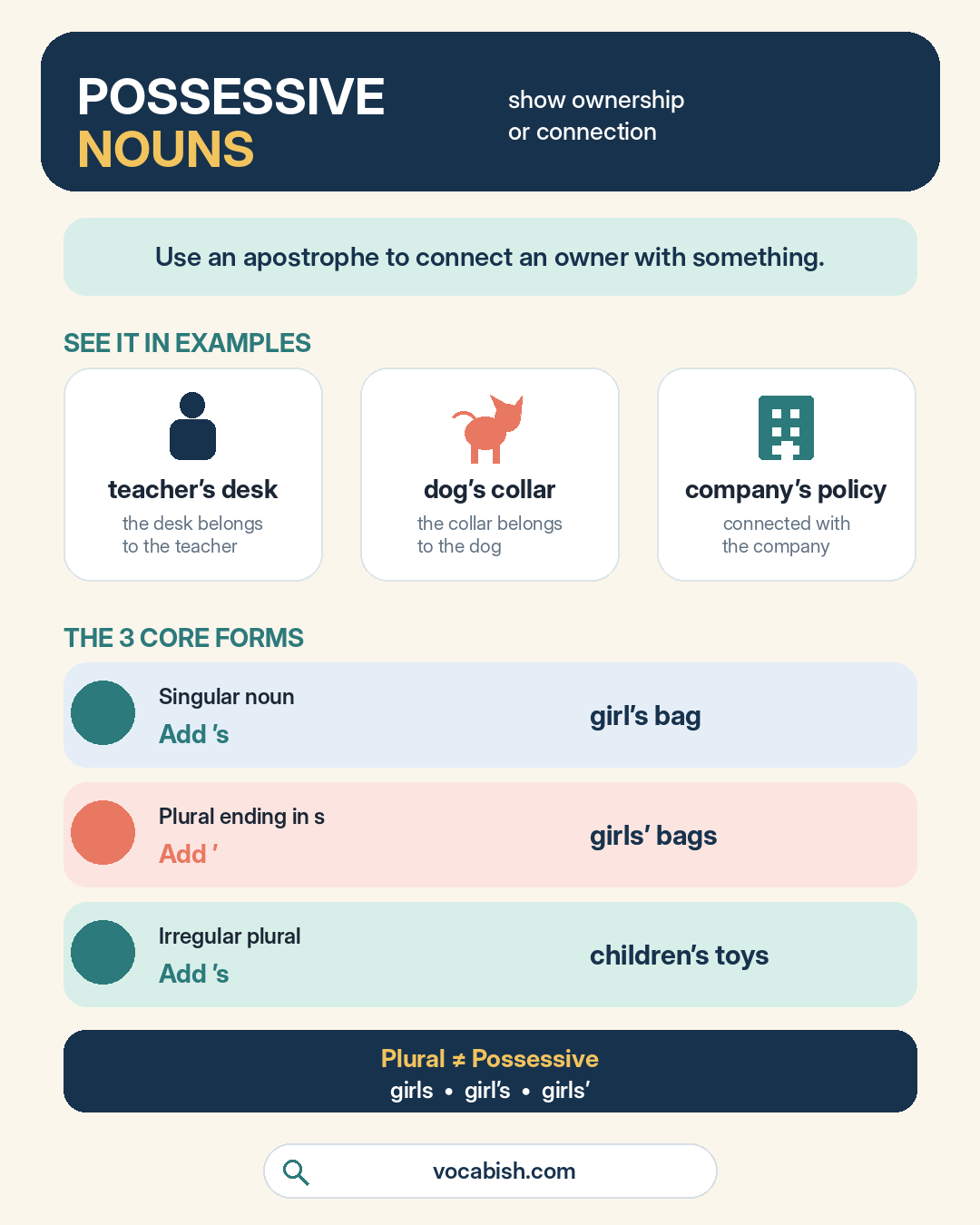
Possessive nouns show that a person, animal, place, or thing owns something or has a close connection with it. In writing, we usually form them by adding an apostrophe, either with or without s.
- the teacher’s desk — the desk belongs to the teacher
- the dog’s collar — the collar belongs to the dog
- the company’s policy — the policy is connected with the company
- yesterday’s meeting — the meeting took place yesterday
The position of the apostrophe depends mainly on whether the noun is singular or plural.
How Possessive Nouns Show Ownership
Possessive nouns do more than show physical ownership. They can also express relationships, parts, qualities, time, or association.
Use | Example | Meaning |
|---|---|---|
Ownership | Sara’s laptop | The laptop belongs to Sara. |
Relationship | Ali’s sister | Ali and the sister are related. |
Part of something | the car’s engine | The engine is part of the car. |
Association | the school’s principal | The principal is connected with the school. |
Time | a week’s holiday | A holiday lasting one week |
Quality or feature | the room’s size | The size of the room |
A possessive noun normally comes before the person or thing it describes:
- the child’s bicycle
- the birds’ nests
- the workers’ uniforms
Do not confuse a possessive noun with a regular plural:
- girls = more than one girl
- girl’s = belonging to one girl
- girls’ = belonging to several girls
Singular Possessive Forms
For most singular nouns, add ’s, even when the noun already ends in s.
Singular Noun | Possessive Form | Example |
|---|---|---|
boy | boy’s | The boy’s shoes are wet. |
teacher | teacher’s | The teacher’s notes were helpful. |
cat | cat’s | The cat’s tail moved slowly. |
bus | bus’s | The bus’s door was damaged. |
class | class’s | The class’s project won first prize. |
Use the same rule with singular irregular nouns:
- the child’s toy
- the woman’s coat
- the person’s opinion
- the mouse’s tail
The noun may represent a person, animal, object, organization, or place:
- Pakistan’s history
- the restaurant’s menu
- the phone’s screen
- the horse’s saddle
Plural Possessive Forms
For a regular plural noun ending in s, add only an apostrophe after the final s.
Plural Noun | Possessive Form | Example |
|---|---|---|
students | students’ | The students’ books are on the table. |
teachers | teachers’ | The teachers’ office is upstairs. |
dogs | dogs’ | The dogs’ bowls need cleaning. |
parents | parents’ | The parents’ meeting begins at six. |
For an irregular plural noun that does not end in s, add ’s.
Irregular Plural | Possessive Form | Example |
|---|---|---|
children | children’s | The children’s playground is closed. |
men | men’s | The men’s changing room is nearby. |
women | women’s | The women’s team won the match. |
people | people’s | People’s opinions can change. |
mice | mice’s | The mice’s hiding place was discovered. |
Compare these forms carefully:
Form | Meaning |
|---|---|
student’s bag | One student owns the bag. |
students’ bags | Several students own the bags. |
child’s room | One child uses the room. |
children’s room | Several children use the room. |
Related Resources: Singular and Plural Nouns
Names Ending in “S”
A singular name ending in s usually takes ’s in modern English.
- James’s bicycle
- Chris’s office
- Charles’s decision
- Jess’s handbag
- Mr. Jones’s car
The extra s is normally pronounced:
- James’s sounds like “James-iz.”
- Chris’s sounds like “Chris-iz.”
Some writing styles use only an apostrophe after certain names, especially historical or classical names:
- Socrates’ ideas
- Jesus’ teachings
Style guides do not always agree, so consistency matters. For everyday ESL writing, adding ’s to a singular name is the clearest rule:
- James’s phone
- Lucas’s room
- Thomas’s appointment
For plural family names ending in s, add only an apostrophe:
- the Smiths’ house
- the Joneses’ garden
- the Williamses’ car
Joint and Separate Ownership
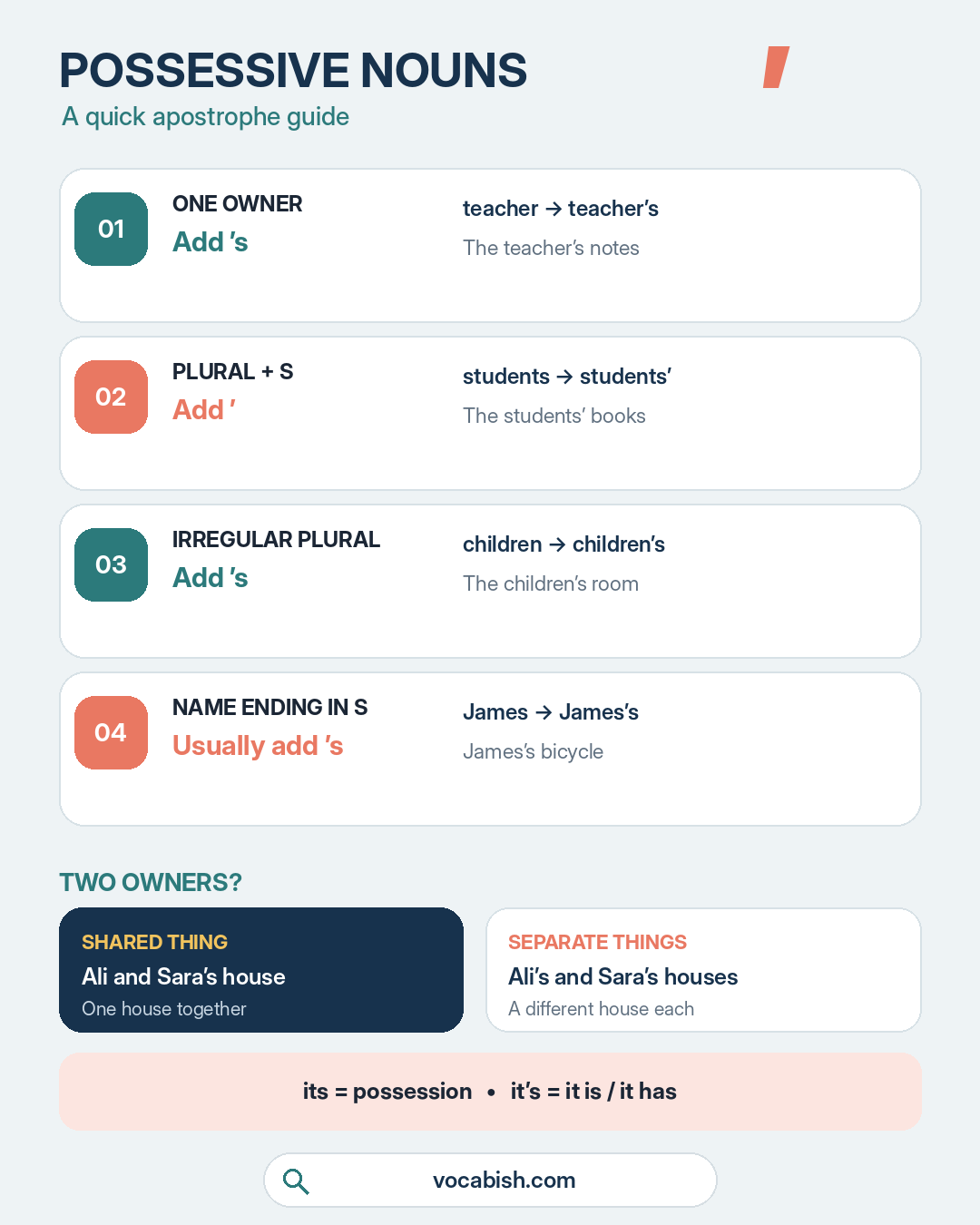
When two or more people share one thing, add the possessive ending only to the final name.
- Amina and Hira’s apartment
They share one apartment. - Jack and Emma’s business
They own one business together. - My mother and father’s room
They share the same room.
When each person owns a different thing, make every name possessive.
- Amina’s and Hira’s apartments
Each person has a separate apartment. - Jack’s and Emma’s businesses
Each person owns a different business. - The manager’s and assistant’s offices
They have separate offices.
Ownership Type | Correct Form | Meaning |
|---|---|---|
Joint ownership | Bilal and Ahmed’s car | They share one car. |
Separate ownership | Bilal’s and Ahmed’s cars | Each owns a car. |
Joint responsibility | Sara and Mia’s project | They worked on one project. |
Separate work | Sara’s and Mia’s projects | Each completed a different project. |
Apostrophe Mistakes
- Do not use an apostrophe to make a regular plural.
Incorrect: Three book’s are missing.
Correct: Three books are missing. - Place the apostrophe according to the owner.
Incorrect: The teachers room is locked.
Correct: The teachers’ room is locked. - Do not confuse possessive “its” with “it’s.”
Its shows possession: The bird damaged its wing.
It’s means “it is” or “it has”: It’s raining. - Do not omit the second possessive ending for separate ownership.
Incorrect: Adam and Noah’s bicycles were different.
Correct: Adam’s and Noah’s bicycles were different. - Do not put the apostrophe before the plural “s.”
Incorrect: The player’s uniforms were washed.
Correct: The players’ uniforms were washed.
Sentence Correction Practice
Correct the possessive noun in each sentence.
- The girls bag is under the chair.
- My parents car is being repaired.
- The childrens toys are in the box.
- James bicycle has a flat tire.
- The two dogs collars are red.
- Maria and Anas laptops are different.
- The companys website was updated.
- Its door is open, but its empty inside.
Answers
- The girl’s bag is under the chair.
- My parents’ car is being repaired.
- The children’s toys are in the box.
- James’s bicycle has a flat tire.
- The two dogs’ collars are red.
- Maria’s and Ana’s laptops are different.
- The company’s website was updated.
- Its door is open, but it’s empty inside.
FAQs About Possessive Nouns
A possessive noun shows ownership, relationship, connection, or association between a noun and another person, animal, place, object, or idea.
Add an apostrophe followed by “s” to most singular nouns, including singular nouns that already end with the letter “s.”
When a plural noun already ends in “s,” place an apostrophe after the final “s” without adding another letter.
Irregular plural nouns that do not end in “s” become possessive by adding an apostrophe and “s,” as in children’s clothes.
Both forms appear in published writing, but “James’s” follows the common modern rule for making a singular name ending in “s” possessive.
“Its” is a possessive determiner showing ownership, while “it’s” is a shortened form of either “it is” or “it has.”
For shared ownership, add the possessive ending to the final name; for separate ownership, make each person’s name possessive.
Summary on Possessive Nouns
Possessive nouns show ownership or connection. Add ’s to singular nouns and irregular plurals, but add only an apostrophe to regular plurals ending in s. With two owners, the apostrophe also shows whether they share something or own separate things.
You May Also Like