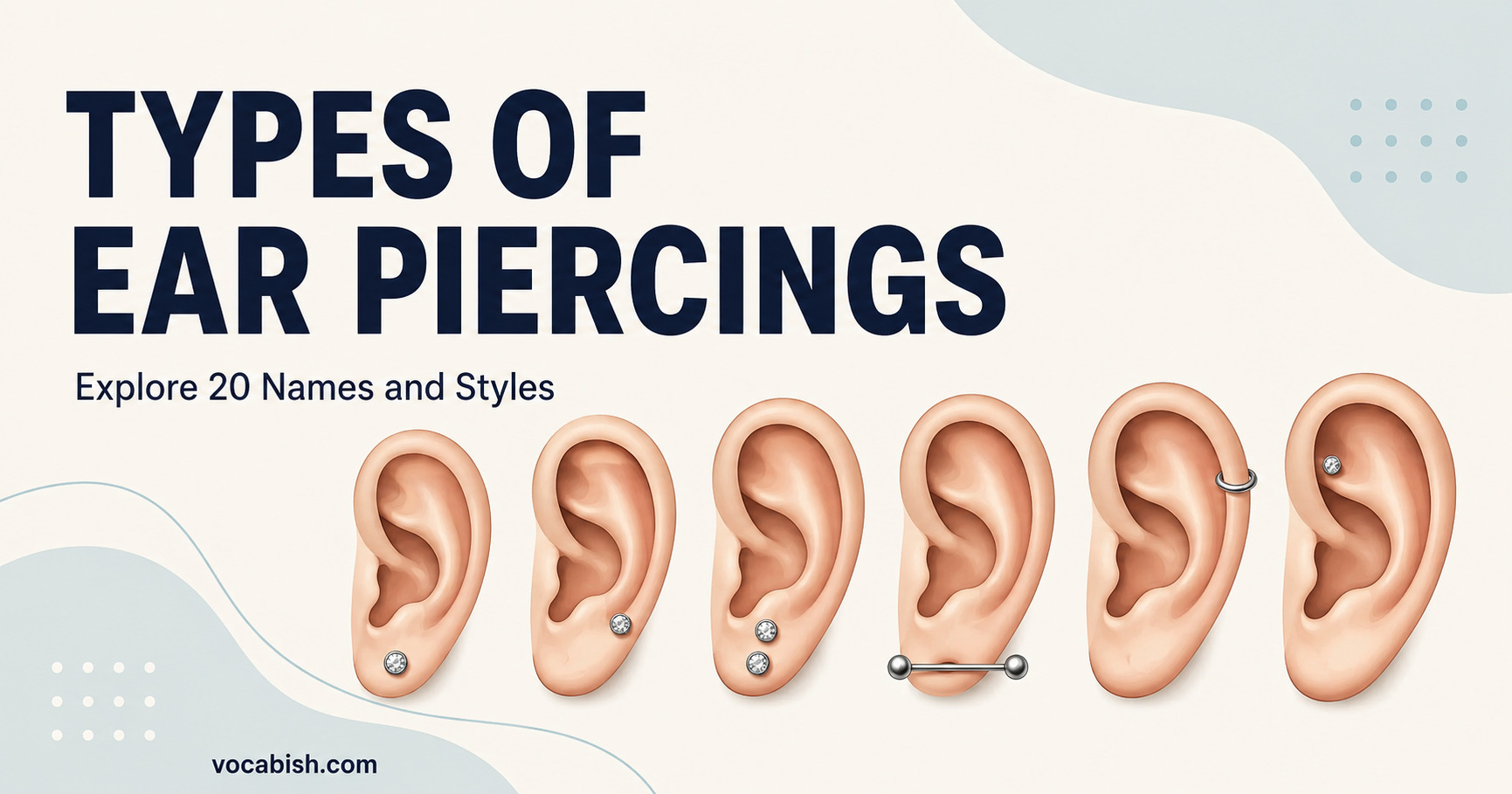

Ear piercings can be placed through the soft earlobe or different parts of the outer-ear cartilage. Common types include lobe, helix, conch, tragus, daith, rook, snug, industrial and orbital piercings.
In this blog post, you will learn 20 widely recognised ear-piercing names, where each one sits and how similar placements differ. The types are organised into lobe, outer-cartilage, inner-cartilage and connected-piercing categories.
Definition and Scope
An ear piercing is an opening made through the earlobe or cartilage of the external ear so that jewellery can be worn.
In this context, “types” may refer to anatomical placements, such as the tragus or conch, or jewellery configurations involving multiple holes, such as industrial and orbital piercings. The visible external ear, medically called the auricle or pinna, contains structures including the lobule, helix, antihelix, concha and tragus.
There is no official medical list establishing one fixed number of ear-piercing types. Names come mainly from professional piercing practice, and totals vary because some sources count subtypes, paired piercings and styling arrangements separately. This article covers 20 commonly used terms, including several related conch and helix placements.
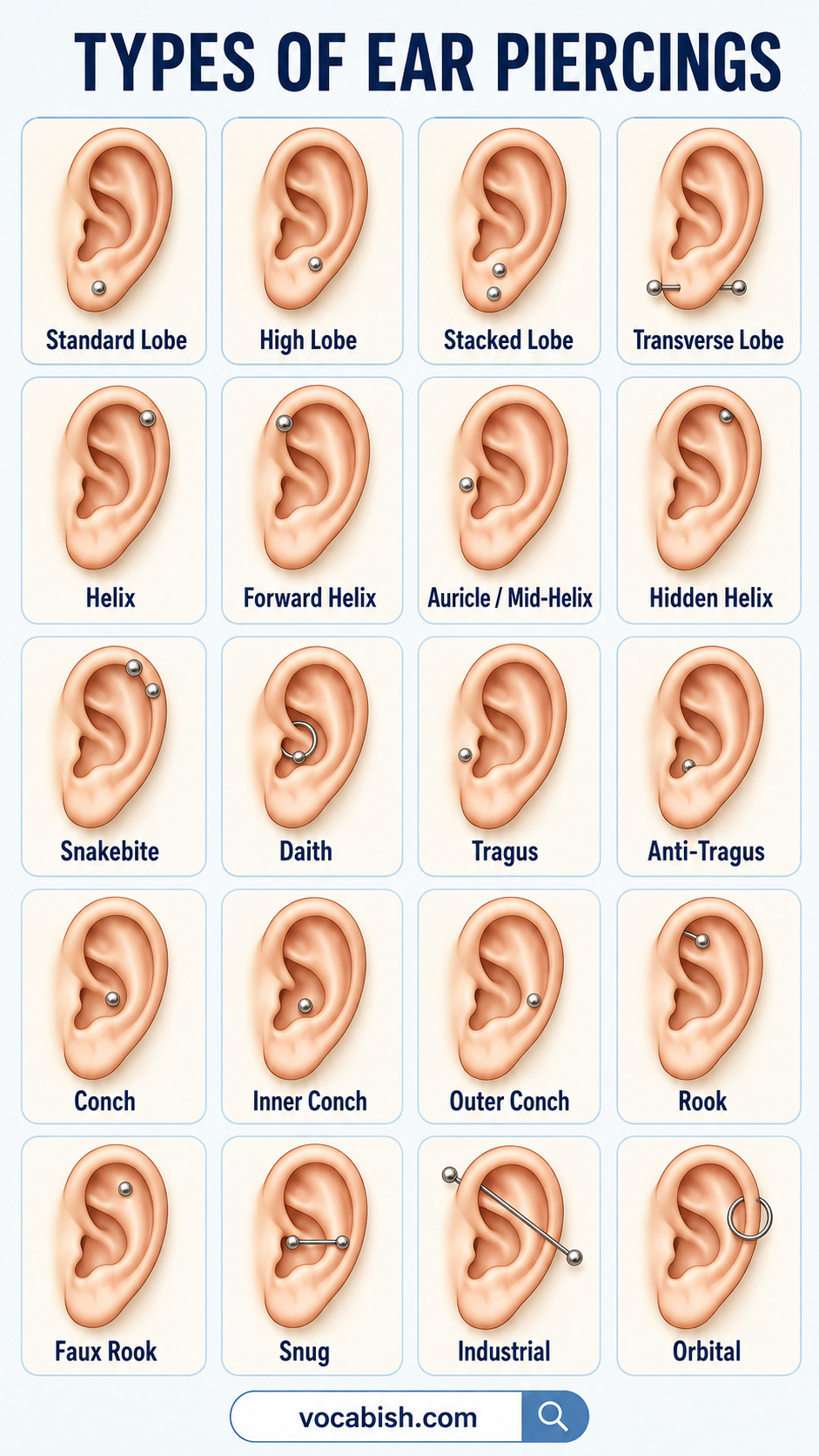
Complete List of Types of Ear Piercings
- Standard Lobe
- High Lobe
- Stacked Lobe
- Transverse Lobe
- Helix
- Forward Helix
- Auricle/Mid-Helix
- Hidden Helix
- Snakebite
- Daith
- Tragus
- Anti-Tragus
- Conch
- Inner Conch
- Outer Conch
- Rook
- Faux Rook
- Snug
- Industrial
- Orbital
Types of Ear Piercings by Main Category
The categories below distinguish soft-tissue piercings from cartilage placements and multi-hole configurations. Some terms overlap because piercing names may describe anatomy, jewellery orientation or the visual arrangement of several piercings.
Lobe Piercings
Lobe piercings pass through the soft, flexible lower portion of the ear rather than its main cartilage framework. High, stacked and transverse versions change the position or direction of the opening.
- Standard Lobe: Passes through the soft lower earlobe and commonly holds studs or hoops.
- High Lobe: Sits above the standard lobe piercing within soft, non-cartilaginous tissue.
- Stacked Lobe: Places two or more nearby lobe piercings in a layered arrangement.
- Transverse Lobe: Runs horizontally through the earlobe, showing both jewellery ends on one side.
Outer-Cartilage Piercings
These piercings occupy the ear’s outer rim or nearby upper cartilage. The exact position depends on the shape and prominence of the wearer’s helix and surrounding folds.
- Helix: Pierces the upper outer cartilage rim and suits studs or hoops.
- Forward Helix: Sits on the front upper rim where cartilage meets the head.
- Auricle/Mid-Helix: Occupies the outer cartilage midway between the upper helix and lobe.
- Hidden Helix: Hides beneath the upper rim, allowing decorative jewellery to hang downward.
- Snakebite: Uses two closely spaced piercings, usually positioned along the helix.
Inner-Cartilage Piercings
Inner-cartilage placements use the folds, projections and bowl-shaped areas around the ear canal. Several are anatomy-dependent because the necessary ridge or cartilage prominence may be shallow or absent.
- Daith: Passes through the innermost cartilage fold directly above the ear canal.
- Tragus: Pierces the small cartilage projection immediately in front of the canal.
- Anti-Tragus: Sits on the cartilage prominence opposite the tragus, above the lobe.
- Conch: Describes piercing within the central bowl-shaped cartilage of the outer ear.
- Inner Conch: Occupies the deeper conchal bowl, positioned closer to the ear canal.
- Outer Conch: Sits farther outward within the conchal area, nearer the ear rim.
- Rook: Pierces the raised antihelix fold above the daith in inner cartilage.
- Faux Rook: Mimics rook placement through flat cartilage rather than the raised fold.
- Snug: Runs horizontally through the inner antihelix ridge above the anti-tragus.
Connected Piercings
Industrial and orbital piercings each use two openings, but they connect those openings with different jewellery. Their angles and spacing must suit the wearer’s anatomy.
- Industrial: Connects two cartilage piercings with one straight barbell across the ear.
- Orbital: Links two nearby holes using one ring that circles the tissue.
Important Differences Between Similar Ear Piercings
Piercings | Main Location | Key Difference | Typical Configuration |
|---|---|---|---|
Helix and forward helix | Outer cartilage rim | Helix sits along the outer edge; forward helix sits near the head | Single or multiple openings |
Helix and mid-helix | Outer rim | Mid-helix sits lower, roughly halfway up the ear | Stud or hoop |
Conch and helix | Central bowl versus outer rim | Conch occupies the ear bowl; helix follows the outer edge | Stud or suitable hoop |
Daith and rook | Inner cartilage folds | Daith sits nearer the canal; rook occupies the higher antihelix fold | Usually curved jewellery or rings |
Rook and faux rook | Inner fold versus flat cartilage | A true rook passes through a ridge; a faux rook passes backwards | Different piercing directions |
Snug and anti-tragus | Antihelix ridge versus cartilage projection | Snug crosses a ridge; anti-tragus pierces the lower prominence | Usually compact jewellery |
Industrial and orbital | Two connected holes | Industrial uses a barbell; orbital uses one circular ring | Multi-hole configuration |
The names describe where the piercing passes through tissue, not simply where the visible jewellery appears. A professional assessment is therefore more reliable than choosing from a photograph alone.
How to Choose the Right Ear Piercing
Consider these practical factors before selecting a placement:
- Ear anatomy: Ask an experienced piercer whether the required cartilage fold, space and angle are suitable.
- Daily habits: Headphones, glasses, helmets, phones and hair may press against particular placements.
- Sleeping position: Avoid choosing the side you regularly sleep on when possible.
- Jewellery preference: Some placements suit studs, while others require rings or curved barbells.
- Healing commitment: Cartilage piercings generally demand more protection from pressure and friction than lobe piercings.
- Existing piercings: Check spacing carefully so jewellery does not touch, crowd or pull neighbouring holes.
- Professional standards: Choose an experienced piercer working in a clean, appropriately licensed studio.
- Initial jewellery: Size, shape, finish and material should match the placement and allow for normal swelling.
Basic Ear-Piercing Aftercare
Aftercare recommendations can vary by region and individual circumstances, so follow the instructions given by a qualified piercer.
The Association of Professional Piercers recommends washing your hands before touching the area, using sterile wound-wash saline containing 0.9% sodium chloride and avoiding unnecessary jewellery rotation. It also advises against alcohol, hydrogen peroxide, iodine, harsh antibacterial products and excessive cleaning.
Keep pressure, friction, headphones and unclean bedding away from a healing cartilage piercing. Seek medical advice for increasing pain, heat, swelling, pus, spreading redness or feeling generally unwell. Untreated cartilage infection can become serious.
Ear-Piercing Terms Explained
- Auricle and mid-helix are not identical: Anatomically, the auricle means the entire visible outer ear. Piercers may use “auricle” informally for a mid-helix placement.
- Conch can mean an area or piercing: The concha is the ear’s bowl-shaped region. Inner and outer conch piercings identify more precise positions.
- A conch hoop is not always an orbital: A conch hoop passes through one hole, while an orbital ring connects two separate piercing holes.
- Snakebite describes two nearby piercings: It usually refers to a closely spaced pair, often positioned along the helix.
- High lobe and stacked lobe may overlap: A high lobe describes position, while a stacked lobe describes multiple closely arranged piercings.
- Daith piercings do not treat migraines: Reliable medical evidence does not support daith piercing as a proven migraine treatment.
Summary of the Main Ear-Piercing Categories
Category | Main Tissue or Area | Common Examples | Best Known For |
|---|---|---|---|
Lobe piercings | Soft lower ear tissue | Standard, high, stacked, transverse | Flexible positioning and varied jewellery |
Outer-cartilage piercings | Helix and outer upper ear | Helix, forward helix, mid-helix, hidden helix | Decorating the ear’s outer border |
Inner-cartilage piercings | Folds and bowl around the canal | Daith, rook, conch, tragus, snug | Distinct placements within visible ear anatomy |
Connected piercings | Two coordinated openings | Industrial, orbital | One piece of jewellery connecting two holes |
Arrangement terms | Multiple nearby piercings | Snakebite, stacked lobe | Creating a planned visual grouping |
Imitation placements | Alternative anatomical route | Faux rook | Reproducing a look without piercing the original fold |
Frequently Asked Questions
There is no universally official number of ear-piercing types. The total changes according to whether a source counts anatomical placements, subtypes, multiple-hole arrangements and newer styling terms separately. This article includes 20 commonly recognised names rather than claiming a fixed worldwide total.
The main practical categories are lobe, outer-cartilage, inner-cartilage and connected piercings. Lobe piercings pass through softer tissue, while cartilage piercings use the ear’s rim, bowl, folds or projections. Industrial and orbital piercings connect two separate openings.
The standard lobe is the most familiar ear-piercing placement. It passes through the soft lower earlobe and can hold many stud, hoop and drop-earring designs. It is also structurally different from piercings passing through firm cartilage.
Lobe piercings pass through soft tissue, whereas cartilage piercings pass through the firmer framework shaping the upper and central ear. Cartilage placements require particular attention to pressure, irritation and infection because complications involving ear cartilage may be more serious.
A helix piercing is one type of cartilage piercing. It sits along the outer cartilage rim, while other cartilage piercings include the conch, tragus, daith, rook, snug and anti-tragus. Therefore, every helix is a cartilage piercing, but not every cartilage piercing is a helix.
A rook sits in the raised antihelix fold higher inside the ear. A daith passes through an inner fold closer to the entrance of the ear canal. Because ear folds differ between individuals, one placement may be suitable even when the other is not.
Seek medical advice promptly if the area becomes increasingly hot, painful, swollen or produces pus, especially when cartilage is involved. Do not remove the jewellery unless a healthcare professional advises you to do so, because premature removal may complicate drainage or allow the opening to close.
Key Takeaways
- There is no official worldwide total for types of ear piercings.
- This article covers 20 common anatomical placements and configurations.
- Lobe piercings use soft tissue, while most other placements use cartilage.
- Conch, helix and lobe names may include narrower positional subtypes.
- Industrial and orbital piercings connect two holes with different jewellery.
- Anatomy, lifestyle, jewellery quality and aftercare should influence selection.
Conclusion
Understanding the main types of ear piercings makes it easier to identify placements, compare similar names and discuss suitable options with a professional piercer. Lobe styles occupy soft tissue, while helix, conch, tragus, daith, rook and snug piercings use different areas of the ear’s cartilage. Industrial and orbital designs differ because they connect two openings with a barbell or ring.
Piercing terminology is largely professional and informal rather than an official medical classification, so lists may contain different totals. Choose according to your anatomy, daily habits and willingness to protect the area during healing. Safe technique, appropriate initial jewellery and responsible aftercare matter more than following a particular trend.
You May Also Like