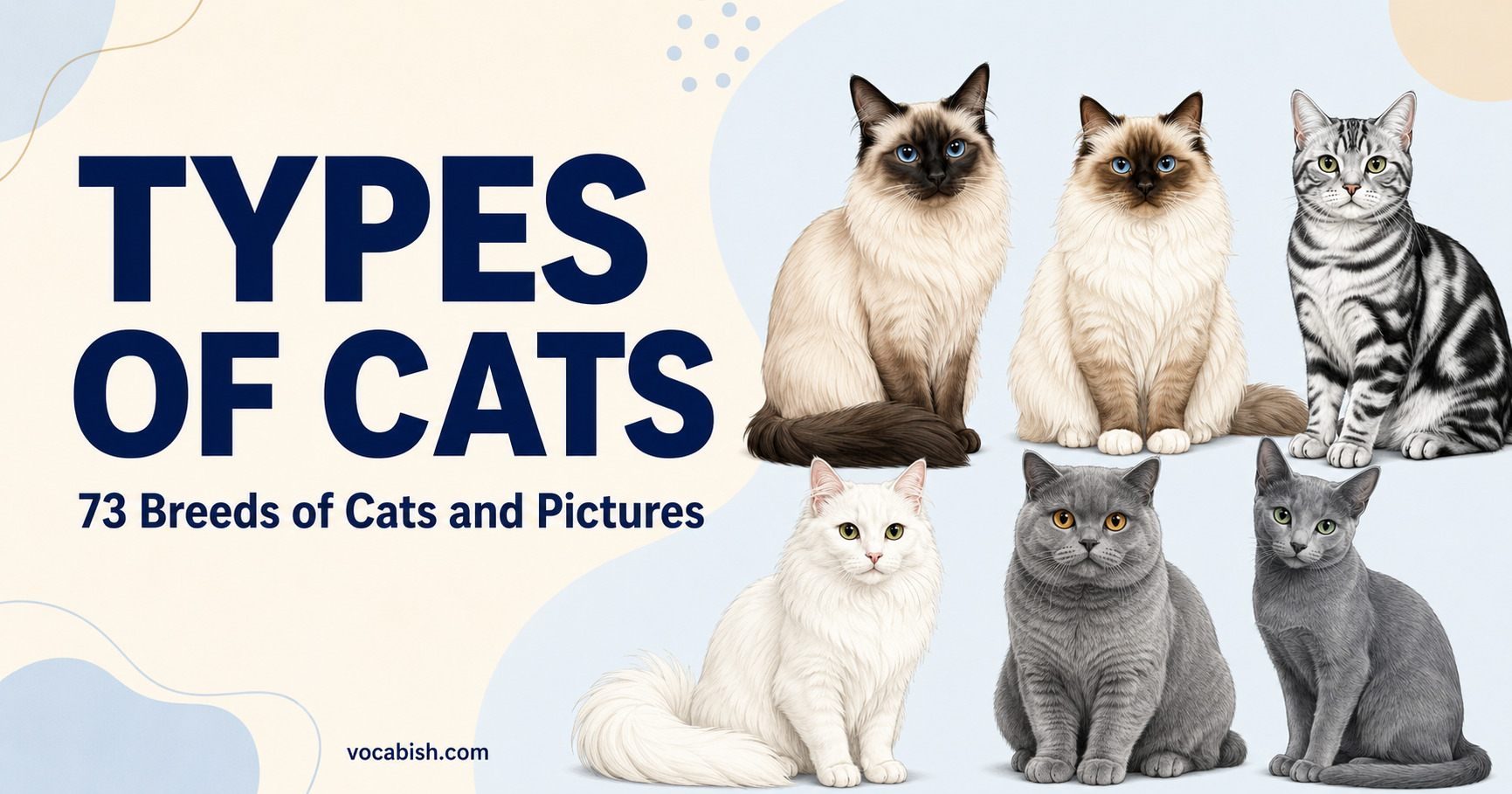

Cats come in many recognised breeds, including Persian, Siamese, Maine Coon, Bengal, Ragdoll, British Shorthair, and Sphynx. There are 73 cat breed groups, although totals differ between registration organisations.
In this blog post, you will learn the main types of cats, their defining physical features, coat types, body structures, and common personality tendencies. The breeds are organised into practical groups to help you understand, recognise, compare, and choose between them.
What Are the Different Types of Cats?
Types of cats are recognised breeds and breed variants belonging to the domestic cat species, scientifically called Felis catus. A breed is a population developed or maintained according to an established ancestry and breed standard. Coat colours such as tabby, calico, tortoiseshell, and tuxedo are patterns rather than separate breeds.
Complete List of 73 Types of Cats
The following overview groups the breeds by their most noticeable physical or ancestral characteristics.
Longhaired and Semi-Longhaired Cats
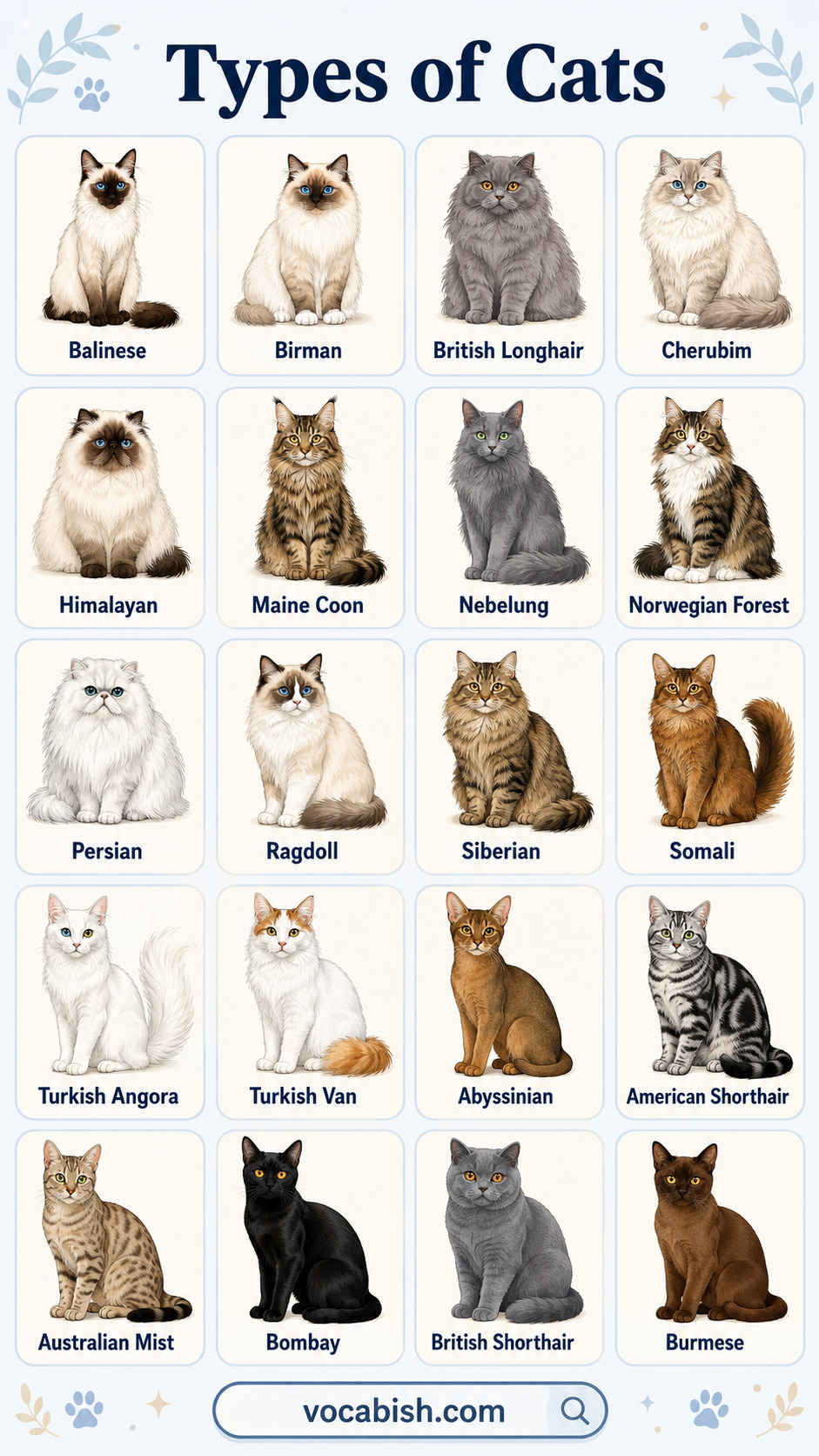
Balinese | Birman | British Longhair |
Cherubim | Himalayan | Maine Coon |
Nebelung | Norwegian Forest | Persian |
Ragdoll | Siberian | Somali |
Turkish Angora | Turkish Van |
Classic and Natural Shorthair Cats
Abyssinian | American Shorthair | Australian Mist |
Bombay | British Shorthair | Burmese |
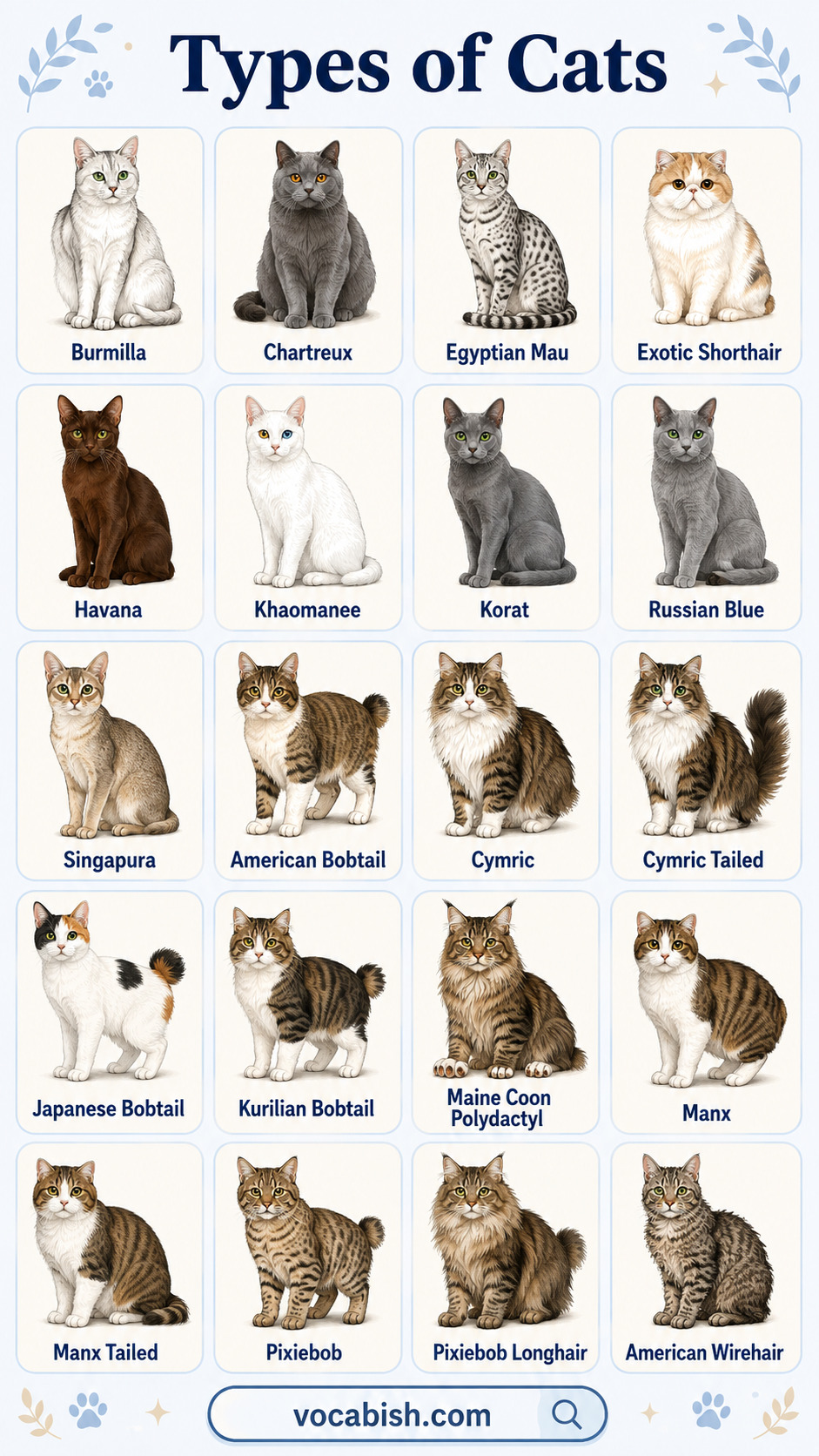
Burmilla | Chartreux | Egyptian Mau |
Exotic Shorthair | Havana | Khaomanee |
Korat | Russian Blue | Singapura |
Bobtail, Tailless, and Polydactyl Cats
American Bobtail | Cymric | Cymric Tailed |
Japanese Bobtail | Kurilian Bobtail | Maine Coon Polydactyl |
Manx | Manx Tailed | Pixiebob |
Pixiebob Longhair |
Rex, Wirehaired, and Unusual-Coated Cats
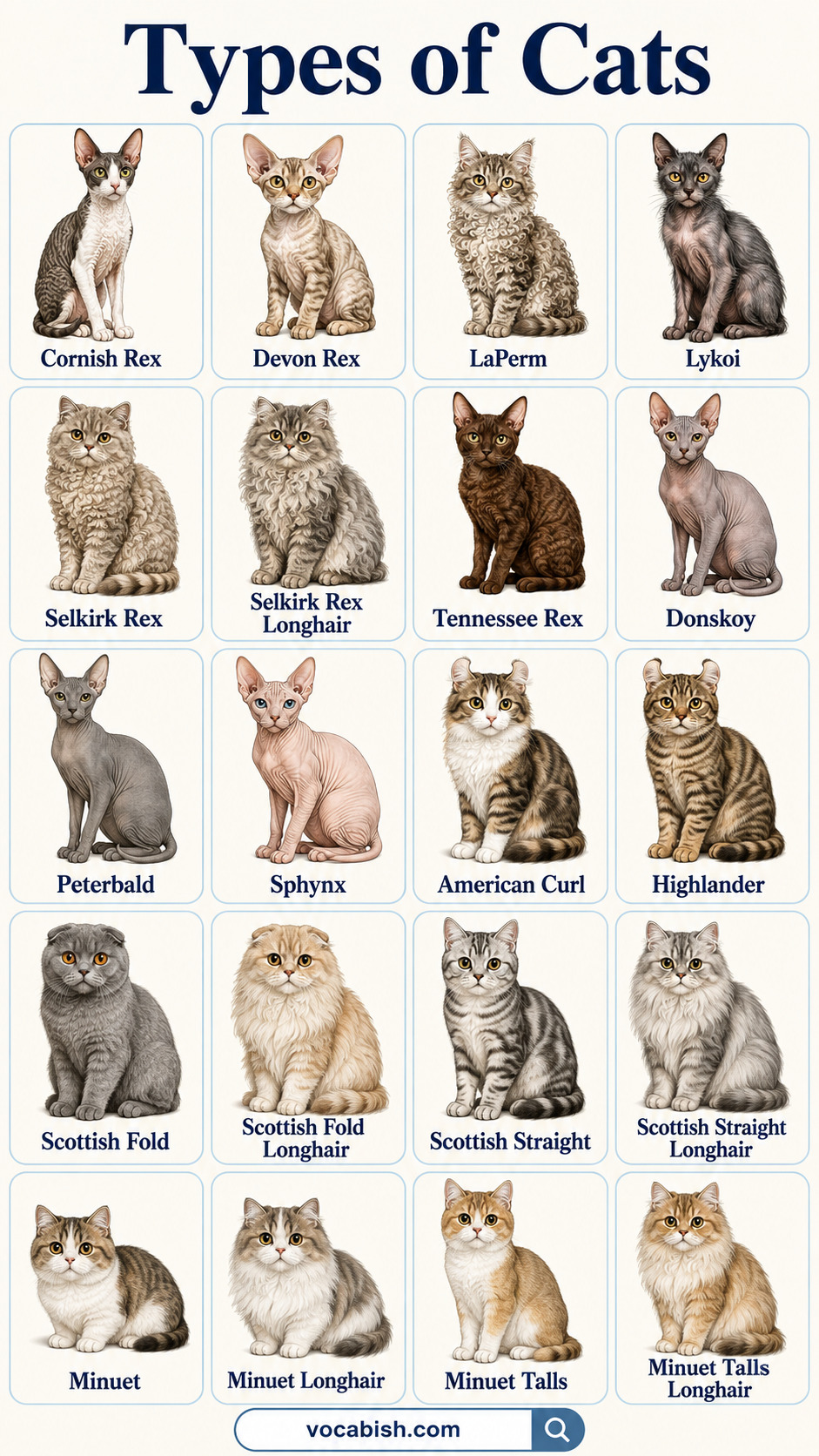
American Wirehair | Cornish Rex | Devon Rex |
LaPerm | Lykoi | Selkirk Rex |
Selkirk Rex Longhair | Tennessee Rex |
Hairless and Sparse-Coated Cats
| Donskoy | Peterbald | Sphynx |
Curled, Folded, and Specialised-Ear Cats
American Curl | Highlander | Scottish Fold |
Scottish Fold Longhair | Scottish Straight | Scottish Straight Longhair |
Short-Legged and Related Cat Breeds
Minuet | Minuet Longhair | Minuet Talls |
Minuet Talls Longhair | Munchkin | Munchkin Longhair |
Spotted and Wild-Looking Cats
Bengal | Chausie | Ocicat |
Savannah | Toyger |
Oriental, Pointed, and Asian-Related Cats
Oriental Longhair | Oriental Shorthair | Siamese |
Snowshoe | Thai | Tonkinese |
Main Cat Breed Categories
The categories below make a large breed list easier to understand. They are based mainly on coat length, tail structure, ears, body shape, ancestry, and visually distinctive features.
Category | Main Shared Feature | Number Included |
|---|---|---|
Longhaired and semi-longhaired | Medium-length or long coats | 14 |
Classic and natural shorthairs | Conventional short coats and body structures | 15 |
Bobtail, tailless, and polydactyl | Tail or toe differences | 10 |
Rex, wirehaired, and unusual-coated | Curled, crimped, roan, or wire coats | 8 |
Hairless and sparse-coated | Little hair or variable hairlessness | 3 |
Curled, folded, and specialised-ear | Distinctive ear shape or position | 6 |
Short-legged and related | Short or variant leg proportions | 6 |
Spotted and wild-looking | Spots, stripes, or wild-cat appearance | 5 |
Oriental, pointed, and Asian-related | Colourpoint markings or Oriental ancestry | 6 |
These groups can overlap. For example, the Balinese is both longhaired and closely related to the Siamese, while the Bengal is shorthaired but is better recognised by its spotted or marbled coat.
Longhaired and Semi-Longhaired Types of Cats
These breeds have medium-length or long coats. Grooming requirements depend on coat density, undercoat, texture, and the cat’s ability to maintain its fur.
- Balinese: Longhaired Siamese-related breed with vivid blue eyes and colourpoint markings.
- Birman: Silky colourpoint cat distinguished by white gloves on every paw.
- British Longhair: Round-bodied cat with a dense, plush coat and calm expression.
- Cherubim: Large, gentle longhaired breed developed from established Ragdoll-related breeding lines.
- Himalayan: Longhaired Persian-type cat displaying vivid blue eyes and colourpoint markings.
- Maine Coon: Large, rectangular cat with a shaggy coat and tufted ears.
- Nebelung: Slender blue longhair with green eyes and a soft double coat.
- Norwegian Forest: Strong climbing cat with a weather-resistant coat and triangular head.
- Persian: Longhaired, round-headed breed with a dense coat requiring regular grooming.
- Ragdoll: Large blue-eyed colourpoint cat known for a relaxed, affectionate nature.
- Siberian: Powerful Russian forest cat with a thick, water-resistant triple coat.
- Somali: Longhaired Abyssinian relative with a ticked coat and bushy tail.
- Turkish Angora: Fine-boned, silky-coated Turkish breed with a plumed tail and elegance.
- Turkish Van: Semi-longhaired cat recognised by distinctive coloured head and tail markings.
Classic and Natural Shorthair Types of Cats
These cats generally have conventional body structures and short coats. Some developed naturally in particular regions, while others resulted from selective breeding.
- Abyssinian: Slender, active cat recognised by its warm, evenly ticked short coat.
- American Shorthair: Sturdy, adaptable shorthair with balanced proportions and many accepted colours.
- Australian Mist: Spotted or marbled Australian breed with a gentle, people-focused temperament.
- Bombay: Muscular black shorthair with copper eyes and a glossy coat.
- British Shorthair: Round-faced, sturdy cat known for its dense, plush short coat.
- Burmese: Compact, muscular cat with a close coat and sociable behaviour.
- Burmilla: Silver-shaded breed combining a muscular body with expressive green eyes.
- Chartreux: Robust French breed with blue-grey fur, copper eyes, and quiet manners.
- Egyptian Mau: Athletic, naturally spotted shorthair with green eyes and graceful movement.
- Exotic Shorthair: Persian-type cat with a dense short coat and rounded face.
- Havana: Medium-sized brown cat with green eyes and a distinctive muzzle.
- Khaomanee: White Thai breed often recognised by blue, gold, or odd eyes.
- Korat: Silver-blue Thai cat with a heart-shaped face and luminous green eyes.
- Russian Blue: Elegant blue-grey cat with green eyes and a dense double coat.
- Singapura: Small ticked cat with large eyes, rounded ears, and lively curiosity.
Bobtail, Tailless, and Polydactyl Types of Cats
These breeds are identified by shortened tails, absent tails, different tail lengths, or additional toes. Tail and toe structures vary considerably between individuals.
- American Bobtail: Muscular cat with a naturally shortened tail and adaptable personality.
- Cymric: Longhaired Manx-related cat, usually tailless, with a compact rounded body.
- Cymric Tailed: Longhaired Manx-related variety retaining a naturally longer, clearly visible tail.
- Japanese Bobtail: Slender cat with a pompom-like tail and expressive upright posture.
- Kurilian Bobtail: Powerful island breed with a distinctive short, kinked pompom tail.
- Maine Coon Polydactyl: Maine Coon variety carrying extra toes on one or more paws.
- Manx: Rounded island breed ranging from tailless to partially tailed forms.
- Manx Tailed: Manx variety retaining a longer tail while preserving rounded structure.
- Pixiebob: Muscular, spotted breed with a short tail and wild-looking appearance.
- Pixiebob Longhair: Longhaired Pixiebob variety with spotting, sturdy build, and bobbed tail.
Rex, Wirehaired, and Unusual-Coated Types
Rex breeds usually have curled or waved coats. Other cats in this category have crimped, wirelike, roan, or partly sparse fur.
- American Wirehair: American shorthair mutation distinguished by uniquely springy, crimped, resilient fur.
- Cornish Rex: Fine-boned cat with a soft, wavy coat lacking guard hairs.
- Devon Rex: Large-eared breed with a short, rippled coat and elfin expression.
- LaPerm: Curly-coated breed whose loose waves may occur in varying lengths.
- Lykoi: Partly hairless breed with a roan coat and wolf-like appearance.
- Selkirk Rex: Broad-bodied cat carrying a plush, naturally curly and dense short coat.
- Selkirk Rex Longhair: Longhaired rex with loose curls, dense fur, and sturdy proportions.
- Tennessee Rex: Curly-coated breed noted for satin-like sheen and rich coat texture.
Hairless and Sparse-Coated Types of Cats
Hairless cats may have fine down, patches of hair, or changing coat coverage. They still require skin care and protection from unsuitable temperatures.
- Donskoy: Hairless Russian breed whose coatlessness develops through a dominant gene.
- Peterbald: Elegant Russian breed ranging from hairless to short, brushlike coats.
- Sphynx: Nearly hairless cat with warm skin, prominent ears, and muscular build.
Curled, Folded, and Specialised-Ear Types
These cats are grouped by visible ear structure. The underlying traits are different, so curled ears, folded ears, and straight ears should not be treated as identical.
- American Curl: Medium-sized breed identified by ears curving gently backwards from birth.
- Highlander: Athletic breed with curled ears, substantial body, and playful behaviour.
- Scottish Fold: Round-bodied cat recognised by forward-folding ears caused by cartilage mutation.
- Scottish Fold Longhair: Longhaired fold-eared variety with rounded features and a dense coat.
- Scottish Straight: Straight-eared Scottish breed sharing the Fold’s rounded body and face.
- Scottish Straight Longhair: Longhaired straight-eared variety with dense plush fur and rounded proportions.
Short-Legged and Related Types of Cats
- Minuet: Short-legged Persian-related breed with a round face and compact body.
- Minuet Longhair: Longhaired Minuet combining short legs, rounded features, and flowing fur.
- Minuet Talls: Long-legged Minuet variety retaining the breed’s rounded, compact Persian-influenced appearance.
- Minuet Talls Longhair: Longhaired, long-legged Minuet with rounded features and a flowing coat.
- Munchkin: Short-legged cat created by a naturally occurring dominant limb mutation.
- Munchkin Longhair: Longhaired Munchkin with shortened legs and a silky, weather-resistant coat.
Spotted and Wild-Looking Types of Cats
These breeds resemble small wild cats through their spotting, marbling, stripes, height, or body proportions. Their ancestry and development are not identical.
- Bengal: Athletic breed with vivid spots or marbling and a muscular body.
- Chausie: Tall, athletic breed developed from domestic cats and jungle-cat ancestry.
- Ocicat: Domestic spotted breed resembling a wild cat without recent wild ancestry.
- Savannah: Long-legged hybrid breed descending from domestic cats and African servals.
- Toyger: Striped domestic breed selectively developed to resemble a miniature tiger.
Oriental, Pointed, and Asian-Related Types
These cats include slender Oriental breeds, traditional Thai breeds, and cats carrying temperature-sensitive colourpoint patterns.
- Oriental Longhair: Slender, longhaired breed with large ears and numerous coat colours.
- Oriental Shorthair: Fine-boned shorthair with large ears and extensive accepted colour possibilities.
- Siamese: Sleek, vocal colourpoint breed with blue eyes and strong social needs.
- Snowshoe: Blue-eyed colourpoint cat identified by contrasting white feet and facial markings.
- Thai: Moderate-bodied traditional Siamese type with blue eyes and rounded contours.
- Tonkinese: Sociable breed blending Siamese and Burmese ancestry, type, and colouring.
Important Differences Between Similar Cat Types
Cats or Terms Compared | Main Difference |
|---|---|
Persian and Exotic Shorthair | Similar rounded structure, but the Exotic has a shorter coat |
Siamese and Thai | Siamese is more elongated; Thai retains more moderate contours |
Manx and Cymric | Cymric is traditionally the longhaired Manx-related form |
Sphynx and Donskoy | Their hairlessness developed through different genetic mechanisms |
Bengal and Ocicat | Bengal has hybrid ancestry; Ocicat lacks recent wild-cat ancestry |
Scottish Fold and Scottish Straight | Fold ears bend forwards; Straight ears remain upright |
Breed and coat pattern | Breed describes ancestry; pattern describes fur markings |
Domestic Shorthair and American Shorthair | One is a general type; the other is a pedigree breed |
How to Identify Different Types of Cats
Breed identification from appearance alone is uncertain, especially when a cat has no registration records.
- Examine the coat length, density, texture, colours, and markings.
- Observe body proportions, head shape, ear position, and eye colour.
- Check whether the tail is full-length, shortened, kinked, or absent.
- Look for defining features such as curls, folded ears, or colourpoints.
- Compare the cat with official breed standards rather than social-media photographs.
- Use pedigree documents when confirmed breed identification is important.
- Ask a veterinarian before assuming a physical difference is harmless.
A cat resembling a recognised breed is not automatically a member of that breed. Confirmed pedigree status normally requires documented ancestry from an accepted registry.
How to Choose the Right Cat
Choose according to the individual cat’s health, personality, age, care needs, and compatibility with your household—not appearance alone.
- Activity level: Decide whether you can support an energetic or quieter cat.
- Social needs: Consider working hours, family activity, children, and other animals.
- Grooming: Match coat maintenance with your available time and experience.
- Space: Provide suitable climbing, resting, playing, and toileting areas.
- Health: Research inherited conditions and request appropriate health-test records.
- Age: Adult cats often have more predictable personalities than young kittens.
- Source: Consider reputable rescue organisations or welfare-focused registered breeders.
- Individual behaviour: Meet the cat and observe confidence, handling, and sociability.
Cornell recommends considering personality, age, appearance, existing animals, and care responsibilities before selecting a cat. Cats Protection also advises researching breed-specific needs, inherited conditions, and relevant health screening.
Cat Personality Categories
Breed can influence general tendencies, but genetics, socialisation, early experiences, health, and home environment also shape behaviour. Individual personality should remain the deciding factor.
Personality Category | Common Behaviour | Example Breeds |
|---|---|---|
Active and athletic | Climbs, explores, plays, and needs regular stimulation | Abyssinian, Bengal, Savannah |
Social and people-focused | Seeks company and follows household members | Burmese, Ragdoll, Tonkinese |
Calm and reserved | Usually prefers predictable, quieter surroundings | British Shorthair, Chartreux |
Vocal and communicative | Frequently uses calls to gain attention | Siamese, Oriental Shorthair |
Curious and adaptable | Investigates changes and learns household routines | American Shorthair, Japanese Bobtail |
These are broad tendencies, not guarantees. A confident mixed-breed adult may suit a household better than a pedigree kitten whose general breed profile appears suitable.
Common Confusions About Types of Cats
Appearance and health: Extreme features may cause health concerns, so appearance should not be the only selection factor.
Species vs breed: All domestic cat breeds belong to Felis catus. Persian, Siamese, and Bengal are breeds, not separate species.
Tabby: Tabby is a coat pattern that appears in many breeds and mixed-breed cats.
Calico and tortoiseshell: These terms describe colour patterns rather than specific cat breeds.
Domestic Shorthair vs American Shorthair: Domestic Shorthair is a general description, while American Shorthair is a recognised pedigree breed.
Pedigree, purebred, and mixed-breed: Pedigree cats have documented ancestry, while mixed-breed cats have combined or unknown ancestry.
Breed totals: Cat organisations recognise different numbers because their classification and acceptance rules vary.
Summary of the Main Cat Categories
Category | Key Characteristic | Common Examples | Main Identification Feature |
|---|---|---|---|
Longhaired | Medium or long fur | Persian, Maine Coon, Ragdoll | Coat length and density |
Classic shorthair | Short conventional coat | British Shorthair, Burmese | Body and head structure |
Bobtail or tailless | Modified tail length | Manx, Japanese Bobtail | Tail shape |
Rex or wirehaired | Curled or crimped fur | Cornish Rex, LaPerm | Coat texture |
Hairless | Minimal or variable fur | Sphynx, Donskoy | Skin and coat coverage |
Specialised ears | Curled, folded, or related ears | American Curl, Scottish Fold | Ear direction |
Short-legged | Shortened limb proportions | Munchkin, Minuet | Leg length |
Wild-looking | Spots, stripes, or tall build | Bengal, Savannah, Toyger | Markings and proportions |
Oriental or pointed | Slender build or colourpoints | Siamese, Thai, Snowshoe | Head shape and points |
Frequently Asked Questions
There is no universally accepted total. TICA currently states that it recognises 73 breeds, while GCCF recognises 40 and FIFe maintains a differently organised list. Totals vary because organisations treat coat lengths, related forms, developing breeds, and competition status differently.
The main practical groups include longhaired, shorthair, bobtail, tailless, rex-coated, hairless, folded-ear, short-legged, spotted, colourpoint, and Oriental-related cats. These groups describe visible features and ancestry, but they are not universal scientific classifications.
The accepted scientific name is Felis catus. Persian, Siamese, Maine Coon, and other domestic breeds all belong to this species, despite major differences in coat, size, colouring, and body structure.
Non-pedigree domestic cats are more broadly encountered than individual pedigree breeds. They may be described as Domestic Shorthair, Domestic Medium Hair, or Domestic Longhair according to coat length, but these descriptions do not identify a specific ancestry.
A breed is defined by ancestry and a recognised standard, while a coat pattern describes fur markings. Tabby, calico, tortoiseshell, colourpoint, smoke, and tuxedo patterns can occur across different breeds or among non-pedigree cats.
Begin with pedigree documents because appearance alone is unreliable. You can compare coat, body, head, ears, tail, eyes, and markings with recognised standards, but many mixed-breed cats resemble pedigree breeds without sharing documented ancestry.
Key Takeaways
- Domestic cat breeds belong to the species Felis catus.
- TICA’s recognised-breed directory represents 73 consolidated breed groups.
- Registry totals vary because recognition and grouping policies are different.
- Coat patterns such as tabby and calico are not separate breeds.
- Physical appearance alone cannot reliably confirm a cat’s ancestry.
- Health, personality, care requirements, and welfare matter more than appearance.
Conclusion
Understanding the different types of cats makes it easier to recognise breed features, compare care requirements, and avoid confusing breeds with coat colours or patterns. The 73 breeds covered here range from longhaired Persian and Maine Coon cats to spotted Bengals, short-tailed Manx cats, curly-coated rex breeds, and nearly hairless Sphynx cats.
Breed classifications are created by registration organisations rather than by one universal scientific system, so published totals will continue to differ. When choosing a cat, consider the individual animal’s health, personality, grooming needs, activity level, and compatibility with your home. A recognised breed can provide useful background, but it cannot completely predict behaviour or suitability.
You May Also Like