
Have you ever known what you wanted to say but could not find the right word? Learning advanced English words can help you express ideas, feelings, actions, and opinions more clearly.
This collection includes 1,000 advanced English words with meanings, short example sentences, parts of speech, and familiar alternatives. The words are grouped by topic, so ESL students, school learners, and non-native speakers can study them without facing one long, confusing list.
Feature | Details |
|---|---|
Total words | 1,000 |
Learning level | Elementary to intermediate |
Meanings | Clear, learner-focused explanations |
Examples | Short, age-appropriate sentences |
Organization | 20 topic groups |
PDF | Printable version included |
What Are Advanced English Words?
Advanced English words express an idea with greater accuracy, detail, or emotion than common everyday words. Some appear in conversations, while others are more common in schoolwork, stories, presentations, and formal writing.
An advanced word does not need to be extremely long or rare. A useful word such as reluctant, accurate, or grateful may be advanced for a learner because it communicates a specific meaning.
Are Advanced Words Always Difficult?
No. A word may feel difficult only because you have not seen it before. Once you understand its meaning and use it in a few sentences, it becomes part of your active vocabulary.
The best advanced words are not the most complicated ones. They are the words that help you communicate more clearly.
Why Should Kids Learn Advanced Vocabulary?
A stronger vocabulary helps school learners:
- understand books and lessons;
- write clearer stories and assignments;
- describe feelings accurately;
- speak with more confidence;
- follow instructions and discussions;
- explain ideas without repeating common words.
How to Use This List of Advanced English Words
Do not try to memorize all 1,000 words at once. Choose a small group, read each meaning, and notice how the word works in its example sentence.
A practical routine is:
- Learn five to ten words each day.
- Read every word and meaning aloud.
- Compare it with the familiar alternative.
- Read the example sentence twice.
- Write one sentence of your own.
- Review the words after one day and one week.
1000 Advanced English Words List with Simple Meanings
The following 1000 advanced English words list is divided into 20 useful topics. Each entry shows the word, its part of speech, an easy meaning, a short example, and a more familiar alternative.
Remember that a basic word and an advanced word are not always exact replacements. Meaning, tone, grammar, and context still matter.
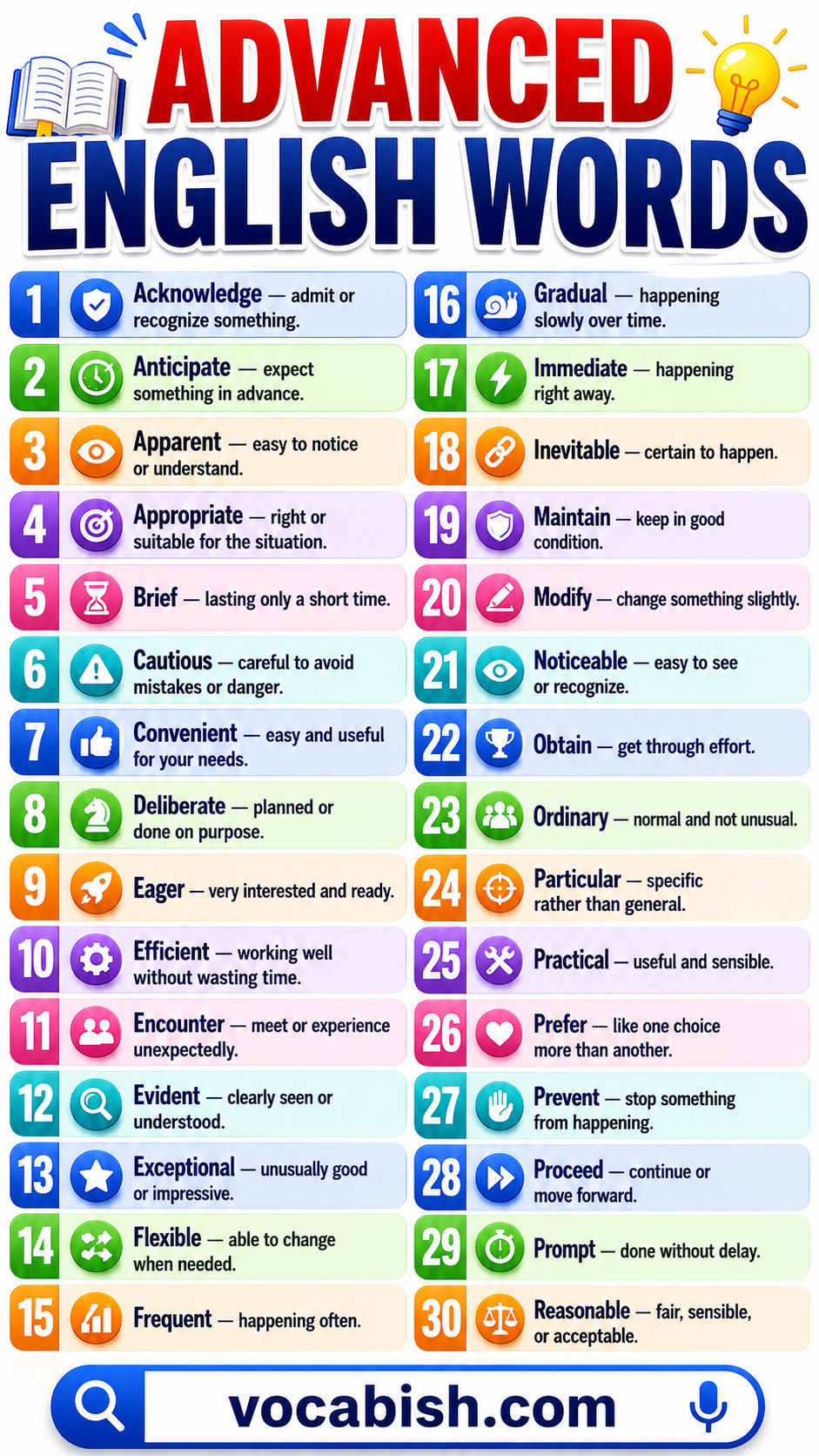
1. Daily Use Advanced English Words
Advanced Word | Meaning | Example |
|---|---|---|
Acknowledge | Admit or show that something is known | Lina acknowledged her mistake and corrected it. |
Anticipate | Expect something before it happens | We anticipate rain after lunch. |
Apparent | Easy to notice or understand | Her excitement was apparent from her smile. |
Appropriate | Suitable for a situation | Wear appropriate shoes for the hike. |
Brief | Lasting only a short time | We had a brief meeting before class. |
Cautious | Careful to avoid danger or mistakes | Amir was cautious near the wet floor. |
Convenient | Easy and useful for your needs | The bus stop is convenient for students. |
Deliberate | Planned or done intentionally | His slow movement was deliberate. |
Eager | Very interested and ready | The children were eager to begin. |
Efficient | Working well without wasting time | This method is quick and efficient. |
Encounter | Meet or experience unexpectedly | We encountered heavy traffic on the way. |
Evident | Clearly seen or understood | Her improvement was evident in the test. |
Exceptional | Unusually good or impressive | Maya gave an exceptional performance. |
Flexible | Able to change when needed | Our study plan is flexible. |
Frequent | Happening often | Frequent practice improves pronunciation. |
Gradual | Happening slowly over time | His reading showed gradual improvement. |
Immediate | Happening without delay | The cut needed immediate attention. |
Inevitable | Certain to happen | Some mistakes are inevitable while learning. |
Maintain | Keep something in good condition | We maintain the garden every weekend. |
Modify | Change something slightly | You can modify the plan later. |
Noticeable | Easy to see or recognize | There was a noticeable change in her voice. |
Obtain | Get something through effort | Students can obtain books from the library. |
Ordinary | Normal and not unusual | It looked like an ordinary box. |
Particular | Specific rather than general | I need a particular type of paper. |
Practical | Useful and sensible | Her suggestion was practical and affordable. |
Prefer | Like one choice more than another | I prefer reading before bedtime. |
Prevent | Stop something from happening | Helmets help prevent head injuries. |
Proceed | Continue or move forward | Please proceed to the next question. |
Prompt | Done without unnecessary delay | Thank you for your prompt reply. |
Reasonable | Fair, sensible, or acceptable | The teacher gave us a reasonable deadline. |
Recommend | Suggest something as a good choice | I recommend this book for young readers. |
Reluctant | Unwilling or unsure about doing something | Noah was reluctant to speak first. |
Request | Ask for something politely | She requested more time for the task. |
Require | Need something for a purpose | The activity requires scissors and glue. |
Respond | Answer or react to something | Please respond before Friday. |
Scarce | Difficult to find or obtain | Clean water was scarce during the drought. |
Select | Choose from several options | Select one answer from the list. |
Significant | Important or large enough to notice | The team made significant progress. |
Sufficient | As much as is needed | We have sufficient food for everyone. |
Suitable | Right for a person or purpose | This story is suitable for younger students. |
Temporary | Lasting for a limited time | The road closure is temporary. |
Tolerate | Accept something unpleasant without reacting strongly | I cannot tolerate very loud music. |
Typical | Normal for a person or group | Rain is typical here in winter. |
Urgent | Needing quick attention | The message was marked urgent. |
Valuable | Useful, important, or worth much | Her advice was valuable to the team. |
Verify | Check that something is correct | Verify the answer before submitting it. |
Willing | Ready to do something | Zara was willing to help her classmate. |
Withdraw | Remove or move away | He decided to withdraw his application. |
Accessible | Easy to reach, use, or understand | The website is accessible on mobile phones. |
Affordable | Not too expensive | We found an affordable school bag. |
2. Advanced Words for School and Classroom
Advanced Word | Meaning | Example |
|---|---|---|
Academic | Connected with school or education | She received an academic award. |
Accomplish | Successfully finish something | We accomplished every task before lunch. |
Accurate | Correct and free from mistakes | His calculation was accurate. |
Assignment | A piece of schoolwork | Our science assignment is due Monday. |
Attentive | Listening or watching carefully | The class remained attentive during the lesson. |
Calculate | Find an answer using numbers | Calculate the total cost of the books. |
Collaborate | Work with other people | The students collaborated on a poster. |
Comprehend | Fully understand something | She could comprehend the difficult paragraph. |
Concentrate | Give full attention to something | Please concentrate on the instructions. |
Conduct | Organize or carry out an activity | The class conducted a science experiment. |
Contribute | Give ideas, effort, or resources | Everyone contributed an idea. |
Demonstrate | Show how something works | The teacher demonstrated the new method. |
Discipline | Controlled and responsible behaviour | Good discipline helps the class learn. |
Discuss | Talk about a subject together | We discussed the story’s ending. |
Educate | Teach or provide knowledge | Museums educate visitors about history. |
Evaluate | Judge quality or progress carefully | The teacher evaluated our presentations. |
Examination | A formal test of knowledge | Her mathematics examination begins tomorrow. |
Feedback | Comments that help someone improve | The teacher gave helpful feedback. |
Formulate | Develop an idea or plan carefully | We formulated a plan for the project. |
Instruct | Tell or teach someone what to do | The coach instructed us to warm up. |
Interpret | Explain the meaning of something | Students interpreted the poem differently. |
Knowledge | Information and understanding | Reading increases your knowledge. |
Lecture | A formal educational talk | We attended a lecture about space. |
Memorize | Learn something so you can remember it | Memorize the first four lines. |
Objective | A result you want to achieve | Our objective is to finish the model. |
Participate | Take part in an activity | Everyone participated in the discussion. |
Perform | Carry out an activity or present something | The group performed a short play. |
Presentation | A talk given to an audience | Her presentation included clear pictures. |
Progress | Improvement over time | You have made excellent progress. |
Revise | Study something again before a test | I revised my notes after dinner. |
Schedule | A plan showing times and activities | Check tomorrow’s class schedule. |
Solve | Find the answer to a problem | Can you solve this puzzle? |
Standard | An expected level of quality | Her work met the required standard. |
Strategy | A planned way to achieve something | Our reading strategy saved time. |
Submit | Give work to a teacher or authority | Submit your homework before noon. |
Summarize | Give the main points briefly | Summarize the chapter in five sentences. |
Task | A piece of work to complete | The first task was easy. |
Technique | A particular way of doing something | This drawing technique uses light lines. |
Topic | The subject being discussed or studied | Today’s topic is renewable energy. |
Worksheet | A page containing learning activities | Complete the vocabulary worksheet. |
Achieve | Reach a goal through effort | She achieved a high score. |
Compare | Examine similarities and differences | Compare the two characters. |
Complete | Finish every part of something | Complete the sentences before class ends. |
Improve | Make or become better | Daily reading can improve fluency. |
Organize | Arrange things in a clear order | Organize your notes by topic. |
Prepare | Get ready for something | We prepared for the spelling test. |
Recite | Say something aloud from memory | He recited the poem confidently. |
Research | Careful study to discover information | Our research focused on sea animals. |
Review | Look at something again | Review your answers before leaving. |
Study | Spend time learning a subject | She studies English every evening. |
3. Words for Learning, Thinking and Memory
Advanced Word | Meaning | Example |
|---|---|---|
Absorb | Take in and understand information | He absorbed the lesson quickly. |
Assess | Judge something carefully | Assess your work before submitting it. |
Assume | Believe something without complete proof | Do not assume the answer is correct. |
Awareness | Knowledge that something exists | The campaign raised awareness about recycling. |
Brainstorm | Produce many ideas quickly | We brainstormed names for the club. |
Categorize | Place things into groups | Categorize the animals by habitat. |
Contemplate | Think carefully for a long time | She contemplated both choices. |
Curious | Wanting to know or learn more | The curious child asked many questions. |
Deduce | Reach an answer using known facts | We deduced that the door was locked. |
Determine | Discover or decide something | The test will determine the winner. |
Differentiate | Recognize differences between things | Can you differentiate fact from opinion? |
Estimate | Make a close guess about an amount | Estimate how many beans are inside. |
Examine | Look at something very carefully | Examine the picture for hidden details. |
Explore | Study or investigate something new | We explored several possible answers. |
Focus | Direct attention toward one thing | Focus on the speaker’s main point. |
Grasp | Understand an idea | Mia quickly grasped the new rule. |
Identify | Recognize and name something | Identify the main character. |
Imagine | Form a picture or idea in your mind | Imagine living on another planet. |
Infer | Form an opinion from clues | We inferred that the character was afraid. |
Inquire | Ask for information | I inquired about the library hours. |
Insight | A clear understanding of something | The interview gave us insight into her work. |
Logical | Based on clear and sensible reasoning | His explanation was logical. |
Perceive | Notice or understand something | She perceived a change in his tone. |
Predict | Say what may happen in the future | Predict what will happen next. |
Question | Express doubt or ask for an explanation | She questioned the unusual result. |
Recall | Bring a fact back into your mind | I could not recall his name. |
Recognize | Know something because you saw it before | I recognized the song immediately. |
Reflect | Think carefully about an experience | Reflect on what you learned today. |
Remember | Keep or bring information to mind | Remember to bring your notebook. |
Retain | Continue to remember information | Pictures help learners retain new words. |
Reason | Think in a clear, sensible way | She reasoned that both answers were possible. |
Speculate | Guess without having all the facts | We speculated about the surprise guest. |
Suppose | Think something is probably true | I suppose the shop is closed. |
Trace | Follow the development or path of something | Trace the river on the map. |
Visualize | Create a mental picture | Visualize the scene before drawing it. |
Wonder | Think curiously about something | I wonder why the leaves changed colour. |
Discover | Find something previously unknown | Scientists discovered a new species. |
Analyze | Study something by examining its parts | Analyze the writer’s main argument. |
Classify | Arrange things into named groups | Classify these rocks by colour. |
Connect | Recognize a relationship between ideas | Connect the cause with its effect. |
Consider | Think carefully before deciding | Consider every option before choosing. |
Investigate | Examine something to discover facts | The class investigated how plants grow. |
Learn | Gain knowledge or a skill | We learned three new expressions. |
Notice | Become aware of something | Did you notice the spelling change? |
Process | Understand and deal with information | Give her time to process the instructions. |
Understand | Know the meaning of something | I understand the first example. |
Conclude | Reach a final opinion from evidence | We concluded that the water was unsafe. |
Associate | Connect one thing with another | I associate that song with summer. |
Synthesize | Combine ideas into a new whole | Synthesize the facts into one paragraph. |
Conceptualize | Form a clear idea in your mind | She conceptualized the design before drawing it. |
4. Advanced Words for Speaking and Communication
Advanced Word | Meaning | Example |
|---|---|---|
Announce | Make information publicly known | The principal announced the results. |
Articulate | Express an idea clearly | She articulated her opinion confidently. |
Assert | State something firmly | He asserted that the answer was correct. |
Assure | Tell someone something with confidence | I assured her that we had enough time. |
Comment | Give an opinion or observation | The teacher commented on my handwriting. |
Communicate | Share information or feelings | Pictures can communicate powerful ideas. |
Complain | Express unhappiness about something | He complained about the noisy room. |
Confess | Admit something that was hidden | She confessed that she broke the cup. |
Convince | Make someone believe or agree | The evidence convinced the judges. |
Debate | Discuss opposing opinions formally | The class debated the new rule. |
Declare | State something clearly and officially | She declared the competition open. |
Describe | Explain what someone or something is like | Describe the animal in three sentences. |
Emphasize | Give special importance to something | The coach emphasized teamwork. |
Express | Show or communicate a thought or feeling | Art helps children express emotions. |
Greet | Welcome someone with words or actions | We greeted the visitors at the door. |
Hint | Suggest something without saying it directly | Dad hinted that a surprise was coming. |
Imply | Communicate an idea indirectly | Her smile implied that she agreed. |
Inform | Give someone facts or information | Please inform us about any changes. |
Interrupt | Speak while another person is talking | Do not interrupt the speaker. |
Mention | Refer to something briefly | She mentioned the trip during lunch. |
Negotiate | Discuss until an agreement is reached | The teams negotiated a fair solution. |
Persuade | Encourage someone to agree or act | I persuaded him to join the club. |
Pronounce | Say a word in a particular way | Can you pronounce this name? |
Propose | Put forward an idea or plan | Sara proposed a different meeting time. |
Quote | Repeat someone’s exact words | He quoted a line from the story. |
Reassure | Help someone feel less worried | Mum reassured me before the test. |
Remark | Say something as a comment | She remarked that the room felt cold. |
Reply | Answer someone | Please reply to the invitation. |
Report | Give information about an event | The students reported their findings. |
Reveal | Make hidden information known | The final chapter reveals the secret. |
State | Express something clearly | State your answer in one sentence. |
Suggest | Offer an idea for consideration | I suggest taking a short break. |
Translate | Change words into another language | Translate the sentence into English. |
Urge | Strongly encourage someone | The teacher urged us to keep practising. |
Voice | Express an opinion or concern | She voiced her worries politely. |
Warn | Tell someone about possible danger | The sign warned drivers about ice. |
Whisper | Speak very quietly | He whispered the answer to his friend. |
Address | Speak or write to someone directly | The captain addressed the team. |
Apologize | Say that you are sorry | He apologized for arriving late. |
Argue | Give reasons for or against an idea | She argued that the rule was unfair. |
Clarify | Make something easier to understand | Could you clarify the last instruction? |
Consult | Ask someone for expert advice | We consulted the librarian. |
Explain | Make an idea clear | Please explain how the machine works. |
Notify | Officially tell someone about something | The school notified parents about the closure. |
Repeat | Say or do something again | Please repeat the final sentence. |
Speak | Use your voice to communicate | Speak clearly during your presentation. |
Converse | Talk with another person | We conversed in English during lunch. |
Elaborate | Add more detail to an explanation | Can you elaborate on your idea? |
Narrate | Tell a story or describe events | Ali narrated the story with expression. |
Interject | Add a short comment while others speak | Nina interjected with a useful question. |
5. Words for Reading, Writing and Storytelling
Advanced Word | Meaning | Example |
|---|---|---|
Abstract | A short summary of a longer text | Read the abstract before the full report. |
Allusion | An indirect reference to something known | The story contains an allusion to a fairy tale. |
Annotate | Add notes or comments to a text | Annotate the paragraph with key ideas. |
Author | A person who writes a book or text | The author visited our school. |
Chapter | One main division of a book | We read the third chapter today. |
Character | A person or creature in a story | The main character solves the mystery. |
Cite | Name the source of information | Cite the book in your report. |
Compose | Create a piece of writing or music | She composed a short poem. |
Context | Information surrounding a word or event | Use context to guess the meaning. |
Contrast | Show how things are different | Contrast the two settings. |
Create | Make something new | Create an ending for the story. |
Draft | An early version of a piece of writing | I completed the first draft. |
Edit | Correct and improve written work | Edit your paragraph for spelling mistakes. |
Ending | The final part of a story | The ending surprised every reader. |
Excerpt | A short part taken from a longer text | We read an excerpt from the novel. |
Fiction | Writing based on imagined events | The library has a large fiction section. |
Figurative | Using imaginative rather than literal language | A heart of gold is figurative language. |
Genre | A category of writing or art | Mystery is her favourite genre. |
Headline | The title of a news report | The headline caught my attention. |
Illustrate | Explain with pictures or examples | The diagram illustrates the water cycle. |
Introduction | The opening part of a text | Her introduction clearly presents the topic. |
Journal | A personal or academic record of writing | I record new words in my journal. |
Manuscript | A text before it is published | The editor reviewed the manuscript. |
Metaphor | A comparison saying one thing is another | Time is a thief is a metaphor. |
Nonfiction | Writing based on facts | He prefers nonfiction books about animals. |
Paragraph | A group of sentences about one idea | Begin a new paragraph here. |
Plot | The main events of a story | The plot becomes exciting near the end. |
Publish | Prepare writing for public reading | The class published a school magazine. |
Reader | A person who reads | The opening should interest the reader. |
Recount | Tell events in the order they happened | Recount your trip in five sentences. |
Reference | A source used for information | The encyclopedia was a useful reference. |
Rhyme | Words ending with similar sounds | Light and night form a rhyme. |
Scene | One part of a play or story | The final scene takes place outside. |
Sequence | The order in which events happen | Put the pictures in sequence. |
Setting | The time and place of a story | The story’s setting is a mountain village. |
Source | The place where information comes from | Check whether the source is reliable. |
Stanza | A grouped set of lines in a poem | The poem contains four stanzas. |
Structure | The way parts are arranged | The essay has a clear structure. |
Summary | A short account of the main points | Write a summary of the article. |
Symbol | Something representing a larger idea | The dove is a symbol of peace. |
Theme | The central idea of a text | Friendship is the story’s main theme. |
Title | The name of a book or text | Choose an interesting title. |
Tone | The attitude shown through language | The letter has a friendly tone. |
Write | Produce words on a page or screen | Write three sentences about your family. |
Dialogue | A conversation between characters | The dialogue made the scene lively. |
Description | Words explaining what something is like | Add a description of the house. |
Caption | A short text placed near a picture | Read the caption under the photograph. |
Prologue | An opening section before the main story | The prologue introduces an old mystery. |
Sequel | A story continuing an earlier one | We borrowed the sequel from the library. |
Epilogue | A closing section after the main story | The epilogue explains what happened later. |
6. Advanced Words for Positive Emotions
Advanced Word | Meaning | Example |
|---|---|---|
Admiration | Warm respect for someone or something | I felt admiration for her courage. |
Affectionate | Showing love and care | The affectionate puppy licked my hand. |
Amused | Finding something funny or entertaining | We were amused by his silly dance. |
Appreciative | Feeling thankful for something | She was appreciative of our help. |
Cheerful | Noticeably happy and positive | He gave us a cheerful greeting. |
Confident | Sure of your ability or decision | Ella felt confident before speaking. |
Content | Peacefully satisfied | He felt content after finishing his work. |
Delighted | Very pleased or happy | Grandma was delighted by the card. |
Elated | Extremely happy and excited | The team felt elated after winning. |
Encouraged | Feeling more hopeful or confident | Her kind words made me feel encouraged. |
Energetic | Full of energy and activity | The energetic children raced outside. |
Enthusiastic | Showing strong interest and excitement | She was enthusiastic about the project. |
Excited | Very happy and interested about something | We were excited about the trip. |
Fascinated | Extremely interested in something | The children were fascinated by the telescope. |
Grateful | Feeling thankful | I am grateful for your support. |
Hopeful | Believing that something good may happen | We remained hopeful about the result. |
Inspired | Filled with a desire to create or act | The story inspired me to write. |
Joyful | Full of happiness | Joyful music filled the hall. |
Lively | Full of energy and excitement | We had a lively class discussion. |
Motivated | Ready and willing to work toward something | She felt motivated to practise daily. |
Optimistic | Expecting good results | He is optimistic about the competition. |
Peaceful | Calm and free from disturbance | The garden felt peaceful at sunrise. |
Pleased | Happy or satisfied | Dad was pleased with my progress. |
Proud | Happy about an achievement | We felt proud of our teamwork. |
Reassured | Less worried after receiving comfort | I felt reassured after speaking to the teacher. |
Refreshed | Rested and full of new energy | The short break left us refreshed. |
Relaxed | Calm and free from worry | She felt relaxed after the exercise. |
Relieved | Happy because a worry has ended | I was relieved to find my keys. |
Satisfied | Pleased because expectations were met | He felt satisfied with his drawing. |
Serene | Very calm and peaceful | Her face looked serene. |
Thankful | Pleased and grateful | We were thankful for the warm shelter. |
Thrilled | Extremely excited and pleased | She was thrilled by the invitation. |
Triumphant | Proud and happy after success | The runners looked triumphant. |
Trusting | Willing to believe someone is honest | The trusting child followed the instructions. |
Upbeat | Cheerful and hopeful | He remained upbeat despite the delay. |
Vibrant | Full of energy, life, or colour | The festival felt vibrant and joyful. |
Warmhearted | Kind and caring | Our warmhearted neighbour helped everyone. |
Welcoming | Friendly toward visitors | The staff were warm and welcoming. |
Wonderful | Extremely pleasant or enjoyable | We had a wonderful afternoon. |
Zealous | Showing strong energy for a cause or goal | She was zealous about protecting animals. |
Blissful | Extremely peaceful and happy | We enjoyed a blissful morning by the lake. |
Buoyant | Cheerful and able to stay positive | His buoyant mood lifted the group. |
Comforted | Feeling calmer after receiving support | The frightened child felt comforted. |
Fulfilled | Happy because something meaningful was achieved | She felt fulfilled after helping the team. |
Radiant | Looking bright and joyful | Her radiant smile filled the room. |
Ecstatic | Extremely happy | The fans were ecstatic about the victory. |
Exhilarated | Very excited and full of energy | We felt exhilarated after the ride. |
Fond | Feeling warm affection | I am fond of my old storybooks. |
Jubilant | Showing great joy after success | Jubilant students cheered after the result. |
Jovial | Cheerful, friendly, and sociable | Our jovial host told funny stories. |
7. Words for Difficult Emotions and Reactions
Advanced Word | Meaning | Example |
|---|---|---|
Agitated | Troubled and unable to remain calm | The loud noise made him agitated. |
Alarmed | Suddenly frightened or worried | We were alarmed by the smoke. |
Anxious | Worried about what may happen | She felt anxious before the test. |
Ashamed | Feeling bad about something you did | He felt ashamed of his rude comment. |
Bewildered | Extremely confused | The complicated map left us bewildered. |
Bitter | Angry and unhappy about unfair treatment | He felt bitter after being excluded. |
Bored | Uninterested because nothing feels engaging | The children became bored during the delay. |
Concerned | Worried about someone or something | Mum was concerned about the weather. |
Confused | Unable to understand clearly | I felt confused by the instructions. |
Disappointed | Unhappy because hopes were not met | We were disappointed by the cancellation. |
Discouraged | Feeling less confident or hopeful | One mistake left him discouraged. |
Embarrassed | Uncomfortable because of attention or a mistake | She felt embarrassed after forgetting her line. |
Envious | Wanting something another person has | He felt envious of her new bicycle. |
Fearful | Feeling afraid | The fearful kitten hid under the chair. |
Frustrated | Annoyed because progress is difficult | I felt frustrated by the broken puzzle. |
Furious | Extremely angry | Dad was furious about the damaged window. |
Guilty | Feeling responsible for doing something wrong | She felt guilty about telling a lie. |
Hesitant | Unsure or slow to act | He was hesitant to answer. |
Homesick | Sad because you are away from home | Sara felt homesick during camp. |
Impatient | Unwilling to wait calmly | The impatient crowd checked the clock. |
Insecure | Lacking confidence in yourself | He felt insecure about his pronunciation. |
Irritated | Slightly angry or annoyed | The repeated tapping made me irritated. |
Jealous | Upset because someone has what you want | She felt jealous of her sister’s prize. |
Lonely | Sad because you lack company | The new student felt lonely. |
Miserable | Extremely unhappy or uncomfortable | The cold rain made us miserable. |
Nervous | Worried or slightly afraid | I felt nervous before performing. |
Offended | Hurt or upset by words or actions | He was offended by the unfair joke. |
Overwhelmed | Unable to manage strong feelings or work | She felt overwhelmed by all the homework. |
Puzzled | Unable to understand something | We were puzzled by the final clue. |
Regretful | Sorry about a past action | He sounded regretful after the argument. |
Resentful | Angry about unfair treatment | She felt resentful about doing all the work. |
Restless | Unable to relax or remain still | The children grew restless while waiting. |
Sad | Feeling unhappy | He felt sad when his friend moved. |
Skeptical | Doubting that something is true | I was skeptical of the strange claim. |
Startled | Suddenly surprised or frightened | The bell startled the sleeping cat. |
Stressed | Worried because of pressure | She felt stressed during exam week. |
Suspicious | Believing something may be dishonest or wrong | The detective became suspicious of the story. |
Tense | Nervous and unable to relax | The room became tense before the result. |
Terrified | Extremely frightened | The child was terrified by the thunder. |
Troubled | Worried or emotionally upset | His troubled expression concerned us. |
Uncertain | Not sure about something | I am uncertain about the answer. |
Uneasy | Slightly worried or uncomfortable | The dark hallway made me uneasy. |
Upset | Unhappy, worried, or angry | She was upset about the lost book. |
Vulnerable | Easily hurt or affected | Young plants are vulnerable to frost. |
Worried | Thinking that something bad may happen | We were worried about the missing dog. |
Withdrawn | Quiet and avoiding other people | He became withdrawn after changing schools. |
Annoyed | Slightly angry | She was annoyed by the interruption. |
Desperate | Feeling a strong need with little hope | They were desperate to find shelter. |
Gloomy | Sad and without hope | His gloomy mood lasted all morning. |
Distressed | Extremely worried or upset | The lost child looked distressed. |
8. Positive Personality and Character Words
Advanced Word | Meaning | Example |
|---|---|---|
Adaptable | Able to adjust to change | An adaptable student handles new routines well. |
Ambitious | Strongly wanting to achieve something | She is ambitious about becoming a scientist. |
Brave | Willing to face fear or danger | The brave child asked for help. |
Calm | Peaceful and not excited or worried | He remained calm during the storm. |
Caring | Showing concern for others | Our caring neighbour checked on everyone. |
Compassionate | Caring deeply about another person’s suffering | The compassionate girl helped the injured bird. |
Considerate | Thinking about other people’s needs | It was considerate to lower the music. |
Cooperative | Willing to work well with others | The cooperative group shared every task. |
Courageous | Brave in a difficult situation | Her courageous decision protected the team. |
Courteous | Polite and respectful | The courteous student held the door open. |
Creative | Able to produce original ideas | He found a creative solution. |
Dependable | Trusted to do what is expected | Mia is a dependable team member. |
Determined | Unwilling to give up | He remained determined after two mistakes. |
Diligent | Working carefully and consistently | The diligent learner revised every evening. |
Disciplined | Able to control behaviour and follow routines | A disciplined athlete practises regularly. |
Fair | Treating people equally and reasonably | The teacher made a fair decision. |
Faithful | Loyal and dependable | The faithful dog waited by the gate. |
Forgiving | Willing to stop feeling angry | She was forgiving after the apology. |
Friendly | Kind and pleasant toward others | The friendly student welcomed me. |
Generous | Willing to give or share | He was generous with his time. |
Gentle | Calm, kind, and not rough | Use a gentle voice with the puppy. |
Honest | Truthful and not deceptive | She gave an honest answer. |
Humble | Not acting as if you are better than others | The winner remained humble. |
Imaginative | Full of original or creative ideas | Her imaginative story included a flying library. |
Independent | Able to act without constant help | He became an independent reader. |
Kind | Helpful and caring | A kind classmate shared her notes. |
Loyal | Continuing to support someone | He remained loyal to his friends. |
Mature | Behaving sensibly for your age | She gave a mature response. |
Modest | Not boasting about abilities or success | He was modest about his award. |
Open-minded | Willing to consider different ideas | Be open-minded during the discussion. |
Patient | Able to wait without becoming annoyed | The patient teacher explained it again. |
Polite | Showing good manners | He made a polite request. |
Punctual | Arriving or happening at the correct time | The punctual student arrived before class. |
Reliable | Able to be trusted | This source is reliable. |
Respectful | Showing care for people and rules | The audience remained respectful. |
Responsible | Trusted to manage duties properly | She is responsible for feeding the rabbit. |
Selfless | Caring more about others than yourself | His selfless act helped the whole group. |
Sensible | Showing good judgment | Wearing a coat was a sensible choice. |
Sincere | Honest and genuine in feeling | She offered a sincere apology. |
Supportive | Giving help and encouragement | My classmates were supportive. |
Thoughtful | Showing careful attention to others | The note was a thoughtful gesture. |
Trustworthy | Deserving trust | A trustworthy person keeps promises. |
Understanding | Patient and aware of others’ feelings | The coach was understanding about my mistake. |
Wise | Showing sound judgment and experience | Grandma gave us wise advice. |
Devoted | Very loyal and committed | The devoted volunteer visited every week. |
Resourceful | Good at finding clever solutions | The resourceful child repaired the model. |
Benevolent | Kind and willing to help others | A benevolent donor supplied new books. |
Genuine | Honest, sincere, and not false | Her concern was genuine. |
Gracious | Polite, kind, and pleasant | The host was gracious to every guest. |
Principled | Guided by strong moral beliefs | She made a principled decision. |
9. Complex Personality and Behaviour Words
Advanced Word | Meaning | Example |
|---|---|---|
Aggressive | Ready to argue, threaten, or attack | His aggressive tone upset the group. |
Aloof | Distant and not socially friendly | The new character seemed aloof. |
Arrogant | Acting as if you are better than others | His arrogant remarks annoyed everyone. |
Bossy | Always telling others what to do | The bossy child controlled every game. |
Careless | Not giving enough attention | A careless mistake changed the answer. |
Clingy | Wanting constant attention or closeness | The tired toddler became clingy. |
Competitive | Strongly wanting to win | She becomes competitive during races. |
Controlling | Trying to direct other people’s choices | His controlling behaviour frustrated the team. |
Cruel | Intentionally causing pain or sadness | The story’s villain was cruel. |
Cunning | Clever at achieving something through trickery | The cunning fox escaped the trap. |
Defensive | Quickly protecting yourself from criticism | He became defensive when questioned. |
Demanding | Expecting too much from others | The demanding customer wanted immediate service. |
Dishonest | Not truthful | The dishonest character hid the facts. |
Disrespectful | Showing a lack of respect | Interrupting the guest was disrespectful. |
Dramatic | Showing emotions in an exaggerated way | His dramatic reaction surprised us. |
Greedy | Wanting more than you need | The greedy character kept every prize. |
Grumpy | Easily annoyed and unhappy | He felt grumpy after missing breakfast. |
Impulsive | Acting without thinking first | Her impulsive choice caused a problem. |
Indecisive | Unable to choose easily | I felt indecisive at the menu. |
Insensitive | Not noticing or caring about others’ feelings | The joke sounded insensitive. |
Irresponsible | Not acting with proper care or duty | Leaving the gate open was irresponsible. |
Lazy | Unwilling to make an effort | The lazy character avoided every chore. |
Manipulative | Controlling people through unfair methods | His manipulative excuse fooled no one. |
Moody | Often changing between emotional states | She felt moody after a tiring day. |
Naive | Lacking experience and trusting too easily | The naive boy believed the false story. |
Nosy | Too interested in private matters | It was nosy to read her message. |
Obstinate | Refusing to change your opinion or action | The obstinate donkey would not move. |
Overconfident | More confident than your ability supports | He became overconfident before the match. |
Pessimistic | Expecting bad results | Her pessimistic prediction worried the team. |
Possessive | Unwilling to share people or things | The child became possessive of the toy. |
Reckless | Acting without considering danger | Reckless cycling can cause injuries. |
Rebellious | Resisting rules or authority | The rebellious character ignored every warning. |
Reserved | Quiet and unwilling to share feelings | He is reserved around strangers. |
Rude | Not polite or respectful | Her rude reply shocked the visitor. |
Secretive | Hiding thoughts or activities | He became secretive about the project. |
Selfish | Caring mainly about yourself | Keeping all the supplies was selfish. |
Shy | Nervous around unfamiliar people | The shy student spoke softly. |
Stubborn | Refusing to change your mind | He was stubborn about the seating plan. |
Tactless | Speaking without considering feelings | His tactless comment hurt her. |
Temperamental | Experiencing sudden mood changes | The temperamental actor became upset quickly. |
Timid | Shy and easily frightened | The timid rabbit hid behind the box. |
Unpredictable | Difficult to know or guess beforehand | The weather became unpredictable. |
Vain | Too proud of appearance or ability | The vain prince admired every portrait. |
Disruptive | Interrupting an activity or process | Disruptive talking delayed the lesson. |
Argumentative | Often starting disagreements | He became argumentative when tired. |
Boastful | Talking too proudly about yourself | Her boastful speech annoyed the team. |
Deceitful | Intentionally dishonest | The deceitful character invented false stories. |
Domineering | Trying to control everyone | The domineering captain ignored suggestions. |
Eccentric | Unusual in behaviour or appearance | The eccentric inventor wore mismatched shoes. |
Forgetful | Often failing to remember things | My forgetful uncle misplaced his glasses. |
10. Powerful Advanced Action Verbs
Advanced Word | Meaning | Example |
|---|---|---|
Acquire | Gain or obtain something | She acquired new skills during the course. |
Activate | Make something begin working | Press the button to activate the alarm. |
Adapt | Change to suit new conditions | Animals adapt to their environments. |
Assemble | Join parts together | We assembled the model carefully. |
Capture | Catch or record something | The camera captured a bright rainbow. |
Combine | Join two or more things | Combine the flour and water. |
Construct | Build something from parts | Students constructed a wooden bridge. |
Decrease | Make or become smaller | Turning off lights can decrease energy use. |
Deliver | Take something to a person or place | The courier delivered our package. |
Detect | Discover something difficult to notice | The sensor detected smoke. |
Develop | Create or improve something over time | They developed a new learning app. |
Eliminate | Remove something completely | Eliminate the incorrect answers first. |
Establish | Start or create something firmly | The school established a reading club. |
Expand | Make something larger or more detailed | Expand your answer with an example. |
Generate | Produce or create something | Solar panels generate electricity. |
Handle | Manage or deal with something | She handled the problem calmly. |
Implement | Put a plan or decision into action | The class implemented a recycling plan. |
Increase | Make or become greater | Reading can increase your vocabulary. |
Influence | Affect someone or something | Friends can influence our choices. |
Initiate | Cause a process to begin | The captain initiated the discussion. |
Inspect | Examine something carefully | Inspect the bicycle before riding. |
Install | Put equipment or software into place | Dad installed the new program. |
Invent | Create something that did not exist | She invented a useful kitchen tool. |
Launch | Start or send something forward | The club launched a new campaign. |
Manage | Control or organize something successfully | He managed the team’s schedule. |
Manufacture | Produce goods, usually in large numbers | The factory manufactures bicycles. |
Measure | Find the size, amount, or degree | Measure the table before buying cloth. |
Operate | Control or use a machine | Only adults may operate this equipment. |
Produce | Make, grow, or create something | Plants produce oxygen. |
Protect | Keep someone or something safe | Sunscreen protects your skin. |
Reduce | Make something smaller or less | We should reduce plastic waste. |
Remove | Take something away | Remove your shoes at the door. |
Repair | Fix something damaged | The mechanic repaired the bicycle. |
Replace | Put something new in place of another | Replace the empty battery. |
Restore | Return something to a better condition | Workers restored the old building. |
Secure | Make something safe or firmly fixed | Secure the lid before shaking the bottle. |
Separate | Divide or keep things apart | Separate paper from plastic. |
Strengthen | Make something stronger | Exercise can strengthen your muscles. |
Transform | Change something greatly | Heat transforms ice into water. |
Transport | Carry people or goods somewhere | Trains transport passengers between cities. |
Update | Add the newest information | Update the chart with today’s results. |
Utilize | Use something for a purpose | We utilized old boxes for storage. |
Build | Make something by joining parts | They built a shelter from branches. |
Observe | Watch something carefully | Observe how the plant moves toward light. |
Allocate | Give something for a particular purpose | The teacher allocated ten minutes for reading. |
Attach | Join or fasten one thing to another | Attach the label to the jar. |
Coordinate | Organize people or actions to work together | Mina coordinated the school event. |
Dismantle | Take something apart | We dismantled the old shelf. |
Extract | Remove something from another substance | The machine extracts juice from oranges. |
Merge | Join things to form one whole | Merge the two files into one. |
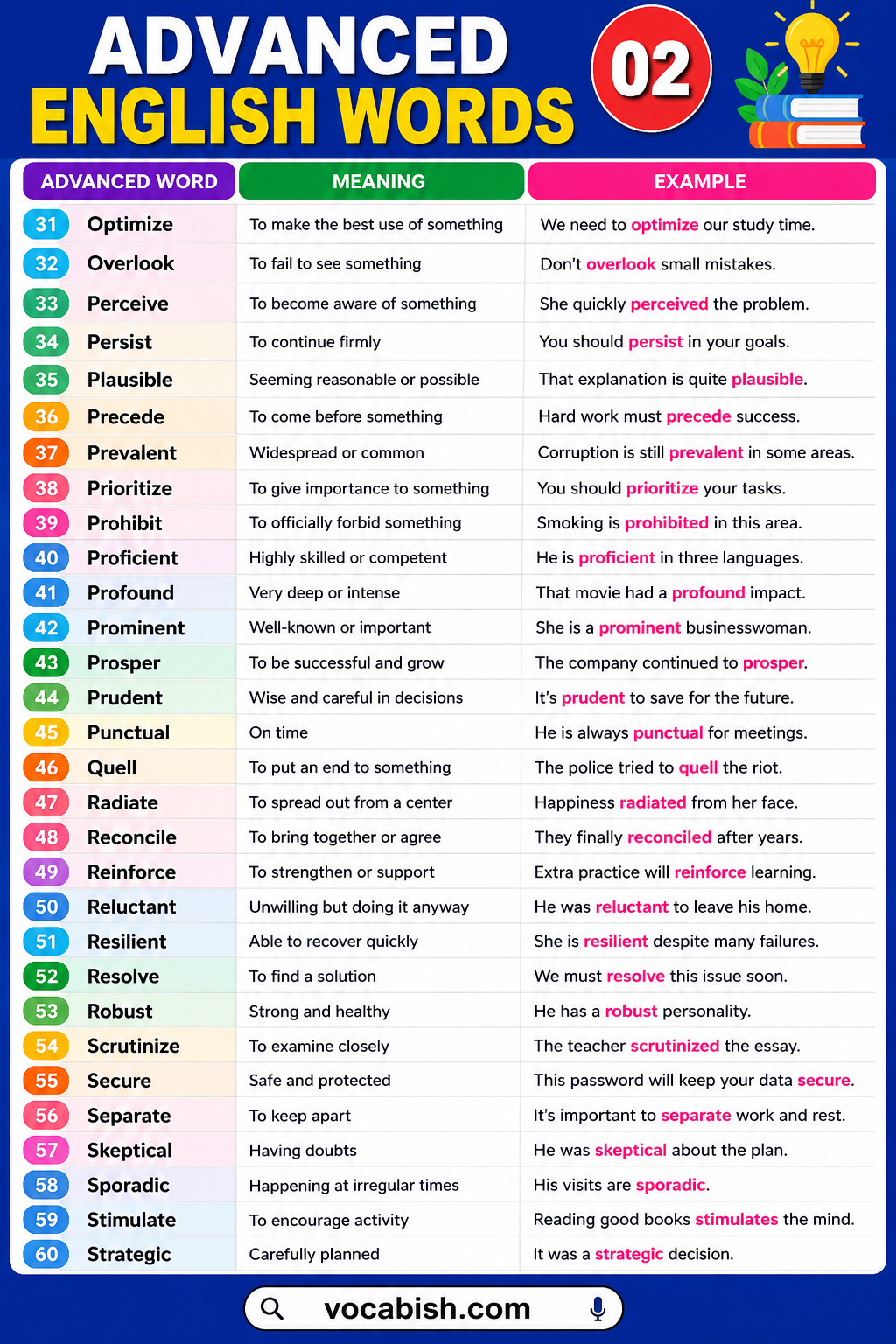
11. Words for Movement, Change and Progress
Advanced Word | Meaning | Example |
|---|---|---|
Accelerate | Begin moving or happening faster | The car accelerated on the open road. |
Advance | Move forward or make progress | The hikers advanced toward the summit. |
Alter | Change something | We altered the design slightly. |
Approach | Move closer to something | The train approached the station. |
Ascend | Move upward | The balloon ascended into the sky. |
Balance | Keep something steady | She balanced the book on her head. |
Bend | Make or become curved | Bend the wire carefully. |
Circulate | Move continuously around an area | Warm air circulates through the room. |
Climb | Move upward using hands or feet | We climbed the steep hill. |
Collapse | Fall down suddenly | The wet sandcastle collapsed. |
Continue | Keep doing something | Continue reading from page twelve. |
Decline | Become smaller, weaker, or fewer | Temperatures decline after sunset. |
Descend | Move downward | The hikers descended before dark. |
Drift | Move slowly without control | Leaves drifted across the pond. |
Emerge | Come into view or become known | The moon emerged from the clouds. |
Evolve | Develop gradually | Languages evolve over time. |
Extend | Make longer or reach farther | Extend your arm toward the wall. |
Fall | Move downward | Rain began to fall. |
Fluctuate | Rise and fall irregularly | The temperature fluctuated all day. |
Flow | Move smoothly and continuously | Water flowed under the bridge. |
Grow | Become larger or develop | The plant grew toward the window. |
Leap | Jump a long distance or height | The deer leaped over the fence. |
Migrate | Move from one region to another | Many birds migrate during winter. |
Move | Change position or place | Move the chair closer. |
Pause | Stop for a short time | She paused before answering. |
Recover | Return to a normal or healthy state | The plant recovered after watering. |
Retreat | Move backward or away | The waves retreated from the shore. |
Rise | Move upward | Hot air rises. |
Rotate | Turn around a central point | Earth rotates once each day. |
Rush | Move with great speed | The children rushed toward the gate. |
Shift | Move slightly from one position | Shift the box to the left. |
Slide | Move smoothly over a surface | The book slid off the table. |
Soar | Fly or rise high | The eagle soared above the valley. |
Spread | Extend over a wider area | The paint spread across the paper. |
Stabilize | Make or become steady | The doctor stabilized the injured bird. |
Stop | End movement or activity | The bus stopped near school. |
Stretch | Extend your body or an object | Stretch your arms before running. |
Swing | Move backward and forward | The gate swung in the wind. |
Travel | Move from one place to another | Light travels extremely fast. |
Tremble | Shake slightly | The leaves trembled in the breeze. |
Turn | Change direction or position | Turn the page carefully. |
Vary | Change or differ | Prices vary between shops. |
Wander | Move without a fixed direction | We wandered through the market. |
Weaken | Make or become less strong | Heavy rain weakened the wall. |
Bounce | Move up again after hitting a surface | The ball bounced across the floor. |
Crawl | Move slowly close to the ground | The caterpillar crawled along the leaf. |
Glide | Move smoothly and quietly | The swan glided across the lake. |
Halt | Stop moving or operating | The driver halted at the crossing. |
Hover | Remain in one position in the air | A bee hovered above the flower. |
Sprint | Run very fast for a short distance | She sprinted to the finish line. |
12. Family, Friendship and Social-Life Words
Advanced Word | Meaning | Example |
|---|---|---|
Accept | Welcome or agree to receive something | She accepted my apology. |
Accompany | Go somewhere with another person | Dad accompanied me to the library. |
Advise | Suggest what someone should do | The teacher advised us to revise. |
Belong | Be accepted as part of a group | Everyone deserves to belong. |
Celebrate | Mark a happy event | We celebrated her achievement. |
Comfort | Help someone feel less sad or worried | I comforted my upset friend. |
Compromise | Reach agreement through shared changes | We compromised on the game rules. |
Cooperate | Work together willingly | The teams cooperated during cleanup. |
Encourage | Give someone confidence or hope | Her parents encouraged her to continue. |
Forgive | Stop feeling angry about a mistake | He forgave me after I apologized. |
Gather | Come together in one place | The family gathered for dinner. |
Help | Make something easier for someone | I helped my brother with homework. |
Include | Make someone or something part of a group | Include everyone in the activity. |
Introduce | Tell people each other’s names | I introduced Maya to my cousin. |
Invite | Ask someone to attend | We invited our neighbours to lunch. |
Join | Become part of a group or activity | Would you like to join us? |
Listen | Give attention to sound or speech | Listen carefully to your friend. |
Mentor | Guide someone with less experience | An older student mentored the new learner. |
Reconcile | Restore a friendly relationship | The friends reconciled after talking. |
Respect | Treat someone with care and value | We should respect different opinions. |
Share | Let others use or have part of something | The children shared their materials. |
Socialize | Spend time talking with others | We socialized after the event. |
Support | Help someone emotionally or practically | Friends supported her during the competition. |
Trust | Believe someone is honest or reliable | I trust her to keep the secret. |
Welcome | Greet someone warmly | The class welcomed the new student. |
Agree | Have the same opinion | We agreed on a meeting time. |
Bond | Develop a close relationship | The teammates bonded during practice. |
Care | Feel concern or affection | Good friends care about each other. |
Console | Comfort someone who is unhappy | She consoled her brother after the loss. |
Defend | Protect someone from criticism or harm | He defended his friend fairly. |
Entertain | Provide enjoyment or interest | The magician entertained the children. |
Friendship | A caring relationship between friends | Their friendship lasted many years. |
Host | Receive and entertain visitors | Our school hosted the competition. |
Interact | Communicate or act with others | Students interacted during the activity. |
Partner | A person who works with another | Ask your partner to check the answer. |
Relationship | The connection between people | Trust strengthens a relationship. |
Reunite | Bring together again after separation | The trip reunited old friends. |
Visit | Go to see a person or place | We visited our grandparents. |
Volunteer | Offer to help without being forced | I volunteered to carry the boxes. |
Appreciate | Recognize the value of someone or something | I appreciate your patience. |
Assist | Help someone complete something | She assisted the younger students. |
Befriend | Become a friend to someone | He befriended the new classmate. |
Congratulate | Praise someone for success | We congratulated the winning team. |
Empathize | Understand another person’s feelings | Try to empathize with her disappointment. |
Engage | Take part or communicate actively | Everyone engaged in the discussion. |
Guide | Show someone the correct way | Maya guided us through the museum. |
Honor | Show respect or admiration | The event honored community volunteers. |
Mediate | Help people settle a disagreement | The teacher mediated between the groups. |
Praise | Express approval of someone | The coach praised our teamwork. |
Cherish | Care deeply about someone or something | I cherish our family traditions. |
13. Home, Habits and Daily Activities
Advanced Word | Meaning | Example |
|---|---|---|
Arrange | Put things in a planned order | Arrange the books by size. |
Bake | Cook food using dry oven heat | We baked bread this morning. |
Bathe | Wash the body in water | The keeper bathed the muddy dog. |
Clean | Remove dirt from something | Clean the table after lunch. |
Collect | Bring several things together | We collected leaves for the project. |
Consume | Eat, drink, or use something | People should consume enough water. |
Cook | Prepare food using heat | Dad cooked vegetable soup. |
Decorate | Make something look more attractive | We decorated the room with paper stars. |
Dust | Remove fine dirt from a surface | Dust the shelves with a soft cloth. |
Fold | Bend something over itself | Fold the towel neatly. |
Groom | Clean and care for appearance | She groomed the horse before riding. |
Habit | An action repeated regularly | Reading nightly is a useful habit. |
Pack | Put items into a bag or container | Pack your lunch before school. |
Preserve | Keep something in good condition | Freezing helps preserve food. |
Recycle | Process waste so it can be used again | We recycle paper and glass. |
Relax | Rest and become less tense | I relax by reading quietly. |
Routine | A regular way of doing things | My morning routine begins at seven. |
Scrub | Clean by rubbing firmly | Scrub the pan with a brush. |
Serve | Give food or assistance | They served dinner at six. |
Shop | Visit places to buy things | We shopped for school supplies. |
Sort | Arrange things into groups | Sort the clothes by colour. |
Store | Keep something for later use | Store the rice in a dry container. |
Sweep | Clean a floor with a brush | Sweep the kitchen floor. |
Tidy | Make a place neat | Tidy your desk before leaving. |
Unload | Remove items from a vehicle or container | We unloaded the groceries. |
Wash | Clean something with water | Wash your hands before eating. |
Water | Give water to plants | Water the flowers in the evening. |
Wipe | Clean or dry by rubbing | Wipe the window with a cloth. |
Wrap | Cover something with paper or material | Wrap the gift carefully. |
Awaken | Stop sleeping or make someone wake | Birds awakened us at sunrise. |
Commute | Travel regularly between home and work or school | She commutes by train each day. |
Exercise | Move the body to improve fitness | We exercise before breakfast. |
Rest | Stop activity to recover energy | Rest for ten minutes after running. |
Sleep | Rest with your eyes closed | Children need enough time to sleep. |
Vacuum | Clean using a suction machine | Please vacuum the carpet. |
Meal | Food eaten at one time | Breakfast is my first meal. |
Household | People living together in one home | Everyone in the household helped. |
Nourish | Provide food needed for health and growth | Healthy meals nourish the body. |
Brew | Prepare a drink by soaking or boiling | Mum brewed a pot of tea. |
Cleanse | Make something thoroughly clean | The soap cleanses the skin gently. |
Declutter | Remove unnecessary items from a space | We decluttered the cupboard. |
Disinfect | Clean to remove harmful germs | Disinfect the surface after use. |
Dry | Remove water or moisture | Dry the dishes with a towel. |
Furnish | Provide a room with furniture | They furnished the room with two desks. |
Iron | Smooth clothes using a heated tool | Dad ironed his shirt. |
Mend | Repair cloth or a small damaged item | Grandma mended the torn pocket. |
Mop | Clean a floor with a wet tool | We mopped the kitchen floor. |
Rinse | Wash quickly with clean water | Rinse the cup after using it. |
Roast | Cook food with dry heat | We roasted vegetables for dinner. |
Sew | Join cloth using thread | She sewed a button onto her coat. |
14. Nature, Weather and Environment Words
Advanced Word | Meaning | Example |
|---|---|---|
Abundant | Existing in large amounts | Wildflowers are abundant in spring. |
Atmosphere | The gases surrounding a planet | Earth’s atmosphere contains oxygen. |
Biodiversity | The variety of living things in an area | Rainforests contain rich biodiversity. |
Breeze | A light and gentle wind | A cool breeze entered the room. |
Climate | The usual weather of a region | The desert has a dry climate. |
Coast | Land beside the sea | We walked along the rocky coast. |
Conserve | Protect something from waste or loss | Turn off taps to conserve water. |
Drought | A long period with little rain | The drought damaged many crops. |
Ecosystem | Living things and their shared environment | A pond is a small ecosystem. |
Endangered | At serious risk of disappearing | The species is endangered. |
Environment | The natural or physical surroundings | Plastic waste harms the environment. |
Erosion | Gradual wearing away of land | Waves caused erosion along the coast. |
Fertile | Able to support healthy plant growth | Crops grow well in fertile soil. |
Flood | Water covering normally dry land | The flood closed several roads. |
Flourish | Grow or develop successfully | These plants flourish in sunlight. |
Forest | A large area covered with trees | Deer live in the forest. |
Fragile | Easily damaged or broken | Coral reefs are fragile habitats. |
Habitat | The natural home of a plant or animal | The wetland is a bird habitat. |
Humid | Containing a high amount of moisture in the air | The afternoon felt hot and humid. |
Hurricane | A powerful tropical storm | The hurricane brought strong winds. |
Island | Land completely surrounded by water | They sailed toward a small island. |
Lightning | A bright electrical flash during a storm | Lightning lit the dark sky. |
Meadow | An open field covered with grass | Butterflies flew across the meadow. |
Mountain | A very high natural area of land | Snow covered the mountain. |
Natural | Existing in nature rather than being made | The cave has a natural entrance. |
Ocean | A vast area of salt water | Whales travel across the ocean. |
Pollution | Harmful waste in air, water, or land | Traffic adds to air pollution. |
Rainfall | The amount of rain an area receives | Annual rainfall is low here. |
Renewable | Able to be replaced naturally | Wind is a renewable energy source. |
River | A large natural stream of water | The river flows through the town. |
Season | A period of the year with certain weather | Autumn is a cool season. |
Shelter | A place giving protection | The trees provided shelter from rain. |
Soil | The upper layer of earth where plants grow | Seeds were planted in moist soil. |
Species | A group of similar living things | The scientist recorded a rare species. |
Storm | Severe weather with wind, rain, or snow | The storm arrived overnight. |
Temperature | A measurement of how hot or cold something is | The temperature dropped below zero. |
Thunder | The loud sound following lightning | Thunder shook the windows. |
Valley | Low land between hills or mountains | A river crossed the valley. |
Vegetation | Plants growing in an area | Thick vegetation covered the hillside. |
Weather | Current conditions in the air outside | The weather changed suddenly. |
Wildlife | Animals living freely in nature | The park protects local wildlife. |
Woodland | Land covered with trees | We followed a path through woodland. |
Arid | Extremely dry with little rainfall | Cacti survive in arid regions. |
Coastal | Located near the sea | The coastal village depends on fishing. |
Misty | Filled with light fog | The morning was cool and misty. |
Tropical | Connected with hot regions near the equator | Mangoes grow in tropical climates. |
Volcanic | Connected with a volcano | The island has volcanic rock. |
Blizzard | A severe snowstorm with strong wind | The blizzard blocked the road. |
Canopy | The upper layer formed by tree branches | Monkeys moved through the forest canopy. |
Drizzle | Very light rain | A gentle drizzle began at noon. |
15. Words for Places, Objects and Appearance
Advanced Word | Meaning | Example |
|---|---|---|
Ancient | Very old and from the distant past | We visited an ancient castle. |
Attractive | Pleasant to look at | The garden looked attractive in spring. |
Broad | Wide from side to side | A broad river crossed the valley. |
Compact | Small but efficiently arranged | The compact camera fits in my pocket. |
Curved | Having a rounded rather than straight shape | We followed a curved path. |
Delicate | Easily damaged or requiring gentle care | The vase is extremely delicate. |
Dilapidated | Old and badly damaged | They repaired a dilapidated house. |
Enormous | Extremely large | An enormous tree shaded the playground. |
Elegant | Graceful and stylish | She wore an elegant dress. |
Empty | Containing nothing | The bottle was completely empty. |
Familiar | Known from previous experience | The song sounded familiar. |
Fancy | Decorative, unusual, or expensive-looking | The cafe had fancy chairs. |
Flat | Smooth and level without curves | Place the box on a flat surface. |
Glossy | Smooth and shiny | The magazine has glossy pages. |
Graceful | Moving or appearing smoothly and attractively | The dancer looked graceful. |
Grand | Large and impressive | We entered a grand hall. |
Huge | Very large | A huge crowd filled the square. |
Narrow | Having little width | We walked through a narrow passage. |
Neat | Clean and carefully arranged | Her handwriting is neat. |
Modern | Connected with the present time | The school has a modern library. |
Oval | Shaped like a stretched circle | The table has an oval top. |
Pale | Light in colour | The walls were pale blue. |
Picturesque | Visually attractive like a picture | We stayed in a picturesque village. |
Polished | Smooth and shiny from careful rubbing | The floor looked polished. |
Rough | Uneven and not smooth | The rock had a rough surface. |
Round | Shaped like a circle or ball | She carried a round basket. |
Shiny | Reflecting light brightly | The coin looked shiny. |
Spacious | Having plenty of room | Their classroom is bright and spacious. |
Spotless | Completely clean | The kitchen was spotless. |
Steep | Rising or falling at a sharp angle | We climbed a steep hill. |
Straight | Having no curve or bend | Draw a straight line. |
Sturdy | Strong and unlikely to break | The sturdy table held the heavy box. |
Symmetrical | Having matching parts on both sides | The butterfly’s wings are symmetrical. |
Tall | Having great height | A tall tower stood nearby. |
Tiny | Extremely small | A tiny insect landed on the leaf. |
Transparent | Allowing light and images to pass through | The container is transparent. |
Unusual | Different from what is common | We heard an unusual sound. |
Vast | Extremely large in area or amount | The desert appeared vast. |
Visible | Able to be seen | The moon was clearly visible. |
Vivid | Bright, strong, and clear | She used vivid colours. |
Worn | Damaged by long or frequent use | His shoes looked worn. |
Bright | Producing or reflecting much light | A bright lamp lit the desk. |
Colorful | Containing many bright colours | We saw a colorful mural. |
Crowded | Filled with too many people or things | The bus was crowded. |
Dark | Having little or no light | The tunnel was dark. |
Angular | Having sharp corners or angles | The building has an angular design. |
Cluttered | Filled with untidy objects | His desk looked cluttered. |
Dim | Giving or containing little light | The hallway was dim. |
Ornate | Covered with detailed decoration | The door had an ornate pattern. |
Rectangular | Shaped like a rectangle | We used a rectangular sheet of paper. |
16. Science, Technology and Discovery Words
Advanced Word | Meaning | Example |
|---|---|---|
Algorithm | A set of steps used to solve a problem | The program follows an algorithm. |
Artificial | Made by people rather than occurring naturally | The plant is artificial. |
Atom | A very small unit that forms matter | Every object contains atoms. |
Battery | A device that stores and supplies electrical energy | The toy needs a new battery. |
Chemical | A substance with a particular composition | The scientist handled the chemical carefully. |
Circuit | A complete path through which electricity flows | The bulb lit when we completed the circuit. |
Data | Facts or information collected for study | We recorded the data in a table. |
Digital | Using computer or electronic technology | The school uses digital textbooks. |
Discovery | Something found or learned for the first time | The discovery changed our understanding. |
Electricity | Energy carried through charged particles | Electricity powers the computer. |
Energy | The ability to cause movement or change | Food gives our bodies energy. |
Engineer | A person who designs or builds systems | The engineer tested the bridge. |
Experiment | A test performed to learn something | Our experiment measured plant growth. |
Formula | A rule expressed using numbers or symbols | Use the formula to find the area. |
Gravity | The force pulling objects toward Earth | Gravity makes objects fall. |
Innovation | A useful new idea, method, or product | The water filter was a clever innovation. |
Internet | A worldwide network connecting computers | We used the internet for research. |
Invention | Something created for the first time | The telephone was an important invention. |
Laboratory | A room used for scientific work | Students wore goggles in the laboratory. |
Machine | A device that performs work | The machine sorts the bottles. |
Material | A substance used to make something | Wood is a natural material. |
Microscope | A tool that makes tiny things appear larger | We viewed cells through a microscope. |
Network | Connected computers, people, or systems | The computers share one network. |
Particle | An extremely small piece of matter | Dust particles floated in the light. |
Planet | A large object moving around a star | Earth is a planet. |
Programmed | Given coded instructions to follow | The robot was programmed to turn left. |
Robot | A machine able to perform actions automatically | The robot carried the box. |
Satellite | An object moving around a planet or other body | The satellite sends weather images. |
Scientific | Connected with science and careful investigation | We followed a scientific method. |
Sensor | A device that detects a physical change | The sensor detected movement. |
Software | Programs used by a computer | We installed drawing software. |
Solar | Connected with the sun | Solar panels collect sunlight. |
Solution | A liquid mixture or an answer to a problem | Salt dissolved in the solution. |
Space | The area beyond Earth’s atmosphere | Astronauts travel through space. |
Specimen | A sample used for examination | We examined a leaf specimen. |
Technology | Tools and systems created through scientific knowledge | Technology helps people communicate. |
Telescope | A tool for viewing distant objects | We saw Jupiter through the telescope. |
Theory | An explanation supported by evidence | The scientist tested her theory. |
Virtual | Existing through computer technology rather than physically | We joined a virtual classroom. |
Astronomy | The study of stars, planets, and space | Astronomy helps us understand the universe. |
Biology | The study of living things | Biology explains how plants grow. |
Device | A tool or machine made for a purpose | This device measures temperature. |
Download | Copy digital information to your device | Download the worksheet before class. |
Electronic | Operating through electrical technology | The door has an electronic lock. |
Fossil | Preserved remains or traces of ancient life | We saw a dinosaur fossil. |
Genetic | Connected with genes and inherited features | Eye colour is partly genetic. |
Molecule | A group of atoms joined together | Water contains oxygen and hydrogen molecules. |
Orbit | Move around a planet, star, or object | Earth orbits the sun. |
Oxygen | A gas needed by humans and many living things | Our lungs take oxygen from the air. |
Physics | The study of matter, energy, forces, and motion | Physics explains why objects fall. |
17. Words for Problems, Decisions and Solutions
Advanced Word | Meaning | Example |
|---|---|---|
Alternative | Another possible choice | Walking is an alternative to taking the bus. |
Challenge | A difficult task requiring effort | Learning the speech was a challenge. |
Choice | An act or option of selecting | You have a choice between two books. |
Consequence | A result caused by an action | Missing practice had a consequence. |
Decide | Choose after thinking | We decided to leave early. |
Decision | A choice made after consideration | It was a difficult decision. |
Difficulty | A problem that makes something hard | She had difficulty opening the jar. |
Dilemma | A choice between difficult options | He faced a dilemma about which team to join. |
Disadvantage | A condition making success harder | The heavy bag was a disadvantage. |
Evidence | Facts that support an idea | The footprints provided evidence. |
Feasible | Possible and practical to do | The plan is feasible within our budget. |
Issue | A subject or problem needing attention | Noise became a serious issue. |
Option | One possible choice | We considered every option. |
Outcome | The final result of an event | The outcome surprised us. |
Plan | A set of intended actions | Our plan includes three steps. |
Priority | Something more important than other tasks | Safety is our first priority. |
Problem | A situation needing an answer or solution | We discussed the main problem. |
Resolve | Find an answer or settle something | The teacher helped resolve the disagreement. |
Result | What happens because of an action | Hard work produced a good result. |
Risk | The possibility of harm or loss | Climbing alone involves risk. |
Cause | Something making an event happen | Heavy rain was the cause of flooding. |
Correct | Remove an error | Correct the spelling before printing. |
Effect | A change caused by something else | Lack of sleep has an effect on focus. |
Fix | Repair or solve something | We fixed the broken wheel. |
Goal | A result you want to reach | My goal is to read ten books. |
Judge | Form an opinion after considering facts | Do not judge before hearing both sides. |
Obstacle | Something blocking progress | The fallen tree became an obstacle. |
Response | An answer or reaction | Her response was calm and clear. |
Successful | Achieving the intended result | The experiment was successful. |
Barrier | Something preventing movement or progress | Cost was a barrier to the project. |
Conflict | A serious disagreement | The groups resolved their conflict. |
Constraint | A limit affecting what can be done | Time was our main constraint. |
Drawback | A negative feature of something | The long journey is one drawback. |
Error | A mistake | One error changed the final score. |
Failure | Lack of success | The first failure taught us what to change. |
Fault | Responsibility for a mistake or a defect | The broken switch was the fault. |
Hurdle | A difficulty that must be overcome | Cost was the final hurdle. |
Limitation | A condition restricting ability or progress | The device has one limitation. |
Remedy | A way to correct a problem | Rest was the best remedy. |
Setback | A problem delaying progress | Rain caused a temporary setback. |
Shortage | A lack of something needed | The village faced a water shortage. |
Threat | Something likely to cause harm | Pollution is a threat to wildlife. |
Troubleshoot | Find and correct the cause of a problem | We troubleshot the computer issue. |
Uncertainty | Lack of complete knowledge or confidence | Weather uncertainty changed our plans. |
Verdict | A final judgment or decision | The judges announced their verdict. |
Weigh | Consider advantages and disadvantages | Weigh both options carefully. |
Workaround | A temporary method for avoiding a problem | We found a workaround for the error. |
Crisis | A dangerous or extremely difficult situation | The community worked together during the crisis. |
Dispute | A disagreement or argument | They settled the dispute peacefully. |
Resolution | A solution to a disagreement or problem | Talking led to a fair resolution. |
18. Powerful Descriptive Adjectives
Advanced Word | Meaning | Example |
|---|---|---|
Astonishing | Extremely surprising | The magician’s final trick was astonishing. |
Awful | Very unpleasant or bad | The spoiled milk smelled awful. |
Beautiful | Very pleasing to see or experience | The garden looked beautiful. |
Brilliant | Extremely clever, bright, or successful | She had a brilliant idea. |
Charming | Pleasant and attractive | We stayed in a charming cottage. |
Chilly | Uncomfortably cool | The morning air felt chilly. |
Delicious | Having a very pleasant taste | The soup was delicious. |
Dreadful | Extremely bad or unpleasant | We experienced dreadful weather. |
Exhausted | Extremely tired | I felt exhausted after the race. |
Fascinating | Extremely interesting | The documentary was fascinating. |
Filthy | Extremely dirty | His boots were filthy. |
Freezing | Extremely cold | The water felt freezing. |
Gigantic | Extremely large | A gigantic statue stood outside. |
Gorgeous | Extremely beautiful | The sunset looked gorgeous. |
Horrendous | Extremely unpleasant or shocking | Traffic was horrendous this morning. |
Hungry | Needing or wanting food | We were hungry after swimming. |
Incredible | Extremely impressive or difficult to believe | Her memory is incredible. |
Magnificent | Extremely beautiful or impressive | The palace looked magnificent. |
Marvelous | Extremely good or enjoyable | We had a marvelous time. |
Massive | Very large and heavy | A massive rock blocked the path. |
Miniature | Much smaller than the usual size | He built a miniature house. |
Mysterious | Difficult to explain or understand | A mysterious light appeared. |
Outstanding | Extremely good and noticeable | She produced outstanding work. |
Perfect | Having no faults for a purpose | The weather was perfect for a picnic. |
Precious | Highly valuable or deeply loved | The photograph is precious to me. |
Remarkable | Unusual and worthy of attention | He made a remarkable recovery. |
Ridiculous | Extremely unreasonable or silly | The oversized hat looked ridiculous. |
Scorching | Extremely hot | We walked in scorching sunshine. |
Silent | Making no sound | The room became silent. |
Splendid | Very impressive or enjoyable | The actors gave a splendid performance. |
Starving | Extremely hungry | We were starving after the hike. |
Stunning | Extremely attractive or impressive | The mountain view was stunning. |
Terrible | Extremely bad or unpleasant | The storm caused terrible damage. |
Terrific | Extremely good | You did a terrific job. |
Tremendous | Very great in amount, size, or effect | The team made tremendous progress. |
Breathtaking | So beautiful or impressive that it surprises you | The waterfall was breathtaking. |
Colossal | Extremely large | A colossal ship entered the harbour. |
Creepy | Causing an uncomfortable feeling of fear | The empty house looked creepy. |
Dazzling | Extremely bright or impressive | The dancer wore a dazzling costume. |
Delightful | Very pleasant or enjoyable | We had a delightful conversation. |
Dense | Closely packed together | Dense fog covered the road. |
Exquisite | Extremely beautiful and carefully made | The vase had an exquisite pattern. |
Fierce | Strong, powerful, or aggressive | Fierce winds shook the trees. |
Flawless | Having no visible mistakes | Her performance was flawless. |
Hilarious | Extremely funny | The puppy’s reaction was hilarious. |
Immense | Extremely large or great | The ocean seemed immense. |
Minuscule | Extremely small | A minuscule insect crossed the page. |
Spectacular | Extremely impressive to see | The fireworks were spectacular. |
Rugged | Rough, uneven, and difficult to cross | We explored the rugged coast. |
Striking | Easily noticed because it is unusual or attractive | She wore a striking blue coat. |
19. Academic and Formal English Words
Advanced Word | Meaning | Example |
|---|---|---|
Adequate | Enough or acceptable for a purpose | We had adequate time to finish. |
Benefit | A helpful or positive result | Exercise has many health benefits. |
Concept | A general idea | The lesson explains the concept of gravity. |
Consistent | Remaining the same or following a pattern | Her results were consistent. |
Constitute | Form or make up something | These chapters constitute half the book. |
Criteria | Standards used for judging something | Read the marking criteria carefully. |
Define | State the exact meaning of something | Define the term in one sentence. |
Derive | Obtain something from a source | Many words derive from Latin. |
Distribute | Give or spread among several people | The teacher distributed the worksheets. |
Element | One necessary or important part | Trust is an important element of friendship. |
Factor | Something affecting a result | Weather was a major factor. |
Function | The purpose or job of something | The heart’s function is to pump blood. |
Indicate | Show or point toward something | Dark clouds indicate possible rain. |
Individual | One person considered separately | Each individual received a badge. |
Method | A planned way of doing something | We tested a different method. |
Occur | Happen | The change occurred overnight. |
Principle | A basic rule or belief | Fairness is an important principle. |
Relevant | Directly connected with the subject | Include only relevant details. |
Role | A function or position | Bees play a role in pollination. |
Section | One part of a larger whole | Read the final section. |
Specific | Clearly identified and exact | Give a specific example. |
Valid | Reasonable, acceptable, or logically sound | Her concern was valid. |
Variable | Something that can change | Temperature was the main variable. |
Category | A group of similar things | Place each word in the correct category. |
Coherent | Clear, logical, and well connected | The paragraph is coherent. |
Component | One part of a larger system | The battery is a key component. |
Definition | A statement explaining a word’s meaning | Write a clear definition. |
Framework | A basic structure supporting an idea or system | The outline provides a writing framework. |
Hypothesis | A testable explanation or prediction | Our hypothesis was that light helps growth. |
Justify | Give good reasons for something | Justify your answer with evidence. |
Major | Important, serious, or large | Pollution is a major concern. |
Minor | Less important or serious | The page had a minor error. |
Notion | An idea or belief | He rejected the notion that failure is permanent. |
Policy | An official rule or plan | The school has a safety policy. |
Proportion | A part compared with the whole | A large proportion of students agreed. |
Range | A group of different options or amounts | The shop offers a wide range of books. |
Regulate | Control something through rules | Laws regulate road safety. |
Whereas | Used to contrast two facts | Mia likes fiction, whereas Ali prefers history. |
Aggregate | A total formed by combining amounts | The aggregate score was ninety. |
Analytical | Using careful examination and reasoning | She used an analytical approach. |
Annotation | A note added to explain part of a text | Her annotation explained the difficult phrase. |
Citation | A reference naming an information source | Add a citation after the quotation. |
Correlation | A connection between two changing things | The chart shows a correlation between sleep and focus. |
Domain | A particular area of knowledge or activity | Biology is her strongest domain. |
Empirical | Based on observation or experiment | The claim needs empirical evidence. |
Methodology | The organized methods used in a study | The report explains its methodology. |
Parameter | A limit or condition controlling a process | Work within the project parameters. |
Qualitative | Based on qualities and descriptions | We collected qualitative comments from students. |
Quantitative | Based on numbers and measurements | The graph presents quantitative data. |
Scope | The range covered by a subject or activity | Space travel is outside the project’s scope. |
20. Linking, Reasoning and Opinion Words
Advanced Word | Meaning | Example |
|---|---|---|
Accordingly | In a way that matches the situation | Rain was expected; accordingly, we stayed inside. |
Additionally | Used to add another point | Additionally, bring a pencil. |
Admittedly | Used when accepting that something is true | Admittedly, the task was difficult. |
Alternatively | Used to present another option | Alternatively, you may work at home. |
Although | Despite the fact that | Although it rained, we continued. |
Apparently | According to what seems true | Apparently, the shop closes early. |
Because | For the reason that | We stayed inside because it rained. |
Certainly | Without doubt | She certainly deserves the award. |
Consequently | As a result | The road flooded; consequently, school closed. |
Conversely | Introducing an opposite idea | Some plants need shade; conversely, others need sun. |
Despite | Without being prevented by something | Despite the rain, we played. |
Especially | More than usual or more than others | I enjoy science, especially biology. |
Eventually | In the end, after some time | We eventually found the correct path. |
Evidently | In a way that is clear from evidence | Evidently, the door had been opened. |
Finally | At the end or after a long wait | Finally, the bus arrived. |
Firstly | Used to introduce the first point | Firstly, read the instructions. |
However | Used to introduce a contrast | The task was hard; however, we finished. |
Indeed | Used to emphasize a statement | The story was indeed surprising. |
Instead | As a replacement or alternative | We walked instead. |
Likewise | In the same way | Sara enjoys reading; likewise, her brother loves books. |
Meanwhile | During the same period | I cooked; meanwhile, Ali set the table. |
Nevertheless | Despite what was just mentioned | It was late; nevertheless, we continued. |
Obviously | In a way that is easy to understand | Obviously, the empty bottle needs refilling. |
Otherwise | If not, or in a different way | Leave now; otherwise, we will be late. |
Overall | Considering everything | Overall, the event was successful. |
Perhaps | Possibly | Perhaps we should ask for help. |
Presumably | Probably, based on available facts | The lights are off, so presumably nobody is home. |
Previously | At an earlier time | We previously studied this topic. |
Probably | Likely to happen or be true | It will probably rain. |
Secondly | Used to introduce the second point | Secondly, check your spelling. |
Similarly | In almost the same way | Both stories are similarly structured. |
Since | Because, or from a past time | Since it was late, we left. |
Specifically | In an exact or detailed way | Specifically, underline the final sentence. |
Still | Despite that, or continuing until now | It was cold, but we still walked. |
Therefore | For that reason | The road was closed; therefore, we turned back. |
Though | Despite the fact that | Though she was nervous, she spoke clearly. |
Thus | As a result or in this way | The evidence was weak; thus, the claim failed. |
Unless | Except if something happens | We cannot begin unless everyone is ready. |
While | During the time that, or in contrast | I read while she drew. |
Yet | But despite that | He was tired, yet he continued. |
Arguably | As can reasonably be argued | This is arguably the strongest answer. |
Comparatively | When compared with something else | The second task was comparatively easy. |
Generally | In most cases | Generally, plants need sunlight. |
Notably | In a way worth special attention | Notably, every group finished early. |
Ultimately | Finally, after everything is considered | Ultimately, the choice is yours. |
Increasingly | More and more over time | Students increasingly use digital tools. |
Initially | At the beginning | Initially, the instructions seemed confusing. |
Namely | Used to give exact details | We need two items, namely paper and glue. |
Nonetheless | Despite what has been said | It was difficult; nonetheless, we succeeded. |
Subsequently | Later, after another event | She revised and subsequently improved her score. |
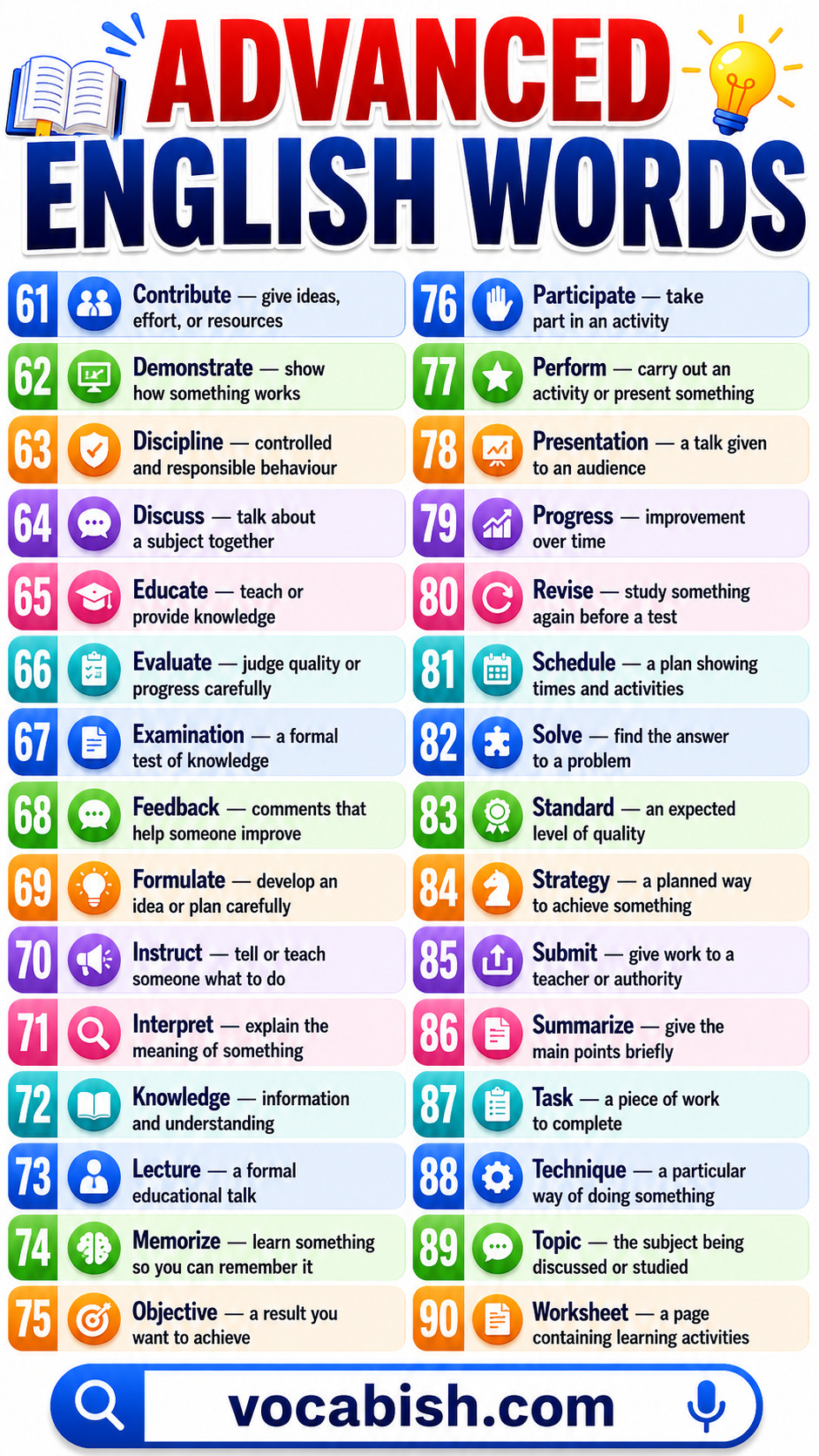
Normal vs Advanced English Words in Sentences
An advanced sentence should remain clear and natural. The goal is not to replace every common word, but to choose a more precise expression when it adds useful meaning.
Normal English | Advanced English |
The test was very difficult. | The test was extremely challenging. |
She is very careful with her work. | She is meticulous about her work. |
The old house was badly damaged. | The dilapidated house needed major repairs. |
I was very happy with the result. | I was delighted with the result. |
The room was very clean. | The room was spotless. |
He explained the rule more clearly. | He clarified the rule. |
We got the information from the library. | We obtained the information from the library. |
The team made a plan. | The team formulated a strategy. |
The storm was very bad. | The storm was horrendous. |
She looked at the insect carefully. | She examined the insect carefully. |
The group worked together. | The group collaborated. |
The teacher showed us the method. | The teacher demonstrated the method. |
He thought carefully about the choice. | He contemplated the choice. |
The machine found smoke. | The machine detected smoke. |
The view was very beautiful. | The view was breathtaking. |
Related Resources: Normal vs Advanced English Words and Sentences
100 Daily Use Advanced English Words for Quick Revision
These 100 words are among the most practical entries in the collection. Review them in smaller groups and return to the main categories when you need the full meaning and example.
Word | Quick meaning | Main category |
Acknowledge | Admit or recognize | Daily use |
Anticipate | Expect beforehand | Daily use |
Appropriate | Right for the situation | Daily use |
Cautious | Careful about danger | Daily use |
Convenient | Easy and useful | Daily use |
Efficient | Working without waste | Daily use |
Encounter | Meet unexpectedly | Daily use |
Flexible | Able to change | Daily use |
Immediate | Without delay | Daily use |
Maintain | Keep in good condition | Daily use |
Modify | Change slightly | Daily use |
Obtain | Get through effort | Daily use |
Particular | Exact or specific | Daily use |
Practical | Useful and sensible | Daily use |
Proceed | Continue forward | Daily use |
Prompt | Quick and timely | Daily use |
Reasonable | Fair and sensible | Daily use |
Recommend | Suggest positively | Daily use |
Reluctant | Unwilling or unsure | Daily use |
Require | Need for a purpose | Daily use |
Respond | Answer or react | Daily use |
Select | Choose carefully | Daily use |
Significant | Important or noticeable | Daily use |
Sufficient | As much as needed | Daily use |
Suitable | Right for a purpose | Daily use |
Temporary | Lasting briefly | Daily use |
Urgent | Needing quick action | Daily use |
Verify | Check correctness | Daily use |
Accomplish | Finish successfully | School |
Accurate | Free from errors | School |
Collaborate | Work together | School |
Comprehend | Understand fully | School |
Concentrate | Give full attention | School |
Contribute | Add effort or ideas | School |
Demonstrate | Show clearly | School |
Evaluate | Judge carefully | School |
Feedback | Comments for improvement | School |
Interpret | Explain meaning | School |
Participate | Take part | School |
Progress | Improvement over time | School |
Revise | Study again | School |
Strategy | Planned approach | School |
Summarize | State main points | School |
Assess | Judge or measure | Thinking |
Brainstorm | Produce many ideas | Thinking |
Consider | Think carefully | Thinking |
Deduce | Reach an answer from facts | Thinking |
Determine | Decide or discover | Thinking |
Differentiate | Recognize differences | Thinking |
Estimate | Make a close guess | Thinking |
Examine | Look at carefully | Thinking |
Explore | Investigate broadly | Thinking |
Grasp | Understand an idea | Thinking |
Identify | Recognize and name | Thinking |
Infer | Reach a conclusion from clues | Thinking |
Recall | Bring back to mind | Thinking |
Reflect | Think about experience | Thinking |
Retain | Continue remembering | Thinking |
Visualize | Form a mental picture | Thinking |
Articulate | Express clearly | Communication |
Assure | State confidently | Communication |
Clarify | Remove confusion | Communication |
Communicate | Share information | Communication |
Convince | Make someone believe | Communication |
Emphasize | Give special importance | Communication |
Express | Show thoughts or feelings | Communication |
Inform | Give facts | Communication |
Negotiate | Discuss toward agreement | Communication |
Persuade | Encourage agreement or action | Communication |
Propose | Present an idea | Communication |
Reassure | Reduce someone’s worry | Communication |
Reveal | Make something known | Communication |
Suggest | Offer an idea | Communication |
Compassionate | Caring about suffering | Character |
Considerate | Thinking of others | Character |
Courageous | Brave in difficulty | Character |
Dependable | Able to be trusted | Character |
Determined | Unwilling to give up | Character |
Diligent | Careful and hardworking | Character |
Generous | Willing to share | Character |
Humble | Not boastful | Character |
Reliable | Consistently trustworthy | Character |
Resourceful | Clever at finding solutions | Character |
Responsible | Trusted with duties | Character |
Sincere | Honest in feeling | Character |
Supportive | Giving help and encouragement | Character |
Thoughtful | Showing care and attention | Character |
Acquire | Gain or obtain | Action |
Adapt | Adjust to change | Action |
Construct | Build carefully | Action |
Detect | Discover something hidden | Action |
Eliminate | Remove completely | Action |
Establish | Set up firmly | Action |
Implement | Put into action | Action |
Influence | Affect a result | Action |
Initiate | Cause to begin | Action |
Restore | Return to good condition | Action |
Transform | Change greatly | Action |
Alternative | Another possible choice | Decisions |
Consequence | Result of an action | Decisions |
Feasible | Possible and practical | Decisions |
Priority | Most important concern | Decisions |
Resolve | Solve or settle | Decisions |
Evidence | Facts supporting an idea | Decisions |
How You Can Remember Advanced Words and Meanings
Memorizing a definition once rarely makes a word usable. Learners remember vocabulary more effectively when they meet it repeatedly, connect it with a situation, and use it in their own language.
Learn Five Words at a Time
Choose five words from one topic rather than selecting random words from the full list. A small set is easier to review, compare, and use during the day.
For example:
- acknowledge;
- anticipate;
- cautious;
- convenient;
- verify.
Connect Each Word with a Picture
A mental or physical picture can make an unfamiliar word easier to remember. You might connect dilapidated with an old damaged house or serene with a quiet lake.
The picture should represent the meaning, not only the spelling.
Use New Words in Short Stories
Choose three to five new words and place them in a short paragraph:
Maya was reluctant to enter the competition. Her teacher reassured her and suggested a practical strategy. Maya practised daily and eventually gave an outstanding performance.
This activity shows how words connect naturally.
Compare Basic and Advanced Words
Comparisons help learners understand strength and context:
- happy → delighted;
- careful → meticulous;
- brave → courageous;
- possible → feasible;
- old → ancient;
- tired → exhausted.
Remember that the advanced alternative may carry a stronger or more specific meaning.
Review Words After One Day and One Week
Review each new group:
- later on the same day;
- the following day;
- after three days;
- after one week.
During each review, cover the meaning and try to explain the word from memory. Then create a new sentence instead of repeating the original example.
Common Mistakes When Using Advanced English Words
A stronger vocabulary should make communication clearer. It becomes unhelpful when learners choose words only because they appear longer, rarer, or more formal.
Using an Advanced Word in the Wrong Context
Two words can share a broad meaning without being interchangeable.
For example, ancient means extremely old and usually relates to distant history. It would sound unnatural to describe a two-year-old phone as ancient unless you were joking.
Replacing Every Simple Word
Common words such as go, make, help, and think are often the most natural choices. Do not replace them unless the new word adds accuracy.
“Please help me” usually sounds better in conversation than “Please facilitate my progress.”
Ignoring the Part of Speech
A learner may understand a word but use the wrong grammatical form:
- Success is a noun.
- Successful is an adjective.
- Succeed is a verb.
- Successfully is an adverb.
Check how the word functions before placing it in a sentence.
Using Formal Words in Casual Conversation
Words such as constitute, empirical, and methodology fit academic writing. They may sound unnatural in a casual conversation with friends.
Match your vocabulary to the audience and situation.
Memorizing Meanings Without Examples
A definition tells you what a word means, but an example shows:
- where it belongs in a sentence;
- which prepositions accompany it;
- whether it sounds formal or conversational;
- which nouns and verbs commonly appear beside it.
Always learn a word in context.
FAQs About Advanced English Words
Useful examples include meticulous, reluctant, articulate, compassionate, feasible, significant, transform, and consequently. Each expresses a more precise meaning than a common alternative.
They are age-appropriate vocabulary terms that improve reading, writing, speaking, and emotional expression without relying on rare, outdated, or unnecessarily confusing language.
Most learners can begin with five to ten words daily, then adjust the number according to their available time, memory, and review routine.
No. A difficult word may be rare or unfamiliar, while an advanced word is useful because it communicates a precise idea in context.
Learn the meaning, observe natural examples, and practise one new word in a suitable sentence instead of forcing several formal terms together.
Words such as evaluate, relevant, significant, consequently, nevertheless, evidence, and justify help writers explain relationships, arguments, comparisons, and conclusions clearly.
Use the PDF download section below to access the printable vocabulary book containing the topic lists, meanings, examples, and revision material.
Download 1000 Advanced English Words with Meanings PDF
The printable PDF brings the complete vocabulary collection into one study resource. Learners can use it offline, teachers can print selected pages, and parents can create weekly revision activities.
The PDF include:
- all 1,000 words in 20 categories;
- short meanings and example sentences;
- parts of speech;
- familiar alternatives;
- a clickable table of contents;
- an alphabetical word index;
- basic vs advanced comparisons;
- revision and sentence-writing pages.
Learning advanced vocabulary is not about making every sentence sound formal. It is about having more choices. Study a few words at a time, notice how people use them, and return to this list whenever you need a clearer way to express an idea.
You May Also Like