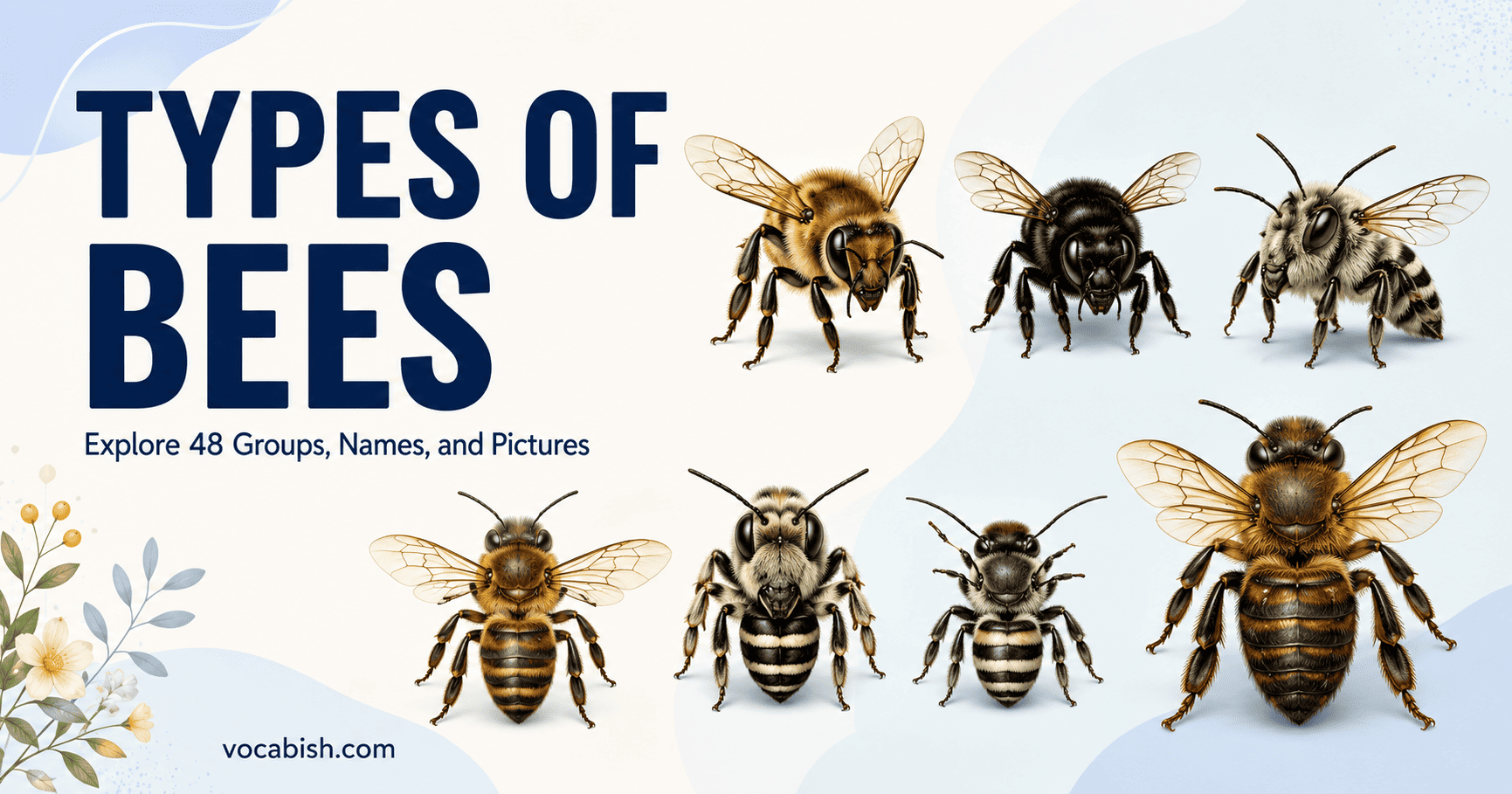

Bees are not one single kind of insect. More than 20,000 known species are classified into seven recognised families: Apidae, Megachilidae, Halictidae, Andrenidae, Colletidae, Melittidae, and Stenotritidae. Familiar types include honey bees, bumblebees, carpenter bees, mason bees, leafcutter bees, mining bees, sweat bees, and stingless bees. In this blog post, you will learn 46 representative bee types, their scientific classification, and the practical features used to recognise major groups.
What Are the Different Types of Bees?
Bees are pollen- and nectar-feeding insects belonging to the clade Anthophila within the superfamily Apoidea and order Hymenoptera. Scientists formally classify living bees into seven families. These families are further divided into subfamilies, tribes, genera, species, and sometimes subspecies.
In everyday language, however, a “type of bee” may refer to:
- A scientific family, such as Halictidae
- A tribe or genus, such as stingless bees or bumblebees
- A named species, such as the western honey bee
- A behavioural group, such as cuckoo bees
- An informal regional name, such as plasterer bee
The 46 names below represent important families, groups, genera, species, and one recognised hybrid population. They are not a complete catalogue of every bee species. Totals differ among sources because new species continue to be described, scientific names are revised, and some populations are classified differently by different authorities.
What to Know About Types of Bees
- More than 20,000 known bee species belong to seven recognised scientific families.
- This article covers 46 representative groups, species, and recognised bee forms.
- Honey bees, bumblebees, and stingless bees are social, but most bees are solitary.
- Nest location, pollen placement, body hair, and building materials aid identification.
- Common names may represent a family, tribe, genus, species, or behavioural group.
- Regional field guides remain essential for dependable species-level identification.
Complete List of 46 Types of Bees
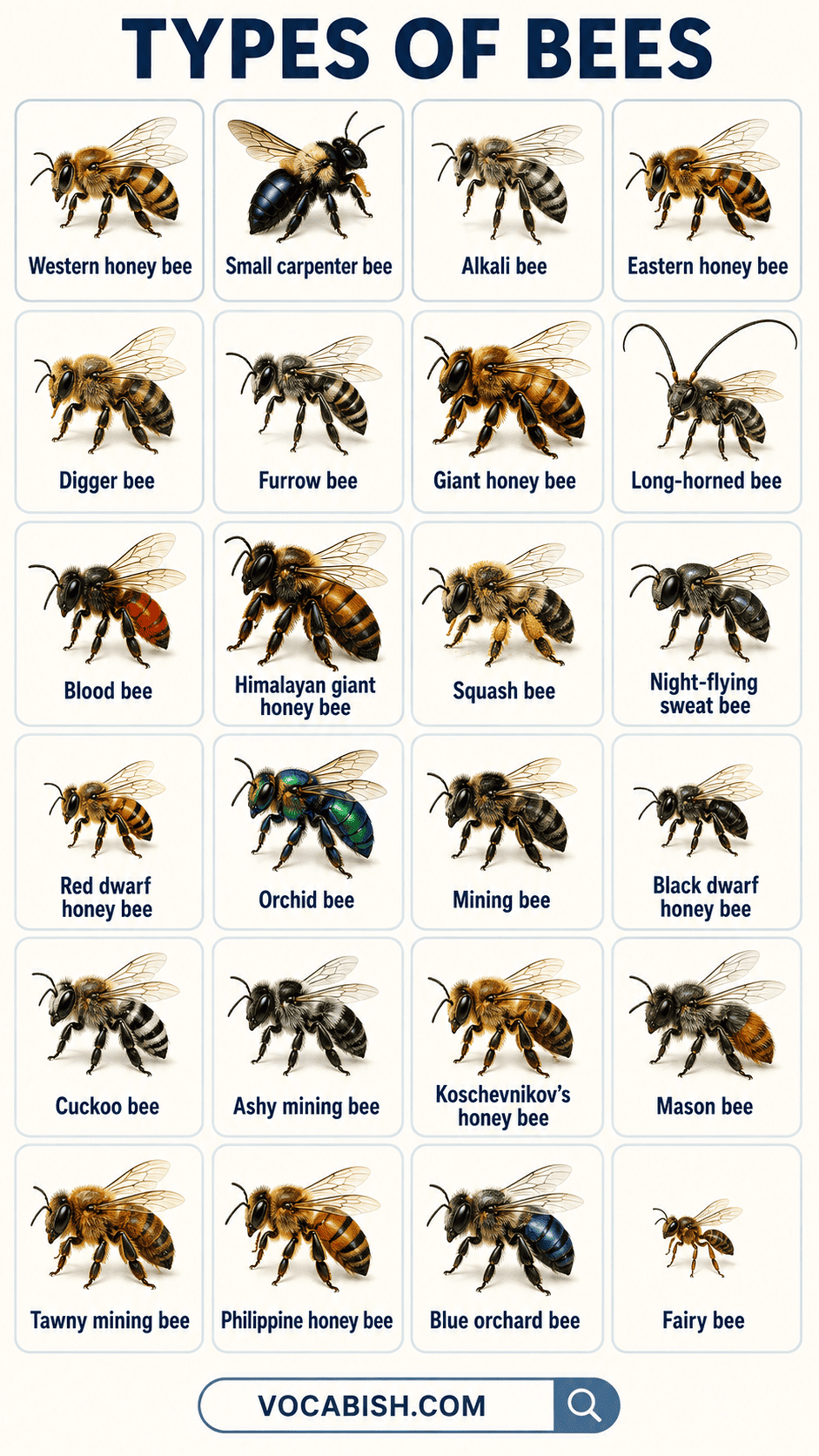
Western honey bee | Small carpenter bee | Alkali bee |
Eastern honey bee | Digger bee | Furrow bee |
Giant honey bee | Long-horned bee | Blood bee |
Himalayan giant honey bee | Squash bee | Night-flying sweat bee |
Red dwarf honey bee | Orchid bee | Mining bee |
Black dwarf honey bee | Cuckoo bee | Ashy mining bee |
Koschevnikov’s honey bee | Mason bee | Tawny mining bee |
Philippine honey bee | Blue orchard bee | Fairy bee |
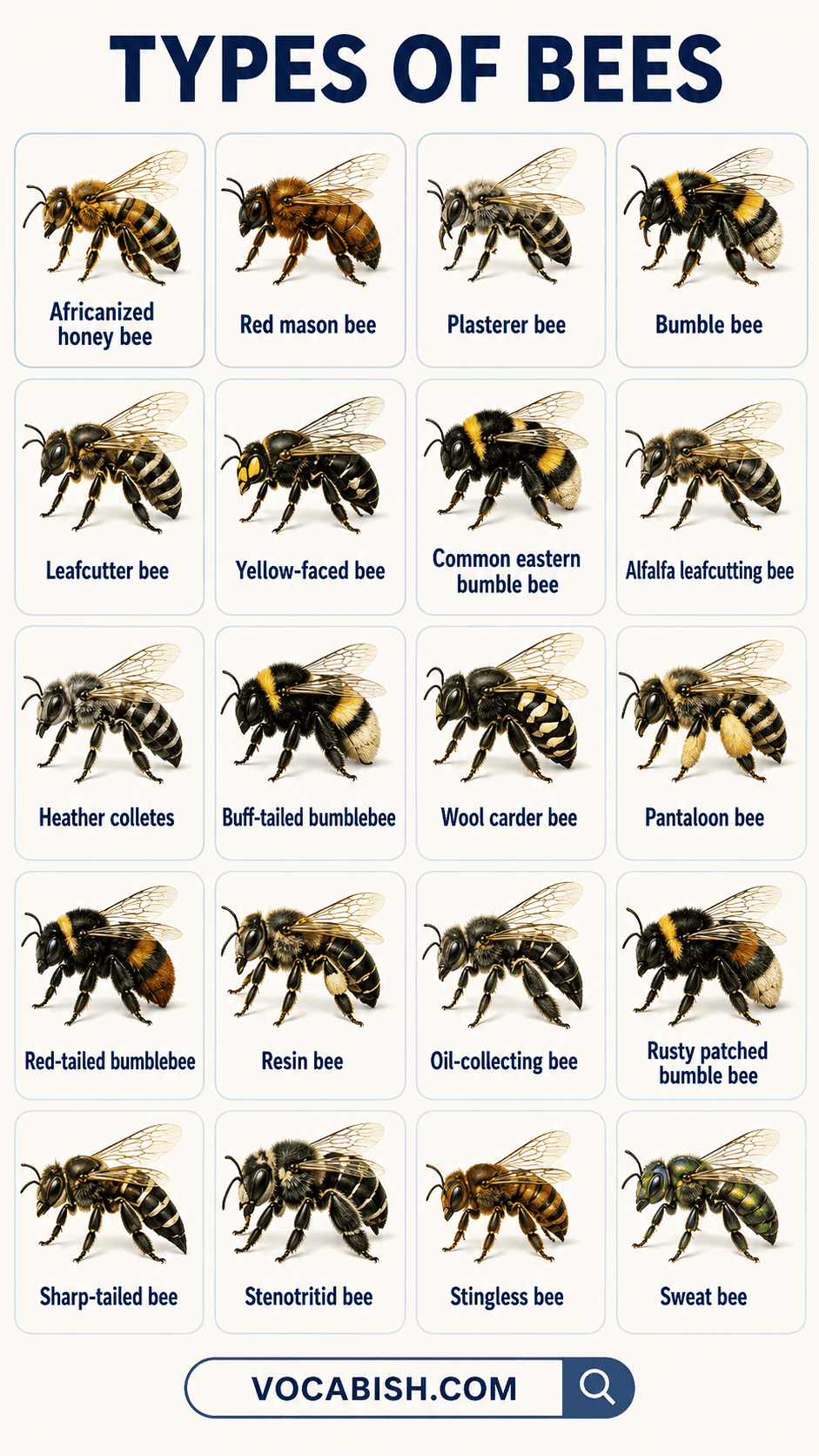
Africanized honey bee | Red mason bee | Plasterer bee |
Bumble bee | Leafcutter bee | Yellow-faced bee |
Common eastern bumble bee | Alfalfa leafcutting bee | Heather colletes |
Buff-tailed bumblebee | Wool carder bee | Pantaloon bee |
Red-tailed bumblebee | Resin bee | Oil-collecting bee |
Rusty patched bumble bee | Sharp-tailed bee | Stenotritid bee |
Stingless bee | Sweat bee | |
Large carpenter bee | Metallic green sweat bee |
Types of Bees by Scientific Family
Apidae
Apidae is the largest and most varied bee family. It includes social honey bees, bumblebees and stingless bees, alongside solitary carpenter, digger, long-horned and orchid bees and numerous nest-parasitic species. The eight listed Apis species are recognised honey bees, while Africanized honey bees are hybrid western honey bee populations rather than a separate species.
Honey Bees, Bumblebees, Carpenter Bees, and Related Groups
- Western honey bee (Apis mellifera): Globally managed species forming perennial colonies and producing substantial honey stores.
- Eastern honey bee (Apis cerana): Asian cavity-nester managed regionally for honey, wax, and crop pollination.
- Giant honey bee (Apis dorsata): Large Asian species building exposed single combs beneath branches and cliffs.
- Himalayan giant honey bee (Apis laboriosa): High-altitude giant nesting openly on Himalayan cliffs despite cold conditions.
- Red dwarf honey bee (Apis florea): Small Asian honey bee constructing exposed combs on shrubs and trees.
- Black dwarf honey bee (Apis andreniformis): Small, dark Asian species nesting openly and defending compact colonies.
- Koschevnikov’s honey bee (Apis koschevnikovi): Reddish Southeast Asian cavity-nester associated mainly with tropical forest habitats.
- Philippine honey bee (Apis nigrocincta): Cavity-nesting island species recognised by reddish legs and body markings.
- Africanized honey bee (Apis mellifera hybrids): Hybrid western honey bees showing strong nest defence in warmer regions.
- Bumble bee (Bombus species): Robust, hairy social bee using buzz pollination on many flowers.
- Common eastern bumble bee (Bombus impatiens): Widespread North American species commonly managed for greenhouse crop pollination.
- Buff-tailed bumblebee (Bombus terrestris): Large European species with golden bands and a pale tail.
- Red-tailed bumblebee (Bombus lapidarius): Dark-bodied European bumblebee recognised by its bright reddish tail tip.
- Rusty patched bumble bee (Bombus affinis): North American species identified by rusty markings on worker abdomens.
- Stingless bee (tribe Meliponini): Tropical social bees with reduced stingers, living in perennial colonies.
- Large carpenter bee (Xylocopa species): Large-bodied bee excavating nesting tunnels inside dead wood or timber.
- Small carpenter bee (Ceratina species): Slender bee nesting within pithy stems rather than excavating hardwood.
- Digger bee (Anthophora species): Fast-flying solitary bee nesting underground, often near spring flower patches.
- Long-horned bee (tribe Eucerini): Male bees possess unusually long antennae; females usually nest underground.
- Squash bee (Eucera pruinosa): Specialist pollinator visiting squash blossoms early and nesting in soil.
- Orchid bee (tribe Euglossini): Brilliant tropical bee whose males collect fragrances from orchid flowers.
- Cuckoo bee (subfamily Nomadinae): Nest parasite laying eggs inside other bees’ provisioned brood cells.
Megachilidae
Megachilidae contains mostly solitary bees with strong mandibles and varied nest-building behaviour. Unlike most other pollen-collecting bees, females generally transport pollen on specialised hairs beneath the abdomen. Mason, leafcutter, carder, and resin bees may use mud, leaves, fibres, or plant resin within their nests.
Mason, Leafcutter, Carder, and Resin Bees
- Mason bee (Osmia species): Solitary cavity-nester using mud or similar materials between brood cells.
- Blue orchard bee (Osmia lignaria): Metallic mason bee managed for efficient spring orchard crop pollination.
- Red mason bee (Osmia bicornis): European mason bee nesting in cavities and pollinating spring fruit trees.
- Leafcutter bee (Megachile species): Solitary bee cutting leaf pieces to line underground or cavity nests.
- Alfalfa leafcutting bee (Megachile rotundata): Managed solitary pollinator widely used for commercial alfalfa seed production.
- Wool carder bee (Anthidium manicatum): Bee scraping plant fibres to build nests inside existing cavities.
- Resin bee (various megachilid genera): Solitary megachilid collecting plant resin to construct and seal nests.
- Sharp-tailed bee (Coelioxys species): Cuckoo megachilid with pointed abdomen, invading nearby leafcutter bee nests.
Halictidae
Halictidae includes small or medium-sized ground-nesting bees with exceptionally varied social systems. Members range from solitary species to bees living in organised colonies, while several lineages are nest parasites. Colours vary from dark brown to brilliant metallic green.
Sweat Bees, Alkali Bees, and Furrow Bees
- Sweat bee (family Halictidae): Small ground-nester sometimes attracted to salts found in human perspiration.
- Metallic green sweat bee (tribe Augochlorini): Shimmering green halictid usually nesting underground and visiting varied flowers.
- Alkali bee (Nomia melanderi): Gregarious ground-nester commercially managed for pollinating alfalfa seed crops efficiently.
- Furrow bee (Lasioglossum and Halictus species): Small halictid nesting in soil, with solitary or social lifestyles.
- Blood bee (Sphecodes species): Red-bodied cuckoo bee entering sweat bee nests to exploit provisions.
- Night-flying sweat bee (Megalopta species): Large-eyed tropical halictid foraging during twilight or genuinely dark nights.
Andrenidae
Andrenidae consists primarily of solitary ground-nesting bees. Most mining bees belong to the large genus Andrena, while the family also contains minute Perdita species, including some of the world’s smallest bees.
Mining and Fairy Bees
- Mining bee (Andrena species): Solitary ground-nester excavating burrows, often appearing during early spring blooms.
- Ashy mining bee (Andrena cineraria): Black-and-grey European mining bee forming conspicuous nesting aggregations in soil.
- Tawny mining bee (Andrena fulva): Fox-coloured female emerges in spring and nests beneath short vegetation.
- Fairy bee (Perdita species): Minute Perdita bee, often specialised on flowers in arid landscapes.
Ashy and tawny mining bees are common European examples of the wider Andrena group. Their visible soil entrances may occur close together, although individual females normally maintain separate brood tunnels.
Colletidae
Colletidae are mainly solitary bees known for waterproofing brood cells with transparent secretions. Plasterer bees commonly nest in soil, while nearly hairless yellow-faced bees often occupy hollow stems and carry pollen internally.
Plasterer and Yellow-Faced Bees
- Plasterer bee (Colletes species): Ground-nesting bee waterproofing brood cells with transparent, cellophane-like secretions inside nests.
- Yellow-faced bee (Hylaeus species): Small, nearly hairless bee carrying pollen internally and nesting in stems.
- Heather colletes (Colletes succinctus): Late-summer plasterer bee strongly associated with flowering heather habitats locally.
Heather colletes is also called the heather bee or girdled colletes in parts of Britain and Ireland, illustrating how regional common names can vary.
Melittidae
Melittidae is a comparatively small family of solitary, ground-nesting bees. Many members have specialised relationships with particular flowering plants.
Pantaloon and Oil-Collecting Bees
- Pantaloon bee (Dasypoda hirtipes): Female bears long hind-leg hairs and digs nests in sandy soil.
- Oil-collecting bee (Macropis species): Macropis bee gathers floral oils from loosestrife for larval provisions.
The pantaloon bee’s name refers to the conspicuously long pollen-carrying hairs on the female’s hind legs.
Stenotritidae
Stenotritidae is the smallest recognised bee family and is restricted to Australia. Its members are large, fast-flying, solitary bees that normally construct nests in the ground.
Australian Stenotritid Bees
- Stenotritid bee (family Stenotritidae): Large Australian ground-nester belonging to the smallest recognised bee family.
Honey Bees, Bumblebees, Solitary Bees, and Cuckoo Bees Compared
Group | Social Structure | Typical Nest | Key Feature | Honey Storage |
|---|---|---|---|---|
True honey bees | Highly eusocial | Cavities or exposed combs | Wax combs and organised castes | Substantial |
Bumblebees | Usually annual eusocial colonies | Underground or sheltered cavities | Robust bodies and buzz pollination | Small nest reserves |
Stingless bees | Perennial eusocial colonies | Tree or structural cavities | Reduced functional stingers | Yes |
Solitary nest-building bees | Individual females provision nests | Soil, stems, wood, or cavities | No permanent worker caste | No large reserves |
Cuckoo bees | Parasitic rather than nest-building | Host bees’ nests | Females invade provisioned brood cells | None |
Most bee species do not live in honey-producing colonies. A solitary female normally builds or occupies a nest, gathers provisions, lays eggs, and seals each brood cell without assistance from worker bees. Some solitary species still form dense nesting aggregations.
How to Identify Different Types of Bees
- Examine body shape and hair. Bumblebees are generally stout and densely hairy, while yellow-faced and many cuckoo bees appear smoother or more wasp-like.
- Look for pollen-carrying structures. Honey bees and bumblebees use hind-leg baskets, megachilids carry pollen beneath the abdomen, and yellow-faced bees transport it internally.
- Observe the nest entrance. Mining and sweat bees use soil, carpenter bees occupy wood or stems, and mason or leafcutter bees often use existing cavities.
- Notice building materials. Mud suggests mason bees, circular leaf pieces indicate leafcutters, and plant fibres may reveal carder bees.
- Record season, flowers, and location. Many species emerge alongside particular plants and may occur only within restricted geographical regions.
- Avoid relying on colour alone. Closely related bees can vary significantly, and dependable species identification may require microscopic examination or specialist keys.
Common Confusions About Bees Types
- A bee family is not a single type. Each family contains numerous genera, species, appearances, nesting habits, and social systems.
- Queen, worker, and drone are castes. They are colony roles or sexes, not separate bee species.
- Africanized honey bees are not a distinct species. They are hybrid populations within the western honey bee.
- Solitary does not always mean widely separated. Hundreds of females may nest close together while maintaining independent brood cells.
- “Native bee” depends on location. Western honey bees are native to parts of Europe, Africa, and Asia but were introduced to the Americas.
- Bumblebee spelling varies regionally. “Bumblebee” is common in British English, while many North American authorities use “bumble bee.”
- Hoverflies are not bees. Hoverflies have one functional pair of wings, whereas bees possess two pairs.
Summary of the Seven Bee Families
Family | Key Characteristic | Common Examples | Typical Nesting |
|---|---|---|---|
Apidae | Most varied social and behavioural systems | Honey, bumble, carpenter, orchid bees | Cavities, wood, soil, exposed combs |
Megachilidae | Pollen carried beneath female’s abdomen | Mason, leafcutter, carder bees | Cavities, stems, soil |
Halictidae | Diverse social organisation and metallic colours | Sweat, alkali, furrow bees | Mainly soil |
Andrenidae | Mostly solitary spring-emerging miners | Mining and fairy bees | Soil burrows |
Colletidae | Waterproof brood-cell linings | Plasterer and yellow-faced bees | Soil, stems, wood holes |
Melittidae | Strong floral specialisation | Pantaloon and oil-collecting bees | Soil burrows |
Stenotritidae | Small Australian-only family | Stenotritid bees | Soil burrows |
The seven-family system is the formal scientific framework. Common names such as mason bee, mining bee, or sweat bee are useful for general recognition but do not always correspond neatly to one taxonomic rank.
FAQs About Types of Bees
There are more than 20,000 known bee species worldwide, organised into seven recognised families. This article covers 46 representative groups and species, not every formally described bee currently known to science.
The seven recognised bee families are Apidae, Megachilidae, Halictidae, Andrenidae, Colletidae, Melittidae, and Stenotritidae. Apidae includes many familiar groups, while Stenotritidae is restricted to Australia and remains comparatively small in diversity.
Honey bees are species within the genus Apis, whereas bumblebees belong to Bombus. Honey bees maintain perennial colonies; most bumblebee colonies are annual and rely heavily on buzz pollination in many flowers.
No. Most bee species are solitary, meaning each female builds and provisions her own nest. Some solitary bees nest in dense aggregations, but they do not maintain shared worker castes.
Only true honey bees and certain stingless bees store harvestable quantities of honey. Many other bees consume nectar and pollen but provision individual brood cells instead of maintaining large honey reserves.
Carpenter bees usually have robust bodies and excavate wood or pithy stems. Large carpenter bees often show shiny abdomens, unlike the densely hairy abdomens typical of many familiar wild bumblebees.
Cuckoo bees are nest parasites that place eggs in other bees’ prepared brood cells. Their larvae use the host’s food provisions, so adult females generally lack pollen-carrying structures entirely themselves.
Conclusion
Understanding the types of bees begins with recognising that common names and scientific ranks are not interchangeable. Bees belong to seven families, but familiar names such as honey bee, bumblebee, mason bee, mining bee, and sweat bee may describe a genus, tribe, family, or individual species. The 46 examples above show how bees differ in social behaviour, nesting materials, pollen transport, habitat, and flower choice.
Learning these distinctions makes field observation more accurate and helps gardeners, students, and general readers appreciate pollinator diversity without assuming every bee lives in a hive or produces honey. Reliable species identification should still use regional keys or expert confirmation.
You May Also Like