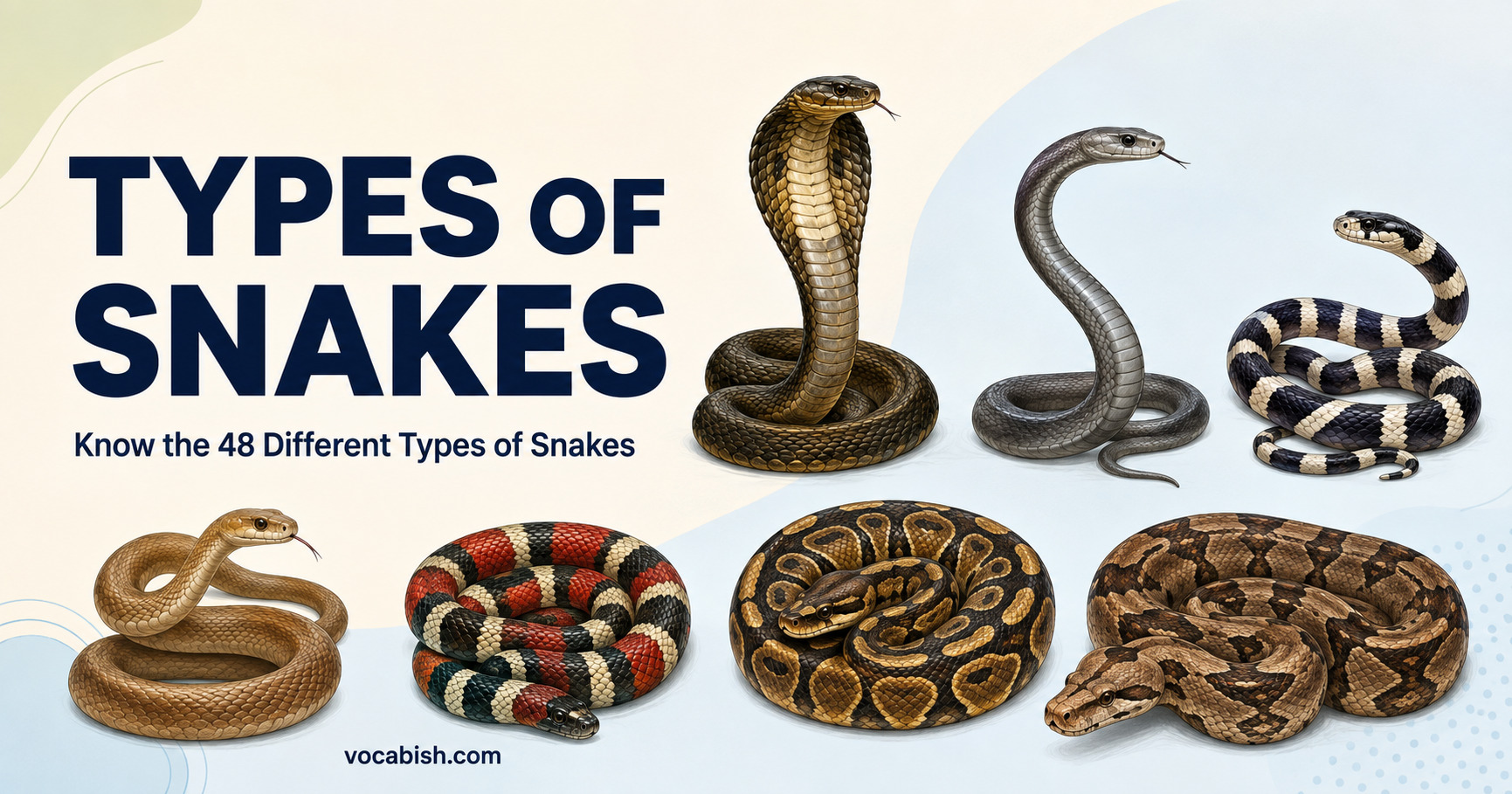

Snakes include boas, pythons, cobras, mambas, rattlesnakes, vipers, garter snakes, sea snakes, and many specialised burrowing species. Scientists recognised 4,249 living snake species as of June 2026, although that number changes as new species are described or existing species are reclassified.
In this blog post, you will learn 48 widely recognised types of snakes. They are organised into practical groups based on scientific relationships, venom-delivery systems, body structure, habitat, and behaviour.
Definition and Scope
Snakes are elongated, limbless reptiles classified within Serpentes, also called Ophidia, in the order Squamata.
The word type is not a formal taxonomic rank. It may describe a species, genus, family, ecological group, or familiar common-name group. For example, the ball python is a species, pythons form a family, and “constrictor” describes a hunting method rather than a scientific family.
This article covers 48 representative common types rather than listing all 4,249 recognised species. Scientific sources may provide different family totals because researchers sometimes treat the same lineage as a family, subfamily, or broader clade.
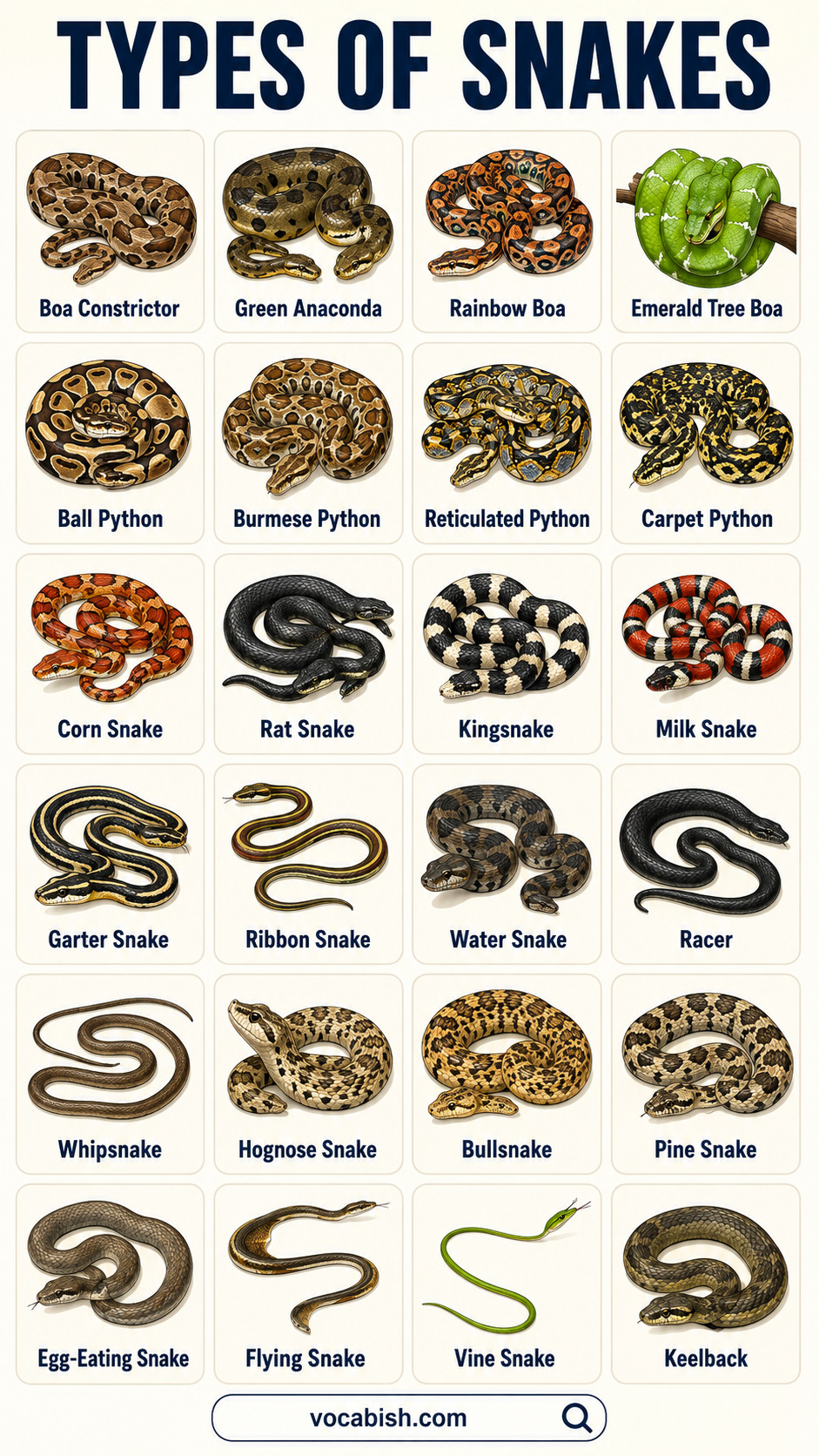
Complete List of 48 Types of Snakes
Boa constrictor | Green anaconda | Rainbow boa |
Emerald tree boa | Ball python | Burmese python |
Reticulated python | Carpet python | Corn snake |
Rat snake | Kingsnake | Milk snake |
Garter snake | Ribbon snake | Water snake |
Racer | Whipsnake | Hognose snake |
Bullsnake | Pine snake | Egg-eating snake |
Flying snake | Vine snake | Keelback |
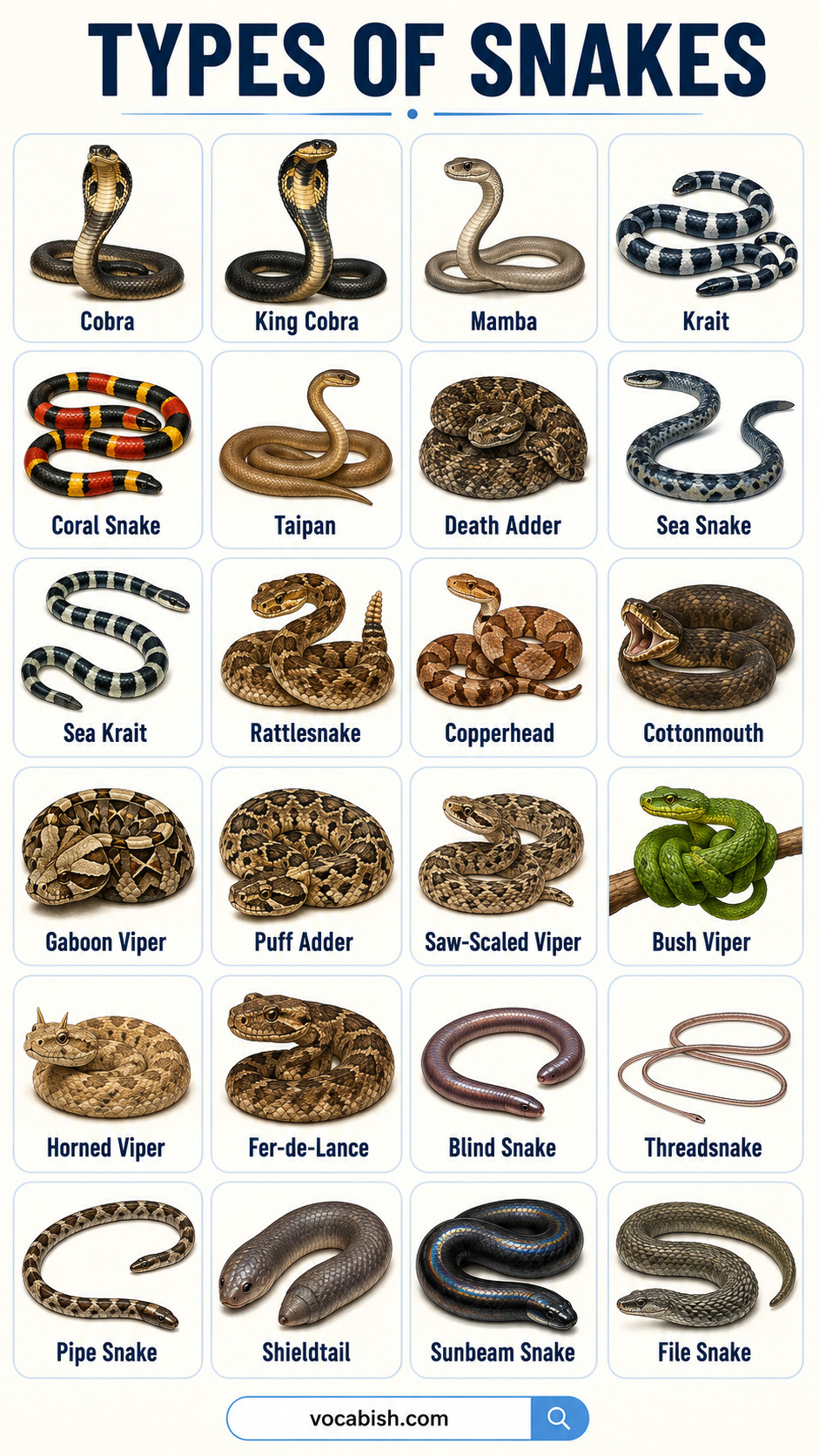
Cobra | King cobra | Mamba |
Krait | Coral snake | Taipan |
Death adder | Sea snake | Sea krait |
Rattlesnake | Copperhead | Cottonmouth |
Gaboon viper | Puff adder | Saw-scaled viper |
Bush viper | Horned viper | Fer-de-lance |
Blind snake | Threadsnake | Pipe snake |
Shieldtail | Sunbeam snake | File snake |
Main Types of Snakes by Classification
The following categories combine scientific relationships with practical identification. Some common names cover several related species, while others refer to one particular species.
Boas and Pythons
Boas belong mainly to the family Boidae, while pythons belong to Pythonidae. Both groups contain muscular, nonvenomous snakes that commonly subdue prey through constriction, but they are separate evolutionary lineages.
- Boa constrictor: Heavy-bodied American constrictor with saddle markings and strong climbing ability.
- Green anaconda: Massive South American boa adapted to rivers, swamps, and flooded forests.
- Rainbow boa: Iridescent South American boa favouring humid forests and small vertebrate prey.
- Emerald tree boa: Arboreal Amazonian boa with vivid green colouring and white markings.
- Ball python: Compact African python known for defensive curling and calm captive behaviour.
- Burmese python: Large Southeast Asian constrictor inhabiting forests, wetlands, grasslands, and waterways.
- Reticulated python: Very long Southeast Asian python recognised by complex netlike markings.
- Carpet python: Variable Australasian python occupying forests, rocky areas, and human settlements.
Green anacondas are boas adapted strongly to aquatic environments, while rainbow boas receive their common name from the light-reflecting iridescence of their scales.
Colubrids and Related Snakes
Colubrids form an exceptionally diverse group. Familiar names such as rat snake, corn snake, racer, and kingsnake usually belong to Colubridae, although modern studies sometimes place related lineages in separate families or subfamilies. Venom systems vary, so “colubrid” should not automatically be treated as meaning harmless.
- Corn snake: Slender North American rat snake with reddish blotches and a checkered belly.
- Rat snake: Mostly nonvenomous rodent hunter, often climbing trees, barns, and buildings.
- Kingsnake: Powerful American constrictor that commonly eats rodents, lizards, and snakes.
- Milk snake: Colorful kingsnake relative whose bands often mimic venomous coral snakes.
- Garter snake: Common North American live-bearing snake associated with gardens and wetlands.
- Ribbon snake: Slender garter-snake relative with bold stripes and strongly semi-aquatic habits.
- Water snake: Robust aquatic colubrid often mistaken for venomous cottonmouths in America.
- Racer: Fast, alert colubrid that actively pursues lizards, rodents, and insects.
- Whipsnake: Long, slender daytime hunter with excellent vision and rapid movement.
- Hognose snake: Upturned snout aids digging; dramatic threat displays often deter predators.
- Bullsnake: Large gopher-snake relative that hisses loudly and controls rodent populations.
- Pine snake: Strong burrowing colubrid favoring sandy habitats, pine woods, and rodents.
- Egg-eating snake: Specialized African and Asian snakes swallow bird eggs without chewing.
- Flying snake: Arboreal Asian colubrid that glides by flattening its body midair.
- Vine snake: Extremely slender tree-dweller using camouflage and binocular vision while hunting.
- Keelback: Often aquatic snakes with ridged scales; venom capability varies by species.
Corn snakes are members of the wider rat-snake group, while milk snakes belong to the kingsnake genus. Milk snakes are harmless but may resemble venomous coral snakes through defensive mimicry.
Elapids
Elapids belong to the family Elapidae. They generally possess short, fixed front fangs and include cobras, mambas, kraits, coral snakes, taipans, and marine elapids. Death adders look similar to vipers but are scientifically elapids.
- Cobra: Front-fanged elapid that spreads a hood during defensive threat displays.
- King cobra: The world’s longest venomous snake, specializing mainly in hunting other snakes.
- Mamba: Fast African elapid with potent venom and mostly arboreal or terrestrial habits.
- Krait: Nocturnal Asian elapid with powerful venom and contrasting banded patterns.
- Coral snake: A small, brightly banded elapid with short fixed fangs and potent venom.
- Taipan: Highly venomous Australasian elapid adapted to grasslands, floodplains, or coasts.
- Death adder: Ambush-hunting Australasian elapid with viper-like body and distinctive tail lure.
- Sea snake: Fully marine elapid with paddle-shaped tail, breathing air at surface.
- Sea krait: Amphibious elapid that hunts underwater but rests and breeds ashore.
The king cobra is not a member of the true cobra genus Naja. It belongs to Ophiophagus and feeds primarily on other snakes.
Vipers and Pit Vipers
Vipers belong to the family Viperidae and possess long, hinged front fangs. Pit vipers form a viper subfamily distinguished by heat-sensitive facial pits between the eye and nostril.
- Rattlesnake: American pit viper identified by segmented tail rattle and heat-sensing pits.
- Copperhead: North American pit viper with coppery head and hourglass body bands.
- Cottonmouth: Semi-aquatic American pit viper displaying a pale mouth when threatened.
- Gaboon viper: Heavy African viper with leaf-like camouflage, large fangs, and broad head.
- Puff adder: Widespread African viper relying on camouflage, ambush, and explosive strikes.
- Saw-scaled viper: Small irritable viper producing rasping sounds by rubbing keeled scales.
- Bush viper: Arboreal African viper with strongly keeled scales and variable colors.
- Horned viper: Desert-adapted viper, often horned above eyes and capable of sidewinding.
- Fer-de-lance: Large American pit viper associated with humid lowlands and agricultural edges.
Gaboon vipers use complex leaf-like patterns to disappear against forest-floor litter. Rattlesnakes combine a segmented warning rattle with heat-sensing facial pits used when locating warm-blooded prey.
Blind, Burrowing, and Specialised Aquatic Snakes
Several early-diverging or highly specialized snake groups live mainly underground or in water. Scientific families include blind snakes, threadsnakes, pipe snakes, shieldtails, sunbeam snakes, and file snakes.
- Blind snake: Tiny burrowing snake with reduced eyes, feeding mainly on social insects.
- Threadsnake: Exceptionally slender burrower eating ant and termite larvae deep underground.
- Pipe snake: Secretive cylindrical burrower with small head and short, patterned tail.
- Shieldtail: An Asian burrowing snake with a reinforced tail tip and earthworm-based diet.
- Sunbeam snake: Iridescent Southeast Asian burrower with smooth scales and wedge-shaped head.
- File snake: An aquatic Asian-Australasian snake with loose skin, rough scales, and a fish diet.
Differences Between the Main Snake Groups
Group | Scientific Relationship | Typical Fang System | Common Hunting Method | Key Distinction |
|---|---|---|---|---|
Boas | Mainly Boidae | No specialised venom fangs | Constriction | Usually bear live young |
Pythons | Pythonidae | No specialised venom fangs | Constriction | Generally lay eggs |
Colubrids and relatives | Several related families | Absent, rear-fanged or specialised | Grabbing, swallowing or constriction | Extremely varied group |
Elapids | Elapidae | Short fixed front fangs | Venom injection | Includes terrestrial and marine snakes |
Vipers | Viperidae | Long hinged front fangs | Ambush and venom injection | Includes true vipers and pit vipers |
Blind and burrowing snakes | Several ancient families | Small, unspecialised mouths | Underground invertebrate feeding | Reduced eyes and cylindrical bodies |
These features describe broad patterns rather than universal rules. Fang structure, reproduction, and hunting behaviour may differ among species within the same major group.
How to Identify Different Types of Snakes
Accurate identification requires several features rather than one visual shortcut.
- Begin with location: Country, region, and habitat greatly reduce possible species.
- Observe from a distance: Never approach, catch, or reposition an unknown snake.
- Check body patterns: Note bands, blotches, stripes, diamonds, and uniform colouring.
- Study body proportions: Compare overall length, thickness, head size, and tail shape.
- Notice scale texture: Smooth, glossy, and strongly keeled scales reflect light differently.
- Consider habitat use: Identify whether it was climbing, swimming, burrowing, or ground-dwelling.
- Record behaviour carefully: Hooding, rattling, or flattening may help but are not conclusive.
- Use local references: Compare photographs through trusted museums or wildlife authorities.
Head shape alone is unreliable because harmless snakes can flatten their heads defensively. Colour patterns can also vary by age, region and individual. Wildlife authorities therefore recommend identifying the complete combination of features instead of relying on a single rule.
Common Confusions You Should Know About
- Type vs species: A species is scientific; “type” may describe any broader group.
- Constrictors: Boas, pythons and kingsnakes constrict prey but belong to different families.
- Venomous vs poisonous: Venom is injected; poison is harmful when touched or eaten.
- Colubrids: Most are harmless, but some species possess venom and rear fangs.
- Triangular heads: Head shape alone cannot prove whether a snake is venomous.
- Colour rhymes: Coral-snake rhymes are regional and unreliable for worldwide identification.
- Sea snakes vs sea kraits: Sea kraits regularly return to land; sea snakes rarely do.
- Anacondas vs pythons: Anacondas are South American boas, not members of the python family.
Summary of the Main Categories
Category | Key Characteristic | Common Examples | Best Known For |
|---|---|---|---|
Boas and pythons | Muscular, mostly nonvenomous constrictors | Anaconda, ball python, boa constrictor | Subduing prey through constriction |
Colubrids and relatives | Highly varied body forms and diets | Corn snake, kingsnake, garter snake | Representing numerous familiar snake groups |
Elapids | Fixed front fangs | Cobra, mamba, taipan | Efficient front-fanged venom delivery |
Vipers | Long hinged front fangs | Rattlesnake, puff adder, copperhead | Ambush hunting and rapid strikes |
Blind and burrowing snakes | Reduced eyes and cylindrical bodies | Blind snake, threadsnake, shield tail | Living and feeding mainly underground |
Specialised aquatic snakes | Adaptations for swimming and aquatic feeding | Sea snake, file snake | Marine or freshwater lifestyles |
Frequently Asked Questions
Scientists recognised 4,249 living snake species in June 2026. The total changes continually as researchers describe new species, combine previously separated populations, or elevate subspecies to full species. This article covers 48 familiar types rather than every recognised species.
The main practical groups are boas, pythons, colubrids and their relatives, elapids, vipers, blind snakes, and other specialised burrowing or aquatic groups. These categories combine family relationships with visible features, venom systems, and lifestyles.
Boas and pythons belong to separate families. Most boas give birth to live young, while most pythons lay eggs. Both groups include powerful constrictors, but their natural ranges and evolutionary histories differ.
No, many snake species do not possess a medically significant venom-delivery system. Boas and pythons subdue prey through constriction, while numerous other snakes seize or swallow small prey directly. Venom capability should always be assessed at the species level.
Cobras, king cobras, mambas, kraits, coral snakes, taipans, death adders, sea snakes, and sea kraits are elapids. Members generally possess fixed front fangs, although their body shapes, habitats, and venom effects differ considerably.
All pit vipers are vipers, but not all vipers are pit vipers. Pit vipers possess heat-sensitive facial pits between their eyes and nostrils. True vipers lack these specialised pits but retain the hinged front-fang system characteristic of Viperidae.
Key Takeaways
- Scientists recognised 4,249 living snake species in June 2026.
- The 48 names covered here represent species, genera, and common groups.
- Boas, pythons, elapids, vipers, and colubrids are scientifically distinct lineages.
- Constriction, venom use, and aquatic living are behaviours, not single taxonomic categories.
- Reliable identification depends on location, markings, scales, proportions, and expert references.
- Never handle an unknown snake, even when it appears harmless or inactive.
Conclusion
Understanding the different types of snakes requires separating scientific classifications from familiar common names. Boas and pythons are mostly recognised as constrictors; elapids possess fixed front fangs, and vipers use long, hinged fangs. Colubrids and related groups show far greater variation, while blind snakes, shieldtails, and file snakes demonstrate specialised underground or aquatic lifestyles.
Learning these categories makes it easier to recognise important differences in appearance, habitat, and behaviour. However, no short list can represent all 4,249 known species. When identifying types of snakes in the wild, use regional references, observe from a safe distance, and avoid relying on head shape or colour alone.
You May Also Like