
Have you ever wondered how people said one, ten, fifty, or one hundred in Old English? Old English numbers may look unfamiliar at first, but many are surprisingly close to the number words we use today.
Words such as ān (one), fīf (five), twelf (twelve), and hund (hundred) help show how Modern English developed from earlier forms. Once you understand a few pronunciation rules and counting patterns, numbers from 1 to 100 become much easier to recognize.
Old English spelling was not completely uniform, so the same numeral can appear in different forms in manuscripts and modern editions. The forms below mainly follow common West Saxon and normalized scholarly spellings.
Old English Numbers at a Glance
Old English used cardinal numerals for counting, just as Modern English uses one, two, three, and so on. Several modern number words are direct descendants of these earlier forms.
Modern English | Old English |
|---|---|
One | ān |
Two | twēgen / twā / tū |
Three | þrīe / þrēo |
Four | fēower |
Five | fīf |
Six | siex / six |
Seven | seofon |
Eight | eahta |
Nine | nigon |
Ten | tīen |
Twenty | twēntig |
Thirty | þrītig |
Forty | fēowertig |
Fifty | fīftig |
Sixty | siextig |
Seventy | hundseofontig |
Eighty | hundeahtatig |
Ninety | hundnigontig |
One hundred | hund |
These forms are supported by traditional Old English grammars, which also show that twēgen/twā and þrīe/þrēo changed according to grammatical gender.
How to Pronounce Old English Numbers
Old English pronunciation differs from Modern English, so reading the words exactly as modern spelling can be misleading.
The pronunciations in this article are learner-friendly approximations, not strict International Phonetic Alphabet transcriptions.
A few rules will help:
- ā = a long “ah” sound
- ē = approximately a long “ay” sound
- ī = long “ee”
- þ = “th,” usually like thin in these number forms
- eo = a two-part vowel, roughly “eh-oh”
- ea = another two-part vowel sound
- h after a vowel can sound like the ch in Scottish loch
- -tig was not pronounced exactly like modern “tig”; in many forms its final sound was closer to -tee-y
- A macron such as the line over ā, ē, or ī marks a long vowel in modern edited texts.
Old English vowel length mattered, and letters such as þ and ð could both represent “th” sounds.
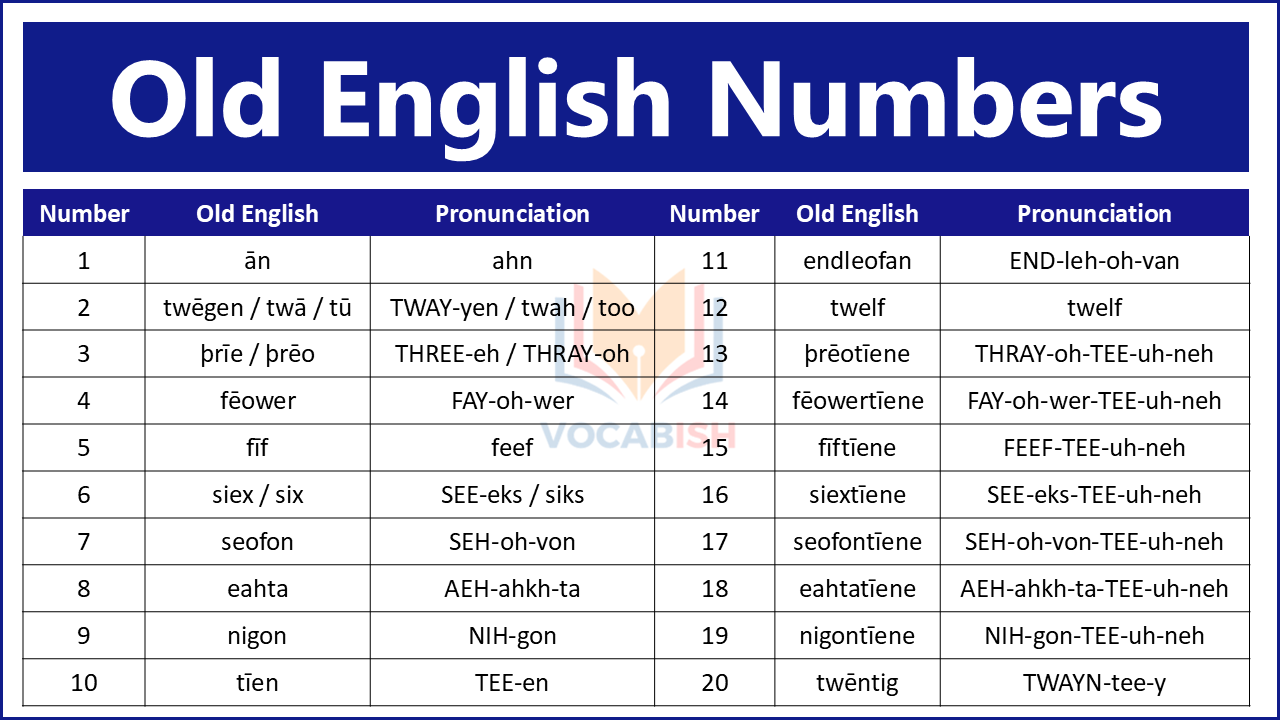
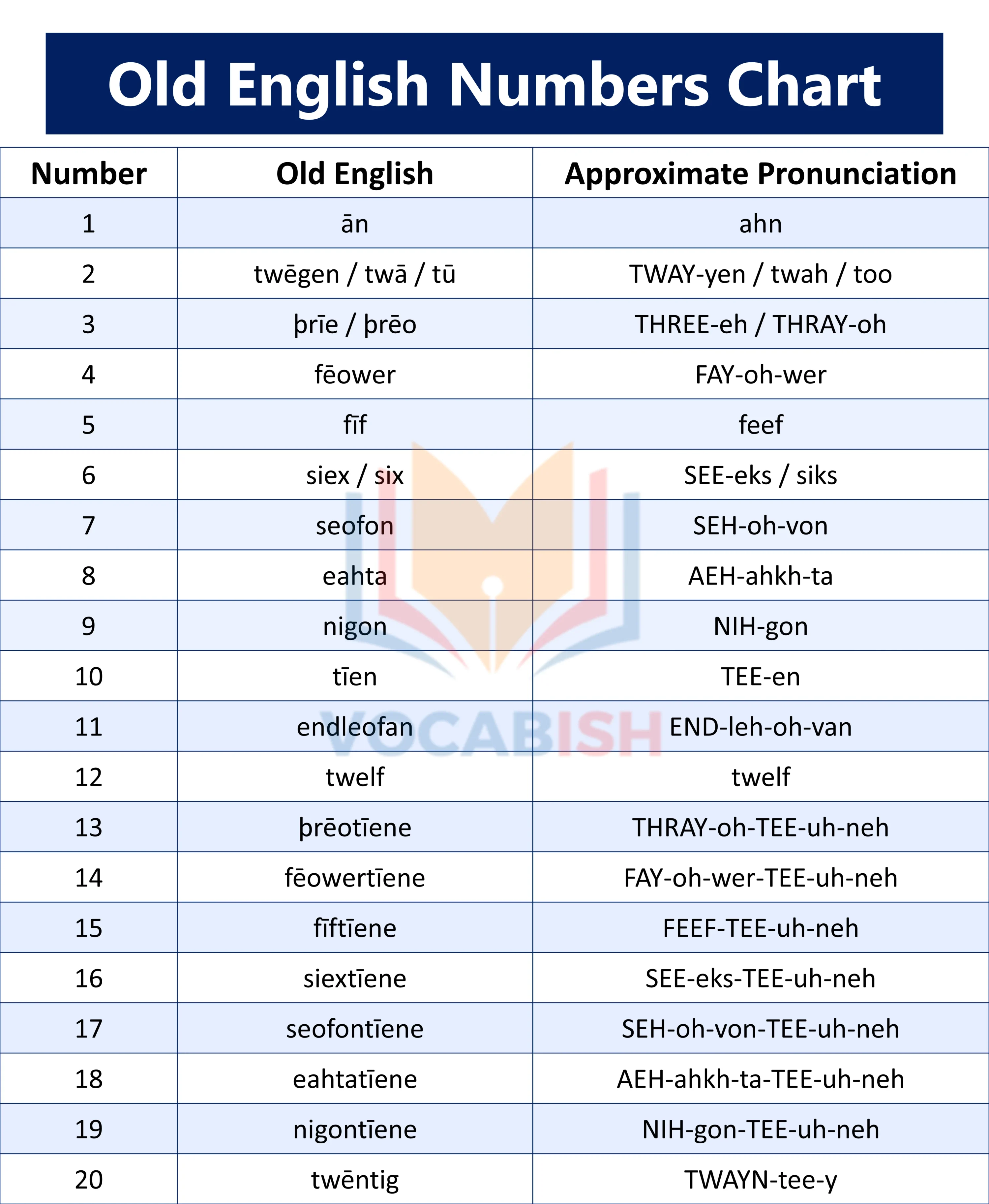
Old English Numbers 1–10
The first ten numbers are the foundation for the rest of the counting system. Several already resemble their Modern English descendants.
Number | Old English | Approximate Pronunciation |
|---|---|---|
1 | ān | ahn |
2 | twēgen / twā / tū | TWAY-yen / twah / too |
3 | þrīe / þrēo | THREE-eh / THRAY-oh |
4 | fēower | FAY-oh-wer |
5 | fīf | feef |
6 | siex / six | SEE-eks / siks |
7 | seofon | SEH-oh-von |
8 | eahta | AEH-ahkh-ta |
9 | nigon | NIH-gon |
10 | tīen | TEE-en |
Notice how close some words are to Modern English:
- fīf → five
- six → six
- seofon → seven
- nigon → nine
- tīen → ten
The pronunciation of seofon, for example, is reconstructed approximately as /ˈseo.fon/, with the f often voiced between vowels.
Numbers 11–20 in Old English
Eleven and twelve have their own forms. Numbers thirteen through nineteen use forms related to the smaller number plus a word element connected with ten.
Number | Old English | Approximate Pronunciation |
|---|---|---|
11 | endleofan | END-leh-oh-van |
12 | twelf | twelf |
13 | þrēotīene | THRAY-oh-TEE-uh-neh |
14 | fēowertīene | FAY-oh-wer-TEE-uh-neh |
15 | fīftīene | FEEF-TEE-uh-neh |
16 | siextīene | SEE-eks-TEE-uh-neh |
17 | seofontīene | SEH-oh-von-TEE-uh-neh |
18 | eahtatīene | AEH-ahkh-ta-TEE-uh-neh |
19 | nigontīene | NIH-gon-TEE-uh-neh |
20 | twēntig | TWAYN-tee-y |
The structure of þrēotīene “thirteen” can clearly be seen as a form related to three + ten. Its reconstructed pronunciation contains two distinct parts rather than sounding like modern thirteen.
Why Eleven and Twelve Are Different
Old English endleofan became Modern English eleven, while twelf developed into twelve.
These words did not follow the regular thirteen-to-nineteen pattern.
Endleofan was pronounced approximately /ˈendˌleo.fɑn/, which explains why its written form looks quite different from modern eleven.
Old English Numbers 21–100 with Pronunciation
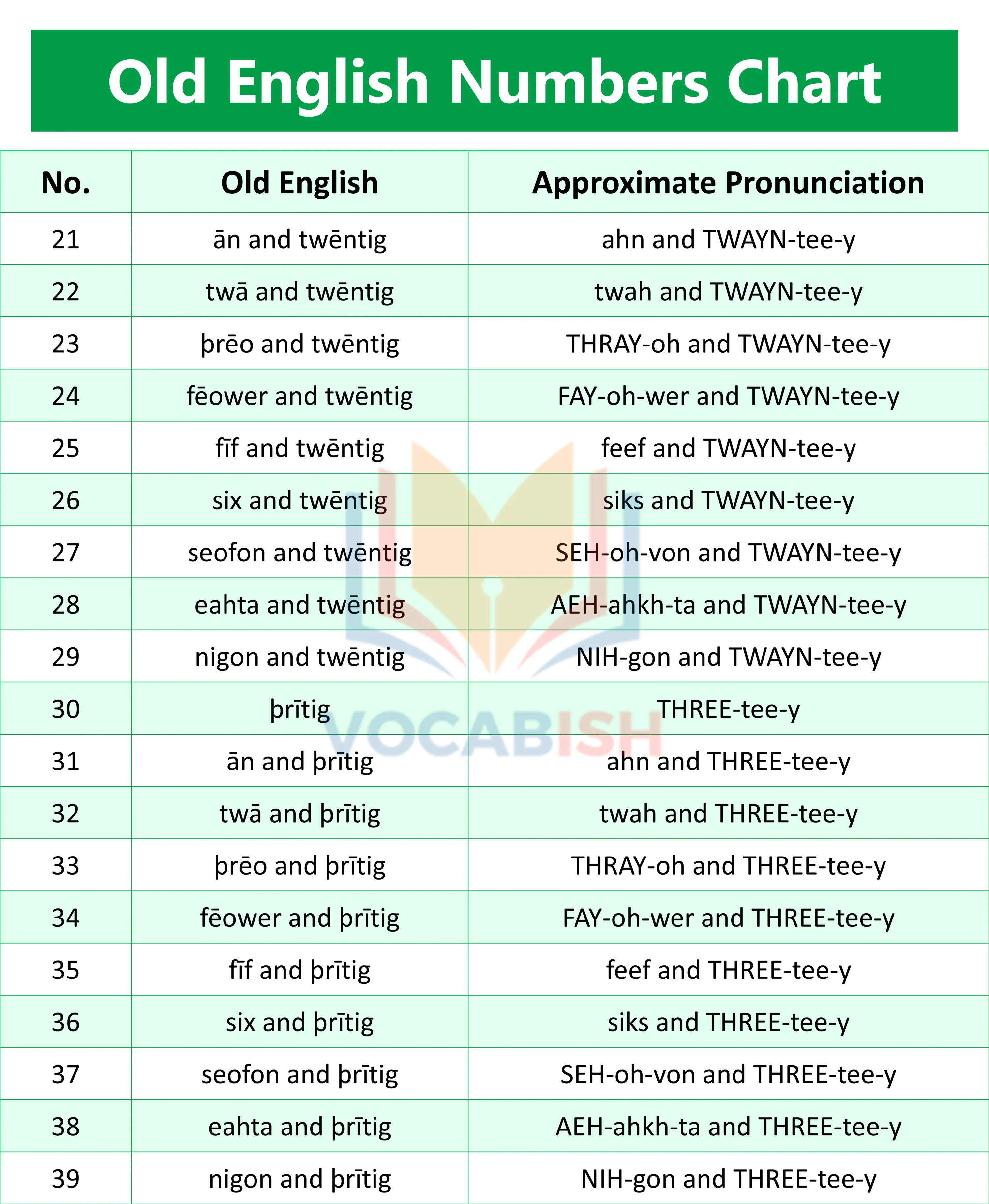
Numbers above twenty become much easier when you know the tens. A common Old English pattern places the smaller number before the multiple of ten.
For example:
ān and twēntig = one and twenty = 21
A traditional Old English grammar records ān ond twēntig for twenty-one.
Old English Numbers 21–29
No. | Old English | Approximate Pronunciation |
|---|---|---|
21 | ān and twēntig | ahn and TWAYN-tee-y |
22 | twā and twēntig | twah and TWAYN-tee-y |
23 | þrēo and twēntig | THRAY-oh and TWAYN-tee-y |
24 | fēower and twēntig | FAY-oh-wer and TWAYN-tee-y |
25 | fīf and twēntig | feef and TWAYN-tee-y |
26 | six and twēntig | siks and TWAYN-tee-y |
27 | seofon and twēntig | SEH-oh-von and TWAYN-tee-y |
28 | eahta and twēntig | AEH-ahkh-ta and TWAYN-tee-y |
29 | nigon and twēntig | NIH-gon and TWAYN-tee-y |
Old English Numbers 30–39
30 = þrītig, the ancestor of Modern English thirty.
No. | Old English | Approximate Pronunciation |
|---|---|---|
30 | þrītig | THREE-tee-y |
31 | ān and þrītig | ahn and THREE-tee-y |
32 | twā and þrītig | twah and THREE-tee-y |
33 | þrēo and þrītig | THRAY-oh and THREE-tee-y |
34 | fēower and þrītig | FAY-oh-wer and THREE-tee-y |
35 | fīf and þrītig | feef and THREE-tee-y |
36 | six and þrītig | siks and THREE-tee-y |
37 | seofon and þrītig | SEH-oh-von and THREE-tee-y |
38 | eahta and þrītig | AEH-ahkh-ta and THREE-tee-y |
39 | nigon and þrītig | NIH-gon and THREE-tee-y |
Old English Numbers 40–49
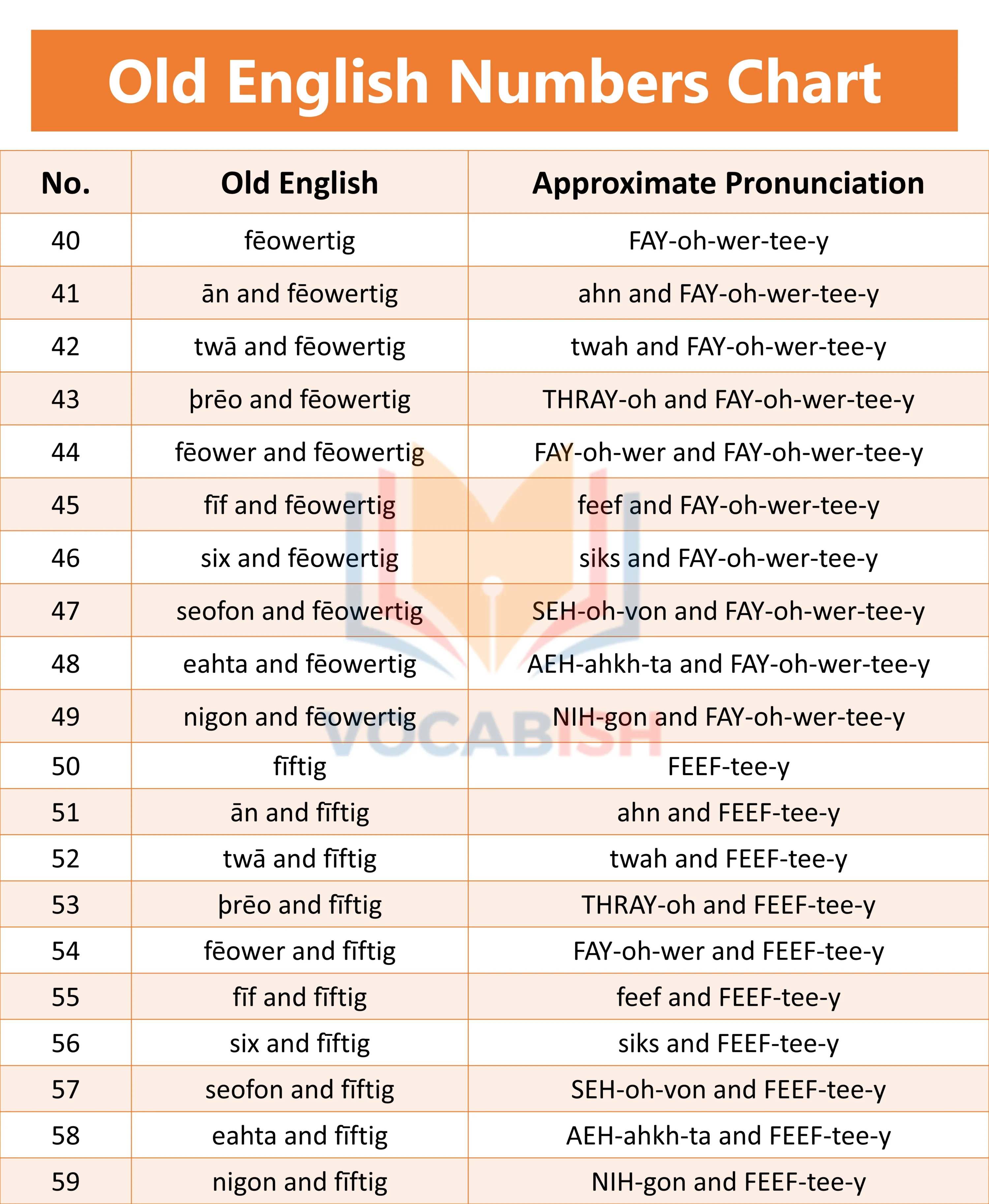
40 = fēowertig
This word still clearly contains fēower, meaning “four.”
No. | Old English | Approximate Pronunciation |
|---|---|---|
40 | fēowertig | FAY-oh-wer-tee-y |
41 | ān and fēowertig | ahn and FAY-oh-wer-tee-y |
42 | twā and fēowertig | twah and FAY-oh-wer-tee-y |
43 | þrēo and fēowertig | THRAY-oh and FAY-oh-wer-tee-y |
44 | fēower and fēowertig | FAY-oh-wer and FAY-oh-wer-tee-y |
45 | fīf and fēowertig | feef and FAY-oh-wer-tee-y |
46 | six and fēowertig | siks and FAY-oh-wer-tee-y |
47 | seofon and fēowertig | SEH-oh-von and FAY-oh-wer-tee-y |
48 | eahta and fēowertig | AEH-ahkh-ta and FAY-oh-wer-tee-y |
49 | nigon and fēowertig | NIH-gon and FAY-oh-wer-tee-y |
The reconstructed pronunciation of fēowertig is approximately /ˈfeoː.wer.tij/.
Old English Numbers 50–59
50 = fīftig
The relationship between fīf and fīftig is easy to see.
No. | Old English | Approximate Pronunciation |
|---|---|---|
50 | fīftig | FEEF-tee-y |
51 | ān and fīftig | ahn and FEEF-tee-y |
52 | twā and fīftig | twah and FEEF-tee-y |
53 | þrēo and fīftig | THRAY-oh and FEEF-tee-y |
54 | fēower and fīftig | FAY-oh-wer and FEEF-tee-y |
55 | fīf and fīftig | feef and FEEF-tee-y |
56 | six and fīftig | siks and FEEF-tee-y |
57 | seofon and fīftig | SEH-oh-von and FEEF-tee-y |
58 | eahta and fīftig | AEH-ahkh-ta and FEEF-tee-y |
59 | nigon and fīftig | NIH-gon and FEEF-tee-y |
Old English Numbers 60–69
The usual form for sixty is siextig, although spelling variants occur.
No. | Old English | Approximate Pronunciation |
|---|---|---|
60 | siextig | SEE-eks-tee-y |
61 | ān and siextig | ahn and SEE-eks-tee-y |
62 | twā and siextig | twah and SEE-eks-tee-y |
63 | þrēo and siextig | THRAY-oh and SEE-eks-tee-y |
64 | fēower and siextig | FAY-oh-wer and SEE-eks-tee-y |
65 | fīf and siextig | feef and SEE-eks-tee-y |
66 | six and siextig | siks and SEE-eks-tee-y |
67 | seofon and siextig | SEH-oh-von and SEE-eks-tee-y |
68 | eahta and siextig | AEH-ahkh-ta and SEE-eks-tee-y |
69 | nigon and siextig | NIH-gon and SEE-eks-tee-y |
Old English Numbers 70–79
Seventy often appears as hundseofontig.
No. | Old English | Approximate Pronunciation |
|---|---|---|
70 | hundseofontig | hund-SEH-oh-von-tee-y |
71 | ān and hundseofontig | ahn and hund-SEH-oh-von-tee-y |
72 | twā and hundseofontig | twah and hund-SEH-oh-von-tee-y |
73 | þrēo and hundseofontig | THRAY-oh and hund-SEH-oh-von-tee-y |
74 | fēower and hundseofontig | FAY-oh-wer and hund-SEH-oh-von-tee-y |
75 | fīf and hundseofontig | feef and hund-SEH-oh-von-tee-y |
76 | six and hundseofontig | siks and hund-SEH-oh-von-tee-y |
77 | seofon and hundseofontig | SEH-oh-von and hund-SEH-oh-von-tee-y |
78 | eahta and hundseofontig | AEH-ahkh-ta and hund-SEH-oh-von-tee-y |
79 | nigon and hundseofontig | NIH-gon and hund-SEH-oh-von-tee-y |
Shorter forms such as seofontig also existed. The fuller hundseofontig is well documented in Old English texts.
Old English Numbers 80–89
Eighty commonly appears as hundeahtatig.
No. | Old English | Approximate Pronunciation |
|---|---|---|
80 | hundeahtatig | hund-AEH-ahkh-ta-tee-y |
81 | ān and hundeahtatig | ahn and hund-AEH-ahkh-ta-tee-y |
82 | twā and hundeahtatig | twah and hund-AEH-ahkh-ta-tee-y |
83 | þrēo and hundeahtatig | THRAY-oh and hund-AEH-ahkh-ta-tee-y |
84 | fēower and hundeahtatig | FAY-oh-wer and hund-AEH-ahkh-ta-tee-y |
85 | fīf and hundeahtatig | feef and hund-AEH-ahkh-ta-tee-y |
86 | six and hundeahtatig | siks and hund-AEH-ahkh-ta-tee-y |
87 | seofon and hundeahtatig | SEH-oh-von and hund-AEH-ahkh-ta-tee-y |
88 | eahta and hundeahtatig | AEH-ahkh-ta and hund-AEH-ahkh-ta-tee-y |
89 | nigon and hundeahtatig | NIH-gon and hund-AEH-ahkh-ta-tee-y |
Old English Numbers 90–100
Ninety commonly appears as hundnigontig, while one hundred can simply be hund.
No. | Old English | Approximate Pronunciation |
|---|---|---|
90 | hundnigontig | hund-NIH-gon-tee-y |
91 | ān and hundnigontig | ahn and hund-NIH-gon-tee-y |
92 | twā and hundnigontig | twah and hund-NIH-gon-tee-y |
93 | þrēo and hundnigontig | THRAY-oh and hund-NIH-gon-tee-y |
94 | fēower and hundnigontig | FAY-oh-wer and hund-NIH-gon-tee-y |
95 | fīf and hundnigontig | feef and hund-NIH-gon-tee-y |
96 | six and hundnigontig | siks and hund-NIH-gon-tee-y |
97 | seofon and hundnigontig | SEH-oh-von and hund-NIH-gon-tee-y |
98 | eahta and hundnigontig | AEH-ahkh-ta and hund-NIH-gon-tee-y |
99 | nigon and hundnigontig | NIH-gon and hund-NIH-gon-tee-y |
100 | hund | hund |
Other attested forms for one hundred include hundred and hundtēontig, but hund provides the clearest basic form for learners. Traditional grammar lists hund for 100.
How Old English Numbers Above 20 Were Formed
Once you know the basic numbers and the tens, much of the system follows a recognizable pattern.
Instead of the usual Modern English order:
twenty-one
Old English could say:
ān and twēntig
Literally:
one + and + twenty
The pattern continues:
- twā and twēntig = 22
- þrēo and þrītig = 33
- fēower and fēowertig = 44
- fīf and fīftig = 55
- six and siextig = 66
So the structure can be represented as:
unit + and + tens
This older ordering survived for centuries after the Old English period and has parallels in several other Germanic languages.
The Meaning of -tig in Old English Numbers
The ending -tig is found in many multiples of ten:
- twēntig
- þrītig
- fēowertig
- fīftig
- siextig
It developed into the Modern English -ty ending seen in twenty, thirty, forty, and fifty.
That means the relationship between Old and Modern English is easier to see when the words are placed side by side.
Old English | Modern English |
|---|---|
twēntig | twenty |
þrītig | thirty |
fēowertig | forty |
fīftig | fifty |
siextig | sixty |
The reconstructed pronunciation of twēntig is approximately /ˈtweːn.tij/, showing why the ending should not be read like modern English tig.
Why 70, 80, and 90 Look Different
One of the strangest features for learners appears at seventy.
The traditional forms include:
- 70 — hundseofontig
- 80 — hundeahtatig
- 90 — hundnigontig
The element hund- occurs before the tens expression in these forms.
Shorter forms also developed or occur in Old English material:
- seofontig
- eahtatig
- nigontig
So seeing seofontig instead of hundseofontig does not necessarily mean one source is wrong. Old English had dialectal, chronological, and spelling variation.
Old English Numbers vs Modern English
Many Modern English numerals become easier to understand when their Old English ancestors are placed beside them.
Old English | Modern English | What Changed? |
|---|---|---|
ān | one | spelling and vowel changed |
twā / twēgen | two | forms were reduced |
þrīe / þrēo | three | spelling became simpler |
fēower | four | middle sounds disappeared |
fīf | five | final f became voiced |
six | six | changed very little |
seofon | seven | spelling shortened |
eahta | eight | pronunciation changed greatly |
nigon | nine | middle consonant disappeared |
tīen | ten | vowel shortened |
endleofan | eleven | first part was reduced |
twelf | twelve | final sound changed |
twēntig | twenty | -tig became -ty |
fēowertig | forty | form shortened |
hund | hundred | longer form became dominant |
The comparison shows that Modern English number words are not a newly created system. Many have been continuously reshaped from much older Germanic forms.
One, Two, and Three Had Different Grammatical Forms
The first three Old English numbers need special attention because they could change according to grammar.
One: ān
Ān means “one,” but it could behave like an adjective and change its ending according to case, gender, and number.
It is also the historical source behind Modern English one and the indefinite article an.
Two: twēgen, twā, and tū
Old English did not always use one fixed word for “two.”
Common nominative forms included:
- twēgen — masculine
- twā — feminine
- twā / tū — neuter
Three: þrīe and þrēo
The number three also had gender forms:
- þrīe — masculine
- þrēo — feminine and neuter
Traditional Old English grammar explicitly records these distinctions.
For a learner memorizing a basic counting sequence, you may therefore encounter either:
ān, twēgen, þrīe…
or lists that prefer:
ān, twā, þrēo…
Both reflect genuine Old English forms; their grammatical use differs.
Common Old English Number Spelling Variations
Old English was written for centuries across different regions, so one fixed spelling system should not be expected.
You may encounter variations such as:
Meaning | Possible Forms |
|---|---|
Six | six, siex, syx |
Seven | seofon, syfon, seofun |
Eleven | endleofan, endlefan, endlufon |
Twenty | twentig, twēntig |
Sixty | sixtig, siextig |
Seventy | seofontig, hundseofontig |
Eighty | eahtatig, hundeahtatig |
Ninety | nigontig, hundnigontig |
Hundred | hund, hundred, hundtēontig |
Macrons such as ā and ī are especially worth understanding. They are commonly added by modern editors to show vowel length and were not a universal feature of original Anglo-Saxon manuscripts.
How to Learn Old English Numbers Faster
Memorizing 100 separate words is unnecessary. Learn the system in groups.
Start with these nine:
ān, twā, þrēo, fēower, fīf, six, seofon, eahta, nigon
Then learn:
tīen, endleofan, twelf
Next, learn the teen forms:
þrēotīene → nigontīene
Finally, memorize the tens:
twēntig, þrītig, fēowertig, fīftig, siextig, hundseofontig, hundeahtatig, hundnigontig
After that, numbers such as 24 or 56 can be built from familiar pieces:
24 = fēower and twēntig
56 = six and fīftig
93 = þrēo and hundnigontig
This pattern-based approach reduces the amount of vocabulary you need to memorize.
Common Mistakes with Old English Numbers
A few points cause most learner confusion:
- Do not pronounce þ like the letter p; it represents a “th” sound.
- Do not assume Old English always used modern tens + unit word order.
- Remember that “two” and “three” had different grammatical forms.
- Do not treat macrons such as ī as decorative marks; they indicate vowel length.
- Expect spelling variants because Old English was not written with one completely fixed modern standard.
Quick Old English Counting Practice
Try reading these aloud before checking the answers.
1. What is 5 in Old English?
fīf
2. What is 12?
twelf
3. What is 20?
twēntig
4. What does ān and twēntig mean?
21
5. What does fīf and þrītig mean?
35
6. What does eahta and fīftig mean?
58
7. What is hundseofontig?
70
8. What is hund?
100
FAQs About Old English Numbers
They were ān, twēgen/twā, þrīe/þrēo, fēower, fīf, six/siex, seofon, eahta, nigon, and tīen, with some grammatical and spelling variation.
The usual Old English word for one is ān, pronounced approximately “ahn.” It could also change its form according to grammatical context.
Ten is tīen in a common normalized spelling. The long ī sounds roughly like “ee,” giving an approximate pronunciation of “TEE-en.”
Twenty is twēntig. It was pronounced roughly “TWAYN-tee-y,” and it is the direct historical ancestor of Modern English twenty.
A common form was ān and twēntig, literally “one and twenty.” Old English frequently placed the unit before the multiple of ten.
Seventy can appear as hundseofontig, with shorter seofontig also found. The longer form is well documented in surviving Old English material.
A common word for one hundred is hund. Other recorded forms include hundred and hundtēontig, depending on period and context.
Yes. Dialects, periods, manuscripts, and editorial conventions produced forms such as six/siex, seofontig/hundseofontig, and nigontig/hundnigontig.
Conclusion
Old English numbers become far less intimidating once you recognize their patterns. Start with ān, twā, þrēo, fēower, and fīf, then learn the teens and multiples of ten.
The strongest connection to Modern English can be seen in forms such as twēntig → twenty, þrītig → thirty, fīftig → fifty, and hund → hundred. Learning the numbers from 1–100 also gives you a useful introduction to Old English spelling, pronunciation, grammar, and the history of everyday English vocabulary.
Explore More Old English Related Articles
- How to Speak Words, Phrases, and Sentences in Old English
- Complete Guide on Old English Pronunciation
- Old English Alphabets Explained from A to Z
- 75+ Old English Phrases with Meanings
- Old English Pronouns Explained with Uses