
What would I, you, he, she, we, and they look like if we went back to Anglo-Saxon England? Old English pronouns may look unusual at first, but several are surprisingly close to the words we use today.
For example, Old English ic meant “I,” þū meant “you,” hē meant “he,” and wē meant “we.” Pronouns also changed form according to person, number, grammatical gender, and case. Learning these basic forms makes Old English sentences much easier to recognize and understand.
What Are Old English Pronouns?
Old English pronouns are words that replace nouns or names, much as pronouns do in Modern English. They can refer to the speaker, the listener, another person, an object, or a group.
Modern English uses words such as:
- I
- you
- he
- she
- it
- we
- they
Old English had equivalent words, but its system contained more forms because pronouns changed according to their grammatical role.
For example:
ic = I
þū = you
hē = he
hēo = she
hit = it
wē = we
gē = you, plural
hīe = they
The basic personal-pronoun system is well attested in Old English grammar and texts.
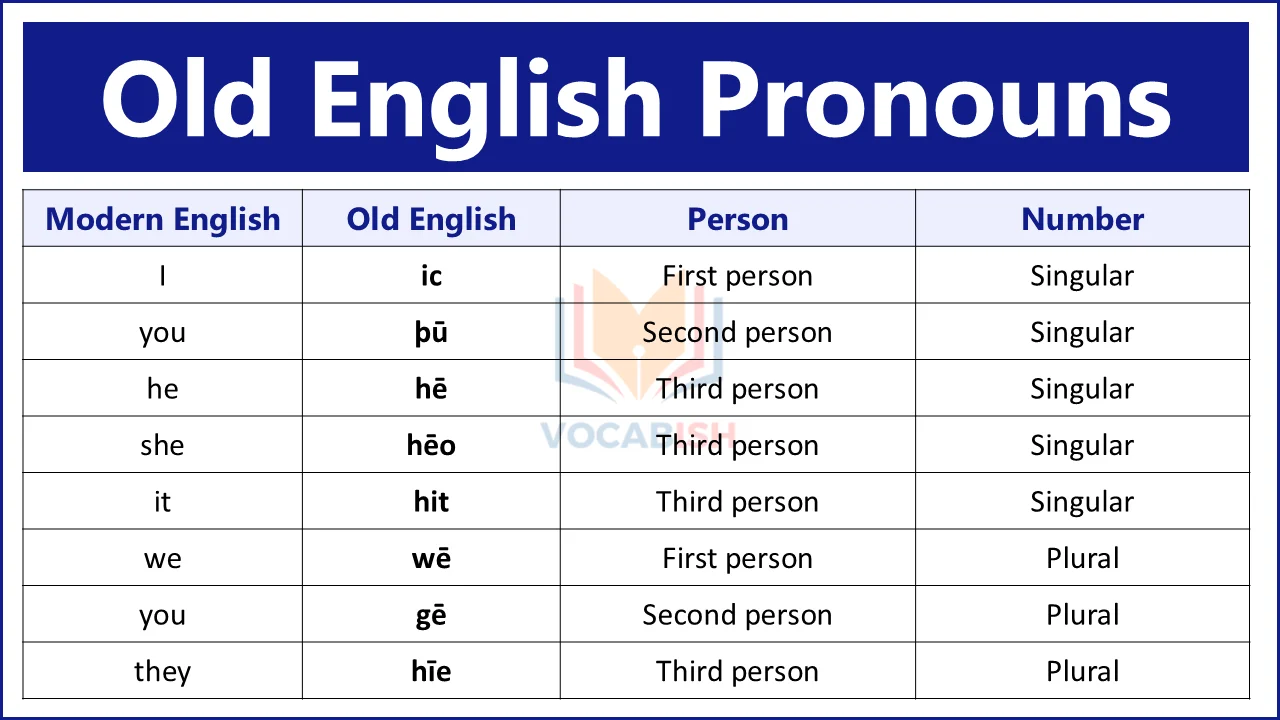
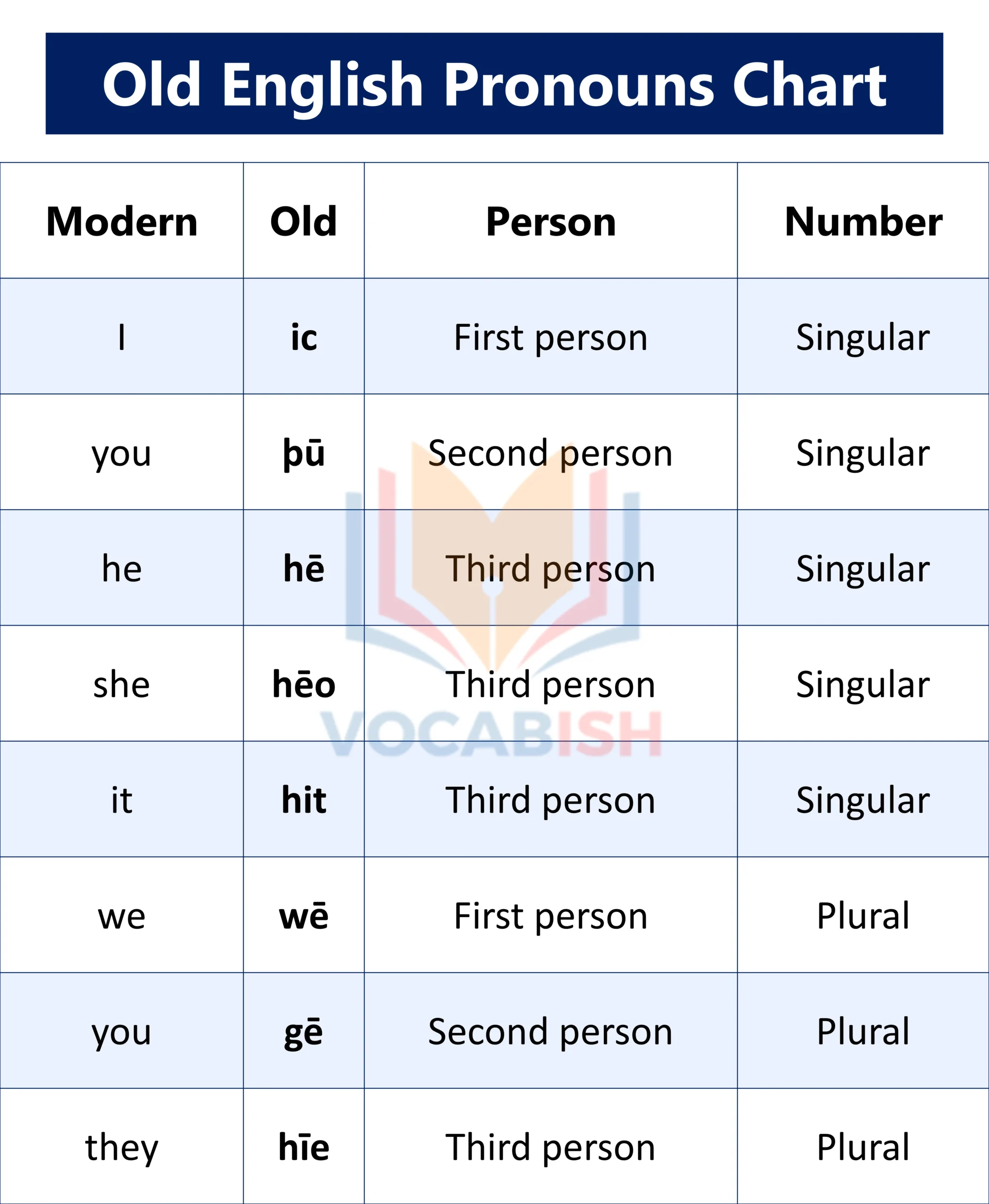
Old English Pronouns at a Glance
Here are the most useful subject forms to learn first.
Modern English | Old English | Person | Number |
|---|---|---|---|
I | ic | First person | Singular |
you | þū | Second person | Singular |
he | hē | Third person | Singular |
she | hēo | Third person | Singular |
it | hit | Third person | Singular |
we | wē | First person | Plural |
you | gē | Second person | Plural |
they | hīe | Third person | Plural |
These are nominative forms, meaning they are normally used as the subject of a sentence.
A useful pattern is:
ic → I
þū → you
hē → he
hēo → she
hit → it
wē → we
gē → you all
hīe → they
How to Say I in Old English
The Old English word for I is ic.
Ic = I
Ic is the first-person singular nominative pronoun. It is used when a speaker refers to himself or herself.
Example:
Ic eom Englisc.
I am English.
Another basic pattern is:
Ic singe.
I sing.
The pronunciation of ic is not the same as the Modern English word “ick.” In many teaching systems, its final sound is explained as being close to the ch in “church,” giving a pronunciation roughly similar to itch.
Its other common case forms include:
Case | Old English | Modern Meaning |
|---|---|---|
Nominative | ic | I |
Accusative | mē | me |
Genitive | mīn | my/mine |
Dative | mē | me |
Notice how mīn is still easy to connect with Modern English mine.
How to Say You in Old English
Old English did not use one word for every type of “you.” It normally distinguished between one person and several people.
Þū = You, Singular
Þū means you when speaking to one person.
Example:
Þū eart gōd.
You are good.
The letter þ is called thorn. Here it represents a th sound, so þū can be pronounced approximately like thoo, with the th of “thin.”
The main singular forms are:
Case | Old English | Modern Meaning |
|---|---|---|
Nominative | þū | you |
Accusative | þē | you |
Genitive | þīn | your/yours |
Dative | þē | you |
The relationship between þīn and later English thine is easy to see.
Gē = You, Plural
When addressing more than one person, Old English commonly used gē.
Example:
Gē sindon frēond.
You are friends.
The initial g here was pronounced differently from the hard g in “go.” In standard teaching pronunciation, gē sounds approximately like ye.
Its forms include:
Case | Old English | Modern Meaning |
|---|---|---|
Nominative | gē | you |
Accusative | ēow | you |
Genitive | ēower | your |
Dative | ēow | you |
Modern English mostly lost this singular–plural distinction and now normally uses you for both.
He, She, and It in Old English
Old English had separate third-person singular pronouns for masculine, feminine, and neuter grammatical gender.
Hē = He
The Old English word for he is hē.
Example:
Hē is cyning.
He is a king.
Its main forms are:
Case | Old English | Modern Meaning |
|---|---|---|
Nominative | hē | he |
Accusative | hine | him |
Genitive | his | his |
Dative | him | him |
Several of these forms survived with surprisingly little change.
hē → he
his → his
him → him
Hēo = She
The common normalized Old English form for she is hēo.
Example:
Hēo is cwēn.
She is a queen.
Its main forms are:
Case | Old English | Modern Meaning |
|---|---|---|
Nominative | hēo | she |
Accusative | hīe / hēo | her |
Genitive | hire | her |
Dative | hire | her |
Different manuscripts and dialects may show variant spellings, so learners can meet forms such as hēo and hīe in different contexts.
Hit = It
Old English hit means it.
Example:
Hit is gōd.
It is good.
Its forms include:
Case | Old English | Modern Meaning |
|---|---|---|
Nominative | hit | it |
Accusative | hit | it |
Genitive | his | its |
Dative | him | it |
The Modern English word it developed from this older form.
One important difference is grammatical gender. Old English nouns could be masculine, feminine, or neuter, and grammatical gender did not always match natural biological sex.
How to Say We in Old English
The Old English word for we is wē.
This is one of the easiest pronouns for Modern English speakers to remember because it looks almost identical.
Example:
Wē sindon frēond.
We are friends.
Its main forms are:
Case | Old English | Modern Meaning |
|---|---|---|
Nominative | wē | we |
Accusative | ūs | us |
Genitive | ūre | our |
Dative | ūs | us |
You can see several familiar connections:
wē → we
ūs → us
ūre → our
The spellings changed over time, but their relationship remains clear.
How to Say They in Old English
The usual normalized Old English pronoun meaning they is hīe, often written hie when vowel length is not marked.
Example:
Hīe sindon gōde.
They are good.
Its case forms include:
Case | Old English | Modern Meaning |
|---|---|---|
Nominative | hīe | they |
Accusative | hīe | them |
Genitive | hira | their |
Dative | him / heom | them |
Several spelling variants occur in surviving Old English material, including forms such as hīe, hī, hȳ, hēo, hira, hiera, and heora.
Modern they, them, and their are therefore not simply unchanged versions of the common Old English third-person plural forms. During Middle English, forms associated with Scandinavian influence became established, while older English plural pronouns declined. Cambridge’s historical discussion notes the transition from Old English hie toward the later they forms.
A Special Feature: “We Two” and “You Two”
Old English had something Modern English has lost: dual pronouns.
A dual pronoun refers specifically to two people, rather than one person or a larger group.
Wit = We Two
wit means approximately:
we two
the two of us
Its forms are:
Case | Form | Meaning |
|---|---|---|
Nominative | wit | we two |
Accusative | unc | us two |
Genitive | uncer | of us two / our |
Dative | unc | to us two |
Git = You Two
git refers specifically to two people being addressed.
Case | Form | Meaning |
|---|---|---|
Nominative | git | you two |
Accusative | inc | you two |
Genitive | incer | your, of you two |
Dative | inc | to you two |
These dual forms existed only in the first and second persons. There was no separate third-person dual pronoun equivalent to “they two.”
This gives Old English a distinction like:
ic = I
wit = we two
wē = we, three or more/general plural
and:
þū = you, one person
git = you two
gē = you, plural
Old English Pronoun Cases
One of the biggest differences between Old and Modern English is the importance of grammatical case.
A pronoun could change its form according to what it was doing in the sentence.
The four main cases learners need are:
- Nominative – usually the subject
- Accusative – often the direct object
- Genitive – often shows possession
- Dative – often marks an indirect object or follows certain prepositions
Nominative: Who Does the Action?
The nominative identifies the subject.
Hē singþ.
He sings.
Here, hē performs the action.
Accusative: Who Receives the Action?
The accusative commonly marks a direct object.
Se cyning geseah hine.
The king saw him.
Hine is the accusative form corresponding to hē.
Genitive: Who Owns Something?
The genitive often expresses possession.
his bōc
his book
mīn sweord
my sword
Dative: To or For Whom?
The dative commonly appears with indirect objects and after certain prepositions.
Ic sealde him bōc.
I gave him a book.
Here, him identifies the recipient.
Because case endings carry grammatical information, Old English word order could be more flexible than Modern English word order.
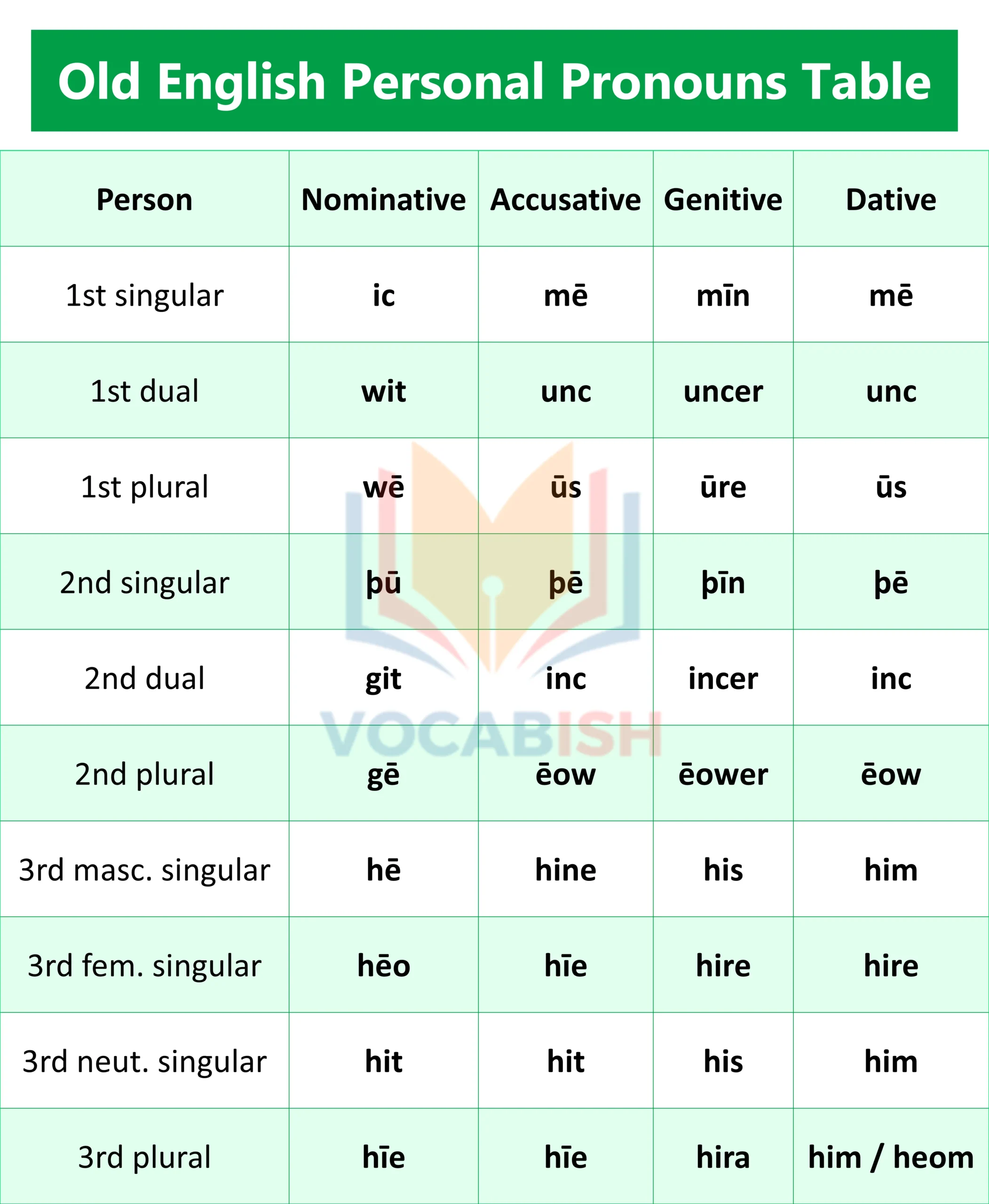
Complete Old English Personal Pronouns Table
Here is a learner-friendly overview of the core system.
Person | Nominative | Accusative | Genitive | Dative |
|---|---|---|---|---|
1st singular | ic | mē | mīn | mē |
1st dual | wit | unc | uncer | unc |
1st plural | wē | ūs | ūre | ūs |
2nd singular | þū | þē | þīn | þē |
2nd dual | git | inc | incer | inc |
2nd plural | gē | ēow | ēower | ēow |
3rd masc. singular | hē | hine | his | him |
3rd fem. singular | hēo | hīe | hire | hire |
3rd neut. singular | hit | hit | his | him |
3rd plural | hīe | hīe | hira | him / heom |
Historical sources contain alternative spellings, so a text may not always match a normalized classroom table exactly.
Possessive Pronouns in Old English
Several genitive pronoun forms performed jobs similar to Modern English my, your, our, and their.
The most useful forms are:
Old English | Modern English |
|---|---|
mīn | my, mine |
þīn | your, yours |
his | his |
hire | her |
ūre | our |
ēower | your, plural |
hira | their |
Some are easy to recognize through later English forms:
mīn → mine
þīn → thine
his → his
ūre → our
Old English first- and second-person genitive forms could also behave adjectivally and take inflection according to the noun they modified.
For an introductory learner, however, it is enough to first remember their basic possessive meanings.
Pronunciation of Common Pronouns
Pronunciation is reconstructed from historical evidence, and exact sounds could vary by period and dialect. These learner approximations are therefore guides rather than perfect Modern English equivalents.
Pronoun | Meaning | Approximate Learner Pronunciation |
|---|---|---|
ic | I | roughly “itch” |
þū | you | “thoo,” with th as in thin |
hē | he | long “heh” sound |
hēo | she | roughly “heh-oh” |
hit | it | similar to “hit” |
wē | we | roughly “weh/way,” with a pure long vowel |
gē | you, plural | approximately “ye” |
hīe | they | roughly “hee-eh” |
Two symbols deserve special attention.
Þ — Thorn
The letter þ is called thorn.
In þū, it represents a th sound.
So:
þū = you
It should not be read as a p or b.
Macron Marks
The line above a vowel in forms such as þū, hē, wē, and gē is called a macron.
It marks a historically long vowel in normalized modern editions and learning materials.
Original Old English manuscripts did not consistently use these modern macron marks. They are added by editors and teachers to make vowel length easier to see.
Old English vs Modern English Pronouns
The two systems share clear similarities, but Old English had more grammatical distinctions.
Feature | Old English | Modern English |
|---|---|---|
First singular | ic | I |
Second singular | þū | you |
Third masculine | hē | he |
Third feminine | hēo | she |
Third neuter | hit | it |
First plural | wē | we |
Second plural | gē | you |
Third plural | hīe | they |
Separate dual forms | Yes | No |
Four main cases | Yes | Mostly reduced |
Grammatical gender | Strongly important | Much less important |
Singular/plural “you” distinction | Yes | Usually no |
Modern English still preserves some case differences.
For example:
I → me
he → him
she → her
we → us
they → them
Old English simply used this type of case distinction much more widely.
How Pronouns Work with Verbs
Pronouns and verbs often work together to show grammatical person.
Compare these Old English subject forms:
ic – I
þū – you
hē/hēo/hit – he/she/it
wē – we
gē – you
hīe – they
A verb could have different endings depending on the subject.
For example, Old English teaching paradigms show patterns such as:
ic write – I write
þū writst – you write
hē writ – he writes
wē writaþ – we write
gē writaþ – you write
hīe writaþ – they write
Notice something useful: plural wē, gē, and hīe can share the same verb form.
That pattern helps learners recognize sentences even before they know every word.
Easy Ways to Remember Old English Pronouns
You do not need to memorize the complete case table at once.
Start with the subject forms:
ic – I
þū – you
hē – he
hēo – she
hit – it
wē – we
gē – you all
hīe – they
Then connect familiar-looking forms:
- mīn looks like mine
- þīn looks like thine
- his is still his
- him is still him
- wē is almost we
- ūs became us
- ūre is related to our
- ēower is related to your
Finally, learn wit and git as special “two-person” pronouns.
This approach is easier than trying to memorize every case simultaneously.
Common Confusions to Avoid
A few forms regularly confuse new learners.
- þū means singular “you.” It does not mean “the.”
- gē means plural “you.” Its initial letter is not pronounced like the modern g in go.
- hēo usually means “she,” while hīe commonly means “they” in normalized learning texts.
- hit means “it.” Do not assume it always refers to something naturally neuter, because Old English used grammatical gender.
- wit and git refer specifically to two people, not ordinary plural “we” and “you.”
Quick Practice Examples
Here are short examples to help you recognize the main pronouns.
Ic
Ic eom hēr.
I am here.
Þū
Þū eart hēr.
You are here.
Hē
Hē is cyning.
He is a king.
Hēo
Hēo is cwēn.
She is a queen.
Hit
Hit is gōd.
It is good.
Wē
Wē sindon hēr.
We are here.
Gē
Gē sindon hēr.
You are here.
Hīe
Hīe sindon hēr.
They are here.
The goal at first is not to translate long Anglo-Saxon texts. It is to recognize who is speaking, who is being addressed, and who or what a sentence refers to.
Quick Old English Pronouns Cheat Sheet
For fast revision, remember these eight forms:
English | Old English |
|---|---|
I | ic |
you — one person | þū |
he | hē |
she | hēo |
it | hit |
we | wē |
you — several people | gē |
they | hīe |
And two special forms:
wit = we two
git = you two
If you know these ten forms, you can already recognize many common personal pronouns in beginner Old English texts.
FAQs About Old English Pronouns
Ic is the Old English nominative pronoun meaning “I.” Its object form is mē, while mīn expresses possession and developed into “mine.”
Old English uses þū for one person and gē for several people. It also has git, meaning specifically “you two.”
The Old English masculine nominative pronoun is hē. Its common object forms include hine in the accusative and him in the dative.
The common normalized Old English form for “she” is hēo. Other forms appear according to case, dialect, and manuscript spelling.
The normal plural form is wē, while wit specifically means “we two.” Other case forms include ūs for “us” and ūre for “our.”
The commonly taught nominative form is hīe. Historical texts contain several spelling variants, while the modern pronoun “they” became established later.
Yes. Þū normally addressed one person, while gē addressed several. Old English even had git, used specifically when speaking to two people.
Pronouns changed according to person, number, gender, and grammatical case. These forms showed whether a pronoun was subject, object, possessive, or indirect object.
Conclusion
Old English pronouns become much easier once you start with the main subject forms: ic, þū, hē, hēo, hit, wē, gē, and hīe. Several connect directly with Modern English words, while forms such as wit and git reveal grammatical distinctions English has since lost.
After learning these basic pronouns, the next useful step is to study their nominative, accusative, genitive, and dative forms. That foundation makes Old English sentences, verbs, and original texts far easier to understand.
Explore More Old English Related Articles
- How to Speak Words, Phrases, and Sentences in Old English
- Complete Guide on Old English Pronunciation
- Old English Alphabets Explained from A to Z
- 75+ Old English Phrases with Meanings