
Learning how to speak Old English can help you understand how English sounded during the Anglo-Saxon period. Old English had different pronunciation, vocabulary, grammar, and sentence patterns from Modern English. It also used letters such as þ, ð, and æ, which may look unfamiliar today. By learning common Old English words, useful phrases, and basic sentences, you can begin speaking and reading the language with more confidence.
What Does It Mean to Speak Old English?
Old English, often called Anglo-Saxon, was the earlier form of English found in texts from Anglo-Saxon England. It had its own pronunciation, vocabulary, grammatical endings, and sentence patterns.
Learning to speak it today involves reconstructed historical pronunciation. We know much about its sound system from manuscripts, spelling patterns, related Germanic languages, and historical linguistic study.
It is important not to confuse Old English with Shakespearean English.
For example:
Type | Example |
|---|---|
Modern English | You are my friend. |
Shakespeare-style English | Thou art my friend. |
Old English | Þū eart mīn frēond. |
Words such as thou, thee, hast, and dost may sound old to modern ears, but using them does not automatically create Old English.
True Old English uses forms such as ic, þū, hē, hēo, eom, eart, and sindon.
How to Speak Old English: Start with the Sounds
If you want to learn how to speak Old English, begin with pronunciation rather than memorizing long sentences. Old English spelling was generally much closer to pronunciation than Modern English spelling.
One helpful rule is that letters were normally pronounced. Even a final e, which is often silent in Modern English, could be pronounced in Old English.
You should pay particular attention to:
- þ and ð
- æ
- long and short vowels
- c and g
- sc
- cg
- h after vowels
- pronounced final letters
Old English pronunciation also varied by period and dialect, so a single modern reconstruction cannot represent every speaker who lived in Anglo-Saxon England.
Important Old English Letters and Pronunciation
Several Old English letters and spelling combinations behave differently from Modern English. Modern editions also sometimes add marks such as macrons to help learners identify long vowels.
Letter or Spelling | Approximate Sound | Example | Meaning |
|---|---|---|---|
þ | th in thin or this | þæt | that |
ð | th in thin or this | oðer | other |
æ | a in cat | fæder | father |
sc | usually sh | scip | ship |
cg | dge in bridge | ecg | edge, sword |
c | k or ch | cyning / cild | king / child |
g | g, y, or a fricative | god / geard | God / yard |
h | h or German/Scottish ch | cniht | young man, knight |
r | usually rolled or trilled | rōf | strong, brave |
Old English þ and ð did not work like two completely separate modern letters. Scribes could use them for the sounds represented by Modern English th, and spelling practices varied.
How to Pronounce SC
In many words, sc sounds similar to Modern English sh.
scip → ship
scield → shield
The connection becomes easy to remember when you compare Old and Modern English.
How to Pronounce CG
The combination cg often represents a sound close to Modern English dge.
ecg → roughly “edge”
brycg → roughly “bridge”
Historical pronunciation guides identify cg with the sound represented by dge in many Modern English words.
How to Pronounce C
Old English c can have more than one pronunciation.
Compare:
cyning — king
cild — child
In learner editions, you may sometimes see ċ with a dot to show the “ch” sound. That dot is a modern editorial aid rather than an original Anglo-Saxon spelling convention.
How to Pronounce G
Old English g may represent several sounds.
For example:
god — God
geard — yard
In modern teaching materials, ġ is sometimes used when the letter has a sound similar to Modern English y.
Long and Short Old English Vowels
Vowel length matters in Old English. Modern learning materials often place a macron over a long vowel.
Compare:
a → ā
e → ē
i → ī
o → ō
u → ū
y → ȳ
æ → ǣ
The difference can affect meaning.
A famous example is:
god = God
gōd = good
The long vowel in gōd was held longer and had a different quality from the short vowel in god.
Macrons generally come from modern editors. Anglo-Saxon manuscripts normally did not consistently mark vowel length.
Common Old English Words to Learn First
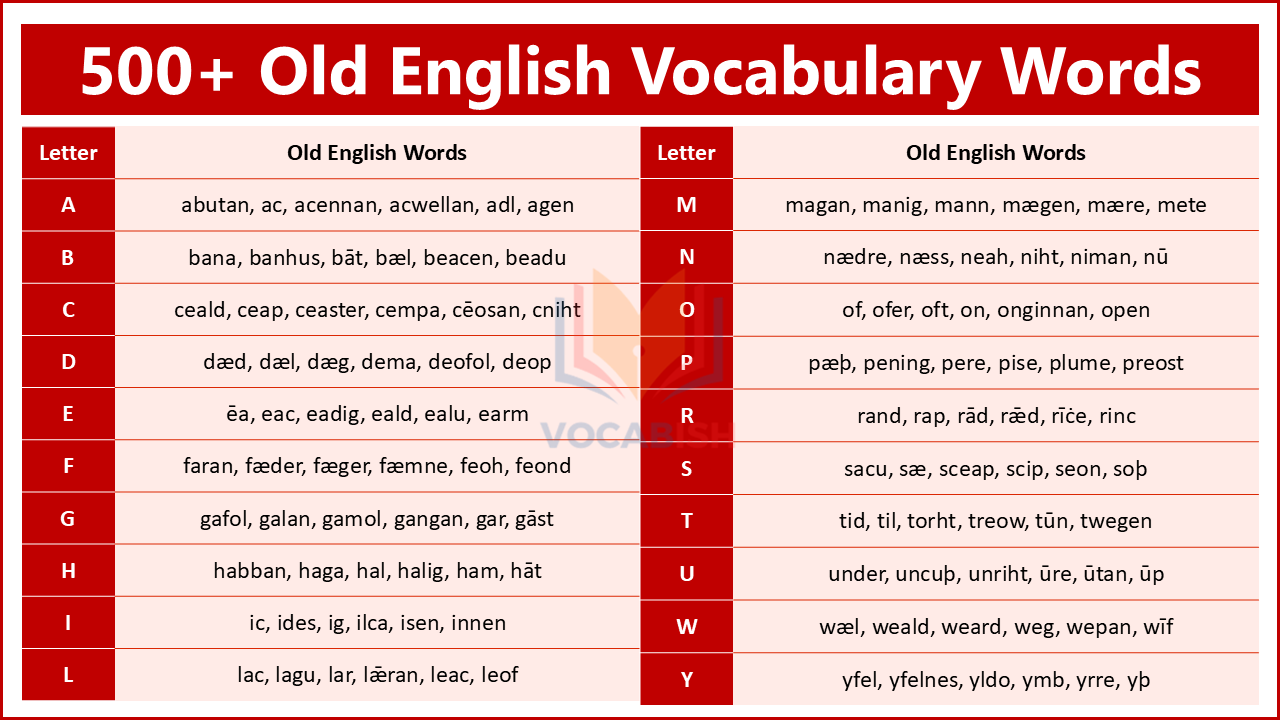
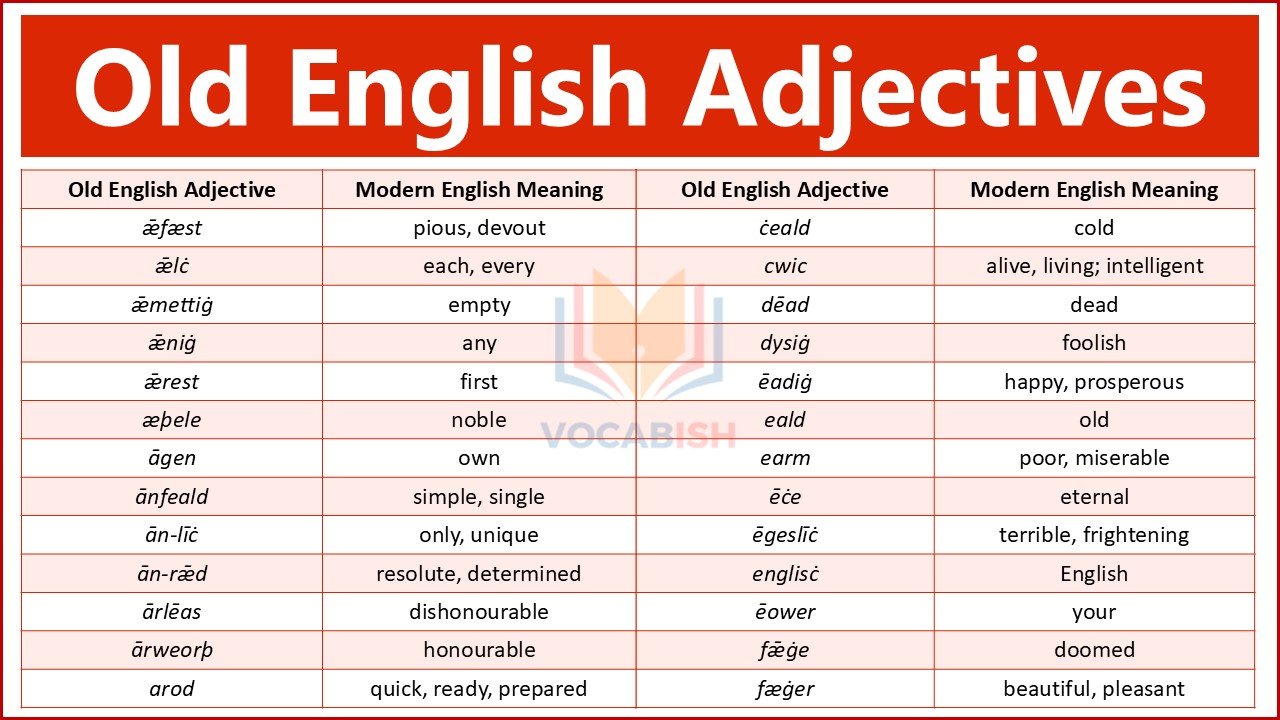
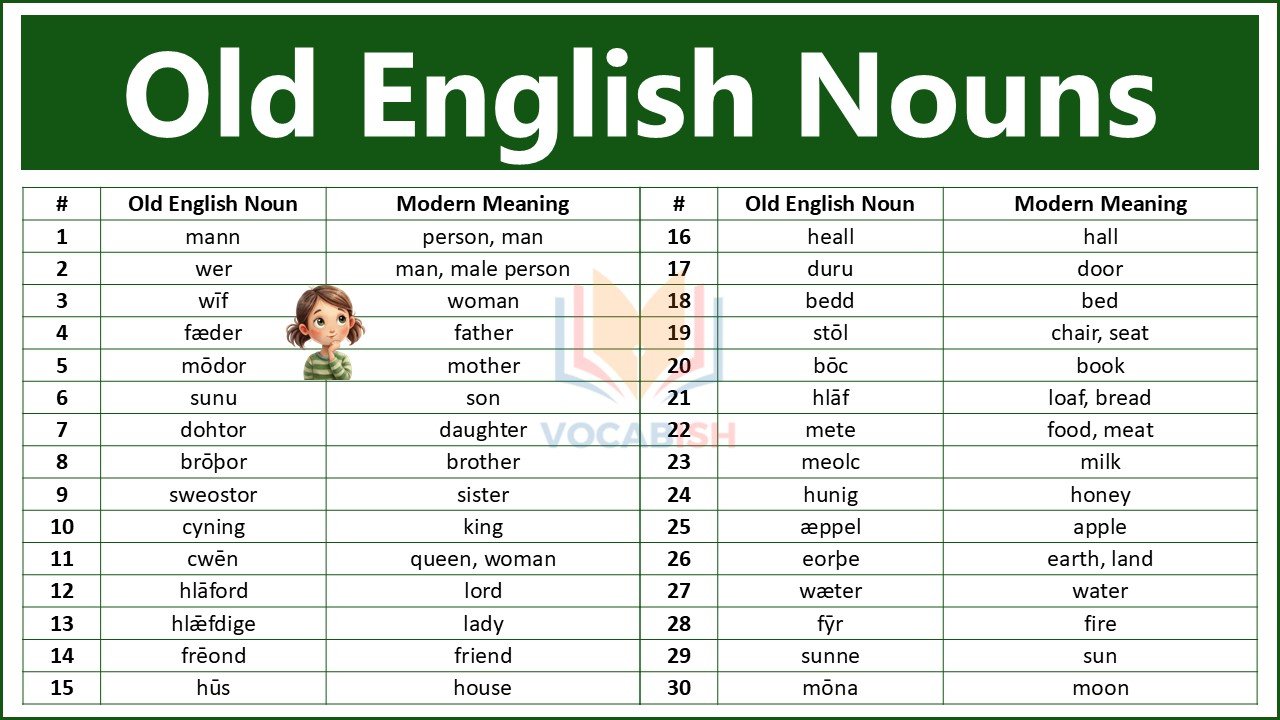
You do not need hundreds of words before trying basic speech. Start with pronouns, common nouns, adjectives, question words, and everyday verbs.
Many frequently used Modern English words descend from Old English vocabulary.
Old English | Modern English |
|---|---|
ic | I |
þū | you, singular |
wē | we |
gē | you, plural |
hē | he |
hēo | she |
hit | it |
hīe | they |
mann | man, person |
wīf | woman, wife |
cild | child |
frēond | friend |
fæder | father |
mōdor | mother |
sunu | son |
hūs | house |
land | land |
dæg | day |
niht | night |
sunne | sun |
mōna | moon |
wæter | water |
hlāf | bread |
bōc | book |
word | word |
lufu | love |
gōd | good |
yfel | bad, evil |
micel | great, large |
lȳtel | little |
nū | now |
hēr | here |
þǣr | there |
hwā | who |
hwæt | what |
hū | how |
Englisc | English |
The Ashmolean Museum gives several recognizable comparisons, including fæder/father, sunu/son, mann/man, land/land, hūs/house, word/word, and sunne/sun.
Useful Old English Verbs
Verbs allow you to turn vocabulary into speech.
Old English Verb | Meaning |
|---|---|
bēon | to be |
wesan | to be |
habban | to have |
gān | to go |
cuman | to come |
sprecan | to speak |
secgan | to say |
singan | to sing |
etan | to eat |
drincan | to drink |
sēon | to see |
lufian | to love |
þancian | to thank |
cunnan | to know how, be able |
magan | to be able, may |
Unlike Modern English, Old English verbs can change considerably according to person, number, tense, and verb class.
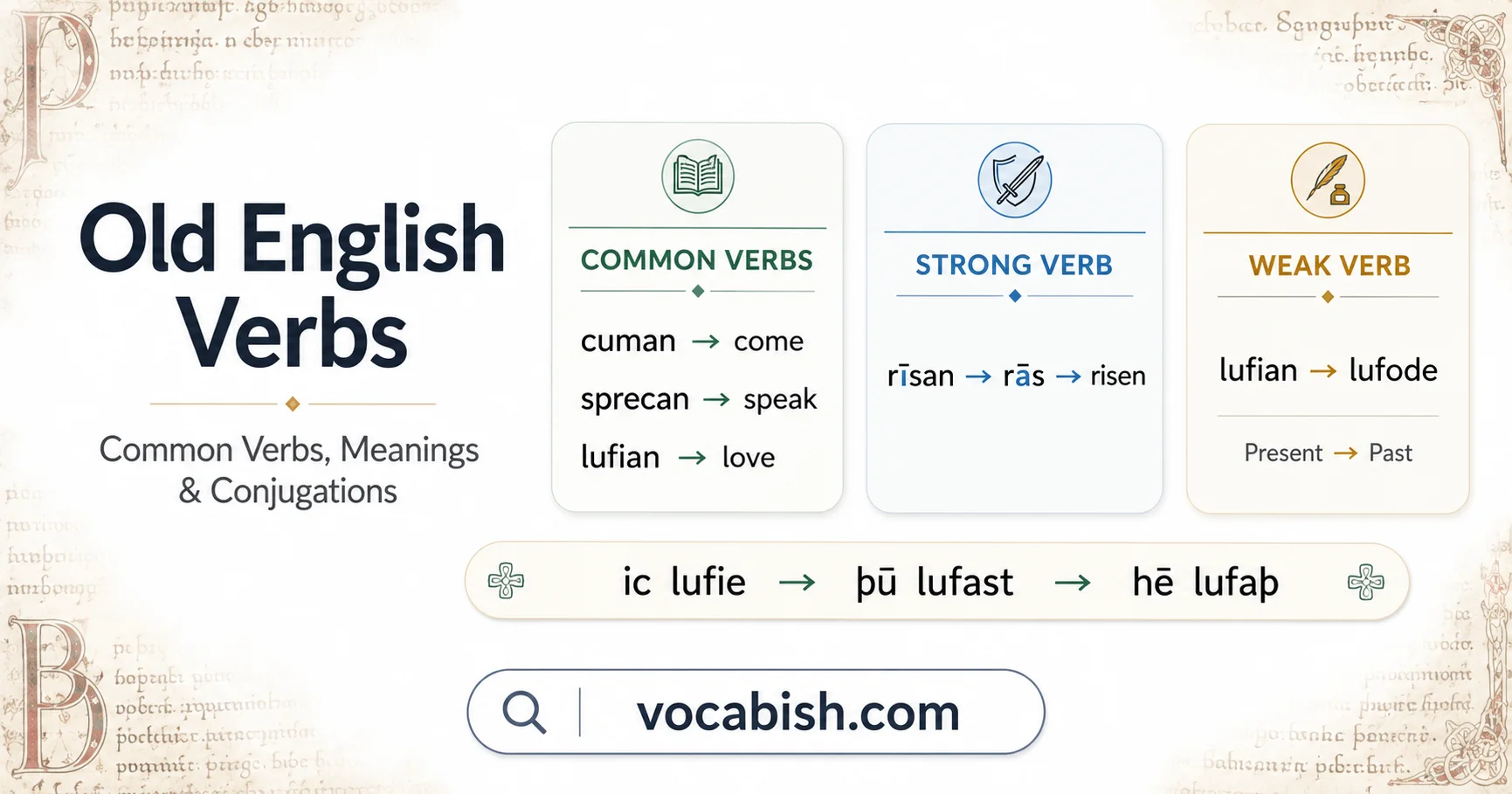
For example, sprecan means “to speak,” but you cannot simply place sprecan after every pronoun. The verb takes different forms according to grammar. Old English learning materials classify sprecan as a strong verb.
Old English Pronouns
Learning pronouns gives you the foundation for building short sentences.
Old English had singular and plural pronouns, but it also had special dual forms for exactly two people. It also marked four grammatical cases: nominative, accusative, dative, and genitive.
For basic speaking, start with these forms:
Modern English | Subject | Object / Related Form | Possessive |
|---|---|---|---|
I | ic | mē | mīn |
you, singular | þū | þē | þīn |
he | hē | hine | his |
she | hēo | hīe / hire | hire |
it | hit | hit | his |
we | wē | ūs | ūre |
you, plural | gē | ēow | ēower |
they | hīe | hīe | heora |
Old English manuscripts contain spelling variations, so you may see alternative forms in dictionaries and texts.
Þū vs Gē
Old English distinguishes between singular and plural “you.”
þū = you, one person
gē = you, more than one person
This distinction later changed as English developed.
Learn the Old English Verb “To Be”
The verb to be is one of the most useful verbs for basic Old English conversation.
Old English actually inherited several related sets of forms connected with the idea of “being.” For your first sentences, the eom/is forms are especially useful.
Pronoun | Old English | Modern English |
|---|---|---|
ic | eom | am |
þū | eart | are |
hē | is | is |
hēo | is | is |
hit | is | is |
wē | sind(on) | are |
gē | sind(on) | are |
hīe | sind(on) | are |
Examples:
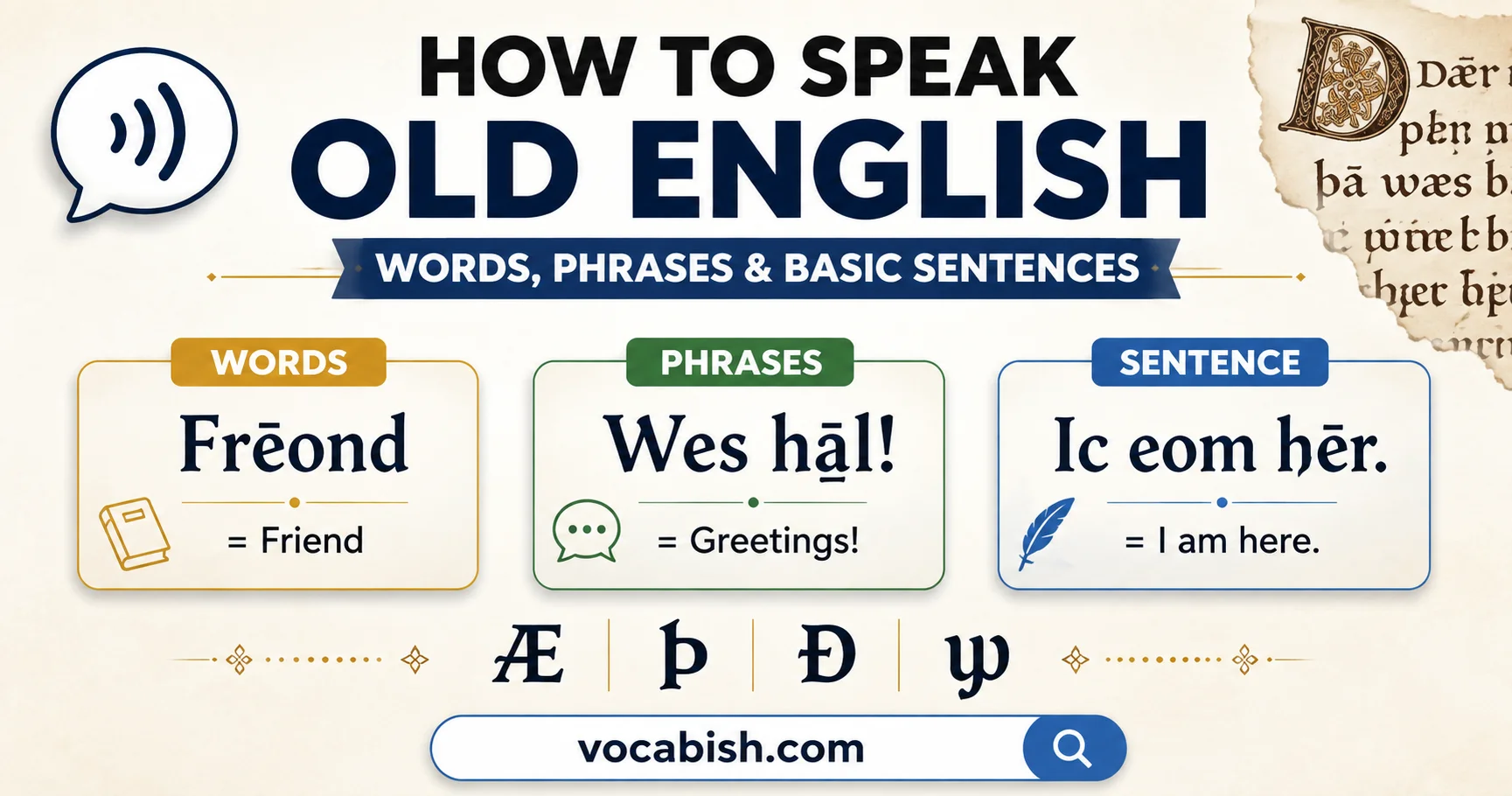
Ic eom hēr.
I am here.
Þū eart mīn frēond.
You are my friend.
Hē is gōd.
He is good.
Hīe sind hēr.
They are here.
The plural appears as forms such as sind, sint, and sindon in surviving texts.
Useful Old English Phrases
Surviving Old English writing is not a modern tourist phrasebook, so we should be careful about calling every newly constructed sentence an “everyday Anglo-Saxon phrase.”
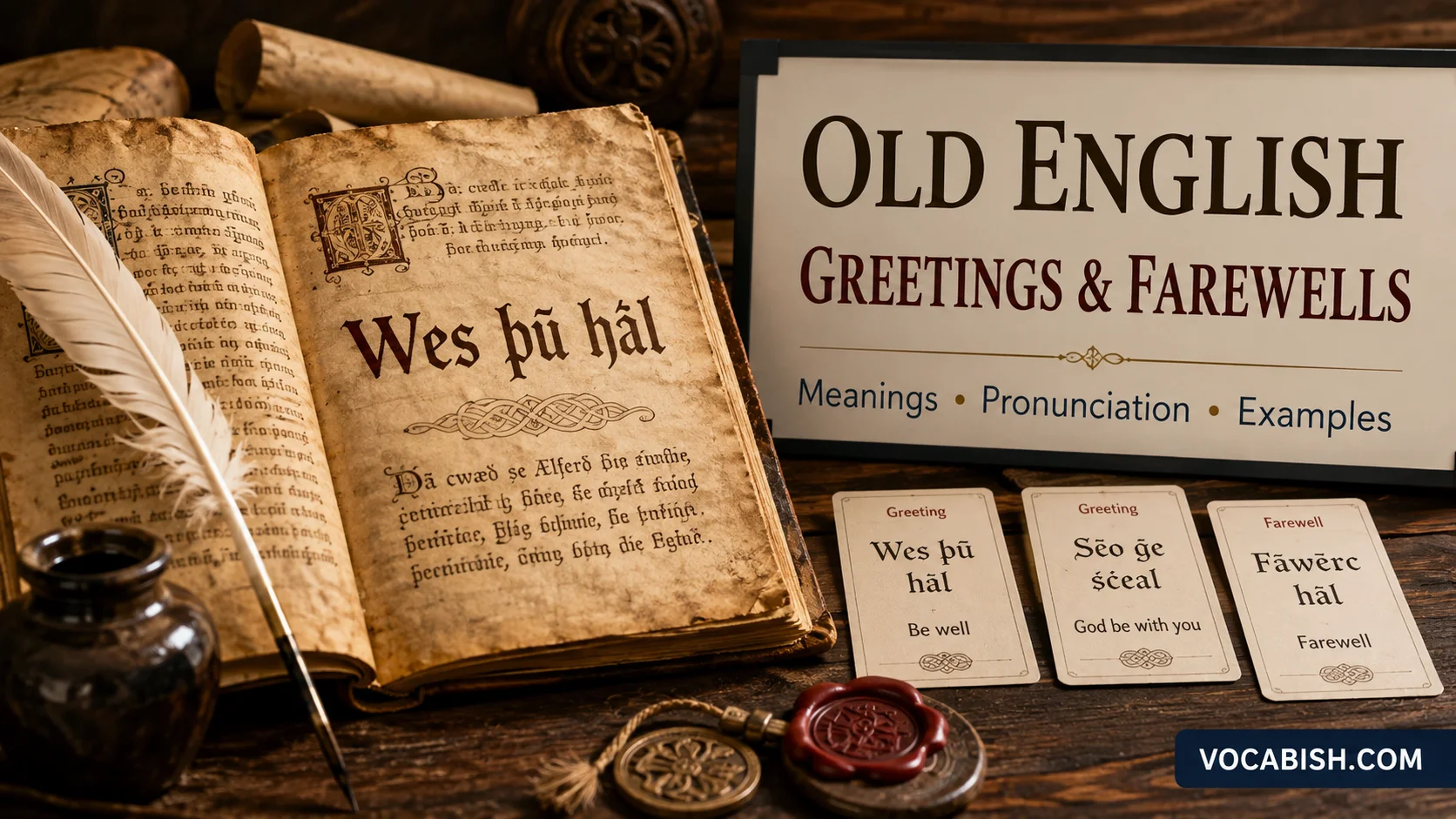
The examples below combine attested vocabulary and Old English grammatical patterns for speaking practice. Some, such as wes hāl, are historically attested expressions.
Old English | Modern English |
|---|---|
Wes hāl! | Be well! / Greetings! |
Wes hāl, frēond mīn! | Be well, my friend! |
Hwæt hǣtst þū? | What are you called? |
Ic hāte Ælfred. | I am called Alfred. |
Hū eart þū? | How are you? |
Ic eom hāl. | I am well. |
Ic þancie þē. | I thank you. |
Hwǣr is þæt hūs? | Where is that house? |
Meaht þū Englisc sprecan? | Can you speak English? |
Ic sprece Englisc. | I speak English. |
Þæt is mīn hūs. | That is my house. |
Þū eart mīn frēond. | You are my friend. |
The salutation wes hāl, literally connected with being healthy or whole, is historically documented in Old English and survives indirectly in the later word wassail.
How Do You Say Hello in Old English?
A useful historically based greeting is:
Wes hāl!
Its literal sense is approximately:
“Be well!” or “Be in good health!”
It can therefore function much like a greeting or good wish.
An Old English form of the expression occurs in Beowulf, including Wes þū … hāl.
How Do You Say “My Name Is…” in Old English?
One useful construction is:
Ic hāte Ælfred.
This literally means something close to:
“I am called Alfred.”
The verb hātan can mean “call” or “name,” and its first-person present form is hāte.
To ask someone:
Hwæt hǣtst þū?
This means:
“What are you called?”
How Do You Say “Thank You” in Old English?
The verb þancian means to thank and takes the person being thanked in the dative case.
A useful sentence is:
Ic þancie þē.
Literally:
I thank you.
Instead of memorizing it only as a fixed phrase, notice the structure:
Ic = I
þancie = thank
þē = you, dative/object form
That pattern teaches useful grammar at the same time.
Basic Old English Sentences
Once you know a few pronouns and verbs, begin building very short sentences.
1. Ic eom hēr.
Meaning: I am here.
- ic = I
- eom = am
- hēr = here
2. Þū eart mīn frēond.
Meaning: You are my friend.
- þū = you
- eart = are
- mīn = my
- frēond = friend
3. Þæt is mīn hūs.
Meaning: That is my house.
This sentence is close enough to Modern English structure that its meaning is easy to recognize.
4. Ic sprece Englisc.
Meaning: I speak English.
sprecan is the infinitive “to speak,” while sprece is a first-person singular form.
5. Hē is gōd.
Meaning: He is good.
Notice that gōd has a long vowel.
6. Sēo sunne scīnþ.
Meaning: The sun shines.
A closely related form, seo sunne scinþ, appears in the Ashmolean Museum’s Old English learning material.
7. Sing mē hwæthwegu.
Meaning: Sing something for me.
This is not merely a modern practice sentence. A form of it appears in the Old English account of Cædmon:
Sing mē hwæthwegu.
Here, sing is an imperative, mē means “for me,” and hwæthwegu means “something.”
8. Hwæt sceal ic singan?
Meaning: What shall I sing?
This sentence also appears in the Cædmon passage. It provides a useful authentic example of an Old English question.
How Old English Sentences Are Formed
Old English sentence structure is more flexible than Modern English because word endings carry more grammatical information.
Subject–Verb–Object is still a common pattern, but other orders occur regularly. Verb–Subject order can appear after certain introductory adverbs, while verbs may occur later in some subordinate clauses.
A good starting pattern is:
Subject + Verb + Object
For example:
Ic sprece Englisc.
Ic — subject
sprece — verb
Englisc — object or language being spoken
Do not assume, however, that every authentic Old English sentence will follow modern English word order.
Why Do Old English Words Change Their Endings?
Old English uses cases. A word’s ending can help show its job in the sentence.
The four main cases are:
Case | Main Job |
|---|---|
Nominative | subject |
Accusative | direct object |
Genitive | possession or relationship |
Dative | indirect object and use after many prepositions |
Modern English still preserves small traces of this system.
Compare:
he → him → his
Old English has a much wider system of these changes.
For example, the pronoun corresponding to “he” can appear as hē, hine, him, or his, depending on its grammatical role.
Questions in Old English
Question words are excellent vocabulary because they let you create many different sentences.
Old English | Modern English |
|---|---|
hwā | who |
hwæt | what |
hwǣr | where |
hū | how |
hwonne | when |
for hwī | why |
hwilc / hwelc | which |
Basic Question Pattern
As in Modern English, a question may place a verb before the subject.
For practice:
Hū eart þū?
How are you?
Hwæt hǣtst þū?
What are you called?
Hwǣr is þæt hūs?
Where is that house?
Meaht þū Englisc sprecan?
Can you speak English?
An authentic Old English example is:
Hwæt sceal ic singan?
What shall I sing?
Negative Sentences in Old English
The common Old English negative particle is:
ne
It normally comes before the verb.
For example, historical Old English texts contain constructions such as:
Ne con ic …
meaning approximately:
I cannot / I do not know how …
In the Cædmon narrative, ne appears before con, a form of cunnan, “know how to, be able.”
Old English could also combine ne with another word.
For example:
ne + ǣfre → nǣfre
Meaning:
never
Old English sources contain this type of contraction.
Old English Words That Still Look Familiar
One enjoyable way to build Old English vocabulary is to look for ancestors of Modern English words.
Old English | Modern English |
|---|---|
fæder | father |
mōdor | mother |
brōþor | brother |
sweostor | sister |
sunu | son |
dohtor | daughter |
mann | man |
hūs | house |
land | land |
bōc | book |
word | word |
sunne | sun |
mōna | moon |
fisc | fish |
scip | ship |
cyning | king |
cild | child |
frēond | friend |
dæg | day |
niht | night |
Do not pronounce every Old English word exactly as its modern descendant. Pronunciation has changed greatly during the history of English, particularly the long vowels.
A Short Old English Conversation
The following is a learner conversation built from useful Old English forms. It is intended for speaking practice rather than as a claim that Anglo-Saxons used this exact dialogue as a fixed exchange.
A: Wes hāl!
B: Wes hāl!
A: Hwæt hǣtst þū?
B: Ic hāte Eadgar. Hwæt hǣtst þū?
A: Ic hāte Ælfred.
B: Hū eart þū?
A: Ic eom hāl.
B: Meaht þū Englisc sprecan?
A: Gēa, ic sprece Englisc.
Modern English Meaning
A: Greetings!
B: Greetings!
A: What are you called?
B: I am called Edgar. What are you called?
A: I am called Alfred.
B: How are you?
A: I am well.
B: Can you speak English?
A: Yes, I speak English.
The goal is not to memorize the whole conversation immediately. Practise one exchange until you can say it comfortably, then add another.
Common Old English Speaking Mistakes
A few misunderstandings can make Old English sound more like fantasy dialogue than the historical language.
- Do not treat Shakespearean English as Old English. “Thou hast” belongs to a much later stage of English.
- Do not ignore vowel length. god and gōd, for example, are different words.
- Do not pronounce every c as k. Words such as cild could have a “ch” sound.
- Do not assume þ always differs from ð. Their spelling usage overlapped considerably.
- Do not force Modern English word order onto every sentence. Old English syntax is more flexible.
How to Practise Speaking Old English
Reading Old English silently helps with vocabulary, but speaking aloud trains your ear and mouth to recognize its sound patterns.
A short daily routine can work well.
Step 1: Practise Five Sounds
Say words containing:
þ — þæt
æ — fæder
sc — scip
cg — ecg
h — cniht
Spend more time on accuracy than speed.
Step 2: Memorize the Main Pronouns
Start with:
ic — þū — hē — hēo — wē — gē — hīe
Say them aloud rather than only reading them.
Step 3: Practise “To Be”
Repeat:
Ic eom.
Þū eart.
Hē is.
Hēo is.
Wē sind.
Gē sind.
Hīe sind.
Once these forms feel natural, add nouns and adjectives.
Step 4: Build Three-Word Sentences
Try patterns such as:
Ic eom hēr.
Hē is gōd.
Þæt is hūs.
Short structures make grammar easier to notice.
Step 5: Turn Statements into Questions
Statement:
Þū eart hāl.
Practice question:
Hū eart þū?
Statement:
Þū meaht Englisc sprecan.
Question:
Meaht þū Englisc sprecan?
Step 6: Read Authentic Old English Aloud
After basic vocabulary becomes comfortable, read short lines from texts such as:
- Beowulf
- Cædmon’s Hymn
- The Wanderer
- The Seafarer
- the Anglo-Saxon Chronicle
Old English teaching resources from the University of Texas include texts, grammatical analysis, vocabulary, and audio-based lessons.
Step 7: Listen, Repeat, and Compare
A useful pronunciation routine is:
- Listen to one word.
- Repeat it aloud.
- Listen again.
- Compare your pronunciation.
- Repeat until the sound becomes comfortable.
This listen-and-repeat method is also recommended in university Old English pronunciation exercises.
A Quick Old English Speaking Cheat Sheet
Modern English | Old English |
|---|---|
I | ic |
you | þū |
we | wē |
he | hē |
she | hēo |
they | hīe |
am | eom |
are | eart / sind |
is | is |
what | hwæt |
who | hwā |
how | hū |
here | hēr |
there | þǣr |
good | gōd |
friend | frēond |
house | hūs |
speak | sprecan |
go | gān |
come | cuman |
be well / greetings | wes hāl |
I am called… | ic hāte… |
I thank you | ic þancie þē |
I am here | ic eom hēr |
What shall I sing? | hwæt sceal ic singan? |
FAQs About How to Speak Old English
Start with Old English pronunciation, then learn common pronouns, verbs, vocabulary, and short sentence patterns before moving to longer authentic Anglo-Saxon texts.
No. Old English belongs to a much earlier period. Shakespeare wrote Early Modern English, which is far closer to today’s English.
Wes hāl is a historically attested greeting or good wish. It literally expresses the idea of being healthy, safe, or well.
Ic eom means “I am.” The second-person equivalent is þū eart, while hē is means “he is.”
A useful construction is Ic þancie þē, literally “I thank you.” The verb þancian takes the person thanked in the dative.
It requires practice because pronunciation, noun cases, verb forms, and vocabulary differ from Modern English, but short sentences can be learned quite quickly.
Usually not without study. Some vocabulary remains recognizable, but Old English pronunciation, grammar, spelling, and many everyday words differ greatly from Modern English.
Listen to reconstructed pronunciation, repeat short words aloud, distinguish long and short vowels, and practise letters such as þ, ð, æ, c, g, and h.
Conclusion
Learning how to speak Old English becomes much easier when you work in small stages. Begin with its sounds, learn core words such as ic, þū, gōd, hūs, and frēond, and then practise short phrases such as Wes hāl, Ic eom hēr, and Ic hāte…
Do not try to make Modern English sound ancient by adding thee and thou. Learn the actual Anglo-Saxon pronunciation, pronouns, verb forms, and sentence patterns instead. With regular listening and speaking practice, Old English begins to feel less mysterious and much more systematic.
Explore More Related Topics
- Old English Pronunciation: Complete Guide
- A to Z Old English Alphabet with Pronunciation
- 75+ Old English Phrases with Meanings
- Old English Words with Meanings and Examples