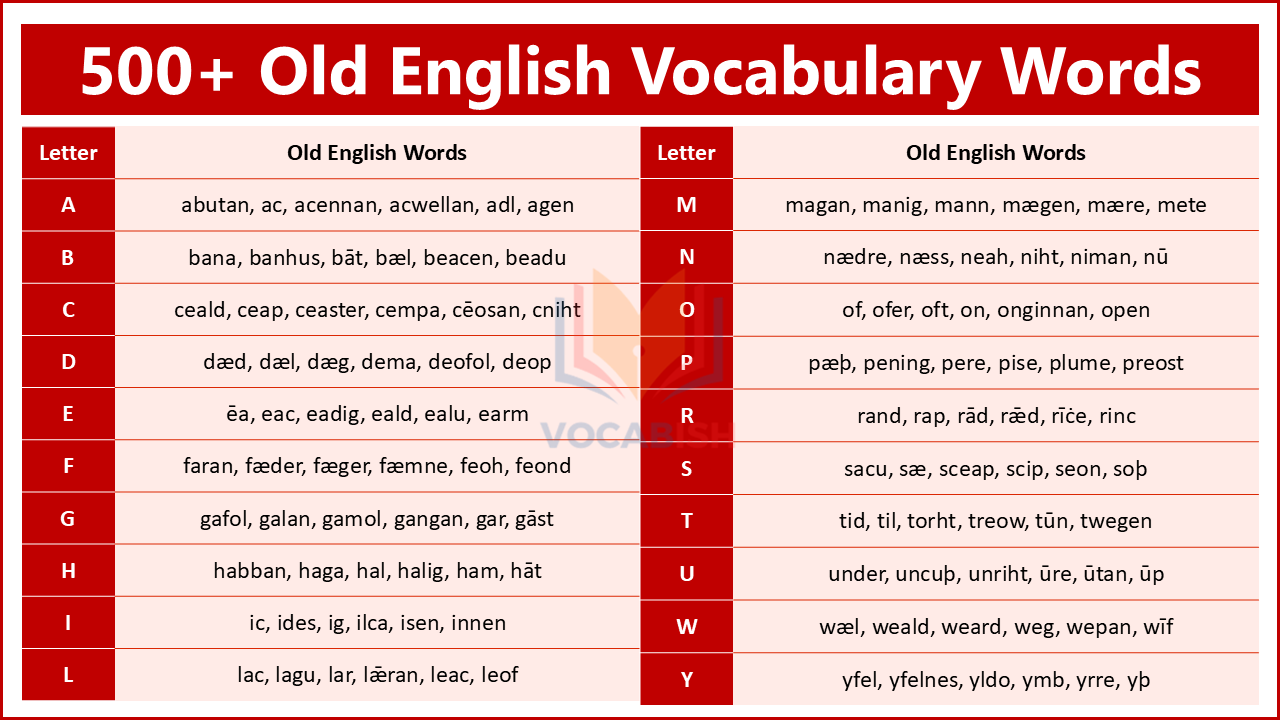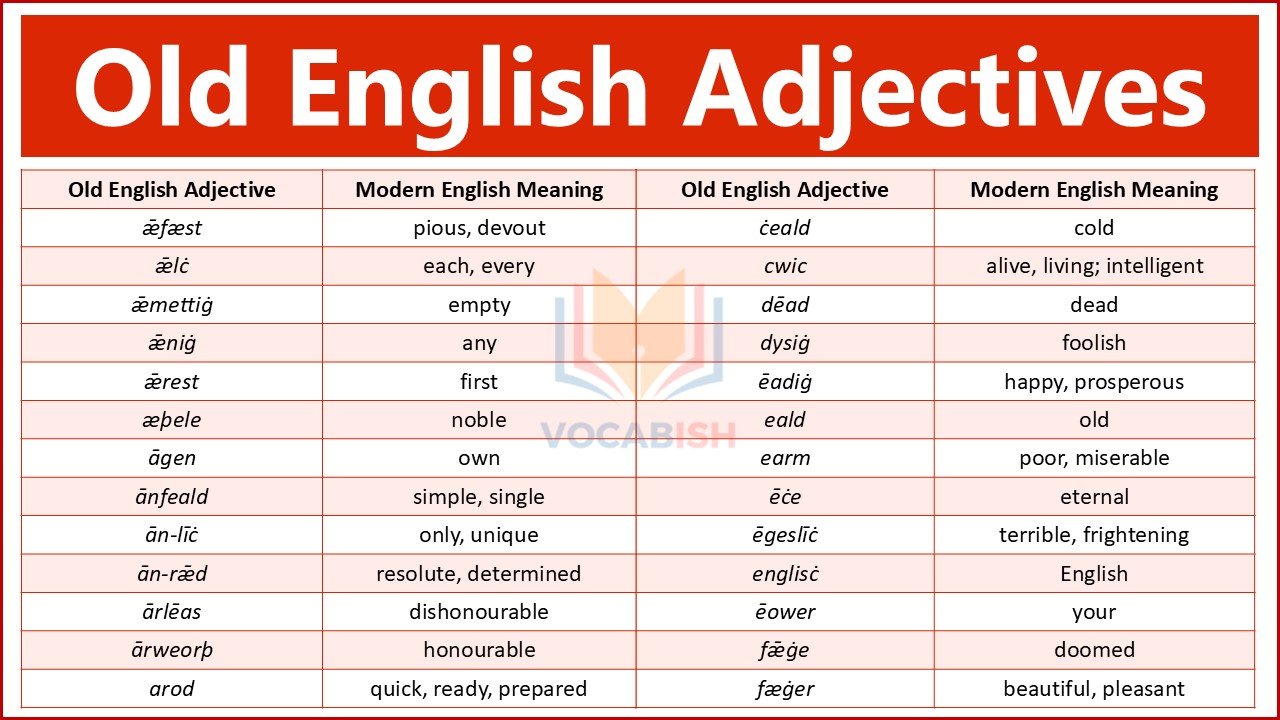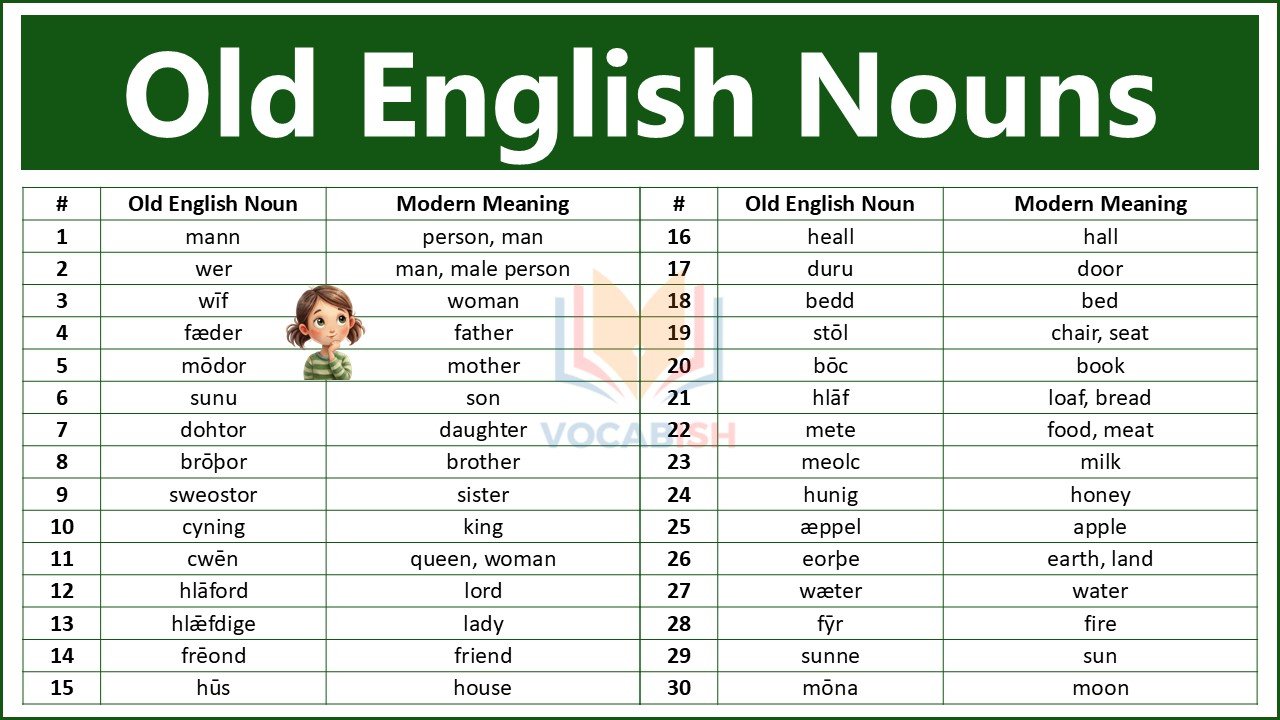

Old English pronunciation can look difficult because it uses letters and sounds that are uncommon in Modern English. Words such as þæt, fæder, scip, and cniht may seem unfamiliar at first. However, Old English spelling was often closely connected to the way words were spoken. Learning vowel sounds, special letters, consonant rules, and word stress makes reading much easier. This article explains Old English pronunciation with clear sound rules, useful examples, and easy pronunciation tips for learners.
What Does Old English Pronunciation Sound Like?
Old English does not sound like Modern English spoken with an old-fashioned accent. It had its own vowel system, consonant sounds, stress patterns, and spelling conventions.
One useful rule for learners is to pronounce the letters you see. Old English did not normally contain the large number of silent letters found in Modern English, so letters in words such as cniht were actually sounded.
Compare these examples:
Old English | Meaning | Main Difference |
|---|---|---|
scip | ship | sc sounds like “sh” |
cniht | boy, young man | c and h are pronounced |
fæder | father | æ has an “a” sound |
hūs | house | ū is a long “oo” sound |
þæt | that | þ represents a “th” sound |
gōd | good | ō is held longer than short o |
Historical pronunciation is reconstructed from spelling, related Germanic languages, poetry, later sound changes, and other linguistic evidence. Different Old English dialects and periods could therefore sound somewhat different.
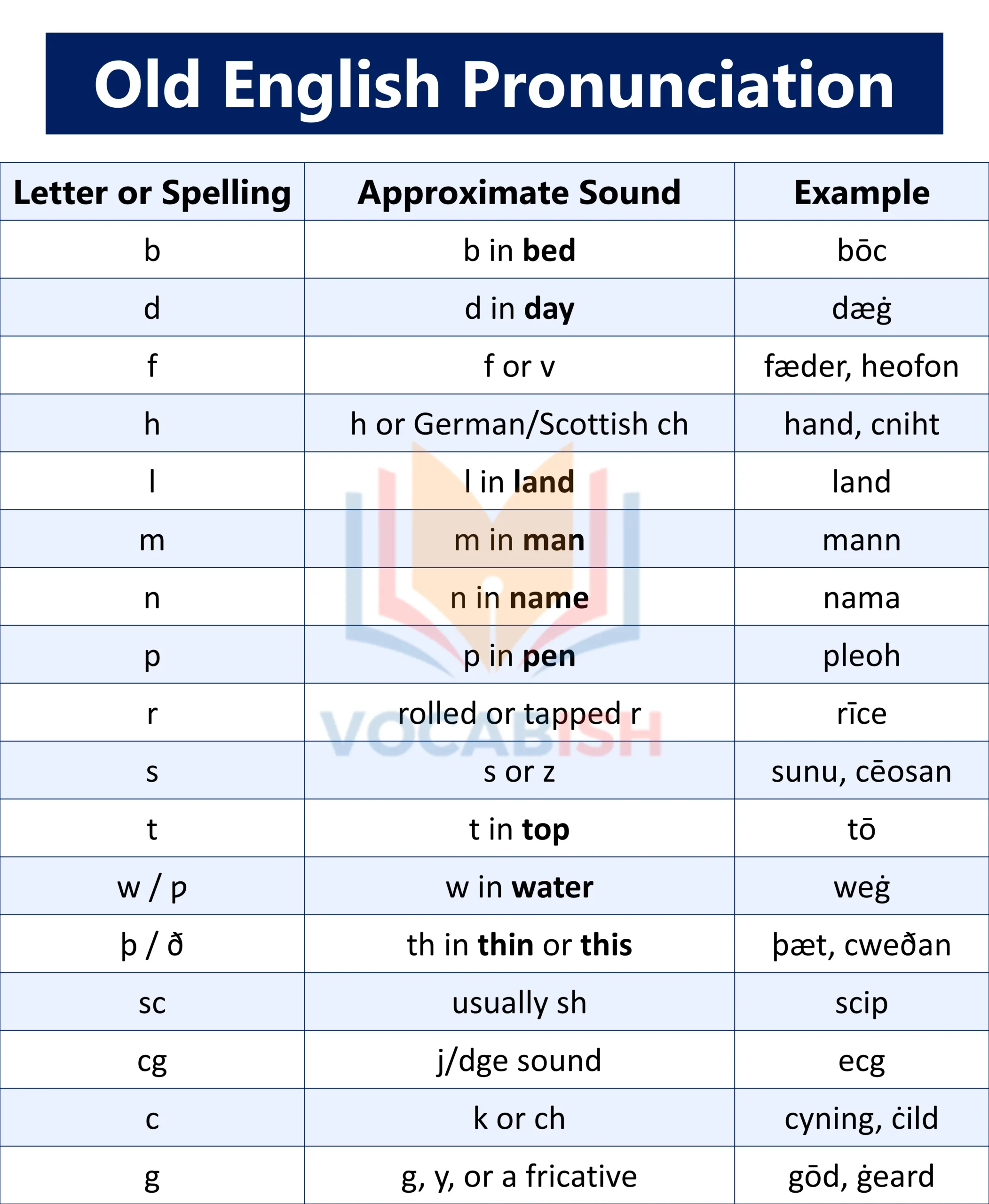
Old English Letters and Sounds at a Glance
Most familiar consonants have values close to those used in Modern English. A smaller group of letters needs extra attention because its pronunciation changes according to position or historical development.
Here is a practical overview.
Letter or Spelling | Approximate Sound | Example |
|---|---|---|
b | b in bed | bōc |
d | d in day | dæġ |
f | f or v | fæder, heofon |
h | h or German/Scottish ch | hand, cniht |
l | l in land | land |
m | m in man | mann |
n | n in name | nama |
p | p in pen | pleoh |
r | rolled or tapped r | rīce |
s | s or z | sunu, cēosan |
t | t in top | tō |
w / ƿ | w in water | weġ |
þ / ð | th in thin or this | þæt, cweðan |
sc | usually sh | scip |
cg | j/dge sound | ecg |
c | k or ch | cyning, ċild |
g | g, y, or a fricative | gōd, ġeard |
Modern textbooks sometimes place a dot above ċ and ġ to show their palatal pronunciations. These dots are editorial learning aids rather than normal Old English manuscript spelling.
How to Pronounce Old English Vowels
Vowels are one of the biggest differences between Old and Modern English pronunciation. Old English distinguished clearly between short and long vowels.
A macron—the line above a vowel in forms such as ā, ē, ī, ō, ū—is commonly added in modern learning materials to show that the vowel was long. Original manuscripts did not normally mark vowel length this way.
Short Old English Vowels
Short vowels were generally pronounced as steady vowel sounds rather than as Modern English letter names.
Vowel | IPA | Rough Sound Guide | Example |
|---|---|---|---|
a | /ɑ/ or /a/ | a in father, but short | mann |
æ | /æ/ | a in cat | cræft |
e | /ɛ/ | e in bed | helpan |
i | /ɪ/ | i in sit | scip |
o | /ɔ/ | short open o sound | god |
u | /ʊ/ | u in put | sunu |
y | /y/ | rounded “ee” sound | cyning |
English examples are only approximations because accents differ. IPA gives a more precise indication of the reconstructed sound.
Long Old English Vowels
A long vowel lasted longer than its short partner and could also differ slightly in vowel quality.
Long Vowel | IPA | Rough Sound Guide | Example |
|---|---|---|---|
ā | /ɑː/ | long “ah” | stān |
ǣ | /æː/ | long a of cat | ǣrest |
ē | /eː/ | long pure “eh/ay” | hēr |
ī | /iː/ | ee in see | wīf |
ō | /oː/ | pure long “o” | gōd |
ū | /uː/ | oo in food | hūs |
ȳ | /yː/ | long rounded “ee” | fȳr |
Old English long vowels should not simply be read as the modern English names of the letters. Their values were closer to the pure vowels heard in many continental European languages.
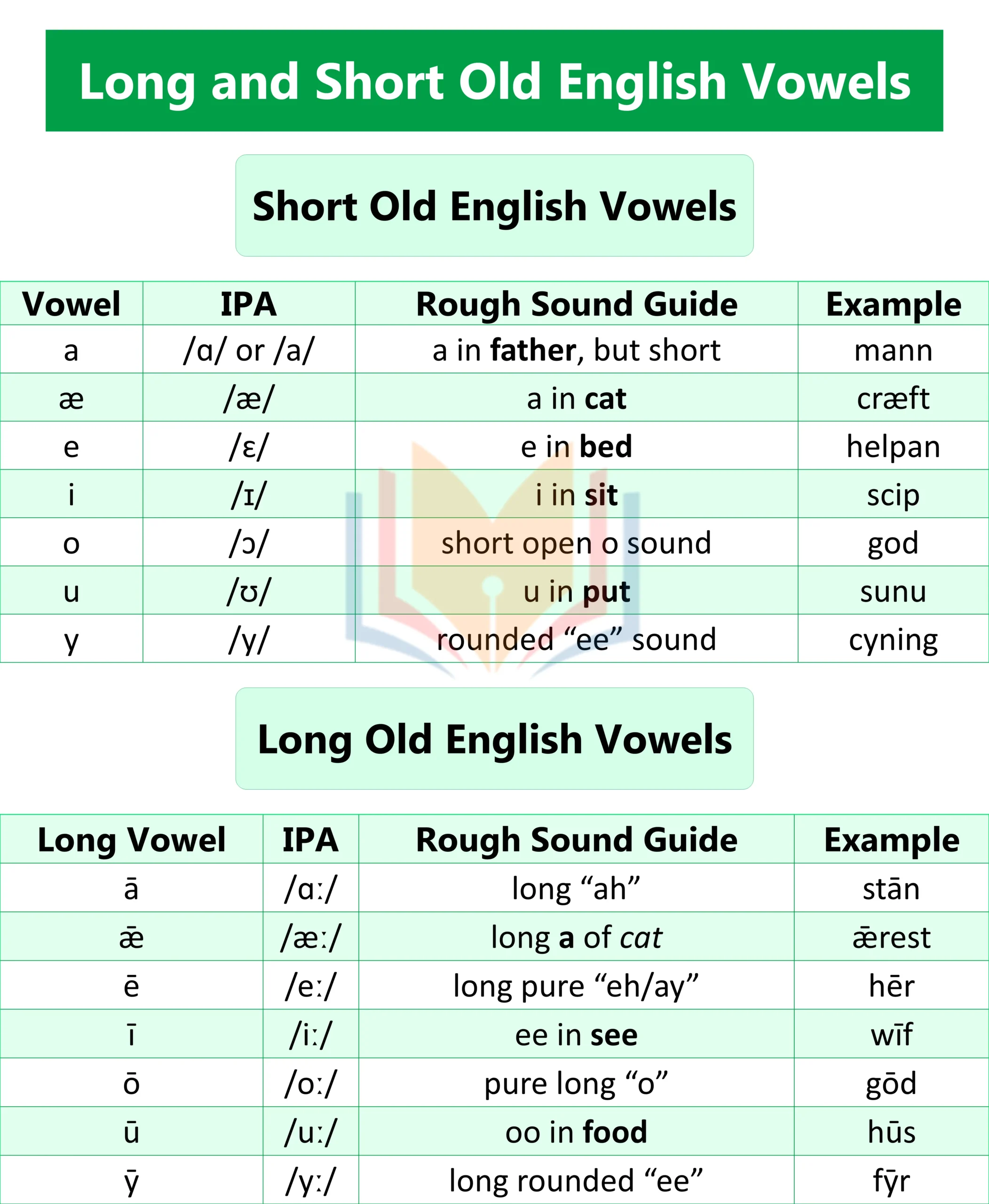
Short vs Long Vowels in Old English
Vowel length could distinguish one word from another, so holding a vowel for the correct amount of time mattered.
For learners, the macron is one of the easiest clues to notice.
Short | Long | Difference |
|---|---|---|
a | ā | short a → long a |
æ | ǣ | short ash → long ash |
e | ē | short e → long e |
i | ī | short i → long ee-like sound |
o | ō | short o → long pure o |
u | ū | short u → long oo |
y | ȳ | short rounded vowel → long rounded vowel |
For example:
god = “God”
gōd = “good”
The words were distinguished partly by the length and quality of their vowels.
A useful practice method is to exaggerate the long vowel slightly while learning:
o → ō
u → ū
i → ī
This makes the contrast easier to hear.
Special Old English Letters and Their Pronunciation
Several letters disappeared from everyday Modern English writing. Their sounds, however, are not necessarily difficult.
The most important ones for new learners are æ, þ, ð, and ƿ.
Æ / æ — Ash
The letter æ is called ash.
It usually represents a front vowel similar to the a in words such as cat or bad.
Examples:
- þæt — that
- fæder — father
- cræft — skill, craft
- dæġ — day
Think of æ as one letter, not as separate a + e sounds.
Þ / þ — Thorn
The letter þ is called thorn.
It represents one of the sounds written th in Modern English.
It may sound like:
- /θ/ in thin
- /ð/ in this
Example:
þæt → roughly /θæt/
Ð / ð — Eth
The letter ð is called eth.
It also represents the Modern English th sounds.
One important point is that Old English þ and ð were not consistently divided into “voiceless th” and “voiced th.” Scribes could use the two letters for the same sound in different spellings of a word.
For example, forms such as þær and ðær could both appear.
ƿ — Wynn
The letter ƿ, called wynn, represented the /w/ sound.
That is the same basic consonant heard at the beginning of:
water, wind, way
Modern editions usually replace wynn with the familiar letter w, partly because ƿ can easily be confused visually with þ.
Old English Pronunciation Rules for C, G, F, S, H and SC
A few Old English consonants can represent more than one sound. Context matters, especially with c, g, f, s, and h.
Modern editions sometimes use special markings to make these differences easier to recognize.
C and Ċ
Old English c could have a hard /k/ sound or a palatal sound similar to Modern English ch.
Form | Sound | Example |
|---|---|---|
c | /k/ | cyning |
ċ | /tʃ/ | ċild |
So:
ċild sounds close to child.
The dot is normally supplied by a modern editor.
G and Ġ
Old English g had several possible pronunciations.
Form | Approximate Sound | Example |
|---|---|---|
g | hard g | gōd |
ġ | y in yes | ġeard |
g | /ɣ/ fricative in some positions | dragan |
The /ɣ/ sound does not survive as a regular consonant in standard Modern English. It was produced with friction near the back of the mouth.
F Can Sound Like V
Old English f was not always pronounced /f/.
It was commonly voiced to /v/ when it occurred between voiced sounds, especially between vowels.
Compare:
- wīf → /f/
- wīfum → the f could sound like /v/
This helps explain some later relationships between words such as wife and wives.
S Can Sound Like Z
Old English s followed a similar pattern.
It could sound like /z/ between voiced sounds.
For example:
cēosan — “to choose”
The s was voiced rather than pronounced as the ordinary /s/ of sun.
SC Usually Sounds Like SH
In many common Old English words, sc represents a sound close to Modern English sh.
Examples include:
- scip → ship
- fisc → fish
- scyld → shield
However, sc could also have /sk/ in particular environments or words.
CG Sounds Like J or DGE
The spelling cg usually represents a sound close to /dʒ/.
Examples:
ecg → edge
brycg → bridge
This is another case where the Modern English descendant helps reveal the older pronunciation.
H Has Two Important Sounds
At the beginning of a word, h could sound much like the h in Modern English house.
After a vowel, it could become a stronger fricative similar to the sound in Scottish loch or German Bach.
For example:
cniht
The h was not silent. It had a fricative sound represented approximately by IPA /x/.
That makes the Old English word very different from the Modern English pronunciation of knight.
Old English Diphthongs
A diphthong is a vowel sound that moves from one vowel position toward another within the same syllable.
Old English, particularly the well-documented West Saxon variety, used combinations such as ea, eo, ēa, and ēo. Their exact pronunciation could vary by period and dialect.
Common spellings include:
Diphthong | Approximate Reconstruction |
|---|---|
ea | /æɑ/ or similar glide |
ēa | long /æːɑ/ type glide |
eo | /eɔ/ or /ɛɔ/ |
ēo | long /eːɔ/ type glide |
ie | a front-vowel glide in some dialects |
īe | long form of the front-vowel glide |
The first part of an Old English diphthong generally carried greater prominence than the second.
Examples include words such as:
- eald — old
- heofon — heaven
- ēage — eye
Learners do not need to perfect every reconstructed diphthong immediately. Start by recognizing that two-vowel spellings such as eo should not automatically be pronounced according to Modern English spelling rules.
Stress in Old English Pronunciation
Word stress tells you which syllable receives the strongest emphasis. Old English stress was more predictable than stress in many Modern English words.
Primary stress generally falls near the beginning of the word, especially on the first syllable of the main lexical stem. Some prefixes, including ge-, are normally unstressed.
For example:
fæder
→ FÆ-der
cyning
→ CY-ning
When an unstressed prefix is added, the main root can retain the stronger stress.
This stress pattern is particularly important when reading Old English poetry because its verse depends heavily on stressed syllables and alliteration.
Pronouncing Double Consonants
Double consonants were not simply a spelling habit. Old English could distinguish between shorter and longer consonants.
A doubled consonant should therefore be held slightly longer.
For example:
sunu
and a word containing nn
would not treat the single and doubled consonants identically.
A useful technique is to imagine a tiny pause while holding the consonant:
nn → n-n
tt → t-t
ss → s-s
Do not insert another vowel between them.
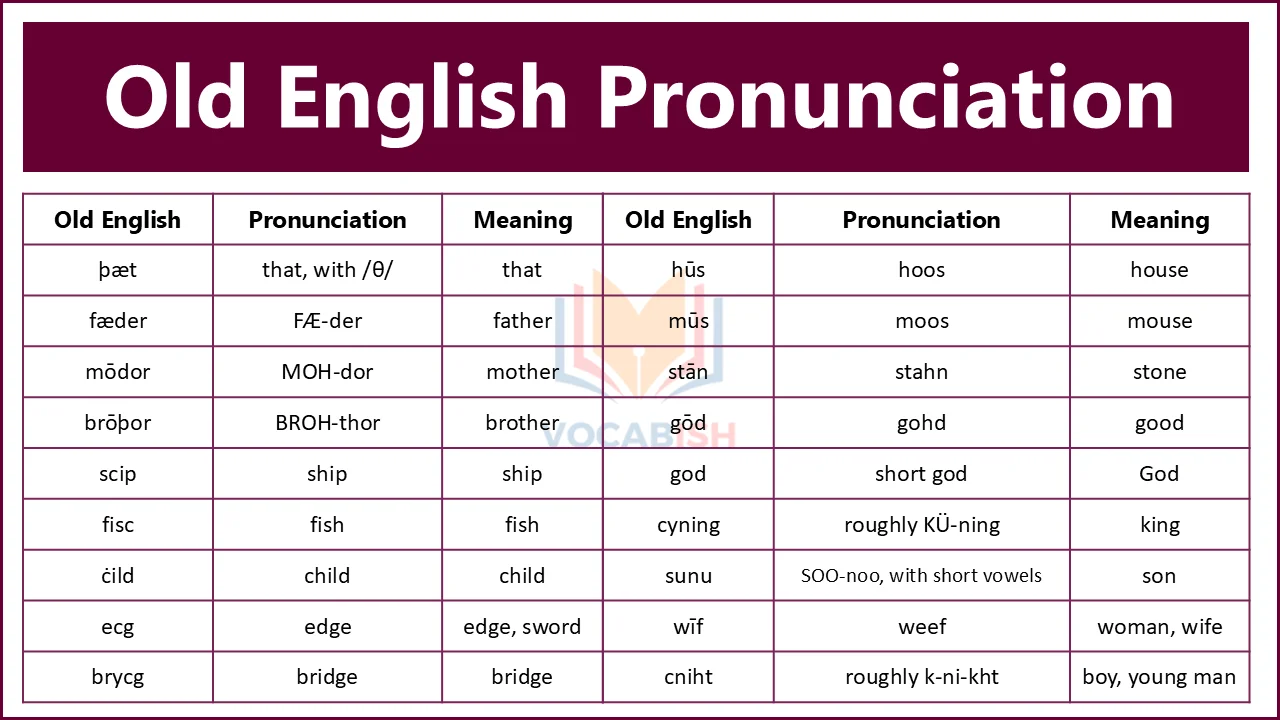
Old English Pronunciation Examples
Seeing complete words makes the pronunciation rules easier to understand.
The pronunciations below are learning approximations. Exact historical pronunciation could differ by dialect and period.
Old English | Approximate Pronunciation | Meaning |
|---|---|---|
þæt | that, with /θ/ | that |
fæder | FÆ-der | father |
mōdor | MOH-dor | mother |
brōþor | BROH-thor | brother |
scip | ship | ship |
fisc | fish | fish |
ċild | child | child |
ecg | edge | edge, sword |
brycg | bridge | bridge |
hūs | hoos | house |
mūs | moos | mouse |
stān | stahn | stone |
gōd | gohd | good |
god | short god | God |
cyning | roughly KÜ-ning | king |
sunu | SOO-noo, with short vowels | son |
wīf | weef | woman, wife |
cniht | roughly k-ni-kht | boy, young man |
ġeard | begins with y sound | yard, enclosure |
cræft | kraft with /æ/ | skill, craft |
The spellings may look distant from Modern English, but several modern words preserve traces of these older forms.
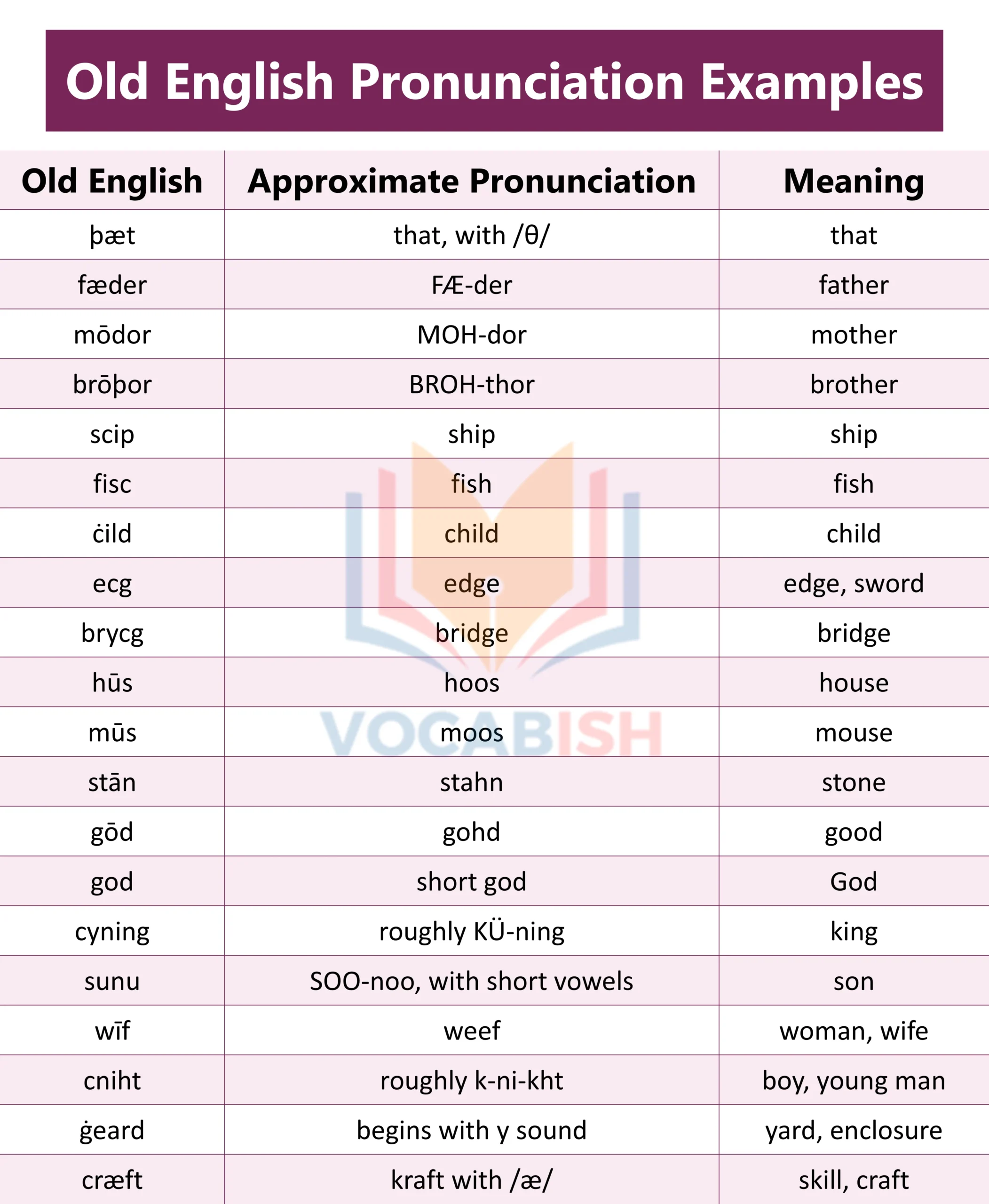
How to Pronounce a Short Old English Sentence
Consider this well-known opening:
Hwæt! Wē Gār-Dena in ġeārdagum…
When reading Old English, avoid applying modern spelling rules automatically.
Work through it in stages:
- Identify long vowels marked with macrons.
- Look for letters such as þ, ð, and æ.
- Check whether c or g has a palatal pronunciation.
- Pronounce consonants that Modern English might leave silent.
- Give the main root syllables clear stress.
- Keep vowels relatively pure instead of turning every long vowel into a modern English diphthong.
Reading slowly at first produces better results than trying to imitate a dramatic medieval accent.
How to Practice Old English Pronunciation
Good pronunciation develops more quickly when you practice sounds before attempting long passages.
Start with individual letters, then words, and finally short sentences.
A useful routine is:
- Learn æ, þ, ð, and ƿ first.
- Practice short and long vowel pairs.
- Compare c / ċ and g / ġ.
- Practice sc as “sh” in common words.
- Say f and s both voiced and voiceless.
- Practice the /x/ sound in words such as cniht.
- Stress the main root syllable clearly.
- Read five to ten words aloud each day.
- Listen to scholarly Old English recordings when possible.
- Repeat the same passage until the sounds become familiar.
Listening and repeating is especially useful because written English approximations cannot represent every historical sound accurately.
Common Old English Pronunciation Mistakes
These mistakes can make Old English sound too much like Modern English:
- Reading ā, ē, ī, ō, and ū as modern letter names. The macron marks vowel length.
- Treating þ as always /θ/ and ð as always /ð/. Both letters could represent either “th” sound.
- Making letters silent. Words such as cniht contained consonants that later disappeared.
- Pronouncing every sc as /sk/. Many Old English words use a sound like Modern English “sh.”
- Ignoring æ. Ash represents its own vowel sound and should not be read as separate a + e.
FAQs About Old English Pronunciation
Old English used pronounced consonants, short and long vowels, special letters, and more predictable stress. Its sound system differed noticeably from Modern English.
It can look difficult, but many sounds are familiar. Learners mainly need practice with vowel length, æ, þ, ð, c, g, and h.
Old English þ, called thorn, represents a “th” sound like /θ/ in thin or /ð/ in this, depending on context.
Both thorn þ and eth ð represented Old English “th” sounds. They were not consistently used to distinguish voiced and voiceless pronunciation.
The letter æ, called ash, is usually pronounced approximately like the a in cat, although exact vowel quality could vary.
As a practical learner rule, Old English letters should normally be pronounced. Consonants later lost from words such as knight were once spoken.
A line called a macron marks a long vowel in modern editions. For example, ū is held longer than short u.
Old English c may sound like /k/ or /tʃ/. Modern editors often write palatal /tʃ/ as ċ to help learners identify it.
Conclusion
Old English pronunciation becomes much easier once you stop applying Modern English spelling rules to it. Start with vowel length, then learn æ, þ, ð, c, g, sc, and h.
Remember that macrons mark long vowels, thorn and eth both represent “th” sounds, sc often sounds like “sh,” and consonants now silent in Modern English were often pronounced. Exact sounds could vary across dialects and historical periods, but these patterns provide a practical foundation for reading Old English words and passages aloud with greater accuracy.
You May Also Like