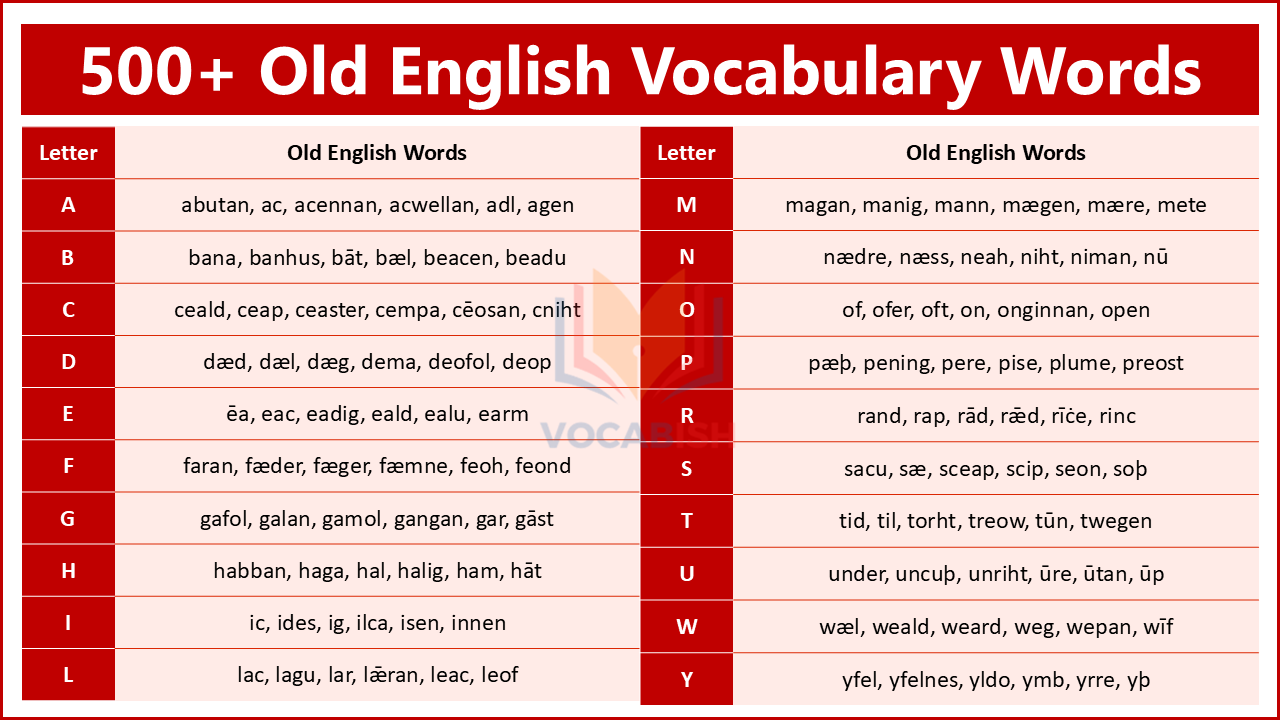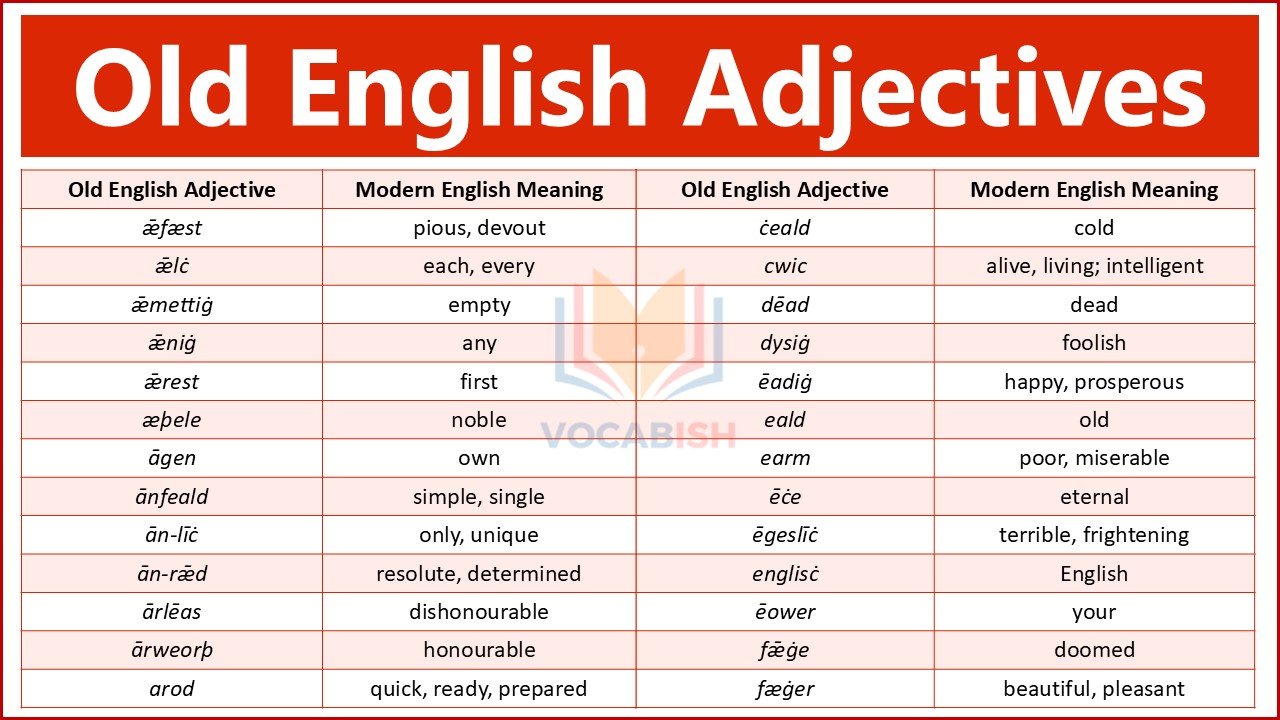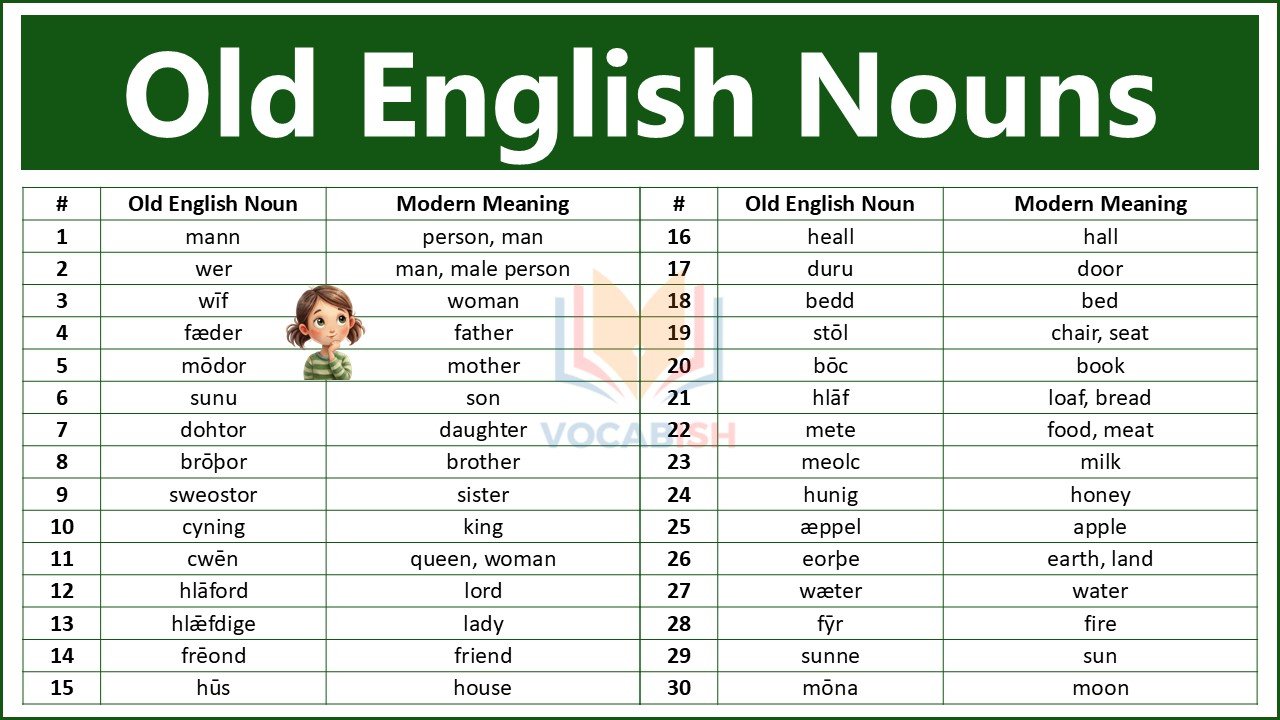
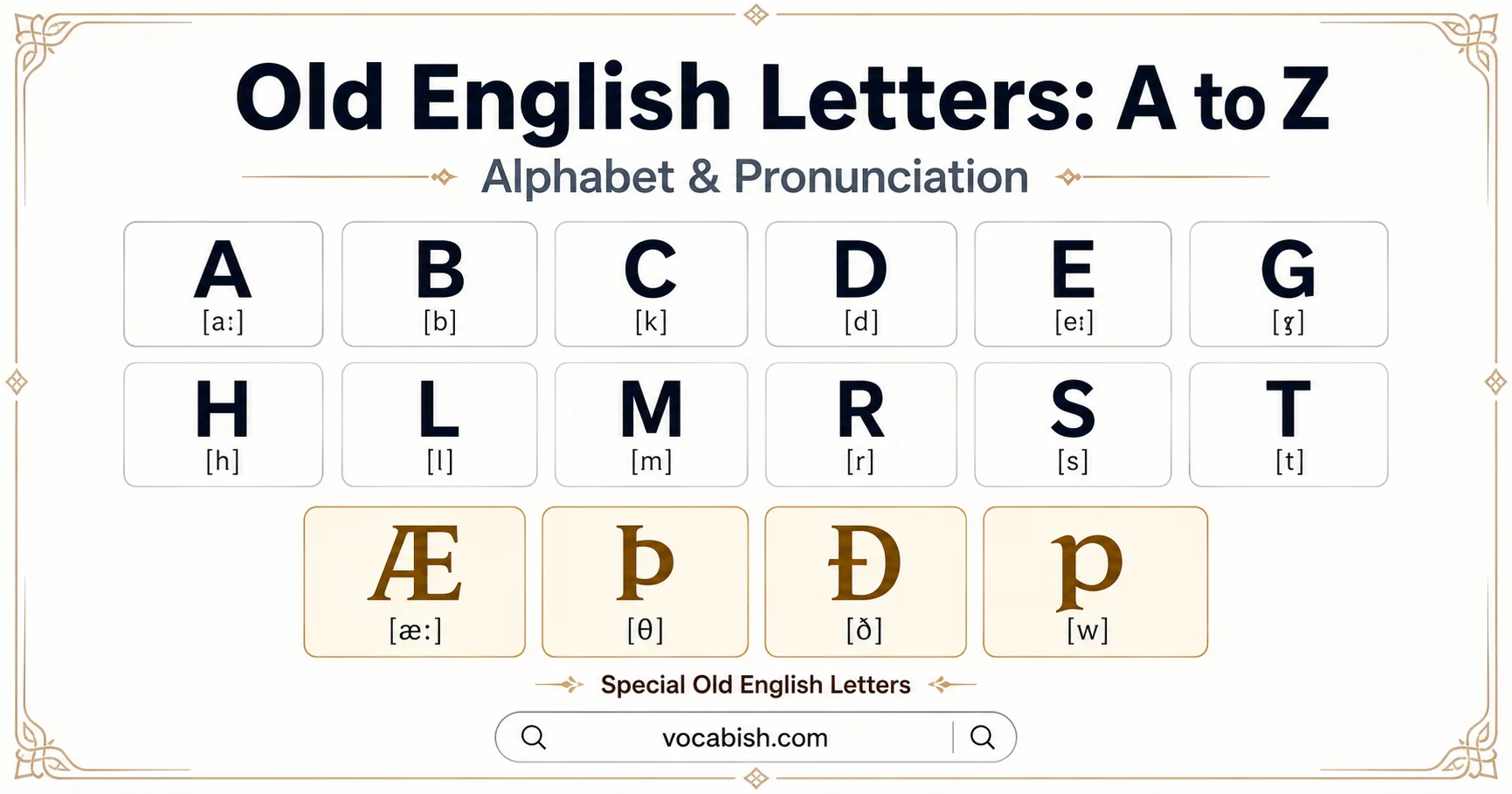

Old English Letters show how English was written many centuries ago. The Old English alphabet was based mainly on Latin letters, but it also included special characters such as æ, þ, ð, and ƿ. Some modern letters were rare or not used in the same way. Pronunciation was also different from today. Learning these letters, sounds, and spelling patterns makes Old English words easier to read and understand. This article explains the Old English alphabet A to Z, special letters, pronunciation rules, and clear examples for learners.
What Are Old English Letters?
Old English letters are the characters used to write English roughly during the early medieval period before Middle English developed. The writing system was mainly based on the Latin alphabet, which became established in England through Christian literacy. Anglo-Saxon writers also used additional characters for sounds that Latin letters did not represent conveniently.
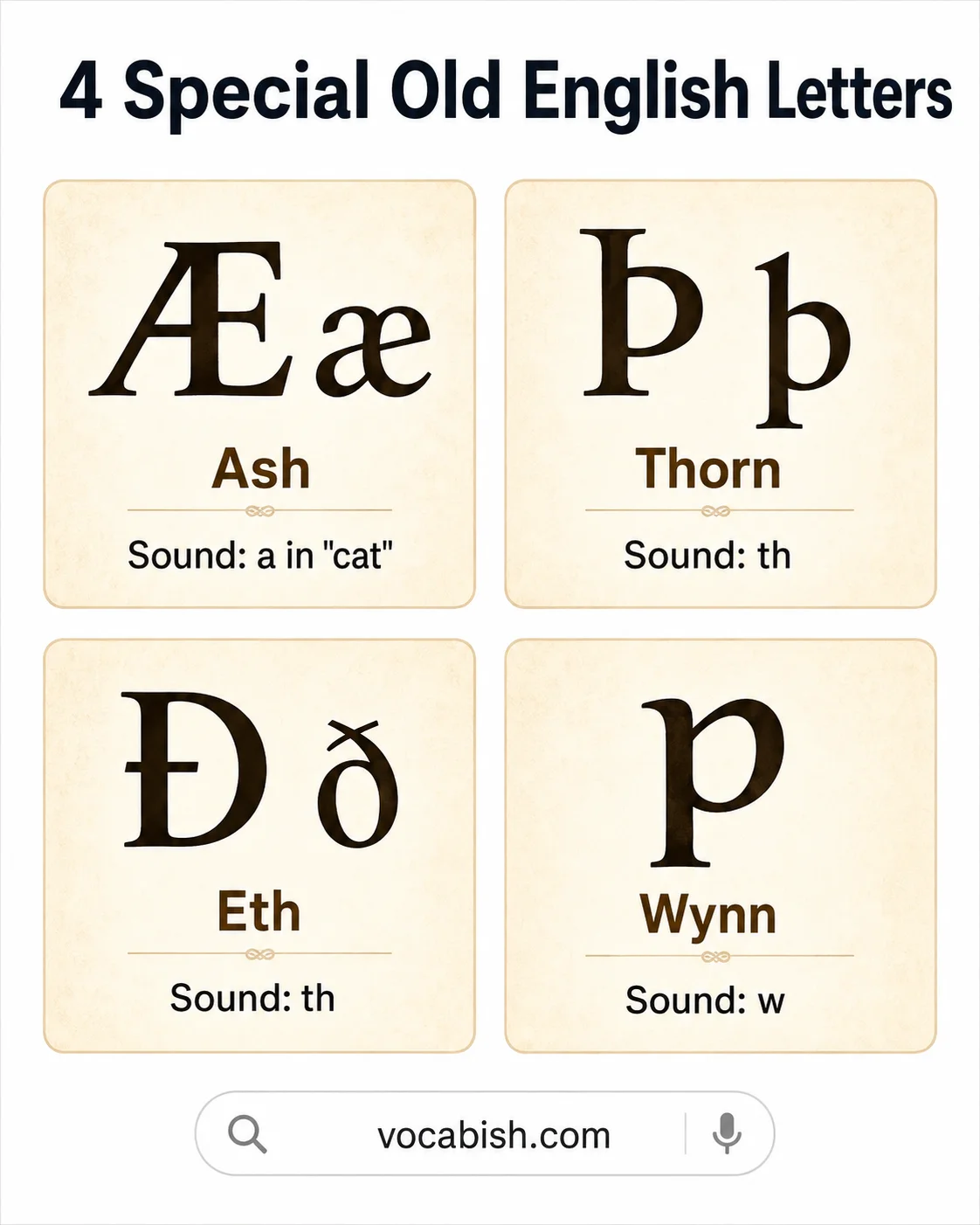
Among the most recognizable characters are:
- Æ æ – ash
- Þ þ – thorn
- Ð ð – eth
- ƿ – wynn
The Latin alphabet supplemented by æ, ð, þ, and ƿ was used for written Old English.
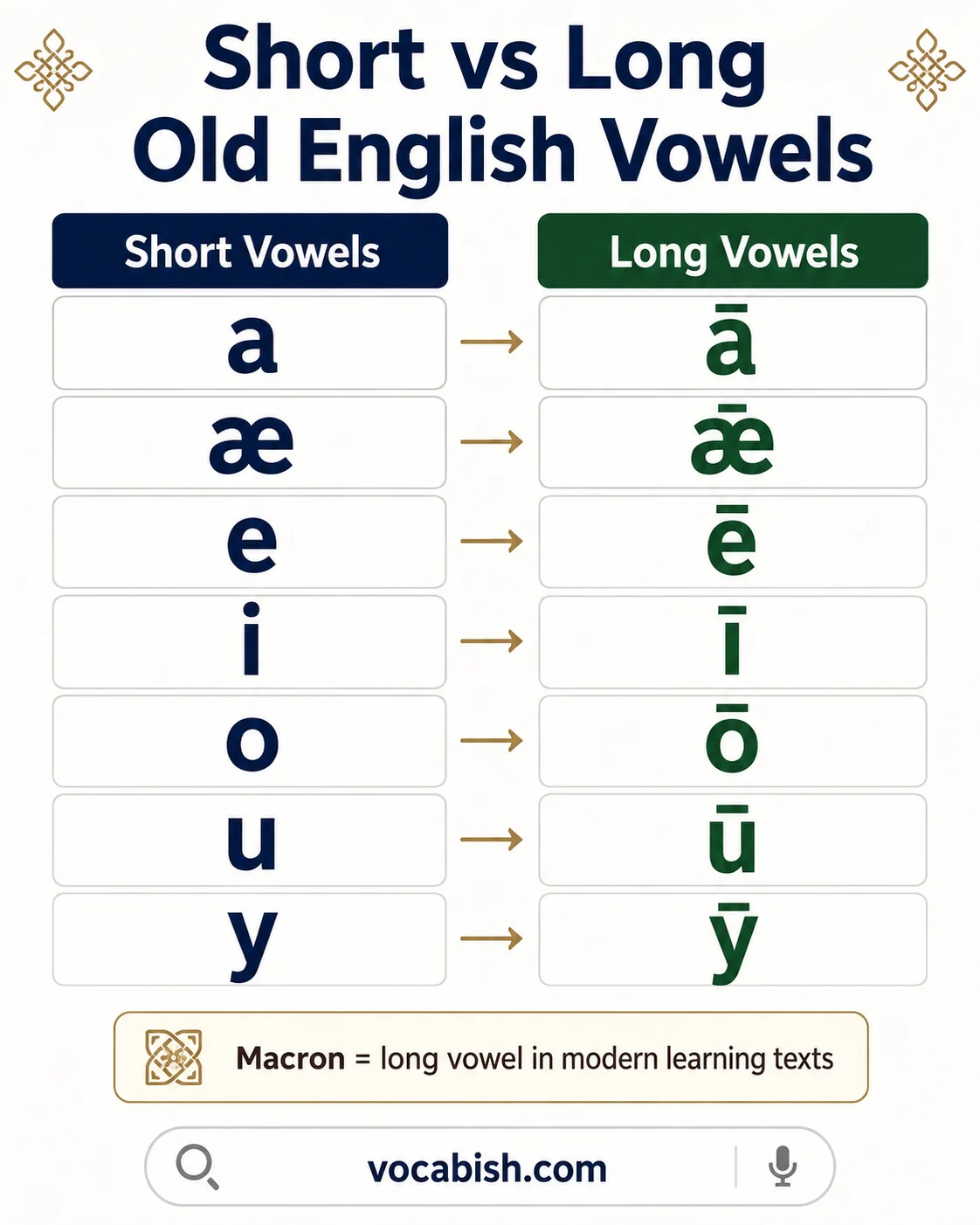
You may also see letters such as ā, ē, ī, ō, and ū in textbooks. The lines above these vowels are called macrons. Modern editors commonly add them to show that a vowel was long; they should not be treated as separate historical alphabet letters.
Old English Alphabet at a Glance
There was no exact historical equivalent of today’s standardized 26-letter English alphabet. Some modern letters were uncommon or absent, while Old English had characters that have since disappeared.
A learner-friendly representation looks roughly like this:
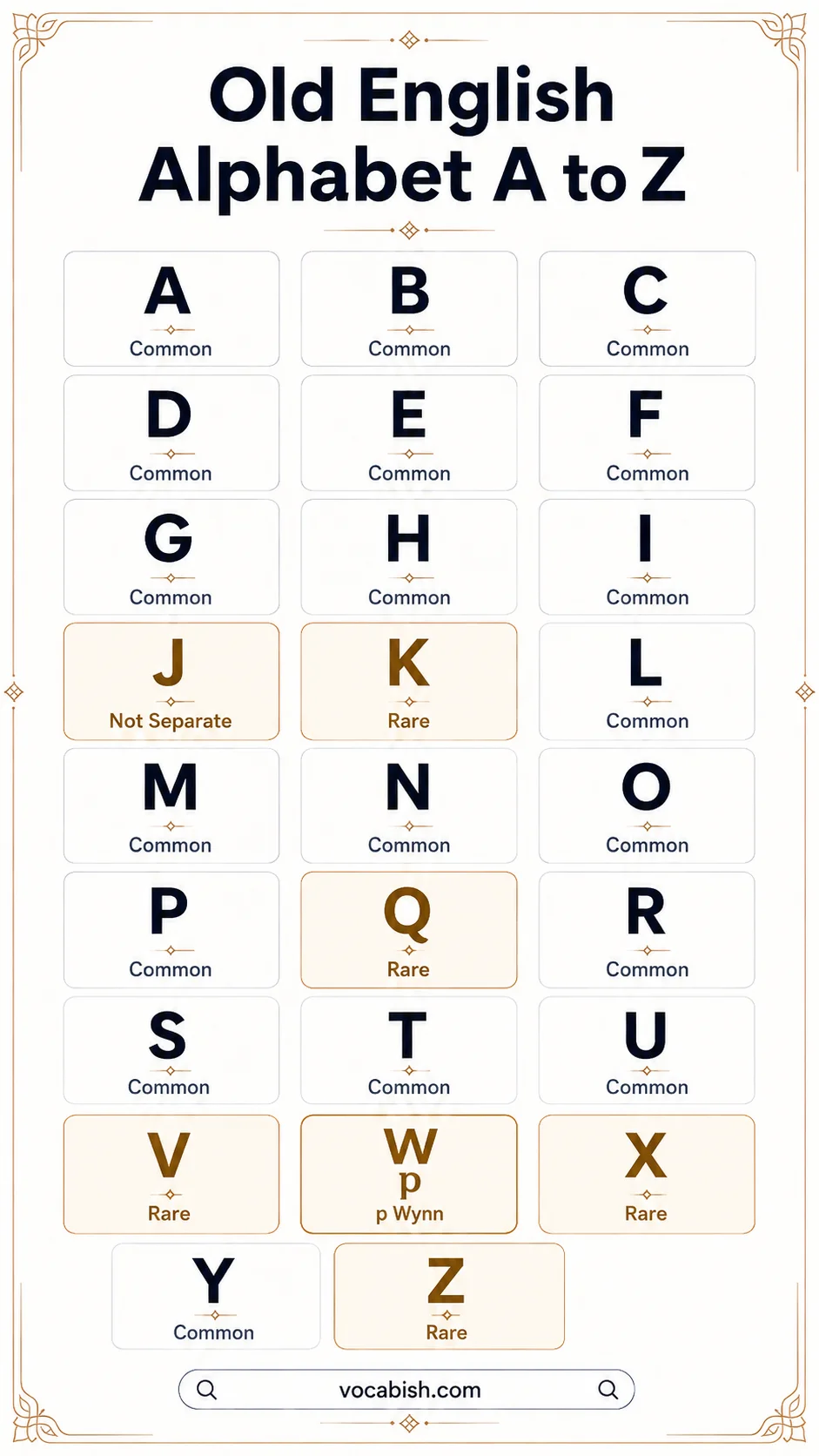
A, Æ, B, C, D, Ð, E, F, G, H, I, L, M, N, O, P, R, S, T, Þ, U, ƿ/W, X, Y
The exact appearance and spelling could vary between manuscripts, regions, and periods because Old English spelling was not completely standardized.
Letters such as J were not independent Old English letters in the modern sense. K, Q, V, and Z were uncommon in native vocabulary, while wynn (ƿ) could represent the sound now written w.
Old English Alphabet A to Z with Pronunciation
The following Old English alphabet A to Z chart uses the modern alphabet as a reference. This makes it easier for learners searching from A to Z to see which modern letters existed, which were rare, and how their sounds were represented.
Letter | Old English Use | Approximate Pronunciation | Example or Note |
|---|---|---|---|
A a | Common | a as in father | mann – man |
B b | Common | b as in boy | bōc – book |
C c | Common | k or ch | cyning – king |
D d | Common | d as in did | dæg – day |
E e | Common | e as in bet | ende – end |
F f | Common | f or v | fæder – father |
G g | Common | hard g or y-like sound | gōd – good |
H h | Common | h or German-like ch | hūs – house |
I i | Common | i as in bit | ic – I |
J j | Not a separate native letter | — | y-like sound could be written with g |
K k | Rare | k as in kite | c normally served this role |
L l | Common | l as in land | land – land |
M m | Common | m as in man | mann – man |
N n | Common | n as in night | nama – name |
O o | Common | o as in pot | oxa – ox |
P p | Common | p as in pin | Used much like modern p |
Q q | Rare | kw | Native words often used cw |
R r | Common | rolled or tapped r | rīce – kingdom |
S s | Common | s or z | sunu – son |
T t | Common | t as in toy | tō – to |
U u | Common | u as in put | under – under |
V v | Rare | v | f often represented the v sound |
W w | Modern transcription | w as in work | Historical ƿ could represent w |
X x | Used | ks as in box | Found in some words and spellings |
Y y | Common vowel | rounded front vowel | yldu – age |
Z z | Rare | z or related sound | Not common in native spelling |
Old English pronunciation was much more closely connected to spelling than present-day English pronunciation. Academic teaching materials note that letters in Old English words were normally pronounced rather than routinely becoming silent as they often do today.
Special Old English Letters You Should Know
The most noticeable difference between Old and Modern English is not A through Z. It is the group of extra letters that Anglo-Saxon writers used.
Æ æ — Ash
Æ, called ash, represented a vowel sound similar to the a in bat.
Pronunciation: approximately /æ/
Examples:
- dæg – day
- fæder – father
- æfter – after
- wæs – was
The letter was a standard and important part of Old English writing.
Þ þ — Thorn
Þ, called thorn, represented a th sound.
It could occur in words such as:
- þæt – that
- þe – who, which, that
- þurh – through
Do not assume thorn always represented only the unvoiced sound in modern thin. Old English þ and ð were not consistently separated according to pronunciation in manuscripts.
Ð ð — Eth
Ð, called eth, was another way of writing a th sound.
Examples include:
- ðæt – that
- oð – until
- lēoð – song or poem
Old English scribes could use þ and ð for the same word in different places. They were not two perfectly separate sound symbols in historical spelling.
ƿ — Wynn
ƿ, called wynn, represented the sound /w/, like the w in water.
Because wynn can look confusingly similar to thorn in historical writing, modern editions often replace it with the familiar letter w.
For example, an editor may print a word with w even when the manuscript used wynn.
Old English Vowels and Their Pronunciation
Old English vowel pronunciation was different from the pronunciation learners expect from Modern English spelling.
A useful starting chart is:
Vowel | Approximate Sound | Easy Comparison |
|---|---|---|
a | /ɑ/ | a in father |
æ | /æ/ | a in bat |
e | /e/ | e in bet |
i | /i/ | i in bit |
o | /o/ | o in pot |
u | /u/ | u in put |
y | /y/ | similar to German ü |
These comparisons are only pronunciation aids. Historical pronunciation is reconstructed, and exact sounds could vary by dialect and period.
Old English y is especially unfamiliar to modern English speakers. Earlier Old English pronunciation had a rounded front vowel comparable to German ü; in later developments, this sound often merged with i in some dialects.
Short and Long Vowels in Old English
Vowel length could distinguish words and pronunciation in Old English.
Modern teaching editions commonly mark long vowels with a macron:
Short | Long |
|---|---|
a | ā |
æ | ǣ |
e | ē |
i | ī |
o | ō |
u | ū |
y | ȳ |
For example:
- i was short.
- ī was held longer.
- u was short.
- ū was a longer vowel.
A useful modern approximation is:
- ī → similar to ee in beet
- ō → similar to oa in boat
- ū → similar to oo in boot
Modern editors use macrons to help readers distinguish these long vowels, although such marks are usually editorial rather than separate letters of the original alphabet.
Consonants That Can Change Their Sound
Some Old English letters are easy to pronounce because they behave much like modern consonants. Others depend heavily on the surrounding letters.
C Could Sound Like K or CH
Old English c commonly had two pronunciations.
Hard c: similar to k
Example:
cuman – to come
Palatal c: similar to ch in chin
Example:
ic – I
In learning editions, a palatal c is sometimes written ċ to make the pronunciation clearer. The dot is an editorial aid rather than a separate historical letter.
G Had Several Pronunciations
The letter g could have a hard sound, a softer sound, or a sound resembling modern y depending on its position and surrounding vowels.
For learners:
- Hard g → similar to go
- Palatal g → can sound similar to y in yes
Teaching editions sometimes write the palatal form as ġ.
This explains why reading an Old English g exactly like every modern English g can produce the wrong pronunciation.
F Could Sound Like F or V
Old English f did not always sound like modern f.
At the beginning or end of many words, it sounded like:
f in fish
Between voiced sounds, it could be pronounced more like:
v in very
For example, the f in a word such as ofer could have a voiced pronunciation.
S Could Sound Like S or Z
The letter s could also become voiced.
Compare the approximate sounds:
- s as in sing
- z as in rise
A single s between voiced sounds could be pronounced more like /z/.
H Was Not Always Modern H
At the beginning of a word, h could sound much like modern h.
After vowels, however, it could have a stronger sound similar to the ch in German Bach or ich.
That difference matters when reading words whose descendants later developed silent gh, such as historical forms connected with words like night.
Important Old English Letter Combinations
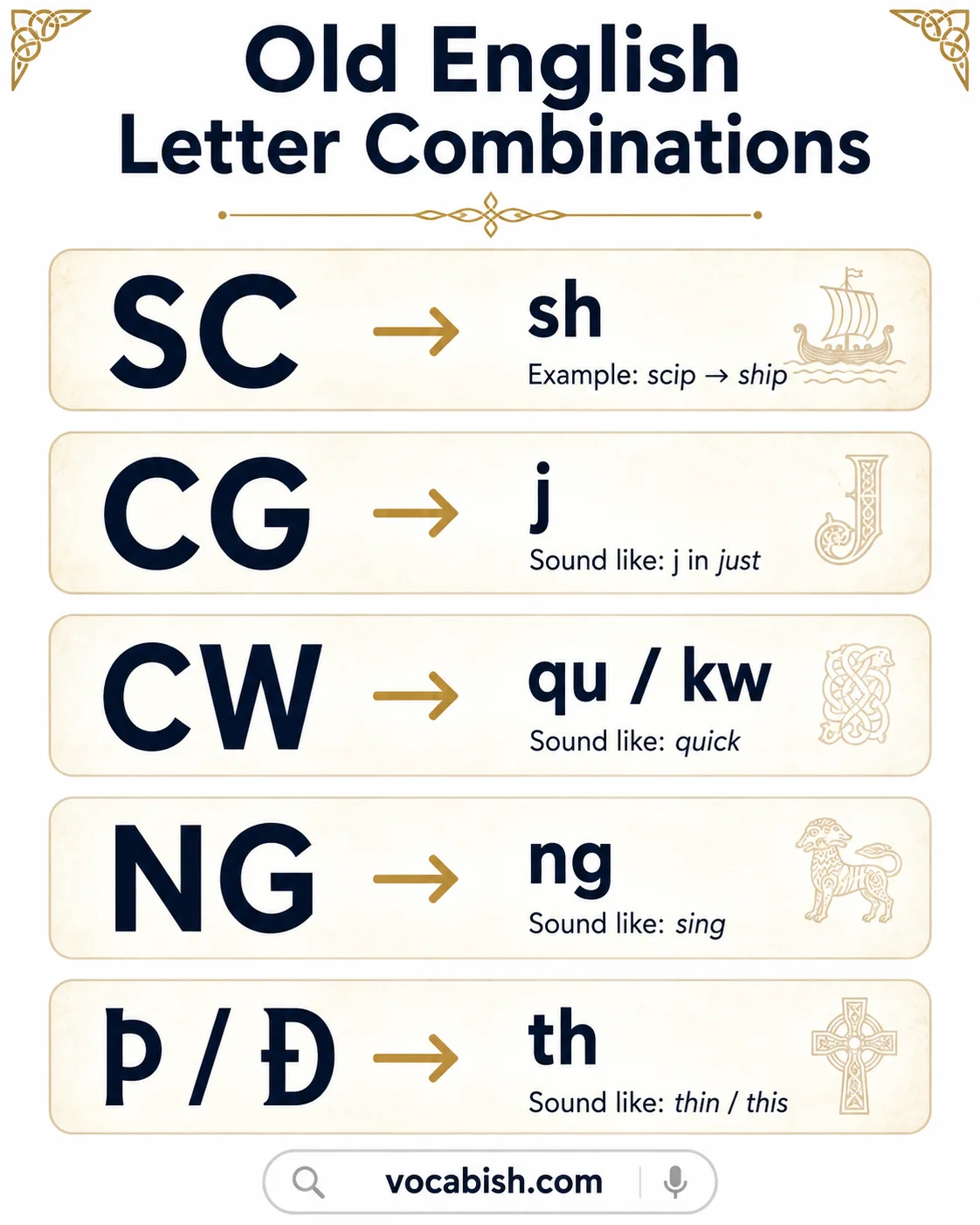
Two letters together could represent sounds that are easy to miss if each character is read separately.
Combination | Approximate Sound | Modern Comparison |
|---|---|---|
cg | /dʒ/ | j in just |
sc | /ʃ/ in many later Old English forms | sh in ship |
ng | /ŋg/ or related ng sound | ng in finger |
cw | /kw/ | qu in quick |
þ / ð | th sounds | thin or this |
For learners, sc is especially important.
The Old English word:
scip
means ship and is pronounced much closer to modern ship than a modern reader might expect from its spelling.
Similarly, cg could represent a sound comparable to modern j. Academic Old English teaching materials give cg approximately the sound of j in just.
How to Pronounce Old English Words
You do not need to memorize every historical sound before reading basic Old English. Start with a few dependable habits.
- Pronounce the written letters.
Old English generally did not use silent letters in the way Modern English does. - Watch c and g carefully.
They may have hard or palatal pronunciations. - Treat æ as a vowel.
It is not decorative typography. It represents a real vowel sound. - Read þ and ð as th sounds.
Do not pronounce them as p, b, d, or another similar-looking letter. - Notice vowel length.
A macron in a modern edition tells you to hold the vowel longer. - Learn common combinations.
In particular, remember sc, cg, and cw.
Old English vs Modern English Alphabet
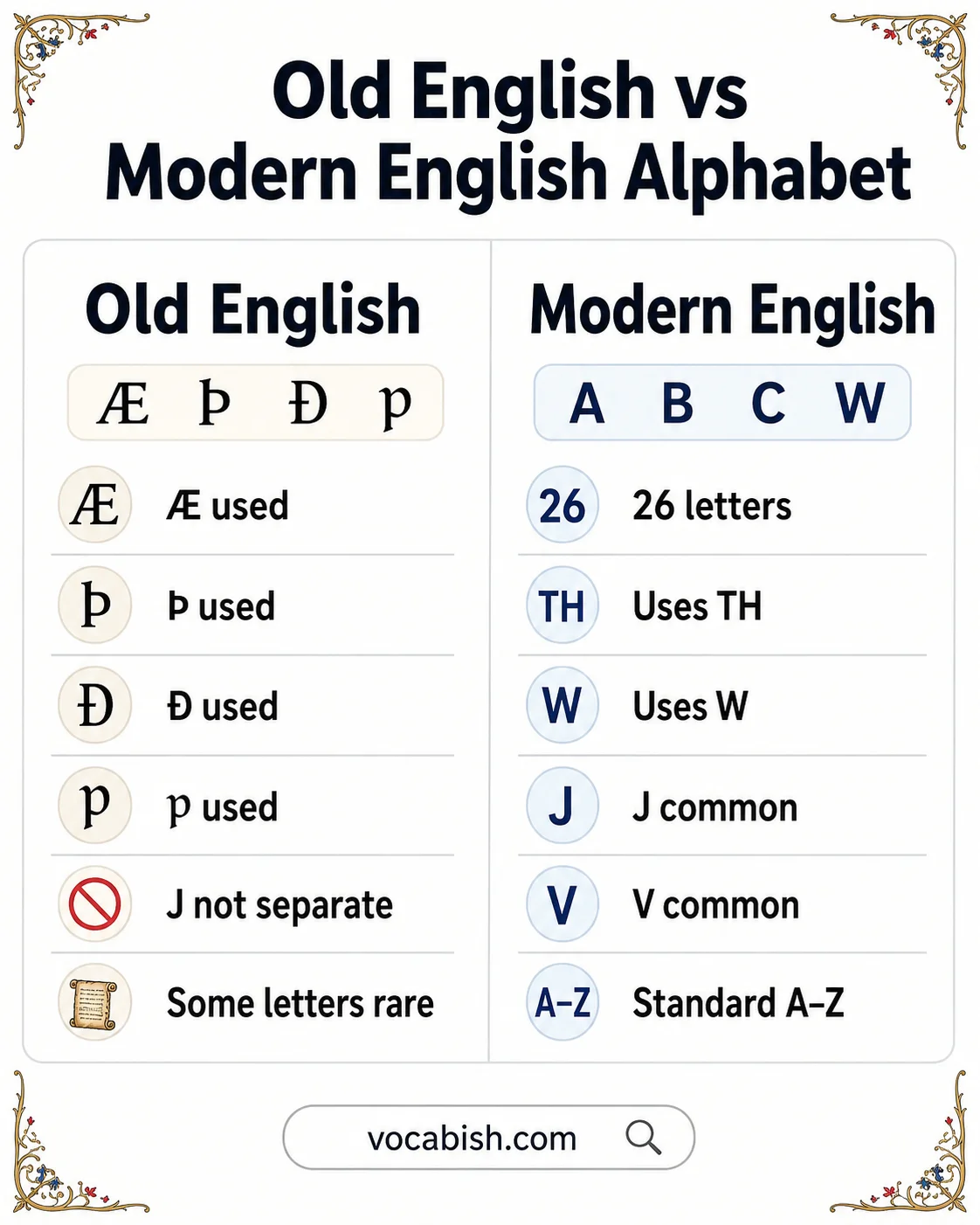
Modern English uses a fixed set of 26 letters from A to Z. Historical Old English used a different combination of Latin letters and added characters.
Feature | Old English | Modern English |
|---|---|---|
Latin-based alphabet | Yes | Yes |
Æ used regularly | Yes | No |
Þ used regularly | Yes | No |
Ð used regularly | Yes | No |
Wynn ƿ used | Yes | No |
J as normal independent letter | No | Yes |
V widely used as today | No | Yes |
W written in modern form | Not always; ƿ could be used | Yes |
Macrons in learning texts | Added by editors | Usually not used |
Spelling standardized | Much less standardized | Highly standardized |
The Old English writing system developed from Latin writing practices but added letters needed for English sounds. Spelling could differ according to dialect, period, manuscript, and scribe.
This is why calling it simply a “26-letter Old English alphabet” is historically misleading.
Were Old English Letters Originally Runes?
Old English can also be found in Anglo-Saxon runic writing, known as the futhorc, particularly in early inscriptions. However, the runic system and the Latin-based Old English alphabet are not the same thing.
The manuscript language most students encounter in works such as Beowulf is normally presented through the Latin-based Old English writing tradition.
Christian missionaries helped introduce Latin literacy, and Anglo-Saxon scribes adapted the Latin alphabet to English sounds.
So:
Old English alphabet ≠ Anglo-Saxon runes
They are related parts of early English writing history, but they are different writing systems.
Common Confusions About Old English Letters
- Old English did not simply use today’s A–Z alphabet. Several modern letters were rare or absent.
- Þ and ð were not consistently separate sounds in spelling. Scribes could alternate between them.
- Æ is one letter, not A + E pronounced separately.
- ƿ is wynn, not thorn. Modern editions usually replace it with w.
- Ā, ē, ī, ō, and similar forms are not extra alphabet letters. The macrons mainly help modern readers identify long vowels.
Old English Pronunciation Examples
Here are a few words that show how the alphabet works in practice.
Old English | Meaning | Pronunciation Hint |
|---|---|---|
dæg | day | æ like bat |
fæder | father | æ + voiced medial f possible |
þæt | that | initial th |
scip | ship | sc ≈ sh |
cyning | king | c begins with a k-like sound |
hūs | house | long ū |
gōd | good | long ō |
bōc | book | long ō |
ic | I | final c can be ch-like |
sunu | son | pronounce both vowels |
Many familiar English words descend from forms that already existed in Old English. Academic examples include hand, word, mann, under, sittan, wæs, and gōd, although their pronunciation or spelling may have changed over time.
Why Do Old English Letters Look Different?
English changed continuously after the Old English period. Writing practices changed as well.
Some special characters disappeared, while other Latin letters became more common. Wynn was replaced by w, while thorn and eth eventually gave way to the digraph th in standard English spelling.
Pronunciation also changed greatly over the centuries. As a result, a modern word may look related to an Old English form but sound quite different.
Compare:
- bōc → book
- hūs → house
- fæder → father
- scip → ship
- under → under
- mann → man
These examples show that Modern English still carries a large amount of vocabulary inherited from its Old English ancestor.
FAQs About Old English Letters
Old English letters are characters used to write early medieval English, including familiar Latin letters plus special forms such as æ, þ, ð, and ƿ.
There was no single standardized 26-letter system identical to today’s alphabet. The exact set and spelling conventions varied across periods, dialects, and manuscripts.
The best-known special letters are æ (ash), þ (thorn), ð (eth), and ƿ (wynn). They represented sounds needed for writing Old English.
Þ, or thorn, represents a th sound. Depending on its phonetic environment, the sound could resemble the th in thin or this.
Both represented th sounds, and Old English scribes did not consistently use them to distinguish two separate pronunciations. Their spelling could vary within texts.
The /w/ sound certainly existed, but scribes could write it with ƿ, called wynn. Modern editors commonly replace wynn with the letter w.
J was not a regular independent Old English letter like it is today. Some sounds now associated with y or j were represented using other spellings.
No. Anglo-Saxon runes belong to the futhorc writing system, while most surviving Old English manuscript writing uses an adapted Latin alphabet.
Conclusion
Old English letters show how different early English writing was from today’s familiar A-to-Z system. The language used many recognizable Latin letters, but it also included æ, þ, ð, and ƿ, while several modern letters were rare or absent.
Once you learn the major vowel sounds, special characters, and changing pronunciations of c, g, f, s, and h, the Old English alphabet becomes much easier to read. Instead of treating Old English spelling like Modern English, pronounce its letters carefully and pay attention to historical sound patterns. That gives you a much clearer starting point for reading early English words and texts.
You May Also Like