
Have you ever wondered how people said “hello,” “thank you,” or “I love you” hundreds of years ago? Old English phrases can sound strange at first, but many become surprisingly understandable once their meanings are explained.
Old English, also called Anglo-Saxon, was spoken in England from roughly the fifth century to the end of the eleventh century. It differs greatly from Modern English in spelling, grammar, pronunciation, and word forms.
There is also an important distinction. Expressions such as “prithee,” “good morrow,” “forsooth,” and “how dost thou?” often get called Old English today, but most belong to later stages of English. In this article, authentic Old English forms are clearly separated from later archaic and old-fashioned British expressions.
What Are Old English Phrases?
Old English phrases are expressions written or formed in the English language used by the Anglo-Saxons before Middle English developed.
The language may look almost foreign to a modern reader:
Old English: Hū eart þū?
Modern English: How are you?
Old English had more grammatical endings than Modern English. Its word order could also be more flexible because those endings helped show the role of each word in a sentence.
You may also see Old English called:
- Anglo-Saxon
- Ænglisc
- Early English
- Anglo-Saxon English
- Old English language
The surviving language includes prose, poetry, religious works, historical records, laws, and famous literary texts such as Beowulf.
Old English vs Old-Fashioned English
Many internet lists mix Old English with Shakespearean English, Middle English, and later archaic British expressions.
They are related historically, but they are not the same thing.
Type | Approximate Period | Example | Modern Meaning |
|---|---|---|---|
Old English | 5th–11th centuries | Wes hāl | Be well / Hello |
Middle English | c. 12th–15th centuries | How fare ye? | How are you? |
Early Modern English | c. 16th–17th centuries | Prithee | Please / I ask you |
Archaic English | Various later periods | Forsooth | Indeed / Truly |
Modern English | Present day | How are you? | Asking about someone’s condition |
For example, prithee is recorded as an archaic expression meaning a request or wish and developed from “I pray thee.” Its known use belongs much later than the main Anglo-Saxon period.
So, when people search for Old British English phrases, they may actually be looking for a mixture of Anglo-Saxon and later old-fashioned English. Both types are covered below, but they are labelled clearly.
Common Old English Phrases with Meanings
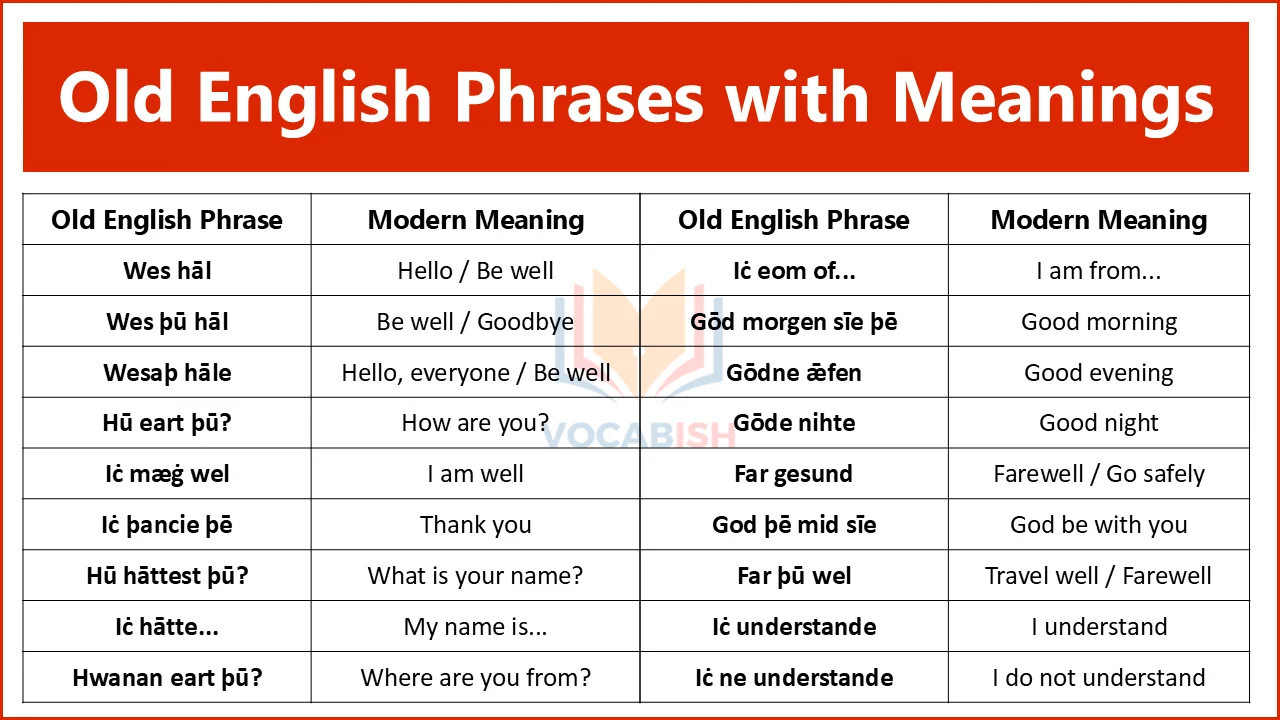
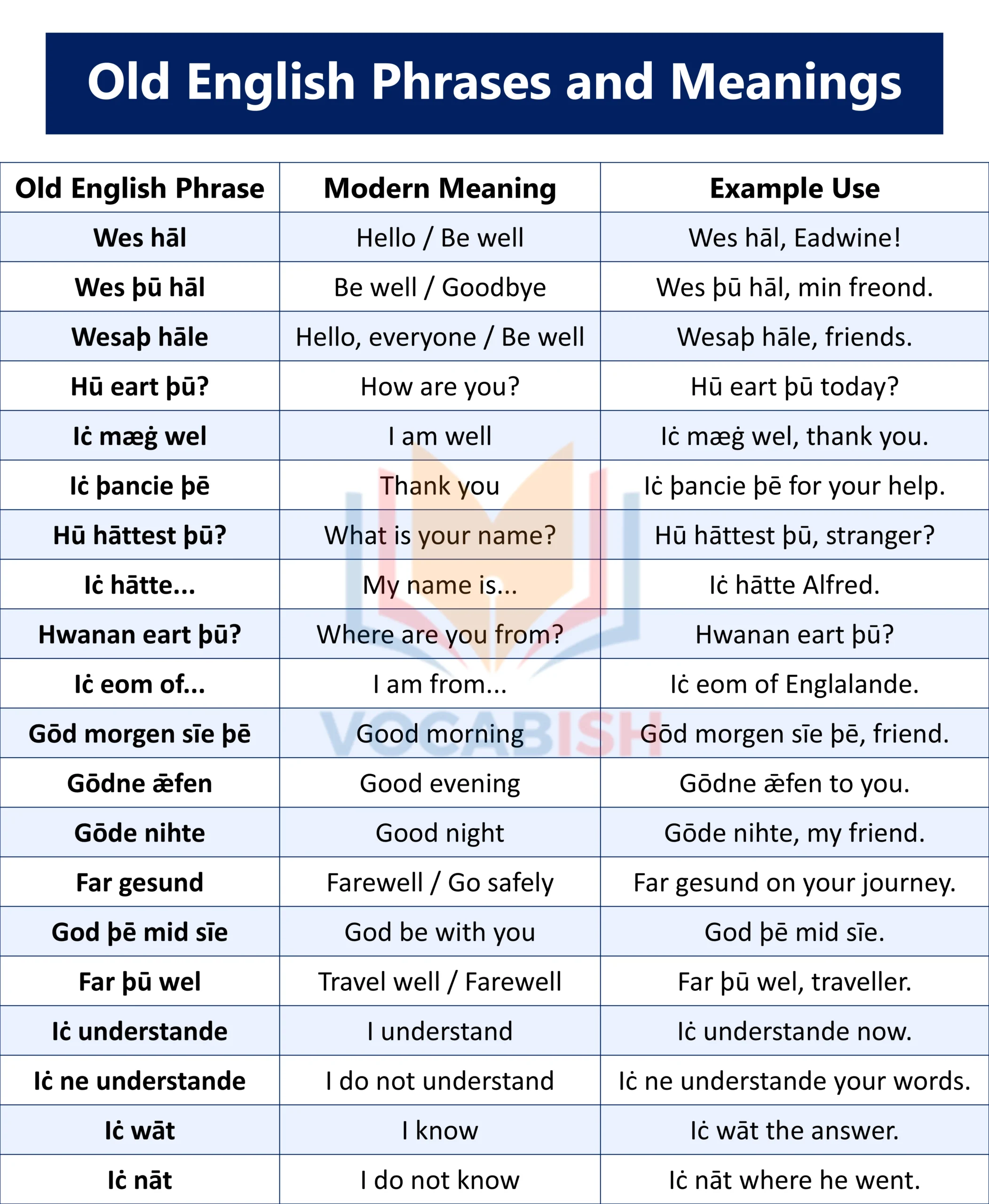
These useful forms show how everyday ideas can be expressed in Old English. The spellings follow common modern scholarly or learner conventions. Collections of Old English phrases include singular, dual, and plural forms because the language distinguished number more clearly than Modern English does.
Old English Phrase | Modern Meaning | Example Use |
|---|---|---|
Wes hāl | Hello / Be well | Wes hāl, Eadwine! |
Wes þū hāl | Be well / Goodbye | Wes þū hāl, min freond. |
Wesaþ hāle | Hello, everyone / Be well | Wesaþ hāle, friends. |
Hū eart þū? | How are you? | Hū eart þū today? |
Iċ mæġ wel | I am well | Iċ mæġ wel, thank you. |
Iċ þancie þē | Thank you | Iċ þancie þē for your help. |
Hū hāttest þū? | What is your name? | Hū hāttest þū, stranger? |
Iċ hātte… | My name is… | Iċ hātte Alfred. |
Hwanan eart þū? | Where are you from? | Hwanan eart þū? |
Iċ eom of… | I am from… | Iċ eom of Englalande. |
Gōd morgen sīe þē | Good morning | Gōd morgen sīe þē, friend. |
Gōdne ǣfen | Good evening | Gōdne ǣfen to you. |
Gōde nihte | Good night | Gōde nihte, my friend. |
Far gesund | Farewell / Go safely | Far gesund on your journey. |
God þē mid sīe | God be with you | God þē mid sīe. |
Far þū wel | Travel well / Farewell | Far þū wel, traveller. |
Iċ understande | I understand | Iċ understande now. |
Iċ ne understande | I do not understand | Iċ ne understande your words. |
Iċ wāt | I know | Iċ wāt the answer. |
Iċ nāt | I do not know | Iċ nāt where he went. |
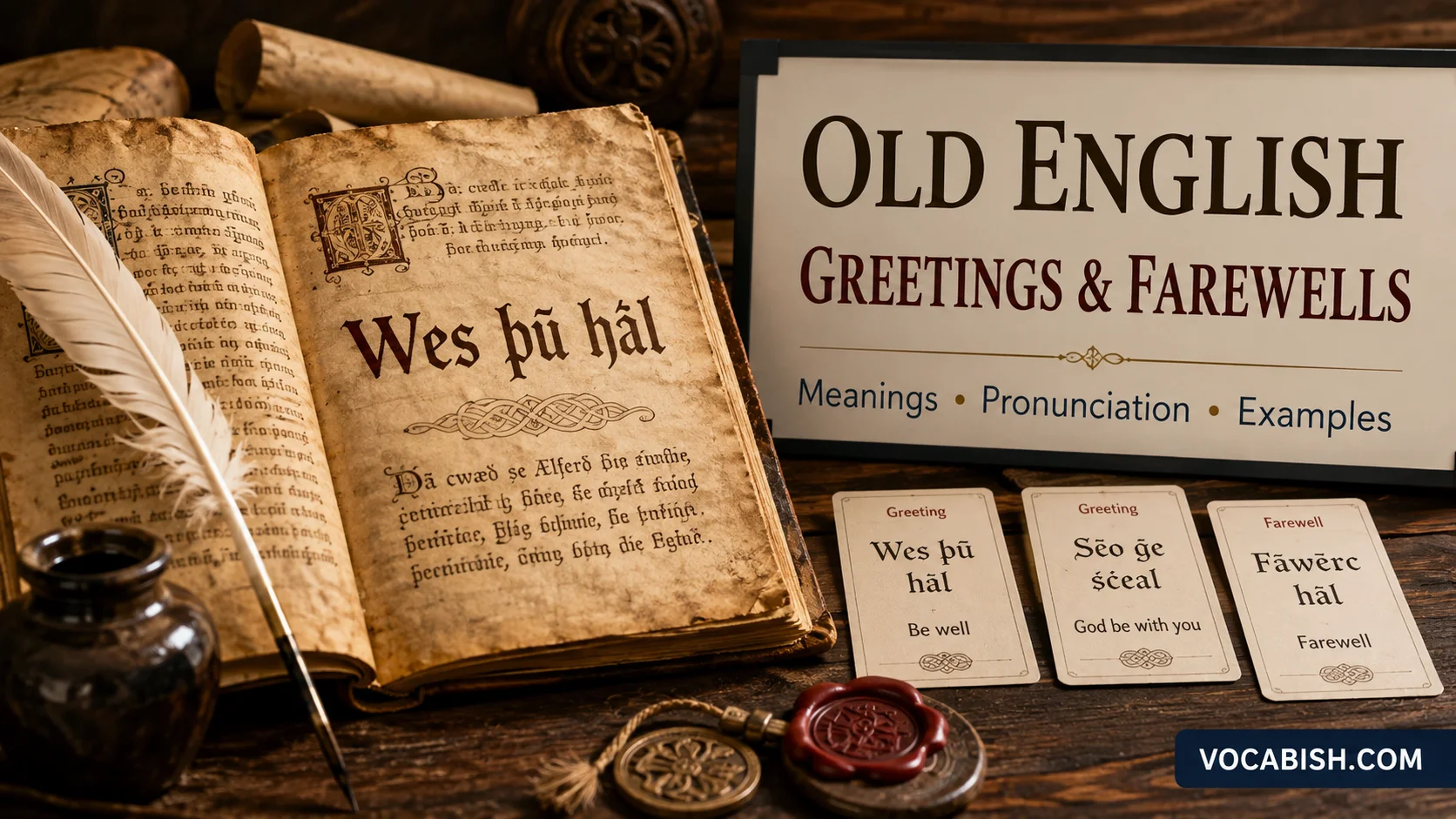
A particularly interesting phrase is wes hāl. It could function as a greeting or a farewell and literally carries the idea of being healthy or well.
Old English Greetings and Polite Expressions
Greetings are some of the easiest Old English phrases for learners to remember because their purpose is familiar.
Meeting Someone
Wes hāl
Meaning: Hello; be well.
Hū eart þū?
Meaning: How are you?
Hū hāttest þū?
Meaning: What is your name?
Iċ hātte Ælfrēd.
Meaning: My name is Alfred.
Hwanan eart þū?
Meaning: Where are you from?
Mē līcaþ þē tō mētanne.
Meaning: I am pleased to meet you.
Being Polite
Iċ bidde þē.
Meaning: Please; literally connected with asking or requesting.
Iċ þancie þē.
Meaning: Thank you.
Wilcume.
Meaning: Welcome.
Belāda mē.
Meaning: Excuse me / Forgive me.
These forms are useful for seeing how ordinary social expressions could work in Old English phrase practice.
Saying Goodbye
Wes þū hāl.
Meaning: Be well.
Far gesund.
Meaning: Go safely.
Far þū wel.
Meaning: Travel well.
God þē mid sīe.
Meaning: God be with you.
The similarity between far þū wel and modern farewell makes this phrase especially easy to remember.
Old English Phrases About Love and Friendship
Old English was not limited to battles, kings, and heroic poetry. Learners can also express affection and personal feelings.
Old English Phrase | Meaning |
|---|---|
Iċ lufie þē | I love you |
Iċ gewilnige þē | I miss / long for you |
Mē līcaþ þē | I like you / You please me |
Min freond | My friend |
Mīn lēofa | My dear / My beloved |
Iċ þancie þē | I thank you |
Wes þū hāl | Be well |
God þē mid sīe | God be with you |
Examples in Sentences:
Iċ lufie þē.
“I love you.”
Iċ gewilnige þē.
“I miss you” or “I long for you.”
Wes þū hāl, min freond.
“Be well, my friend.”
The learner phrase Iċ lufie þē is commonly given as an Old English equivalent of “I love you.”
Fancy Old English Phrases and Archaic Expressions
Many expressions described online as fancy Old English phrases actually belong to later English. They remain useful when reading historical fiction, plays, fantasy stories, or older literature.
Phrase | Meaning in Modern English |
|---|---|
Prithee | Please / I ask you |
Forsooth | Indeed / Truly |
Methinks | It seems to me |
Godspeed | I wish you success |
Well met | Welcome / Glad to meet you |
Fare thee well | Goodbye |
I beseech thee | I beg you |
What sayest thou? | What do you say? |
How dost thou? | How are you? |
Wouldst thou? | Would you? |
Thou art | You are |
I know not | I do not know |
Make haste | Hurry |
Hold thy tongue | Be quiet |
Hark! | Listen! |
Perchance | Perhaps |
These should usually be called archaic, historical, or Early Modern English-style expressions, rather than true Old English.
For example, methinks means “it seems to me,” while forsooth means “indeed” or “in truth.” Both now strongly suggest archaic speech.
Godspeed survives today as a formal or old-fashioned wish for success, especially when someone is departing on a journey or undertaking.
Old British English Phrases
People looking for Old British English phrases often want expressions heard in historical dramas, old books, Shakespearean-style dialogue, or fantasy writing.
Here are some recognizable examples:
Good Morrow
Meaning: Good morning.
Example:
“Good morrow, my friend.”
It has a strongly historical sound today.
Well Met
Meaning: Welcome, or I am pleased to meet you.
Example:
“Well met, traveller.”
The expression is classified as an archaic salutation.
Prithee, Speak
Meaning: Please speak.
Modern version:
“Please tell me.”
I Know Not
Meaning: I do not know.
Example:
“I know not where he has gone.”
What Sayest Thou?
Meaning: What do you say?
Modern version:
“What do you think?”
I Beseech Thee
Meaning: I strongly beg or request you.
Example:
“I beseech thee, hear me.”
Make Haste
Meaning: Hurry.
Example:
“Make haste! We must leave.”
Fare Thee Well
Meaning: Goodbye; may things go well for you.
A related spelling, fare thee well, still appears in examples of deliberately old-fashioned speech.
Funny Old English Phrases
Some authentic Old English learner phrases sound amusing to modern English speakers because the spelling and sentence structure are unfamiliar.
Þes wer abygþ eall
Meaning: This man will pay for everything.
A useful phrase if your Anglo-Saxon friend happens to be feeling generous.
Wolde þū mid mē fricigan?
Meaning: Would you like to dance with me?
This one works surprisingly well for a medieval-themed party.
Hwær stent se gangern?
Meaning: Where is the toilet?
Proof that even historical language learners need practical vocabulary.
Gā aweg!
Meaning: Go away!
Short, clear, and rather difficult to misunderstand.
Forlǣte mec!
Meaning: Leave me alone!
Another useful expression when an Anglo-Saxon conversation is going badly.
Fȳr!
Meaning: Fire!
One of the shortest emergency expressions to remember.
Ablinn!
Meaning: Stop!
A direct command meaning “stop” or “cease.”
Mīn lyftcræft is ful ǣla
Meaning: My hovercraft is full of eels.
This is, of course, a humorous modern sentence translated into Old English rather than an expression used by Anglo-Saxons. It appears in modern phrase collections as a language-learning joke.
Useful Old English Phrases for Everyday Situations
Here are more practical expressions grouped by purpose.
Understanding
- Iċ understande — I understand
- Iċ ne understande — I do not understand
- Iċ wāt — I know
- Iċ nāt — I do not know
- Ġēse — Yes
- Nese — No
- Wēninga — Maybe
Asking for Help
- Help þū! — Help!
- Iċ bidde þē — Please
- Iċ bidde þē þæt þū þæt eftige — Please say that again
- Iċ bidde þē þæt þū sprece slāwor — Please speak more slowly
- Iċ bidde þē hit tō āwrītanne — Please write it down
Travel and Farewells
- Far gesund — Go safely
- Far þū wel — Travel well
- Gōd wyrd sīe þē — Good luck
- Gōd dæġ sīe þē — Have a good day
- God þē mid sīe — God be with you
These learner equivalents and their singular or plural variations are found in modern Old English phrase collections.
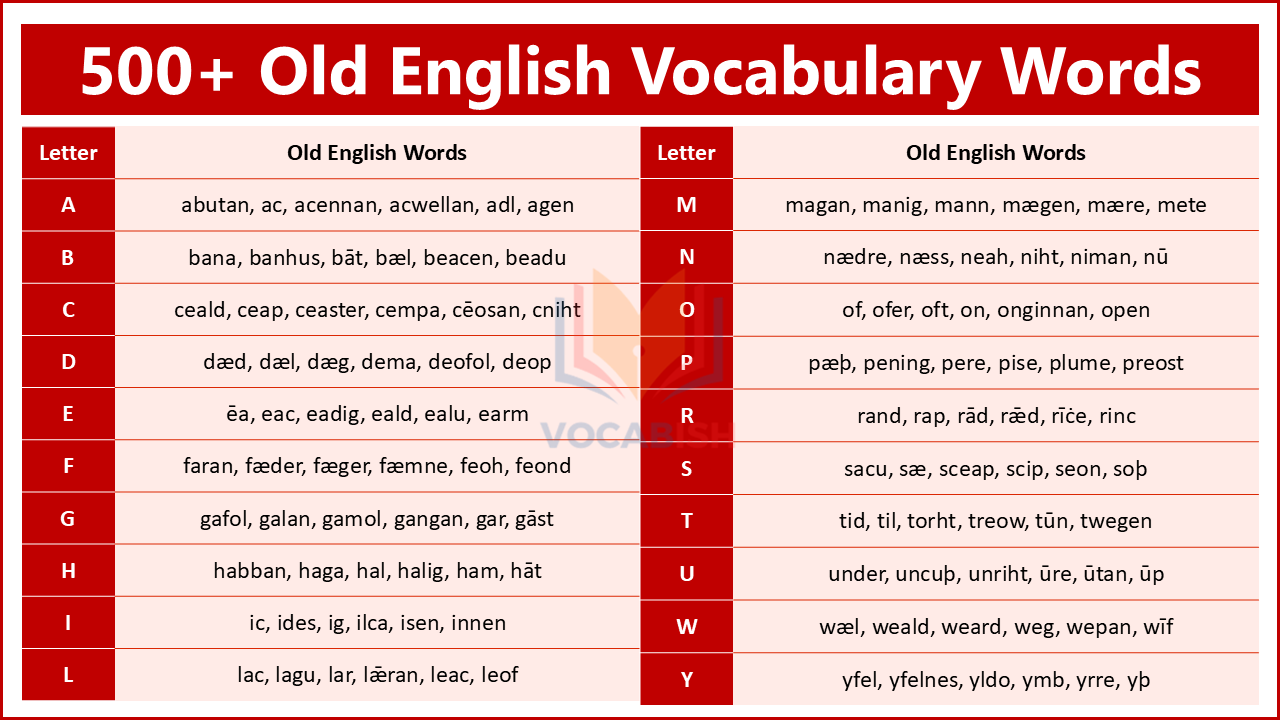
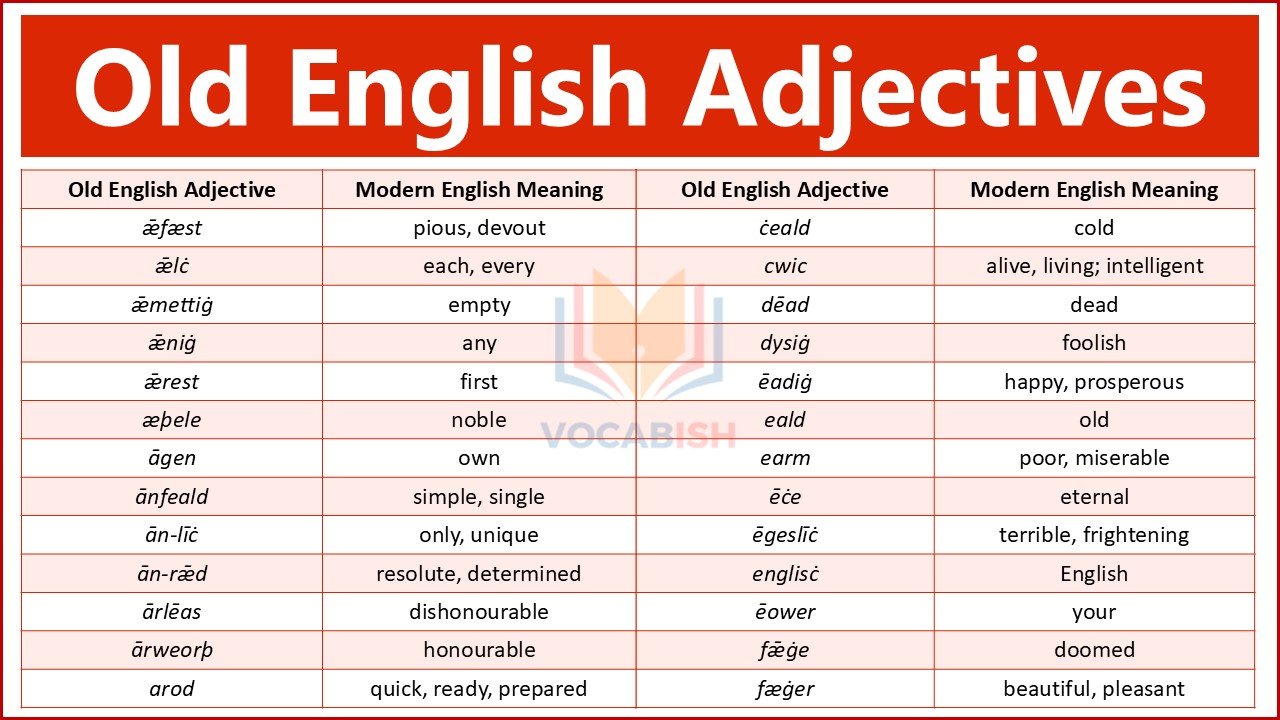
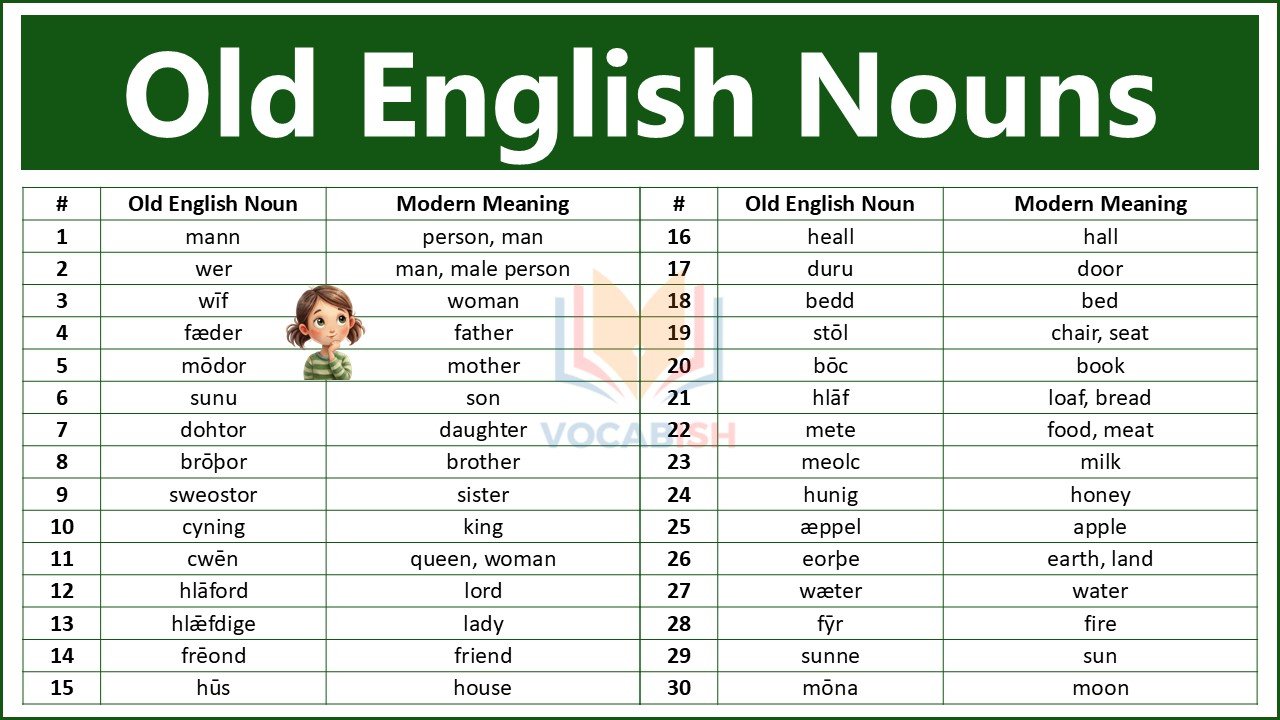
Old English Words Used Inside Common Phrases
Knowing a few individual words makes whole phrases easier to understand.
Old English Word | Meaning | Modern Connection |
|---|---|---|
gōd | good | good |
morgen | morning | morn / morning |
niht | night | night |
dæġ | day | day |
hāl | healthy, whole | hale / whole |
freond | friend | friend |
lufu | love | love |
help | help | help |
fȳr | fire | fire |
wāt | know | wit |
þancian | thank | thank |
understandan | understand | understand |
cuman | come | come |
sittan | sit | sit |
hand | hand | hand |
Many high-frequency Old English words survived into Modern English, sometimes with only spelling or pronunciation changes.
That is why a sentence such as “Iċ understande” can look surprisingly familiar even after roughly a thousand years of language change.
How to Read Old English Letters
Old English writing contains several letters that are uncommon in Modern English.
Þ — Thorn
The letter þ represents a “th” sound.
Examples:
- þū — you
- þē — you
- þancie — thank
Ð — Eth
The letter ð could also represent a “th” sound.
Old English scribes did not consistently divide the modern voiced and unvoiced “th” sounds between þ and ð.
Æ — Ash
The letter æ represents a vowel sound somewhat like the vowel in words such as “cat,” though exact pronunciation varied.
Examples:
- dæġ — day
- hwær — where
Ġ — Dotted G
Modern edited texts may use ġ to help learners distinguish certain historical pronunciations.
Examples:
- ġē — you, plural
- ġēa — yes
Ċ — Dotted C
Modern editors may use ċ to represent a pronunciation similar to modern “ch” in appropriate positions.
Example:
- Iċ — I
The Line Above a Vowel
A line such as ā, ē, ī, ō, ū is called a macron.
Modern editors often use macrons to show historically long vowels. Such editorial marks help learners with pronunciation and were not a universal spelling feature of original Old English manuscripts.
Here’s a complete and detailed guide on Old English Letters.
Fancy Archaic Phrases for Writing and Conversation
These expressions are useful when creating historical dialogue, fantasy writing, character speech, or playful captions.
Archaic Phrase | Plain English |
|---|---|
Prithee, tell me | Please tell me |
Methinks so | I think so / It seems so |
Forsooth! | Indeed! |
Well met, friend | Nice to meet you |
Fare thee well | Goodbye |
Godspeed | Good luck |
I beseech thee | I beg you |
What sayest thou? | What do you say? |
Thou art kind | You are kind |
Wouldst thou join me? | Would you join me? |
I know not | I do not know |
Make haste | Hurry |
Hark unto me | Listen to me |
Hold thy tongue | Be quiet |
Perchance it is so | Perhaps it is true |
Remember that these are mainly old-fashioned or archaic English phrases, not a pure list of Anglo-Saxon expressions.
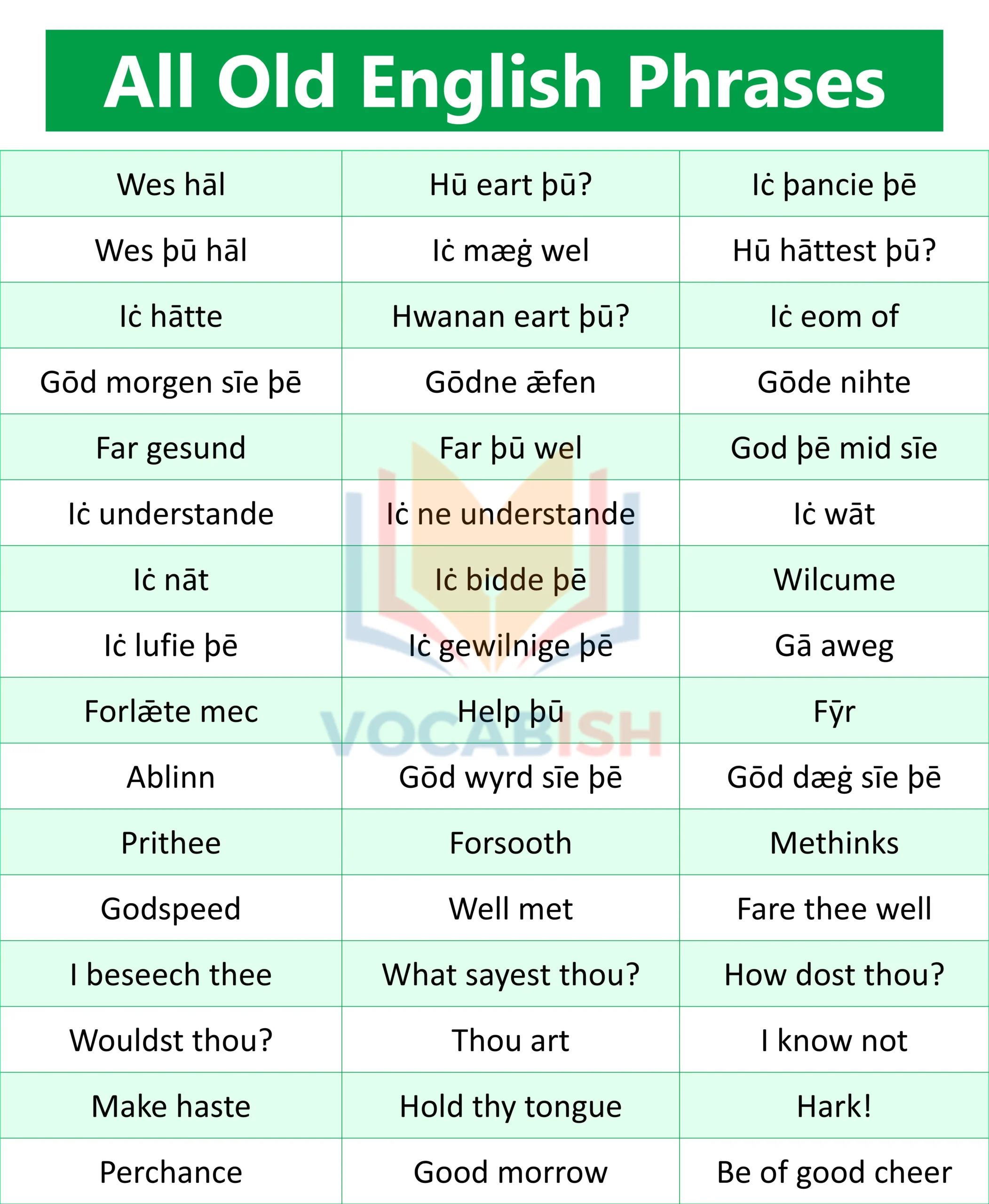
List of All Old English Phrases
The following quick-reference list contains authentic Old English learner forms alongside later archaic expressions commonly searched as “Old English.” Refer to the sections above when you need the exact historical category.
Wes hāl | Hū eart þū? | Iċ þancie þē |
Wes þū hāl | Iċ mæġ wel | Hū hāttest þū? |
Iċ hātte | Hwanan eart þū? | Iċ eom of |
Gōd morgen sīe þē | Gōdne ǣfen | Gōde nihte |
Far gesund | Far þū wel | God þē mid sīe |
Iċ understande | Iċ ne understande | Iċ wāt |
Iċ nāt | Iċ bidde þē | Wilcume |
Iċ lufie þē | Iċ gewilnige þē | Gā aweg |
Forlǣte mec | Help þū | Fȳr |
Ablinn | Gōd wyrd sīe þē | Gōd dæġ sīe þē |
Prithee | Forsooth | Methinks |
Godspeed | Well met | Fare thee well |
I beseech thee | What sayest thou? | How dost thou? |
Wouldst thou? | Thou art | I know not |
Make haste | Hold thy tongue | Hark! |
Perchance | Good morrow | Be of good cheer |
Common Mistakes and Confusions
A few distinctions will help you use these expressions more accurately:
- Shakespearean English is not Old English. Shakespeare wrote in Early Modern English, centuries after the Anglo-Saxon period.
- “Wherefore” means “why,” not “where.” “Wherefore art thou?” asks “Why are you?” rather than “Where are you?”
- Thou does not simply mean “old-fashioned you.” Historical forms changed according to grammar, number, and social usage.
- Modern edited spelling may differ. Old English manuscripts did not have one perfectly standardized spelling system.
- Not every phrasebook sentence is an ancient quotation. Some are modern learner constructions showing how an everyday idea can be expressed in Old English.
FAQs About Old English Phrases
Common examples include Wes hāl for “hello,” Hū eart þū? for “how are you?” and Iċ þancie þē for “thank you.”
Wes hāl was a common health-based greeting meaning roughly “be well.” Depending on context, it could also be used when parting.
A commonly taught Old English equivalent is Iċ lufie þē, where Iċ means “I,” lufie means “love,” and þē means “you.”
Not in the strict linguistic sense. “Good morrow” represents later historical English and sounds archaic today rather than belonging to Anglo-Saxon Old English.
No. Shakespeare wrote around the beginning of the seventeenth century in Early Modern English, which developed several centuries after the Old English period.
Prithee is an archaic request word meaning roughly “please” or “I ask you.” It developed from the expression “I pray thee.”
Forsooth means “indeed” or “in truth.” In Modern English, it is mainly used humorously or when someone wants to imitate archaic speech.
Old English used different spelling, vocabulary, grammatical endings, and letters such as þ, ð, and æ, making it less immediately recognizable to modern readers.
Conclusion
Old English phrases give us a fascinating look at how English speakers communicated centuries ago. Expressions such as Wes hāl, Hū eart þū?, Iċ þancie þē, Far þū wel, and Iċ lufie þē show both the differences and the surprising connections between Anglo-Saxon and Modern English.
For learners, the most important point is to separate true Old English from later expressions such as prithee, forsooth, methinks, good morrow, and fare thee well. Once that difference is clear, common, fancy, funny, and old British English phrases become much easier to understand and use correctly.
You May Also Like