
How would you say “hello” if you travelled back to Anglo-Saxon England? Old English greetings were quite different from the familiar hello, hi, and goodbye we use today. Expressions often wished someone health, safety, or well-being. One of the best-known forms is Wes þū hāl, meaning “be well” or “be healthy.” Old English, also called Anglo-Saxon, developed in Britain from around the middle of the fifth century and looked and sounded very different from Modern English.
What Were Old English Greetings Like?
Old English speakers did not simply use older-looking versions of modern phrases. Their language had its own grammar, vocabulary, sounds, and social expressions.
Historical evidence shows that wes þū hāl and related forms were used as greetings. Research on historical English pragmatics also notes that the same wish for health could function when people parted.
The phrase is built around the idea of being hāl, meaning healthy, whole, safe, or sound.
So instead of thinking only:
Hello!
think more along the lines of:
Be well!
That difference helps explain the character of several genuine Old English greeting expressions.
Old English Greetings: Quick List
The following table gives the most useful forms for learners. Some are directly supported by surviving Old English usage, while others are best understood as literal or teaching constructions.
Old English | Modern Meaning | Use | Historical Note |
|---|---|---|---|
Wes þū hāl | Be well! / Hail! | One person | Well-supported greeting |
Hāl wes þū | Hail! / Be well! | One person | Attested word order |
Hāle wese gē | Be well, all of you! | Several people | Attested plural form |
Sȳ þū hāl | May you be well! / Hail! | One person | Attested variant |
Hāl bēo þū | Be well! / Hail! | One person | Attested variant |
Wilcuma | Welcome guest | Welcoming vocabulary | Originally a noun |
Gōdne morgen | Good morning | Morning | Useful literal construction |
Gōdne ǣfen | Good evening | Evening | Useful literal construction |
Gōde niht | Good night | Night | Useful literal construction |
God þē mid sīe | God be with you | Parting blessing | Common teaching equivalent |
Far gesund | Go safely / Fare well | One person | Learner-friendly parting phrase |
Wesaþ hāle | Be well! | Several people | Plural farewell or greeting |
The Bosworth–Toller dictionary records forms including Hāl wes ðū, Hāle wese gē, Sȳ þū hāl, and Hāl bēo þū, showing that the health-wish formula appeared in several grammatical arrangements.
Wes Þū Hāl: The Main Old English Greeting
If you learn only one Old English greeting, Wes þū hāl is the most useful choice.
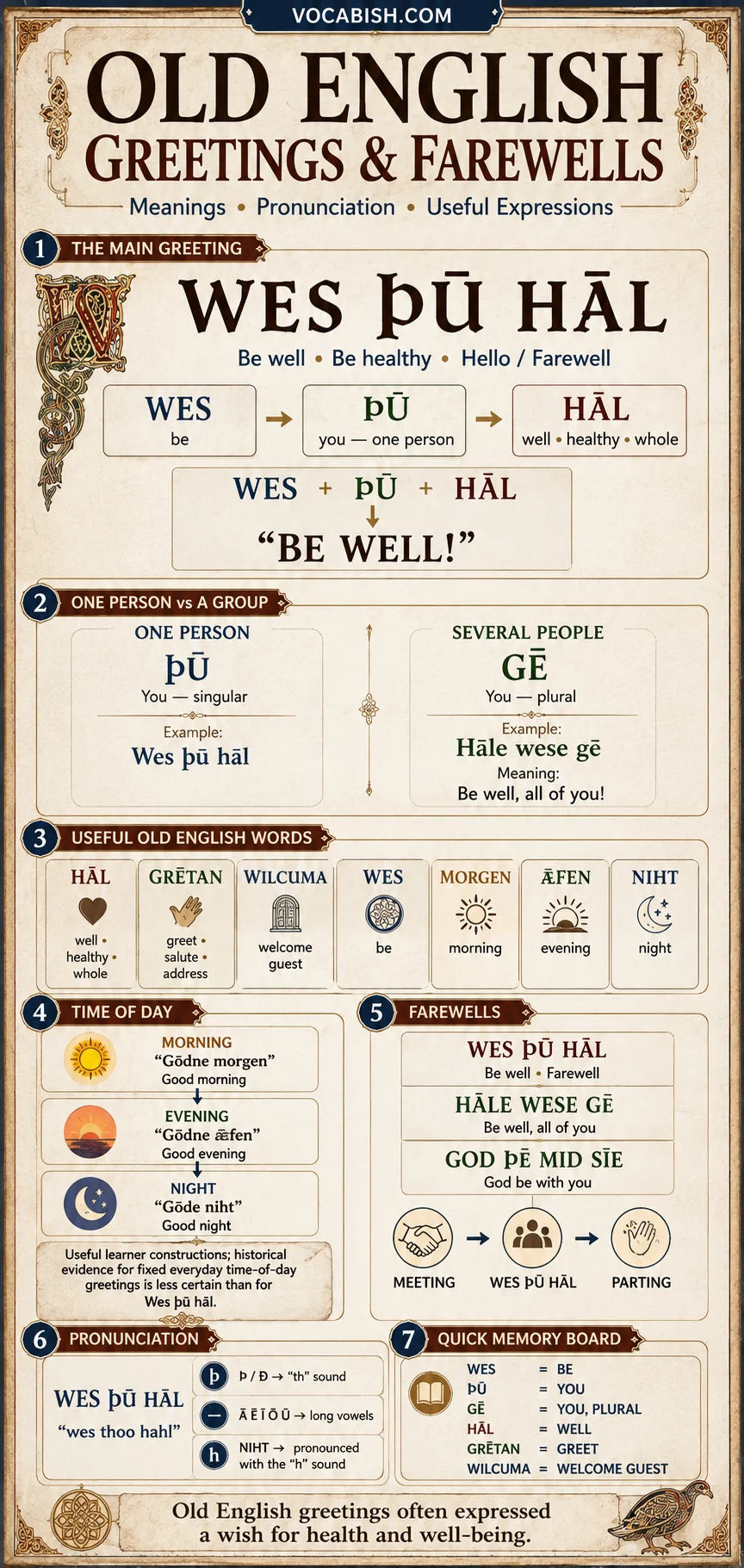
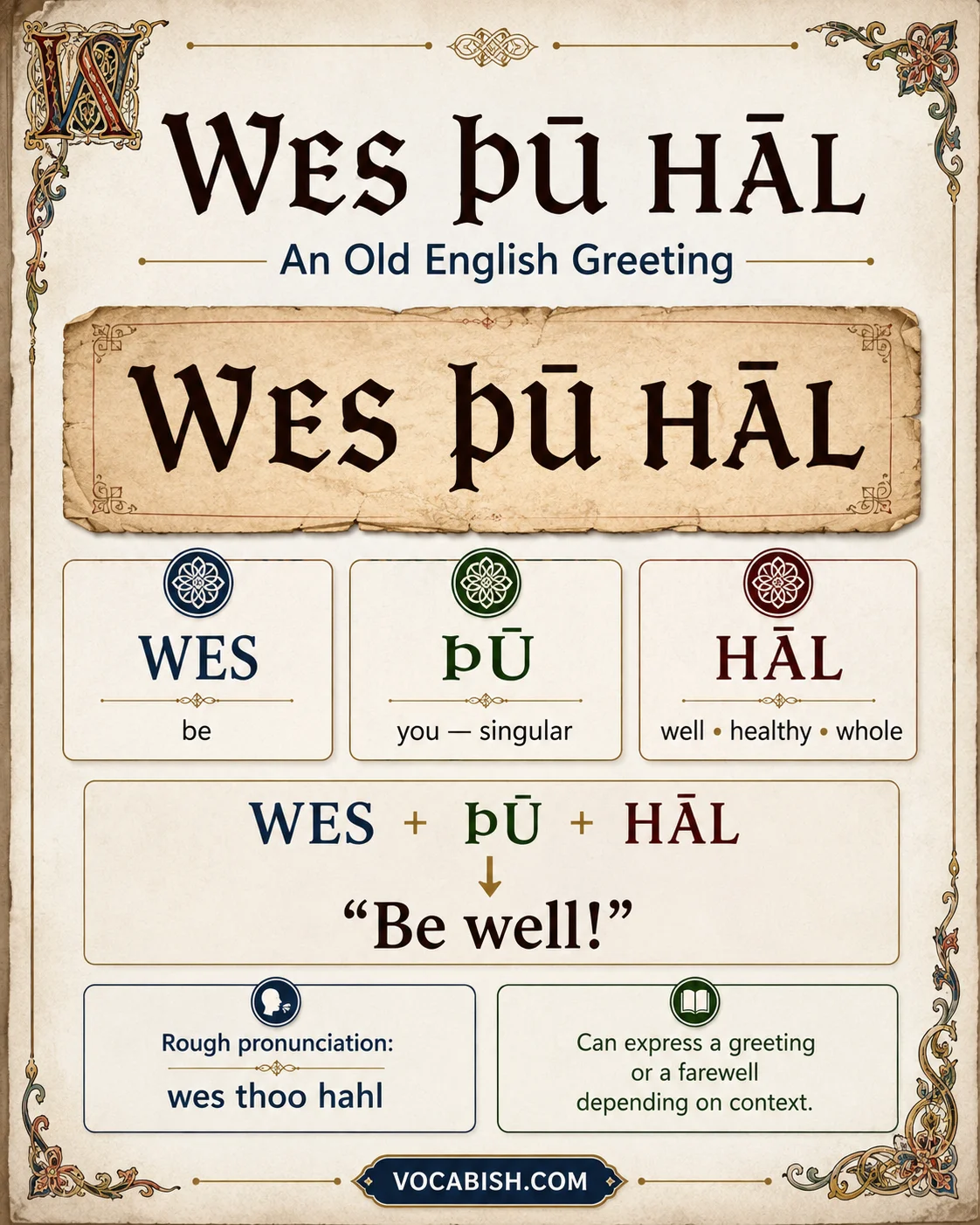
Wes þū hāl
Meaning: Be well! / Be healthy! / Hail!
Rough pronunciation: wes thoo hahl
The expression contains three parts:
- wes = be
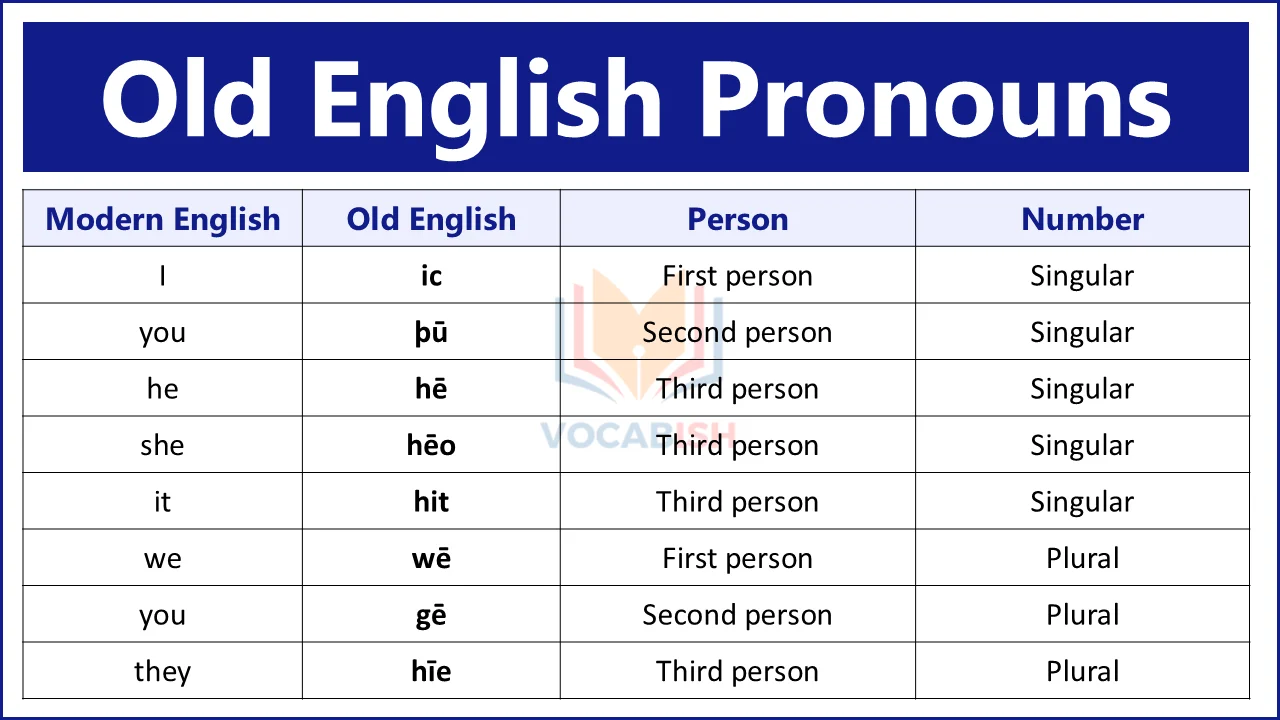
- þū = you, singular
- hāl = healthy, whole, sound, well
It is therefore more literal than modern “hello.”
A close translation is:
“Be you well.”
In natural Modern English, “Hail!”, “Greetings!”, or simply “Hello!” may communicate its function.
Historical sources contain the related arrangement Hāl wes þū, showing that word order was not limited to the form most commonly taught today.
Hāl wes þū
Meaning: Hail! / Be well!
Rough pronunciation: hahl wes thoo
This contains the same basic words as Wes þū hāl. Only their arrangement changes.
For learners, it is enough to remember that both forms express a wish for another person’s health and well-being.
Greeting One Person and a Group
Old English grammar distinguished more clearly between speaking to one person and speaking to several people.
Modern English uses you for both. Old English commonly used þū for one person and gē for more than one.
Speaking to one person
Use:
Wes þū hāl!
Meaning:
Be well! / Hello!
You may also encounter:
Hāl wes þū!
or:
Sȳ þū hāl!
The latter has the sense of “May you be well” or “Hail.” A form of it appears in surviving Old English material.
Speaking to several people
An attested plural form is:
Hāle wese gē!
Meaning:
Be well, all of you!
A normalized learner form often seen is:
Wesaþ gē hāle!
Here:
- wesaþ = be, when addressing several people
- gē = you, plural
- hāle = well or healthy
The grammatical change from wes to wesaþ is important because Old English verbs changed according to person and number.
Situation | Old English | Meaning |
|---|---|---|
One person | Wes þū hāl | Be well! |
Several people | Hāle wese gē | Be well, all of you! |
Words for Greeting and Welcome
Not every useful greeting word was a complete fixed expression. Old English also had vocabulary for greeting, welcoming, and addressing another person.
These words help us understand how Anglo-Saxon speakers described social interaction.
Grētan
Grētan is the Old English ancestor of modern greet.
It could mean to address someone, accost someone, salute them, welcome them, or speak words of greeting. Bosworth–Toller records uses connected with courteous speech when meeting another person.
So the modern connection is easy to remember:
grētan → greet
The word could also be used more broadly than modern greet. Context determined its exact meaning.
Wilcuma
Wilcuma is another interesting Old English word.
Meaning: welcome guest
Rough pronunciation: WIL-koo-mah
Unlike modern welcome!, wilcuma was originally a noun referring to a person whose arrival was desired or pleasing. It later contributed to the history of the modern word welcome.
For that reason, it is better to learn:
wilcuma = a welcome guest
rather than assuming it always worked exactly like today’s shouted greeting “Welcome!”
Good Morning, Good Evening, and Good Night
Modern learners naturally want Old English versions of familiar time-based greetings. These can be formed with genuine Old English vocabulary, but their historical use needs a little care.
Evidence for fixed everyday expressions such as modern good morning is much weaker than the evidence for wes þū hāl. Modern teaching resources therefore often present time-of-day forms as useful constructions rather than securely established conversational formulas.
Gōdne morgen
Meaning: Good morning
Rough pronunciation: GOHD-neh MOR-gen
- gōdne = good
- morgen = morning
This is an understandable Old English construction. However, learners should not assume that Anglo-Saxons routinely greeted each other with it exactly as English speakers say “Good morning” today.
Gōdne ǣfen
Meaning: Good evening
Rough pronunciation: GOHD-neh AE-ven
The word ǣfen means evening and is related historically to modern even and evening.
For practical learning, Gōdne ǣfen works as a literal Old English rendering of good evening.
Gōde niht
Meaning: Good night
Rough pronunciation: GOH-deh nikht
The final sound in niht was not pronounced like the silent letters in modern night. The h represented a sound made farther back in the mouth, somewhat like the sound in Scottish loch.
Time | Learner Form | Meaning |
|---|---|---|
Morning | Gōdne morgen | Good morning |
Evening | Gōdne ǣfen | Good evening |
Night | Gōde niht | Good night |
Notice that gōd changes form. Old English adjectives changed their endings according to grammatical case, gender, and number. That is why learners encounter forms such as gōdne and gōde rather than always seeing gōd.
Old English Farewells and Goodbye Expressions
Old English leave-taking could also use wishes for health and safety. In fact, wes þū hāl could work at both meeting and parting.
Historical-pragmatics research notes that wes þū hāl is the clearest possible Old English leave-taking formula identified in the surviving evidence.
Wes þū hāl
Meaning when parting: Be well! / Farewell!
The context tells you whether the phrase is functioning as a greeting or a farewell.
Compare:
Meeting:
Wes þū hāl!
“Hello! Be well!”
Leaving:
Wes þū hāl!
“Farewell! Stay well!”
This may seem unusual to modern learners, but many languages use wishes for health, peace, or safety when both meeting and leaving.
Wesaþ hāle
Meaning: Be well, all of you!
This is the plural idea behind the same farewell.
Use it when addressing several people rather than one person.
Far gesund
Literal meaning: Go safe and sound / Fare safely
- far = go, travel
- gesund = sound, safe, healthy, uninjured
Forms such as Far gesund appear in modern Old English phrase collections as useful farewell expressions. They are best treated as learner-friendly constructions rather than placed on the same historical level as wes þū hāl.
God þē mid sīe
Meaning: God be with you
This is commonly taught as a religious parting blessing.
Break it down:
- God = God
- þē = you
- mid = with
- sīe = may be / be
It expresses a wish that God remain with the person who is leaving.
Because religion played a major role in surviving Anglo-Saxon literature and written culture, blessing language is common in the texts that have reached us. Still, learners should distinguish a grammatical Old English equivalent from proof that every such phrase was a standard everyday goodbye.
How to Pronounce Old English Greetings
Old English pronunciation was not identical across every century or dialect. For elementary learners, a few sound rules make the phrases much easier to approach.
Þ and Ð
The letters þ and ð are called thorn and eth.
Both could represent sounds similar to modern th.
Examples:
- þū → roughly thoo
- þē → roughly theh/thee
Do not pronounce þ as p.
Long vowels
Modern teaching editions often place a line called a macron over a vowel to show that it was long.
Examples:
- ā
- ē
- ī
- ō
- ū
A long Old English vowel was generally held longer than its short counterpart. It does not automatically have the same sound as a “long vowel” in Modern English.
H in niht
In niht, the h was pronounced.
Think of a soft throat sound similar to the ch in Scottish loch rather than modern English night.
Quick Pronunciation Table
Old English | Learner-Friendly Pronunciation | Meaning |
|---|---|---|
Wes þū hāl | wes thoo hahl | Be well / Hello |
Hāl wes þū | hahl wes thoo | Hail / Hello |
Hāle wese gē | HAH-leh WEH-zeh yay | Be well, everyone |
Wilcuma | WIL-koo-mah | Welcome guest |
Gōdne morgen | GOHD-neh MOR-gen | Good morning |
Gōdne ǣfen | GOHD-neh AE-ven | Good evening |
Gōde niht | GOH-deh nikht | Good night |
These spellings are learning approximations, not exact IPA transcriptions. Historical pronunciation varied by period and dialect.
Short Old English Greeting Conversations
Because surviving Old English was written mainly for literature, religion, law, learning, and administration, we do not possess recordings or complete transcripts of ordinary Anglo-Saxon conversations.
The dialogues below are therefore learning examples built from useful Old English forms rather than quotations from historical conversations.
Meeting One Person
Person A: Wes þū hāl!
Person B: Hāl wes þū!
Modern English:
A: Hello! Be well!
B: Hail! Be well!
Greeting Several People
Speaker: Hāle wese gē!
Modern English:
Be well, all of you! / Greetings, everyone!
A Short Farewell
Person A: Wes þū hāl!
Person B: Sȳ þū hāl!
Modern English:
A: Farewell!
B: May you be well!
These examples show why literal translations can sound slightly unusual. Old English expressions do not always match Modern English phrases word for word.
Old English vs Modern English Greetings
Many familiar English greetings developed much later than the Anglo-Saxon period.
Old English should therefore not be confused with the English of Shakespeare or other Early Modern writers.
Modern Expression | Old English Connection |
|---|---|
Hello | Use Wes þū hāl as a historical greeting equivalent |
Hi | No direct everyday Old English equivalent with exactly the same modern use |
Greetings | Related idea expressed through grētan and greeting formulas |
Welcome | Connected historically with wilcuma, “welcome guest” |
Good morning | Gōdne morgen is a useful literal construction |
Good evening | Gōdne ǣfen is a useful literal construction |
Good night | Gōde niht is a useful learner rendering |
Goodbye | Wes þū hāl works well as an attested health-wish farewell |
Farewell | Health and safety wishes can express the same function |
Old English is the earliest historical form of English. It developed centuries before the language normally associated with Shakespeare, whose works belong to Early Modern English.
Why Does “Hāl” Appear So Often?
The word hāl is central to several Old English greetings because it carried meanings connected with health, wholeness, safety, and soundness.
That makes:
Wes þū hāl
much more meaningful than a random equivalent of “hi.”
It is literally a positive wish for the person being addressed.
The Bosworth–Toller dictionary records hāl in contexts meaning sound, healthy, safe, and whole, including several greeting formulas.
This also helps learners remember the phrase:
hāl → healthy / whole → “be well”
Greeting Vocabulary Worth Learning
A few individual words make Old English greeting expressions easier to understand.
Old English Word | Meaning |
|---|---|
hāl | healthy, whole, well |
wes | be! |
þū | you, singular |
gē | you, plural |
grētan | to greet, salute, address |
wilcuma | welcome guest |
gōd | good |
morgen | morning |
ǣfen | evening |
niht | night |
gesund | sound, healthy, safe |
mid | with |
God | God |
Learning these words is often more useful than memorizing long lists of invented “Anglo-Saxon phrases.” For example, Bosworth–Toller specifically defines grētan with senses including addressing, greeting, welcoming, saluting, and taking leave.
Common Confusions to Avoid
Old-looking English is not automatically Old English. Keep these points in mind:
- “Good morrow” is not typical Old English. It belongs to a much later stage of English.
- “Thou” is not the standard Old English spelling. Old English normally used þū.
- Wilcuma originally means “welcome guest.” Do not automatically treat it exactly like modern “Welcome!”
- Time-based greetings are often teaching constructions. Wes þū hāl has stronger historical support as a greeting formula.
- Old English spelling varies. You may see þ and ð, or different editorial spellings of the same expression.
FAQs About Old English Greetings
Wes þū hāl is one of the safest Old English equivalents of “hello.” Literally, it means “be well” or “be healthy.”
Surviving texts show health-wish formulas such as Wes þū hāl and Hāl wes þū, which functioned as greetings or salutations.
Wes þū hāl could also function when parting, giving the sense “be well” or “farewell,” depending on the conversational context.
Gōdne morgen literally expresses “good morning,” but time-of-day greetings are better treated as learner constructions than securely documented everyday formulas.
Wes þū hāl literally means “be well” or “be healthy.” It was a positive wish that could work as a greeting.
An attested plural expression is Hāle wese gē, meaning roughly “be well, all of you” or “greetings to you all.”
No. “Good morrow” belongs to later English. Genuine Old English looks different, with forms such as Wes þū hāl and Hāl wes þū.
Wilcuma means a “welcome guest” or desired visitor. It is historically connected with modern welcome, but originally functioned as a noun.
Conclusion
Old English greetings were not simply modern greetings written with strange letters. Expressions such as Wes þū hāl, Hāl wes þū, and Hāle wese gē show that greeting someone could involve wishing them health and well-being.
For learners, Wes þū hāl is the best phrase to remember first. It is short, historically supported, and useful both for understanding a greeting and a farewell. Once you recognize words such as hāl, þū, gē, grētan, and wilcuma, Old English greetings become much easier to read and remember.
Explore More Old English Resources
- 60+ Old English Names with Meanings
- Old English Verbs with Meanings
- Old English Numbers 1–100 with Pronunciation
- 75+ Old English Phrases with Meanings
- 120+ Old English Words and Meanings