
What did English words such as mann, hūs, sunne, hlāf, and cyning mean hundreds of years ago?
These are examples of Old English nouns, the nouns used in English roughly from the Anglo-Saxon period through about 1100. Many familiar modern words developed from these earlier forms, although their spelling, pronunciation, grammar, and meanings sometimes changed over time.
This Old English nouns list gives you common words with their modern English meanings, grouped by topic. It is useful for ESL learners, school students, English-history readers, and anyone interested in where familiar English vocabulary came from.
Quick answer: Old English nouns are naming words used in English before Middle English became dominant. Examples include mann (person/man), wīf (woman), hūs (house), wæter (water), hand (hand), and cyning (king).
What Are Old English Nouns?
Old English was the form of English used in England approximately from 450 to 1100, with the Bosworth-Toller dictionary describing the documented language primarily as used around 700–1100. It is much older than the English spoken today and is not the same as modern English with unusual spelling.
An Old English noun could name a:
- person
- animal
- object
- place
- body part
- natural feature
- period of time
- idea or quality
Old English nouns also changed their endings according to grammatical case, number, and gender. For example, fōt means “foot,” while some of its plural forms appear as fēt, showing the vowel change that eventually became part of modern English foot/feet.
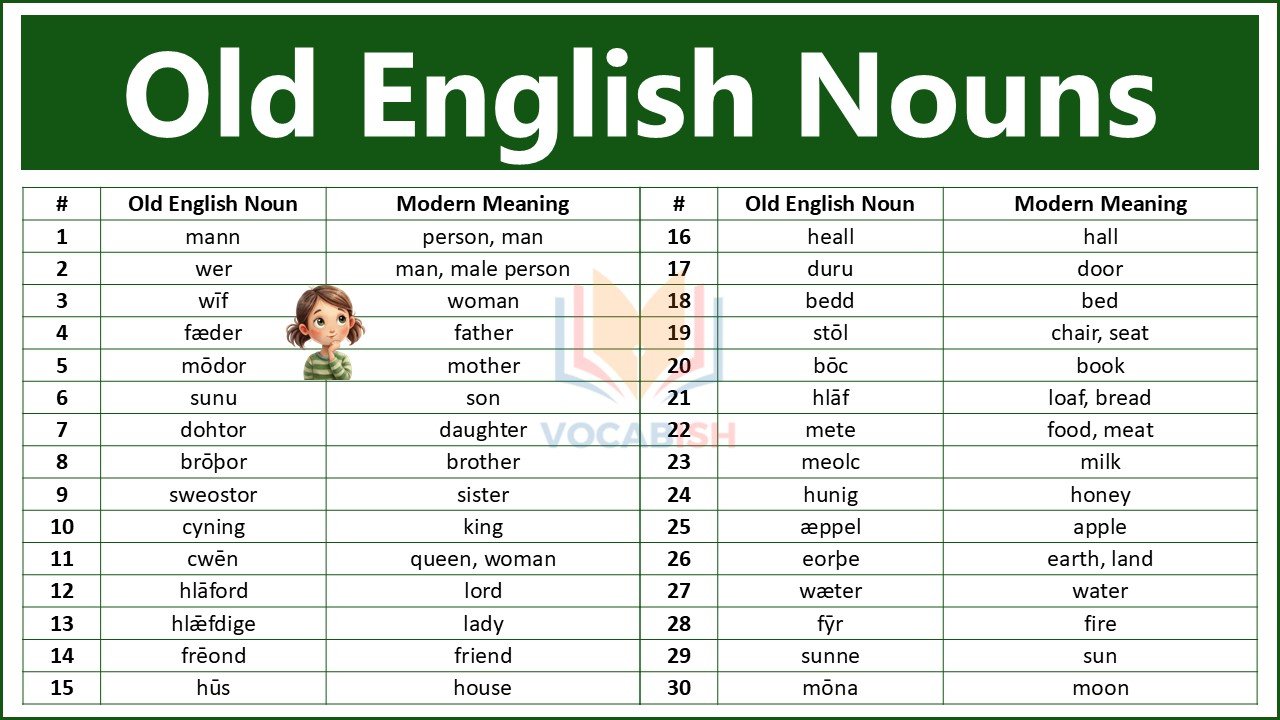
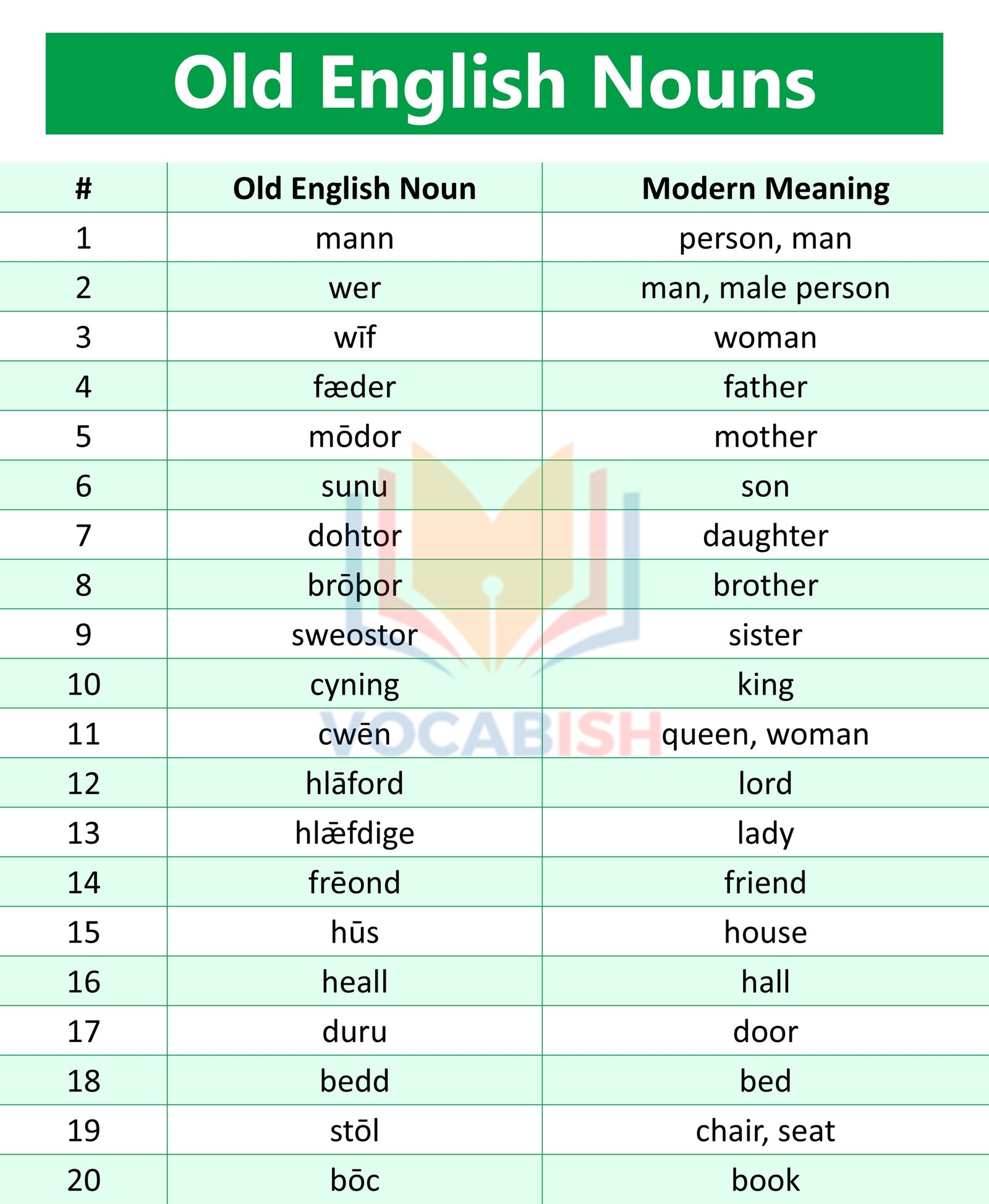
Old English Nouns List with Meanings
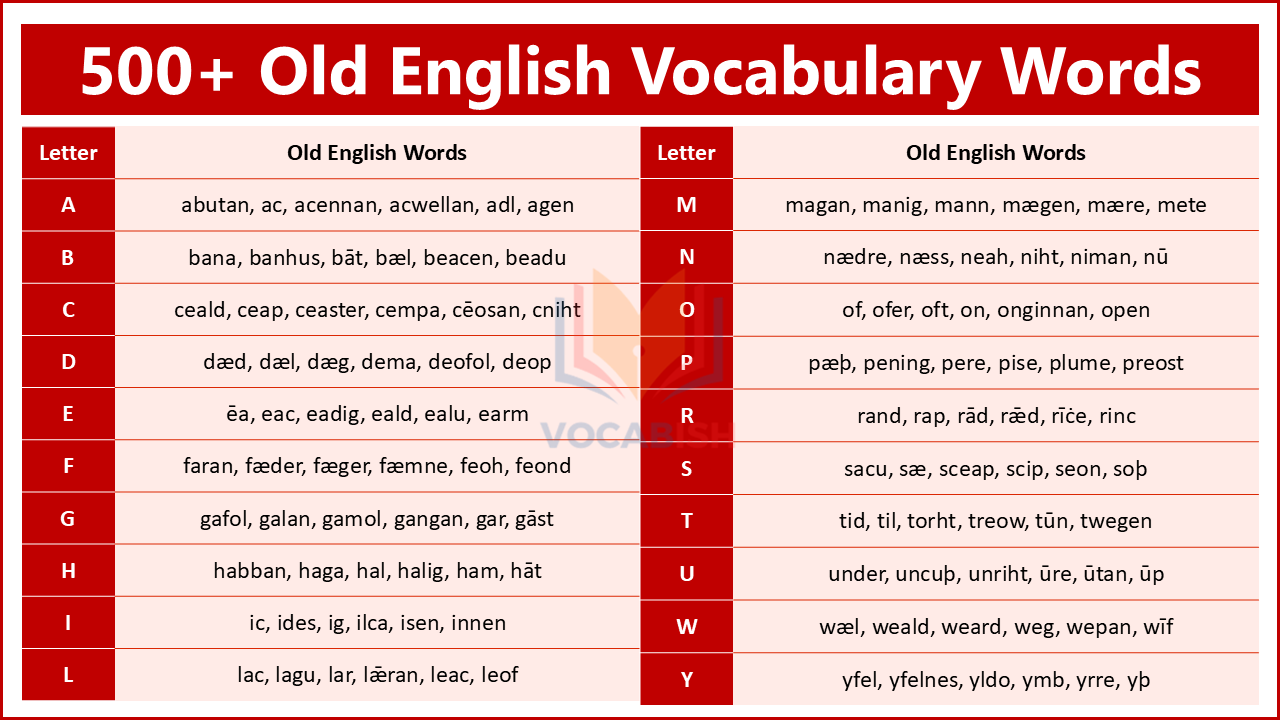
The table below presents useful Old English nouns in their commonly cited dictionary forms. Spellings include characters such as þ (thorn), æ, and long-vowel marks such as ā, ē, ī, ō, ū.
# | Old English Noun | Modern Meaning |
|---|---|---|
1 | mann | person, man |
2 | wer | man, male person |
3 | wīf | woman |
4 | fæder | father |
5 | mōdor | mother |
6 | sunu | son |
7 | dohtor | daughter |
8 | brōþor | brother |
9 | sweostor | sister |
10 | cyning | king |
11 | cwēn | queen, woman |
12 | hlāford | lord |
13 | hlǣfdige | lady |
14 | frēond | friend |
15 | hūs | house |
16 | heall | hall |
17 | duru | door |
18 | bedd | bed |
19 | stōl | chair, seat |
20 | bōc | book |
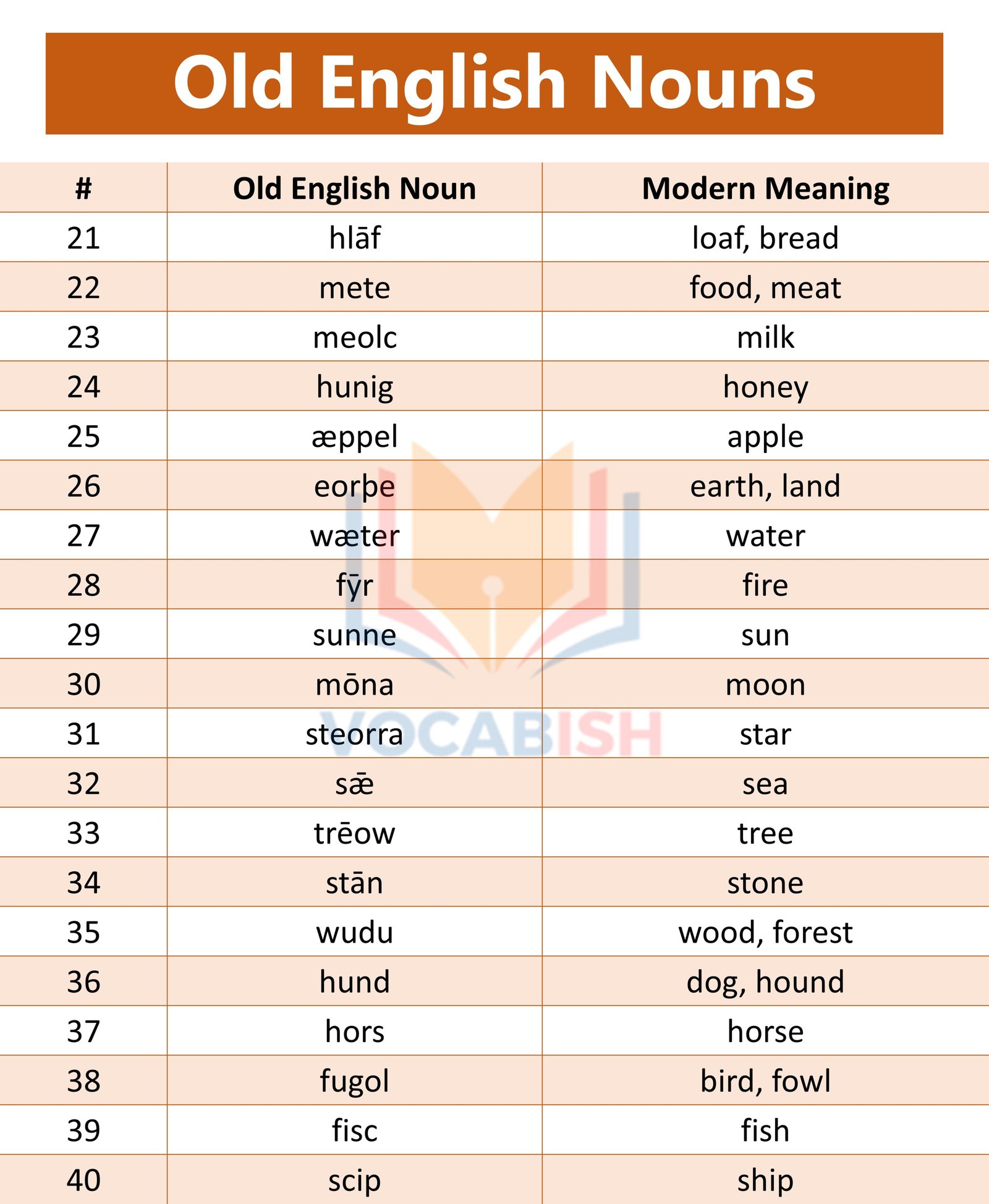
21 | hlāf | loaf, bread |
22 | mete | food, meat |
23 | meolc | milk |
24 | hunig | honey |
25 | æppel | apple |
26 | eorþe | earth, land |
27 | wæter | water |
28 | fȳr | fire |
29 | sunne | sun |
30 | mōna | moon |
31 | steorra | star |
32 | sǣ | sea |
33 | trēow | tree |
34 | stān | stone |
35 | wudu | wood, forest |
36 | hund | dog, hound |
37 | hors | horse |
38 | fugol | bird, fowl |
39 | fisc | fish |
40 | scip | ship |
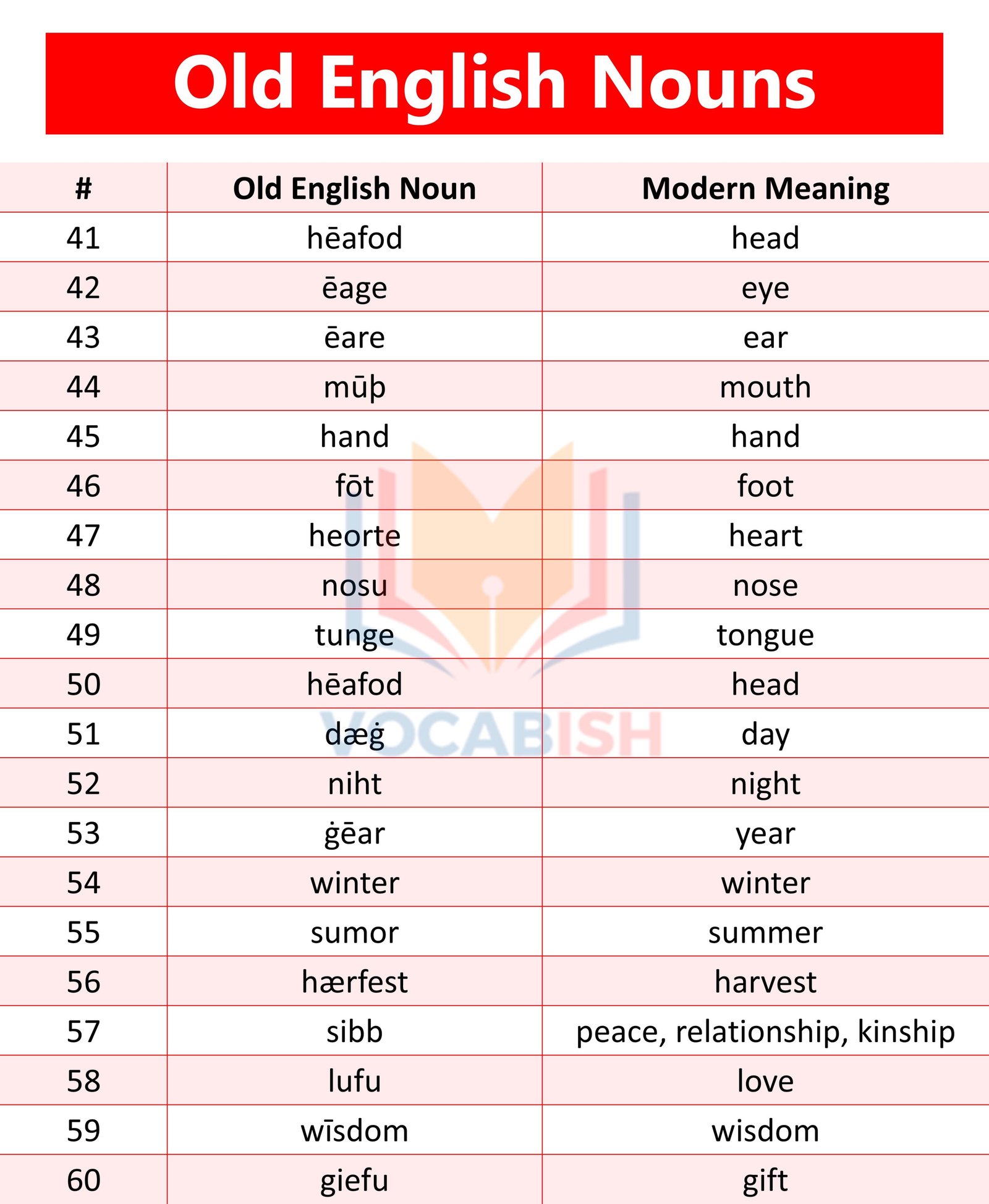
41 | hēafod | head |
42 | ēage | eye |
43 | ēare | ear |
44 | mūþ | mouth |
45 | hand | hand |
46 | fōt | foot |
47 | heorte | heart |
48 | nosu | nose |
49 | tunge | tongue |
50 | hēafod | head |
51 | dæġ | day |
52 | niht | night |
53 | ġēar | year |
54 | winter | winter |
55 | sumor | summer |
56 | hærfest | harvest |
57 | sibb | peace, relationship, kinship |
58 | lufu | love |
59 | wīsdom | wisdom |
60 | giefu | gift |
Many of these meanings and forms are documented in Old English dictionaries and teaching resources, including Bosworth-Toller and the University of Glasgow’s Old English materials.
Old English Nouns for People and Family
Family vocabulary is one of the easiest areas for modern English learners to recognize because several Old English words remain surprisingly close to their modern forms.
Family and People
Old English | Modern English |
|---|---|
mann | person, man |
wer | man, male |
wīf | woman |
fæder | father |
mōdor | mother |
sunu | son |
dohtor | daughter |
brōþor | brother |
sweostor | sister |
frēond | friend |
The meaning of mann is especially important. In Old English, mann could mean a human being of either sex, not only a male person. The dictionary records both the general human sense and its grammatical forms.
Likewise, wīf meant “a woman” or “female person” in Old English. Its meaning was broader than the modern English sense of wife, showing how word meanings can shift over centuries.
A Useful Historical Contrast
Old English:
- mann = person or man
- wīf = woman
Modern English:
- man = generally an adult male
- woman = adult female
The history of these two words shows why you should not assume that an Old English word always had exactly the same meaning as its modern-looking descendant.
Old English Nouns for Nature and Animals
Old English speakers needed words for familiar parts of the natural world, including land, water, weather, animals, trees, and the sky.
Nature Vocabulary
Old English Noun | Meaning |
|---|---|
eorþe | earth, land |
wæter | water |
fȳr | fire |
sǣ | sea |
trēow | tree |
stān | stone |
wudu | wood, forest |
sunne | sun |
mōna | moon |
steorra | star |
Several of these are easy to recognize because modern English preserved closely related forms. A learner seeing wæter, stān, trēow, or steorra can often make a reasonable connection with water, stone, tree, and star.
Animal Nouns
Old English | Modern English |
|---|---|
hund | dog, hound |
hors | horse |
fugol | bird, fowl |
fisc | fish |
The noun fugol is particularly interesting because its descendant is no longer the ordinary modern word bird, although the related word fowl survives.
Old English Nouns for the Body
Old English body-part nouns often resemble the words used today.
Old English | Modern English |
|---|---|
hēafod | head |
ēage | eye |
ēare | ear |
mūþ | mouth |
hand | hand |
fōt | foot |
heorte | heart |
nosu | nose |
tunge | tongue |
One especially useful example is fōt. The singular means “foot,” while its plural form is fēt, which helps explain the old vowel alternation behind modern foot → feet. Old English also had other nouns with related vowel changes, a feature known as vowel mutation or i-mutation.
Old English Nouns for Home and Everyday Life
Household vocabulary shows how much of basic English survived through language change.
Home and Objects
Old English | Modern English |
|---|---|
hūs | house |
heall | hall |
duru | door |
bedd | bed |
stōl | chair, seat |
bōc | book |
These words are useful for learners because their modern descendants remain common everyday vocabulary.
For example:
hūs → house
duru → door
bedd → bed
bōc → book
The spelling changed considerably in some cases, but the historical relationship remains clear.
Food and Drink
Old English | Modern Meaning |
|---|---|
hlāf | loaf, bread |
mete | food, meat |
meolc | milk |
hunig | honey |
æppel | apple |
The word mete is worth remembering because its meaning was not restricted to animal flesh. It could refer generally to food, while modern meat developed a narrower sense.
This is a good example of semantic change, which happens when a word’s meaning becomes broader, narrower, stronger, weaker, or otherwise different over time.
Old English Nouns for Society, Work, and War
Old English literature often describes kings, warriors, households, ships, weapons, and social relationships. This vocabulary appears frequently in historical texts and works such as Beowulf.
Some useful nouns include:
Old English | Modern Meaning |
|---|---|
cyning | king |
cwēn | queen, woman |
hlāford | lord |
hlǣfdige | lady |
mann | person, man |
wer | man |
frēond | friend |
scip | ship |
The noun cyning is especially recognizable: it developed into modern king. Historical forms such as hlāford and hlǣfdige also belong to the word history behind lord and lady.
Old English social vocabulary could be quite specific, and some terms described a person’s position, occupation, sex, or relationship to another person. Therefore, an apparently familiar word should still be checked in a historical dictionary rather than interpreted only through modern English.
Old English Nouns for Time and Abstract Ideas
Not all nouns referred to physical things. Old English also had words for time, feelings, relationships, knowledge, values, and other ideas.
Time
Old English | Modern English |
|---|---|
dæġ | day |
niht | night |
ġēar | year |
winter | winter |
sumor | summer |
hærfest | harvest |
Abstract Nouns
Old English | Modern Meaning |
|---|---|
sibb | peace, relationship, kinship |
lufu | love |
wīsdom | wisdom |
giefu | gift |
Abstract nouns are especially useful when studying how modern English vocabulary developed because many of their descendants remain part of everyday speech.
Old English Nouns That Still Exist in Modern English
Some Old English nouns have remained recognizable for more than a thousand years.
Here are several strong examples:
Old English | Modern English |
|---|---|
fæder | father |
mōdor | mother |
sunu | son |
brōþor | brother |
sweostor | sister |
cyning | king |
hūs | house |
bōc | book |
hand | hand |
fōt | foot |
wæter | water |
stān | stone |
trēow | tree |
hors | horse |
fisc | fish |
dæġ | day |
niht | night |
ġēar | year |
lufu | love |
wīsdom | wisdom |
The spelling may look unfamiliar, but the connection becomes easier once you understand that Old English used letters and spelling conventions that are no longer standard in modern English.
Old English vs Modern English Nouns
Old English and Modern English are related, but they do not work in exactly the same way.
Spelling Changed
A word such as:
hūs → house
shows a major spelling and pronunciation change over time.
Likewise:
fisc → fish
looks quite different despite having the same basic meaning.
Pronunciation Changed
Letters such as þ represented sounds that modern English usually writes with th.
For example:
brōþor contains þ, while modern English has brother.
The letter þ is called thorn.
Grammar Changed
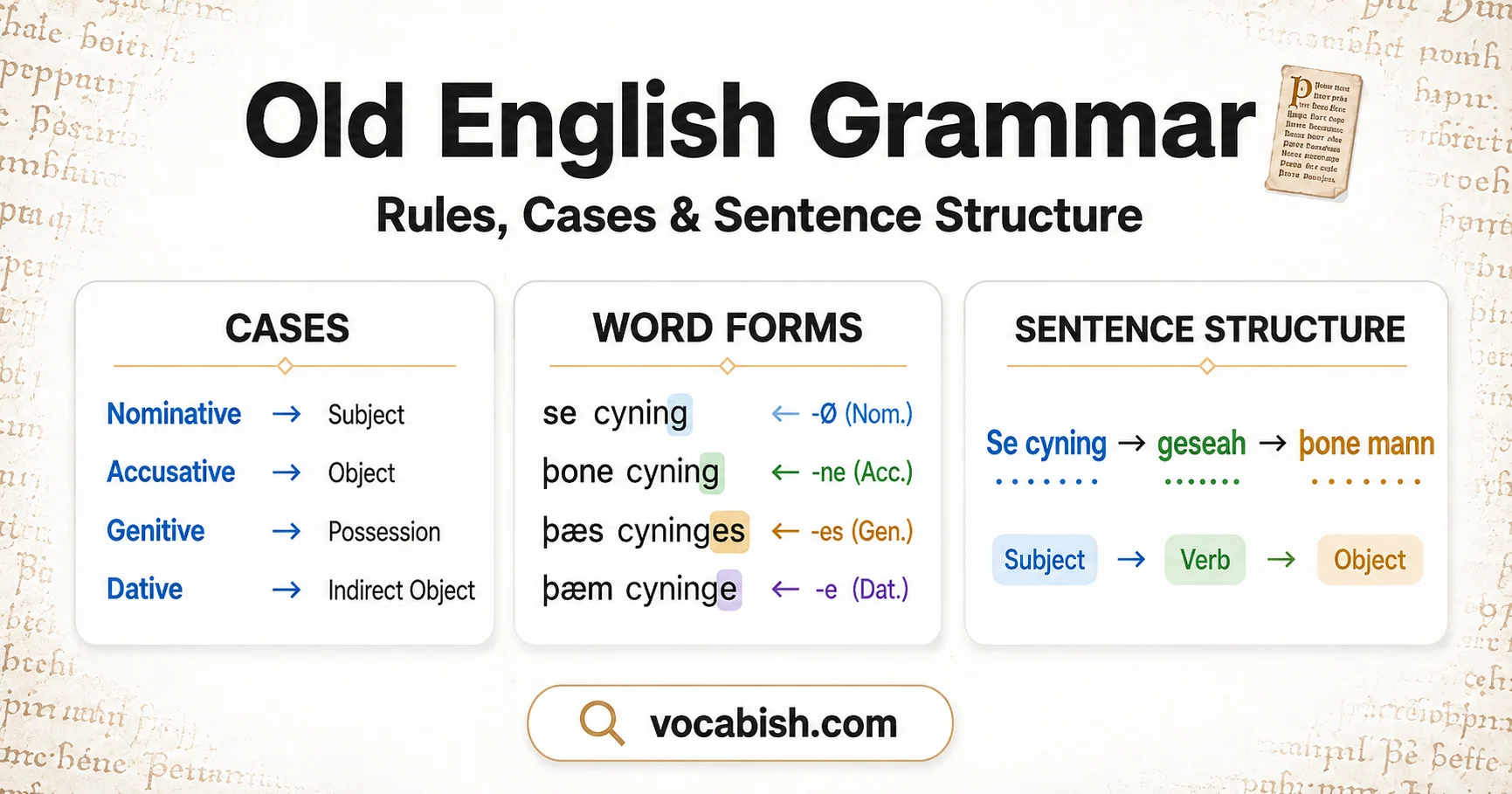
Old English nouns had grammatical cases and several noun-declension patterns. Their endings could change depending on their role in a sentence.
For instance, teaching materials show forms such as:
sunu — son
suna — sons / son’s context depending on form
sunum — to or for sons
The exact interpretation depends on the grammatical case and sentence context.
Modern English has kept only a small part of this noun inflection system.
What Happened to Old English Nouns?
Old English did not suddenly disappear and get replaced by modern English overnight.
Instead, English changed gradually.
Several influences shaped the language:
- sound changes altered pronunciation
- spelling conventions changed
- noun endings became less prominent
- word meanings shifted
- contact with other languages introduced new vocabulary
- English moved from Old English through Middle English and eventually toward Early Modern and Modern English
As a result, some Old English nouns survived almost intact, some changed their spelling, some developed new meanings, and others disappeared from everyday English.
Common Confusions About Old English Nouns
- Old English is not the same as Shakespearean English. Shakespeare wrote much later, during the Early Modern English period.
- Wīf did not simply mean modern “wife.” In Old English it could mean a woman or female person.
- Mann did not always mean only “adult male.” It could refer to a human being of either sex.
- Old English spelling is not random. Letters such as þ, æ, and long-vowel marks represent historical spelling conventions.
- A familiar-looking noun may have had a different meaning. Historical context matters when interpreting Old English vocabulary.
How to Read Old English Nouns
You do not need to memorize the entire Old English grammatical system before learning its vocabulary.
Start by recognizing a few common spelling patterns.
1. Learn Familiar Word Families
Try matching related forms:
stān → stone
wæter → water
hors → horse
fisc → fish
hand → hand
This makes historical vocabulary easier to remember.
2. Learn the Special Letters
Some of the most noticeable symbols are:
Letter | General Modern Equivalent |
|---|---|
þ | th |
ð | th |
æ | a sound represented by several modern spellings depending on the word |
ġ | often indicates a historical “y”- or “j”-type sound in certain contexts |
These letters can make a word appear much more unfamiliar than it really is.
3. Watch for Meaning Changes
Do not automatically translate an Old English noun according to its modern-looking spelling.
wīf is a strong example. The modern English word wife developed from the same historical word family, but the older meaning was broader.
4. Pay Attention to Inflections
The basic dictionary form is only one form of an Old English noun.
The ending may change when the noun becomes plural or takes a different grammatical case.
This is why Old English reading requires attention to the whole sentence, not just one vocabulary item.
A Quick Old English Vocabulary Study Set
For learners who want a smaller set to memorize first, these 20 nouns provide a useful starting point:
Old English | Meaning |
|---|---|
mann | person, man |
wīf | woman |
fæder | father |
mōdor | mother |
sunu | son |
dohtor | daughter |
brōþor | brother |
cyning | king |
hūs | house |
bōc | book |
hlāf | loaf, bread |
wæter | water |
fȳr | fire |
trēow | tree |
stān | stone |
hors | horse |
fisc | fish |
hand | hand |
fōt | foot |
lufu | love |
Learning these first gives you a strong foundation for recognizing Old English words in historical texts.
FAQs About Old English Nouns
An Old English noun is a naming word used in the English language before about 1100, during the period commonly called Old English or Anglo-Saxon English.
Examples include mann for person, hūs for house, wæter for water, fisc for fish, and cyning for king.
Mann could mean a human being of either sex, although related forms and context could produce more specific meanings.
Wīf commonly meant a woman or female person; its meaning was broader than the modern English noun wife.
No. Old English had different vocabulary, pronunciation, spelling, grammar, and noun inflections, although many modern words descend from it.
The Old English noun hūs means “house” and is historically related to the modern English word house.
Old English used letters such as þ, ð, and æ, while pronunciation and spelling changed substantially as English developed.
Usually not. Individual words may look familiar, but Old English grammar, spelling, vocabulary, and sentence structure can make complete texts difficult.
Conclusion
Old English nouns reveal how strongly today’s English is connected to its earliest recorded forms. Words such as fæder, mōdor, hūs, hand, fōt, wæter, stān, hors, and cyning show that some everyday vocabulary has extremely deep roots.
At the same time, words such as mann and wīf remind us that familiar forms can change meaning over time. Learning Old English nouns is therefore not only a vocabulary exercise; it is also a way to understand how English spelling, grammar, pronunciation, and meaning developed.
For accurate historical study, use an Old English dictionary and check the word in context rather than assuming that every old-looking word has exactly the same meaning as its modern descendant. The Bosworth-Toller Anglo-Saxon Dictionary remains a major reference source for Old English vocabulary.
Explore More Old English Guides