
Old English Grammar works differently from Modern English because nouns, adjectives, pronouns, and verbs often change their endings. Cases, grammatical gender, verb conjugation, and flexible word order all help show what each word is doing in a sentence.
Once you understand these patterns, Old English becomes much easier to read. You do not need to memorize every ending at once. Start with the four main cases, learn how words agree with one another, and then use those clues to understand sentence structure
What Makes Old English Grammar Different?
Old English is much more inflected than Modern English. An inflected language changes word forms to show grammatical information such as case, number, gender, person, and tense.
Modern English depends heavily on word order. Old English could rely more on endings, although its word order was not completely free.
Grammar Feature | Old English | Modern English |
|---|---|---|
Noun cases | Four main cases | Mostly lost |
Grammatical gender | Masculine, feminine, neuter | Mostly absent |
Noun endings | Change by case and number | Usually change only for plural/possession |
Adjectives | Agree with nouns | Usually unchanged |
Verbs | More person and number endings | Fewer endings |
Word order | Relatively flexible | More fixed |
Pronouns | Singular, plural and some dual forms | Singular and plural |
Main past formation | Strong and weak patterns | Mostly -ed or irregular forms |
A useful way to think about the difference is this:
Modern English: position often tells you what a word does.
Old English: position and word endings tell you what a word does.
For example:
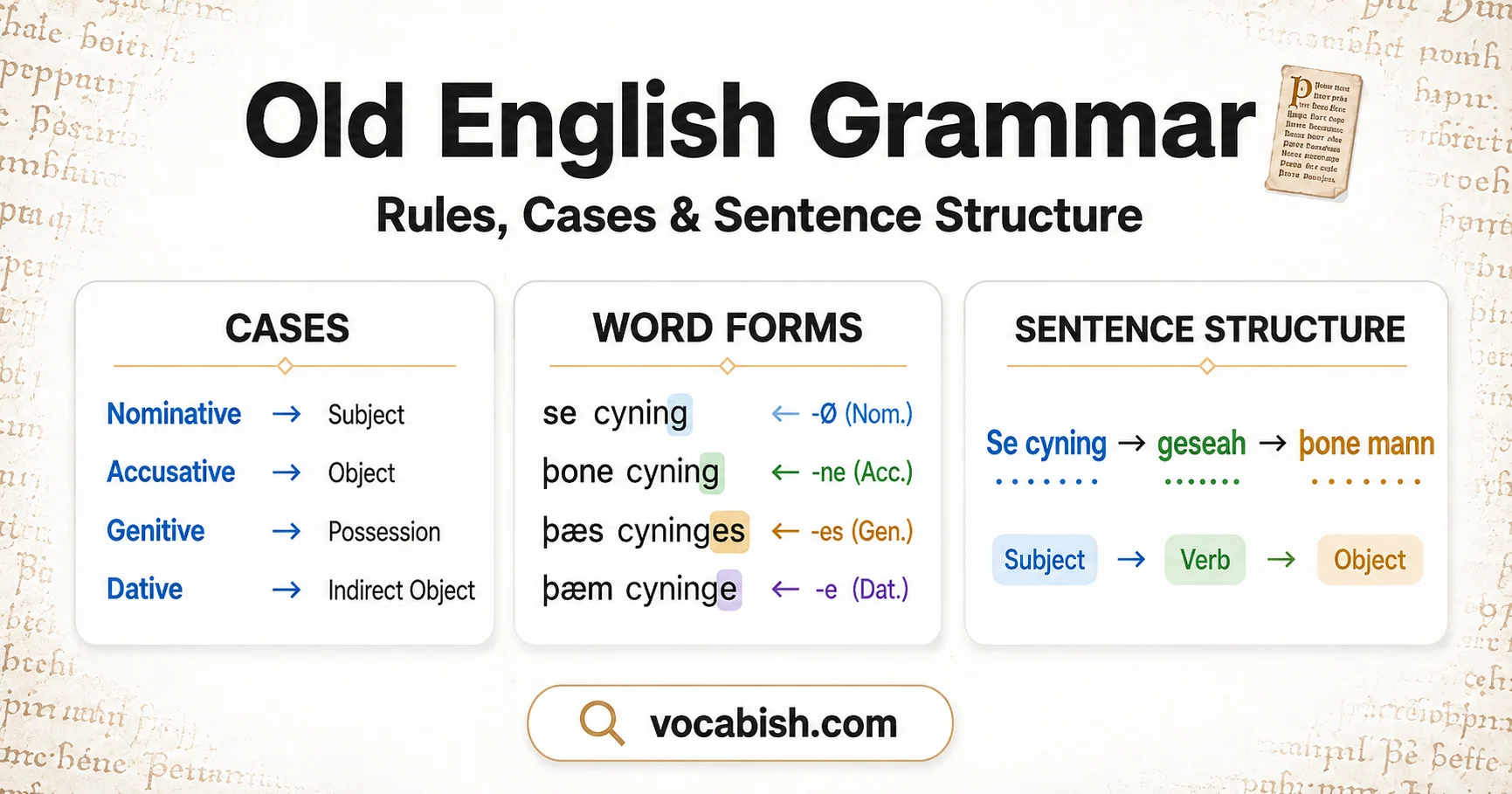
Se cyning geseah þone mann.
The king saw the man.
Here, se cyning is marked as the subject, while þone mann is marked as the object.
Those grammatical markers allow more flexibility than we normally have in Modern English.
The Four Main Old English Cases
The case system is one of the most important parts of Old English Grammar. A case tells you what grammatical job a noun, pronoun, adjective, or demonstrative performs in a sentence.
Old English has four main cases: nominative, accusative, genitive, and dative.
Case | Main Function | Modern English Idea | Example |
|---|---|---|---|
Nominative | Subject | who/what does the action | se cyning – the king |
Accusative | Direct object | who/what receives the action | þone cyning – the king |
Genitive | Possession or relationship | of / ’s | þæs cyninges – of the king |
Dative | Indirect object; after many prepositions | to/for/by/with | þæm cyninge – to the king |
Nominative Case
The nominative usually marks the subject of a sentence.
The subject is the person or thing doing the action or being described.
Se cyning rīxode.
The king ruled.
Here, se cyning is nominative because the king performs the action.
The nominative can also appear with a subject complement:
Se mann is cyning.
The man is a king.
Accusative Case
The accusative commonly marks the direct object.
Se cyning geseah þone biscop.
The king saw the bishop.
- se cyning = subject
- þone biscop = direct object
The bishop directly receives the action of seeing, so the noun phrase is accusative.
This distinction becomes particularly useful when word order changes.
Þone biscop geseah se cyning.
The natural translation can still be:
The king saw the bishop.
The endings and demonstratives help us identify who saw whom.
Genitive Case
The genitive often shows possession or a close relationship between nouns.
þæs cyninges sweord
the king’s sword
Here:
- cyning = king
- cyninges = king’s / of the king
You will often notice -es in the genitive singular of many masculine and neuter strong nouns.
That ending is historically related to the possessive -‘s still used in Modern English.
Dative Case
The dative commonly marks an indirect object and appears after many prepositions.
Hē sealde þæm cnihte þæt sweord.
He gave the boy the sword.
The boy receives the sword indirectly, so þæm cnihte is dative.
The dative is also common after words meaning to, from, with, and similar relationships.
mid þæm cyninge
with the king
What About the Instrumental Case?
You may also encounter the instrumental in Old English grammar books.
Historically, it expressed the means or instrument by which something happened. By the Old English period, however, its forms had largely merged with the dative in nouns. Some separate instrumental forms remained in certain pronouns and adjectives.
For an elementary learner, the four main cases should come first.
Nouns: Gender, Number and Declension
An Old English noun gives you more grammatical information than most Modern English nouns. You need to consider its gender, number, case, and declension pattern before choosing the correct form.
This process of changing a noun’s form is called declension.
Three Grammatical Genders
Old English nouns belong to one of three genders:
- masculine
- feminine
- neuter
Gender is grammatical rather than simply biological.
For example, a word does not become masculine only because it refers to a male person. The grammatical gender belongs to the noun itself and affects surrounding demonstratives and adjectives.
Common examples include:
Old English | Meaning | Gender |
|---|---|---|
cyning | king | Masculine |
stān | stone | Masculine |
giefu | gift | Feminine |
sunne | sun | Feminine |
scip | ship | Neuter |
word | word | Neuter |
Because gender affects agreement, learning a noun together with its gender is useful.
Instead of memorizing only:
scip = ship
learn:
scip = ship, neuter
Singular and Plural
Nouns also change according to number.
Modern English usually adds -s:
stone → stones
Old English used different plural endings depending on the noun class.
For example, the masculine strong noun stān, meaning stone, follows this pattern:
Case | Singular | Plural |
|---|---|---|
Nominative | stān | stānas |
Accusative | stān | stānas |
Genitive | stānes | stāna |
Dative | stāne | stānum |
Notice that one English word can appear as:
stān, stānes, stāne, stānas, stāna, stānum
The stem remains recognizable, but the ending changes.
Strong and Weak Nouns
Old English nouns are traditionally divided into strong, weak, and several smaller declension classes.
Strong nouns often have a wider variety of endings.
Weak nouns frequently contain endings involving -an in several forms.
You do not need to memorize every noun class before reading your first sentence. First learn to recognize common endings such as:
- -es — often genitive singular
- -um — commonly dative plural
- -as — common nominative/accusative plural ending for masculine strong nouns
- -an — frequent in weak noun forms
These are useful clues, not universal rules for every noun.
Articles, Demonstratives and Adjective Agreement
Old English did not have exactly the same article system as Modern English. Forms of the demonstrative se, sēo, þæt developed functions similar to Modern English the while still retaining demonstrative meanings such as that.
These forms change according to case, gender, and number, making them valuable clues when reading a sentence.
Basic Nominative Forms
Gender/Number | Form | Approximate Meaning |
|---|---|---|
Masculine singular | se | the / that |
Feminine singular | sēo | the / that |
Neuter singular | þæt | the / that |
Plural | þā | the / those |
Compare:
se cyning — the king
sēo sunne — the sun
þæt scip — the ship
þā cyningas — the kings
Other cases use different forms.
For masculine singular nouns:
se cyning — nominative
þone cyning — accusative
þæs cyninges — genitive
þæm cyninge — dative
These demonstratives often make the noun’s grammatical role much easier to identify.
Adjective Agreement
Old English adjectives also change their endings.
An adjective agrees with the noun it describes in:
- case
- number
- gender
Adjectives can also follow strong or weak declension patterns.
Compare:
gōd cyning
a good king
and:
se gōda cyning
the good king
The form changes from gōd to gōda because the grammatical environment is different.
Weak adjective forms commonly appear when a demonstrative or possessive already identifies the noun. Strong adjective forms are generally used when no such determiner does that grammatical work.
This means that you should not translate an adjective ending as a separate English word. The ending mainly communicates grammatical information.
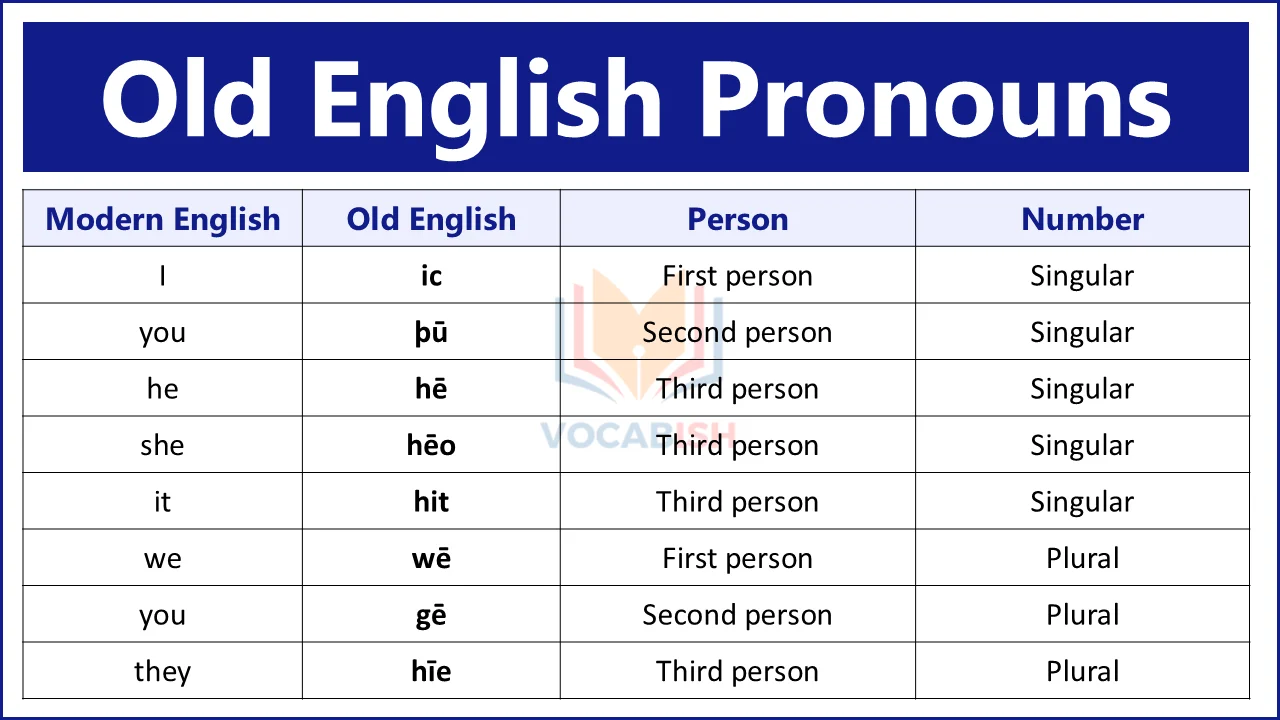
Personal Pronouns in Old English
Old English personal pronouns may look surprisingly familiar. Forms such as ic, wē, hē, mē, ūre, and his are ancestors or close relatives of Modern English forms.
Pronouns decline for case, and Old English even preserves special dual pronouns meaning we two and you two.
Person | Nominative | Accusative/Dative | Meaning |
|---|---|---|---|
1st singular | ic | mē | I / me |
2nd singular | þū | þē | you |
3rd masculine | hē | hine / him | he / him |
3rd feminine | hēo | hīe / hire | she / her |
3rd neuter | hit | hit / him | it |
1st plural | wē | ūs | we / us |
2nd plural | gē | ēow | you |
3rd plural | hīe | hīe / him | they / them |
Spellings vary between manuscripts and edited texts, so you may see slightly different written forms.
Dual Pronouns
The dual refers specifically to two people.
wit = we two
git = you two
Old English could therefore distinguish:
wē — we, more generally
wit — we two
and:
gē — you plural
git — you two
These dual forms later disappeared from English.
Old English Verb Rules
Old English verbs change according to person, number, tense, and mood. The language has two main morphological tenses: present and past, while other time meanings can be expressed through context and additional constructions.
Two major verb groups are particularly important: strong verbs and weak verbs.
Strong Verbs
Strong verbs commonly form their past tense by changing the vowel inside the stem.
A familiar Modern English example is:
sing → sang → sung
Old English uses similar vowel-changing patterns.
For example:
drincan — to drink
dranc — drank
druncon — drank, plural
druncen — drunk
This vowel variation is called ablaut.
Old English grammar traditionally recognizes seven classes of strong verbs.
Weak Verbs
Weak verbs usually form the past using a dental suffix, containing a d or t sound.
For example:
lufian — to love
lufode — loved
lufodon — loved, plural
This pattern is an ancestor of the Modern English -ed past tense.
Verb Type | Main Past-Tense Method | Example Pattern |
|---|---|---|
Strong | Stem-vowel change | drincan → dranc |
Weak | Dental suffix | lufian → lufode |
Preterite-present | Special historical pattern | can, shall-type ancestors |
Anomalous | Irregular forms | bēon/wesan, gān |
Person and Number
The verb ending can change according to its subject.
Using lufian, to love:
ic lufie — I love
þū lufast — you love
hē lufaþ — he loves
wē lufiaþ — we love
This extra information in the verb sometimes allows a subject to be understood from context.
Old English prose can therefore omit a repeated subject in situations where Modern English would normally state it again.
Here’s a complete guide on: Old English Verbs
Verb Moods
Three moods are especially useful to recognize:
Indicative — statements and ordinary questions
Imperative — commands
Subjunctive — possibility, wishes, uncertainty, reported ideas, hypothetical situations, and certain dependent clauses
For example, a subjunctive form may appear where Modern English would use words such as:
may, might, should, or would
However, the exact translation depends on context.
Old English Grammar and Sentence Structure
Old English sentence structure is more flexible than Modern English syntax because grammatical endings help identify subjects, objects, and other relationships. Still, Old English did have recognizable word-order tendencies rather than completely random ordering.
Subject–verb–object patterns are common, especially in prose, but several other arrangements occur regularly.
Subject–Verb–Object
A sentence can look very familiar:
Se cyning geseah þone mann.
Subject: se cyning
Verb: geseah
Object: þone mann
Translation:
The king saw the man.
This is the same basic SVO arrangement common in Modern English.
Verb Before the Subject
When an adverb or adverbial phrase begins a main clause, the verb often appears before the subject.
Þā geseah se cyning þone mann.
Literally:
Then saw the king the man.
Natural Modern English:
Then the king saw the man.
Words such as þā (then), nū (now), and some longer introductory adverbial phrases frequently produce this pattern.
Verbs Later in Dependent Clauses
The verb can appear relatively late in subordinate and relative clauses.
For example:
Ic wāt þæt hē þone mann geseah.
Word for word:
I know that he the man saw.
Natural translation:
I know that he saw the man.
This does not mean every subordinate clause must place the verb last. Old English syntax varies according to period, construction, emphasis, and style.
Infinitives and Participles Often Come Later
With modal or auxiliary constructions, a non-finite verb may occur near the end.
Hē wolde þone mann geseon.
Literally:
He wanted the man to-see.
Natural translation:
He wanted to see the man.
Old English texts frequently separate an auxiliary from its infinitive or participle.
Poetry Is More Flexible
Old English poetry can rearrange sentence elements for:
- emphasis
- rhythm
- metre
- alliteration
- poetic style
For that reason, trying to understand poetry through Modern English word order alone can be frustrating.
Look at the endings first.
Ask:
Which word is nominative? Which is accusative? Which words agree? What verb controls the clause?
Those questions are often more useful than simply reading from left to right.
Prepositions and the Cases They Control
Old English prepositions often determine the case of the noun or pronoun that follows them. Many commonly govern the dative, while others use the accusative or can change case according to meaning.
This relationship between a preposition and its required case is called case government.
Preposition | Common Case | General Meaning |
|---|---|---|
mid | Dative | with |
fram | Dative | from |
tō | Dative | to |
æfter | Dative | after |
þurh | Accusative | through |
geond | Accusative | throughout |
ymb | Accusative | around/about |
on | Dative or accusative | in/on/into/onto |
in | Dative or accusative | in/into |
A useful contrast appears with location and movement.
on þæm hūse
in/on the house — location
on þæt hūs
into/onto the house — movement or direction
This location-versus-direction distinction is helpful, but individual prepositions and historical texts still need to be read according to their actual usage.
How Negatives Work
Old English normally uses the negative particle ne before a finite verb. Unlike present-day standard English, it does not normally need do to create a negative sentence.
Compare:
Hē com.
He came.
Hē ne com.
He did not come.
Modern English inserts did. Old English can simply place ne before the verb.
Negative Contractions
The negative particle can combine with certain verbs.
A familiar example is:
nis = ne + is
So:
Hē nis cyning.
means:
He is not a king.
Other contracted negative forms also occur.
Multiple Negatives
Old English can use more than one negative expression in the same clause to reinforce a single negative meaning.
This differs from the rule often taught for formal Modern English.
Do not automatically interpret two Old English negatives as creating a positive statement.
How to Analyse an Old English Sentence
Reading Old English becomes easier when you stop trying to translate every word immediately. First identify the grammatical clues, then build the natural English sentence.
Consider:
Þā geseah se cyning þone biscop on þære cirican.
Then the king saw the bishop in the church.
Step 1: Find the Finite Verb
geseah = saw
This gives us the main action.
Step 2: Find the Nominative
se cyning
The masculine nominative demonstrative se tells us that cyning is functioning as the subject.
So:
se cyning = the king
Step 3: Find the Accusative
þone biscop
The demonstrative þone marks masculine accusative singular.
So:
þone biscop = the bishop, functioning as the direct object.
Step 4: Check Prepositional Phrases
on þære cirican
The phrase gives the location:
in the church
Step 5: Notice the Opening Adverb
þā = then
Because this adverb starts the clause, seeing the verb before the subject is not surprising.
Step 6: Rebuild Natural Modern English
Do not preserve Old English word order mechanically.
Instead of:
Then saw the king the bishop in the church.
write:
Then the king saw the bishop in the church.
This method works well with increasingly complicated sentences:
verb → cases → agreement → phrases → natural translation
Common Old English Grammar Confusions
Most early difficulties come from applying Modern English rules too strictly. Keep these five points in mind:
- Word order is not enough. Check case endings before deciding what is subject or object.
- Grammatical gender is not biological gender. Learn gender as part of each noun.
- One noun can have several endings. Different forms do not necessarily mean different vocabulary words.
- Se, sēo, and þæt are related forms. Their use depends on gender, case, and number.
- Do not translate word for word. First understand the grammar, then create natural Modern English.
Old English Grammar Rules at a Glance
Old English becomes more manageable when its major rules are reduced to a few recurring patterns.
- Nouns have nominative, accusative, genitive, and dative cases.
- Some instrumental forms also survive.
- Nouns belong to masculine, feminine, or neuter grammatical genders.
- Nouns decline according to case, number, gender, and noun class.
- Adjectives agree with nouns in case, gender, and number.
- Adjectives have strong and weak forms.
- Demonstratives such as se, sēo, and þæt also change form.
- Pronouns decline according to case.
- Old English has special dual pronouns for exactly two people.
- Verbs conjugate according to person and number.
- Old English has morphological present and past tenses.
- Strong verbs commonly form the past through vowel change.
- Weak verbs commonly use a dental past-tense suffix.
- Indicative, imperative, and subjunctive moods occur.
- Word order is more flexible than in Modern English.
- SVO is common, but inversion frequently follows introductory adverbials.
- Non-finite verbs may appear late in a clause.
- Many prepositions govern a particular case.
- ne normally appears before a negated finite verb.
- Inflectional endings are often the best clues for understanding a difficult sentence.
FAQs About Old English Grammar
Old English grammar is the grammatical system used in early English, featuring noun cases, grammatical gender, inflected adjectives, conjugated verbs, and flexible sentence structure.
Old English has four main cases: nominative, accusative, genitive, and dative. Some instrumental forms also survive, especially in pronouns and adjectives.
The nominative marks subjects, accusative marks direct objects, genitive commonly shows possession, and dative marks indirect objects and complements of many prepositions.
Yes. Old English nouns can be masculine, feminine, or neuter. The gender affects demonstratives and adjectives that grammatically agree with each noun.
SVO is common, particularly in prose, but Old English allows other arrangements because case endings and agreement provide additional clues about grammatical roles.
Strong verbs generally form past forms through stem-vowel changes, while weak verbs usually form them with dental suffixes containing d or t.
Inflectional endings identify grammatical functions that Modern English often expresses through position, allowing Old English writers greater flexibility in arranging sentence elements.
It takes practice because of cases and inflections, but learning common endings, demonstratives, verb patterns, and sentence structures makes texts progressively easier to understand.
Conclusion
Old English Grammar may initially look complicated because words change according to case, gender, number, person, and grammatical function. The key is to read the endings instead of relying only on Modern English word order.
Start with the four main cases. Then learn noun and adjective agreement, pronouns, strong and weak verbs, prepositions, and common sentence patterns. Once these systems become familiar, Old English sentences stop looking like scattered unfamiliar forms and begin to reveal a clear grammatical structure.
Explore More Old English Related Articles
- How to Speak Words, Phrases, and Sentences in Old English
- Complete Guide on Old English Pronunciation
- Old English Alphabets Explained from A to Z
- 75+ Old English Phrases with Meanings
- Old English Pronouns Explained with Uses
- 1-100 Old English Numbers with Pronunciation