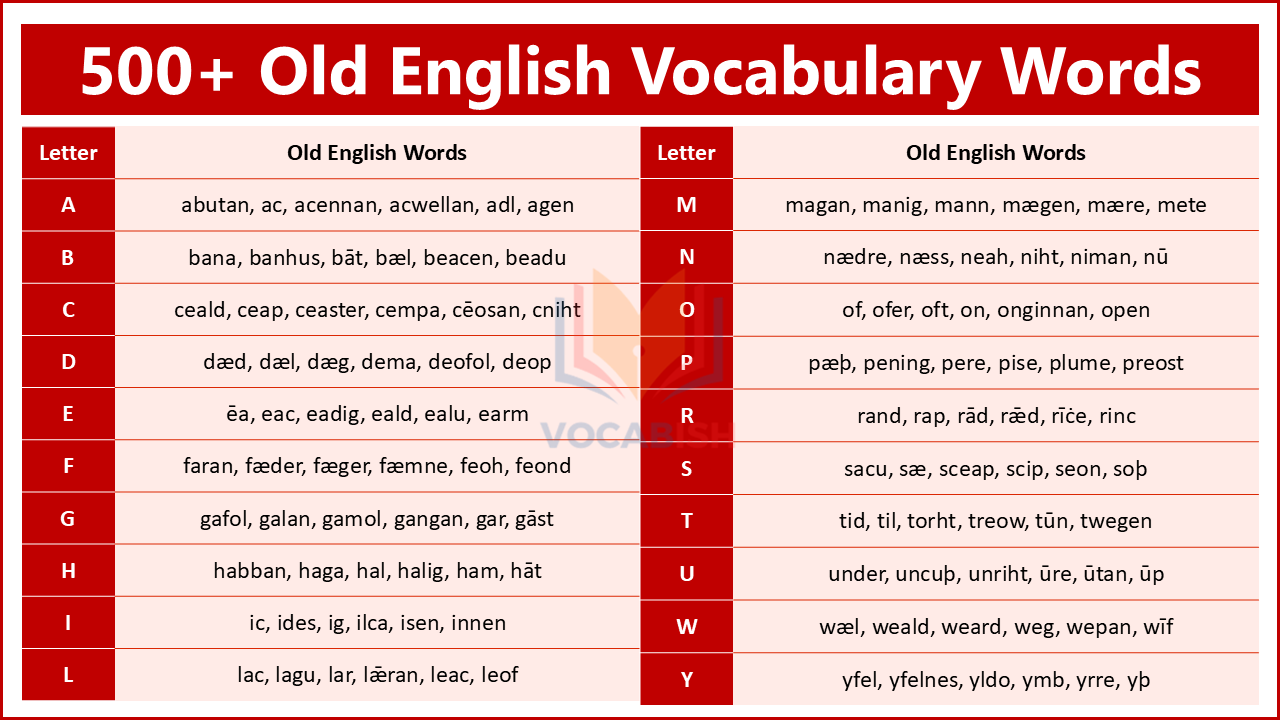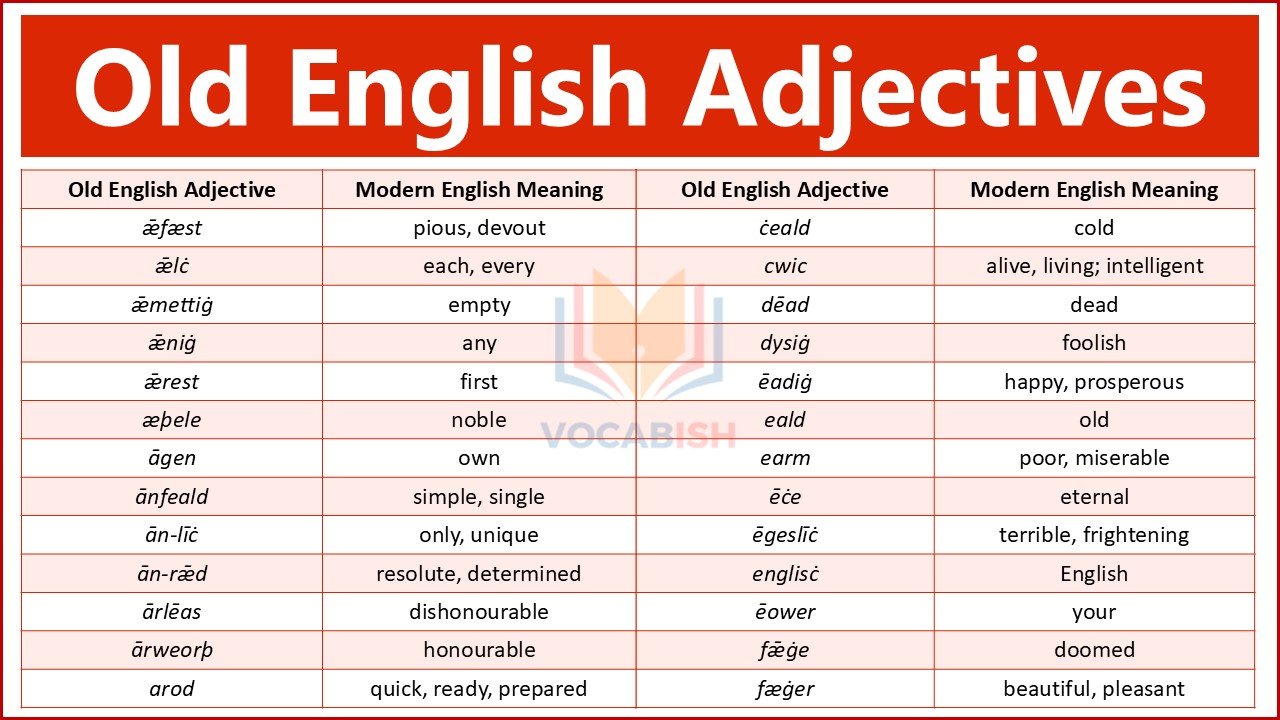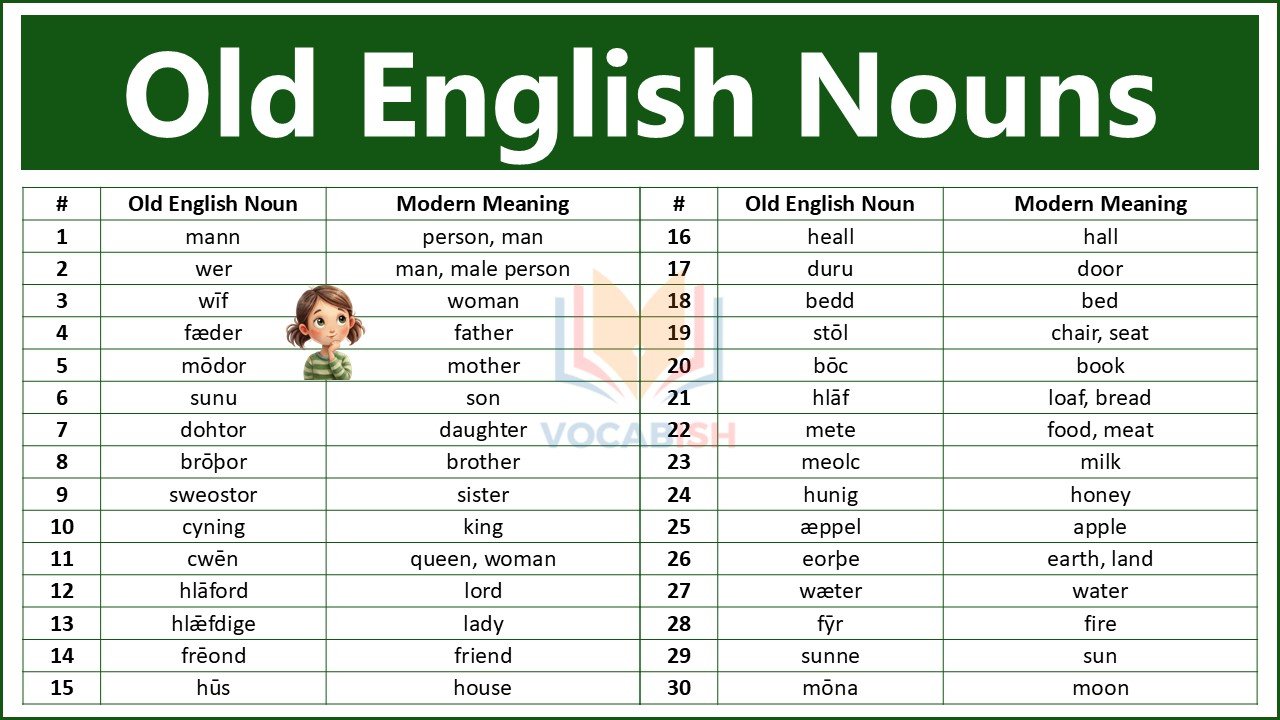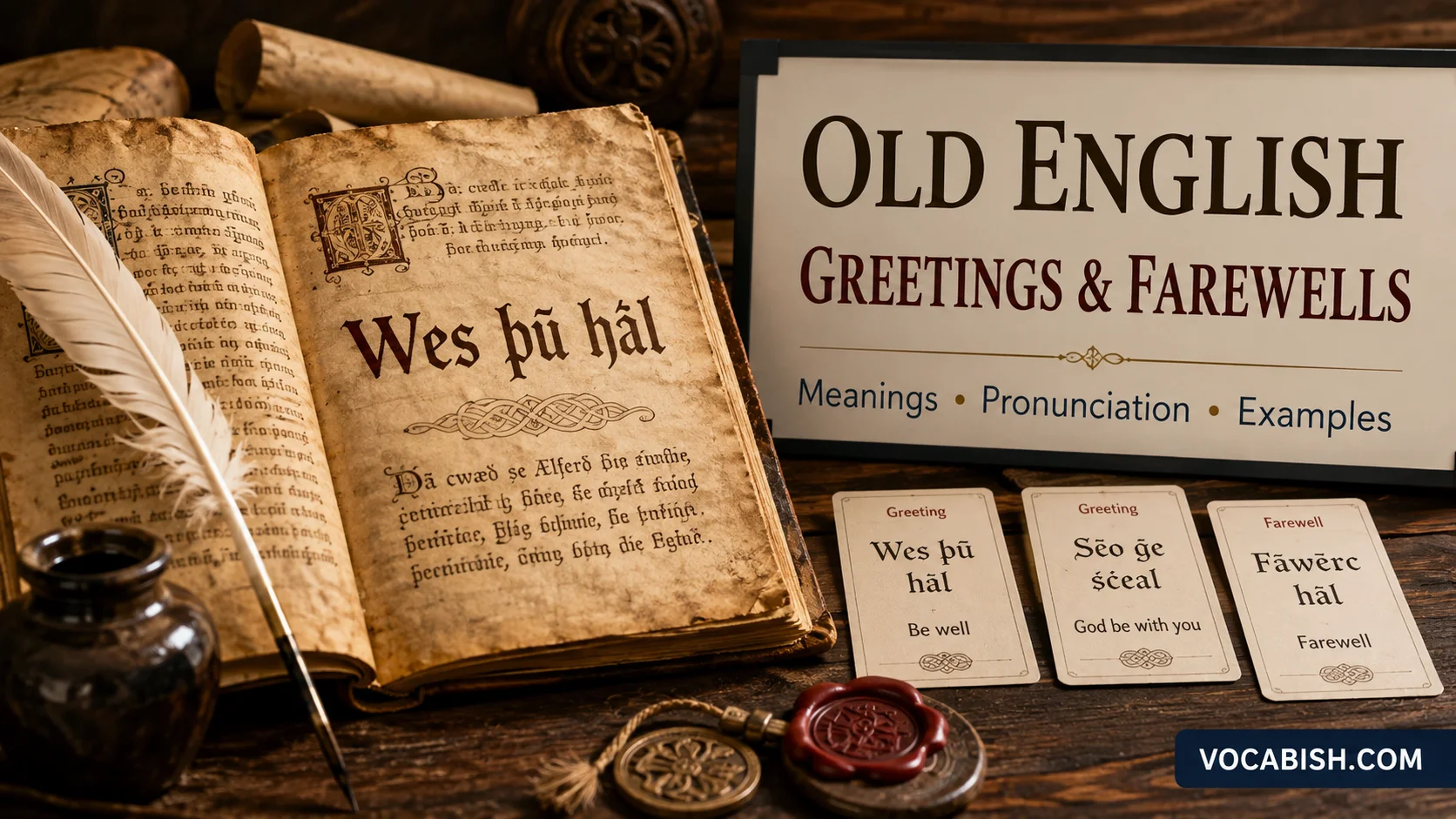

Old English verbs are an important part of understanding how early English worked. They show actions, states, and changes, just like verbs in Modern English. However, their forms change more often for person, number, tense, and mood. Many Old English verbs are grouped as strong, weak, irregular, or preterite-present verbs. Strong verbs often change their internal vowel, while weak verbs usually use a dental ending for the past tense. Learning common Old English verbs, their meanings, and basic conjugation patterns makes old texts much easier to read and understand.
What Are Old English Verbs?
Old English verbs are words that express actions, events, conditions, or states in Old English. Examples include gān “to go,” cuman “to come,” lufian “to love,” sprecan “to speak,” and sēon “to see.”
Unlike most Modern English verbs, Old English verbs changed form according to several grammatical features. These included person, number, tense, and mood.
For example:
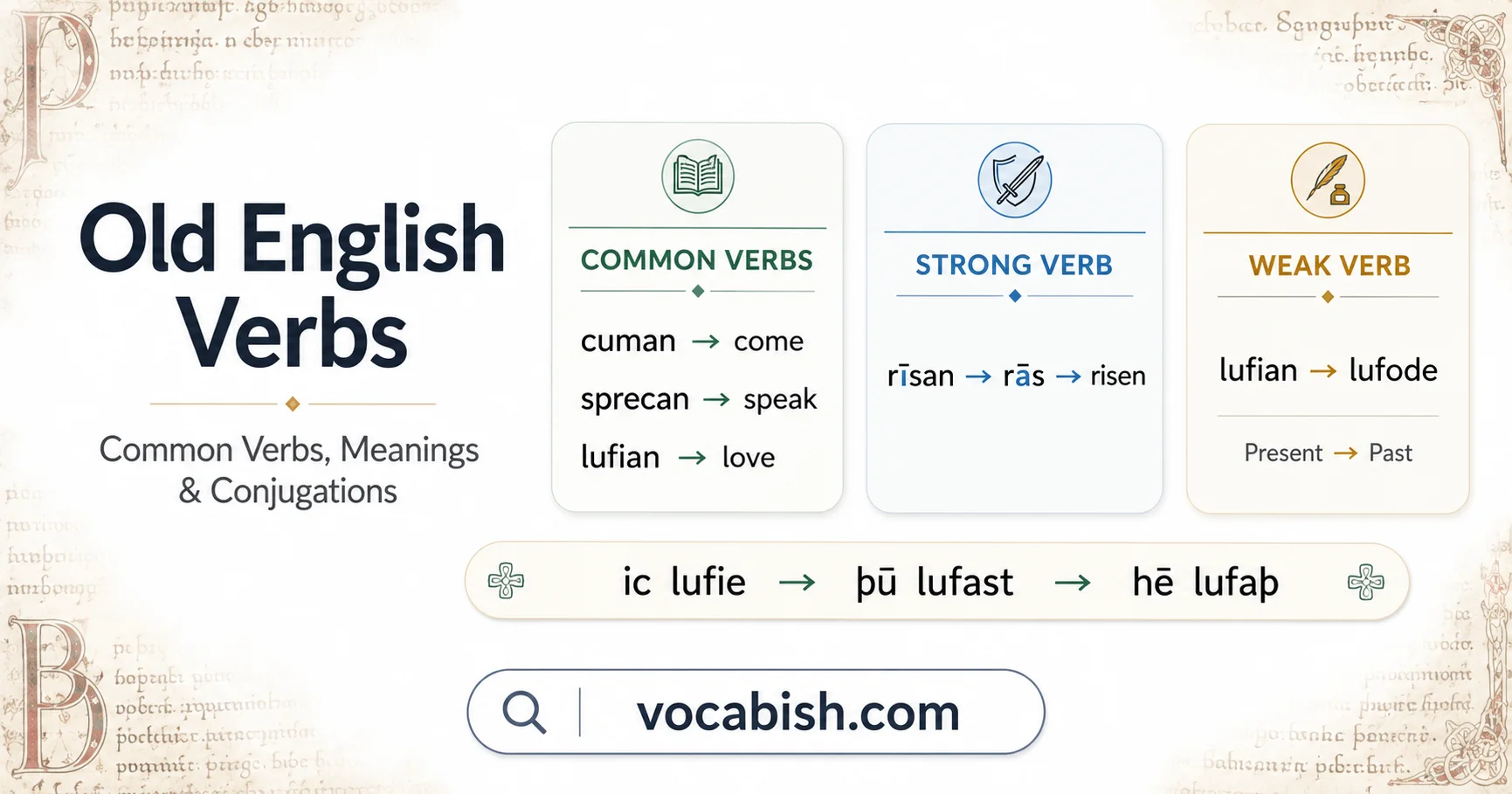
- ic lufie — I love
- þū lufast — you love
- hē lufaþ — he loves
- wē lufiaþ — we love
The basic meaning remains “love,” but the verb ending changes with the subject.
Main Features of Old English Verbs
Old English verbs could show:
- Person: first, second, or third person
- Number: singular or plural
- Tense: present or preterite (past)
- Mood: indicative, subjunctive, or imperative
- Participles: present and past forms
Old English primarily had two inflected tenses: present and preterite. Meanings that Modern English often expresses with additional tense constructions could be communicated through context and auxiliary verbs.
How Old English Verb Conjugation Works
To conjugate a verb means to change its form according to its grammatical use. Old English used more verb endings than Modern English, especially in the singular.
Compare the basic present-tense pattern:
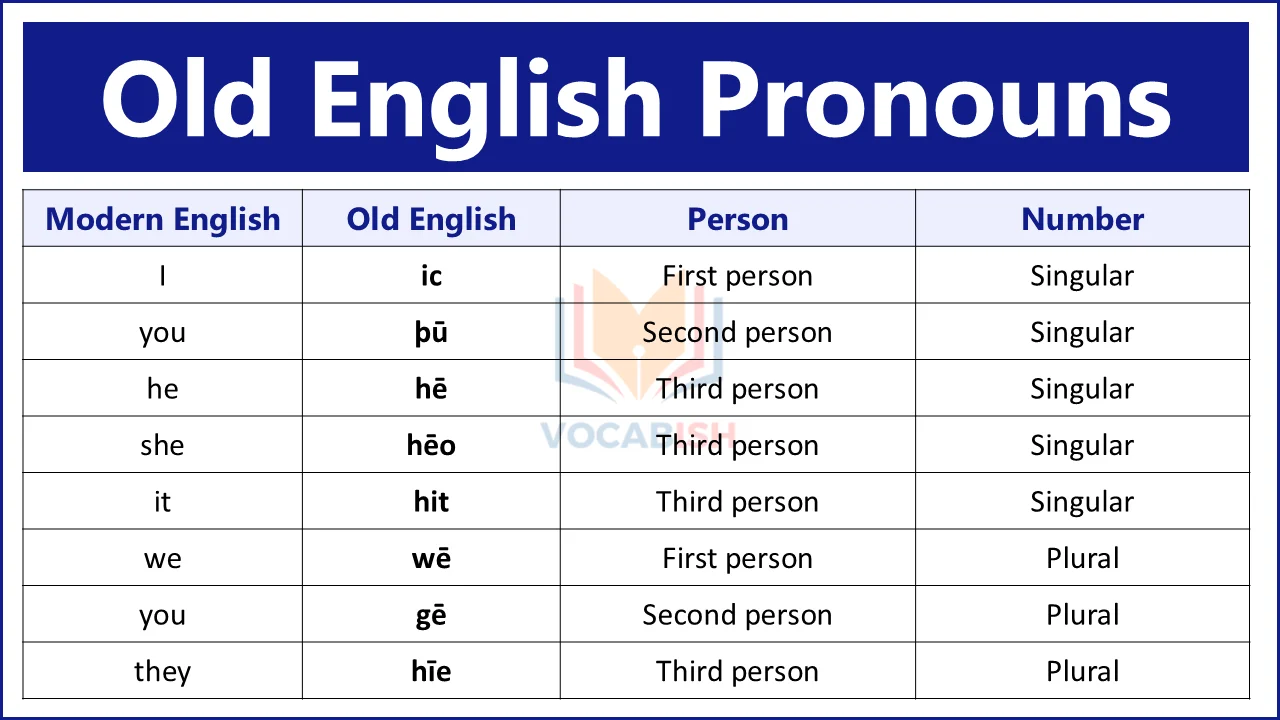
Person | Pronoun | Typical Meaning |
|---|---|---|
First singular | ic | I |
Second singular | þū | you |
Third singular | hē / hēo / hit | he / she / it |
First plural | wē | we |
Second plural | gē | you |
Third plural | hīe | they |
A useful feature for learners is that the three plural persons usually share one verb form. The major differences appear in the singular.
Old English verbs are traditionally divided into seven strong classes and three weak classes, with additional groups for preterite-present and anomalous verbs.
Common Old English Verbs and Meanings
The following vocabulary gives you a practical starting point. Spellings are presented mainly in normalized forms; actual medieval manuscripts may contain spelling differences.
Old English Verb | Modern Meaning | General Type |
|---|---|---|
bēon | to be | irregular |
wesan | to be | irregular |
habban | to have | weak |
dōn | to do | irregular |
gān | to go | irregular |
cuman | to come | strong |
faran | to go, travel | strong |
rīdan | to ride | strong |
sprecan | to speak | strong |
cweþan | to say, speak | strong |
secgan | to say, tell | weak |
sēon | to see | strong |
hīeran | to hear | weak |
findan | to find | strong |
niman | to take | strong |
beran | to carry, bear | strong |
etan | to eat | strong |
drincan | to drink | strong |
slǣpan | to sleep | strong |
standan | to stand | strong |
sittan | to sit | strong |
healdan | to hold | strong |
helpan | to help | strong |
lufian | to love | weak |
leornian | to learn | weak |
macian | to make | weak |
wyrcan | to work, make | weak |
læran | to teach | weak |
þencan | to think | weak |
āscian | to ask | weak |
libban | to live | weak |
willan | to want, wish | irregular |
cunnan | to know how, be able | preterite-present |
magan | to be able, can | preterite-present |
sculan | shall, ought to, must | preterite-present |
mōtan | may, be allowed to | preterite-present |
witan | to know | preterite-present |
weorþan | to become | strong |
hātan | to call, command | strong |
feallan | to fall | strong |
Many familiar Modern English verbs preserve descendants of these Old English forms, although pronunciation, spelling, meanings, and conjugation patterns have changed greatly over time. The seven-class strong-verb system is particularly important for understanding historical vowel alternations.
Strong Verbs in Old English
Strong verbs form their past tense mainly by changing the vowel inside the verb stem rather than by adding a dental past-tense suffix.
This internal vowel change is called ablaut.
A Modern English comparison makes the idea easier:
sing → sang → sung
Old English used the same general principle much more systematically.
For example:
rīsan → rās → rison → risen
These forms represent different principal parts of the strong verb meaning “to rise.” Strong verbs were traditionally organized into seven classes according to their vowel-change patterns.
Examples of Strong Verb Changes
Infinitive | Meaning | Past Singular | Related Form |
|---|---|---|---|
rīsan | rise | rās | risen |
beran | bear, carry | bær | boren |
niman | take | nam | numen |
cuman | come | cōm | cumen |
sprecan | speak | spræc | sprecen |
standan | stand | stōd | standen |
feallan | fall | fēoll | feallen |
faran | travel, go | fōr | faren |
The exact vowel pattern depends on the strong-verb class. Some verbs also show sound changes or spelling variants that make their forms less predictable.
Weak Verbs in Old English
Weak verbs usually create their past forms with a dental suffix containing d or t rather than relying primarily on an internal vowel change.
This system is the historical ancestor of the -ed pattern found in regular Modern English verbs such as love–loved and walk–walked.
Consider lufian, meaning “to love”:
- lufie — I love
- lufast — you love
- lufaþ — he/she/it loves
- lufiaþ — we/you/they love
- lufode — I/he/she loved
- lufodon — we/you/they loved
Class II weak verbs such as lufian have especially recognizable patterns.
More Weak Verb Examples
Verb | Meaning | Example Past Form |
|---|---|---|
lufian | love | lufode |
leornian | learn | leornode |
hīeran | hear | hīerde |
macian | make | macode |
andswarian | answer | andswarode |
Weak verbs were not completely identical. Their exact forms depended partly on their class and the structure of the stem.
Strong vs Weak Old English Verbs
The difference becomes much easier when you focus on how the past tense is formed.
Feature | Strong Verbs | Weak Verbs |
|---|---|---|
Main past-tense marker | vowel change | dental suffix |
Typical change | internal stem vowel | -d-, -t-, or related ending |
Example | rīsan → rās | lufian → lufode |
Number of traditional classes | 7 | 3 |
Modern comparison | sing → sang | love → loved |
A strong verb is therefore not “strong” because its meaning is powerful. A weak verb is not less important. The terms describe historical conjugation patterns.
Common Old English Verb Endings
Verb endings can help you identify the subject even before you translate the entire sentence.
A broadly useful present indicative pattern looks like this:
Person | Common Ending | Example from lufian |
|---|---|---|
1st singular | -e / -ie | ic lufie |
2nd singular | -st / -ast | þū lufast |
3rd singular | -þ / -eþ / -aþ | hē lufaþ |
Plural | -aþ / -iaþ | wē lufiaþ |
These endings are not universal for every verb. Sound changes, verb class, contractions, and irregular forms can alter them.
The character þ, called thorn, represents a “th” sound. You may also encounter ð, called eth, in Old English texts.
How to Conjugate a Strong Old English Verb
Take rīsan, meaning “to rise.” It belongs to Strong Class I.
Its present indicative forms include:
Person | Old English | Modern English |
|---|---|---|
1st singular | ic rīse | I rise |
2nd singular | þū rīsest | you rise |
3rd singular | hē rīseþ | he rises |
plural | wē/gē/hīe rīsaþ | we/you/they rise |
Its past forms show the characteristic strong-verb vowel change:
Person | Old English | Meaning |
|---|---|---|
1st singular | ic rās | I rose |
2nd singular | þū rise | you rose |
3rd singular | hē rās | he rose |
plural | hīe rison | they rose |
The past participle is risen. This historical relationship makes Modern English rise–rose–risen much easier to understand.
How to Conjugate a Weak Old English Verb
The verb lufian, “to love,” gives learners a clear weak-verb model.
Present Indicative
Person | Old English | Meaning |
|---|---|---|
1st singular | ic lufie | I love |
2nd singular | þū lufast | you love |
3rd singular | hē/hēo/hit lufaþ | he/she/it loves |
plural | wē/gē/hīe lufiaþ | we/you/they love |
Past Indicative
Person | Old English | Meaning |
|---|---|---|
1st singular | ic lufode | I loved |
2nd singular | þū lufodest | you loved |
3rd singular | hē/hēo/hit lufode | he/she/it loved |
plural | wē/gē/hīe lufodon | we/you/they loved |
The present participle is lufiende, while the past participle may appear as (ge)lufod.
Notice how much information appears in the ending. Modern English has lost most of these distinctions.
Important Irregular Old English Verbs
Some of the most frequently used verbs do not fit neatly into the normal strong or weak patterns.
Old English grammars often describe verbs such as bēon, wesan, dōn, gān, and willan as anomalous or irregular because their forms cannot be predicted through the standard conjugation rules.
Bēon and Wesan — “To Be”
Old English used several stems for forms associated with Modern English be.
Common present forms include:
Pronoun | Common Form | Meaning |
|---|---|---|
ic | eom / bēo | I am |
þū | eart / bist | you are |
hē/hēo/hit | is / biþ | he/she/it is |
wē/gē/hīe | sind(on) / bēoþ | we/you/they are |
The bēon and eom/is series were not always interchangeable in meaning or use, so they should not be treated merely as alternate spellings.
Common past forms come from the wesan series:
- wæs — was
- wǣre — were
- wǣron — were
These forms are especially interesting because Modern English still preserves was and were.
Gān — “To Go”
The present forms include:
Person | Form |
|---|---|
I | gā |
you | gǣst |
he/she/it | gǣþ |
plural | gāþ |
Its past looks completely different:
- ēode — went
- ēodest — you went
- ēodon — they went
This type of change is called suppletion, where forms of one verb come historically from different stems rather than being produced by a normal tense rule.
Dōn — “To Do”
Common forms include:
Person | Present | Past |
|---|---|---|
1st singular | dō | dyde |
2nd singular | dēst | dydest |
3rd singular | dēþ | dyde |
plural | dōþ | dydon |
The connection with Modern English do–did–done is easy to recognize, even though the forms have changed.
Willan — “To Want”
The Old English verb willan primarily expressed wanting, wishing, or intending. It later played an important part in the development of English future constructions.
Common forms include:
- wille — I want
- wilt — you want
- wile — he/she wants
- willaþ — they want
- wolde — wanted
Its historical forms are related to Modern English will and would.
Modal and Preterite-Present Verbs
Some Old English verbs belonged to a special group called preterite-present verbs. Their present-tense forms historically developed from forms that resembled the past tense of strong verbs, while their own past forms used weak-type dental endings.
Several later developed into important English modal verbs.
Old English Verb | Basic Meaning | Modern Connection |
|---|---|---|
cunnan | know how, be able | can |
magan | be able | may |
sculan | owe, ought, must | shall, should |
mōtan | be allowed, may | must |
witan | know | wit |
þurfan | need | related historical forms |
For example:
sceal could express an obligation or something that ought to happen, while its past form scolde is historically connected with Modern English should.
Similarly, forms of cunnan eventually contributed to Modern English can and could.
Useful Old English Verb Forms in Sentences
Seeing verbs inside short sentences makes them easier to remember.
Ic lufie þē.
Meaning: I love you.
The verb lufie agrees with the first-person singular subject ic.
Hīe cumaþ.
Meaning: They come.
The plural ending -aþ helps identify the verb as plural.
Hē spræc.
Meaning: He spoke.
The form spræc is a past singular form of sprecan, “to speak.” Strong Class V verbs such as sprecan form their preterite through vowel alternation.
Hē stōd.
Meaning: He stood.
Here, stōd is the strong past form associated with standan, “to stand.”
Hīe ēodon.
Meaning: They went.
The irregular past plural ēodon belongs to gān, “to go.”
How Prefixes Change Old English Verbs
Old English frequently placed prefixes before verb stems to modify or develop their meanings.
Some commonly encountered prefixes include ge-, be-, for-, on-, and ā-.
For example:
rīsan — to rise
ārīsan — to arise
Another example is:
fōn — to seize or take
gefōn — to seize or capture
The prefix ge- also appears frequently with past participles, although its presence is not completely automatic in every context. Old English therefore should not be learned through a rule such as “every past participle begins with ge-.”
Verb Parts at a Glance
Consider gelufod, “loved”:
ge- + luf + -od
- ge- — prefix associated with the completed form in many verbs
- luf- — verb stem connected with “love”
- -od — weak past-participle formation
Breaking longer forms into recognizable pieces often makes reading Old English much easier.
Present, Past, Subjunctive and Imperative Forms
Old English conjugation was not limited to ordinary present and past statements.
Indicative
The indicative mood normally presents an action or situation as a statement.
Hē cumaþ.
He comes.
Subjunctive
The subjunctive could be used in contexts involving wishes, possibilities, hypothetical situations, reported ideas, and other non-straightforward assertions.
Strong and weak verbs had both present and past subjunctive forms.
Imperative
The imperative gives a command.
For rīsan:
rīs! — rise!
rīsaþ! — rise! when addressing more than one person.
This singular-versus-plural distinction is much clearer than in Modern English, where both are normally expressed simply as “rise.”
Infinitives and Participles
The dictionary form of many Old English verbs ends in -an or -ian:
- bindan — to bind
- sprecan — to speak
- standan — to stand
- lufian — to love
- leornian — to learn
Old English also used present and past participles.
For example:
rīsende — rising
risen — risen
and:
lufiende — loving
(ge)lufod — loved
Present participles commonly contain -ende, an ending that eventually gave way to the dominant -ing form found in Modern English.
Why Old English Verbs Look Familiar
A surprising number of everyday English verbs have Old English ancestors.
Compare:
Old English | Modern English |
|---|---|
bindan | bind |
drincan | drink |
findan | find |
helpan | help |
standan | stand |
cuman | come |
sittan | sit |
beran | bear |
rīdan | ride |
sprecan | speak |
The words may look different because English pronunciation and spelling changed over many centuries. Their basic relationship, however, can often still be recognized.
Strong-verb vowel alternations also survive in Modern English forms such as rise–rose–risen.
Common Old English Verb Confusions
Keep these points in mind when studying:
- Strong does not mean “powerful.” It describes a vowel-changing conjugation pattern.
- Weak does not mean “unimportant.” Weak verbs normally use a dental past-tense suffix.
- -an is usually part of the infinitive, not the English word “an.”
- Bēon and wesan are not ordinary regular verbs and should be learned separately.
- Spellings may vary between manuscripts and editions, so two legitimate forms can sometimes look different.
How to Learn Old English Verbs Faster
Do not try to memorize hundreds of isolated conjugated forms first. Learn the patterns that produce them.
Start with four groups:
1. Common irregular verbs
Learn bēon/wesan, gān, dōn, and willan because they appear frequently and cannot always be predicted.
2. One clear weak model
Use lufian → lufode to remember how a typical Class II weak verb behaves.
3. One clear strong model
Use rīsan → rās → rison → risen to understand vowel change.
4. High-frequency vocabulary
Learn verbs such as cuman, sprecan, sēon, habban, niman, standan, and findan before rare literary vocabulary.
When you meet a new verb, ask:
What is its infinitive? Is it strong, weak, preterite-present, or irregular? What are its important principal parts?
That method is more useful than memorizing a translation alone.
FAQs About Old English Verbs
Old English verbs express actions, events, and states. They change according to tense, person, number, and mood more extensively than Modern English verbs.
A strong verb forms its past mainly through an internal vowel change, called ablaut. Examples include rīsan–rās and sprecan–spræc.
A weak verb normally forms its past with a dental suffix containing d or t, as in lufian–lufode and hīeran–hīerde.
Traditional Old English grammar recognizes seven strong verb classes, organized mainly around characteristic historical vowel-change or ablaut patterns.
Old English is traditionally described as having three weak verb classes, although their forms and productivity differed considerably from one class to another.
Old English used forms associated with bēon, wesan, and the eom/is series. Common forms include eom, eart, is, sind, and bēo.
The common verb is gān. Its present includes gā and gāþ, while its irregular past includes ēode and plural ēodon.
Old English did not have a separate inflected future tense like its present and preterite. Future meaning could instead be communicated through context and other constructions.
Conclusion
Old English verbs become much easier to understand once you recognize their main patterns. Strong verbs usually form the past through vowel change, while weak verbs generally use dental suffixes. Preterite-present verbs follow another historical pattern, and frequent verbs such as bēon, wesan, gān, dōn, and willan need special attention.
Begin with common verbs and learn their important forms rather than memorizing long tables without context. Once patterns such as rīsan–rās and lufian–lufode become familiar, Old English conjugation starts to feel far more organized—and many unusual patterns in Modern English begin to make sense as well.
Explore More Old English Related Articles
- How to Speak Words, Phrases, and Sentences in Old English
- Complete Guide on Old English Pronunciation
- Old English Alphabets Explained from A to Z
- 75+ Old English Phrases with Meanings
- Old English Pronouns Explained with Uses
- 1-100 Old English Numbers with Pronunciation