
What did people in Anglo-Saxon England say when they wanted to describe something as beautiful, strong, dark, wise, foolish, or ancient? Many of those Old English adjectives still have recognizable relatives in Modern English today.
This Old English Adjectives list brings together a broad selection of Anglo-Saxon descriptive words with clear modern meanings. It includes common adjectives such as eald (“old”), gōd (“good”), lang (“long”), wīs (“wise”), and yfel (“bad, evil”), along with less familiar historical vocabulary. Old English was the English language used before about 1150 and is also commonly called Anglo-Saxon.
One important point comes first: there is no practical dictionary-sized list containing every Old English adjective in every dialect, spelling, compound, and inflected form. Major historical dictionaries contain thousands of lexical entries, while adjectives could also form compounds and appear in different grammatical forms. Bosworth-Toller describes its work as the largest complete dictionary of Old English available in its online edition, and the Dictionary of Old English corpus represents the surviving written language on a very large scale.
The list below therefore aims to be a broad, useful reference list of attested Old English adjectives, especially words that are helpful for learners, historical English study, vocabulary building, and understanding the roots of Modern English.
What Are Old English Adjectives?
Old English adjectives were words used to describe nouns, just as adjectives are used in Modern English. They could describe appearance, size, age, color, character, emotion, social position, physical qualities, and many other features.
For example:
- eald = old
- geong = young
- fæġer = beautiful, pleasant
- heah = high
- dēop = deep
- wīs = wise
- yfel = bad, evil
Unlike Modern English adjectives, Old English adjectives changed their endings according to case, gender, number, and grammatical use. They could also appear in strong and weak forms.
The dictionary form is the most useful form for vocabulary learning, so the list below generally gives the headword rather than every possible grammatical ending.
Old English Adjectives List: 200+ Words and Meanings
The following table gives a large selection of Old English adjectives with modern English meanings. Spellings use commonly used normalized forms, particularly Early West Saxon forms where available.
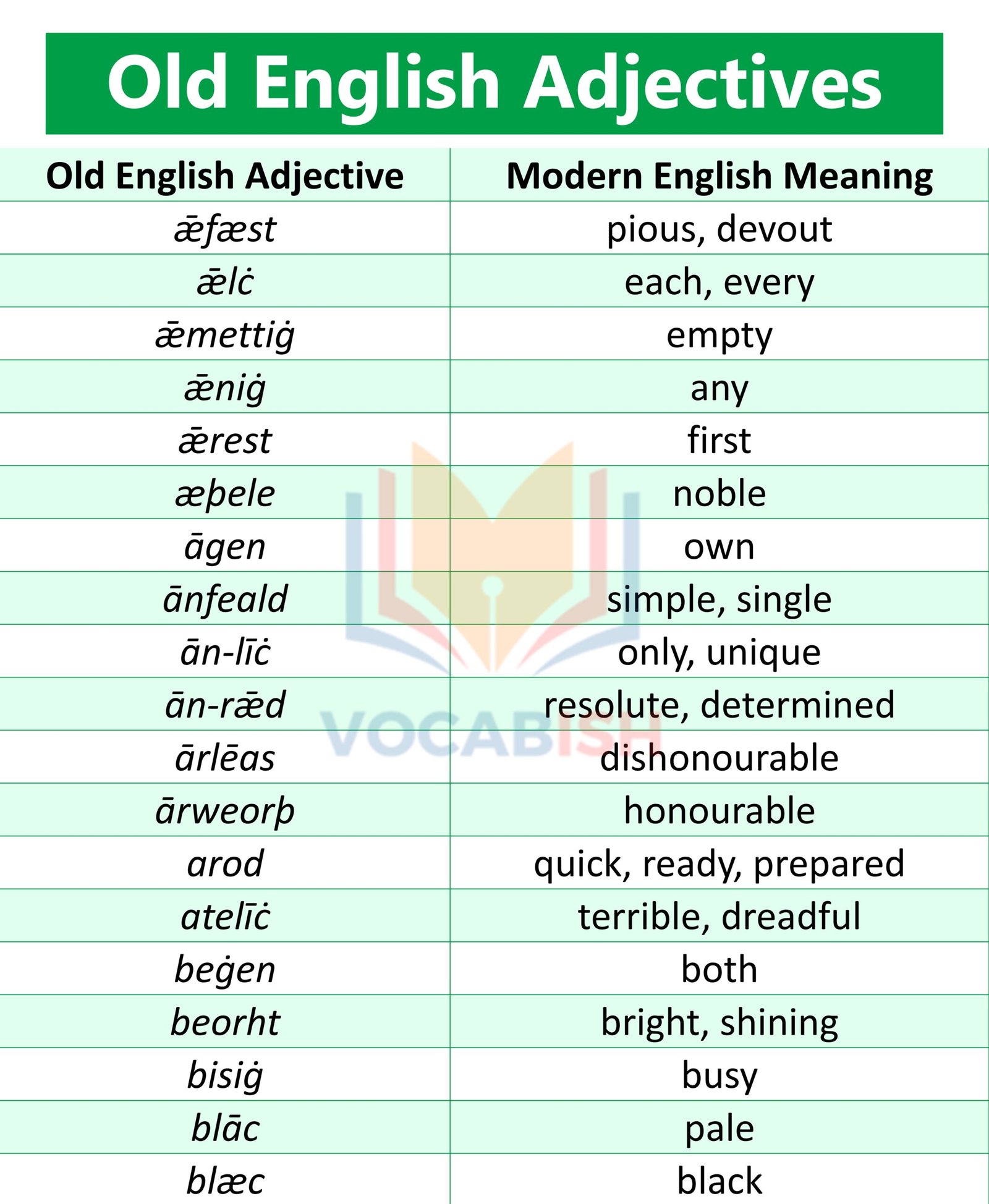
A–B
Old English adjective | Modern English meaning |
|---|---|
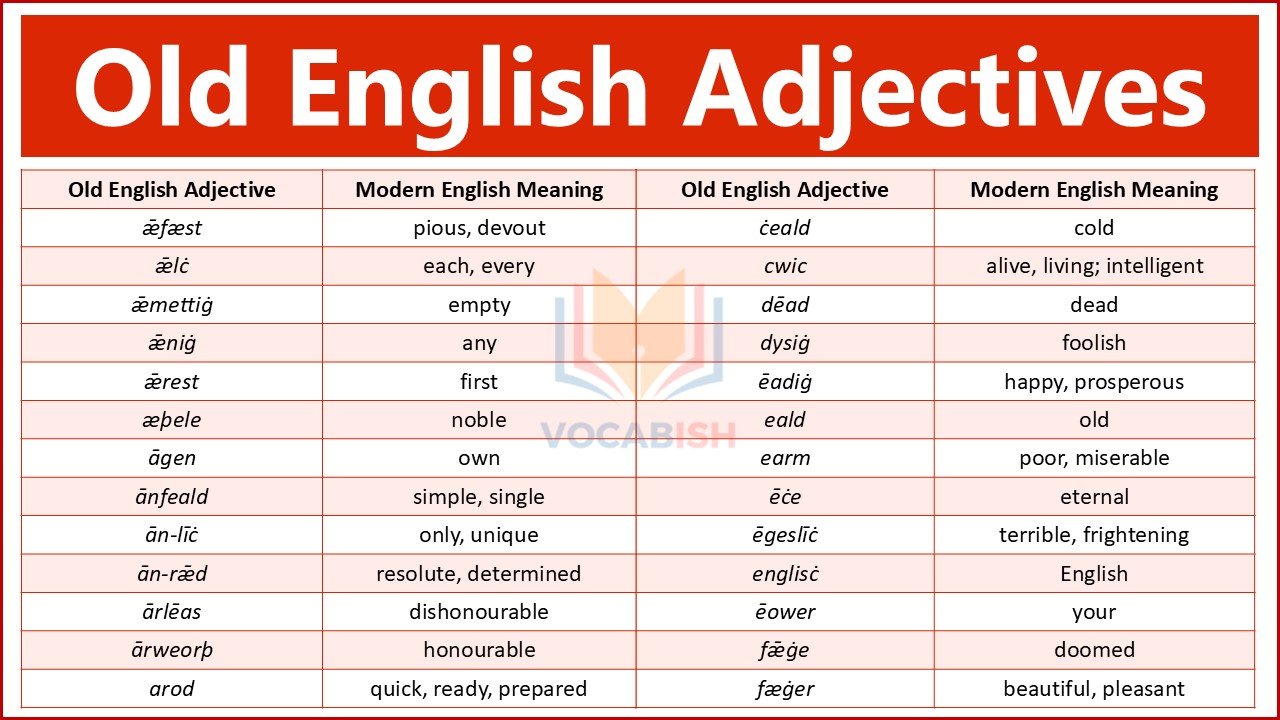
ǣfæst | pious, devout |
ǣlċ | each, every |
ǣmettiġ | empty |
ǣniġ | any |
ǣrest | first |
æþele | noble |
āgen | own |
ānfeald | simple, single |
ān-līċ | only, unique |
ān-rǣd | resolute, determined |
ārlēas | dishonourable |
ārweorþ | honourable |
arod | quick, ready, prepared |
atelīċ | terrible, dreadful |
beġen | both |
beorht | bright, shining |
bisiġ | busy |
blāc | pale |
blæc | black |
brād | broad, wide |
brūn | brown, dark, reddish |
bald | bold, confident, daring |
The core vocabulary list by Colin Gorrie records many of these forms, including ǣfæst, ǣlċ, ǣmettiġ, ǣniġ, ǣrest, æþele, āgen, ānfeald, ānrǣd, ārlēas, ārweorþ, arod, atelīċ, and beorht. Bosworth-Toller independently records adjectives such as bald and beorht with closely related meanings.
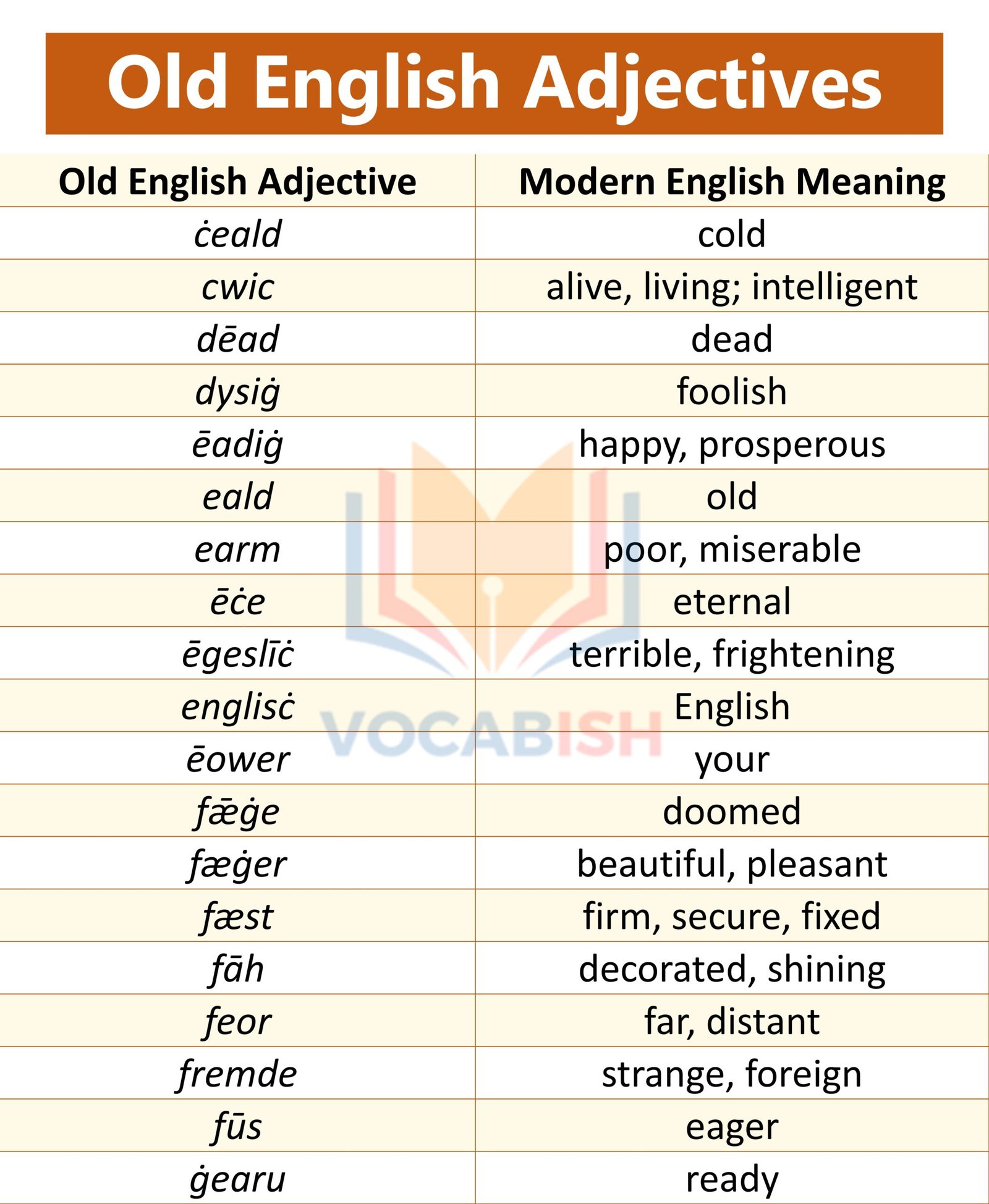
C–E
Old English adjective | Modern English meaning |
|---|---|
ċeald | cold |
cwic | alive, living; intelligent |
dēad | dead |
dēagol | secret, hidden |
dēop | deep |
deorc | dark |
dīere | dear, expensive, precious |
dierne | secret, hidden |
dysiġ | foolish |
ēadiġ | happy, prosperous |
eald | old |
eall | all, entire |
earm | poor, miserable |
ēċe | eternal |
ēgeslīċ | terrible, frightening |
englisċ | English |
ēower | your |
fǣġe | doomed |
fæġer | beautiful, pleasant |
fæst | firm, secure, fixed |
fāh | decorated, shining |
feor | far, distant |
fremde | strange, foreign |
fūs | eager |
ġearu | ready |
ġemǣne | common, universal |
ġenōg | enough, sufficient |
ġeong | young |
ġeorn | eager, desirous |
ġesib | related, familiar |
ġesund | healthy |
These meanings are represented in modern Old English teaching resources and core vocabulary references.
Bosworth-Toller also gives forht as “fearful, timid, affrighted,” illustrating how one Old English adjective could cover several closely related shades of meaning.
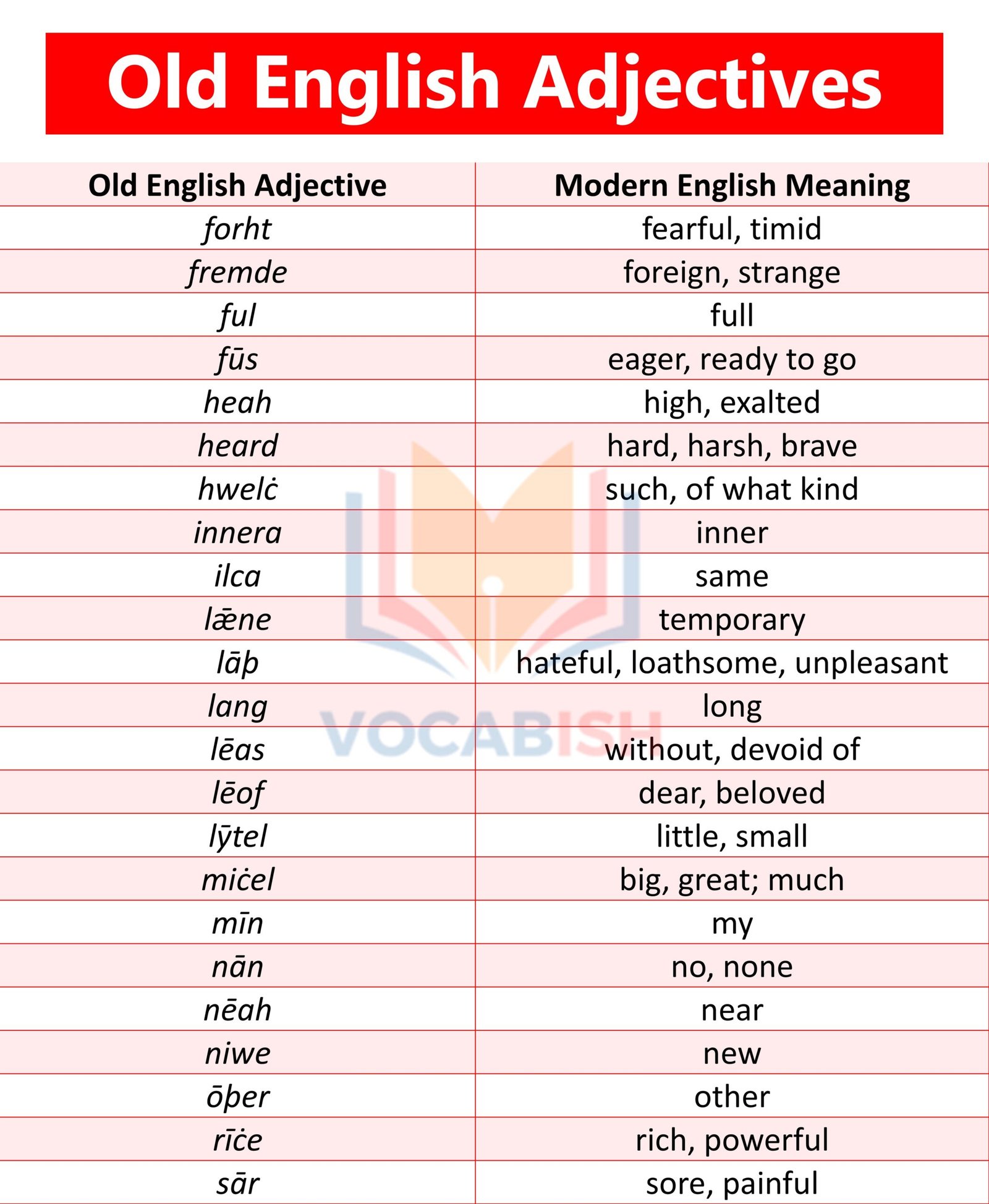
F–H
Old English adjective | Modern English meaning |
|---|---|
forht | fearful, timid |
fremde | foreign, strange |
ful | full |
fūs | eager, ready to go |
heah | high, exalted |
heard | hard, harsh, brave |
hefiġ | heavy |
hlūtor | clear, pure |
hnesce | soft, tender |
hwelċ | such, of what kind |
innera | inner |
ilca | same |
lǣne | temporary |
lāþ | hateful, loathsome, unpleasant |
lang | long |
lēas | without, devoid of |
lēof | dear, beloved |
lȳtel | little, small |
māniġ | many |
mǣre | famous, renowned |
miċel | big, great; much |
mīn | my |
mōdiġ | proud, reckless |
nān | no, none |
nēah | near |
niwe | new |
ōþer | other |
rīċe | rich, powerful |
sār | sore, painful |
sāriġ | sorry, sorrowful |
sċort | short |
sweart | black, dark |
sweotol | clear, distinct |
sum | some, a certain |
til | good |
twēġen | two |
uncūþ | unknown, unfamiliar, strange |
ūr(e) | our |
wīs | wise |
wlanc | proud |
wrāþ | angry, hostile |
yfel | bad, evil |
The core vocabulary source records lang, lāþ, lēas, lēof, lȳtel, mǣre, maniġ, miċel, mōdiġ, and other adjectives directly. It also records rīċe, sār, sāriġ, sweart, sweotol, til, wīs, wlanc, wrāþ, and yfel.
More Useful Old English Adjectives
The following words are especially helpful when reading Old English poetry, prose, historical texts, and vocabulary lists.
Old English adjective | Modern English meaning |
|---|---|
ācenned | born, begotten |
ānum / āne | single, one |
ānlīċ | unique, only |
beadu-cāf | battle-bold, battle-ready |
beorhtlīċ | bright, splendid |
beornlīċ | manly, warrior-like |
brād | broad |
brȳd | broad, ample |
cāf | quick, nimble, prompt |
clǣne | clean, pure |
cwīc | living, alive |
dēor | bold, brave; wild |
drȳġe | dry |
eaþe | easy |
eaþmōd | humble |
ealdor | older, elder |
eġesfull | dreadful, full of fear |
fāh | bright, decorated, variegated |
fæger | fair, beautiful |
fremful | useful, beneficial |
gearo | ready, prepared |
geornfull | eager, diligent, zealous |
grēat | great, large, stout |
halig | holy |
hēah | high |
hōh | crooked, hooked |
hryċġ | rugged, steep |
hlūd | loud |
hlūtor | clear |
lēoht | light |
milde | mild, gentle |
nāht | no, not any |
nearu | narrow |
niwe | new |
rūh | rough |
smēþe | smooth |
strang | strong |
stīf | stiff |
swēte | sweet |
þicce | thick |
þynne | thin |
wearm | warm |
wāc | weak |
wǣt | wet |
wīd | wide |
wundorlic | wonderful, marvelous |
þrȳmfull | glorious, magnificent, mighty |
weorþfull | worthy, honourable, excellent |
Bosworth-Toller records cāf as “quick, sharp, prompt, nimble, swift,” þrȳmfull as “glorious, magnificent, illustrious, mighty,” and weorþfull as “worthy, honourable, glorious, excellent.”
Common Old English Adjectives for Daily Use
Not every historical adjective is equally useful. Some appear frequently in teaching materials because they are easy to recognize or important for understanding basic Old English sentences.
Here are some of the best words to learn first:
Old English | Meaning | Modern connection |
|---|---|---|
eald | old | old |
geong | young | young |
gōd | good | good |
yfel | bad, evil | evil |
miċel | big, great, much | much |
lȳtel | little | little |
lang | long | long |
sċort | short | short |
strang | strong | strong |
heard | hard | hard |
heah | high | high |
dēop | deep | deep |
fæger | beautiful, fair | fair |
wīs | wise | wise |
blæc | black | black |
brūn | brown | brown |
swēte | sweet | sweet |
wearm | warm | warm |
ċeald | cold | cold |
rūh | rough | rough |
Several of these are still visibly related to Modern English words. Old English teaching materials specifically highlight forms such as lang, heard, heah, eald, geong, strang, gōd, lȳtel, miċel, and yfel.
Old English Adjectives That Survived in Modern English
One of the most interesting parts of studying Anglo-Saxon adjectives is seeing how many familiar English words have very old roots.
Words that look almost unchanged:
Old English | Modern English |
|---|---|
blæc | black |
brād | broad |
brūn | brown |
ċeald | cold |
dēad | dead |
dēop | deep |
eald | old |
fæst | fast |
heah | high |
heard | hard |
lang | long |
lēof | lief, beloved |
lȳtel | little |
niwe | new |
strang | strong |
swēte | sweet |
wīs | wise |
yfel | evil |
Some modern forms developed through several centuries of sound and spelling change, so the Old English and Modern English versions do not always look identical.
For example, fæger is related to Modern English fair, while lēof is related to the older sense of lief, meaning dear or beloved. The OED records Old English forms of fair including fæger.
Old English Adjectives and Their Opposites
Learning adjectives in pairs can make historical vocabulary much easier to remember.
Adjective | Meaning | Opposite |
|---|---|---|
eald | old | geong — young |
gōd | good | yfel — bad |
miċel | big, great | lȳtel — little |
lang | long | sċort — short |
strang | strong | wāc — weak |
heah | high | niþer — lower |
brād | broad | nearu — narrow |
þicce | thick | þynne — thin |
wearm | warm | ċeald — cold |
rūh | rough | smēþe — smooth |
beorht | bright | deorc — dark |
clǣne | clean | fūl — foul, dirty |
swēte | sweet | biter — bitter |
fæger | beautiful | unfæger — ugly |
riht | right, correct | lēas — false, devoid |
fāh | decorated, bright | unfāh — undecorated |
A historical Old English teaching text gives many of these contrasting pairs, including miċel–lȳtel, lang–sċort, brād–smæl, þicce–þynne, wearm–ċeald, heah–dēop, eald–geong, beorht–deorc, clǣne–fūl, wǣt–drȳġe, and swēte–biter.
Positive, Negative, and Descriptive Old English Adjectives
Old English adjectives covered many areas of description. They were not limited to physical appearance.
Positive or favorable adjectives
- gōd — good
- fæger — beautiful, fair
- wīs — wise
- halig — holy
- milde — mild, gentle
- ēadiġ — happy, prosperous
- til — good
- weorþfull — worthy, honourable
- fremful — useful, beneficial
- geornfull — eager, diligent
Negative or unfavorable adjectives
- yfel — bad, evil
- lāþ — hateful, unpleasant
- dysiġ — foolish
- wrāþ — angry, hostile
- forht — fearful, timid
- mōdiġ — proud, reckless
- earm — poor, miserable
- atelīċ — terrible, dreadful
Physical or sensory adjectives
- heah — high
- dēop — deep
- lang — long
- brād — broad
- þicce — thick
- þynne — thin
- rūh — rough
- smēþe — smooth
- wearm — warm
- ċeald — cold
- wǣt — wet
- drȳġe — dry
- hlūd — loud
- beorht — bright
- deorc — dark
How Old English Adjectives Changed
Old English adjectives were more grammatically flexible than their Modern English descendants.
The adjective had to agree with the noun it described. That agreement could show case, number, and gender. Adjectives could also occur in strong and weak forms depending on the structure of the sentence.
For example, the basic adjective eald means “old.” In one construction it may appear as eald, while after a demonstrative it can take a weak ending such as ealda. The choice depends on syntax rather than a completely different dictionary word.
This is why historical texts may contain several forms of what modern learners would regard as the same adjective.
Strong and Weak Old English Adjectives
Old English adjectives commonly appeared in two grammatical patterns called strong and weak.
A strong adjective was typically used when the noun was not already marked by a demonstrative or possessive determiner.
Example:
Alfred cyning is eald.
“King Alfred is old.”
After a demonstrative, a weak form could be used:
se ealda cyning
“the old king”
The exact ending changes according to case, gender, and number. Modern English largely lost this system, which is why present-day adjectives normally remain unchanged.
Old English Comparative and Superlative Forms
Old English did not simply add modern -er and -est in every situation, although those endings have their historical relatives in Old English.
A basic pattern looks like:
Positive | Comparative | Superlative | Modern meaning |
|---|---|---|---|
halig | hailgra | haligost | holy |
wīs | wīsra | wīsost | wise |
heard | heardra | heardost | hard |
æðele | æðelra | æðelost | noble |
niwe | niwra | niwost | new |
lang | lengra | lengest | long |
strang | strengra | strengest | strong |
eald | ieldra | ieldest | old |
geong | gingra | gingest | young |
Some important adjectives were irregular.
Positive | Comparative | Superlative |
|---|---|---|
gōd | betera | betest |
yfel | wiersa | wierst |
lȳtel | lǣssa | lǣst |
miċel | māra | mǣst |
Old English teaching resources identify these as major irregular patterns, while also showing vowel changes in words such as eald → ieldra, geong → gingra, lang → lengra, and strang → strengra.
Why Do Some Comparative Forms Look So Different?
The reason is partly i-mutation, also called umlaut. Historical sound changes affected the vowel of the adjective stem before the comparative and superlative forms became fixed.
For example:
- eald → ieldra
- geong → gingra
- lang → lengra
- strang → strengra
- heah → hiera
Those historical changes help explain why Modern English has forms such as:
- old → elder
- long → length
- strong → strength
The relationship is not always a direct one-to-one development, but the shared historical roots are clear.
How to Read Old English Adjectives
Old English uses several letters and spelling conventions that may look unfamiliar at first.
Important letters:
Old English letter | Rough explanation |
|---|---|
þ | “th” sound |
ð | also used for “th” |
æ | vowel similar to the “a” of cat in many descriptions |
ġ | marks a palatal sound in normalized spelling |
ċ | commonly represents a “ch” sound |
sc | often represents a “sh” sound in certain environments |
For example:
þrȳmfull
contains þ, which readers should recognize as a “th”-type consonant.
ċeald
uses ċ and corresponds to Modern English cold.
fæger
is historically related to Modern English fair.
Pronunciation was not perfectly uniform across all Old English dialects. West Saxon is especially prominent in surviving written material, so many modern learning resources use normalized West Saxon forms as their reference vocabulary.
Here’s a complete guide on: Old English A to Z Alphabets
Common Mistakes and Confusions
- Old English is not Shakespearean English. Shakespeare wrote Early Modern English, centuries after Old English.
- Not every old-looking English word is Old English. Some words belong to Middle English or Early Modern English.
- One adjective may have several meanings. For example, yfel can mean “bad,” “evil,” or “harmful” depending on context.
- Spelling varies. Historical manuscripts and modern editions can use different spellings or normalization systems.
- A dictionary form is not every grammatical form. Adjectives could change their endings for case, gender, number, and strong/weak usage.
FAQs About Old English Adjectives
An Old English adjective is a word from the English language used before about 1150 that describes a noun’s qualities, characteristics, quantity, or state.
Common examples include eald (old), gōd (good), yfel (bad), lang (long), miċel (big), and wīs (wise).
In language studies, “Anglo-Saxon” is a common alternative name for Old English, although modern scholarship generally prefers the term Old English.
Words such as old, strong, long, high, cold, black, broad, sweet, wise, little, and new have clear historical relationships with Old English forms.
Eald means old. It is one of the most recognizable Old English adjectives and has the same basic meaning today.
Gōd means good and forms irregular comparative and superlative forms: betera and betest.
Yfel commonly means bad or evil, and it can also describe something harmful or unfavorable depending on context.
Yes. Old English adjectives could change according to case, gender, number, and whether they were used in strong or weak constructions.
Conclusion
Old English adjectives show how much of Modern English has deep historical roots. Words such as eald, lang, strang, wīs, blæc, dēop, swēte, and gōd may look unfamiliar in their Old English spelling, but their meanings are often surprisingly easy to recognize.
This Old English Adjectives List provides a broad learner-focused collection rather than pretending that a short webpage can reproduce every adjective, compound, regional spelling, and grammatical form recorded across the entire Old English period. For dictionary-level research, Bosworth-Toller and the Dictionary of Old English remain much larger historical resources.
The easiest way to start learning is to focus on familiar pairs such as eald–geong, gōd–yfel, miċel–lȳtel, lang–sċort, and beorht–deorc. Once these become familiar, longer Old English texts become much easier to recognize and understand.
Explore More Old English Guides