
What did people in Anglo-Saxon England call a friend, king, house, child, warrior, road, night, or battle? The answers are found in Old English vocabulary, the language used in England roughly from the fifth century to the eleventh century.
Old English, also called Anglo-Saxon, can look unfamiliar because its spelling, grammar, and sounds differ from modern English. Yet many everyday words survive in recognizable forms. Words such as hūs “house,” cild “child,” hand “hand,” fæder “father,” and mōdor “mother” show how closely the older language is connected with English today. The University of St Andrews describes a teaching list of around 600 literary core Old English words, while the Dictionary of Old English covers the vocabulary of English from about 600 to 1150 CE.
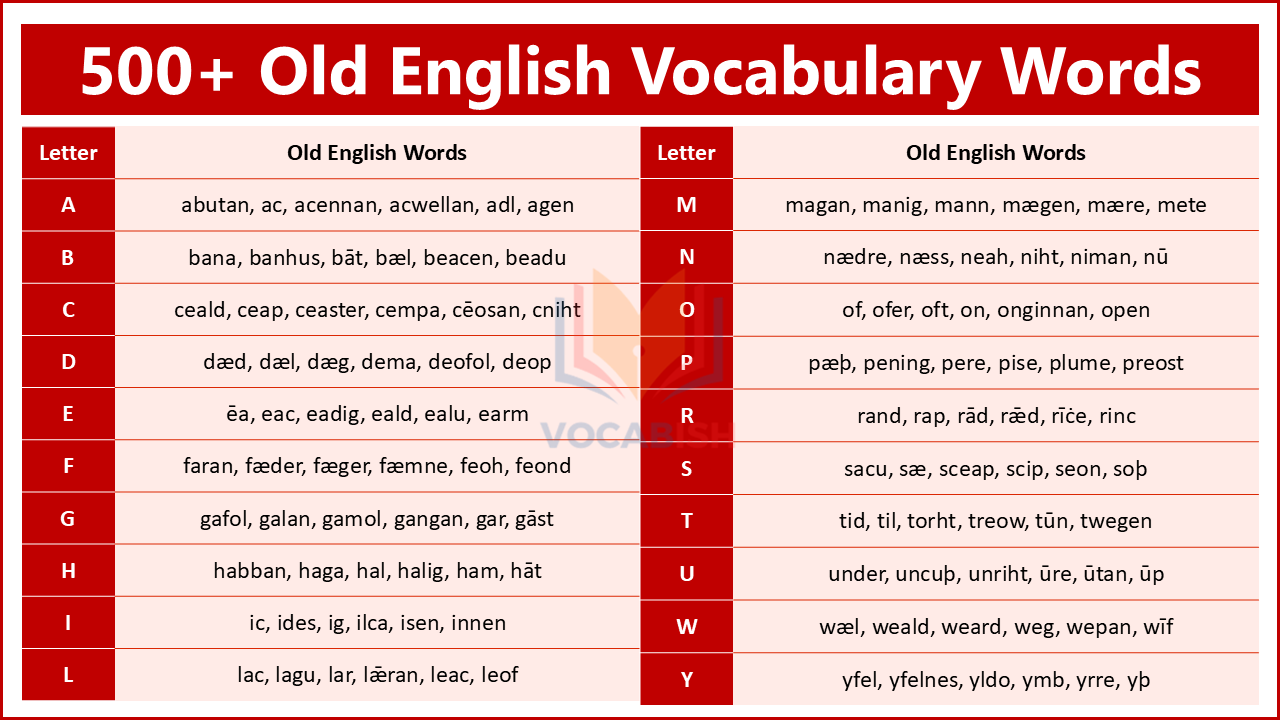
This Old English vocabulary list brings together more than 500 useful words with straightforward modern meanings. It includes nouns, verbs, adjectives, adverbs, pronouns, conjunctions, prepositions, numbers, religious vocabulary, legal terms, household words, nature terms, and poetic expressions.
Spelling note: Old English used letters such as æ, þ, and ð. In this A–Z learner arrangement, æ words are grouped under A and þ words are grouped under T.
What Is Old English?
Old English was the earliest major stage of the English language spoken and written in England. It developed from the Germanic languages brought to Britain by groups traditionally associated with the Angles, Saxons, and Jutes.
It was used in texts such as Beowulf, The Anglo-Saxon Chronicle, religious writings, laws, poetry, translations, and administrative documents.
The period is commonly placed around 450–1100, although dates vary according to whether scholars are discussing linguistic, historical, or literary boundaries. The University of St Andrews identifies Old English as the language spoken and written in England around 450–1100, while the Dictionary of Old English focuses on the vocabulary of the first six centuries of English, approximately 600–1150.
Old English also used letters unfamiliar to most modern readers:
Old English letter | Approximate modern value |
|---|---|
æ | vowel like the “a” in cat in many contexts |
þ | th |
ð | th |
ċ | usually a modern “ch” sound |
ġ | often a “y” or related palatal sound depending on context |
Spelling was not completely standardized, so the same word may appear with different spellings in manuscripts.
How to Read Old English Words
Old English dictionaries generally present words in a dictionary or headword form, rather than every grammatical form a learner may encounter in a text. The St Andrews teaching list uses abbreviations such as adj. for adjective, adv. for adverb, noun for noun, and verb for verb.
For example:
- cyning = king
- cwēn = queen
- hūs = house
- stān = stone
- sunu = son
- dōn = do, make
- gān = go
- sēon = see
One reason Old English seems difficult is that grammar carried information through endings. Modern English relies much more heavily on fixed word order and helper words.
500+ Old English Vocabulary List with Modern Meanings
Here’s the complete list of Old English vocabulary words with their modern English meanings from A to Z.
A — Old English Vocabulary
Old English | Modern meaning |
|---|---|
abutan | about, around |
ac | but |
acennan | bring forth, give birth |
acwellan | kill |
adl | sickness, disease |
agen | own |
aglæca | monster, combatant |
ahwær | anywhere |
alimpan | happen, befall |
alyfan | allow, permit |
an | one; a, an |
andgit | meaning, sense |
andsaca | enemy, adversary |
andswarian | answer |
andwlita | face, appearance |
andwyrdan | answer |
anfeald | simple, onefold |
anfloga | solitary flier |
anginn | beginning |
angel | hook |
anhaga | solitary person |
anlicnes | image, likeness |
anræd | resolute |
anwealda | ruler, lord |
ar | honour, mercy, favour |
ar | copper |
ar | oar |
arleas | dishonourable |
arlice | honourably, kindly |
arod | bold |
arweorþe | honourable |
astyrian | move, remove |
atol | terrible, hateful |
attor | venom, poison |
aþ | oath |
awiht | anything |
axian | ask |
æ | law |
æcer | cultivated field, acre |
æfæst | pious, devout |
æfen | evening |
æfter | after |
æghwa | everyone, everything |
æghwær | everywhere |
ægþer | each, both, either |
æht | property, possessions |
ælc | each, every |
ælfscyne | beautiful as an elf |
ælmesse | alms, charity |
æmettig | empty |
ænig | any |
æppel | apple |
ær | before, previously |
ærende | message, errand |
ærest | first |
ærgod | good from old times |
ærnan | run |
æsc | ash tree; spear |
æscplega | spear-fight, battle |
æscrof | brave in battle |
æstel | reading pointer/book marker |
ætgædere | together |
ætsomne | together |
ætywan | appear, show |
æþele | noble |
æþeling | prince, nobleman |
B — Old English Vocabulary
Old English | Modern meaning |
|---|---|
baldlice | boldly |
bana | slayer |
banhus | body |
banloca | body; muscles, enclosure of bone |
bar | boar |
bat | boat |
bæcere | baker |
bæl | fire; funeral pyre |
bærnan | burn |
be | about, concerning |
beacen | sign, beacon |
beadu | battle |
beadurinc | warrior |
beag | ring, circular ornament |
beaggyfa | ring-giver; lord |
beald | bold |
bealdor | lord |
bealu | harm, misery, injury |
bealusiþ | painful journey |
beam | tree; cross |
bearm | bosom, lap |
bearn | child, son |
bearu | grove |
bebeodan | command |
bedd | bed |
bedælan | deprive |
begen | both |
begeondan | beyond |
begietan | get, acquire |
beginnan | begin |
beheafdian | behead |
behreowsian | repent |
benn | wound |
beon | be |
beor | beer |
beorg | hill, mound, mountain |
beorgan | save, protect |
beorht | bright |
beorn | man, warrior |
gebeorscipe | beer party |
beot | vow, boast |
beran | carry, bear |
berstan | burst |
beswican | deceive, ensnare |
bet | better |
gebetan | improve, remedy |
bete | beet |
betweox | between |
bidan | wait, await |
biddan | ask, bid |
gebiddan | pray |
bifian | shake |
bigong | worship |
bill | sword |
bisgu | occupation |
blac | pale |
blawan | blow |
blæc | black |
blæd | glory |
bletsian | bless |
blod | blood |
boc | book |
boc | beech tree |
bocere | scholar, author |
bocfell | parchment, vellum |
gebocian | grant land by charter |
bocland | chartered hereditary land |
boclic | learned, scientific |
bocstæf | letter, written symbol |
bodian | preach |
bolster | pillow |
bot | repair, remedy, compensation |
bricg | bridge |
brim | sea |
broga | terror, danger |
broþor | brother |
brucan | use, enjoy, benefit from |
brun | brown, dark |
brytenwealda | ruler of Britain |
brytta | distributor, giver |
bur | private room, chamber |
gebur | tenant farmer |
burh | stronghold, fortified place |
butan | without, except, but |
byrgan | bury |
bysig | busy |
bysmor | disgrace, mockery |
C — Old English Vocabulary
Old English | Modern meaning |
|---|---|
casere | emperor |
ceald | cold |
ceap | purchase, price, market, property |
geceapian | buy |
ceaster | town |
cempa | warrior |
ceorl | free countryman, husband |
cicen | chicken |
cipe | onion |
cirice | church |
cist | chest, box, coffin |
clipian | call |
clyppan | embrace |
gecnawan | recognize, understand |
cniht | boy, youth, servant, soldier |
coss | kiss |
cringan | fall, perish |
cuman | come |
cunnan | know |
cunnian | find out, investigate |
cwellan | kill |
cwen | woman, queen |
cwic | alive, living |
cyning | king |
cyrtel | garment, coat |
cyse | cheese |
cyssan | kiss |
cyþan | make known, reveal |
D — Old English Vocabulary
Old English | Modern meaning |
|---|---|
dæd | deed |
dæl | part, portion |
dema | judge |
deofol | devil |
deop | deep |
deor | wild animal |
deorc | dark |
dom | judgment, authority |
don | do |
dream | joy, delight |
dreogan | suffer |
dreor | dripping blood |
drihten | lord |
dugan | be useful |
duguþ | seasoned retainers, mature men |
durran | dare |
duru | door |
dyre | dear, precious |
dyrne | secret, hidden |
dysig | foolish |
E — Old English Vocabulary
Old English | Modern meaning |
|---|---|
ea | river |
eac | also |
eadig | blessed, happy |
eald | old |
ealdor | leader, prince |
ealdor | life, age |
eallwealda | all-ruler, Lord |
earfoþ | hardship, work |
earm | poor, miserable |
ece | eternal |
ecg | edge, sword |
eft | again |
ege | fear |
ehtan | pursue, attack |
el- | from elsewhere |
ele | oil |
ellen | courage, strength |
elþeodig | foreign |
engel | angel |
ent | giant |
eorl | nobleman |
erian | plough |
esne | servant, young man |
F — Old English Vocabulary
Old English | Modern meaning |
|---|---|
faran | go, travel |
fæder | father |
fæger | beautiful, pleasant |
fæmne | woman, virgin |
feax | hair |
fela | many |
feoh | cattle, property, money |
feond | enemy |
feor | far |
feorh | life |
ferhþ | spirit, mind |
fleogan | fly |
flys | fleece, wool |
folc | people, nation |
folde | earth, ground |
folme | hand |
fon | catch, seize |
forhtian | fear |
forlætan | abandon, let go |
forliger | adultery |
forma | first |
forst | frost |
frætwe | ornaments |
frea | lord |
fremde | strange, foreign |
fremman | do, perform |
friþ | peace |
frod | old, wise |
frofor | consolation |
fruma | beginning |
fugol | bird |
fulluht | baptism |
fultum | help, support |
fus | eager |
fyr | fire |
fyrd | army, military service |
fyren | crime, wickedness |
G — Old English Vocabulary
Old English | Modern meaning |
|---|---|
gafol | tribute |
galan | sing |
gamol | old, ancient |
gan | go |
gar | spear |
garleac | garlic |
gast | spirit, soul, ghost |
gat | goat |
geard | yard, enclosure |
geomor | sad |
geond | through, throughout |
geong | young |
georn | eager |
giedd | word, speech, riddle |
giefu | gift |
giet | yet, still |
gif | if |
gioguþ | youth |
gnornian | mourn |
god | good |
God | God |
godspellere | evangelist |
grædig | greedy |
griþ | truce, peace |
guma | man |
guþ | battle, war |
gylp | boast, pride |
gyrd | twig, stick, yard |
gyse | yes |
H — Old English Vocabulary
Old English | Modern meaning |
|---|---|
habban | have |
haga | fence, hedge |
hagosteald | young unmarried man |
hal | safe, whole |
halig | holy |
ham | home |
hat | hot |
hatan | command, call, name |
hælan | heal |
Hælend | Saviour |
hæleþ | hero |
hæþen | heathen |
heafod | head |
heah | high, tall |
hearh | heathen shrine |
heaþu- | war-, battle- |
helm | helmet, protection |
heofon | heaven, sky |
heorot | deer, stag |
here | army |
hergian | ravage |
hild | battle |
hiwisc | household, family |
hlaf | bread, loaf |
hlaford | lord |
hlæfdige | lady, queen |
hlæw | mound, burial mound |
hleo | protection, shelter |
holt | wood, forest |
hord | hoard, treasure |
horshwæl | walrus |
hrægl | garment, clothes |
hu | how |
hund | dog, hound |
hunig | honey |
hunta | hunter |
hus | house |
hwa | who |
hwæl | whale |
hwæt | what |
hwær | where |
hwæþer | whether |
hwelc | which |
hweorfan | turn, change |
hwil | while |
hycgan | think, plan |
hyge | mind, heart, courage |
hyht | joy, hope |
hyrde | guardian, keeper |
hyrst | wooded hill |
hyse | warrior |
I — Old English Vocabulary
Old English | Modern meaning |
|---|---|
ic | I |
ides | lady |
ig | island |
ige | island |
ilca | same |
isen | iron |
K — Old English Vocabulary
Old English | Modern meaning |
|---|---|
kīn | kindred, family |
kenning | recognition, knowledge |
L — Old English Vocabulary
Old English | Modern meaning |
|---|---|
lac | play, sacrifice, offering |
laf | remnant, remainder |
lagu | law |
lar | teaching, learning |
lareow | teacher |
laþ | hateful, hostile |
læce | doctor, healer |
læne | temporary, transitory |
læt | late, slow |
leac | leek |
leas | false, empty, devoid of |
leax | salmon |
leode | people |
leof | dear, beloved |
leoht | light |
leornere | scholar, student |
leoþ | song, poem |
lic | body |
lichama | body |
lid | ship |
lif | life |
lind | shield |
lof | praise |
lofgeorn | eager for praise |
lufu | love |
lyft | air, sky, breeze |
M — Old English Vocabulary
Old English | Modern meaning |
|---|---|
magan | be able, can |
man | crime |
manig | many |
mann | person, human being |
manswerian | commit perjury |
maþelian | speak |
maþm | treasure |
mæg | kinsman |
mægen | strength, power |
mægþ | maiden |
mære | famous, glorious |
mearc | boundary, border, region |
mearh | horse |
mece | sword |
med | reward |
medtrumnes | illness |
meodo | mead |
meotod | creator |
mere | lake, pool |
micel | great, large, much |
mid | with, among |
middangeard | world |
miht | might, power |
mod | spirit, courage, mind |
modig | brave, bold, proud |
modor | mother |
mona | moon |
morþor | crime, violence |
motan | may, be allowed to |
mund | hand, protection |
gemynd | mind, remembrance |
mynster | monastery, church |
N — Old English Vocabulary
Old English | Modern meaning |
|---|---|
nædre | snake, serpent |
næp | turnip |
næss | headland, bluff |
neah | near |
neorxnawang | Paradise |
niman | take |
niþ | hatred, malice, trouble |
genog | enough |
nu | now |
nunne | nun |
nytt | use, utility |
nīwe | new |
næfre | never |
nā | not ever, never |
nama | name |
niht | night |
norþ | north |
nyd | need, necessity |
O — Old English Vocabulary
Old English | Modern meaning |
|---|---|
of | from, of |
ofermod | pride, arrogance |
offrian | offer |
oft | often |
onfon | receive, accept |
ongean | back, again |
ongietan | understand, perceive |
onginnan | begin |
ord | point, spear, vanguard |
oþer | other, second |
oþ þæt | until |
oþþe | or |
ofer | over, across |
on | in, on |
open | open |
oferweald | authority, dominance |
oferdrīfan | drive over, overpower |
oferhīgian | overestimate |
oxa | ox |
P — Old English Vocabulary
Old English | Modern meaning |
|---|---|
pæþ | path |
penig | penny |
peru | pear |
pise | pea |
plume | plum |
preost | priest |
plegan | play |
plōh | plough |
pund | pound |
pundere | pounder, worker |
pytt | pit |
pyttan | put, place |
R — Old English Vocabulary
Old English | Modern meaning |
|---|---|
rand | shield |
rap | rope |
ræd | advice, counsel |
rædan | read, advise, rule |
rice | kingdom |
rice | powerful, great |
ricsian | rule, exercise power |
gerim | number, calculation, calendar |
rinc | man, warrior |
rod | cross |
rodor | sky, heaven |
run | secret counsel, mystery |
rād | riding, journey |
rīdan | ride |
rīċe | powerful, rich |
riht | right, justice |
rihtwis | righteous, just |
rōf | famous, excellent |
rǣsan | rush, attack |
rēaf | robbery, plunder |
rēad | red |
rēcan | care for, reach |
rēon | lament |
rēn | rain |
S — Old English Vocabulary
Old English | Modern meaning |
|---|---|
sacu | battle, lawsuit |
samod | together, at the same time |
sar | sore |
sarig | sorrowful |
sawol | soul |
sæ | sea |
sæta | inhabitant |
sceadu | shadow |
scealc | man, warrior |
sceap | sheep |
sceat | surface, region |
sceatt | money, payment |
sceþþan | injure |
sceawian | see, look at |
scieppan | create |
scir | bright, shiny |
scir | district, administration |
scirgerefa | sheriff |
sculan | must, have to |
se | the |
seo | the |
secan | seek |
secg | man, warrior |
secgan | say |
sefa | heart |
sele | hall, house |
sellan | give, sell |
sendan | send, throw |
seon | see |
gesib | related |
sibb | peace, relationship |
sige | victory |
simle | always |
sinc | treasure |
singal | perpetual |
siþ | journey, fate |
siþþan | since, afterward |
slean | strike, beat, slay |
smeagan | think, examine |
snottor | wise |
socn | search, inquiry, jurisdiction |
sona | soon, immediately |
sorg | sorrow, grief |
soþ | true |
sped | success, speed |
spell | story, message |
sprecan | speak |
spyrian | track, follow |
stan | stone |
stefn | voice |
stieran | steer, control |
stow | place |
stræl | arrow |
gestreon | wealth, treasure |
sum | some, a certain |
gesund | unharmed, whole |
sunne | sun |
sunu | son |
swa | so, thus |
sweart | black, dark |
swefn | dream |
swelc | such |
sweord | sword |
sweostor | sister |
sweotol | clear, evident |
swin | pig |
swincan | labour, toil |
swiþe | very, greatly |
symbel | feast |
syn | sin, crime |
T — Old English Vocabulary
Old English | Modern meaning |
|---|---|
teon | pull, drag |
tid | time |
til | good |
tir | glory |
torht | bright |
treow | tree |
treow | faith, trust, loyalty |
tun | town, village |
tungol | star |
twegen | two |
tweo | doubt, uncertainty |
þa | then, when |
þær | there, where |
þeah | though |
þeaw | custom, practice |
þegn | thane, nobleman, retainer |
þeod | people, nation |
geþeode | language |
þeoden | prince, lord |
þeow | slave, servant |
þolian | suffer |
þonne | then |
þræl | slave, servant |
þrowian | suffer |
þrym | glory |
þurfan | need |
þurh | through |
þis | this |
þes | this |
þū | you |
þīn | your, thine |
þæt | that |
þæt | the |
þām | that, to that |
þā | those, then |
þider | thither |
þus | thus |
þenden | while, until |
þēah | although |
þē | you, thee |
þīn | your |
þū | thou |
U — Old English Vocabulary
Old English | Modern meaning |
|---|---|
uhta | period before dawn |
uncuþ | unknown, strange |
unriht | wrong, injustice |
unrihtwis | unjust |
ut | out |
utan | outside |
under | under |
ūre | our |
ūtan | outside |
ūp | up |
ūppan | upward |
un- | not, opposite of |
ūtel | outer |
ūre | our |
W — Old English Vocabulary
Old English | Modern meaning |
|---|---|
wæl | slaughter, carnage |
wæstm | fruit |
weald | forest, wood |
wealdan | wield, control |
wealdend | ruler, Lord |
weard | guardian |
weaxan | grow |
wen | expectation, hope |
wendan | go, turn, change |
weorþan | become, happen |
wer | man |
wergild | compensatory payment |
werod | troop, company |
westen | desert |
wic | dwelling, abode |
wif | woman, wife |
wig | war, battle |
wiht | creature, being |
willan | want, wish |
wine | friend, lord |
gewinn | war, strife |
winnan | struggle, fight |
gewinnan | conquer, win |
wita | wise man, counsellor |
witan | king’s council |
witan | know |
wite | punishment |
wiþ | against, from, with |
wlanc | proud |
wod | mad, furious |
wolcen | cloud, sky |
woruld | world |
wraþ | hostile, angry |
wræcca | wanderer, exile |
wrecan | avenge |
writan | write |
wudu | wood, forest |
wuldor | glory |
wundor | wonder, miracle |
wunian | dwell |
wynn | joy |
wyrcan | make, work |
wyrd | fate |
wyrm | worm, serpent |
wyrt | herb, plant |
Y — Old English Vocabulary
Old English | Modern meaning |
|---|---|
yfel | evil |
ymb | about, concerning |
yrmþu | hardship |
yrre | anger |
yþ | wave |
yrnan | run |
yfelnes | wickedness |
yldo | age, old age |
yldesta | eldest |
yfel | evil, bad |
ymbsittend | neighbour, surrounding inhabitant |
ymbhwyrft | circuit, surrounding |
ymbweard | surrounding, around |
yþan | flow, move as a wave |
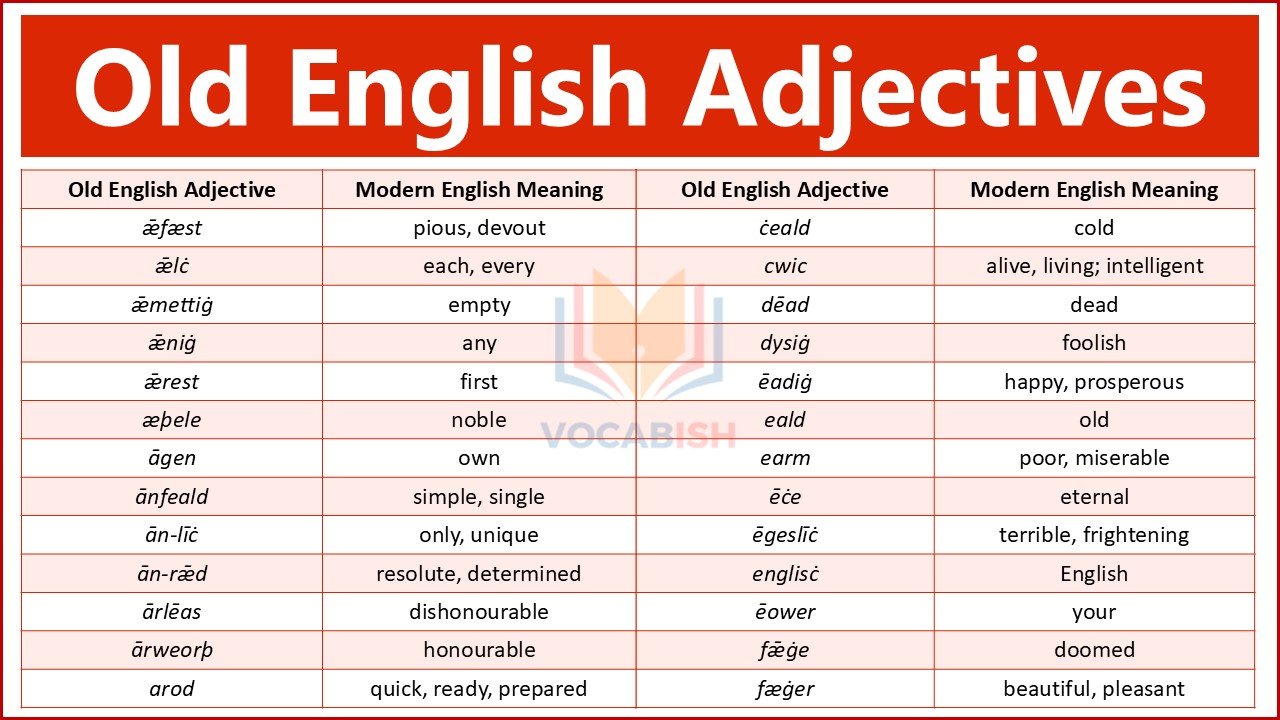
The Most Useful Old English Adjectives A–Z
Because adjectives are an important part of an Old English adjectives list, here are the principal descriptive words from the larger vocabulary above.
Old English adjective | Modern meaning |
|---|---|
agen | own |
anfeald | simple |
anræd | resolute |
arleas | dishonourable |
arod | bold |
arweorþe | honourable |
æfæst | pious |
ælmettig | almighty |
æmettig | empty |
ænig | any |
ærest | first |
æscrof | brave in battle |
æþele | noble |
atol | terrible |
beald | bold |
beorht | bright |
blac | pale |
blæc | black |
boclic | learned |
brun | brown, dark |
bysig | busy |
ceald | cold |
cwic | alive |
deop | deep |
deorc | dark |
dyre | dear |
dyrne | secret |
dysig | foolish |
eadig | blessed, happy |
eald | old |
earm | poor |
ece | eternal |
elþeodig | foreign |
fæger | beautiful, pleasant |
feor | far |
forht | afraid, fearful |
fremde | strange |
frod | old, wise |
fus | eager |
gamol | old, ancient |
geomor | sad |
geong | young |
georn | eager |
god | good |
grædig | greedy |
hal | safe, whole |
halig | holy |
hat | hot |
hæþen | heathen |
heah | high, tall |
ilca | same |
laþ | hateful, hostile |
læne | temporary |
læt | late, slow |
leas | false, empty |
leof | dear, beloved |
lofgeorn | eager for praise |
manig | many |
mære | famous, glorious |
micel | great, large |
modig | brave, bold, proud |
neah | near |
nog | enough |
oþer | other, second |
rice | powerful, great |
riht | right |
sar | sore |
sarig | sorrowful |
scir | bright, shiny |
snottor | wise |
soþ | true |
singal | perpetual |
sweart | black, dark |
sweotol | clear |
til | good |
torht | bright |
uncuþ | unknown, strange |
wlanc | proud |
wod | mad, furious |
wraþ | hostile |
yfel | evil |
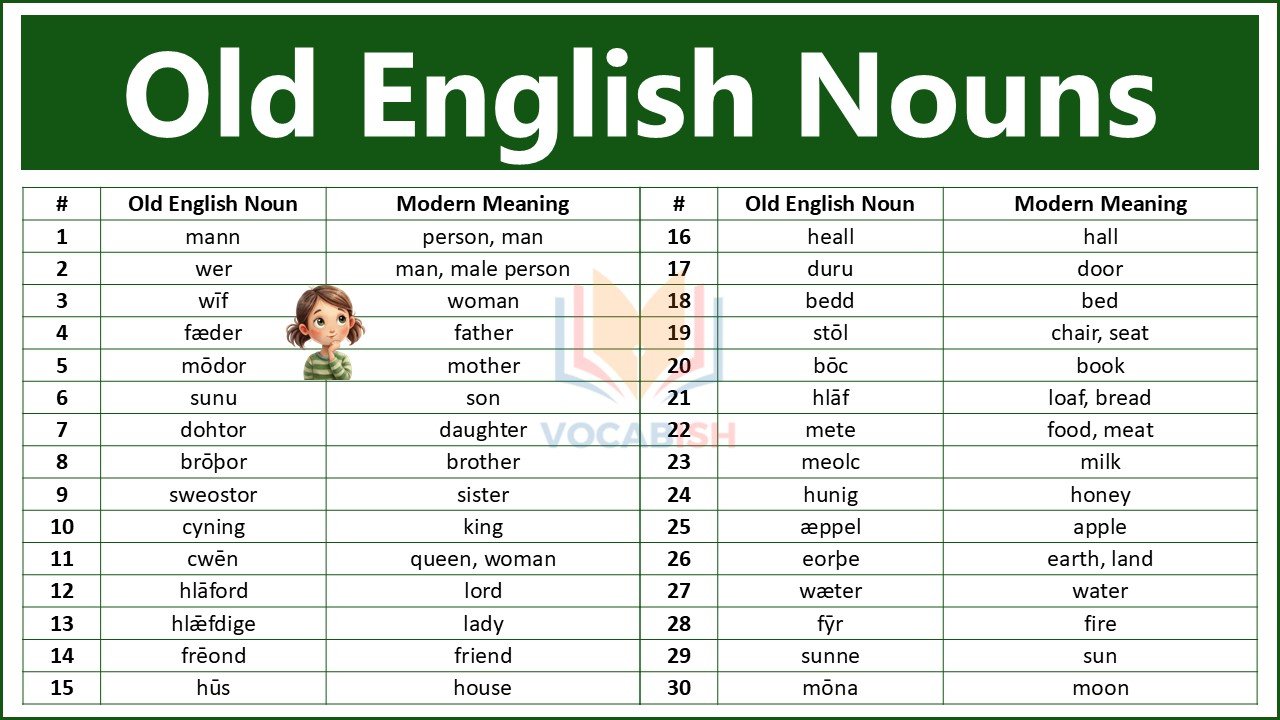
Old English vs Modern English Words
Old English Words | Modern English Words |
|---|---|
fæder | father |
mōdor | mother |
brōþor | brother |
sweostor | sister |
sunu | son |
bearn | child |
cyning | king |
cwēn | queen |
hlāford | lord |
hlæfdige | lady |
cniht | knight, servant, young man |
mann | person |
wīf | woman, wife |
hūs | house |
ham | home |
heall | hall |
duru | door |
weg | way |
pæþ | path |
stān | stone |
treow | tree |
wudu | wood |
sæ | sea |
ēa | river |
sunne | sun |
mōna | moon |
steorra | star |
niht | night |
dæġ | day |
winter | winter |
hors | horse |
hund | dog |
cū | cow |
sceap | sheep |
swīn | pig |
fisc | fish |
fugol | bird |
wyrm | serpent, worm |
hand | hand |
heafod | head |
fot | foot |
tōþ | tooth |
ēage | eye |
mūþ | mouth |
hēorte | heart |
gōd | good |
yfel | evil |
micel | great |
heah | high |
lang | long |
wīs | wise |
strang | strong |
gan | go |
cuman | come |
faran | travel, go |
sēon | see |
etan | eat |
drincan | drink |
sittan | sit |
standan | stand |
slǣpan | sleep |
sprecan | speak |
secgan | say |
þencan | think |
habban | have |
dōn | do |
wyrcan | make, work |
lufian | love |
Useful Old English Prefixes and Word-Building Patterns
Old English vocabulary becomes easier when you recognize recurring word-building patterns.
Element | General function | Example | Modern sense |
ā- | away, out, completed action | ādrīfan | drive away |
be- | around, by, intensive | bebēodan | command |
for- | away, completely, negatively | forgiefan | forgive |
ge- | varied grammatical or lexical function | gebed | prayer |
un- | not, opposite | unriht | wrong, unjust |
mis- | wrongly, badly | misdōn | do wrongly |
ofer- | over, excessively | oferdrēogan | endure too much |
under- | under, beneath | understandan | understand |
þurh- | through | þurhgan | go through |
These elements do not always match modern English prefixes exactly. Old English ge- especially deserves care because its historical functions were broader than simply adding a predictable modern meaning.
Common Spelling and Meaning Confusions
Old English can be confusing when a familiar-looking word has a different historical form or sense.
- þ and ð both commonly represent “th,” so þū is read roughly as “thou.”
- æ is a distinct Old English letter, not just decorative spelling.
- dōm often means judgment, decree, or authority, not simply “doom.”
- mete could mean food generally; its modern descendant meat developed a narrower meaning.
- wīf commonly meant “woman” as well as “wife,” depending on context.
How to Study Old English Vocabulary
The fastest way to make a large vocabulary list memorable is to avoid learning hundreds of isolated definitions.
Group words by meaning:
Family: fæder, mōdor, sunu, brōþor, sweostor
Nature: eorþe, land, wudu, treow, ēa, sæ
Action: gān, cuman, faran, sēon, etan, drincan
Description: gōd, micel, heah, lang, wīs, fæger
Society: cyning, hlāford, þēġn, ealdorman, wita
Then look for modern connections. Seeing fæder → father, mōdor → mother, brōþor → brother, and sunu → son makes the historical relationship far easier to remember.
A Simple Study Method:
- Learn 20–25 words at a time.
- Group them by topic.
- Read each word aloud.
- Connect the word with its modern descendant.
- Read the word in a short Old English passage.
- Review older vocabulary before adding a new group.
Important Historical Note
Not every word that looks “old-fashioned” is technically Old English. Old English belongs to the period before Middle English and is linguistically different from later Middle English, Early Modern English, and archaic modern vocabulary.
For example, Shakespearean words such as thou, thee, hence, and wherefore should not automatically be labeled Old English. In contrast, words such as fæder, mōdor, hūs, cyning, bearn, brōþor, sunu, dōn, gān, and sēon belong to the Old English vocabulary tradition.
The St Andrews resource describes its approximately 600-word selection as a literary core vocabulary for Old English, while Bosworth–Toller records a much broader historical vocabulary used in England approximately from the eighth to the eleventh centuries.
FAQs About Old English Vocabulary
Old English vocabulary is the body of words used in English in Anglo-Saxon England, roughly from the fifth century through the eleventh century.
Old English is often called Anglo-Saxon, especially in historical and literary contexts.
There are many thousands of recorded Old English lexical forms, so a 500-word list is a study selection rather than a complete dictionary.
Yes. Many core English words, including house, father, mother, child, hand, stone, and strong, are inherited from Old English or closely related historical forms.
Words such as cyning “king,” heall “hall,” sweord “sword,” gar “spear,” feond “enemy,” and wyrm “serpent or dragon” are useful Beowulf vocabulary.
Final Takeaway
Learning Old English vocabulary is more than memorizing strange medieval spellings. It reveals the roots of everyday English and explains why familiar words such as father, mother, house, child, stone, hand, king, strong, good, and wise look and sound the way they do today.
This 500+ Old English vocabulary list gives learners a practical starting point, from everyday nouns and common verbs to Anglo-Saxon vocabulary words, archaic terms, poetic expressions, legal vocabulary, and Old English adjectives.
For deeper study, specialist resources such as A Thesaurus of Old English, the Dictionary of Old English, and the online Bosworth–Toller Anglo-Saxon Dictionary provide much broader coverage and contextual information. The Thesaurus of Old English is particularly useful because it organizes vocabulary by subject and meaning rather than only alphabetically.