
The right adjectives to describe someone can tell us much more than a person’s name or job. Words such as kind, honest, confident, shy, rude, and creative describe personality, behavior, appearance, feelings, and character.
Learning these descriptive words helps English learners talk about friends, family members, classmates, teachers, coworkers, and other people more clearly. It also makes speaking and writing more natural.
Here’s a complete guide to 1000+ Descriptive Words in English.
What Are Adjectives to Describe Someone?
Adjectives to describe someone are words that give information about a person’s personality, appearance, behavior, abilities, emotions, or character.
For example:
- Kind — caring and helpful toward others
- Honest — someone who tells the truth
- Friendly — pleasant and easy to talk to
- Shy — uncomfortable speaking with others
- Lazy — unwilling to work or make an effort
- Confident — sure of yourself and your abilities
- Creative — able to produce new and original ideas
- Patient — able to wait calmly
- Rude — not polite or respectful
- Generous — willing to give or share with others
Adjectives can describe a person in a positive, negative, or neutral way. The meaning also depends on the situation and context.
Positive Adjectives to Describe Someone
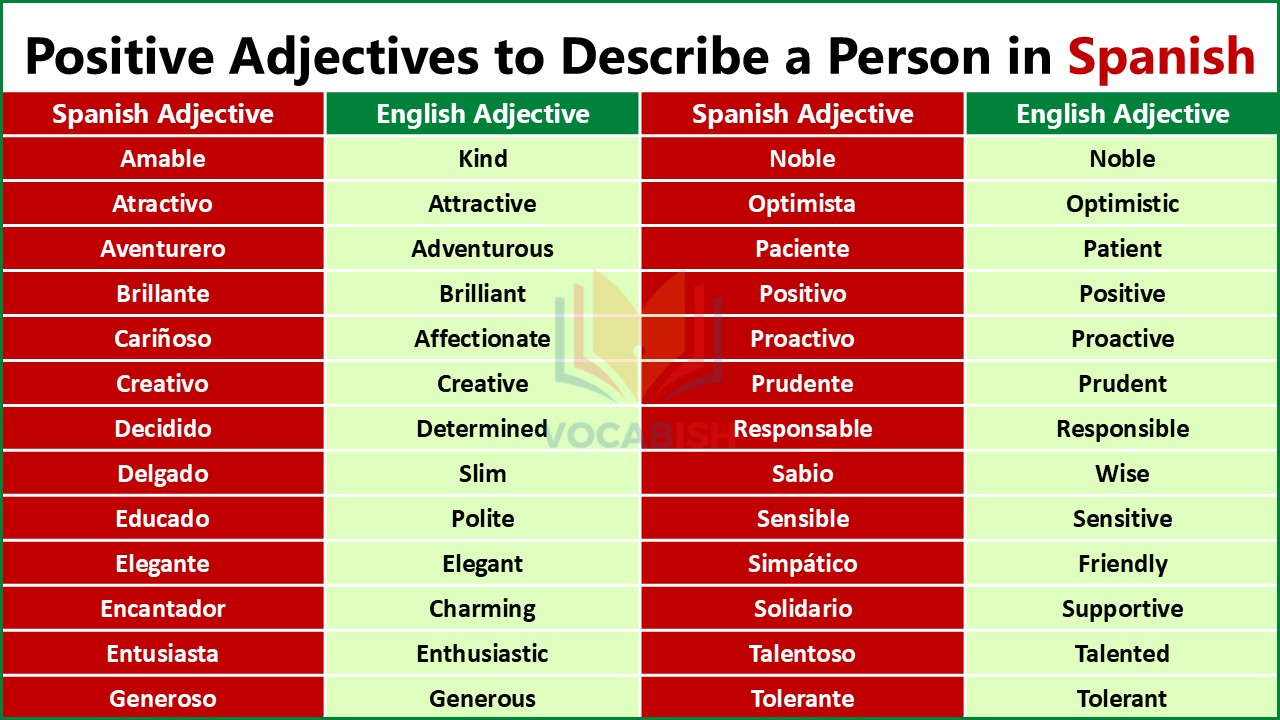
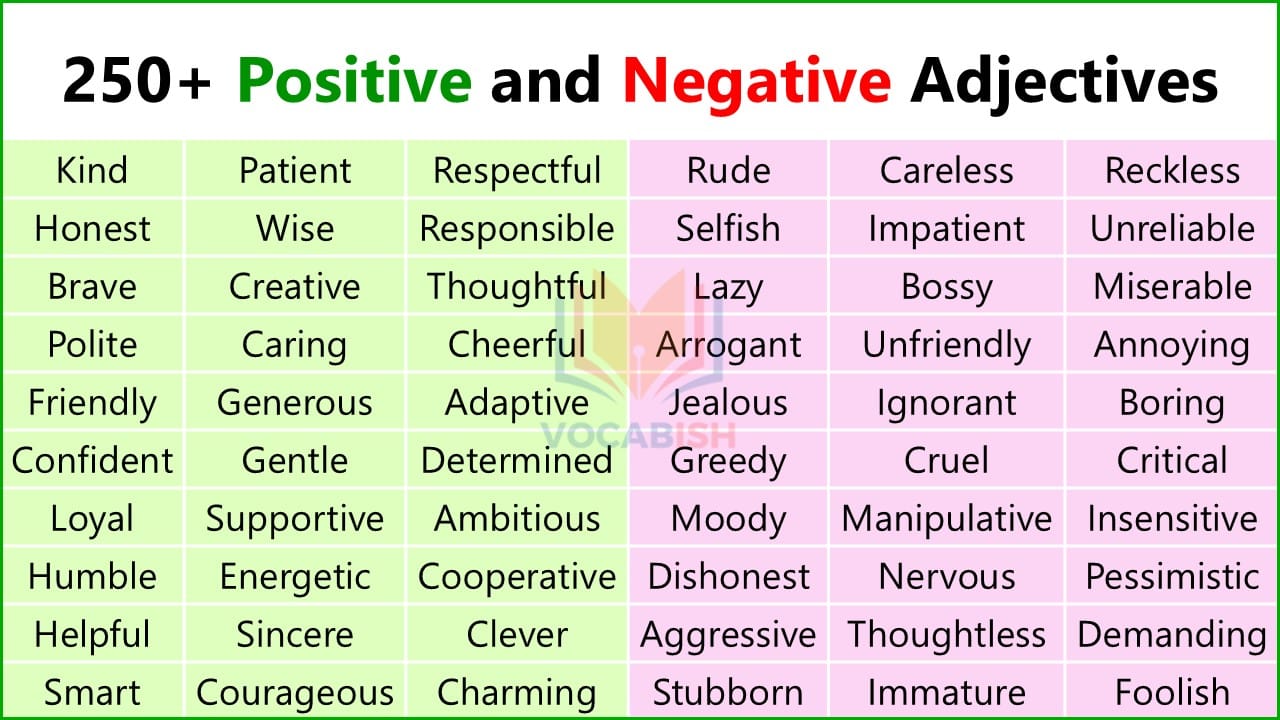
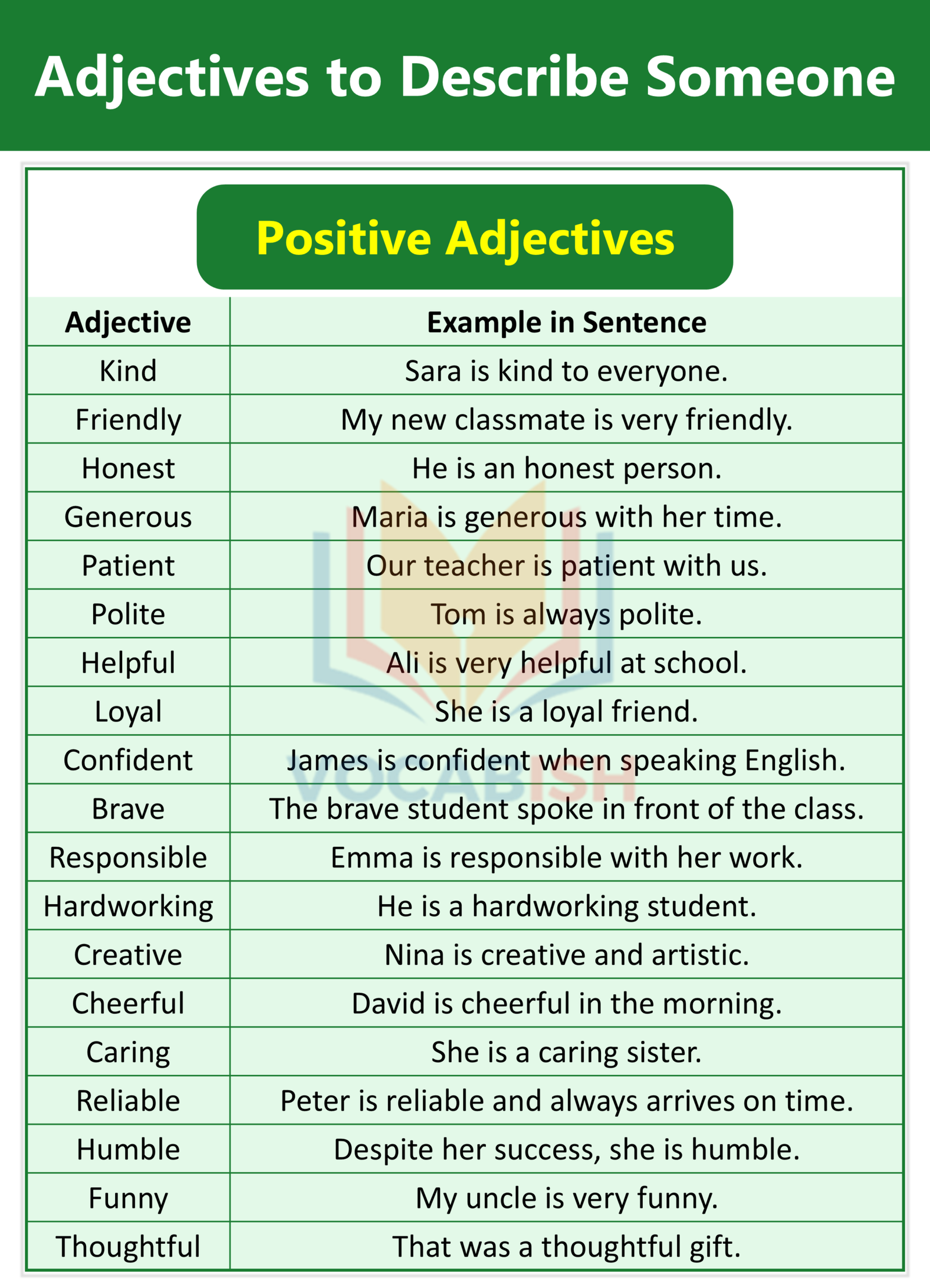
Positive adjectives show qualities that people usually admire or appreciate. They are useful when giving compliments, writing character descriptions, introducing someone, or talking about a person’s strengths.
Adjective | Meaning | Example |
|---|---|---|
Kind | Caring and helpful | Sara is kind to everyone. |
Friendly | Pleasant and sociable | My new classmate is very friendly. |
Honest | Truthful | He is an honest person. |
Generous | Willing to give or share | Maria is generous with her time. |
Patient | Calm when waiting or dealing with problems | Our teacher is patient with us. |
Polite | Showing good manners | Tom is always polite. |
Helpful | Ready to help others | Ali is very helpful at school. |
Loyal | Faithful and supportive | She is a loyal friend. |
Confident | Sure of yourself | James is confident when speaking English. |
Brave | Willing to face difficulty or danger | The brave student spoke in front of the class. |
Responsible | Reliable and careful about duties | Emma is responsible with her work. |
Hardworking | Putting a lot of effort into work | He is a hardworking student. |
Creative | Having original ideas | Nina is creative and artistic. |
Cheerful | Usually happy and positive | David is cheerful in the morning. |
Caring | Showing concern for others | She is a caring sister. |
Respectful | Showing respect | The students are respectful to their teacher. |
Reliable | Someone you can depend on | Peter is reliable and always arrives on time. |
Humble | Not arrogant about achievements | Despite her success, she is humble. |
Funny | Making people laugh | My uncle is very funny. |
Thoughtful | Showing care by considering others | That was a thoughtful gift. |
Other useful positive adjectives include:
ambitious, calm, clever, compassionate, determined, energetic, enthusiastic, generous, intelligent, imaginative, independent, mature, optimistic, organized, sincere, supportive, talented, trustworthy, warm, wise
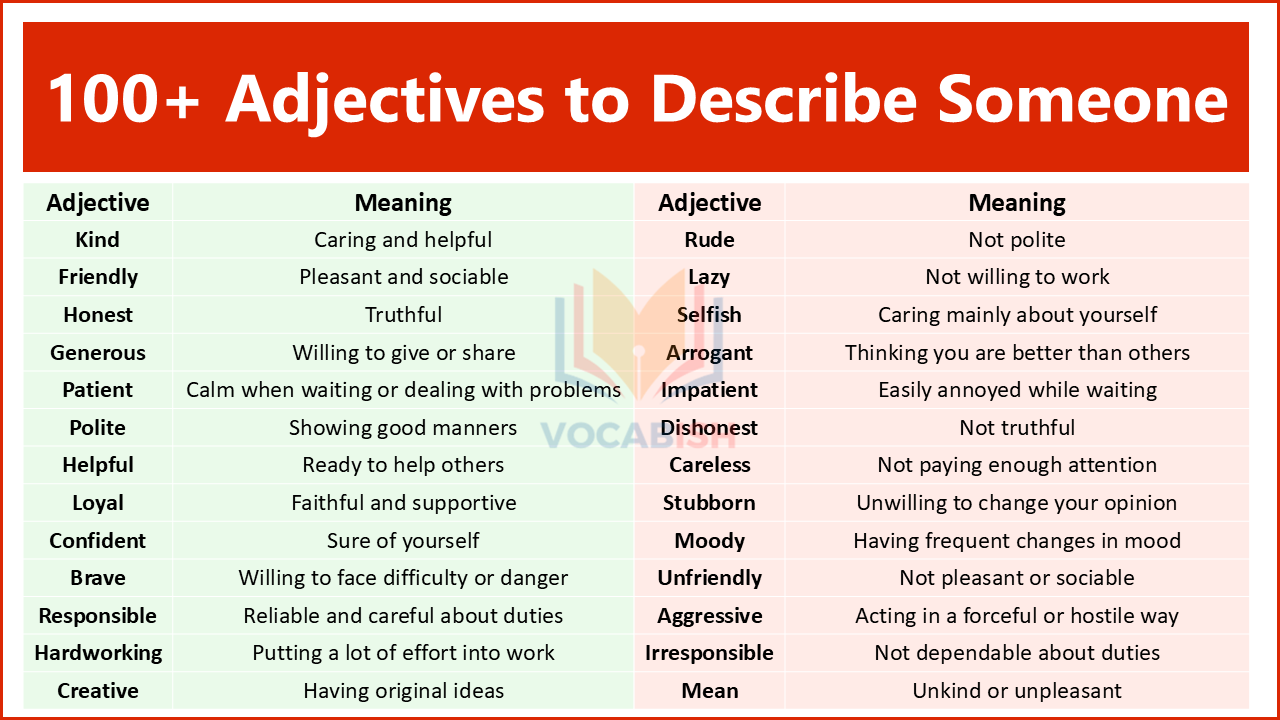
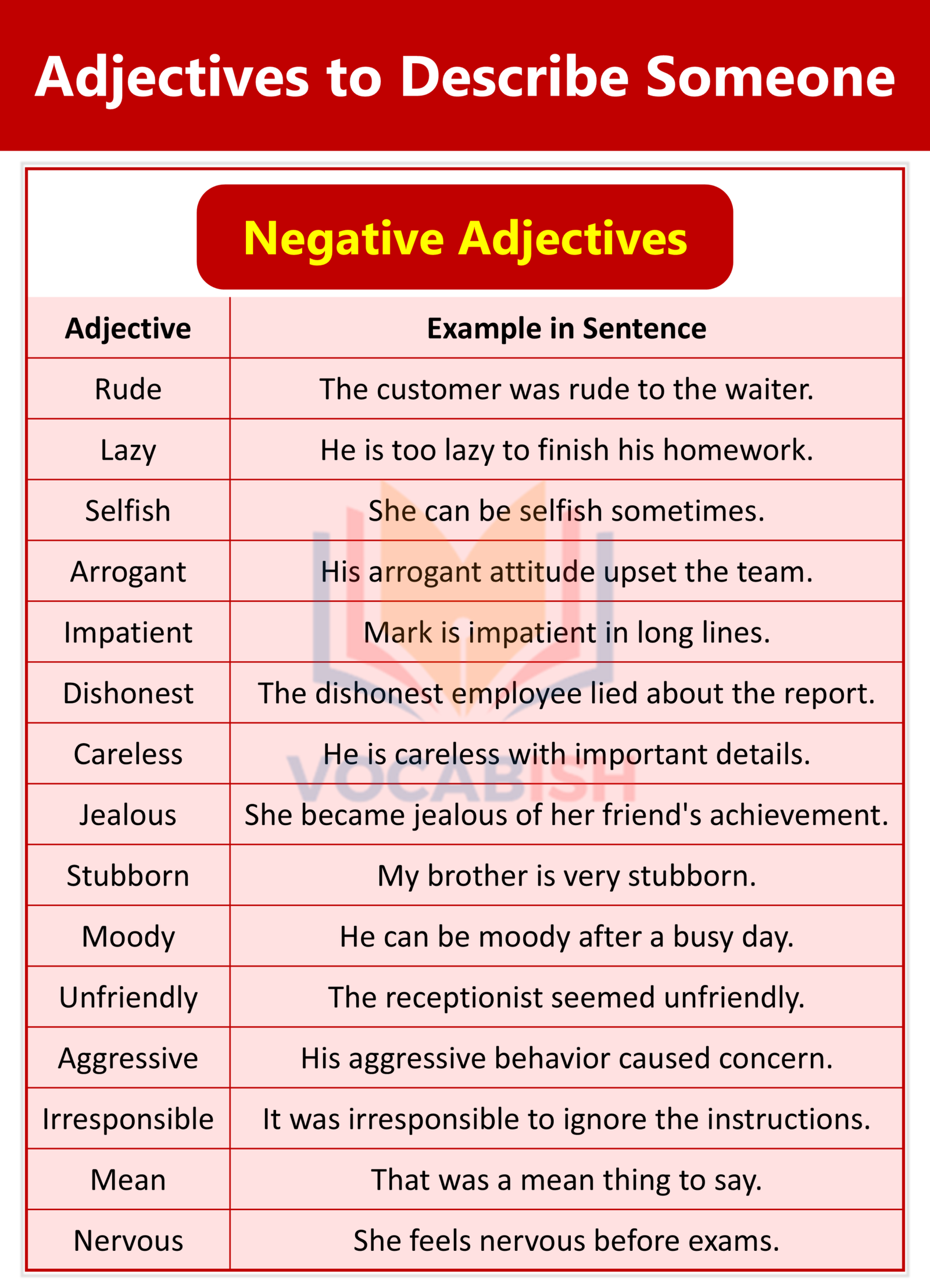
Negative Adjectives to Describe Someone
Negative adjectives describe qualities or behaviors that may cause problems or create an unfavorable impression. Use these words carefully because some can sound judgmental or offensive depending on the situation.
Adjective | Meaning | Example |
|---|---|---|
Rude | Not polite | The customer was rude to the waiter. |
Lazy | Not willing to work | He is too lazy to finish his homework. |
Selfish | Caring mainly about yourself | She can be selfish sometimes. |
Arrogant | Thinking you are better than others | His arrogant attitude upset the team. |
Impatient | Easily annoyed while waiting | Mark is impatient in long lines. |
Dishonest | Not truthful | The dishonest employee lied about the report. |
Careless | Not paying enough attention | He is careless with important details. |
Jealous | Feeling unhappy about another person’s success or attention | She became jealous of her friend’s achievement. |
Stubborn | Unwilling to change your opinion | My brother is very stubborn. |
Moody | Having frequent changes in mood | He can be moody after a busy day. |
Unfriendly | Not pleasant or sociable | The receptionist seemed unfriendly. |
Aggressive | Acting in a forceful or hostile way | His aggressive behavior caused concern. |
Irresponsible | Not dependable about duties | It was irresponsible to ignore the instructions. |
Mean | Unkind or unpleasant | That was a mean thing to say. |
Nervous | Worried or anxious | She feels nervous before exams. |
Use Negative Adjectives Carefully:
A word such as stubborn may sometimes sound negative, but in another context it can suggest determination. Similarly, quiet is usually neutral, while unfriendly clearly gives a negative impression.
Context matters when describing people.
Adjectives for Personality and Character
Personality adjectives describe how someone usually thinks, feels, or behaves.
Common Personality Adjectives:
- Adventurous — enjoys trying new things
- Calm — does not become easily upset
- Caring — shows concern for others
- Confident — believes in their abilities
- Curious — wants to learn or know more
- Determined — continues trying to achieve a goal
- Easygoing — relaxed and not easily worried
- Generous — likes giving or sharing
- Independent — able to do things without depending on others
- Optimistic — expects good things to happen
- Outgoing — enjoys meeting and talking to people
- Quiet — does not talk very much
- Shy — nervous or uncomfortable around people
- Sociable — enjoys being with other people
- Sensitive — easily affected by feelings or criticism
- Serious — focused and not usually playful
- Thoughtful — considers the needs and feelings of others
- Trustworthy — deserves trust
- Warm — friendly and welcoming
Example Sentences:
- My sister is outgoing and loves meeting new people.
- Daniel is quiet, but he is very thoughtful.
- Our coach is determined to help the team improve.
- Lisa is trustworthy, so people often ask for her advice.
Adjectives for Describing Someone’s Appearance
Appearance adjectives describe what someone looks like. They can describe height, build, hair, face, clothing, or general appearance.
Category | Useful Adjectives |
|---|---|
Height | tall, short, average-height |
Build | slim, thin, muscular, strong, stocky |
Hair | long, short, curly, straight, wavy |
Age | young, middle-aged, elderly |
General appearance | attractive, handsome, beautiful, elegant |
Clothing | casual, formal, fashionable, neat |
Features | bearded, clean-shaven, pale, tanned |
Example Sentences:
- My brother is tall and slim.
- She has long, curly hair.
- Mr. Khan looks elegant in a suit.
- The new student has a neat appearance.
When describing appearance, choose respectful and appropriate language, especially when discussing someone you do not know well.
Adjectives for Describing Behavior and Social Skills
These adjectives focus on how someone treats other people or acts in social situations.
Adjective | Meaning |
|---|---|
Courteous | Very polite and respectful |
Cooperative | Willing to work with others |
Considerate | Careful about other people’s feelings |
Helpful | Willing to assist |
Respectful | Showing respect |
Supportive | Giving encouragement or help |
Talkative | Talking a lot |
Quiet | Talking very little |
Impolite | Not polite |
Bossy | Always trying to tell others what to do |
Self-centered | Mainly concerned with yourself |
Uncooperative | Unwilling to work with others |
For example:
Ahmed is cooperative and always works well with his classmates.
Lucy is considerate because she listens when other people are speaking.
Adjectives for Describing Intelligence and Ability
These words describe a person’s mental ability, skills, or approach to learning and solving problems.
- Intelligent — having a high ability to learn and understand
- Clever — quick at learning or solving problems
- Smart — intelligent or good at making decisions
- Wise — able to make good decisions based on experience
- Creative — able to develop original ideas
- Talented — naturally good at something
- Skillful — very good at performing a particular task
- Knowledgeable — knowing a lot about a subject
- Quick-thinking — able to respond or solve problems quickly
- Resourceful — good at finding ways to deal with difficulties
Example Sentences:
- Maria is intelligent and learns new concepts quickly.
- He is creative and comes up with unusual ideas.
- Our teacher is very knowledgeable about English grammar.
- Sam is resourceful when solving technical problems.
Adjectives for Describing Emotions and Mood
Some adjectives describe how someone feels at a particular moment rather than their usual personality.
Positive or Pleasant Feelings
- happy
- cheerful
- excited
- relaxed
- proud
- hopeful
- grateful
- satisfied
- delighted
- confident
Difficult or Unpleasant Feelings
- sad
- angry
- worried
- nervous
- frightened
- disappointed
- confused
- embarrassed
- frustrated
- lonely
Compare these two sentences:
Ahmed is calm.
This usually describes his general personality or behavior.
Ahmed is nervous.
This describes how he feels in a particular situation.
That difference is useful when choosing an adjective.
Adjectives for Describing Someone at School or Work
Different situations call for different descriptive words. At school, you may describe a learner’s attitude, participation, or study habits. At work, you may focus on reliability, communication, and professionalism.
School
- Attentive
- Hardworking
- Curious
- Organized
- Punctual
- Responsible
- Cooperative
- Creative
- Motivated
- Respectful
Example:
Maya is a hardworking and organized student who always completes her assignments.
Work
- Professional
- Reliable
- Punctual
- Productive
- Flexible
- Responsible
- Efficient
- Confident
- Cooperative
- Experienced
Example:
David is a reliable employee who works well with his team.
These words are especially useful in essays, recommendations, interviews, school reports, and professional writing.
Adjectives for Different Relationships
The best adjective depends partly on your relationship with the person.
Describing a Friend
Useful words include:
- Friendly
- Funny
- Loyal
- Honest
- Supportive
- Caring
- Trustworthy
- Cheerful
- Outgoing
- Helpful
Example:
My best friend is loyal, funny, and always supportive.
Describing a Teacher
Useful words include:
- Patient
- Knowledgeable
- Helpful
- Respectful
- Organized
- Encouraging
- Fair
- Kind
Example:
Our English teacher is patient, organized, and encouraging.
Describing a Family Member
Useful words include:
- Loving
- Caring
- Kind
- Supportive
- Responsible
- Cheerful
- Patient
- Generous
Example:
My mother is caring, patient, and supportive.
Describing a Classmate
Useful words include:
- Friendly
- Quiet
- Confident
- Hardworking
- Helpful
- Polite
- Creative
- Cooperative
Example:
Ali is a quiet but hardworking classmate.
How to Use Adjectives in Sentences
English adjectives commonly appear in two main positions.
1. Before a Noun
The adjective comes before the person or thing it describes.
Adjective + noun
- a kind person
- a friendly teacher
- a confident student
- a funny friend
Example:
She is a kind teacher.
2. After a Linking Verb
Adjectives can also come after verbs such as be, seem, look, feel, become, and appear.
- He is friendly.
- She seems confident.
- They look tired.
- I feel nervous.
- He became angry.
This pattern is especially common when describing feelings or personality.
Strong Adjectives vs. Basic Adjectives
Sometimes you can choose a more precise adjective instead of a very general one.
Basic Word | More Specific Choices |
|---|---|
Nice | kind, friendly, thoughtful, pleasant |
Good | honest, reliable, responsible, talented |
Bad | rude, dishonest, careless, selfish |
Smart | intelligent, clever, knowledgeable |
Happy | cheerful, delighted, excited |
Sad | unhappy, disappointed, lonely |
Angry | annoyed, frustrated, furious |
Funny | humorous, amusing, entertaining |
For example, instead of saying:
Ali is a nice person.
You could write:
Ali is a thoughtful and reliable person.
The second sentence gives the reader clearer information.
How to Choose the Right Adjective
Think about exactly what you want to describe.
- For personality: kind, confident, shy, patient
- For appearance: tall, slim, elegant, curly-haired
- For behavior: polite, helpful, aggressive, careless
- For ability: clever, talented, intelligent, creative
- For emotions: happy, nervous, excited, worried
- For work or study: hardworking, punctual, organized, responsible
A precise adjective is usually better than a vague adjective because it tells the reader exactly what you mean.
Common Confusions and Mistakes
- Funny vs. fun: Funny means amusing; fun describes something enjoyable.
- Boring vs. bored: Boring describes something that causes boredom; bored describes how someone feels.
- Interested vs. interesting: A person is interested; something that attracts attention is interesting.
- Confident vs. arrogant: Confident suggests healthy self-belief, while arrogant suggests feeling superior to others.
- Thin vs. slim: Both can describe body size, but slim is generally more positive or neutral.
Practice: Choose the Right Adjective
Choose the best adjective for each sentence.
- Sarah always tells the truth. She is ________.
- Tom never wants to help anyone. He is ________.
- My teacher waits calmly when students need more time. She is ________.
- James believes strongly in his abilities. He is ________.
- My little brother loves meeting new people. He is ________.
- Emma does not talk much in class. She is ________.
- David often forgets important tasks. He is ________.
- Maria creates original drawings and stories. She is ________.
Word Bank:
honest, selfish, patient, confident, outgoing, quiet, careless, creative
Answers:
- honest
- selfish
- patient
- confident
- outgoing
- quiet
- careless
- creative
FAQs About Adjectives to Describe Someone
Adjectives describe a person’s personality, appearance, behavior, emotions, abilities, or character, such as kind, tall, honest, shy, or intelligent.
Common positive adjectives include kind, honest, friendly, generous, patient, confident, hardworking, loyal, thoughtful, and trustworthy.
Common negative adjectives include rude, lazy, selfish, careless, dishonest, impatient, arrogant, stubborn, unfriendly, and irresponsible.
Personality adjectives include friendly, shy, confident, calm, outgoing, curious, generous, patient, serious, caring, and independent.
Use adjectives such as tall, short, slim, muscular, young, elegant, attractive, curly-haired, neat, or fashionable.
“Bored” describes a person’s feeling, while “boring” describes someone or something that causes that feeling.
Use more precise words such as kind, thoughtful, friendly, helpful, respectful, cheerful, generous, or supportive.
Yes. Words such as stubborn, quiet, serious, and independent can sound positive or negative depending on the person and situation.
Conclusion
Learning adjectives to describe someone gives you better ways to talk about personality, appearance, behavior, emotions, and abilities. Instead of relying on general words like nice or good, choose precise adjectives such as kind, reliable, creative, or confident.
The more descriptive vocabulary you learn, the easier it becomes to write detailed sentences, speak naturally, and express exactly what you mean about people.
Explore More Related Articles