
Have you ever understood what someone means without them saying it directly? That is the idea behind Examples of Implicit Sentences. An implicit sentence communicates a message indirectly, so the reader or listener has to use context, tone, or common knowledge to understand the intended meaning.
For example, if someone says, “It’s getting late,” they may simply be talking about the time—or they may implicitly mean, “We should leave now.”
Understanding implicit sentences, implied meaning, context clues, and indirect communication can help English learners understand everyday conversations more naturally.
What Is an Implicit Sentence?
An implicit sentence expresses an idea indirectly rather than stating the complete meaning openly. The listener or reader understands the intended message from the situation, context, tone, or surrounding information.
For example:
- “There’s a lot of noise in here.”
- Possible implicit meaning: “Please be quiet.”
The speaker does not directly say “Be quiet,” but the situation allows the listener to understand the intended request.
Implicit Meaning in Easy English
Implicit means suggested or understood without being directly stated.
An implicit sentence may therefore require you to ask:
“What does the speaker really mean?”
The literal words are only part of the message.
Implicit vs. Explicit Meaning
The easiest way to understand implicit language is to compare it with explicit language.
Explicit means the speaker states the message directly.
- Explicit: “Please close the window.”
- Implicit: “It’s getting cold in here.”
In the second sentence, the speaker does not directly ask you to close the window. However, you may understand that request from the situation.
Another example:
- Explicit: “You should clean your room.”
- Implicit: “I can barely see the floor in here.”
The second sentence suggests the same general idea without saying it directly.
How to Identify an Implicit Sentence
When you hear or read an indirect statement, look beyond the literal words.
Ask yourself:
- What is happening in the situation?
- What does the speaker probably want?
- Is the speaker making a direct statement or hinting at something?
- What information is being suggested rather than stated?
- Does the tone change the meaning?
- What would a natural listener understand from the sentence?
For example:
“Do you know what time it is?”
Literally, this asks whether you know the time. But depending on the situation, it might implicitly mean:
- “You are late.”
- “We should leave.”
- “Why are you still awake?”
Context determines the intended meaning.
Examples of Implicit Sentences
Here are practical Implicit Sentence Examples that English learners may encounter in conversations, classrooms, workplaces, and daily situations.
Everyday Conversation Examples
These examples show how people often communicate indirectly in ordinary situations.
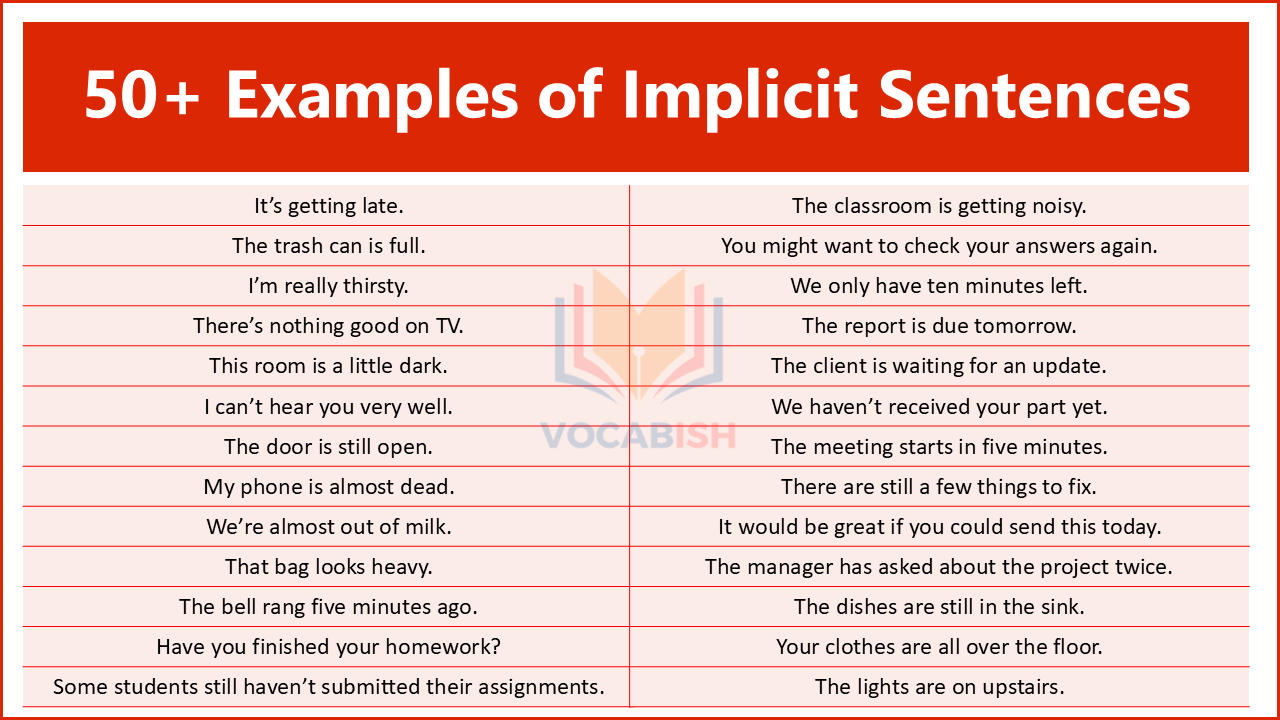
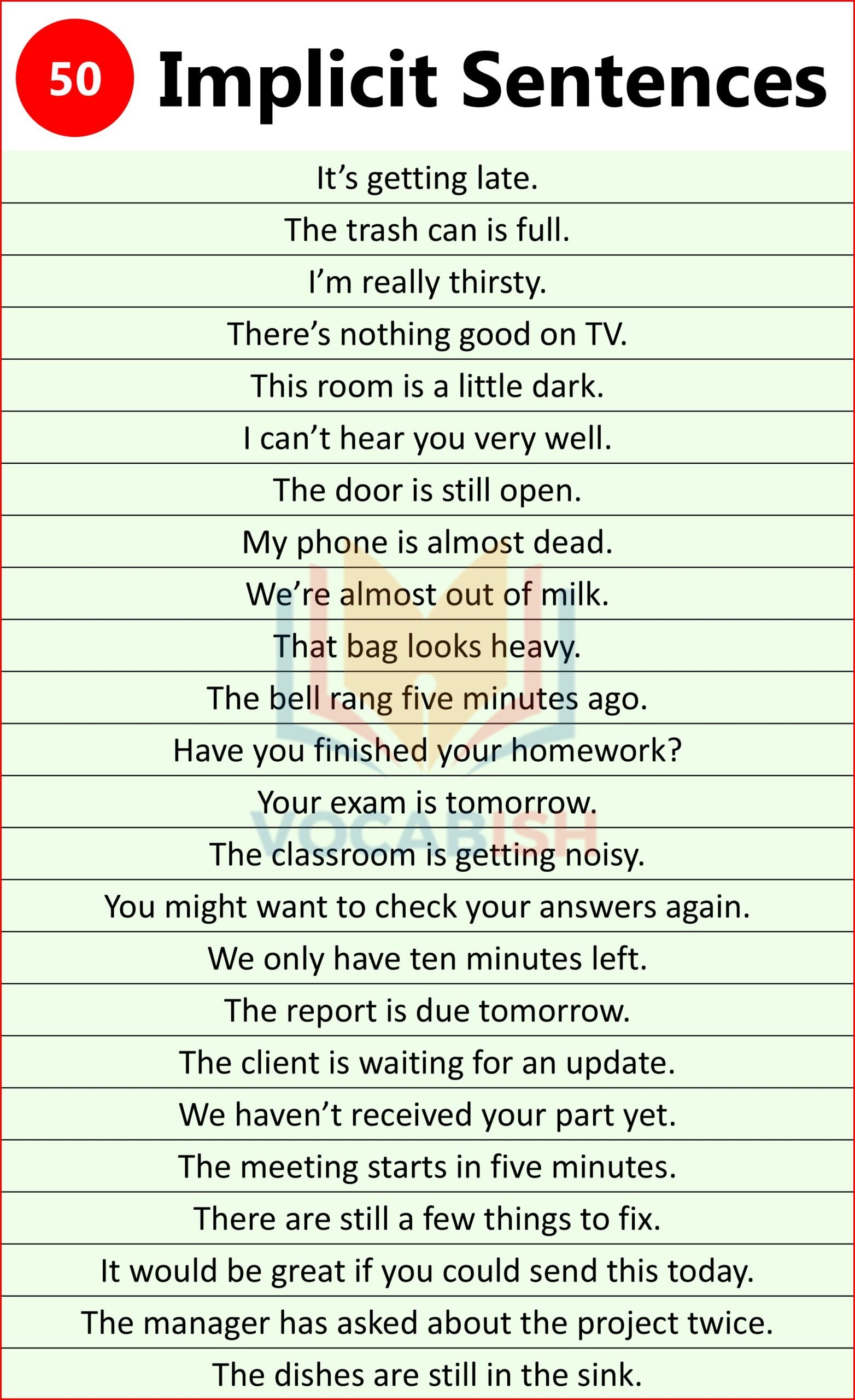
- “It’s getting late.”
- Implicit meaning: We should leave or go home.
- “The trash can is full.”
- Implicit meaning: Someone should take out the trash.
- “I’m really thirsty.”
- Implicit meaning: I would like something to drink.
- “There’s nothing good on TV.”
- Implicit meaning: I want to do something else.
- “This room is a little dark.”
- Implicit meaning: Please turn on a light.
- “I can’t hear you very well.”
- Implicit meaning: Please speak louder.
- “The door is still open.”
- Implicit meaning: Please close the door.
- “My phone is almost dead.”
- Implicit meaning: I need a charger.
- “We’re almost out of milk.”
- Implicit meaning: Someone should buy more milk.
- “That bag looks heavy.”
- Implicit meaning: I may be offering to help you carry it.
Implicit Sentences at School
Students and teachers frequently use implied meanings.
- “The bell rang five minutes ago.”
- Implicit meaning: You should be in class already.
- “Have you finished your homework?”
- Possible implicit meaning: I think you may not have done it.
- “Some students still haven’t submitted their assignments.”
- Implicit meaning: Those students should submit their assignments.
- “Your exam is tomorrow.”
- Implicit meaning: You should study today.
- “The classroom is getting noisy.”
- Implicit meaning: Students should become quieter.
- “You might want to check your answers again.”
- Implicit meaning: There may be mistakes in your answers.
- “We only have ten minutes left.”
- Implicit meaning: Work faster or finish your task soon.
Implicit Sentences at Work
Indirect communication is also common in professional settings.
- “The report is due tomorrow.”
- Implicit meaning: You need to finish the report soon.
- “The client is waiting for an update.”
- Implicit meaning: Someone should contact the client.
- “We haven’t received your part yet.”
- Implicit meaning: Please send your part.
- “The meeting starts in five minutes.”
- Implicit meaning: You should get ready for the meeting.
- “There are still a few things to fix.”
- Implicit meaning: The work is not finished.
- “It would be great if you could send this today.”
- Implicit meaning: Please send it today.
- “The manager has asked about the project twice.”
- Implicit meaning: The project needs attention.
Implicit Sentences at Home
Family members often communicate through hints rather than direct commands.
- “The dishes are still in the sink.”
- Implicit meaning: Please wash the dishes.
- “Your clothes are all over the floor.”
- Implicit meaning: Please pick up your clothes.
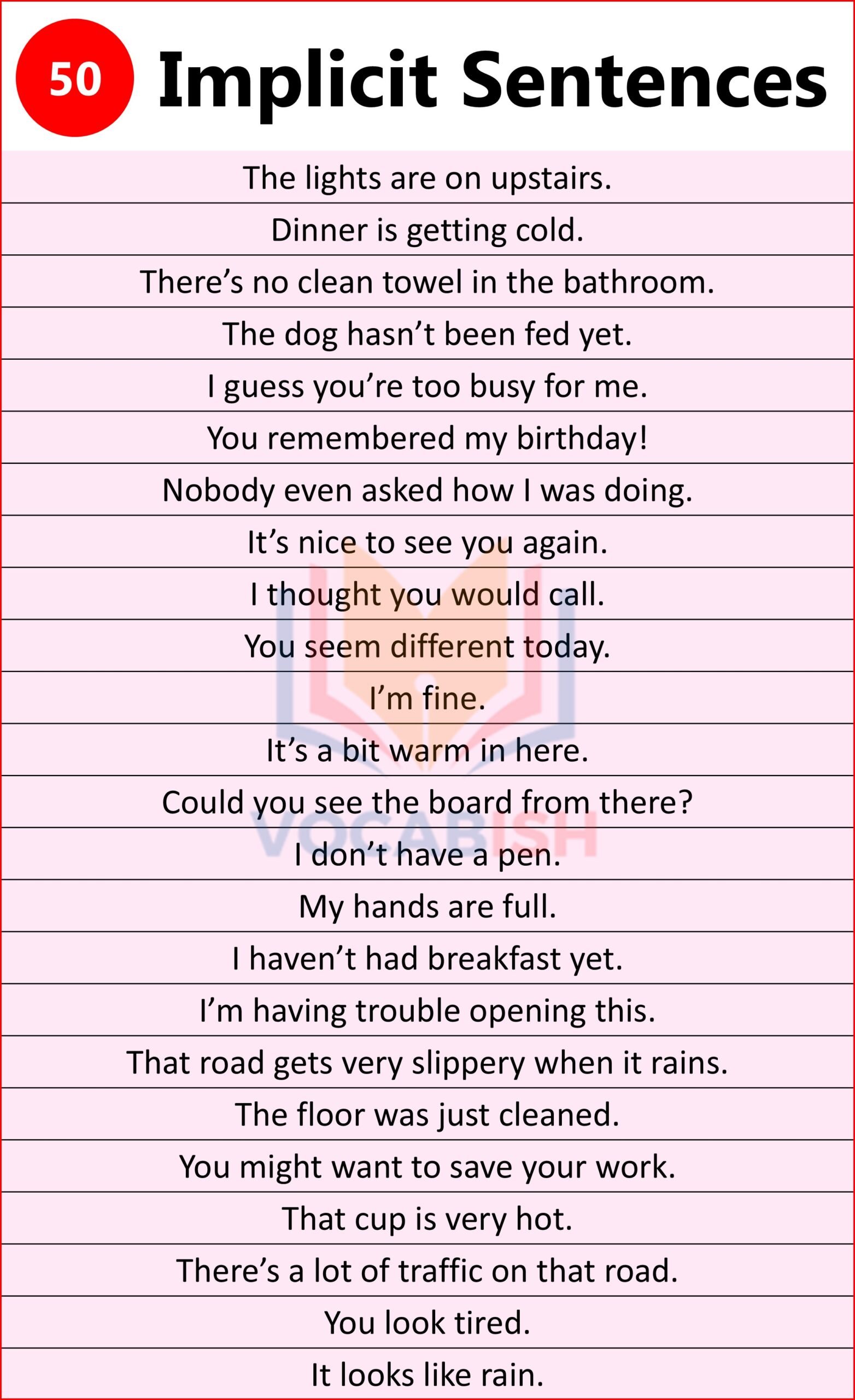
- “The lights are on upstairs.”
- Implicit meaning: Someone should turn them off.
- “Dinner is getting cold.”
- Implicit meaning: Come and eat now.
- “There’s no clean towel in the bathroom.”
- Implicit meaning: We need to wash or replace the towels.
- “The dog hasn’t been fed yet.”
- Implicit meaning: Someone should feed the dog.
Implicit Sentences Expressing Feelings
People do not always directly say how they feel.
- “I guess you’re too busy for me.”
- Implicit meaning: I feel ignored or unimportant.
- “You remembered my birthday!”
- Implicit meaning: I am happy and appreciate that you remembered.
- “Nobody even asked how I was doing.”
- Implicit meaning: I feel hurt or neglected.
- “It’s nice to see you again.”
- Implicit meaning: I am happy that you came.
- “I thought you would call.”
- Implicit meaning: I was expecting your call and may be disappointed.
- “You seem different today.”
- Implicit meaning: Something about your behavior or mood has changed.
- “I’m fine.”
- Depending on tone and context, the implicit meaning may be: I am upset but do not want to talk about it.
Implicit Sentences Used as Requests
A speaker can make a request without using an obvious command.
- “It’s a bit warm in here.”
- Implicit meaning: Please open a window or turn on the fan.
- “Could you see the board from there?”
- Implicit meaning: You may need to move because you are blocking my view.
- “I don’t have a pen.”
- Implicit meaning: Can you lend me a pen?
- “My hands are full.”
- Implicit meaning: Please help me carry this.
- “I haven’t had breakfast yet.”
- Implicit meaning: I would like something to eat.
- “I’m having trouble opening this.”
- Implicit meaning: Can you help me?
Implicit Sentences Used as Warnings
Warnings can also be communicated indirectly.
- “That road gets very slippery when it rains.”
- Implicit meaning: Be careful if you drive there.
- “The floor was just cleaned.”
- Implicit meaning: Be careful because the floor may be slippery.
- “You might want to save your work.”
- Implicit meaning: You could lose your work.
- “That cup is very hot.”
- Implicit meaning: Be careful when touching it.
- “There’s a lot of traffic on that road.”
- Implicit meaning: You may want to choose another route.
Implicit Sentences Used as Suggestions
An indirect statement can gently suggest an action.
- “You look tired.”
- Implicit meaning: You should rest.
- “It looks like rain.”
- Implicit meaning: You should take an umbrella.
- “The library is still open.”
- Implicit meaning: We could go to the library.
- “There’s a new restaurant near here.”
- Implicit meaning: We could eat there.
- “You haven’t eaten anything all day.”
- Implicit meaning: You should have something to eat.
- “You’ve been studying for hours.”
- Implicit meaning: You should take a break.
Examples of Implicit in Short Conversations
Context becomes especially important when understanding implied meaning.
Conversation 1: Leaving a Party
Ali: “It’s almost midnight.”
Sara: “Yeah, I have work tomorrow.”
Implicit meaning: Sara is probably suggesting that it is time for them to leave.
Conversation 2: Asking for Help
Ahmed: “This box is really heavy.”
Bilal: “I’ll help you.”
Implicit meaning: Ahmed indirectly communicates that he needs help.
Conversation 3: At Home
Mother: “The kitchen is a mess.”
Son: “I’ll clean it.”
Implicit meaning: The mother is indirectly asking or reminding her son to clean the kitchen.
Conversation 4: At School
Teacher: “Some of you haven’t opened your books yet.”
Student: “Sorry, ma’am.”
Implicit meaning: The teacher wants the students to open their books.
Conversation 5: At a Restaurant
Customer: “We’ve been waiting for quite a while.”
Waiter: “I’m very sorry. I’ll check on your order.”
Implicit meaning: The customer is indirectly complaining about the delay.
Conversation 6: With a Friend
Friend 1: “I’m really hungry.”
Friend 2: “There’s a pizza place around the corner.”
Implicit meaning: They are suggesting that they go there for food.
Implicit Sentences With Their Intended Meanings
Sometimes one sentence can have different implied meanings depending on context.
- “It’s cold in here.”
- Possible meaning: Close the window.
- Possible meaning: Turn on the heater.
- Possible meaning: Give me a blanket.
- “You’re still awake?”
- Possible meaning: I am surprised.
- Possible meaning: You should be sleeping.
- Possible meaning: Why haven’t you gone to bed?
- “That’s an interesting idea.”
- Positive tone: I like your idea.
- Uncertain tone: I am not convinced.
- Sarcastic tone: I do not like your idea.
- “You have a lot of books.”
- Possible meaning: You like reading.
- Possible meaning: You need more space.
- Possible meaning: I am surprised by how many books you own.
- “You’re wearing that?”
- Neutral tone: I am asking about your clothing choice.
- Surprised tone: I do not think that outfit is appropriate.
- Critical tone: I dislike what you are wearing.
This shows why context, tone, facial expression, and situation matter when interpreting implicit language.
Common Confusions About Implicit Sentences
English learners sometimes confuse implicit meaning with other types of communication.
- Implicit does not mean unclear.
A message can be indirect but still easy to understand from the context. - Implicit does not always mean hidden.
The meaning is often suggested openly through the situation. - Implicit and explicit are opposites in communication.
Explicit language states the message directly; implicit language leaves part of the meaning for the listener to infer. - One sentence can have different implicit meanings.
The same words may communicate different intentions depending on tone and context. - An implicit sentence is not necessarily a question.
Statements such as “It’s cold in here” can carry an implied request.
Practice: Find the Implicit Meaning
Read each sentence and think about what the speaker may really mean.
- “The garbage is starting to smell.”
- “I have an exam tomorrow.”
- “There are no clean glasses left.”
- “It’s very dark in this room.”
- “You’ve been working all morning.”
- “The bus leaves in five minutes.”
- “I can’t carry all these bags.”
- “Your phone has been ringing.”
- “We haven’t eaten since breakfast.”
- “The baby is finally asleep.”
Answers
Possible implicit meanings include:
- “Please take out the garbage.”
- “I need to study.”
- “Please wash some glasses.”
- “Please turn on the light.”
- “You should take a break.”
- “We need to hurry.”
- “Please help me.”
- “You should answer your phone.”
- “We should get something to eat.”
- “Please be quiet.”
Remember that an implicit meaning can vary according to the situation. These are reasonable interpretations, not the only possible answers.
FAQs About Implicit Sentences
An implicit sentence communicates an idea indirectly. The listener understands the intended meaning through context rather than from the exact words alone.
Here are five examples:
1. It’s getting cold in here.
2. The trash can is full.
3. I have an exam tomorrow.
4. We’ve been waiting for a long time.
5. It’s already midnight.
Implicit means suggested or understood without being directly stated. The opposite of implicit is explicit, which means clearly and directly expressed.
An explicit sentence states its message directly, while an implicit sentence suggests its message and requires the listener to infer the intended meaning.
Yes. “Do you know what time it is?” may implicitly mean that someone is late or that it is time to leave.
Speakers often use implicit language to sound polite, gentle, indirect, tactful, or less demanding in social and professional conversations.
Pay attention to the situation, speaker’s tone, surrounding sentences, facial expressions, and what action would naturally follow the speaker’s words.
Not exactly. Implicit meaning is suggested rather than directly stated, while “hidden meaning” can imply that information was deliberately concealed.
Conclusion
Examples of Implicit Sentences help English learners understand an important part of natural communication. People often express requests, feelings, suggestions, warnings, and opinions without stating them directly.
The key is to look beyond the literal sentence and consider the context, situation, tone, and speaker’s intention. Once you learn to recognize implied meaning, everyday English conversations become much easier to understand.
Explore More Example Sentences
- 100 Examples of Multiple Questions in a Sentence
- 120 Examples of Conditional Sentences
- Examples of Longest Palindrome Sentences in English
- 100+ Examples of Noun in English with Sentences
- 100 Example Sentences of Simple Sentences
- 100 Complex and Compound Complex Sentences
- 100 Compound Sentence Examples
- 100 Complex Sentence Examples