
Complex and Compound Complex Sentences Examples can help English learners move beyond short, basic sentences and express ideas with greater detail and accuracy. From everyday conversations to school writing, these sentence types connect independent clauses, dependent clauses, conjunctions, and ideas naturally.
The key difference is straightforward: a complex sentence has one independent clause and at least one dependent clause, while a compound-complex sentence has at least two independent clauses and at least one dependent clause.
Below, you’ll find 100 carefully selected examples, including questions, conversations, daily situations, school sentences, work situations, and common communication patterns.
What Is a Complex Sentence?
A complex sentence contains one independent clause and at least one dependent clause.
A dependent clause often begins with words such as because, although, when, while, if, unless, since, before, after, who, which, or that.
Here is the basic pattern:
Independent clause + dependent clause
- I stayed home because I was tired.
The dependent clause can also come first:
- Because I was tired, I stayed home.
A complex sentence can express time, reason, condition, contrast, purpose, place, or additional information.
What Is a Compound-Complex Sentence?
A compound-complex sentence contains at least two independent clauses and at least one dependent clause.
For example:
- I stayed home because I was tired, and my brother went to the gym.
This sentence has two independent clauses:
- I stayed home.
- My brother went to the gym.
It also has one dependent clause:
- because I was tired
Common coordinating conjunctions used to connect independent clauses include and, but, so, or, for, nor, and yet.
Complex vs. Compound-Complex Sentences
The easiest way to distinguish the two is to count the independent clauses.
Complex sentence
One independent clause + one or more dependent clauses
- When the rain stopped, we went outside.
Compound-complex sentence
Two or more independent clauses + at least one dependent clause
- When the rain stopped, we went outside, and the children started playing.
A useful test is to ask:
How many complete thoughts can stand alone?
If there is only one, the sentence is likely complex. If there are two or more, and there is also a dependent clause, it is compound-complex.
50 Complex Sentence Examples
These examples of complex sentences cover common situations that English learners encounter in conversations, classrooms, homes, workplaces, and everyday communication.
Everyday Conversation Examples
These sentences use common words and situations, making them useful for spoken English.
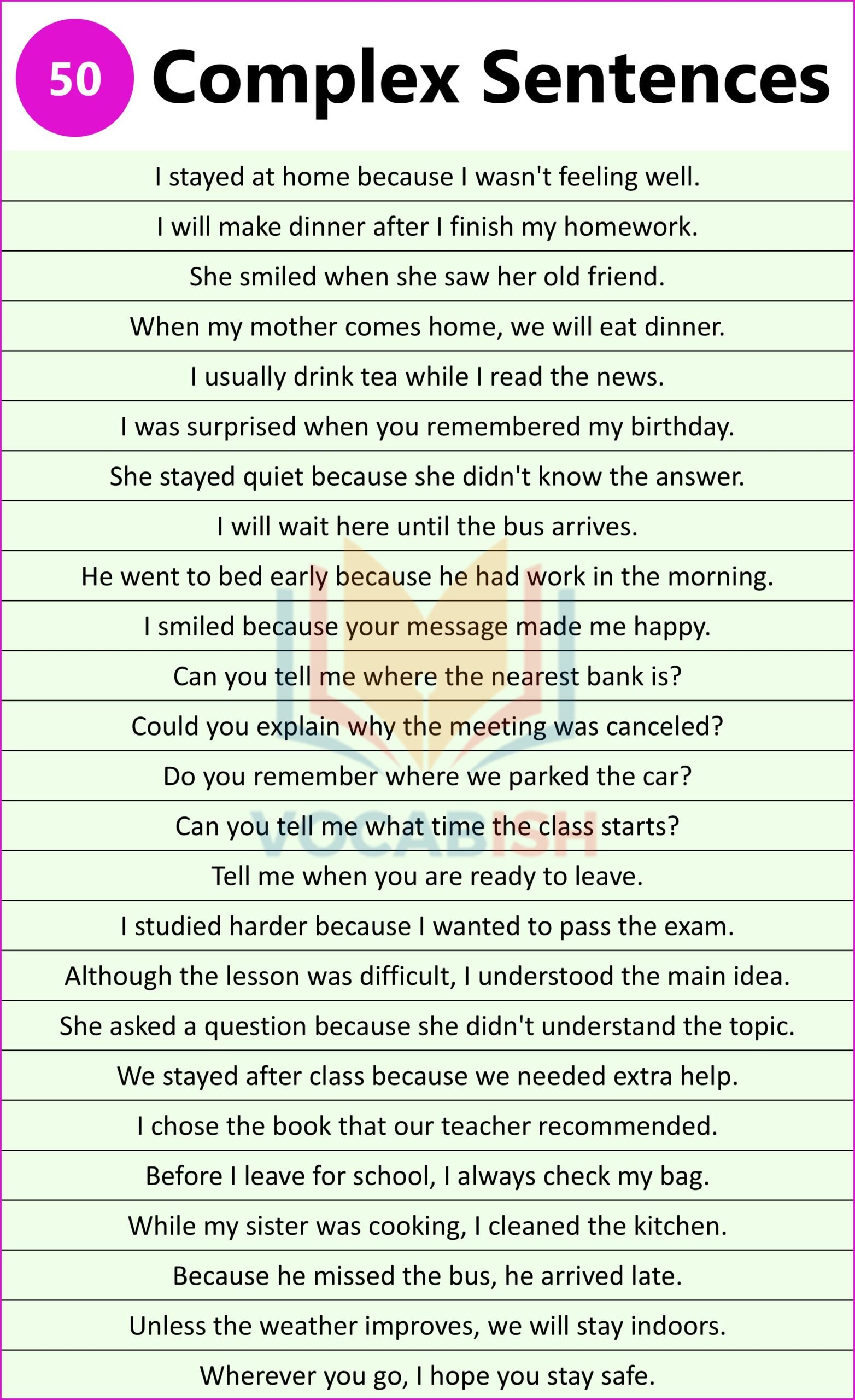
- I stayed at home because I wasn’t feeling well.
- When you arrive, please call me.
- I will make dinner after I finish my homework.
- Although it was raining, we went for a walk.
- She smiled when she saw her old friend.
- I can’t go outside because I have too much work.
- When my mother comes home, we will eat dinner.
- He bought an umbrella because the weather looked bad.
- I usually drink tea while I read the news.
- If you need help, just give me a call.
- I was surprised when you remembered my birthday.
- We can leave whenever you are ready.
- She stayed quiet because she didn’t know the answer.
- Although I was tired, I finished the assignment.
- I will wait here until the bus arrives.
- If the shop is open, we can buy some snacks.
- He went to bed early because he had work in the morning.
- When I have free time, I like to watch movies.
- I smiled because your message made me happy.
- Unless you hurry, you will miss the train.
Questions and Requests
Complex sentences are also common when asking questions, making requests, or explaining what you need.
- Can you tell me where the nearest bank is?
- Do you know when the next bus will arrive?
- Could you explain why the meeting was canceled?
- Can you call me when you get home?
- Do you remember where we parked the car?
- Please let me know if you need anything.
- Can you tell me what time the class starts?
- Do you know whether Sarah is coming tonight?
- Tell me when you are ready to leave.
- Could you explain how this machine works?
School and Learning Examples
These examples fit classroom discussions, homework, assignments, and study situations.
- I studied harder because I wanted to pass the exam.
- When the teacher entered the classroom, everyone became quiet.
- Although the lesson was difficult, I understood the main idea.
- I will finish my project before I go to bed.
- She asked a question because she didn’t understand the topic.
- If you practice every day, your English will improve.
- We stayed after class because we needed extra help.
- The student who won the competition received a certificate.
- I chose the book that our teacher recommended.
- Since the test was difficult, many students asked questions.
Time, Reason, Condition, and Contrast
These sentences show how dependent clauses can express different relationships between ideas.
- Before I leave for school, I always check my bag.
- After the movie ended, we went to a nearby restaurant.
- While my sister was cooking, I cleaned the kitchen.
- Since you are already here, we can start the meeting.
- Because he missed the bus, he arrived late.
- If you save enough money, you can buy a new phone.
- Unless the weather improves, we will stay indoors.
- Although she was nervous, she gave a great presentation.
- Wherever you go, I hope you stay safe.
- I will help you whenever you need me.
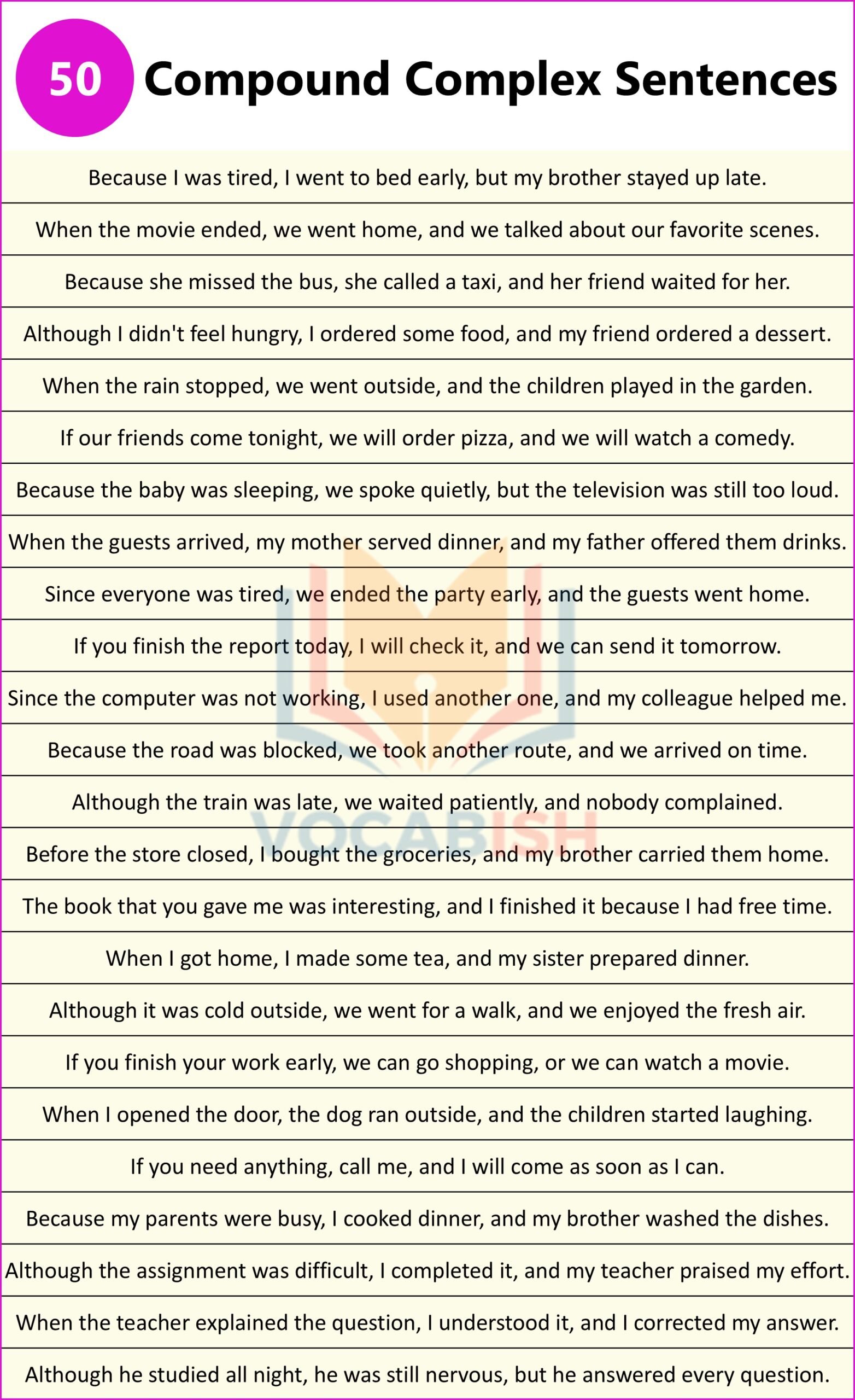
50 Compound-Complex Sentence Examples
A compound-complex sentence combines the features of compound and complex sentences. Each example below contains multiple independent clauses plus a dependent clause.
Everyday Conversation Examples
- When I got home, I made some tea, and my sister prepared dinner.
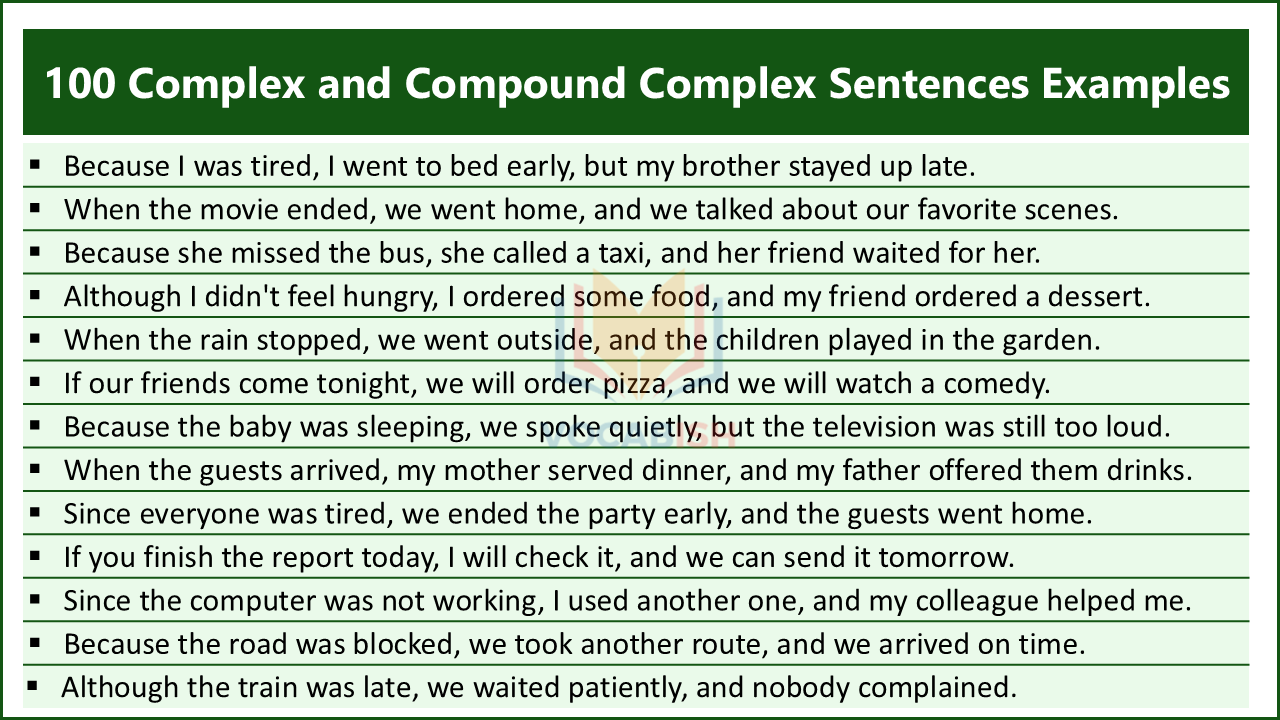
- Because I was tired, I went to bed early, but my brother stayed up late.
- Although it was cold outside, we went for a walk, and we enjoyed the fresh air.
- When the movie ended, we went home, and we talked about our favorite scenes.
- If you finish your work early, we can go shopping, or we can watch a movie.
- Because she missed the bus, she called a taxi, and her friend waited for her.
- When I opened the door, the dog ran outside, and the children started laughing.
- Although I didn’t feel hungry, I ordered some food, and my friend ordered a dessert.
- If you need anything, call me, and I will come as soon as I can.
- When the rain stopped, we went outside, and the children played in the garden.
Family and Social Situations
- Because my parents were busy, I cooked dinner, and my brother washed the dishes.
- When my cousin arrived, everyone welcomed him, and we sat together in the living room.
- Although she was nervous, she joined the conversation, and everyone made her feel comfortable.
- If our friends come tonight, we will order pizza, and we will watch a comedy.
- When my father returned from work, he changed his clothes, and we had dinner together.
- Because the baby was sleeping, we spoke quietly, but the television was still too loud.
- Although we had never met before, we talked easily, and we exchanged phone numbers.
- When the guests arrived, my mother served dinner, and my father offered them drinks.
- If you invite your neighbors, I will prepare some food, and we can enjoy the evening together.
- Since everyone was tired, we ended the party early, and the guests went home.
Work and School Examples
- When the manager arrived, we started the meeting, and everyone discussed the new project.
- Because I had an important deadline, I stayed at the office, but my colleagues went home.
- Although the assignment was difficult, I completed it, and my teacher praised my effort.
- If you finish the report today, I will check it, and we can send it tomorrow.
- When the teacher explained the question, I understood it, and I corrected my answer.
- Since the computer was not working, I used another one, and my colleague helped me.
- Although he studied all night, he was still nervous, but he answered every question.
- When the class ended, the students left the room, and the teacher collected their papers.
- If the meeting finishes early, I will call you, and we can discuss the project.
- Because the instructions were unclear, I asked my teacher for help, and she explained the task.
Time, Condition, and Cause
- When I finish my homework, I will call you, and we can make plans for tomorrow.
- Because the road was blocked, we took another route, and we arrived on time.
- If the weather stays sunny, we will have lunch outside, and the children can play nearby.
- Although the train was late, we waited patiently, and nobody complained.
- After the guests had left, we cleaned the house, and we finally relaxed.
- Before the store closed, I bought the groceries, and my brother carried them home.
- While I was preparing breakfast, my phone rang, and my friend asked me a question.
- Since the electricity went out, we used candles, and we waited until the power returned.
- Unless you leave now, you will miss the bus, and you may have to take a taxi.
- Whenever I visit my grandparents, I bring some fruit, and we spend the afternoon together.
Contrast, Purpose, and Relative Clauses
- Although I wanted to buy the laptop, it was too expensive, so I decided to wait.
- Because she needed a quiet place, she went to the library, and her friend studied at home.
- The teacher who helped me was very patient, and I thanked her after the lesson ended.
- I bought the phone that you recommended, and I was happy because it worked perfectly.
- Although the restaurant was crowded, we found a table, and the waiter served us quickly.
- The book that you gave me was interesting, and I finished it because I had free time.
- When the team reached the final, the players celebrated, and their families cheered loudly.
- If you follow the instructions carefully, you will complete the task, and you will avoid mistakes.
- Although he had little experience, he applied for the job, and the company invited him for an interview.
- When I finally reached the station, the train had already left, so I called my friend and asked for help.
How to Recognize These Sentence Types
When you see a long sentence, don’t judge its type simply by its length. A sentence can be short and complex or long and compound-complex.
Look for these parts:
- Independent clause: Can stand alone as a complete sentence.
- Dependent clause: Cannot normally stand alone as a complete sentence.
- Subordinating conjunction: Words such as because, although, when, if, while, and unless.
- Coordinating conjunction: Words such as and, but, so, or, and yet.
- Relative pronoun: Words such as who, which, and that can introduce dependent clauses.
For example:
- Because I was hungry, I made a sandwich.
This is complex because it contains one independent clause and one dependent clause.
Now compare:
- Because I was hungry, I made a sandwich, and my brother ordered pizza.
This is compound-complex because it has two independent clauses and a dependent clause.
Common Mistakes to Avoid
English learners often make a few predictable errors when combining clauses.
- Incorrect: Because I was tired. I went to bed.
Better: Because I was tired, I went to bed. - Incorrect: Although it was raining but we went outside.
Better: Although it was raining, we went outside. - Incorrect: I stayed home because I was sick, and.
Better: I stayed home because I was sick, and my brother stayed with me. - Incorrect: When I arrived the meeting started.
Better: When I arrived, the meeting started. - Incorrect: I went to school, because I had an exam.
Better: I went to school because I had an exam.
Practice: Identify the Sentence Type
Decide whether each sentence is complex or compound-complex.
- When I arrived home, I called my friend.
- Because the weather was cold, we stayed inside, and we watched television.
- Although she was tired, she finished her homework.
- If you come early, we can have breakfast, and we can leave together.
- I stayed home because I wasn’t feeling well.
- When the teacher arrived, the students became quiet, and the lesson began.
- Unless you study, you may fail the test.
- Although the shop was crowded, I bought my groceries, and I went home.
- I will call you when I reach the office.
- Because he was late, he took a taxi, but he still missed the meeting.
Practice Answers:
- Complex
- Compound-complex
- Complex
- Compound-complex
- Complex
- Compound-complex
- Complex
- Compound-complex
- Complex
- Compound-complex
Tips for Using Complex and Compound-Complex Sentences
For everyday English, you don’t need to make every sentence complicated. Use these structures when you need to connect related ideas naturally.
- Use because to give a reason.
- Use when to connect events by time.
- Use if to talk about a condition.
- Use although to show contrast.
- Use unless to express a condition or exception.
- Use while to connect actions happening at the same time.
- Use before and after to show sequence.
- Use and to add another complete idea.
- Use but to contrast two complete ideas.
- Use so to show a result.
A good writing style combines different sentence types rather than relying on one structure repeatedly.
FAQs About Complex and Compound-Complex Sentences
A complex sentence contains one independent clause and at least one dependent clause connected by a subordinating conjunction or another dependent-clause structure.
A compound-complex sentence contains at least two independent clauses and at least one dependent clause in the same sentence.
A complex sentence has one independent clause, while a compound-complex sentence has two or more independent clauses plus at least one dependent clause.
Yes. A complex sentence can contain multiple dependent clauses as long as it has only one independent clause.
Common words include because, although, when, if, while, since, before, after, unless, and whenever.
Compound-complex sentences commonly use coordinating conjunctions such as and, but, so, or, yet, and for, along with subordinating conjunctions.
They can be more challenging because they combine several clauses, but identifying each clause makes their structure much easier to understand.
Start with two short sentences, add a dependent clause using words such as because or although, and then combine related ideas carefully.
Conclusion
These 100 Complex and Compound Complex Sentences Examples show how English speakers connect ideas about time, reason, condition, contrast, school, work, family, and everyday situations.
Remember the core distinction: one independent clause plus a dependent clause makes a complex sentence; two or more independent clauses plus at least one dependent clause make a compound-complex sentence. Practicing both structures will help you write more naturally and express connected ideas with greater confidence.
Explore More Example Sentences