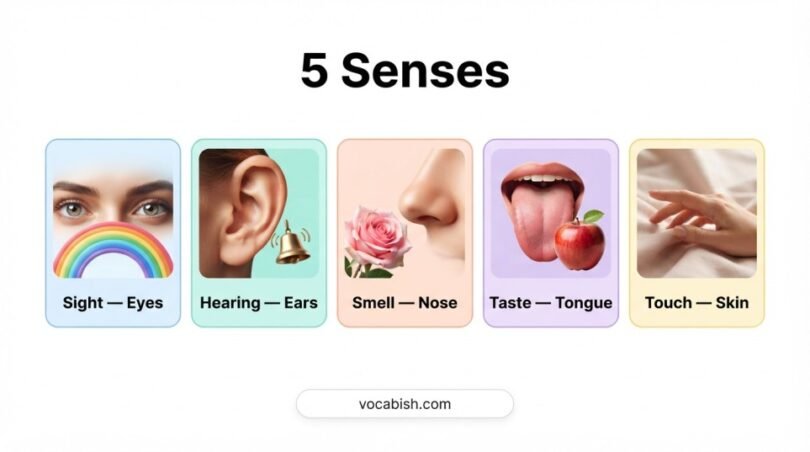

The 5 senses are sight, hearing, smell, taste, and touch. They help us see objects, hear sounds, smell flowers, taste food, and feel different textures. Each sense is connected to a sensory organ: the eyes, ears, nose, tongue, or skin. These organs collect information from our surroundings and send signals to the brain.
We use our senses throughout the day, from hearing an alarm in the morning to tasting dinner at night. Learning their names, functions, and related English vocabulary helps us describe everyday experiences. Below, you will find the five senses with pictures, useful words, example sentences, and practice exercises.
What Are the 5 Senses?
The five senses are the basic ways humans receive information about their surroundings. Each sense has a main sensory organ that detects something different, such as light, sound, smell, taste, or touch. The brain processes this information to help us recognize and respond to things.
The names of the five senses and their organs are:
- Sight (Eyes): Helps us see objects, colors, and shapes.
- Hearing (Ears): Helps us hear voices, music, and sounds.
- Smell (Nose): Helps us recognize different smells around us.
- Taste (Tongue): Helps us identify tastes in food and drinks.
- Touch (Skin): Helps us feel textures, pressure, and temperature.
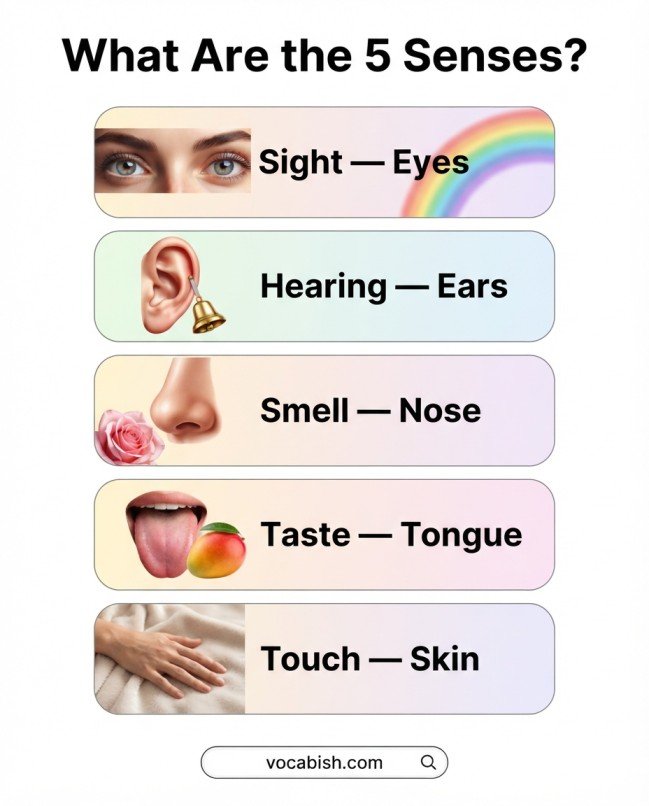
For example, when you see a red apple, your eyes detect light reflected from it. Your brain uses that information to recognize its color and shape.
Five Senses Chart for Kids
This five senses chart brings together the names, organs, functions, and familiar examples for quick revision.
Sense | Organ | Function | Example |
|---|---|---|---|
Sight | Eyes | See colors and objects | Seeing a rainbow |
Hearing | Ears | Hear different sounds | Hearing a bell |
Smell | Nose | Detect different smells | Smelling a flower |
Taste | Tongue | Recognize basic tastes | Tasting a mango |
Touch | Skin | Feel textures and temperature | Feeling a soft pillow |
5 Senses with Pictures and Names
Pictures help us connect each sense with its organ and an everyday action. The five senses diagram shows which body part we use for seeing, hearing, smelling, tasting, and touching.
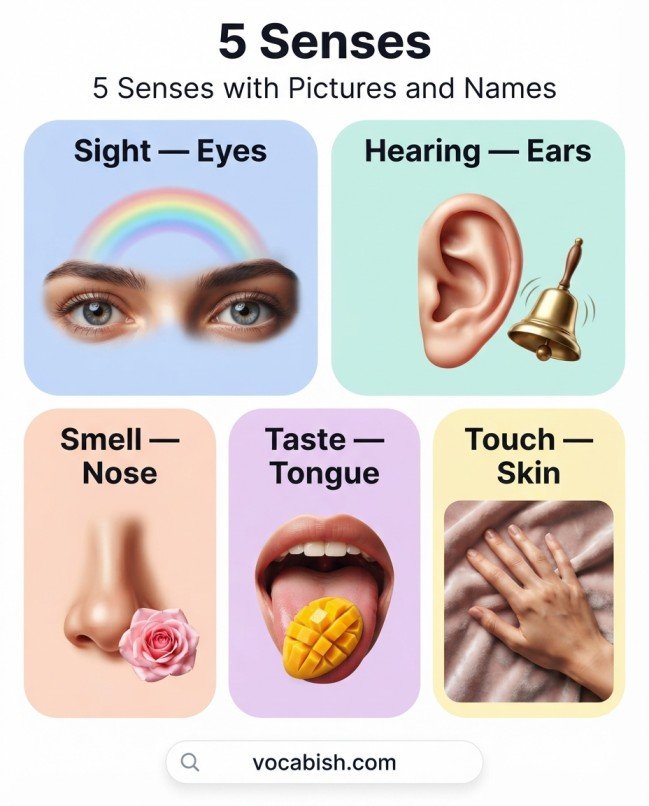
The Five Senses and Their Functions
Each sense performs a different job and helps us recognize things around us. We can describe these experiences using common English verbs and adjectives.
1. Sight — Eyes
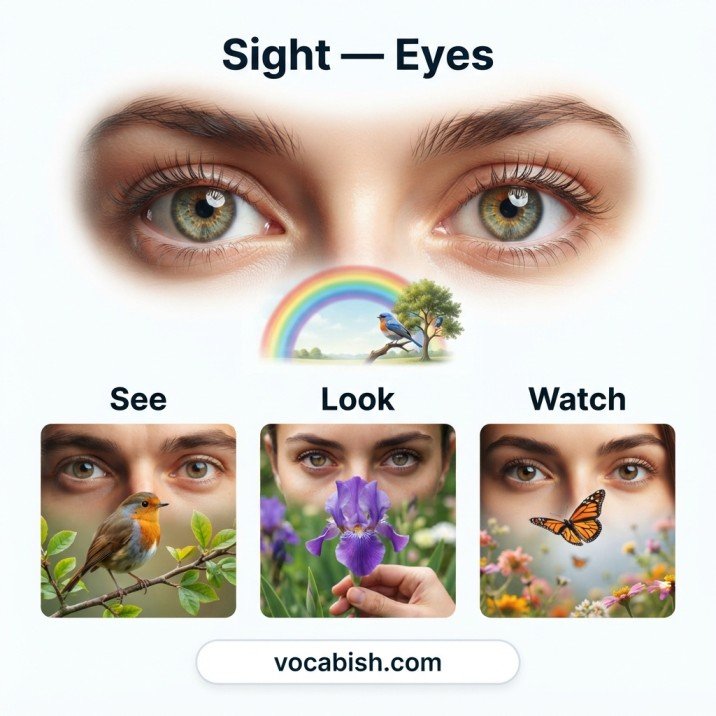
Sight is the ability to see using our eyes. It helps us recognize colors, shapes, sizes, distances, and movement. Light enters the eyes, and the brain processes the information to create what we see.
Vocabulary related to sight:
- See: Notice something using your eyes.
- Look: Direct your eyes toward something.
- Watch: Look at something for some time.
- Bright: Giving or reflecting plenty of light.
- Dark: Having little or no light.
- Colorful: Having many different bright colors.
Example sentences:
- I can see a bird in the tree.
- She watches the colorful butterflies.
- The stars look bright tonight.
2. Hearing — Ears

Hearing is the ability to recognize sounds using our ears. It helps us listen to conversations, enjoy music, and notice sounds such as alarms or approaching vehicles. The ears detect sound vibrations and send signals to the brain.
Vocabulary related to hearing:
- Hear: Notice sounds through your ears.
- Listen: Pay attention to a particular sound.
- Sound: Something that we can hear.
- Loud: Making a strong, easily heard sound.
- Quiet: Making little or no sound.
- Noisy: Making many sounds, often too loudly.
Example sentences:
- I can hear the rain outside.
- The children listen to their teacher.
- The drum makes a loud sound.
3. Smell — Nose
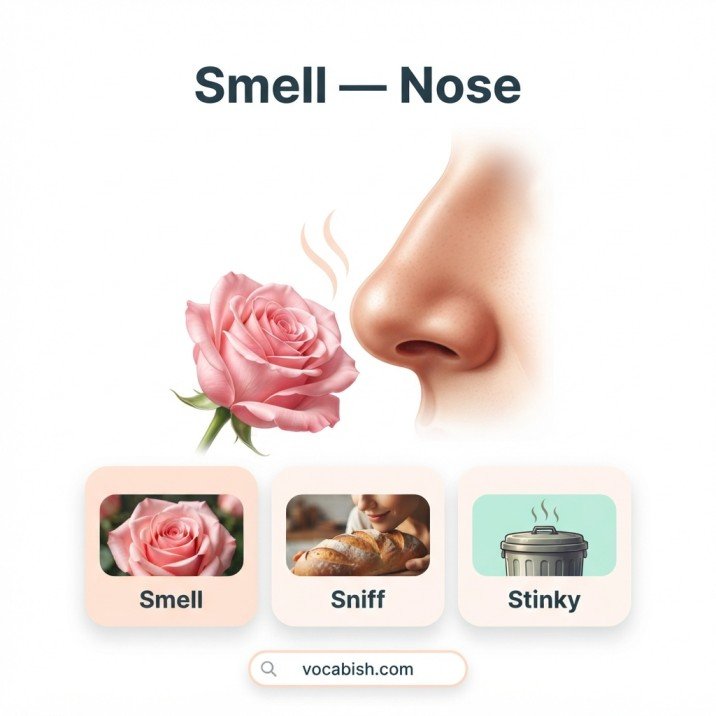
Smell is the ability to recognize odors using our nose. It helps us enjoy the fragrance of flowers, notice cooking food, and detect unpleasant smells. Special sensory cells inside the nose detect odor molecules and send information to the brain.
Vocabulary related to smell:
- Smell: Notice an odor using your nose.
- Sniff: Breathe in through your nose to smell.
- Scent: A particular smell, often a pleasant one.
- Fragrant: Having a pleasant, noticeable smell.
- Fresh: Smelling clean or recently prepared.
- Stinky: Having a strong, unpleasant smell.
Example sentences:
- The roses smell lovely.
- He sniffs the freshly baked bread.
- The rubbish has a stinky smell.
4. Taste — Tongue
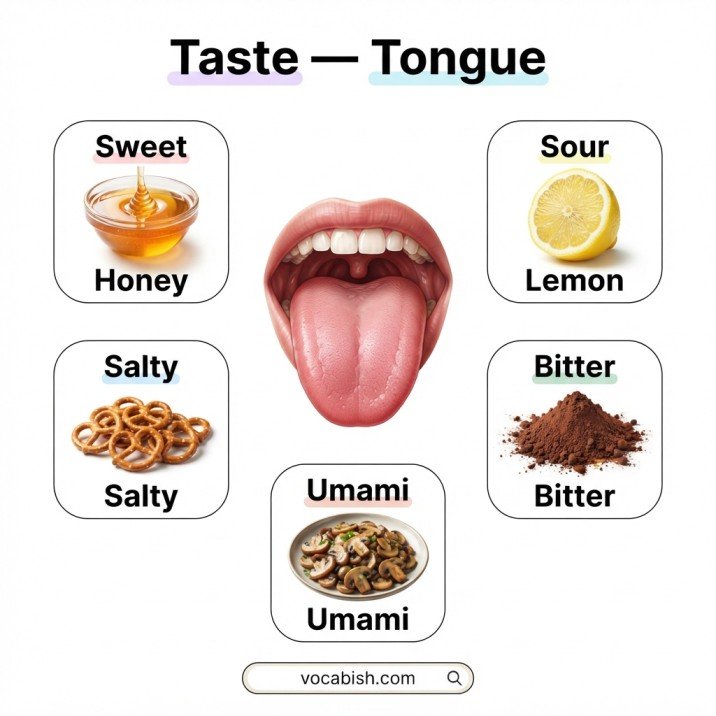
Taste is the ability to detect different tastes in food and drinks. Taste buds, found mainly on the tongue, contain sensory cells that detect substances in food. Our sense of smell also helps create the full flavor of what we eat.
The five basic tastes are:
- Sweet: A sugary taste, like honey or ripe mango.
- Sour: A sharp, acidic taste, like lemon juice.
- Salty: A taste like salt or salted crackers.
- Bitter: A sharp taste, like unsweetened cocoa.
- Umami: A savory taste, like mushrooms or broth.
Umami is pronounced oo-MAH-mee. It is often described as a rich, savory taste.
Example sentences:
- The lemonade tastes sour.
- These biscuits are too salty.
- The mushroom soup has a rich, savory taste.
5. Touch — Skin

Touch helps us feel the surface and physical properties of objects through our skin. Sensory receptors in the skin detect contact, pressure, vibration, and temperature. Different nerve endings also help us notice pain.
Vocabulary related to touch:
- Touch: Make contact with something using your body.
- Feel: Notice a physical sensation through touch.
- Soft: Easy to press or pleasant to touch.
- Hard: Firm and difficult to press.
- Smooth: Having an even surface without rough areas.
- Rough: Having an uneven or bumpy surface.
- Warm: Having a comfortably high temperature.
- Cold: Having a low temperature.
Example sentences:
- This pillow feels soft.
- The stone has a rough surface.
- The water feels cold on my hands.
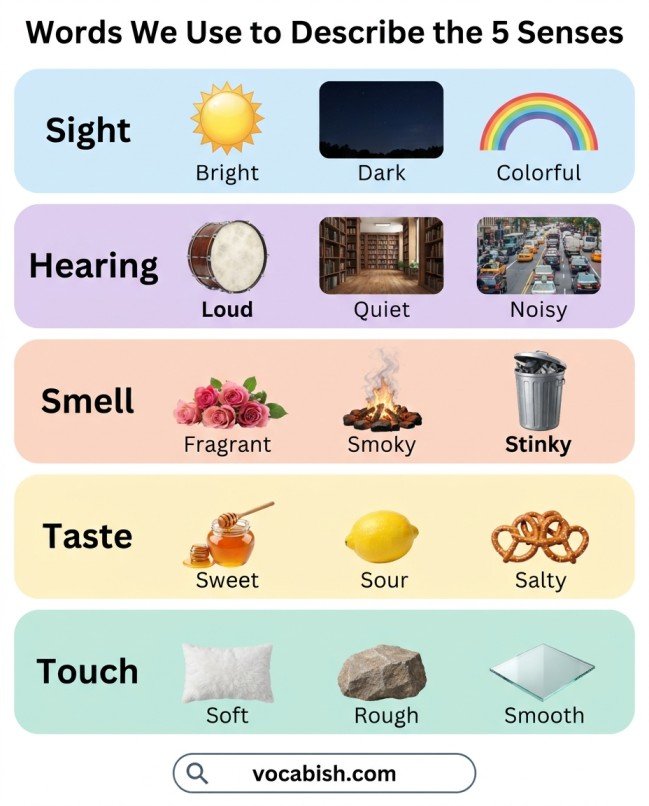
Words We Use to Describe the 5 Senses
Sensory adjectives help us explain how something looks, sounds, smells, tastes, or feels. These words make our descriptions more specific.
Words for sight
- Shiny: Reflecting light from a smooth surface.
- Dull: Not bright or shiny.
- Clear: Easy to see through or recognize.
- Faint: Difficult to see because it is weak.
Words for hearing
- Soft: Not loud when describing a sound.
- High-pitched: Having a high, sharp sound.
- Deep: Having a low sound or voice.
- Silent: Making no sound.
Words for smell
- Smoky: Smelling like smoke.
- Musty: Having an old, damp smell.
- Sweet-smelling: Having a pleasant, sweet scent.
- Pungent: Having a very strong smell.
Words for taste
- Savory: Having a salty or umami-rich flavor.
- Bland: Having very little flavor.
- Tangy: Having a pleasantly sharp, sour taste.
- Mild: Not having a strong flavor.
Words for touch
- Sticky: Staying attached when touched or pressed.
- Slippery: Difficult to hold because it slides easily.
- Bumpy: Having many small raised areas.
- Silky: Feeling very smooth and soft.
Some adjectives describe more than one sense. For example, soft can describe a pillow or a quiet voice.
Examples of the 5 Senses in Everyday Life
We use sensory words when talking about school, food, animals, weather, and objects at home. These ten sentences show how each sense appears in everyday English.
Sight
- I see a rainbow after the rain.
- The classroom looks bright in the morning.
Hearing
- We hear birds singing in the garden.
- The baby is sleeping, so please be quiet.
Smell
- The kitchen smells of freshly baked bread.
- The flowers have a sweet-smelling scent.
Taste
- This orange tastes sweet and juicy.
- The soup has a mild flavor.
Touch
- The kitten’s fur feels soft.
- My hands feel cold in winter.
Commonly Confused Words About the Senses
Some sensory words have similar meanings but different uses. Learning these differences helps us choose the correct word when speaking or writing.
- See, look, and watch: See means notice with your eyes. Look means direct your eyes toward something. Watch means look at something for a period. Examples: “I see a cat.” “Look at the cat.” “Watch the cat playing.”
- Hear and listen: Hear means notice a sound, while listen means pay attention to it. Examples: “I hear music.” “I listen to music every evening.”
- Smell and sniff: Smell means detect an odor. Sniff means breathe in through your nose, often to notice a smell. Examples: “I smell coffee.” “She sniffs the coffee.”
- Taste and flavor: Taste can mean the act of tasting or a taste sensation. Flavor describes the overall experience of food, including smell. Examples: “Taste this soup.” “The soup has a rich flavor.”
- Touch and feel: Touch means make physical contact. Feel means experience a sensation. Examples: “Touch the fabric.” “It feels smooth.”
How Do Our Five Senses Work Together?
Our senses often work at the same time. The brain combines information from different sensory organs to help us recognize objects and understand what is happening around us.
Imagine eating a fresh apple:
- Sight: Your eyes see its red or green color.
- Touch: Your fingers feel its smooth skin.
- Smell: Your nose detects its fruity smell.
- Taste: Your taste buds detect its sweetness or sourness.
- Hearing: Your ears hear the crunch when you bite it.
This is why eating involves more than taste alone. Smell, texture, appearance, and sound can all affect how we experience food.
How to Take Care of Your Sense Organs
Healthy habits help protect the organs we use for sensing the world. Small daily actions can reduce the risk of injury and discomfort.
- Eyes: Take regular breaks from screens and avoid looking directly at the sun.
- Ears: Keep headphone volume moderate and never put sharp objects inside your ears.
- Nose: Avoid inserting objects into your nose and stay away from harmful fumes.
- Tongue and mouth: Brush your teeth regularly and avoid food or drinks that are too hot.
- Skin: Wash your skin gently and use suitable sun protection when outdoors.
Are There More Than Five Human Senses?
Yes. The traditional five senses are useful for basic learning, but humans have other sensory abilities. Scientists recognize systems that help us maintain balance, sense body position, and notice internal body conditions.
Two important examples are:
- Balance (Equilibrioception): Helps us stay upright when standing, walking, or moving. The vestibular system in the inner ear plays a major role.
- Body Position (Proprioception): Helps us know where our arms, legs, and other body parts are without looking at them.
For example, you can touch your nose with your eyes closed because your brain receives information about the position of your hand and arm.
Temperature and pain are also detected through specialized sensory systems, often discussed alongside touch.
5 Senses Practice Quiz
Test your knowledge of sight, hearing, smell, taste, and touch.
0/12
FAQs About the 5 Senses
The five main senses are sight, hearing, smell, taste, and touch. They help us see, hear, smell, taste, and feel the world around us.
The main sense organs are the eyes for sight, ears for hearing, nose for smell, tongue for taste, and skin for touch.
The five senses help us recognize our surroundings, communicate with others, enjoy food, notice possible dangers, and respond to everyday situations.
The sixth sense is often called proprioception, which helps us sense our body's position and movement without looking. Balance is another important sense.
Humans traditionally have 5 senses, but some educational models describe 7 senses by adding balance (vestibular sense) and body-position awareness (proprioception).
Yes. When eating fruit, we can see its color, smell its aroma, taste its sweetness, and feel its texture at the same time.
One expanded classification includes sight, hearing, smell, taste, touch, temperature, pain, balance, proprioception, hunger, thirst, and internal body awareness (interoception). There is no universally agreed list of exactly 12 senses.
Yes. Humans also have sensory abilities such as balance and body-position awareness. These help us move, stay upright, and control our movements.
Conclusion
The 5 senses—sight, hearing, smell, taste, and touch—help us experience and understand the world. Each sense has an associated organ and a different function. Learning their names, sensory vocabulary, and everyday examples helps English learners describe what they see, hear, smell, taste, and feel.