
Old vs New explains the difference between two common opposite adjectives used to describe age, time, condition, ownership, and experience. Old usually refers to something that has existed for a long time or belonged to an earlier period, while new describes something recently made, obtained, introduced, or discovered. Learning how new and old change meaning in different contexts will help you use them correctly in everyday sentences.
Old vs New: The Main Difference
Old and new are opposite adjectives. They often show whether a person, object, idea, or experience has existed for a long time or has appeared recently.
Word | Basic meaning | Example |
|---|---|---|
Old | Existing or used for a long time | This is an old building. |
New | Recently created, bought, introduced, or discovered | She bought a new phone. |
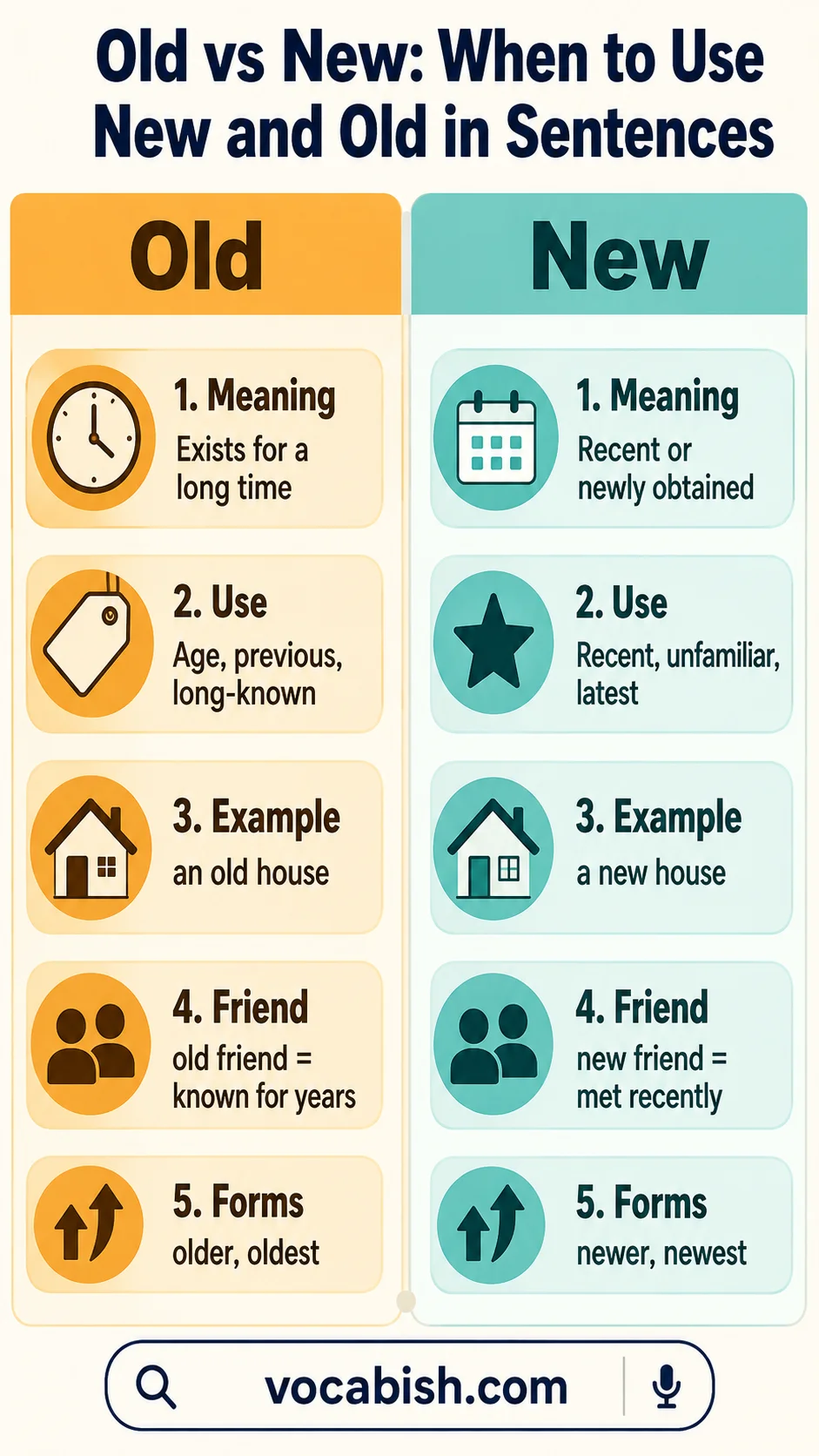
Quick answer: Use old for something that has existed for a long time. Use new for something recent, unfamiliar, or newly acquired.
Compare:
- We live in an old house.
- They moved into a new house.
- I met an old friend yesterday.
- I made a new friend at school.
The meaning changes slightly in the last two examples. An old friend is someone you have known for a long time, while a new friend is someone you met recently.
What Does Old Mean?
The word old usually refers to age or length of existence. It can describe people, animals, objects, traditions, information, relationships, and previous situations.
Pronunciation: /oʊld/
Main Meanings of Old
1. Having lived or existed for many years
- The town has many old buildings.
- Their dog is getting old.
- My grandfather is eighty years old.
2. Used or owned for some time
- I donated my old clothes.
- She replaced her old laptop.
- We sold our old car last month.
Here, old does not always mean ancient or damaged. It may simply mean that the item is no longer the speaker’s latest one.
3. Known for a long time
- Ahmed is an old friend of mine.
- We met some old classmates at the event.
- She contacted an old teacher for advice.
An old friend is not necessarily elderly. The phrase usually means a friend you have known for many years.
4. Belonging to an earlier time
- My grandmother told us an old story.
- They still follow an old tradition.
- This photograph shows the old railway station.
5. Previous or former
- I visited my old school.
- He returned to his old job.
- Our old manager moved to another company.
In these sentences, old means former or previous, not necessarily aged.
What Does New Mean?
The word new describes something that has recently appeared, begun, been made, been purchased, or become known to someone.
Pronunciation: /nuː/ in American English and /njuː/ in many British accents
Main Meanings of New
1. Recently made or created
- They opened a new hospital.
- The company launched a new product.
- We need a new table for the kitchen.
2. Recently bought or received
- Maya is wearing her new shoes.
- I bought a new notebook.
- He showed us his new bicycle.
An object can be called new because it is new to its owner, even if someone else used it before.
I bought a new car, but it is actually five years old.
The car is new to the speaker, but it is not newly manufactured.
3. Recently started or introduced
- She began a new job.
- The school introduced a new rule.
- We are working on a new project.
4. Unfamiliar or not experienced before
- Living alone was a new experience for him.
- This subject is new to me.
- She is new to the city.
5. Recently discovered or learned
- Scientists found new evidence.
- I learned a new word today.
- The report contains new information.
Old and New as Adjectives
Both old and new are most commonly used as adjectives. They usually appear before a noun or after a linking verb such as be, seem, look, or feel.
Before a Noun
- an old bridge
- a new bridge
- an old idea
- a new idea
- an old customer
- a new customer
After a Linking Verb
- The bridge looks old.
- The bridge is new.
- This information seems old.
- Everything feels new.
Position | Old example | New example |
|---|---|---|
Before a noun | She found an old letter. | She wrote a new letter. |
After be | The letter is old. | The letter is new. |
After look | His jacket looks old. | His jacket looks new. |
After feel | The material feels old. | The material feels new. |
Using Old to Talk About Age
The word old is commonly used to state or ask about someone’s age. English follows several fixed sentence patterns for this purpose.
Saying Someone’s Age
Use:
Subject + be + number + years old
- Sara is ten years old.
- My father is fifty years old.
- The building is over one hundred years old.
In everyday conversation, years old can be shortened when the meaning is clear:
- Sara is ten.
- My father is fifty.
- Our cat is six.
Using Age Before a Noun
When an age comes before a noun, use hyphens and keep year singular:
- a ten-year-old student
- a five-year-old child
- a one-year-old puppy
Compare:
- The student is ten years old.
- He is a ten-year-old student.
Do not write a ten-years-old student.
Asking About Age
- How old are you?
- How old is your sister?
- How old is this building?
The natural question is How old…?, even when the person or object is young or recently made.
Using New for Recent Things and Experiences
New does not only mean freshly manufactured. Its exact meaning depends on what is recent: the object, ownership, situation, information, or experience.
New to the World
Something has recently been created or produced:
- a new invention
- a new model
- a new building
- a new law
New to the Owner
Something has recently been obtained:
- my new coat
- her new apartment
- our new television
New to a Place or Group
Someone has recently arrived or joined:
- I am new to this school.
- She is the new team member.
- Please help the new students.
New to an Experience
Something is unfamiliar:
- Online learning is new to him.
- This software is new to our staff.
- The customs were completely new to me.
Brand-New
Brand-new means completely new and never used before.
- She bought a brand-new laptop.
- They moved into a brand-new house.
- The book still looks brand-new.
Use a hyphen when brand-new appears before a noun.
Comparative and Superlative Forms
The comparative and superlative forms help us compare the ages of people or things.
Adjective | Comparative | Superlative |
|---|---|---|
old | older | oldest |
new | newer | newest |
Older and Oldest
- This building is older than that one.
- Ali is older than his brother.
- This is the oldest tree in the park.
Newer and Newest
- My phone is newer than yours.
- The second version is newer.
- This is their newest product.
Use than after a comparative when both things are mentioned:
- The blue car is newer than the red car.
- My school is older than your school.
Use the before a superlative:
- the oldest building
- the newest student
- the newest version
Common Expressions with Old and New
Many everyday expressions contain old and new, but their meanings may not be completely literal.
Expression | Meaning | Example |
|---|---|---|
old friend | A friend known for a long time | I had lunch with an old friend. |
old habits | Behaviours developed in the past | Old habits can be hard to change. |
old-fashioned | No longer modern or popular | That hairstyle looks old-fashioned. |
the old days | A past period remembered by someone | Grandpa often talks about the old days. |
new beginning | A fresh start | Moving abroad gave her a new beginning. |
newcomer | A person who has recently arrived | The newcomer joined our class today. |
good as new | Restored to excellent condition | The repaired chair looks as good as new. |
new to someone | Unfamiliar to a person | This type of work is new to me. |
out with the old, in with the new | Replace older things with newer ones | We redesigned the office—out with the old, in with the new. |
Old-Fashioned and Modern
Old-fashioned often describes styles, beliefs, methods, or objects that belong to an earlier period.
- He uses an old-fashioned camera.
- Some people consider that belief old-fashioned.
- The café has a charming old-fashioned design.
The opposite may be modern, current, up-to-date, or contemporary, depending on the context.
Old vs New in Different Contexts
The meaning of old or new can shift according to the noun being described. Looking at the full phrase prevents misunderstandings.
People and Relationships
- an old man: a man of advanced age
- an old friend: a friend known for a long time
- a new friend: someone recently befriended
- a new baby: a recently born baby
Possessions
- my old phone: the phone I used before
- my new phone: the phone I recently obtained
- an old phone: a phone made or used a long time ago
- a new phone: a recently made or unused phone
Jobs and Places
- my old job: my previous job
- my new job: the job I recently started
- the old office: the previous office or an aged office
- the new office: the recently opened or occupied office
Ideas and Information
- an old idea: an idea discussed or known before
- a new idea: a recently suggested idea
- old information: information that may no longer be current
- new information: recently learned or released information
Versions and Technology
- the old version: an earlier release
- the new version: a later or updated release
- an older model: a model released before another one
- the newest model: the most recently released model
Context | Old | New |
|---|---|---|
Friendship | Known for a long time | Recently met |
Possession | Previously owned or used | Recently obtained |
Information | Previously known or outdated | Recently discovered |
Employment | Former job | Recently started job |
Technology | Earlier model or version | Recent model or version |
Place | Previous or aged location | Recently opened or occupied location |
Can Something Be Both Old and New?
Yes. Something can be old in one sense and new in another. The surrounding words explain the intended meaning.
For example:
- I bought a new antique table.
The table is new to the buyer, but the table itself is old.
- She is the new owner of an old house.
The ownership is recent, while the house has existed for many years.
- We added new paint to the old walls.
The paint is recent, but the walls are not.
This contrast often appears when people compare new and old designs, traditions, technology, buildings, or methods.
Choosing Between Old or New
Ask what you want to communicate before choosing the adjective. Are you talking about age, ownership, familiarity, condition, or sequence?
Use old when something:
- has existed for a long time
- belongs to the past
- was used or owned before
- is no longer the latest version
- has been known for a long time
Use new when something:
- was recently made or introduced
- was recently bought or received
- has recently started
- is unfamiliar to someone
- is the latest version or replacement
Compare these sentence pairs:
- I cannot find my old keys.
I received new keys from the landlord. - We visited our old neighbourhood.
We are enjoying our new neighbourhood. - The teacher removed the old rule.
The school introduced a new rule. - He repaired his old bicycle.
His sister bought a new bicycle. - I spoke to an old colleague.
A new colleague joined our department.
Common Mistakes with Old and New
Most errors happen with age expressions, word order, or meanings such as previous and recently acquired.
- Write She is twelve years old, not She has twelve years.
- Write a six-year-old boy, not a six-years-old boy.
- An old friend usually means a long-time friend, not an elderly friend.
- A new car may be new to its owner without being newly manufactured.
- Use older than and newer than, not more old than or more new than.
Practice Sentences with Old and New
Complete each sentence with old, new, older, oldest, newer, or newest.
- My brother is two years ______ than me.
- We need a ______ computer because this one no longer works.
- That is the ______ building in the village.
- I met an ______ school friend at the market.
- This software is ______ than the version we used last year.
- Our teacher introduced a ______ classroom rule.
- The museum displays many ______ coins.
- This is the company’s ______ mobile application.
Answers
- older
- new
- oldest
- old
- newer
- new
- old
- newest
Sentence-Correction Practice
Correct the mistake in each sentence:
- My daughter is eight year old.
- He is a fifteen-years-old student.
- This laptop is more new than mine.
- She has twenty years old.
- It is the most old bridge in town.
Correct versions:
- My daughter is eight years old.
- He is a fifteen-year-old student.
- This laptop is newer than mine.
- She is twenty years old.
- It is the oldest bridge in town.
FAQs About Old vs New
Old describes something existing for a long time, while new describes something recently made, obtained, started, introduced, or discovered.
Yes. In phrases such as old job, old address, or old school, old often means previous or former.
Yes. A used object can be new to its owner, although it is not brand-new or recently manufactured.
Yes. Use be + age + years old. You can also say “I am 20” when the context is clear.
An old friend is usually someone known for years. An elderly friend is a friend who is advanced in age.
Use five-year-old before a noun, as in “a five-year-old child.” After be, write “five years old.”
The comparative forms are older and newer. Their superlative forms are oldest and newest.
Usually, but not always. Depending on context, the opposite of old may also be young, modern, current, or recent.
Conclusion
The key difference in old vs new depends on time, ownership, familiarity, and context. Use old for something aged, previous, long-known, or from the past. Use new for something recent, newly obtained, unfamiliar, or recently introduced.
Pay attention to the noun that follows each adjective. An old friend, an old phone, and an old tradition express different kinds of age, while a new friend, a new phone, and a new experience describe different kinds of recent change. With regular practice, using old and new in sentences becomes natural.
You May Also Like
