
Should you say “my elder brother” or “my older brother”? The elder vs older difference can be confusing because both words relate to age, seniority, and people who have lived longer.
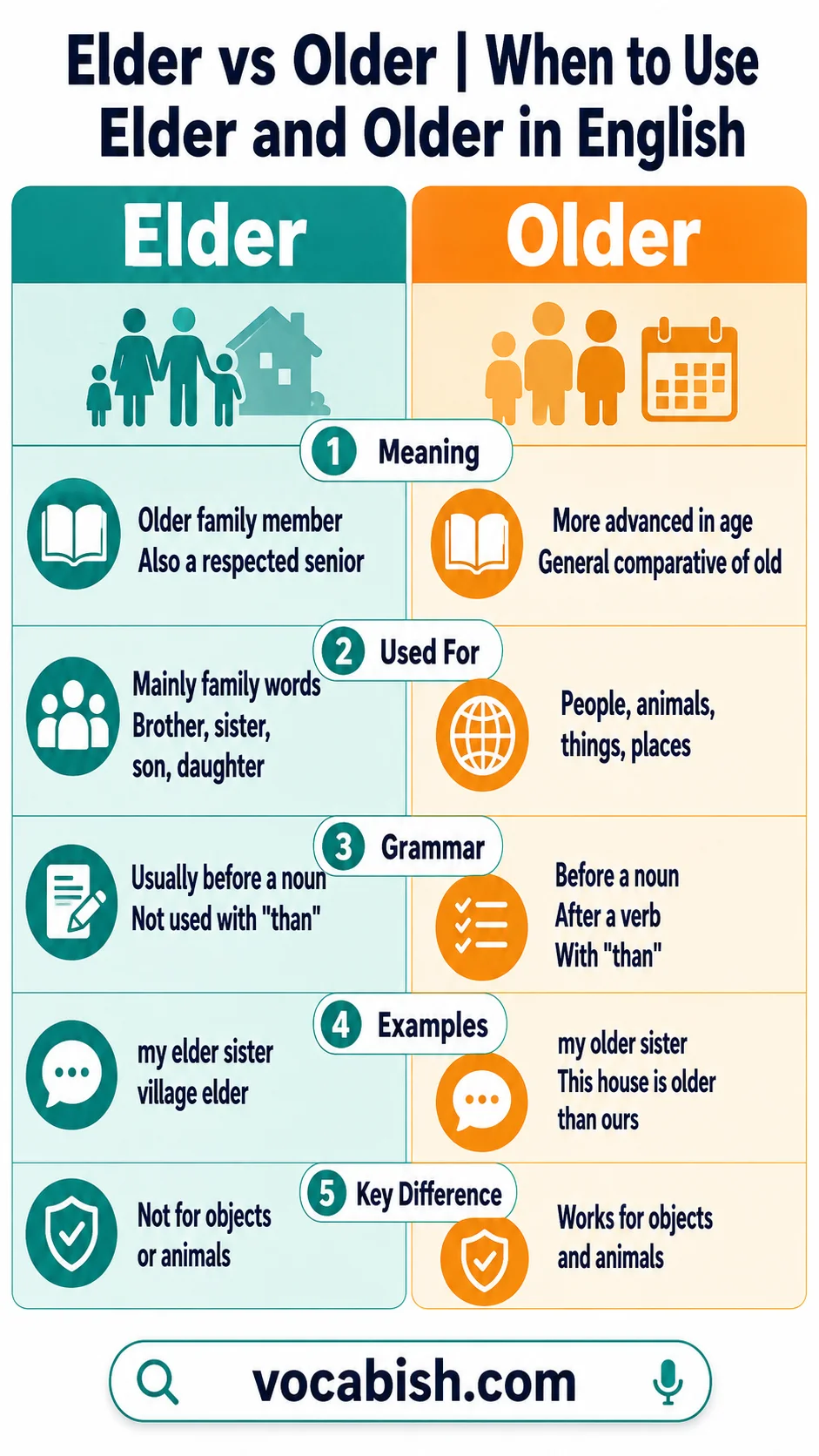
The main rule is easy to remember: older works for people, animals, and things, while elder is mainly used before the name of a family member. You can say “older than,” but you normally cannot say “elder than.”
This article explains when to use elder or older, with grammar rules, comparison tables, natural examples, and common mistakes.
Elder vs Older: Quick Answer
Both words can describe someone who has lived for more years. However, their grammar and range of use are different.
Older is the general comparative form of “old.” Elder has a narrower use and usually appears before a family relationship word.
Quick rule:
Use older for people, animals, objects, places, and comparisons.
Use elder mainly before family words such as brother, sister, son, or daughter.
Quick Comparison
Word | Main Use | Can Describe Things? | Used with “Than”? | Example |
|---|---|---|---|---|
Older | General age comparison | Yes | Yes | This house is older than ours. |
Elder | Family relationships | No | No | My elder sister is a nurse. |
What Does Older Mean?
Older is the comparative form of the adjective old. It shows that a person, animal, object, or place has existed for more time than another.
It is the most common and flexible word when comparing age.
Older Can Describe People
- My father is older than my mother.
- Sara is the older of the two sisters.
- An older man helped us cross the road.
- Older students often help younger students.
In these sentences, older refers to greater age.
Older Can Describe Animals
- This horse is older than the brown one.
- Older dogs may need more rest.
- The older cat sleeps near the window.
Because animals have ages, older can compare them naturally.
Older Can Describe Things and Places
- This building is older than the hospital.
- I bought an older model of the phone.
- Their village is much older than our town.
- She prefers older books and films.
Elder cannot normally replace older in these sentences.
Incorrect:
- This is an elder building.
- My phone is elder than yours.
Correct:
- This is an older building.
- My phone is older than yours.
What Does Elder Mean?
Elder usually describes an older person within a family. It most often comes directly before a family relationship word.
Unlike older, it is not normally used for objects, animals, or direct comparisons with than.
Elder Before a Family Noun
- my elder brother
- her elder sister
- their elder son
- his elder daughter
- our elder cousin
Examples:
- My elder brother lives in London.
- Her elder sister teaches mathematics.
- Their elder son has started university.
- I asked my elder cousin for advice.
Here, elder tells us which family member was born first.
Elder as a Noun
Elder can also be a noun meaning an older or respected member of a family, community, religious group, or organisation.
- We should listen to our elders.
- The village elders met to discuss the problem.
- She is a respected elder in the community.
- The church elders welcomed the visitors.
In this meaning, age may be important, but elder can also suggest authority, experience, wisdom, or social position.
Main Difference Between Elder and Older
The difference becomes clearer when you look at meaning, sentence position, and the type of noun being described.
Older is the normal choice in most situations. Elder is a more limited word connected mainly with family relationships or respected senior members.
Grammar Point | Elder | Older |
|---|---|---|
Refers to greater age | Yes | Yes |
Used for family members | Yes | Yes |
Used for unrelated people | Rarely as an adjective | Yes |
Used for animals | No | Yes |
Used for objects and places | No | Yes |
Used before a noun | Yes | Yes |
Used after a linking verb | Usually no | Yes |
Used with “than” | No | Yes |
Can be a noun | Yes | No |
Common example | My elder sister | My sister is older than me |
Compare these sentence pairs:
- My elder brother is a doctor.
- My brother is older than me.
- Her elder daughter lives abroad.
- Her daughter is older than mine.
Both forms may describe age, but their grammar is different.
When to Use Older
Use older whenever you are making a normal age comparison. It is suitable for almost every context involving people, animals, objects, buildings, traditions, or ideas.
It can appear before a noun, after a verb, or with the word than.
1. Use Older Before a Noun
- an older woman
- an older student
- an older car
- an older tradition
- an older version
Examples:
- An older woman was waiting outside.
- We live in an older house.
- The website is using an older version of the software.
2. Use Older After a Linking Verb
A linking verb connects the subject with a description. Common linking verbs include be, seem, look, and feel.
- He is older.
- She looks older in that photograph.
- This tree seems older than the others.
- The dog is getting older.
You would not normally replace older with elder in these sentences.
Incorrect:
- He is elder.
- She looks elder.
Correct:
- He is older.
- She looks older.
3. Use Older with Than
Use older than when directly comparing the ages of two people or things.
- Ali is older than Hassan.
- My sister is older than me.
- This bridge is older than that one.
- Elephants usually live older than many smaller animals.
A clearer version of the last sentence would be:
- Elephants usually live longer than many smaller animals.
This example shows that the most natural word may depend on whether you are comparing age or length of life.
4. Use Older for Things
Only older can normally describe the age of objects, buildings, systems, languages, customs, and other non-living things.
- an older laptop
- an older road
- an older language
- an older law
- an older method
Example:
- The museum contains objects from an older civilisation.
When to Use Elder
Use elder mainly when identifying an older member of a family. It usually comes immediately before the family noun it describes.
You may also use it as a noun for a respected senior person or as part of a formal name or title.
1. Before Family Relationship Words
- My elder sister works in a bank.
- His elder brother drives a taxi.
- Their elder child is ten years old.
- She gave the keys to her elder son.
In each sentence, elder identifies the family member who was born earlier.
2. For a Respected Senior Person
As a noun, elder can describe someone who holds a respected position because of age, experience, leadership, or tradition.
- The young people asked an elder for advice.
- Community elders attended the meeting.
- He became an elder of the church.
This use is different from the comparative adjective older.
3. In Names and Historical Titles
The Elder sometimes appears after a person’s name to distinguish that person from a younger relative or another person with the same name.
Examples include expressions such as:
- James the Elder
- Pliny the Elder
- John the Elder
In this formal naming pattern, elder means the older of two people with similar or identical names.
Elder or Older for Family Members?
Both elder and older can be correct before family relationship words. The choice often depends on sentence structure, regional usage, and personal style.
Older is more flexible, while elder sounds slightly more traditional or formal in many contexts.
Both Can Be Correct Before the Noun
- My elder brother is an engineer.
- My older brother is an engineer.
- Her elder sister lives in Canada.
- Her older sister lives in Canada.
These pairs have nearly the same meaning.
Older Is Required in a Direct Comparison
- My brother is older than me.
- Her sister is older than mine.
- Their eldest child is two years older than their youngest.
Do not use elder than in standard modern English.
Regional Preference
Elder brother and elder sister are common in British, South Asian, and other varieties of English.
In everyday American English, speakers are more likely to say older brother and older sister.
Neither form is wrong before a family noun:
- my elder sister
- my older sister
However, older is the safer choice when you are unsure because it works in more sentence patterns.
Why We Say Older Than, Not Elder Than
Older is a regular comparative adjective, so it can be followed by than. In its usual family-related use, elder works as an adjective before a noun rather than as a direct comparative.
This grammatical difference explains why the two words are not always interchangeable.
Correct
- Daniel is older than Robert.
- My aunt is older than my mother.
- This photograph is older than that one.
- My elder brother is taller than me.
Incorrect
- Daniel is elder than Robert.
- My aunt is elder than my mother.
- This photograph is elder than that one.
A Useful Sentence Pattern
Use these two patterns:
Elder + family noun
- my elder sister
- his elder son
- their elder daughter
Older + than + person or thing
- older than my sister
- older than his son
- older than this building
Can Elder Be Used Without a Family Noun?
Yes, but its meaning changes. When elder stands alone, it is usually a noun referring to an older or respected person.
It does not normally function like older after verbs such as is, looks, or seems.
Elder as a Noun
- Respect your elders.
- She spoke to a village elder.
- The elders shared stories with the children.
The Elder of Two People
In formal English, you may sometimes see:
- Robert is the elder of the two brothers.
- Maria is the elder of the two sisters.
This structure is grammatically correct, but it sounds more formal than:
- Robert is the older of the two brothers.
- Maria is the older of the two sisters.
For everyday conversation, the older of the two is usually more natural.
Eldest vs Oldest
The same general distinction appears between eldest and oldest. Both identify the person or thing with the greatest age in a group.
Eldest is mainly used for family members, while oldest can describe people, animals, places, and things.
Word | Typical Use | Example |
|---|---|---|
Eldest | Family members | She is the eldest daughter. |
Oldest | People, animals, and things | This is the oldest building. |
Examples with Eldest
- He is my eldest brother.
- Their eldest child is studying medicine.
- Sara is the eldest of four sisters.
- Our eldest son lives abroad.
Examples with Oldest
- He is my oldest brother.
- This is the oldest tree in the park.
- That is the oldest shop in town.
- Maya is the oldest student in the class.
For family members, both forms can be correct:
- my eldest sister
- my oldest sister
For objects and places, use only oldest:
- the oldest bridge
- the oldest book
- the oldest city
Not:
- the eldest bridge
- the eldest book
- the eldest city
Common Mistakes with Elder and Older
Most errors happen when learners use elder with than, place it after a verb, or use it for a non-living object.
The following corrections show how to avoid these problems.
1: Using Elder Than
Incorrect:
- My brother is elder than me.
Correct:
- My brother is older than me.
2: Using Elder for an Object
Incorrect:
- This is an elder computer.
Correct:
- This is an older computer.
3: Using Elder After “Is”
Incorrect:
- James is elder.
Correct:
- James is older.
You may also say:
- James is the elder of the two brothers.
However, this version is more formal.
4: Using Elder for an Unrelated Person
Less natural:
- An elder woman opened the door.
Natural:
- An older woman opened the door.
Use elder as a noun when referring to a respected senior person:
- A village elder opened the meeting.
5: Confusing Elder with Elderly
Elder and elderly are not interchangeable.
- My elder sister is 25.
- An elderly woman was sitting on the bench.
Elder shows a family age relationship. Elderly describes someone who is old or in a later stage of life.
A person can be your elder sister without being elderly.
Elder, Older, and Elderly
These three related words have different uses. Understanding the contrast prevents awkward or incorrect sentences.
Word | Meaning | Example |
|---|---|---|
Elder | Older family member or respected senior person | My elder brother called me. |
Older | Having lived or existed for more time | My brother is older than me. |
Elderly | Old or advanced in age | An elderly man needed a seat. |
Be thoughtful when using elderly. In some contexts, expressions such as older person or older adult may sound more neutral and respectful.
Natural Examples of Elder and Older
Seeing both words in context can help you notice which sentence patterns sound natural.
Family Examples
- My elder sister taught me how to cook.
- My older sister taught me how to cook.
- My sister is three years older than me.
- Their elder son works in finance.
- Their older son works in finance.
- The eldest child takes care of the younger ones.
Everyday Comparisons
- This jacket is older than it looks.
- Older children can complete the task alone.
- Our school is older than the library.
- He looks older with a beard.
- The older dog walks more slowly.
- We replaced the older equipment last year.
Elder as a Respected Person
- The community elders gathered in the hall.
- She asked an elder for guidance.
- The youngest members listened to their elders.
- He is a respected elder in his village.
Short Conversations
These mini-dialogues show how native and fluent speakers commonly use the two words.
Talking About Siblings
A: Is Hamza your younger brother?
B: No, he is my elder brother. He is four years older than me.
Comparing Objects
A: Which car belongs to you?
B: The older one near the gate.
Talking About a Community Leader
A: Who will lead the ceremony?
B: One of the community elders will lead it.
Asking About Sisters
A: Do you have an older sister?
B: Yes. My elder sister lives in Manchester.
An Easy Way to Remember the Difference
Think of older as the all-purpose age word. It works with people, animals, objects, places, and direct comparisons.
Think of elder as a family or respect word.
Memory Formula
Older = general age
- older person
- older dog
- older building
- older than me
Elder = family or respected senior
- elder brother
- elder daughter
- village elder
- respect your elders
A useful reminder is:
Everything can be older, but only a person can be an elder.
FAQs About Elder and Older
Older describes people, animals, and things, while elder mainly describes an older family member or a respected senior person.
Both are correct. Elder brother sounds more traditional, while older brother is widely used and works naturally in most English varieties.
No. Use older than for direct comparisons: “My brother is older than me.” Elder is not normally followed by than.
No. Use older for objects, buildings, places, systems, and ideas, as in “an older house” or “an older method.”
Elder often sounds more traditional or formal when describing relatives. Older is more flexible and common in everyday age comparisons.
Eldest mainly identifies the oldest family member, while oldest can describe family members, unrelated people, animals, objects, and places.
Yes. An elder is an older or respected member of a family, community, religious group, or organisation with experience or authority.
No. An elder sister is only older than another sibling. She may still be young and is not necessarily an elderly person.
Conclusion
The elder vs older difference depends mainly on grammar and context. Use older for general age comparisons involving people, animals, objects, and places. It can appear before a noun, after a verb, and with than.
Use elder mainly before family relationship words, as in elder brother or elder daughter. As a noun, it can also mean a respected senior member of a community or group.
When choosing between elder or older, remember the easiest rule: say elder brother, but say my brother is older than me.
You May Also Like
