
Have you ever needed to interrupt someone, move through a crowd, or ask a speaker to repeat something? Understanding pardon me vs excuse me helps you choose the most natural and polite expression for each situation.
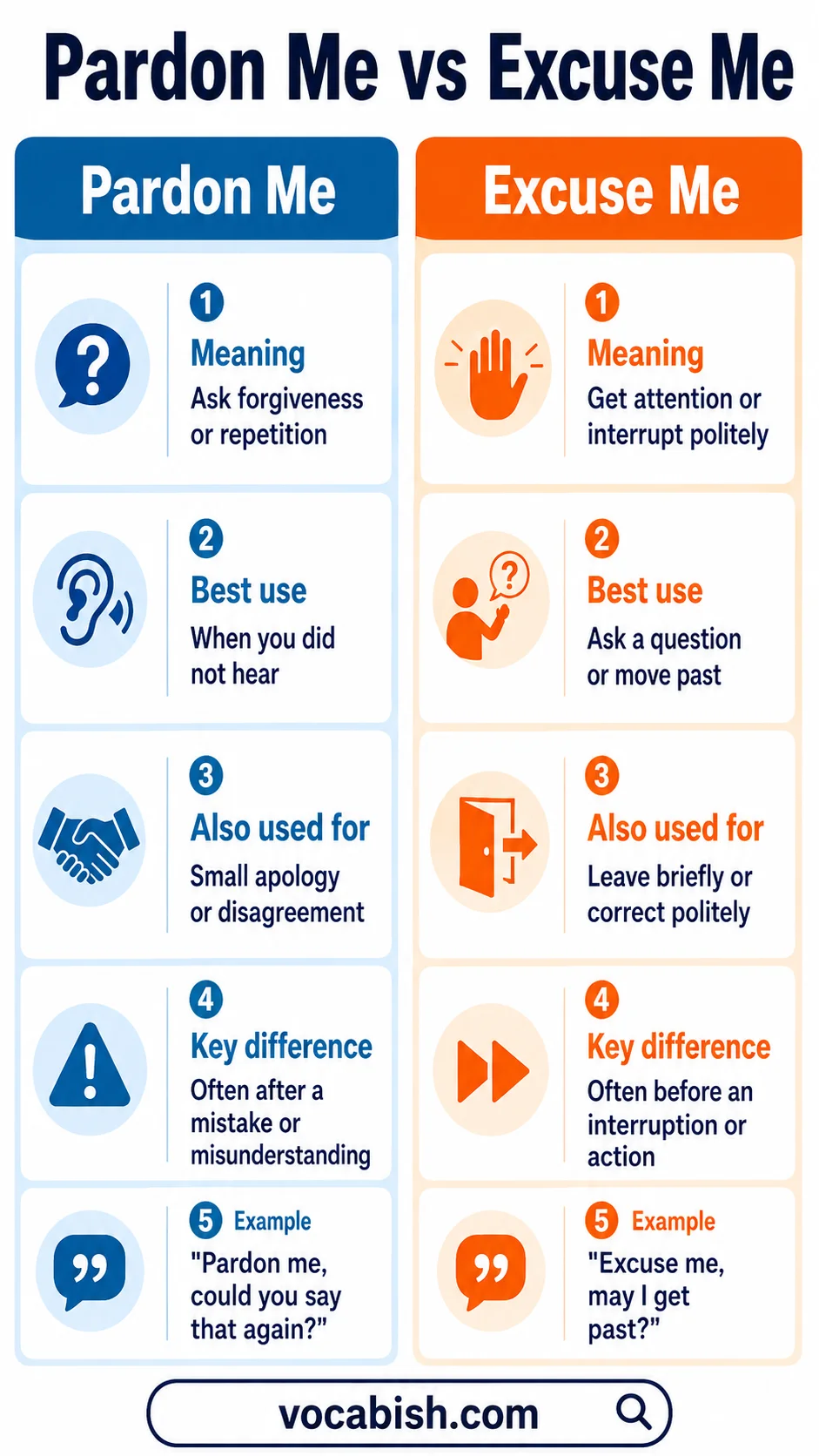
Both phrases show courtesy, but they do not always serve the same purpose. Excuse me is commonly used to get attention, interrupt politely, pass someone, or apologise for a small disturbance. Pardon me is often used to request repetition, make a polite apology, or respond to something surprising or offensive.
Pardon Me vs Excuse Me: Quick Difference
The main difference is connected to purpose. Pardon me often asks for forgiveness or repetition, while excuse me usually gets attention or politely manages a small interruption.
Phrase | Main purpose | Common situations | Example |
|---|---|---|---|
Pardon me | Ask for repetition or forgiveness | Mishearing, apologising, reacting to a rude comment | “Pardon me, could you say that again?” |
Excuse me | Get attention or interrupt politely | Asking questions, passing someone, entering a conversation | “Excuse me, where is the station?” |
A useful memory tip is:
- Use excuse me before you interrupt or inconvenience someone.
- Use pardon me after you mishear, make a small mistake, or need forgiveness.
These are general patterns rather than strict rules. In some situations, either phrase may be correct.
What Does “Pardon Me” Mean?
Pardon me is a polite expression related to forgiveness. The word pardon means to forgive someone for an action, error, or offence.
In everyday conversation, the phrase may mean:
- Please forgive me.
- Please repeat what you said.
- I am sorry for interrupting.
- Did you really say that?
Pronunciation
Pardon me is commonly pronounced:
PAR-dən mee
The second syllable of pardon is usually weak and quick.
Basic examples
- “Pardon me, I did not see you standing there.”
- “Pardon me, could you repeat the address?”
- “Pardon me for arriving late.”
- “Pardon me, but I believe this seat is mine.”
The expression can sound more formal than excuse me, especially in casual conversation.
What Does “Excuse Me” Mean?
Excuse me is a polite expression used when you want someone to forgive a small interruption, inconvenience, or socially awkward action.
It is one of the most common courtesy phrases in English and can be used before speaking, moving, asking, correcting, or leaving.
Pronunciation
As a verb in excuse me, excuse is pronounced:
ik-SKYOOZ mee
The final sound is a z sound, not an s sound.
Basic examples
- “Excuse me, may I ask you a question?”
- “Excuse me, could I get past?”
- “Excuse me, you dropped your wallet.”
- “Excuse me for a moment. I need to take this call.”
The phrase often prepares another person for what you are about to do.
When to Use Pardon Me
Pardon me fits situations involving repetition, forgiveness, polite disagreement, or a reaction to unexpected language. Its tone may be respectful, formal, surprised, or offended.
1. When you did not hear someone
Use pardon me when you want a person to repeat what they said.
- “Pardon me, what time does the meeting begin?”
- “Pardon me? I did not hear the last word.”
- “Pardon me, could you speak a little more slowly?”
In everyday speech, people may shorten the phrase to Pardon?
- “The train leaves from platform nine.”
- “Pardon?”
- “Platform nine.”
Pardon? is polite, but its naturalness varies by country and speaker. Sorry? or Could you repeat that? may sound more conversational in some regions.
2. When apologising for a minor mistake
You can use pardon me after making a small social error.
- “Pardon me, I called you by the wrong name.”
- “Pardon me for stepping in front of you.”
- “Pardon me, I did not realise you were waiting.”
This use is correct, although excuse me or sorry may be more common in relaxed conversation.
3. When interrupting formally
Pardon me may introduce a respectful interruption, especially in professional or formal settings.
- “Pardon me, may I add something?”
- “Pardon me for interrupting, but we have an urgent message.”
- “Pardon me, Professor, could you explain that point again?”
The phrase sounds respectful when speaking to a stranger, teacher, senior colleague, or guest.
4. When disagreeing politely
It may soften a correction or disagreement.
- “Pardon me, but I think the total is incorrect.”
- “Pardon me, but that is not what we agreed.”
- “Pardon me for saying so, but the rule seems unclear.”
The words may be polite, but tone still matters. A sharp voice can make the expression sound unfriendly.
5. When reacting to a rude or surprising comment
Pardon me? can show disbelief, offence, or a request for clarification.
- “You are not qualified for this job.”
- “Pardon me?”
Here, the speaker probably heard the words clearly. The phrase means something closer to:
- “What did you just say?”
- “Did I hear you correctly?”
- “That comment was inappropriate.”
This use depends heavily on facial expression and tone.
When to Use Excuse Me
Excuse me is the more flexible phrase in everyday English. It commonly appears before an interruption, request, movement, correction, or brief departure.
1. When getting someone’s attention
Use excuse me before speaking to someone who is not already talking to you.
- “Excuse me, is this bus going to the airport?”
- “Excuse me, can you help me find this address?”
- “Excuse me, I think you left your umbrella.”
It is more polite than beginning with “Hey” when speaking to a stranger.
2. When interrupting a conversation
Use it when you need to enter a discussion politely.
- “Excuse me, may I say something?”
- “Excuse me for interrupting, but your taxi has arrived.”
- “Excuse me, could I speak to Maria for a moment?”
The phrase recognises that your interruption may inconvenience the other speakers.
3. When moving past someone
Say excuse me when someone is blocking your path or when you need to move through a crowded space.
- “Excuse me, could I get through?”
- “Excuse me, this is my stop.”
- “Excuse me, may I get past you?”
You do not need a long explanation. A polite tone and a brief excuse me are normally enough.
4. When you accidentally touch or bump someone
Use the phrase immediately after a small physical disturbance.
- “Excuse me, I did not mean to bump into you.”
- “Oh, excuse me. I stepped on your shoe.”
- “Excuse me, I nearly knocked over your bag.”
In these examples, sorry may sound warmer because a mistake has already happened.
5. When leaving briefly
Excuse me can show that you need to leave a table, meeting, or conversation for a short time.
- “Please excuse me for a moment.”
- “Excuse me, I need to answer this call.”
- “Would you excuse me? I need to speak with the manager.”
This wording is especially useful during meals, meetings, and formal gatherings.
6. After a cough, sneeze, burp, or similar sound
People sometimes say excuse me after making an unexpected bodily sound.
- “Excuse me,” she said after coughing.
- “Excuse me. I need some water.”
- “Please excuse me,” he said after sneezing loudly.
After a sneeze, the person who sneezed may say excuse me, while another person may say bless you.
7. When correcting someone politely
Use the phrase before pointing out a small error.
- “Excuse me, but I ordered the vegetable soup.”
- “Excuse me, I believe this bill belongs to another table.”
- “Excuse me, but my name is pronounced ‘Leena.’”
The phrase prevents the correction from sounding too direct.
Pardon Me or Excuse Me in Common Situations
Choosing pardon me or excuse me becomes easier when you focus on what is happening before and after the phrase.
Situation | Better choice | Example |
|---|---|---|
You want a stranger’s attention | Excuse me | “Excuse me, do you know the time?” |
You did not hear a speaker | Pardon me | “Pardon me, could you repeat that?” |
You need to pass someone | Excuse me | “Excuse me, may I get through?” |
You interrupt a meeting | Either | “Excuse me, may I add something?” |
You make a small mistake | Either | “Pardon me, I took the wrong seat.” |
You react to a rude statement | Pardon me? | “Pardon me? That was unnecessary.” |
You leave the table briefly | Excuse me | “Please excuse me for a moment.” |
You want formal forgiveness | Pardon me | “Pardon me for the misunderstanding.” |
Before an action: Excuse me
Use excuse me when you are about to do something that may disturb another person.
- “Excuse me, may I sit here?”
- “Excuse me, I need to reach that shelf.”
- “Excuse me, could I interrupt for a moment?”
After a misunderstanding: Pardon me
Use pardon me when something has already been missed, misunderstood, or done incorrectly.
- “Pardon me, I misunderstood your question.”
- “Pardon me, did you say Tuesday or Thursday?”
- “Pardon me for using the wrong title.”
This before-and-after rule is a useful learning tool, although natural English includes exceptions.
Can Pardon Me and Excuse Me Be Used Interchangeably?
Pardon me and excuse me overlap when apologising or interrupting politely. However, replacing one with the other may change the tone or make a sentence sound less natural.
Consider these examples:
- “Excuse me, where is the nearest bank?”
- “Pardon me, where is the nearest bank?”
Both are understandable. The first sounds more natural for getting a stranger’s attention. The second may sound more formal.
Another example:
- “Pardon me, could you repeat your name?”
- “Excuse me, could you repeat your name?”
Both can work. Pardon me focuses more clearly on not hearing or understanding the name.
They are closest in meaning when apologising for a minor interruption:
- “Excuse me for interrupting.”
- “Pardon me for interrupting.”
The first is more common in everyday English, while the second may sound more formal or careful.
Tone, Formality, and Regional Differences
The meaning of each expression depends not only on vocabulary but also on voice, facial expression, setting, and regional habits.
Formality
Pardon me often sounds:
- Formal
- Traditional
- Respectful
- Slightly old-fashioned in some casual settings
Excuse me often sounds:
- Neutral
- Everyday
- Polite
- Suitable for both formal and informal situations
British and American English
Usage differs among individuals and regions, but these broad patterns are useful:
- Excuse me is widely used in both British and American English to get attention or pass someone.
- Pardon? may be used to request repetition, though many British speakers also use Sorry?
- In American English, Excuse me? can request repetition, but tone may make it sound surprised or offended.
- I beg your pardon? is more formal and may express strong surprise or disapproval.
Tone changes the message
Compare:
- “Excuse me, could I get past?”
Polite and practical. - “Excuse me?”
Possibly confused, surprised, or offended. - “Pardon me, could you repeat that?”
Respectful request for repetition. - “Pardon me?”
Possibly a warning that the previous comment was rude.
Learners should listen to the speaker’s voice rather than depending only on the words.
“I Beg Your Pardon” and Other Related Expressions
Several expressions share meanings with pardon me and excuse me, but their tone and purpose differ.
I beg your pardon
This formal expression can request repetition or apologise.
- “I beg your pardon; I did not hear the question.”
- “I beg your pardon for the confusion.”
It can also express offence:
- “You have no right to be here.”
- “I beg your pardon?”
In modern casual conversation, the full phrase may sound very formal or dramatic.
Pardon?
This shortened form asks someone to repeat a statement.
- “The appointment is at half past three.”
- “Pardon?”
- “Half past three.”
Excuse me?
This can mean “Please repeat that,” but it may also show surprise.
- “Excuse me, did you say room fifteen?”
- “Excuse me? You cannot speak to me like that.”
Sorry?
In many English-speaking settings, Sorry? is a natural way to ask for repetition.
- “The office closes at five.”
- “Sorry?”
- “It closes at five.”
It does not always mean that the speaker has done something wrong.
Common Mistakes to Avoid
Learners often understand both expressions but use them in situations where another phrase would sound more natural.
1: Using “pardon me” for every request
Less natural:
- “Pardon me, can I have a glass of water?”
More natural:
- “Excuse me, could I have a glass of water?”
Use excuse me to get the server’s attention. Use please to make the request polite.
2: Saying only “What?”
The word what? may sound impatient or rude when asking someone to repeat something.
Too direct:
- “What?”
More polite:
- “Pardon?”
- “Sorry?”
- “Could you say that again, please?”
3: Confusing “excuse me” with “I am sorry”
Excuse me is often used before a small interruption. I am sorry is usually stronger and more suitable when real harm or inconvenience has occurred.
- Small interruption: “Excuse me, may I come in?”
- Broken promise: “I am sorry I did not call.”
- Minor contact: “Excuse me.”
- Serious mistake: “I am truly sorry.”
4: Using an angry tone
A polite phrase does not sound polite when spoken sharply.
- “EXCUSE ME!”
This may sound annoyed, demanding, or confrontational.
A calm voice makes the same words respectful:
- “Excuse me, could you please move your bag?”
5: Saying “excuse” without “me”
Incorrect:
- “Excuse, where is the library?”
Correct:
- “Excuse me, where is the library?”
The standard expression includes the object pronoun me.
Natural Alternatives for Everyday Conversation
English speakers often choose different phrases depending on the setting and level of formality.
To ask for repetition
- “Sorry?”
- “Could you repeat that, please?”
- “Could you say that again?”
- “I did not catch that.”
- “Would you mind repeating the last part?”
To get someone’s attention
- “Excuse me.”
- “Hello, could you help me?”
- “Sorry to bother you.”
- “May I ask you something?”
To interrupt
- “Sorry to interrupt.”
- “May I add something?”
- “Could I say something here?”
- “May I come in for a moment?”
To move past someone
- “Excuse me.”
- “Could I get through, please?”
- “May I squeeze past?”
- “Sorry, this is my stop.”
To apologise
- “Sorry about that.”
- “Please forgive me.”
- “My apologies.”
- “I did not mean to do that.”
Choose an expression that matches the seriousness of the situation. A small interruption usually needs excuse me, while a meaningful mistake may require a fuller apology.
Examples in Short Conversations
These dialogues show how the expressions work in natural exchanges.
Asking for directions
Nora: Excuse me, could you tell me where the museum is?
Man: Certainly. It is across from the library.
Nora: Thank you.
Asking for repetition
Teacher: Please submit your work by Wednesday.
Student: Pardon me, did you say Wednesday?
Teacher: Yes, Wednesday afternoon.
Moving through a crowd
Adam: Excuse me, could I get past, please?
Passenger: Of course.
Adam: Thank you.
Correcting an order
Customer: Excuse me, I ordered tea, not coffee.
Server: I am sorry. I will replace it immediately.
Responding to a rude remark
Speaker 1: You clearly do not understand the subject.
Speaker 2: Pardon me?
Speaker 1: I am sorry. That came out badly.
Leaving a meeting
Priya: Please excuse me for a moment. I need to take an urgent call.
Manager: That is fine.
Making a formal apology
Guest: Pardon me for arriving late. The road was closed.
Host: Do not worry. We have just started.
Choose the Correct Phrase
Complete each sentence with pardon me or excuse me.
- “________, could you tell me which train goes to Manchester?”
- “________, I did not hear your surname.”
- “________, may I get past you?”
- “________ for interrupting, but the doctor is ready.”
- “________? Did you just call my work useless?”
- “Please ________ while I answer the door.”
- “________, I believe you dropped these keys.”
- “________ for using the wrong name.”
Answers
- Excuse me
- Pardon me
- Excuse me
- Excuse me or pardon me
- Pardon me
- Excuse me
- Excuse me
- Pardon me
Some answers allow both expressions, but one may sound more natural in the given situation.
FAQs About Pardon me and Excuse me
Pardon me commonly requests repetition or forgiveness. Excuse me usually gets attention, introduces an interruption, or acknowledges a small inconvenience.
Say excuse me when moving past someone. It politely signals that you need space without suggesting that a serious mistake occurred.
Yes. Pardon me? or Pardon? politely asks for repetition, although Sorry? is also common in everyday conversation.
Generally, yes. Pardon me can sound more formal or traditional, while excuse me is neutral and widely used in daily situations.
It can sound abrupt, especially with strangers or older people. Use Pardon?, Sorry?, or Could you repeat that, please?
Yes, especially for small interruptions, accidental contact, or bodily sounds. For a serious mistake, I am sorry is usually more appropriate.
Tone changes its meaning. When spoken sharply, Excuse me? may express offence, disbelief, or a challenge rather than a polite request.
Yes, but it sounds formal. People use it to request repetition, apologise carefully, or show surprise at an offensive or unexpected statement.
Conclusion
The difference in pardon me vs excuse me mainly depends on purpose. Use excuse me to get attention, interrupt, move past someone, or manage a small inconvenience. Use pardon me to request repetition, ask forgiveness, or react to a surprising or rude comment.
When choosing between pardon me or excuse me, think about timing: excuse me often comes before an interruption, while pardon me often follows a misunderstanding or minor error. Both expressions can sound polite when used with a calm, respectful tone.
You May Also Like
