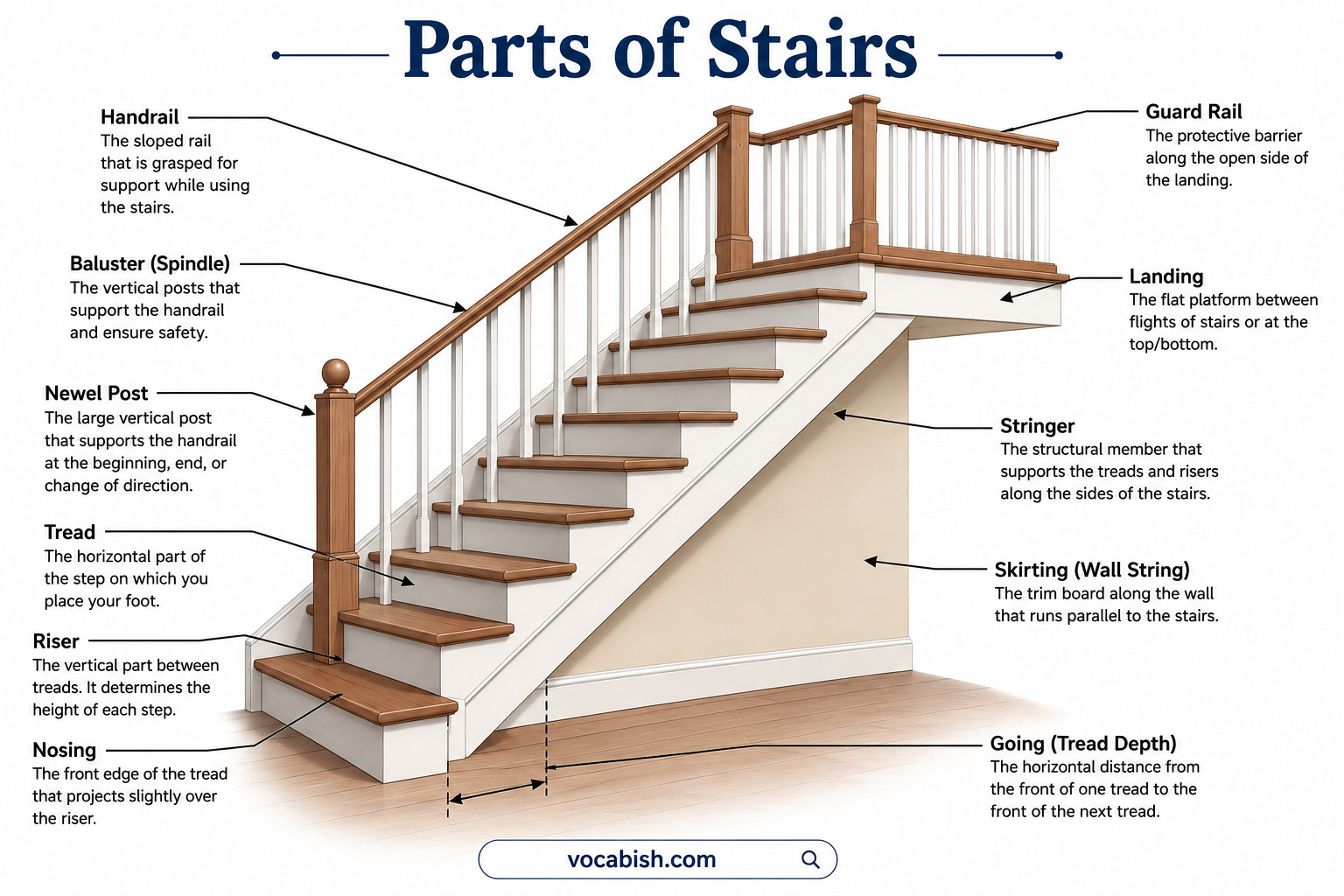

Stairs are structures used to move safely between different levels of a building in homes, schools, offices, and public places. In this blog post, you will learn the parts of stairs with their functions and a diagram to understand how each section of a staircase works together. From the steps and risers to the handrail and landing, every part has a specific role in support, balance, safety, and movement. Learning the names of stair parts helps you understand English vocabulary related to construction, architecture, building structure, and household design commonly used in technical and everyday situations.
What Are the Parts of Stairs?
The parts of stairs are the different sections that make a staircase work safely and properly. Some parts support weight, while others help people walk comfortably and avoid falling.
Builders, architects, and homeowners often use these words. Therefore, learning them improves both vocabulary and real-world understanding.
Main Parts of Stairs Explained
1. Tread
The tread is the flat part where you place your foot.
Function:
- Supports your foot while walking
- Makes climbing comfortable
- Provides walking space
Example:
- “The wooden tread feels smooth.”
2. Riser
The riser is the vertical part between two steps.
Function:
- Supports each stair step
- Adds strength to the staircase
- Controls stair height
Example:
- “The riser is painted white.”
3. Handrail
The handrail is the long rail people hold while using stairs.
Function:
- Helps people balance
- Improves safety
- Supports elderly people and children
Example:
- “Always hold the handrail while walking downstairs.”
4. Baluster
A baluster is a small vertical post under the handrail.
Function:
- Supports the handrail
- Prevents people from falling
- Adds decoration
Example:
- “The metal balusters look modern.”
5. Newel Post
The newel post is the large post at the top or bottom of stairs.
Function:
- Holds the handrail firmly
- Gives strength to the staircase
- Improves stability
Example:
- “The staircase has a strong oak newel post.”
6. Stringer
The stringer is the side support of the staircase.
Function:
- Holds the steps together
- Supports stair weight
- Keeps stairs stable
Example:
- “The wooden stringer cracked.”
7. Landing
A landing is a flat area between sections of stairs.
Function:
- Gives people a resting space
- Changes stair direction
- Improves safety
Example:
- “She stopped at the landing to rest.”
8. Nosing
The nosing is the front edge of a stair tread.
Function:
- Adds extra foot space
- Improves grip
- Reduces slipping
Example:
- “The stair nosing is slightly rounded.”
9. Bannister
“Bannister” is another word for the handrail and support system.
Function:
- Helps people hold the stairs safely
- Supports movement
- Prevents accidents
Example:
- “The child held the bannister tightly.”
10. Step
A step includes both the tread and riser.
Function:
- Helps people move upward or downward
- Creates the staircase structure
Example:
- “Be careful on the wet steps.”
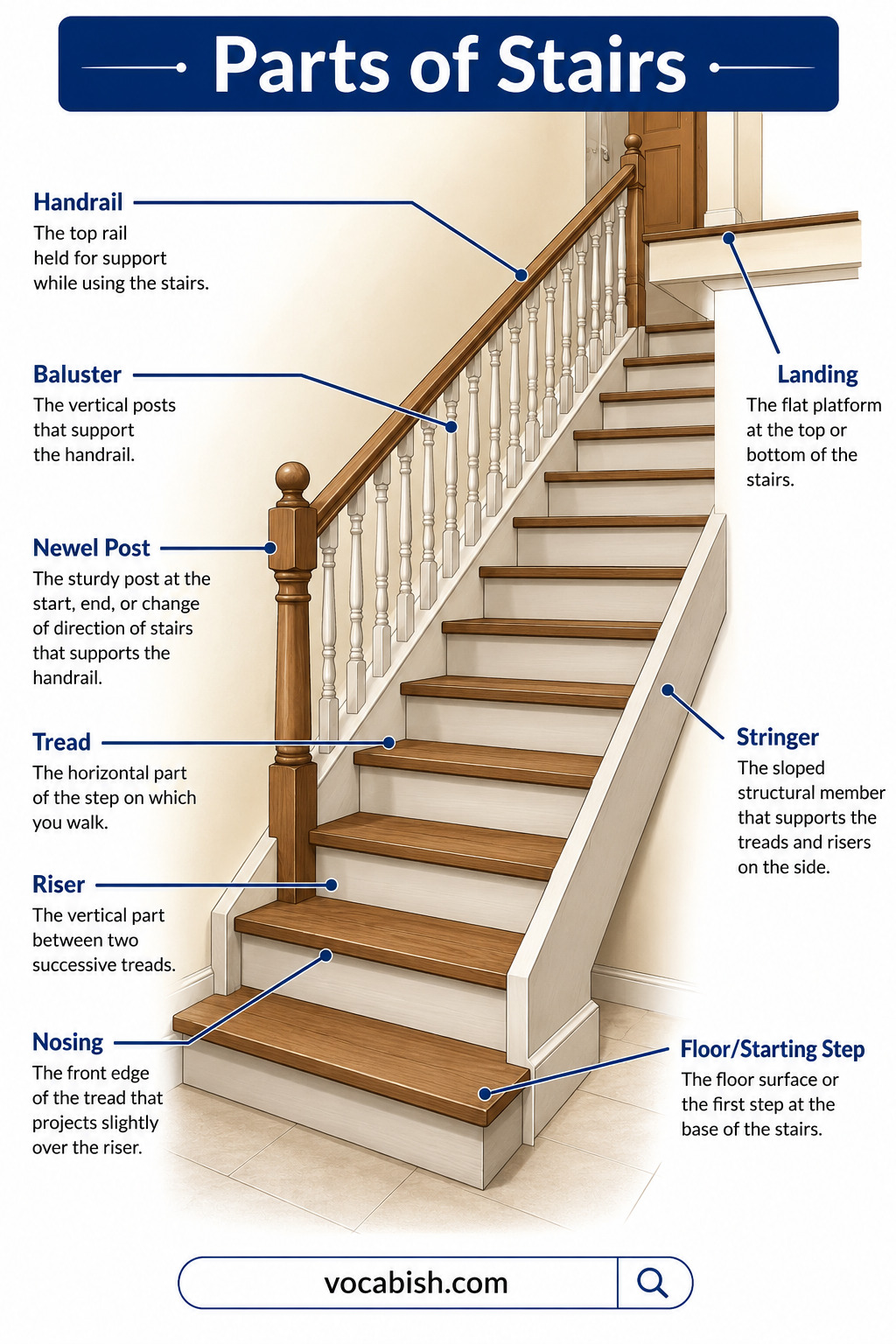
Common Staircase Parts and Terms
Below are important stair-related words with their meaning.
- Staircase — A complete set of stairs
- Step — One level of the staircase
- Tread — Flat surface for walking
- Riser — Vertical part between steps
- Handrail — Rail for holding
- Bannister — Support rail system
- Baluster — Vertical support post
- Newel Post — Large supporting post
- Landing — Flat resting platform
- Stringer — Side support board
- Nosing — Front edge of the step
- Spiral Staircase — Circular staircase
- Wooden Stairs — Stairs made from wood
- Concrete Stairs — Stairs made from concrete
- Metal Stairs — Stairs made from steel or iron
- Stair Carpet — Carpet covering the stairs
- Guardrail — Protective side barrier
- Open Staircase — Stairs without risers
- Closed Staircase — Stairs with risers
- Stair Lift — Chair system for elderly people
Types of Stair Parts
Structural Parts
These parts support the staircase.
- Stringer
- Riser
- Tread
- Newel Post
Safety Parts
These parts help prevent accidents.
- Handrail
- Bannister
- Baluster
- Nosing
Decorative Parts
These parts improve appearance.
- Carved Balusters
- Polished Handrails
- Decorative Newel Posts
English Sentences Using Stair Vocabulary
- “The stairs are very steep.”
- “Please hold the handrail.”
- “The wooden steps look beautiful.”
- “The landing is wide and bright.”
- “The child ran down the staircase.”
- “The metal balusters shine nicely.”
- “The riser needs repair.”
- “We painted the bannister black.”
Important Stair Terms for Beginners
Staircase
A staircase means the full stair structure inside a building.
Spiral Staircase
A spiral staircase turns in a circular shape.
Floating Stairs
Floating stairs look like they hang in the air.
Emergency Stairs
Emergency stairs help people leave buildings safely during danger.
Learning the parts of stairs helps you understand common building and home vocabulary. These words appear in daily life, construction work, schools, offices, and home conversations.
FAQs about Parts of Stairs
The main parts of stairs are tread, riser, handrail, baluster, stringer, landing, nosing, and newel post. Each part helps support safety and movement.
A tread is the flat horizontal part of a stair where people place their feet while walking up or down the staircase.
A riser supports each stair step vertically and helps maintain the height and strength of the staircase structure.
A stringer is the side support of stairs that holds the treads and risers together and keeps the staircase stable.
Nosing is the front edge of a stair tread that extends slightly outward to provide extra foot space and better grip.
Related Articles: