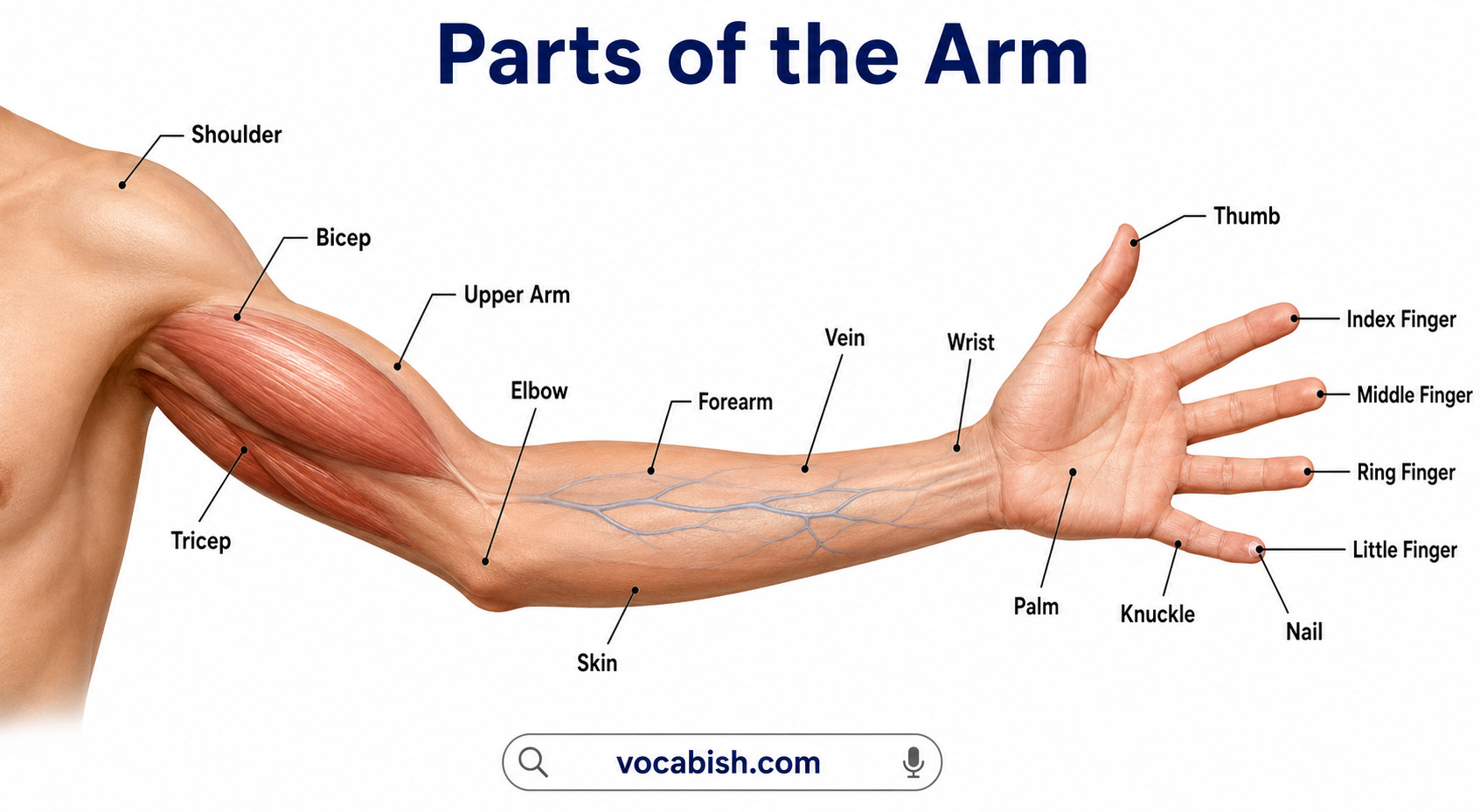

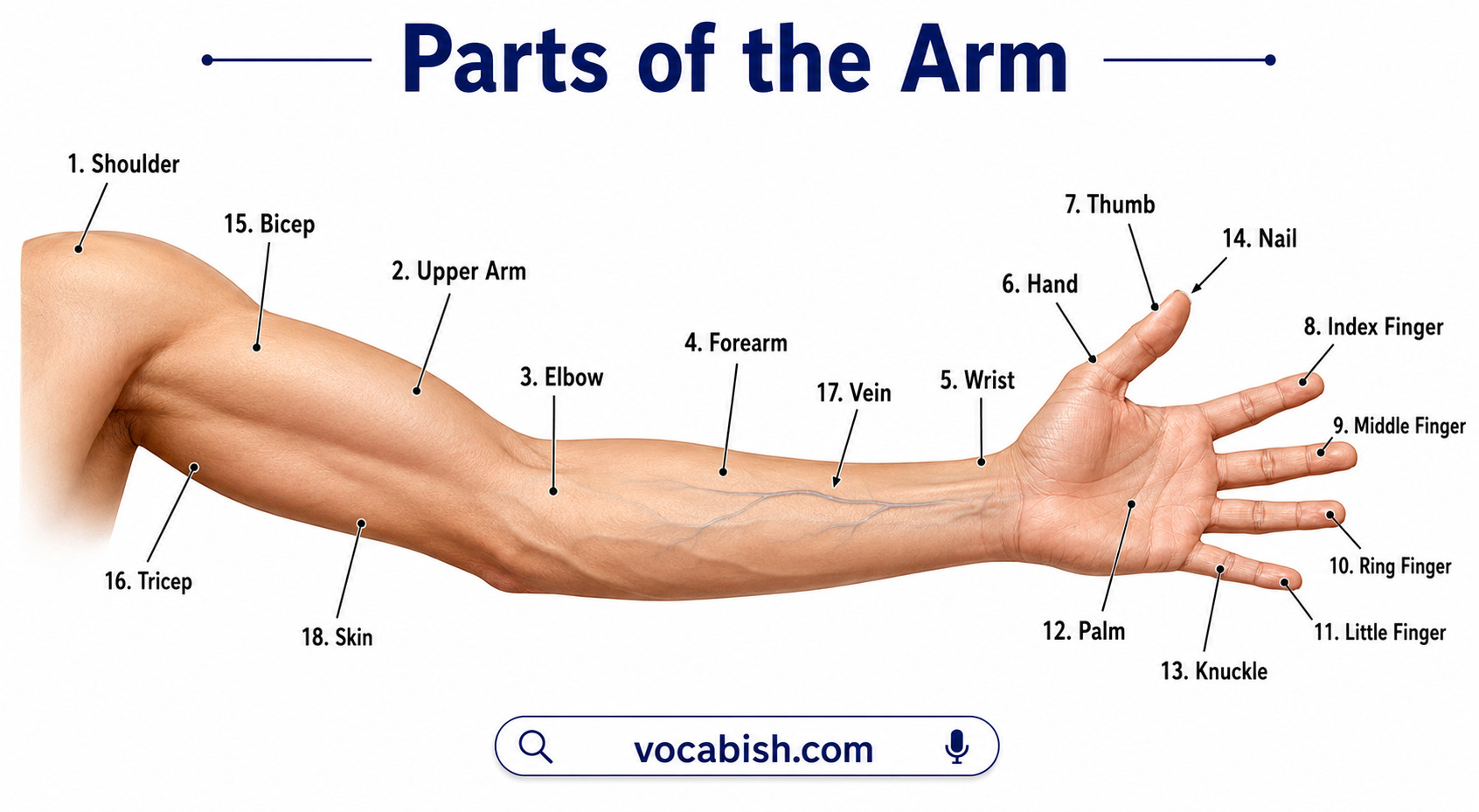
The arm is an important part of the human body that helps people lift, hold, push, pull, and carry different objects in daily life. In this blog post, you will learn the parts of the arm with their names in English and a diagram to understand the structure of the human arm in detail. From the shoulder and elbow to the wrist and fingers, each part of the arm has a specific role in movement, strength, and flexibility. Learning the names of arm parts helps you understand English vocabulary related to human anatomy, body structure, health, and physical movement commonly used in schools, books, and educational studies.
What Are the Parts of the Arm?
The arm is one of the most useful parts of the human body. We use our arms to lift, carry, write, throw, hug, and wave.
In English, the arm has many smaller parts. Each part has its own name and function. Learning these words improves your vocabulary and helps you communicate better.
Main Parts of the Arm in English
Here are the most important arm parts every English learner should know.
Arm Part | Meaning |
|---|---|
Shoulder | The top part that connects the arm to the body |
Upper Arm | The area between the shoulder and elbow |
Elbow | The joint in the middle of the arm |
Forearm | The part between the elbow and wrist |
Wrist | The joint connecting the hand and arm |
Hand | The body part used for holding things |
Fingers | The five small parts attached to the hand |
List of All Parts of the Arm with Meanings
Below is a complete list of arm parts vocabulary words with their meanings:
1. Shoulder
- Connects the arm to the body
- Helps move the arm in many directions
2. Upper Arm
- Located between the shoulder and elbow
- Contains strong muscles
3. Elbow
- A bending joint in the middle of the arm
- Helps the arm fold
4. Forearm
- Between the elbow and wrist
- Used for lifting and turning
5. Wrist
- Small joint before the hand
- Helps hand movement
6. Hand
- Used for touching, holding, and writing
- Contains fingers and thumb
7. Thumb
- Short and strong finger
- Helps grip objects
8. Index Finger
- The pointing finger
- Used for touching and pointing
9. Middle Finger
- The longest finger
- Located in the center
10. Ring Finger
- The finger next to the little finger
- Many people wear rings here
11. Little Finger
- The smallest finger
- Also called the pinky
Explore the names of 5 fingers and their diagrams.
12. Palm
- Inner part of the hand
- Used for holding things
13. Knuckle
- Finger joints visible when making a fist
- Helps fingers bend
14. Nail
- Hard covering on fingers
- Protects fingertips
15. Bicep
- Muscle in the upper arm
- Helps lift objects
16. Tricep
- Muscle at the back of the upper arm
- Helps straighten the arm
17. Vein
- Small tube carrying blood
- Visible under the skin
18. Skin
- Covers the arm and body
- Protects internal parts
Upper Parts of the Arm
The upper arm is strong and helps with lifting and pushing.
- Shoulder
- Bicep
- Tricep
- Upper arm muscle
Lower Parts of the Arm
The lower arm starts at the elbow and ends at the wrist.
- Elbow
- Forearm
- Wrist
- Veins
Hand and Finger Connection
The hand is connected to the arm through the wrist. Fingers help us write, eat, draw, and use tools.
- Thumb
- Index finger
- Middle finger
- Ring finger
- Little finger
Sentences Using Arm Parts
These simple examples help you understand the use of parts of the arm in everyday conversation.
- She raised her arm in class.
- My elbow hit the table.
- He washed his hands carefully.
- The baby held my finger.
- Her wrist hurts after typing.
- The athlete has strong biceps.
- I wear my bracelet on my wrist.
- The child pointed with his index finger.
Diagram of the Parts of Arm
Summary on Parts of Arm
Word | Body Area | Main Use |
|---|---|---|
Shoulder | Top of arm | Connects arm to body |
Elbow | Middle joint | Helps bending |
Forearm | Lower arm | Supports movement |
Wrist | Joint near hand | Moves the hand |
Palm | Inside hand | Holds objects |
Thumb | Hand | Gripping |
Bicep | Upper arm | Lifting |
Learning the parts of the arm in English is simple and practical. These words appear in daily conversations, schools, sports, and health topics. By learning each part step by step, English learners can improve vocabulary and speak more naturally.
FAQs about Parts of the Arm
The main parts of the arm are the shoulder, upper arm, elbow, forearm, wrist, hand, and fingers.
The five fingers are thumb, index finger, middle finger, ring finger, and little finger.
Yes, shoulders are connected to the arms and help arm movement. The shoulder joins the arm to the body and allows lifting, turning, and rotating motions.
The arm connects the shoulder to the wrist, while the hand is attached to the wrist and includes the palm, thumb, and fingers.
The main arm muscles are called the bicep and tricep. These muscles help the arm lift, pull, push, and carry objects.
The upper part of your arm is called the upper arm. It is located between the shoulder and the elbow and contains strong muscles like the bicep and tricep.
Related Articles: