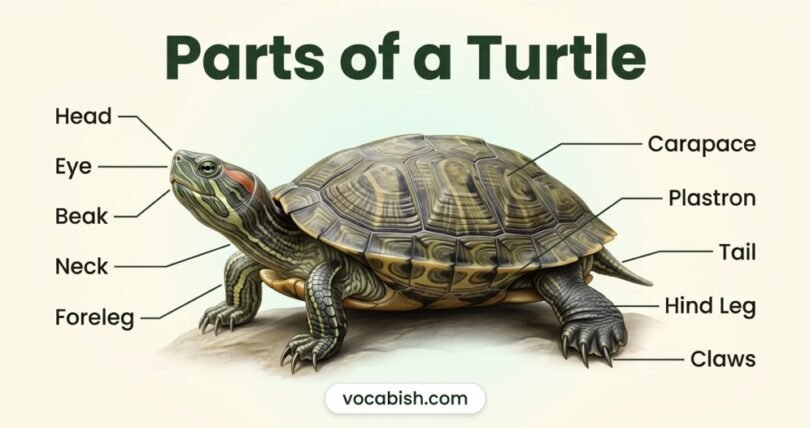

Parts of a turtle include the head, eyes, beak, neck, shell, legs, feet, claws, and tail. Each body part helps the turtle move, find food, breathe, or protect itself. The shell is one of its most important features, covering the upper and lower body while protecting internal organs. Turtles also have different types of limbs depending on where they live. Freshwater turtles often have webbed feet, while sea turtles use flippers for swimming. In this article, you will learn turtle body part names, their functions, and their positions through labelled diagrams. You will also discover the differences between external and internal turtle anatomy.
Parts of a Turtle with Names
A turtle has several visible body parts that help it sense its surroundings, find food, and move through its habitat. Although turtles share a similar body structure, their feet and shells can look different depending on the species.
The following table lists the main external and internal parts of a turtle with short descriptions.
No. | Turtle Part | Short Description |
|---|---|---|
1 | Head | Contains the brain and major sense organs. |
2 | Eyes | Detect light, movement, and nearby objects. |
3 | Eyelids | Cover and protect the eyes. |
4 | Nostrils | Allow air to enter during breathing. |
5 | Beak | Cuts and grips food without teeth. |
6 | Mouth | Takes in food and water. |
7 | Tongue | Helps move food inside the mouth. |
8 | Neck | Connects the head to the body. |
9 | Throat | Contains passages used for breathing and swallowing. |
10 | Shell | Protects the body and supports the skeleton. |
11 | Carapace | Forms the upper section of the shell. |
12 | Plastron | Forms the lower section of the shell. |
13 | Bridge | Connects the upper and lower shell sections. |
14 | Scutes | Keratin plates covering many turtles’ shells. |
15 | Marginal Scutes | Form the outer edge of the carapace. |
16 | Vertebral Scutes | Run along the centre of the carapace. |
17 | Costal Scutes | Cover areas beside the vertebral scutes. |
18 | Forelegs | Support movement and help with digging. |
19 | Hind Legs | Provide support and help propel the body. |
20 | Feet | Support walking or swimming movements. |
21 | Webbed Feet | Help many freshwater turtles swim. |
22 | Flippers | Provide swimming power in sea turtles. |
23 | Claws | Help with gripping, climbing, and digging. |
24 | Tail | Extends behind the shell and contains tail vertebrae. |
25 | Cloaca | Common opening for waste and reproduction. |
26 | Skin | Covers and protects exposed body areas. |
27 | Scales | Protect exposed skin on many body regions. |
28 | Lungs | Absorb oxygen from inhaled air. |
29 | Heart | Pumps blood throughout the body. |
30 | Stomach | Begins chemical digestion of swallowed food. |
31 | Intestines | Absorb nutrients and move digestive waste. |
32 | Liver | Processes nutrients and produces bile. |
33 | Kidneys | Filter blood and regulate water balance. |
34 | Bladder | Stores urine before release. |
35 | Spine | Supports the body and connects with the shell. |
36 | Ribs | Form part of the upper shell structure. |
Parts of a Turtle and Their Functions
Different turtle parts work together to support breathing, feeding, movement, and protection. The shell protects the body, while the head contains sensory organs that help the turtle respond to its surroundings.
Here are the functions of the most important turtle body parts.
Body Part | Main Function | How It Helps the Turtle |
|---|---|---|
Head | Holds sensory organs | Helps locate food and detect danger. |
Eyes | Provides vision | Helps identify movement and obstacles. |
Nostrils | Takes in air | Allows the turtle to breathe at the surface. |
Beak | Bites and cuts food | Helps eat plants or animals. |
Neck | Moves the head | Helps reach food and respond to threats. |
Shell | Protects internal organs | Provides a strong protective covering. |
Carapace | Protects the upper body | Shields the back and supports the skeleton. |
Plastron | Protects the underside | Covers vulnerable lower body areas. |
Forelegs | Supports locomotion | Helps with walking or digging. |
Hind Legs | Supports and propels | Helps move on land or in water. |
Webbed Feet | Improves swimming | Helps push water backward. |
Flippers | Powers swimming | Helps sea turtles travel through water. |
Claws | Provides grip | Helps with digging and climbing. |
Tail | Supports reproductive anatomy | Houses the cloacal opening. |
Lungs | Exchanges respiratory gases | Supplies oxygen to the body. |
Heart | Circulates blood | Delivers oxygen and nutrients to tissues. |
Intestines | Absorbs nutrients | Helps the body use digested food. |
Parts of a Turtle Diagram
A labelled turtle diagram shows where each body part is located. It helps students connect anatomical vocabulary with the correct areas of a turtle’s body.
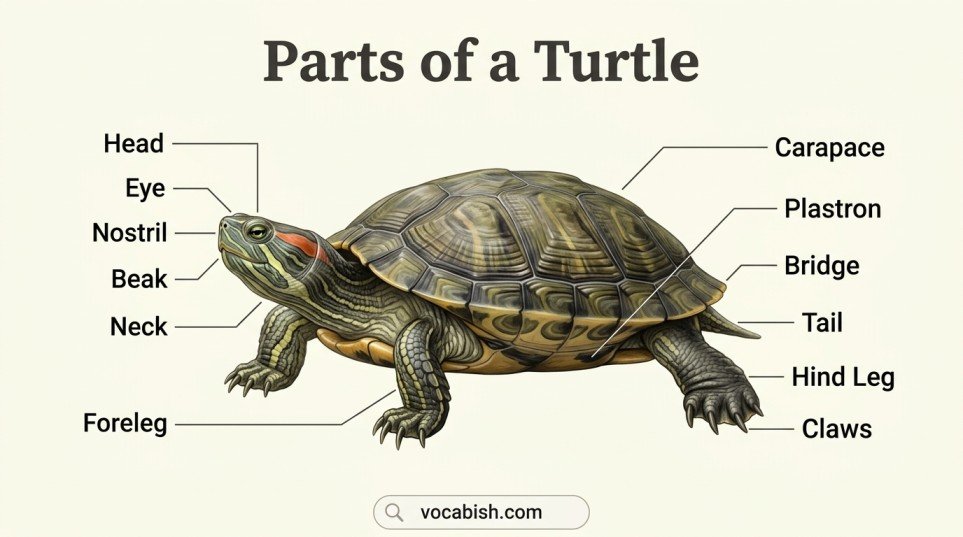
A side-view diagram can show the head, beak, neck, shell, legs, feet, claws, and tail. A separate view of the underside helps identify the plastron and bridge.
External and Internal Parts of a Turtle
Turtle anatomy includes external structures visible outside the body and internal organs hidden beneath the shell. Both groups help the turtle perform important activities such as breathing, eating, and moving.
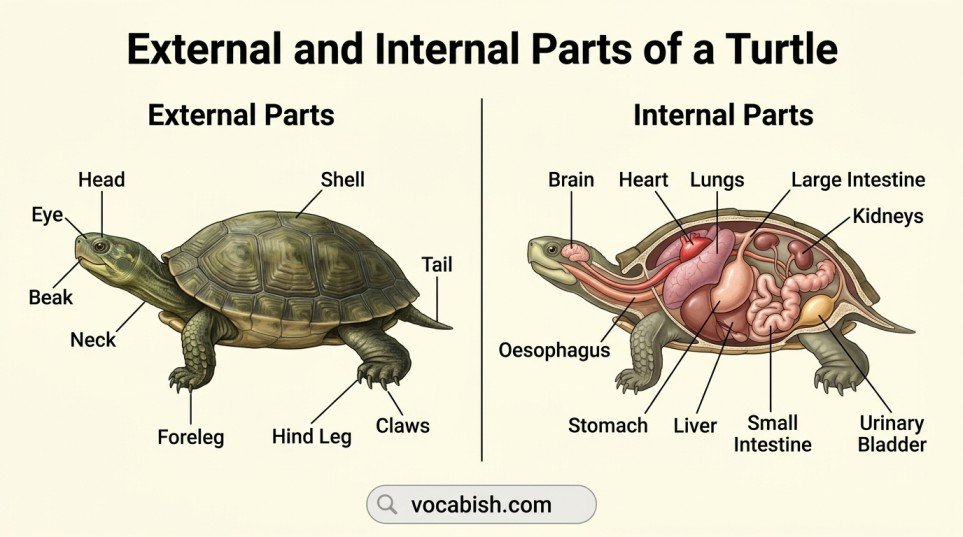
External Parts of a Turtle
External body parts are those you can identify by looking at the turtle.
External Part | Description |
|---|---|
Shell | Hard covering around the main body. |
Head | Front body region containing sensory organs. |
Beak | Toothless structure used for biting food. |
Neck | Flexible region between head and body. |
Legs | Limbs used for movement and support. |
Feet | End portions of the limbs. |
Claws | Hard pointed structures on the toes. |
Tail | Rear extension of the body. |
Skin | Protective covering of exposed areas. |
Internal Parts of a Turtle
Internal organs lie inside the turtle’s body and carry out functions necessary for survival.
Internal Part | Description |
|---|---|
Brain | Controls movement and body activities. |
Heart | Circulates blood through the body. |
Lungs | Exchange oxygen and carbon dioxide. |
Oesophagus | Carries swallowed food toward the stomach. |
Stomach | Breaks down food during digestion. |
Liver | Processes nutrients and produces bile. |
Small Intestine | Absorbs most digested nutrients. |
Large Intestine | Absorbs water and processes waste. |
Kidneys | Remove wastes from the blood. |
Urinary Bladder | Stores urine. |
Spinal Cord | Carries nerve signals through the body. |
Reproductive Organs | Produce eggs or sperm. |
Unlike humans, turtles have a rigid shell surrounding much of their trunk. Their ribs are incorporated into the shell, and specialised muscles help them breathe without expanding the rib cage in the usual way.
Parts of a Turtle Shell
The turtle shell is a living part of its skeleton, not a separate covering that the animal can leave behind. It contains bone and usually has an outer covering of keratin scutes.
A typical hard-shelled turtle has three major shell regions.
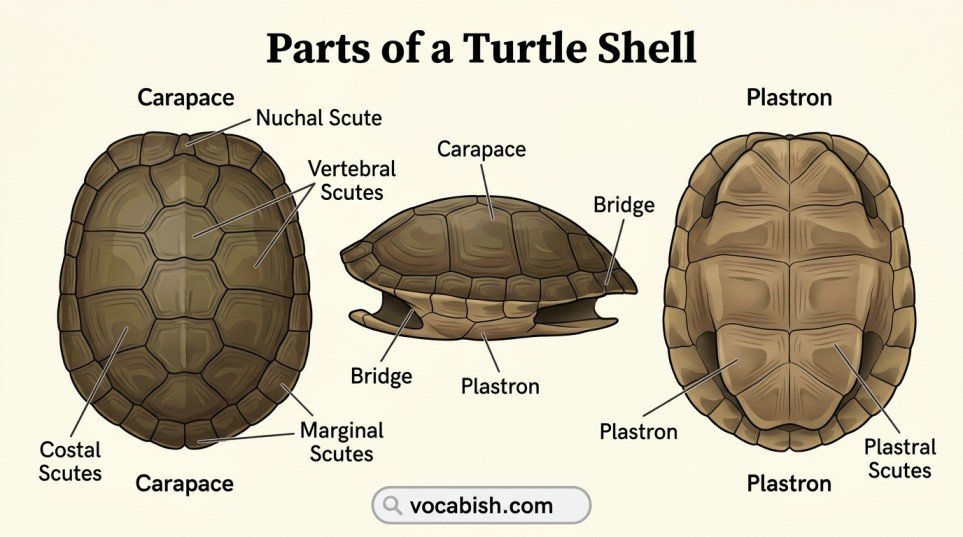
Turtle shell anatomy showing the upper carapace, lower plastron, and shell scutes.
1. Carapace
The carapace is the upper part of the shell. It contains bone connected with the ribs and vertebrae.
Its main function is to protect the turtle’s back and internal organs. The shape varies among species, from highly domed tortoise shells to flatter aquatic turtle shells.
2. Plastron
The plastron is the lower part of the shell. It protects the underside of the turtle’s body.
Some turtles have a hinged plastron that allows them to close parts of their shell for additional protection.
3. Bridge
The bridge connects the carapace to the plastron along the sides of the body.
It helps maintain the shell’s structural strength. The shape and size of the bridge vary among turtle species.
Scutes of a Turtle Shell
Scutes are protective plates made from keratin, the material also found in human fingernails.
Scute Type | Location | Function |
|---|---|---|
Vertebral Scutes | Centre of the upper shell | Cover the central carapace region. |
Costal Scutes | Sides of the upper shell | Cover areas beside the vertebral scutes. |
Marginal Scutes | Outer edge of the upper shell | Protect the shell margin. |
Nuchal Scute | Front edge of the upper shell | Covers the area near the neck. |
Plastral Scutes | Underside of the shell | Cover and protect the plastron. |
Not every turtle has the same shell covering. Leatherback sea turtles have leathery skin over their shell rather than the large hard scutes found in many other species.
Turtle Feet, Legs, and Flippers
Turtle limbs have different shapes because species move through different environments. Land-dwelling turtles need strong legs for walking, while aquatic species have adaptations that make swimming easier.
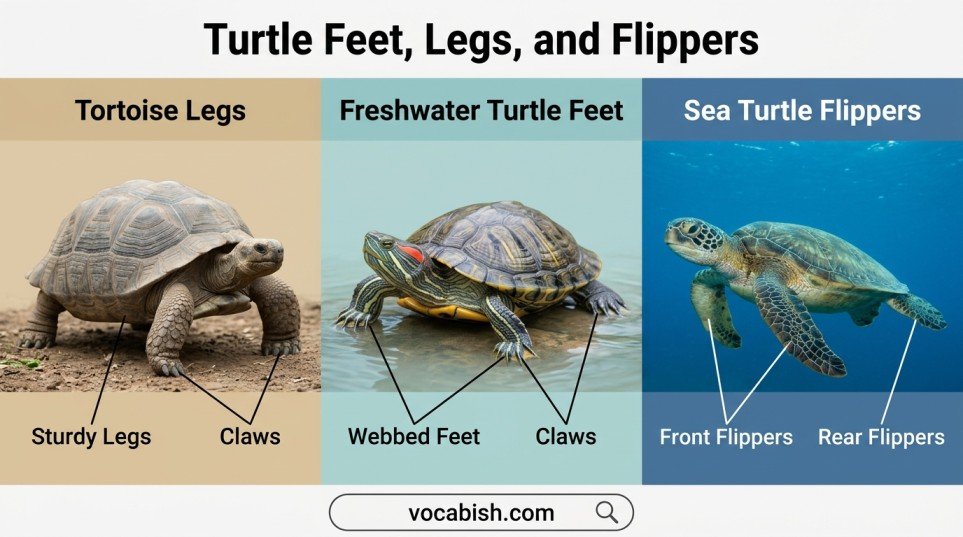
The differences are especially noticeable when comparing tortoises, freshwater turtles, and sea turtles.
Limb Type | Commonly Found In | Main Function |
|---|---|---|
Sturdy Legs | Tortoises | Support walking on land. |
Webbed Feet | Many freshwater turtles | Help with swimming and walking. |
Front Flippers | Sea turtles | Generate swimming propulsion. |
Rear Flippers | Sea turtles | Help steer and stabilise movement. |
Clawed Feet | Many freshwater and land turtles | Help with gripping and digging. |
How Do Turtle Legs Differ From Flippers?
A turtle’s leg usually has distinct toes, often with claws. It can support walking, digging, or climbing.
A sea turtle’s flipper is a flattened, paddle-shaped limb. Its front flippers provide most of the swimming power, while its rear flippers help with steering and digging nests.
Differences Between Turtle, Tortoise, and Sea Turtle Body Parts
Turtles, tortoises, and sea turtles belong to the reptile order Testudines. Their body structures share many features, but shell shapes and limb adaptations reflect where they live.
The word turtle can describe all members of this group, although everyday English often distinguishes freshwater turtles from tortoises and sea turtles.
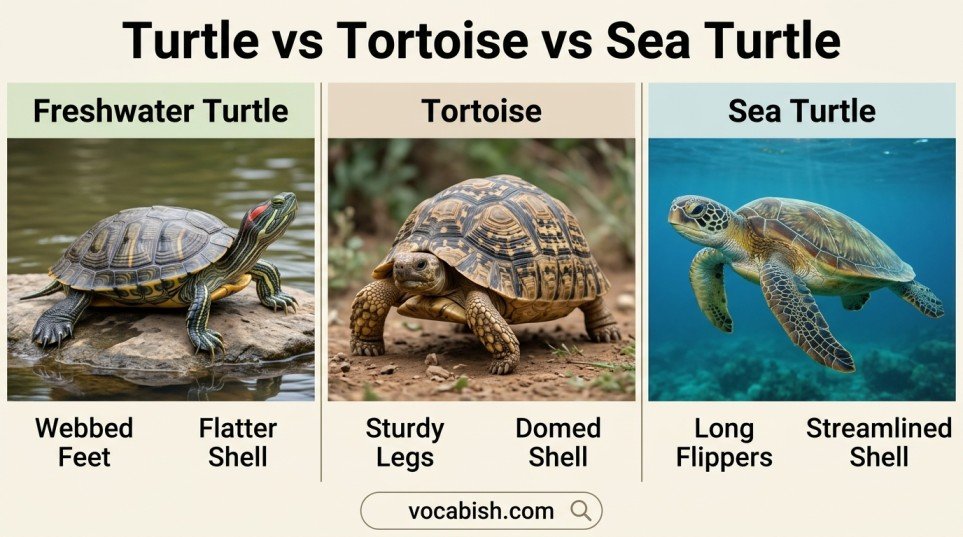
Body Feature | Freshwater Turtle | Tortoise | Sea Turtle |
|---|---|---|---|
Shell | Often flatter | Usually more domed | Generally streamlined |
Front Limbs | Legs with feet | Strong walking legs | Long swimming flippers |
Hind Limbs | Feet, often webbed | Sturdy walking legs | Rear flippers |
Claws | Usually present | Usually present | Reduced or absent in some species |
Neck | Often retractable | Usually retractable | Cannot fully retract into shell |
Movement | Swimming and walking | Mainly walking | Primarily swimming |
Habitat | Freshwater and nearby land | Mainly land | Marine environments |
These differences are general patterns. Individual species may have different adaptations.
How Turtle Body Parts Help Them Survive
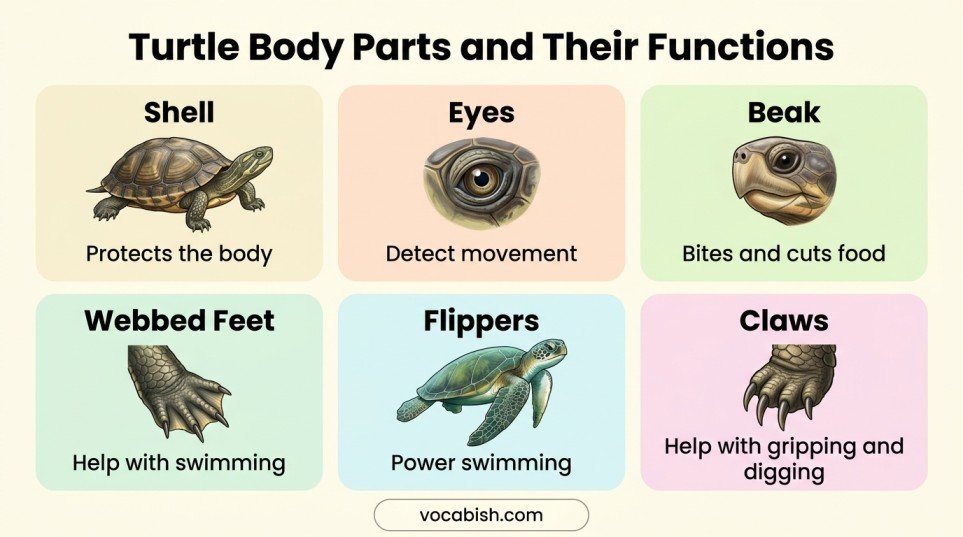
Each part of a turtle’s body contributes to survival in a particular way. Its shell provides protection, while its limbs and sensory organs help it interact with the environment.
Some important adaptations include:
- Shell protection: The bony shell shields the trunk and many internal organs from injury.
- Head retraction: Many freshwater turtles and tortoises pull their heads into their shells when threatened.
- Swimming adaptations: Webbed feet and flippers help aquatic turtles move efficiently through water.
- Feeding adaptations: The beak’s shape helps turtles cut vegetation or grip animal prey.
- Breathing adaptations: Lungs allow turtles to breathe air, even when they spend much of their lives underwater.
- Protective colouring: Shell and skin patterns can help turtles blend into their surroundings.
Sea turtles must surface to breathe because they have lungs rather than gills. They can remain underwater for extended periods, particularly when resting, but they cannot breathe underwater like fish.
Common Turtle Anatomy Mistakes
Some turtle body parts are easily confused because their names describe closely related structures. These distinctions help learners use the correct English vocabulary.
- Shell vs. carapace: The shell includes both the upper carapace and lower plastron.
- Scutes vs. scales: Scutes cover shell surfaces, while scales protect many exposed skin areas.
- Beak vs. teeth: Living turtles have beaks and do not have true teeth.
- Legs vs. flippers: Sea turtles have specialised flippers rather than ordinary walking feet.
- Shell vs. home: A turtle’s shell is attached to its skeleton and cannot be removed safely.
Frequently Asked Questions
The main parts include the head, eyes, beak, neck, shell, legs, feet, claws, and tail. Each performs a different function.
The carapace forms the upper shell, while the plastron covers the underside. Together, they protect the turtle’s body and internal organs.
A turtle’s shell protects its internal organs, supports its body structure, and provides attachment points for muscles and parts of the skeleton.
Living turtles have toothless beaks rather than true teeth. Their sharp or specialised beak edges help them bite and cut different foods.
Many freshwater turtles have webbed feet for swimming and walking. Sea turtles have paddle-shaped flippers adapted for movement through water.
No. A turtle’s shell is permanently connected to its skeleton and contains living tissue. Removing it would cause severe injury.
Major internal organs include the brain, heart, lungs, stomach, liver, intestines, and kidneys. These control body functions and support survival.
Turtles share a basic anatomical structure, but their shell shapes, limbs, claws, and other features vary according to species and habitat.
Conclusion
Learning the Parts of a Turtle helps students recognise the animal’s external features, internal organs, and protective shell structures. The carapace, plastron, head, beak, limbs, and tail each have specific roles. By studying their names, functions, and labelled diagrams, English learners can describe turtle anatomy accurately and understand how different turtle species are adapted to their environments.