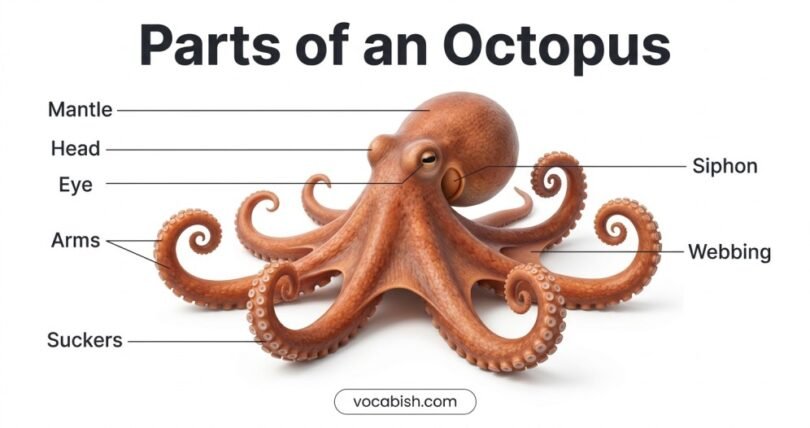

The parts of an octopus include eight flexible arms, suckers, a mantle, a head, eyes, a siphon, a mouth, and a hard beak. Each body part helps the octopus move, catch food, breathe, or protect itself underwater. Unlike many other sea animals, an octopus has no bones, allowing its soft body to squeeze through narrow spaces. Its suckers help it grip objects, while its skin can change colour to blend into its surroundings. In this article, you will learn the names and functions of octopus body parts, explore their internal anatomy, and identify important structures using labelled diagrams and easy explanations.
Parts of an Octopus with Names
The main parts of an octopus include its mantle, head, arms, suckers, eyes, siphon, and beak. Each structure performs a particular function that helps the animal survive underwater.
The following table lists the important external and internal body parts with short descriptions.
Body Part | Location | Function |
|---|---|---|
Mantle | Rounded body behind the head | Protects internal organs and helps with breathing. |
Head | Between the mantle and arms | Contains the brain and supports the eyes. |
Arms | Eight extensions around the mouth | Help with movement, hunting, and exploring. |
Suckers | Undersides of the arms | Grip objects and detect chemical signals. |
Eyes | Either side of the head | Detect light, shapes, and movement. |
Pupil | Centre of each eye | Allows light to enter the eye. |
Skin | Covers the entire body | Provides protection and changes colour for camouflage. |
Webbing | Thin skin between the arm bases | Helps capture prey and control movement. |
Siphon | Muscular tube near the head | Pushes water out for jet propulsion. |
Mouth | Centre where the arms meet | Takes in food. |
Beak | Inside the mouth | Bites and breaks apart prey. |
Radula | Inside the mouth, behind the beak | Helps process food using tiny tooth-like structures. |
Gills | Inside the mantle cavity | Absorb oxygen from seawater. |
Brain | Inside the head | Controls behaviour and processes sensory information. |
Hearts | Inside the body | Pump blood through the gills and body. |
Ink Sac | Inside the mantle | Stores ink used for defence. |
Digestive Gland | Inside the mantle | Helps digest food and store nutrients. |
Stomach | Inside the mantle | Helps break down swallowed food. |
Chromatophores | Within the skin | Expand or contract to change visible skin colour. |
Papillae | On the skin | Change skin texture to help with camouflage. |
Parts of an Octopus Diagram
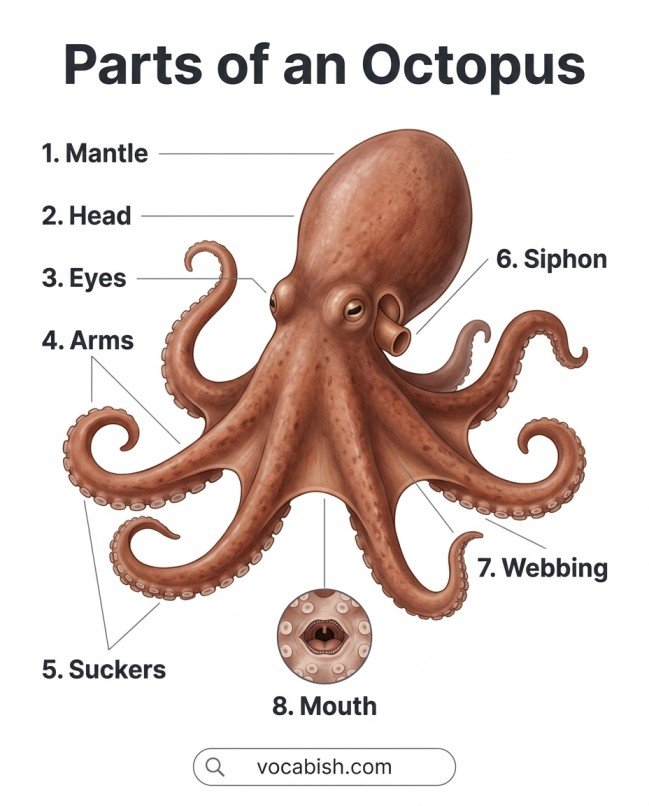
A labelled octopus diagram helps you recognise the position of each body part. It is especially useful for identifying structures that may look similar in photographs.
External Parts of an Octopus and Their Functions
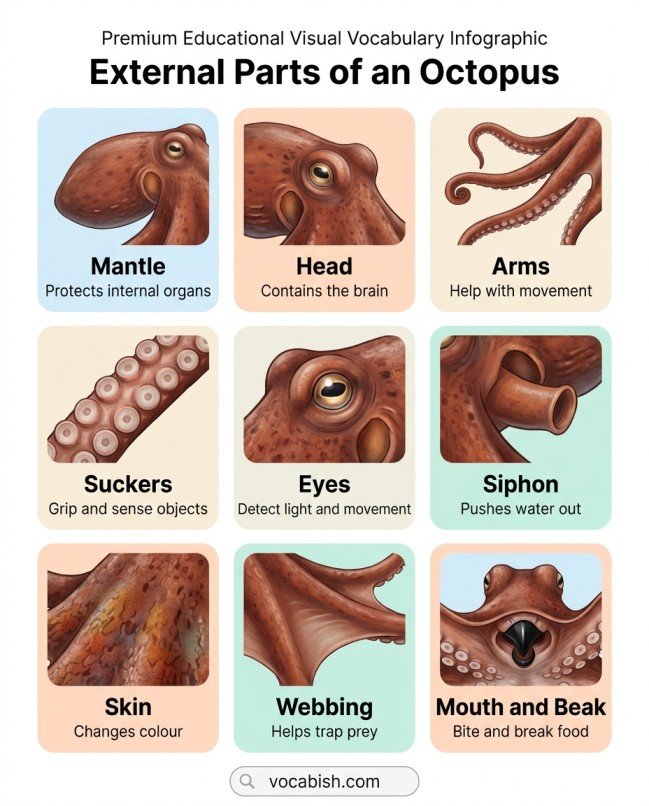
The external anatomy of an octopus helps it interact with its surroundings. These visible structures allow it to swim, crawl, catch prey, sense danger, and hide from predators.
1. Mantle
The mantle is the rounded, muscular part of an octopus’s body. It contains many internal organs, including the gills and digestive system.
The mantle also expands and contracts to move water through the mantle cavity during breathing.
2. Head
The head connects the mantle to the arms. It contains the central brain and supports the eyes.
An octopus uses its head region to process information from its surroundings and coordinate movement.
3. Arms
An octopus has eight arms that can bend, twist, and move independently.
These arms help it crawl across the seabed, capture prey, explore narrow spaces, and handle objects.
Each arm contains numerous nerve cells that help control its movements.
4. Suckers
Suckers are small, round structures found along the underside of the arms.
They create suction to grip surfaces and hold prey. They also contain sensory receptors that allow an octopus to detect chemical substances through contact.
5. Eyes
Octopuses have two well-developed eyes that help them see underwater.
Their eyes detect movement, light, and shapes. The pupils of many octopus species appear horizontal or rectangular.
6. Siphon
The siphon, also called the funnel, is a muscular tube near the head.
An octopus pushes water through this tube to move quickly in the opposite direction. This movement is known as jet propulsion.
The siphon also helps expel waste and released ink.
7. Skin
Octopus skin is soft, flexible, and capable of changing its appearance.
Specialised pigment cells called chromatophores help produce colour changes. Other skin structures can alter the animal’s texture.
These abilities help the octopus hide from predators and communicate.
8. Webbing
Webbing is the thin membrane of skin connecting the bases of an octopus’s arms.
An octopus can spread this webbing around prey, helping prevent smaller animals from escaping.
Some deep-sea species have especially large webs between their arms.
9. Mouth and Beak
The mouth is located underneath the body, where the eight arms meet.
Inside the mouth is a hard, sharp beak that resembles a parrot’s beak.
An octopus uses this structure to bite prey such as crabs and other shellfish.
Internal Anatomy of an Octopus
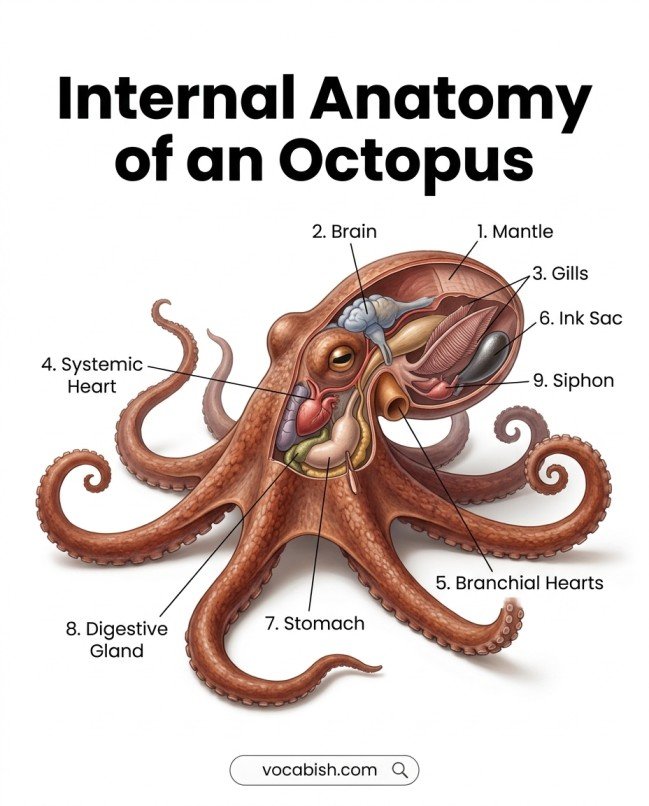
The internal organs of an octopus support breathing, circulation, digestion, and defence. Most of these organs are located inside the mantle, while the central brain surrounds the oesophagus in the head.
Three Hearts
An octopus has three hearts that circulate blood through its body.
Two branchial hearts pump blood towards the gills, while one systemic heart pumps oxygen-rich blood to the rest of the body.
Gills
The gills are respiratory organs inside the mantle cavity.
Water passes over the gills, allowing oxygen to enter the blood and carbon dioxide to leave.
Brain and Nervous System
The central brain processes sensory information and helps control behaviour.
Octopuses also have complex nerve networks in their arms. These networks allow individual arms to perform many movements without continuous instructions from the central brain.
Ink Sac
The ink sac stores a dark substance that an octopus can release when threatened.
The released ink may confuse predators and give the octopus time to escape.
Not all octopus species have a functional ink sac.
Digestive System
The digestive system processes food and absorbs nutrients.
The beak breaks apart prey, the radula helps process food, and the stomach and digestive gland support digestion.
Reproductive Organs
Octopuses reproduce sexually. Males have specialised reproductive structures, including a modified arm called the hectocotylus, which transfers sperm packets.
Females produce eggs and often protect them until they hatch.
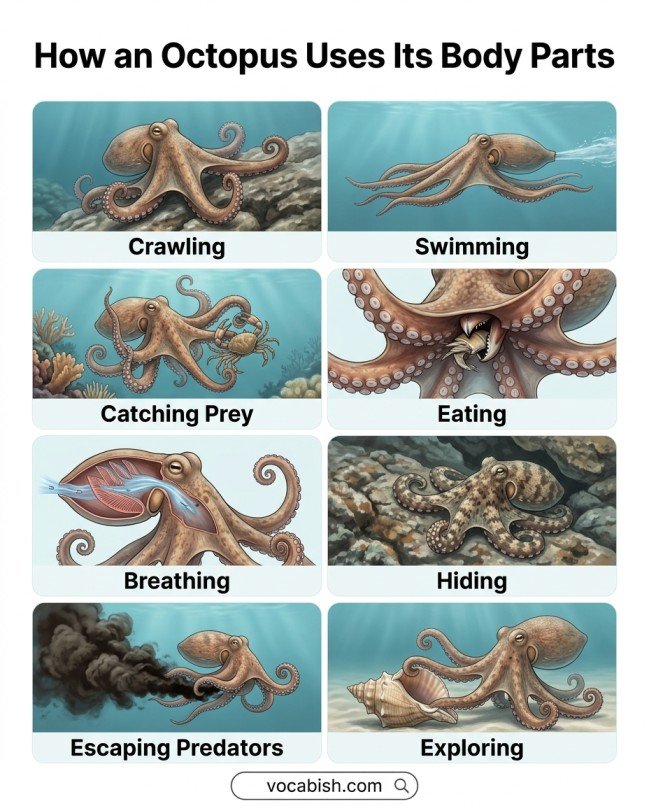
How an Octopus Uses Its Body Parts
Octopus body parts work together during everyday activities. Their flexible anatomy allows them to perform movements that many other marine animals cannot.
Activity | Body Parts Used | How They Work |
|---|---|---|
Crawling | Arms and suckers | Pull the body across underwater surfaces. |
Swimming | Mantle and siphon | Push water backwards to propel the body. |
Catching prey | Arms and webbing | Surround and hold captured animals. |
Eating | Beak and radula | Bite and process food. |
Breathing | Mantle and gills | Move water across respiratory surfaces. |
Hiding | Skin and chromatophores | Change appearance to match surroundings. |
Escaping predators | Ink sac and siphon | Release ink and move away rapidly. |
Exploring | Suckers and eyes | Detect chemical signals and observe objects. |
Do Octopuses Have Arms or Tentacles?
Octopuses have eight arms, not eight tentacles. Although people sometimes call them tentacles, the two terms describe different anatomical structures.
In cephalopods, arms usually have suckers along much of their length. Tentacles are typically specialised for capturing prey and often have suckers concentrated near their tips.
Feature | Octopus Arms | Squid Tentacles |
|---|---|---|
Number | Eight arms | Usually two tentacles |
Suckers | Along much of the arm | Mainly on enlarged tips |
Main purpose | Movement and handling prey | Capturing prey |
Structure | Flexible and muscular | Often longer and specialised |
Squids generally have eight arms and two additional tentacles. Octopuses have only eight arms.
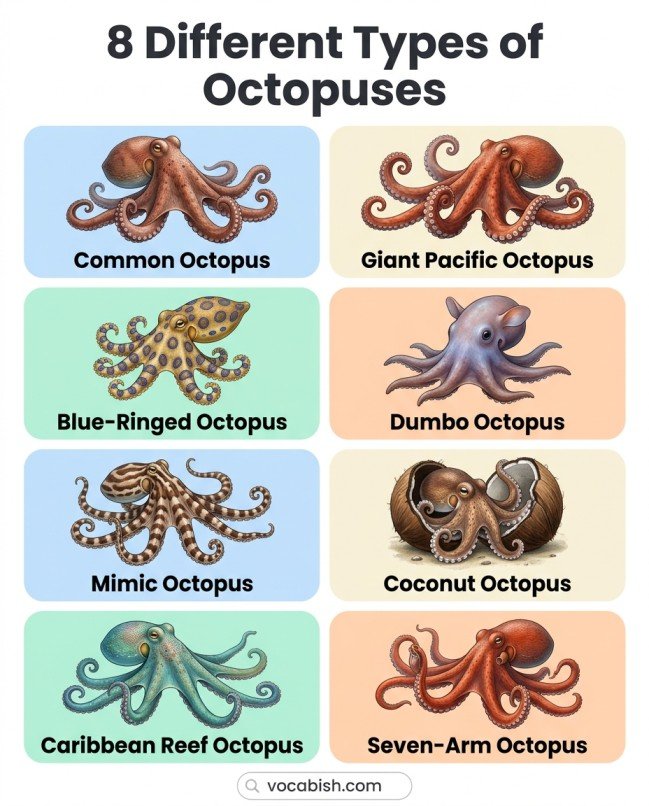
Different Types of Octopuses
There are hundreds of octopus species living in oceans around the world. Their basic body structures are similar, but some species have adaptations suited to their habitats.
Common octopus types and their distinctive features:
Octopus Type | Distinctive Feature | Main Use |
|---|---|---|
Common Octopus | Strong arms and adaptable skin | Hunting and camouflage |
Giant Pacific Octopus | Large body and powerful suckers | Handling prey and moving across rocks |
Blue-Ringed Octopus | Bright blue warning rings | Warning predators when threatened |
Dumbo Octopus | Ear-like fins on the mantle | Swimming in deep water |
Mimic Octopus | Flexible body and changing appearance | Imitating other marine animals |
Coconut Octopus | Flexible arms and object-handling ability | Using shells as shelter |
Caribbean Reef Octopus | Rapid skin colour changes | Camouflage among reefs |
Seven-Arm Octopus | One arm is less visible in males | Specialised reproduction |
These are examples of octopus types, not a complete list of all species. Their distinctive features do not replace the main organs shared by most octopuses.
Interesting Facts About Octopus Anatomy
Octopuses have several unusual anatomical features that distinguish them from many other marine animals.
- Three hearts: Two pump blood to the gills, and one supplies the body.
- Blue blood: Their blood contains hemocyanin, a copper-based protein that carries oxygen.
- No bones: Their soft bodies allow them to squeeze through narrow openings, provided their hard beak can fit.
- Arm regeneration: Many octopuses can regrow an injured or lost arm.
- Sensitive suckers: Their suckers can detect both touch and chemical signals.
- Colour-changing skin: Specialised skin cells help them blend into their surroundings.
- Distributed nervous system: A large proportion of their neurons are located outside the central brain, particularly in their arms.
Common Mistakes About Octopus Body Parts
Some octopus anatomy terms are easily confused, especially when identifying parts in diagrams.
- Arms vs. tentacles: An octopus has eight arms, not eight tentacles.
- Head vs. mantle: The rounded body is the mantle, not the head.
- Suckers vs. suction cups: Suckers are living sensory structures, not just gripping tools.
- Beak vs. teeth: An octopus has a hard beak rather than ordinary teeth.
- Ink sac vs. siphon: The ink sac stores ink, while the siphon expels it with water.
Frequently Asked Questions
The main parts include the mantle, head, eight arms, suckers, eyes, siphon, mouth, and beak. Internal organs include the gills, hearts, and brain.
An octopus has eight flexible arms. Each arm contains muscles, nerves, and suckers that help the animal move, explore surfaces, and catch prey.
The mantle protects important internal organs and helps move water across the gills. Its muscular contractions also support swimming through jet propulsion.
An octopus’s mouth is underneath its body, at the centre of its eight arms. It contains a hard beak used for biting prey.
Two hearts pump blood towards the gills for oxygen exchange. The third heart pumps oxygen-rich blood throughout the rest of the body.
Octopus suckers help grip surfaces, hold prey, and explore objects. Their sensory receptors can also detect chemical signals when they touch something.
Yes, many octopuses can regenerate damaged or lost arms. The process takes time and can restore important structures, including suckers and nerves.
The head contains the central brain and supports the eyes. The mantle is the rounded muscular body that surrounds most internal organs.
Conclusion
Learning the parts of an octopus helps you recognise its external structures and understand how its internal organs function. The eight arms and suckers support movement and hunting, while the mantle, gills, and hearts help the animal survive underwater.
A labelled octopus diagram makes these anatomical names easier to identify and remember. By connecting each body part with its function, English learners can build useful marine animal vocabulary and a better understanding of octopus anatomy.