
Learning shapes in Spanish is a practical way to build everyday vocabulary and improve your confidence in the language. Shape names appear in school lessons, art activities, geometry topics, children’s books, and daily conversations, making them useful words to know from the beginning. Whether you’re looking to understand how to say shapes in Spanish, expand your classroom vocabulary, or compare shapes in Spanish and English, these terms can help you describe objects more accurately.
In this article, you’ll learn more than 50 Spanish shape names, their English meanings, pronunciation tips, and examples that make them easier to remember and use naturally.
What Are Shapes in Spanish?
Shapes are the forms or outlines of objects. In Spanish, the word for shape is forma.
When talking about multiple shapes, Spanish speakers use formas.
Examples:
- Shape = Forma
- Shapes = Formas
You will often hear these words in:
- School lessons
- Art classes
- Math activities
- Children’s learning materials
- Everyday descriptions
For example:
La mesa tiene forma rectangular.
(The table has a rectangular shape.)
Basic Shapes in Spanish and English
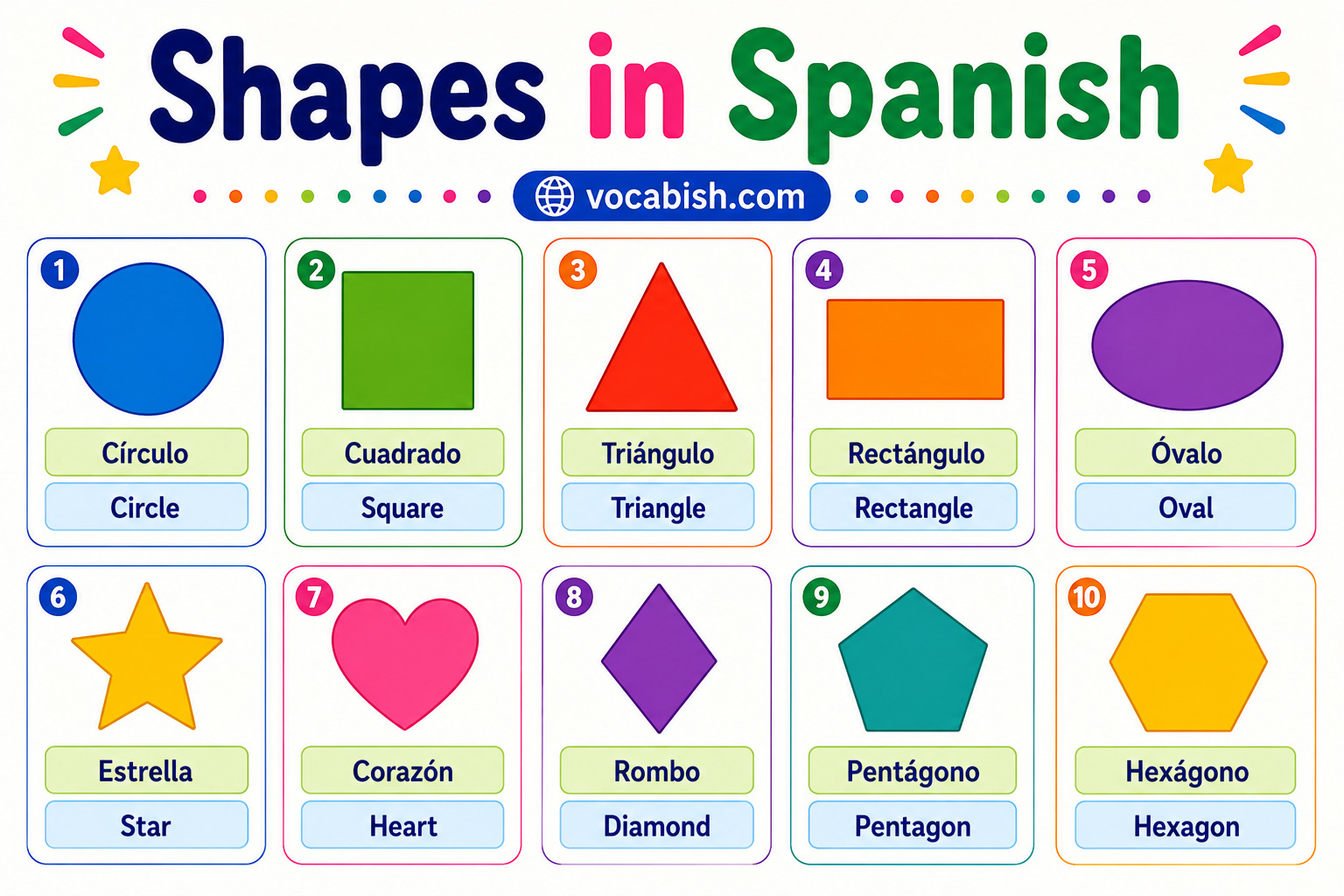
These are the first shapes most learners encounter.
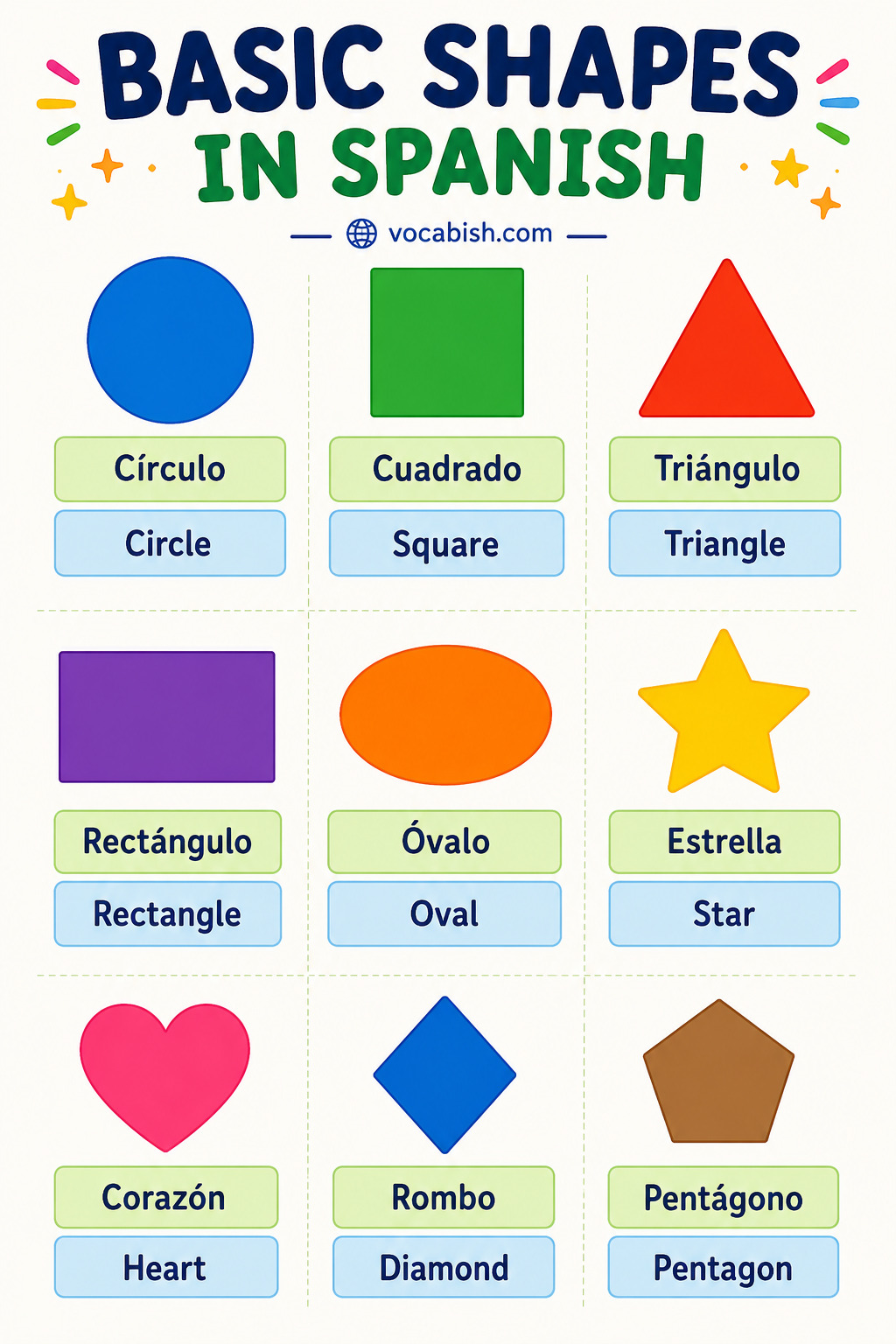
- Círculo (Circle) — Round shape with no corners or edges.
- Cuadrado (Square) — Four equal sides with four corners.
- Triángulo (Triangle) — Three straight sides meeting at corners.
- Rectángulo (Rectangle) — Four sides with opposite sides equal.
- Óvalo (Oval) — Rounded shape longer than a circle.
- Estrella (Star) — Pointed shape with multiple sharp tips.
- Corazón (Heart) — Curved shape symbolizing love and affection.
- Rombo (Diamond) — Slanted four-sided shape with equal sides.
50+ Shapes in Spanish with English Meanings
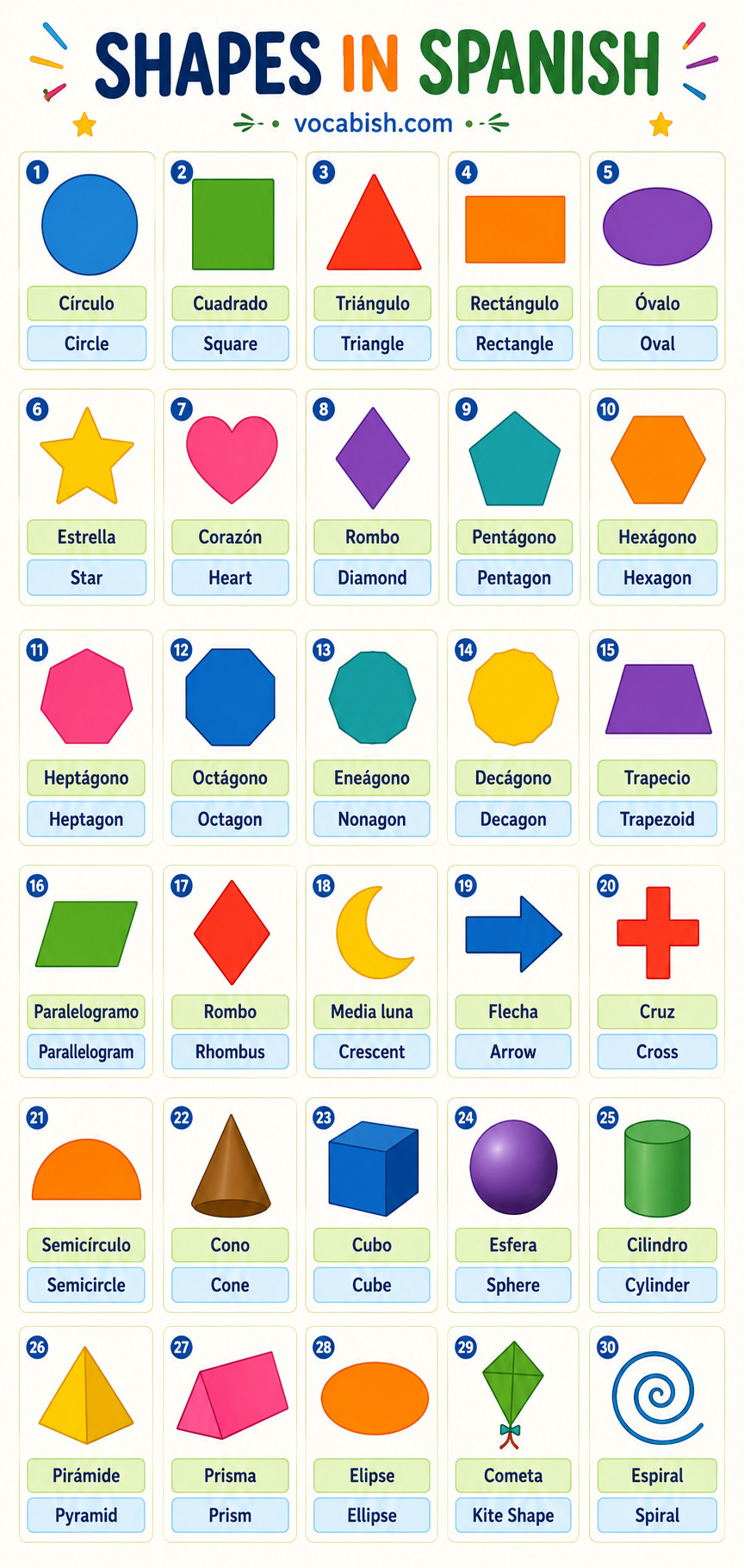
The table below includes many common and advanced shapes with their Spanish and English names.
English Shape | Shape in Spanish |
|---|---|
Circle | Círculo |
Square | Cuadrado |
Triangle | Triángulo |
Rectangle | Rectángulo |
Oval | Óvalo |
Star | Estrella |
Heart | Corazón |
Diamond | Rombo |
Pentagon | Pentágono |
Hexagon | Hexágono |
Heptagon | Heptágono |
Octagon | Octágono |
Nonagon | Eneágono |
Decagon | Decágono |
Trapezoid | Trapecio |
Parallelogram | Paralelogramo |
Rhombus | Rombo |
Crescent | Media luna |
Arrow | Flecha |
Cross | Cruz |
Semicircle | Semicírculo |
Cone | Cono |
Cube | Cubo |
Sphere | Esfera |
Cylinder | Cilindro |
Pyramid | Pirámide |
Prism | Prisma |
Torus | Toroide |
Ellipse | Elipse |
Kite Shape | Cometa |
Spiral | Espiral |
Ring | Anillo |
Arc | Arco |
Polygon | Polígono |
Quadrilateral | Cuadrilátero |
Dodecagon | Dodecágono |
Icosahedron | Icosaedro |
Tetrahedron | Tetraedro |
Octahedron | Octaedro |
Hexahedron | Hexaedro |
Starburst | Estrella radial |
Wave Shape | Onda |
Leaf Shape | Hoja |
Teardrop | Gota |
Egg Shape | Forma de huevo |
Fan Shape | Abanico |
Bell Shape | Campana |
Shield Shape | Escudo |
Cloud Shape | Nube |
Snowflake Shape | Copo de nieve |
Flower Shape | Flor |
Common Geometric Shapes in Spanish
Geometry vocabulary often appears in school and educational materials.
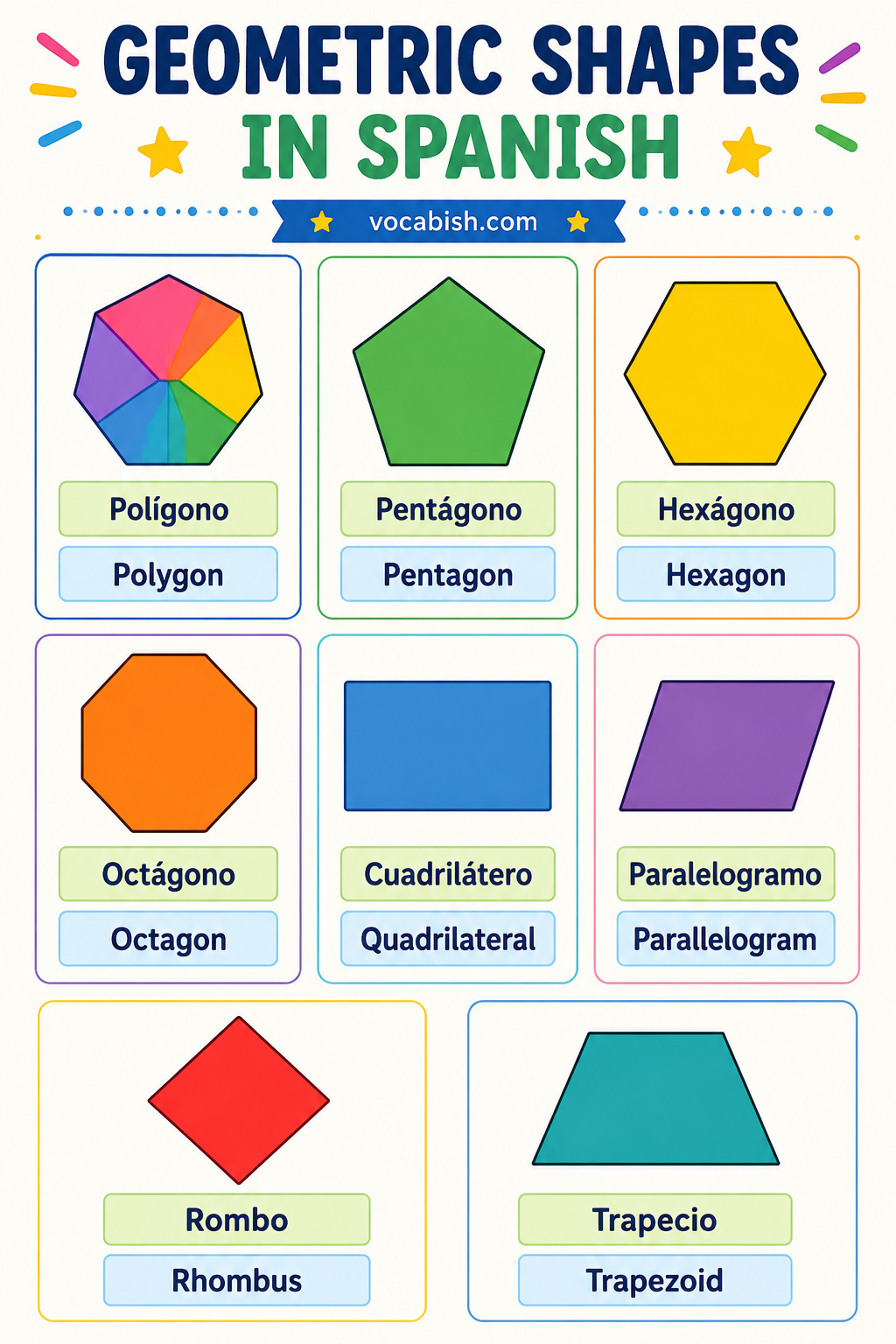
- Polígono (Polygon) — Closed shape made from straight connected sides.
- Pentágono (Pentagon) — Five-sided shape with five equal corners.
- Hexágono (Hexagon) — Six-sided shape often found in honeycombs.
- Octágono (Octagon) — Eight-sided shape commonly used for stop signs.
- Cuadrilátero (Quadrilateral) — Four-sided polygon with four angles and sides.
- Paralelogramo (Parallelogram) — Opposite sides remain parallel and equal length.
- Rombo (Rhombus) — Diamond-shaped figure with four equal sides.
- Trapecio (Trapezoid) — Four-sided shape with one pair parallel sides.
Example Sentences:
- El octágono tiene ocho lados.
The octagon has eight sides. - El pentágono tiene cinco lados.
The pentagon has five sides. - El trapecio tiene un par de lados paralelos.
The trapezoid has one pair of parallel sides.
3D Shapes in Spanish
Three-dimensional shapes describe objects that have length, width, and height.
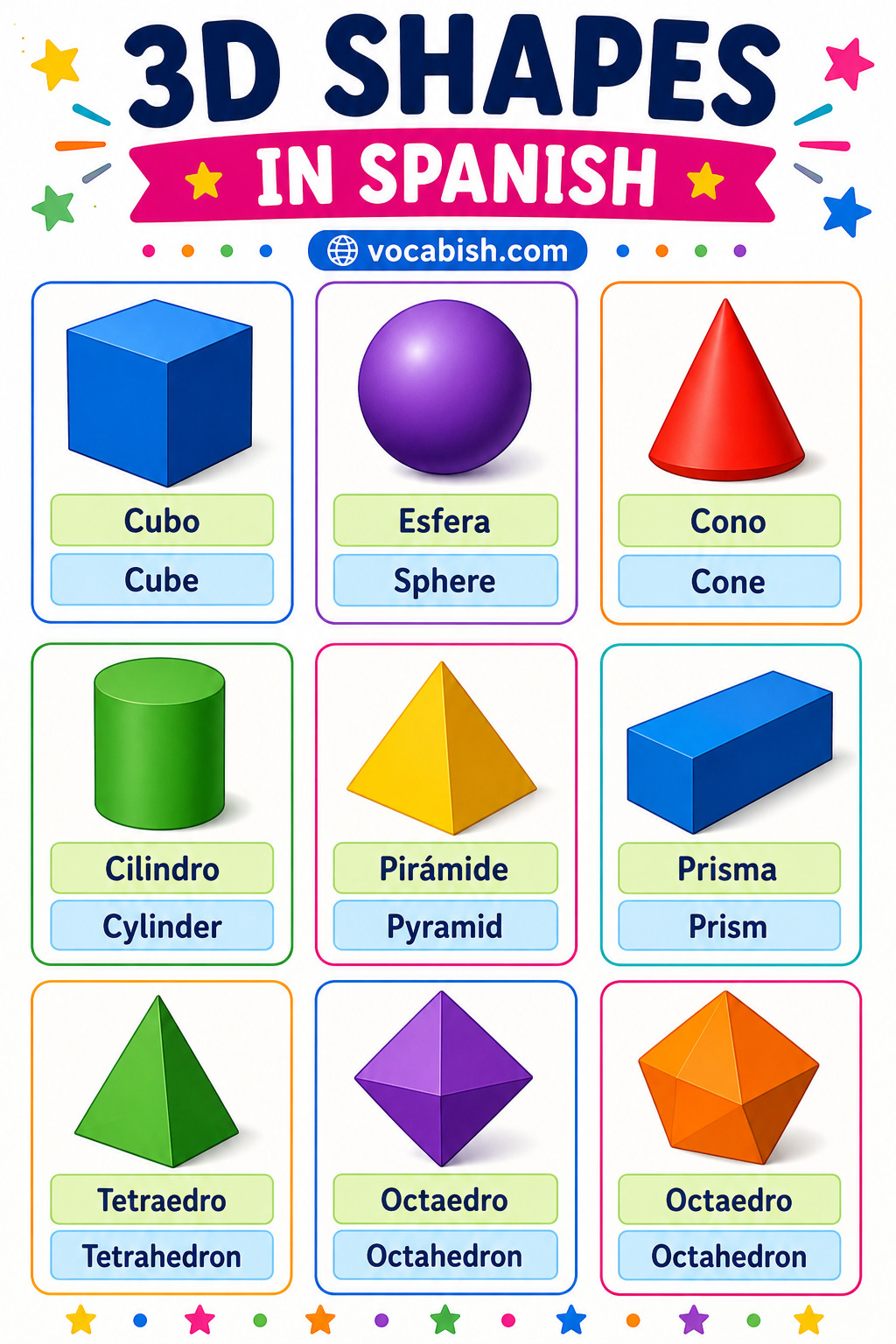
- Cubo (Cube) — Solid shape with six equal square faces.
- Esfera (Sphere) — Perfectly round solid shape like a ball.
- Cono (Cone) — Solid shape with circular base and point.
- Cilindro (Cylinder) — Solid shape with two circular flat ends.
- Pirámide (Pyramid) — Solid shape with triangular sides meeting top.
- Prisma (Prism) — Solid shape with matching parallel ends.
- Tetraedro (Tetrahedron) — Solid shape with four triangular faces.
- Octaedro (Octahedron) — Solid shape with eight triangular faces.
Examples:
- La pelota es una esfera.
The ball is a sphere. - La caja tiene forma de cubo.
The box has the shape of a cube. - El cono de helado tiene forma cónica.
The ice cream cone has a cone shape.
Shapes in Spanish Pronunciation Guide
Knowing pronunciation makes vocabulary easier to remember.
- Círculo (SEER-koo-lo) — Pronounced with a soft “see” sound at the beginning.
- Cuadrado (kwah-DRAH-do) — Stress falls on the second syllable, “DRAH.”
- Triángulo (tree-AHN-goo-lo) — Emphasize the “AHN” syllable when speaking.
- Rectángulo (rek-TAHN-goo-lo) — Strong stress on the “TAHN” syllable.
- Óvalo (OH-vah-lo) — Starts with a clear and open “OH” sound.
- Estrella (es-TREH-ya) — The double “ll” sounds like “y.”
- Corazón (ko-ra-SON) — Stress falls on the final “SON” syllable.
- Pentágono (pen-TA-go-no) — Pronounce “TA” clearly with the strongest stress.
Quick Pronunciation Tip
Spanish vowels usually keep the same sound:
- A = ah
- E = eh
- I = ee
- O = oh
- U = oo
This makes Spanish pronunciation more predictable than English.
Shape Descriptions in Spanish Sentences
Learning vocabulary in context helps you remember it faster.
Talking About Objects
La ventana es rectangular.
The window is rectangular.
La rueda es circular.
The wheel is circular.
La señal tiene forma de octágono.
The sign has the shape of an octagon.
Talking About Drawings
Dibujé una estrella grande.
I drew a large star.
Mi dibujo tiene muchos triángulos.
My drawing has many triangles.
Talking About Nature
La luna parece una media luna.
The moon looks like a crescent.
La nube tiene una forma extraña.
The cloud has a strange shape.
Useful Vocabulary Related to Shapes
When studying shapes, these words are often used together.
English | Spanish |
|---|---|
Shape | Forma |
Side | Lado |
Corner | Esquina |
Angle | Ángulo |
Line | Línea |
Curve | Curva |
Edge | Borde |
Point | Punto |
Symmetry | Simetría |
Surface | Superficie |
Example:
El triángulo tiene tres lados y tres ángulos.
The triangle has three sides and three angles.
Tips for Learning Shapes in Spanish
Learning vocabulary becomes easier when you connect words to objects you see every day.
Label Objects Around You
Try identifying shapes in your home:
- Clock → Círculo
- Door → Rectángulo
- Tile → Cuadrado
Draw and Name Shapes
Create flashcards with:
- Spanish word
- English meaning
- Drawing of the shape
Practice Short Sentences
Examples:
- Es un círculo.
- Es un cuadrado.
- Tiene forma de estrella.
Use Visual Learning
Pictures help connect words and meanings faster than memorization alone.
You May Also Like:
Download Spanish Shapes PDF
Frequently Asked Questions
The Spanish word for shapes is formas. The singular form, shape, is forma.
Circle in Spanish is círculo. It is commonly used in classrooms, math lessons, and everyday descriptions.
Triangle in Spanish is triángulo. A triangle has three sides and three angles.
Use phrases like tiene forma de (has the shape of) or adjectives such as circular, rectangular, or triangular.
Square in Spanish is cuadrado. The same word can also describe something that has a square shape.
Many geometric terms share Latin roots, making words like pentágono, hexágono, and octágono easy to recognize.
Rectangle in Spanish is rectángulo. It is one of the most commonly taught geometric shapes.
Shape vocabulary helps with school subjects, descriptions, daily conversations, and understanding Spanish educational materials more easily.
Final Thoughts
Learning shapes in Spanish gives you practical vocabulary that you can use in school, travel, art, and everyday conversations. Start with common words like círculo, cuadrado, and triángulo, then gradually expand to more advanced geometric shapes.
The more often you see, draw, and describe shapes around you, the faster these Spanish words will become part of your active vocabulary.