
Have you ever described a kind host as graceful or an elegant dancer as gracious? These words look and sound similar, but they describe different qualities.
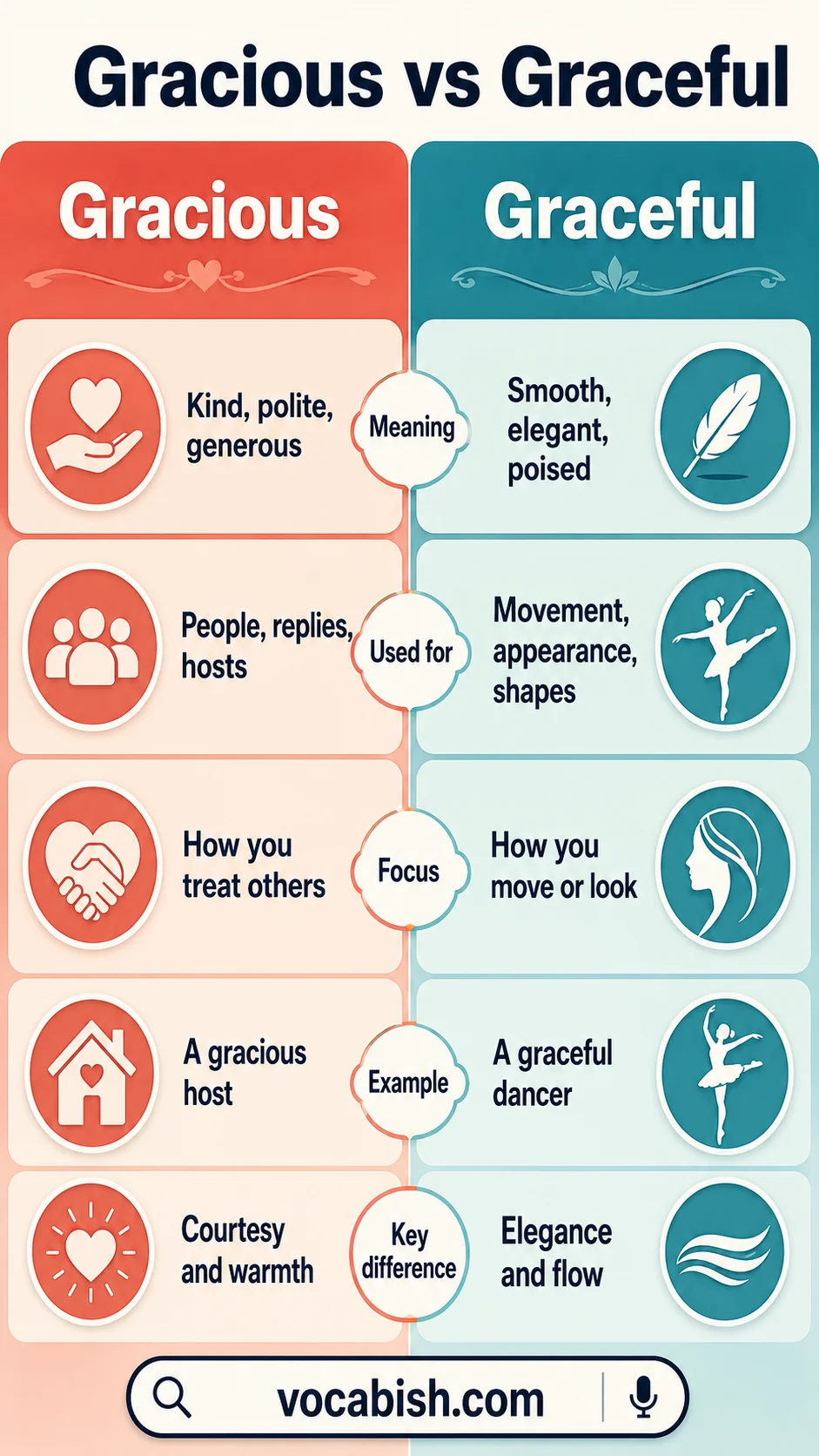
The main difference in gracious vs graceful is straightforward: gracious usually describes kindness, politeness, or generosity, while graceful describes smooth, elegant movement or an attractive manner. Understanding this distinction will help you choose the correct adjective in conversations, school writing, emails, and descriptions.
Gracious vs Graceful: Quick Answer
Both words come from the noun grace, but their meanings have developed in different directions. One usually describes a person’s character, while the other often describes appearance or movement.
- Gracious means kind, polite, welcoming, generous, or willing to forgive.
- Graceful means moving, behaving, or appearing in a smooth, elegant, and attractive way.
Quick comparison
Word | Main meaning | Commonly describes | Example |
|---|---|---|---|
Gracious | Kind, polite, or generous | People, hosts, replies, behaviour | The host was gracious to every guest. |
Graceful | Smooth, elegant, or attractive | Movement, people, animals, shapes | The dancer made a graceful turn. |
A gracious person treats others well. A graceful person moves or behaves elegantly.
What Does Gracious Mean?
Gracious is an adjective used for someone who is kind, polite, welcoming, generous, or considerate. It can also describe words, actions, and behaviour that show these qualities.
Pronunciation: /ˈɡreɪ.ʃəs/
It sounds like: GRAY-shus
Common Meanings of Gracious
1. Kind and polite
A gracious person treats other people with warmth and respect, even in an uncomfortable situation.
- The manager was gracious when I explained my mistake.
- She gave us a gracious welcome.
- He remained gracious despite the criticism.
2. Generous or considerate
The word can describe someone who willingly gives time, attention, praise, or help.
- Our neighbour was gracious enough to drive us home.
- The author was gracious with her time.
- He was gracious in victory and praised the other team.
3. Pleasant and welcoming
Gracious is often used for hosts, guests, replies, invitations, and hospitality.
- They were gracious hosts.
- Thank you for your gracious invitation.
- She greeted everyone with a gracious smile.
4. Comfortable and elegant
In more formal English, gracious may describe a home, lifestyle, or environment that is pleasantly comfortable and refined.
- They live in a gracious country house.
- The hotel offers gracious surroundings.
This use is less common in everyday conversation than the meaning “kind and polite.”
Common Word Combinations with Gracious
Some words naturally appear with gracious:
- gracious host
- gracious welcome
- gracious response
- gracious manner
- gracious smile
- gracious invitation
- gracious gesture
- gracious hospitality
- gracious acceptance
- gracious in defeat
Examples of Gracious in Sentences
- Maya was gracious to everyone at the event.
- The losing player gave a gracious interview.
- Our teacher offered a gracious response to the complaint.
- It was gracious of you to invite us.
- He accepted the apology in a gracious manner.
- The family thanked us for our help with a gracious note.
- She remained calm and gracious during the disagreement.
- The restaurant staff were friendly and gracious.
What Does Graceful Mean?
Graceful is an adjective that describes smooth, controlled, elegant, or attractive movement. It can also describe a shape, design, action, or manner that appears pleasing and well balanced.
Pronunciation: /ˈɡreɪs.fəl/
It sounds like: GRAYS-ful
Common Meanings of Graceful
1. Moving smoothly and elegantly
This is the most common meaning of graceful. It is often used for dancers, athletes, birds, horses, and other moving subjects.
- The ballerina looked graceful on stage.
- A graceful swan moved across the lake.
- The gymnast made a graceful landing.
2. Having an attractive shape or design
Objects and natural features can be graceful when their shapes are smooth, curved, or visually pleasing.
- The bridge has a graceful arch.
- Graceful branches hung over the water.
- The vase had a tall, graceful shape.
3. Handling a situation calmly and elegantly
Graceful can also describe a dignified or well-controlled way of dealing with change, failure, age, or an awkward situation.
- She made a graceful exit from the conversation.
- The actor handled the criticism gracefully.
- He accepted retirement in a graceful way.
In this meaning, graceful is close to “dignified” or “tactful,” but it still suggests smoothness and composure rather than kindness alone.
Common Word Combinations with Graceful
- graceful dancer
- graceful movement
- graceful steps
- graceful pose
- graceful figure
- graceful curve
- graceful arch
- graceful bird
- graceful landing
- graceful exit
Examples of Graceful in Sentences
- The deer made a graceful jump over the fence.
- Her movements were slow and graceful.
- The building has graceful curved windows.
- He made a graceful bow before leaving the stage.
- The cat moved with graceful confidence.
- A graceful willow tree stood beside the river.
- She found a graceful way to change the subject.
- The skater completed a graceful turn.
Main Differences Between Gracious and Graceful
The easiest way to understand these words is to look at the type of quality each one describes.
Point of comparison | Gracious | Graceful |
|---|---|---|
Core meaning | Kind, polite, generous, or welcoming | Smooth, elegant, controlled, or attractive |
Main focus | Character and treatment of others | Movement, appearance, shape, or manner |
Often describes | Hosts, replies, gestures, behaviour | Dancers, animals, movements, objects |
Opposite ideas | Rude, unkind, unfriendly | Awkward, clumsy, stiff |
Example | She was gracious to her guests. | She looked graceful while dancing. |
Consider these two sentences:
- The dancer was gracious.
This means the dancer was kind, polite, or considerate. - The dancer was graceful.
This means the dancer moved smoothly and elegantly.
Both sentences are correct, but they communicate different information.
How to Use Gracious Correctly
Use gracious when your sentence focuses on kindness, courtesy, generosity, hospitality, or respectful behaviour.
1. Use gracious for kind treatment
- She was gracious toward the new student.
- He gave the waiter a gracious thank-you.
- The winner was gracious to her competitors.
2. Use gracious for welcoming people
- Our hosts were warm and gracious.
- The receptionist gave us a gracious welcome.
- They were gracious enough to offer us dinner.
3. Use gracious when someone handles difficulty politely
A person can remain gracious even when disappointed, criticised, or defeated.
- He was gracious in defeat.
- She gave a gracious reply to the negative review.
- The rejected applicant remained gracious and professional.
4. Useful sentence patterns
Gracious + noun
- a gracious host
- a gracious reply
- a gracious gesture
- a gracious invitation
Example: She sent a gracious reply to our message.
Be gracious to/toward someone
Example: Please be gracious to the new members.
It is/was gracious of someone to do something
Example: It was gracious of him to apologise publicly.
Gracious enough to do something
Example: She was gracious enough to answer every question.
How to Use Graceful Correctly
Use graceful when describing smooth movement, elegant appearance, balanced design, or calm handling of a situation.
1. Use graceful for physical movement
- The dancer made a graceful leap.
- The horse moved with a graceful rhythm.
- Her hand movements were graceful and controlled.
2. Use graceful for shapes and objects
- The roof has a graceful curve.
- We admired the graceful lines of the boat.
- The chair has a light, graceful design.
3. Use graceful for calm social behaviour
Sometimes graceful describes how someone avoids embarrassment or manages a difficult situation smoothly.
- He made a graceful exit after noticing the mistake.
- She offered a graceful apology.
- They found a graceful solution to the disagreement.
4. Useful sentence patterns
Graceful + noun
- a graceful dancer
- a graceful movement
- a graceful curve
- a graceful exit
Example: The bird spread its wings in a graceful motion.
Look/seem/appear graceful
Example: She looked graceful in the long dress.
Move in a graceful way
Example: The skater moved in a graceful way across the ice.
With graceful movement
Example: The cat climbed down with graceful movement.
Can Someone Be Both Gracious and Graceful?
Yes, a person can be both gracious and graceful because the words describe separate qualities.
A person may be:
- gracious because they are kind and respectful
- graceful because they move elegantly
For example:
The gracious and graceful performer thanked the audience before leaving the stage.
Here, gracious describes the performer’s polite behaviour. Graceful describes the performer’s elegant movement or appearance.
Another example:
The queen gave her guests a gracious welcome and walked across the hall with graceful steps.
The welcome was kind and courteous. The steps were smooth and elegant.
Common Mistakes with Gracious and Graceful
Because both adjectives begin with grace, learners sometimes use one in place of the other. Checking whether the sentence is about kindness or elegance usually solves the problem.
1: Using gracious for movement
Incorrect: The swan moved graciously across the lake.
Correct: The swan moved gracefully across the lake.
The sentence describes elegant movement, so gracefully is correct.
2: Using graceful for hospitality
Incorrect: Our graceful host made everyone feel welcome.
Correct: Our gracious host made everyone feel welcome.
The sentence describes kindness and hospitality, not physical movement.
3: Assuming graceful only describes women
Graceful can describe people of any gender, as well as animals, objects, movements, and shapes.
- The male dancer was powerful and graceful.
- The eagle made a graceful landing.
- The staircase has a graceful curve.
4: Confusing graciously and gracefully
These adverbs also have different meanings:
- Graciously means kindly or politely.
- Gracefully means smoothly or elegantly.
Compare:
- She graciously accepted the gift.
- She gracefully crossed the stage.
5: Using gracious to mean beautiful
A gracious person may be pleasant and charming, but gracious does not directly mean physically beautiful.
- Gracious woman = a kind, polite, or welcoming woman
- Graceful woman = a woman who moves or appears elegant
Word Forms and Related Vocabulary
Both adjectives come from the word grace, but they form different word families.
Word | Part of speech | Meaning | Example |
|---|---|---|---|
grace | Noun | Elegance, kindness, or dignity | She handled the matter with grace. |
gracious | Adjective | Kind, polite, or generous | He was a gracious host. |
graciously | Adverb | In a kind or polite way | She graciously accepted our thanks. |
graciousness | Noun | The quality of being gracious | Everyone appreciated his graciousness. |
graceful | Adjective | Smooth, elegant, or attractive | The bird made a graceful turn. |
gracefully | Adverb | In a smooth or elegant way | She moved gracefully. |
gracefulness | Noun | The quality of being graceful | The dancer was known for her gracefulness. |
graceless | Adjective | Awkward, rude, or lacking elegance | His graceless remark upset the guests. |
How the suffixes affect meaning
Grace + -ous = gracious
The suffix -ous commonly forms adjectives meaning “having” or “full of” a quality.
In modern use, gracious mainly refers to having kindness, courtesy, generosity, or warmth.
Grace + -ful = graceful
The suffix -ful often means “full of” or “showing” something.
Graceful describes someone or something showing grace through smoothness, elegance, balance, or control.
Adjective + -ly = adverb
Adding -ly changes the adjective into an adverb:
- gracious → graciously
- graceful → gracefully
Adverbs describe how an action happens.
- He spoke graciously.
- She danced gracefully.
Synonyms and Opposites
Related words can make the distinction even clearer.
Synonyms for gracious
- kind
- polite
- courteous
- welcoming
- considerate
- generous
- warm
- respectful
- civil
- hospitable
Opposites of gracious
- rude
- impolite
- unkind
- unfriendly
- inconsiderate
- discourteous
Synonyms for graceful
- elegant
- smooth
- poised
- fluid
- refined
- balanced
- stylish
- flowing
- controlled
- dignified
Opposites of graceful
- awkward
- clumsy
- stiff
- unbalanced
- rough
- graceless
Not every synonym works in every sentence. For example, polite can replace gracious in many contexts, but it may not express the same warmth or generosity.
Gracious vs Graceful in Everyday Contexts
The correct word may change depending on what you are describing.
Context | Correct word | Example |
|---|---|---|
A host welcomes visitors warmly | Gracious | Daniel was a gracious host. |
A dancer moves smoothly | Graceful | The dancer’s movements were graceful. |
A winner praises the losing team | Gracious | She was gracious in victory. |
A bird lands elegantly | Graceful | The bird made a graceful landing. |
Someone accepts criticism politely | Gracious | He gave a gracious response. |
A building has attractive curves | Graceful | The building has graceful lines. |
Someone leaves an awkward situation smoothly | Graceful | She made a graceful exit. |
Someone offers help generously | Gracious | It was gracious of them to help. |
An Easy Way to Remember the Difference
Use this short memory rule:
Gracious is about kindness. Graceful is about elegance.
You can also connect each word to a familiar phrase:
- Gracious host → kind and welcoming
- Graceful dancer → smooth and elegant
Ask yourself one question:
Am I describing how someone treats others or how someone moves and appears?
- Treatment of others → gracious
- Movement or appearance → graceful
Practice: Choose Gracious or Graceful
Complete each sentence with gracious or graceful.
- The ballet student made a __________ turn.
- Our neighbours were __________ and welcoming.
- The politician gave a __________ response to the difficult question.
- The gazelle is a fast and __________ animal.
- It was __________ of you to include everyone.
- The old bridge has a __________ curved shape.
- She remained __________ after losing the competition.
- The skater performed a __________ landing.
- The family were __________ hosts.
- He found a __________ way to leave the conversation.
Answers
- graceful
- gracious
- gracious
- graceful
- gracious
- graceful
- gracious
- graceful
- gracious
- graceful
FAQs About Gracious and Graceful
Gracious describes kindness, politeness, or generosity. Graceful describes smooth movement, elegant appearance, balanced design, or calm and controlled behaviour.
Yes. Someone can be gracious because they treat others kindly and graceful because they move, behave, or carry themselves with elegance.
A dancer is graceful when moving elegantly. The dancer is gracious when speaking politely, thanking the audience, or treating other performers kindly.
A gracious host welcomes guests warmly, treats them politely, considers their comfort, and makes them feel relaxed, respected, and included.
A graceful exit is a calm, tactful, and dignified way of leaving a position, conversation, event, or uncomfortable situation without causing embarrassment.
Yes. Calling someone gracious praises their kindness, courtesy, generosity, warmth, or ability to respond respectfully during a difficult or disappointing situation.
Graciously means in a kind or polite manner. Gracefully means in a smooth, elegant, balanced, or socially skilful manner.
Objects are commonly called graceful when they have elegant shapes or lines. Gracious may describe comfortable, refined buildings or surroundings in formal English.
Conclusion
The difference in gracious vs graceful depends on the quality you want to describe. Use gracious for kindness, politeness, generosity, and welcoming behaviour. Use graceful for smooth movement, elegant appearance, attractive shapes, or calm handling of a situation.
Remember: a gracious person treats people kindly, while a graceful person moves or behaves elegantly. Someone can naturally be both gracious and graceful.
You May Also Like
