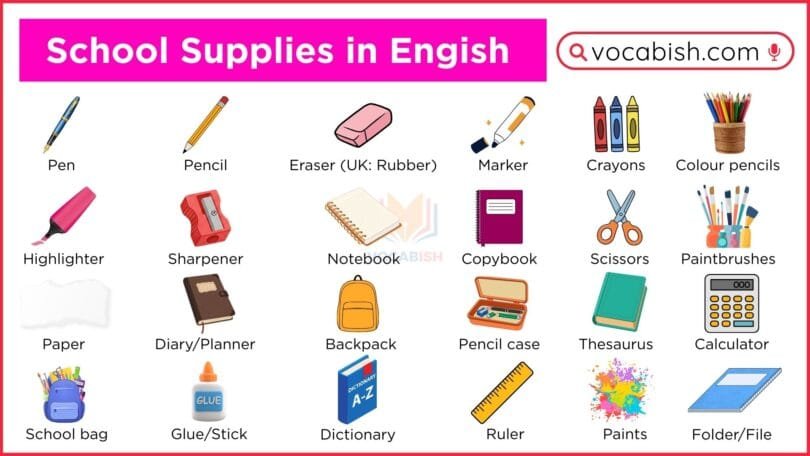

School supplies names in English include the everyday items we use for writing, drawing, reading, organizing notes, and completing classroom activities. Common examples include pencils, erasers, notebooks, rulers, sharpeners, scissors, and school bags. Other supplies, such as compasses, protractors, staplers, and highlighters, help us complete different school tasks. Knowing these names makes it easier to identify classroom objects, talk about stationery, and prepare for school.
In this article, I have collected 140+ school supplies names in English with pictures to help us recognize each item and remember its correct name. We will explore writing tools, paper products, drawing materials, classroom stationery, art supplies, and other essential school items. This visual vocabulary collection is useful for children, students, parents, and teachers who want to build practical English vocabulary.
What are School Supplies?
School supplies are items that students use for learning and studying at school. They include tools for writing, drawing, reading, storing, and organising school work. Learning their English names helps you follow instructions, shop for materials, and improve your vocabulary.
List of Common School Supplies with Pictures
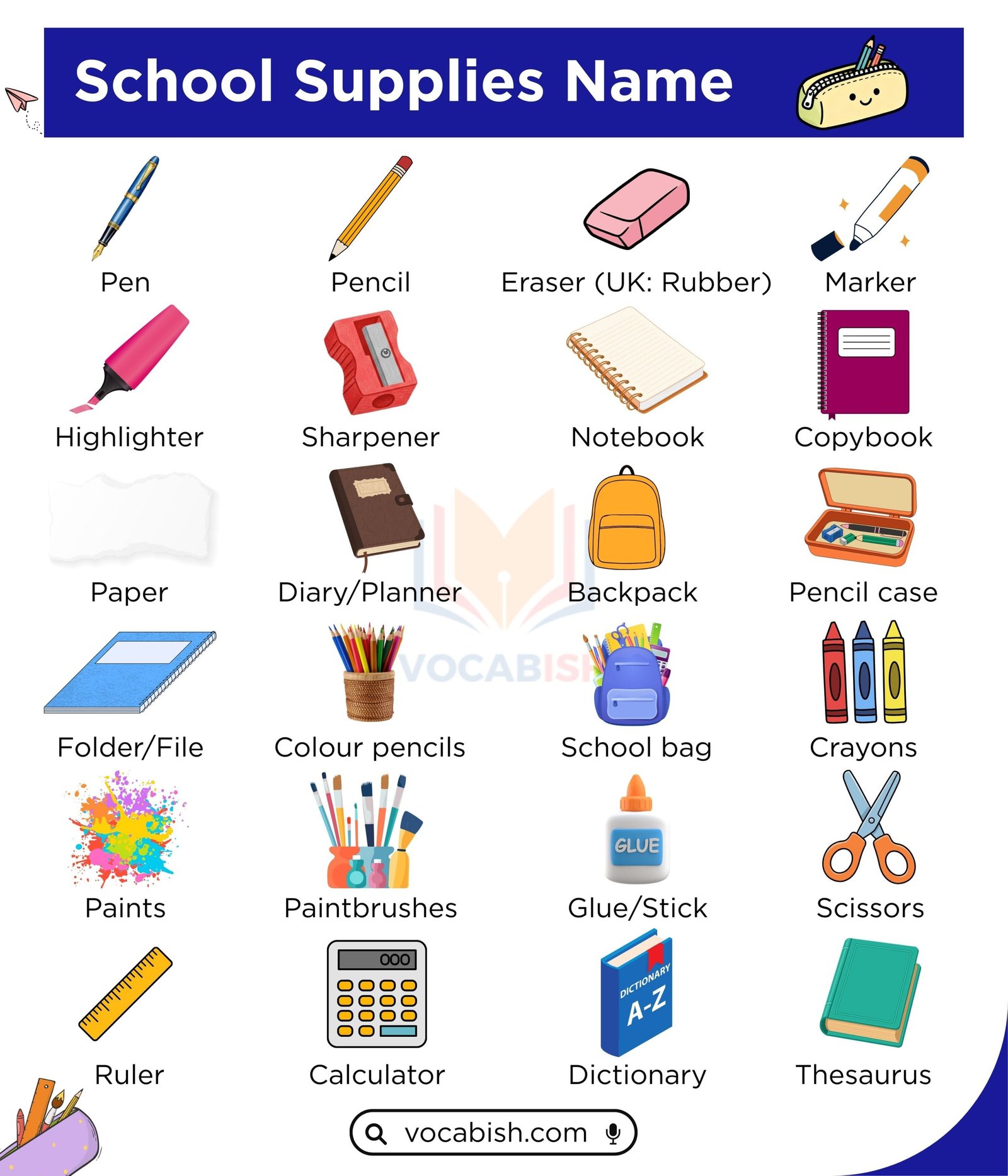
Here’s the list of everyday used school supplies’ names in English with their pictures:
- Pen
- Pencil
- Eraser (UK: Rubber)
- Marker
- Highlighter
- Sharpener
- Notebook
- Copybook
- Loose sheets / Paper
- Diary/Planner
- Backpack / School bag
- Pencil case
- Folder/File
- Colour pencils
- Crayons
- Paints
- Paintbrushes
- Glue/Stick
- Scissors
- Ruler
- Calculator
- Dictionary/Thesaurus
Types of School Supplies with Names
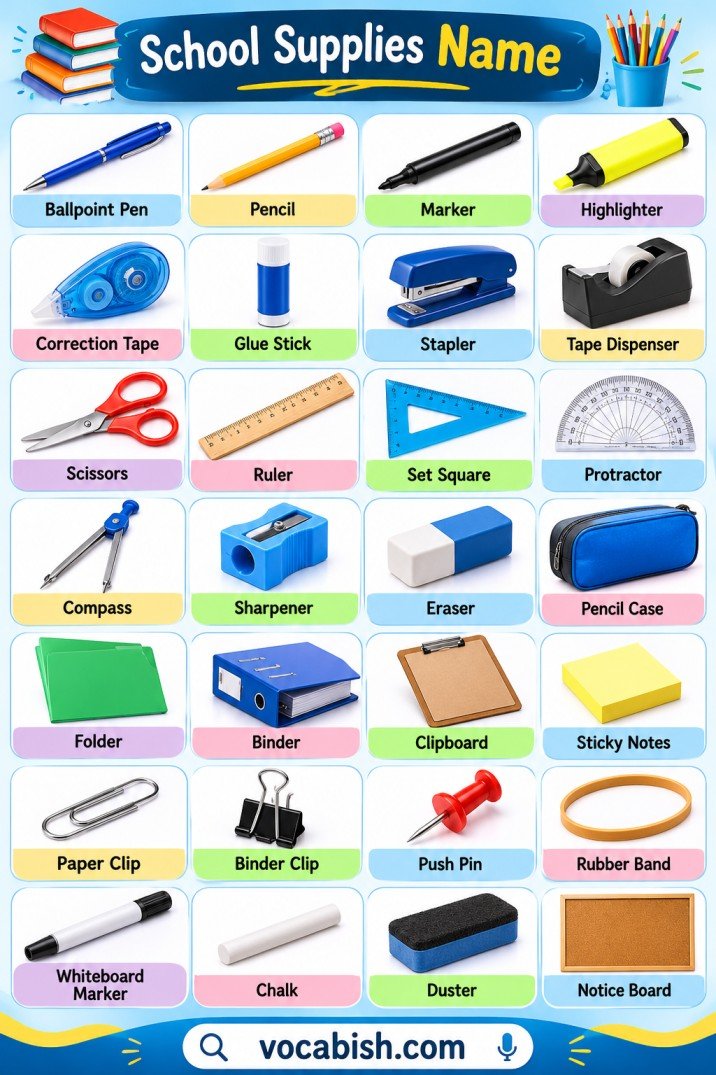
1. Writing Supplies
These are items used for writing, drawing, marking, or correcting written work.
Pen
Used to write on paper.
Example: “I wrote my homework neatly with a blue pen.”
Pencil
Used for writing or drawing and can be erased.
Example: “She sketched a house with a pencil.”
Eraser
Removes pencil marks.
Example: “He used an eraser to fix the mistake.”
Marker
Used for bold writing, drawing, or colouring.
Example: “The teacher wrote the topic on the board with a red marker.”
Highlighter
Highlights important information in books or notes.
Example: “She used a yellow highlighter to mark key points in her book.”
Ballpoint Pen
Uses a small rotating ball to distribute ink while writing.
Example: “He signed his name with a black ballpoint pen.”
Gel Pen
Uses smooth gel-based ink for writing.
Example: “She wrote her class notes with a blue gel pen.”
Fountain Pen
Uses liquid ink for smooth and decorative handwriting.
Example: “He practised his handwriting with a fountain pen.”
Felt-Tip Pen
Has a porous tip for writing, colouring, and drawing.
Example: “The child used a felt-tip pen to colour the picture.”
Permanent Marker
Creates lasting marks on different surfaces.
Example: “She labelled her project box with a permanent marker.”
Whiteboard Marker
Used for writing on whiteboards and can be wiped off.
Example: “The teacher explained the lesson using a black whiteboard marker.”
Correction Pen
Covers writing mistakes with white correction fluid.
Example: “He used a correction pen to cover the wrong word.”
Correction Tape
Covers mistakes with a strip of white tape.
Example: “She corrected the spelling mistake with correction tape.”
Mechanical Pencil
Uses replaceable thin graphite leads instead of wooden pencil tips.
Example: “He used a mechanical pencil to complete his mathematics test.”
Pencil Lead
A graphite refill used in mechanical pencils.
Example: “She replaced the empty pencil lead with a new one.”
2. Paper Products
These are paper-based items used for writing, printing, drawing, and schoolwork.
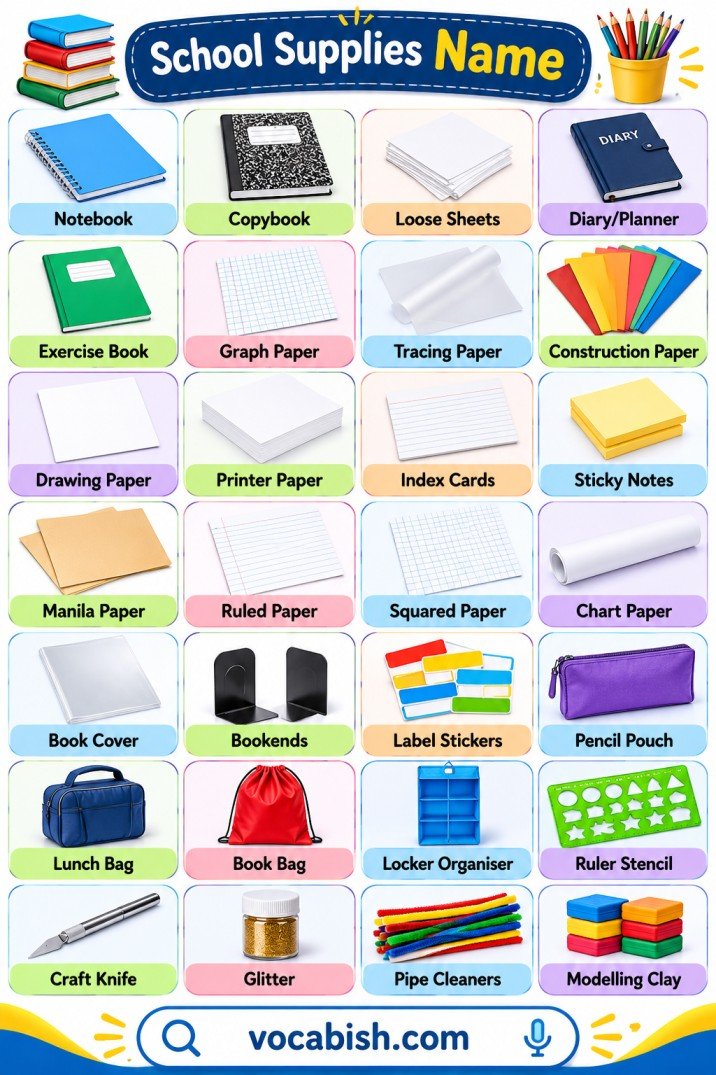
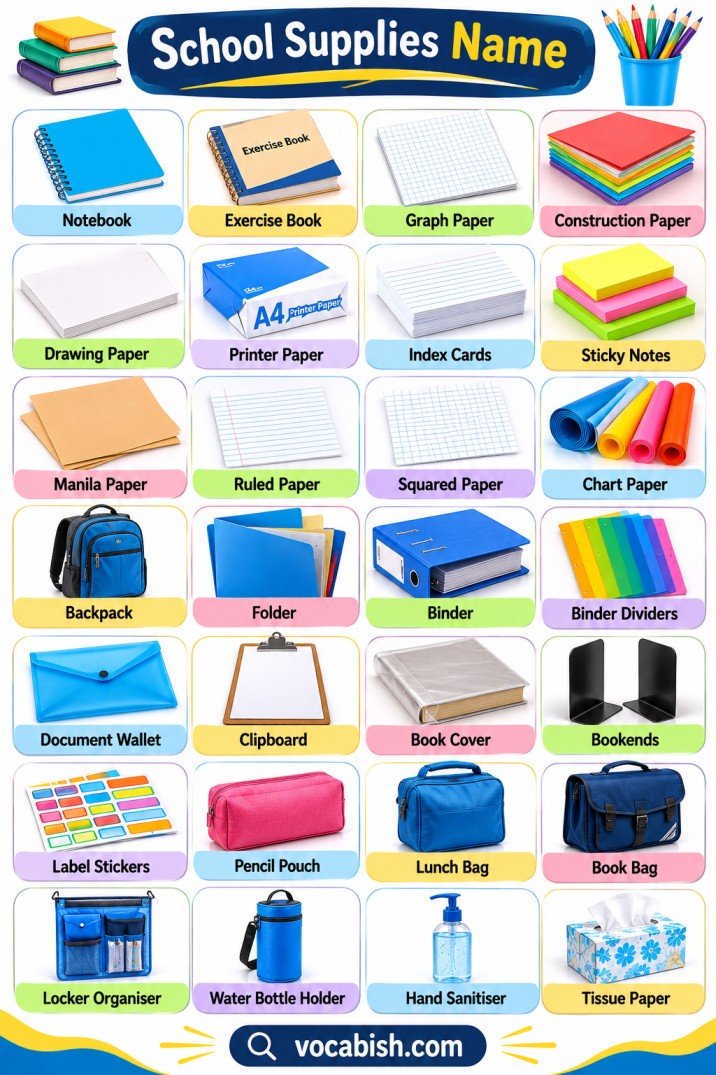
Notebook
Used for writing notes in class or at home.
Example: “She wrote all her maths notes in a notebook.”
Copybook
Used for practice exercises and handwriting improvement.
Example: “He completed the English exercises in his copybook.”
Loose Sheets/Paper
Single sheets used for writing or printing.
Example: “The student handed in his assignment on loose sheets.”
Diary/Planner
Keeps track of homework, tasks, and important dates.
Example: “She wrote her weekly schedule in her planner.”
Exercise Book
Used for completing classroom exercises and written assignments.
Example: “He completed his science questions in his exercise book.”
Graph Paper
Contains a grid of squares for drawing graphs and mathematical diagrams.
Example: “She plotted the results on graph paper.”
Tracing Paper
Thin, transparent paper used for copying drawings and diagrams.
Example: “He copied the map onto tracing paper.”
Construction Paper
Thick, coloured paper used for art and craft projects.
Example: “The students made colourful flowers using construction paper.”
Drawing Paper
Used for sketching, colouring, and drawing.
Example: “She drew a beautiful landscape on drawing paper.”
Printer Paper
Used in printers for printing school assignments and worksheets.
Example: “The teacher printed the test questions on printer paper.”
Index Cards
Small cards used for study notes, definitions, and revision.
Example: “He wrote new vocabulary words on index cards.”
Sticky Notes
Small adhesive papers used for reminders and short notes.
Example: “She placed sticky notes on the important pages of her textbook.”
Manila Paper
Durable paper used for charts, folders, and school projects.
Example: “The group prepared a presentation using manila paper.”
Ruled Paper
Paper with horizontal lines for neat handwriting.
Example: “The teacher asked everyone to write the essay on ruled paper.”
Squared Paper
Paper printed with small squares for mathematics and diagrams.
Example: “He used squared paper to draw a geometry figure.”
Chart Paper
Large sheets used for classroom presentations and educational displays.
Example: “The students prepared a science chart using coloured chart paper.”
3. Organising Supplies
These items help store, carry, and organise school materials.
Backpack/School Bag
Carries books, stationery, and personal items to school.
Example: “She packed her lunch and books in her backpack.”
Folder/File
Keeps papers and documents neat and organised.
Example: “He put his worksheets into a folder to keep them safe.”
Pencil Case
Holds pens, pencils, erasers, and small stationery items.
Example: “She opened her pencil case to find a sharp pencil.”
Binder
Holds loose papers using rings or clips.
Example: “He organised his subject notes in a three-ring binder.”
Binder Dividers
Separate different subjects or sections inside a binder.
Example: “She used binder dividers to organise her science and English notes.”
Document Wallet
Stores and protects loose papers and important documents.
Example: “He kept his certificates in a document wallet.”
Clipboard
Provides a hard writing surface with a clip to hold papers.
Example: “The teacher used a clipboard to check attendance.”
Book Cover
Protects textbooks and notebooks from damage.
Example: “She covered her new textbook with a plastic book cover.”
Bookends
Keep books upright and organised on shelves.
Example: “He placed bookends on both sides of his schoolbooks.”
Label Stickers
Identify books, folders, and other school supplies.
Example: “She put label stickers on all her notebooks.”
Pencil Pouch
A small bag used to store stationery items.
Example: “He kept his coloured pencils in a pencil pouch.”
Lunch Bag
Carries food and snacks to school.
Example: “She packed her sandwich in her lunch bag.”
Book Bag
Carries books and other study materials.
Example: “He used a separate book bag for his library books.”
Locker Organiser
Keeps books, stationery, and personal belongings organised inside a school locker.
Example: “She used a locker organiser to arrange her school supplies.”
4. Art and Craft Supplies
These items are used for drawing, painting, colouring, and creative school projects.
Colour Pencils
Used for colouring pictures or drawings.
Example: “She coloured the rainbow using bright colour pencils.”
Crayons
Wax-based colouring sticks for art or drawing.
Example: “The child drew a house with red and blue crayons.”
Paints and Brushes
Used for painting pictures on paper or canvas.
Example: “He painted a landscape using watercolours and brushes.”
Glue/Glue Stick
Used to stick paper, craft items, or decorations together.
Example: “She used a glue stick to attach the stars to her poster.”
Scissors
Used to cut paper, shapes, or craft materials.
Example: “He carefully cut out the shapes with scissors.”
Watercolours
Water-based paints used for creating colourful artwork.
Example: “She painted a flower using watercolours.”
Acrylic Paints
Quick-drying paints used for artwork and craft projects.
Example: “He used acrylic paints to decorate his wooden model.”
Paint Palette
Holds and mixes different paint colours.
Example: “She mixed blue and yellow paint on her palette.”
Paintbrush
Applies paint to paper, canvas, and other surfaces.
Example: “He used a thin paintbrush to draw small details.”
Sketchbook
A book containing blank pages for drawing and sketching.
Example: “She practised drawing animals in her sketchbook.”
Oil Pastels
Soft colouring sticks used for blending and creating artwork.
Example: “He used oil pastels to make a colourful sunset.”
Modelling Clay
A soft material used to create shapes and three-dimensional objects.
Example: “The children made small animals using modelling clay.”
Craft Paper
Decorative paper used for making cards and creative projects.
Example: “She made a birthday card using craft paper.”
Glitter
Small shiny particles used to decorate artwork and craft projects.
Example: “He added glitter to his school project.”
Ruler Stencil
A template used to draw specific shapes and designs.
Example: “She used a ruler stencil to draw perfect shapes.”
Craft Knife
A sharp cutting tool used for detailed craft work under adult supervision.
Example: “The teacher used a craft knife to cut cardboard for the model.”
Coloured Paper
Paper available in different colours for art and decoration.
Example: “She used coloured paper to make paper flowers.”
Pipe Cleaners
Flexible craft wires covered with soft fibres for making shapes and models.
Example: “The students made butterflies using pipe cleaners.”
5. Learning Tools
These items help with studying, reading, reference work, and classroom learning.
Ruler
Measures length or draws straight lines.
Example: “She used a ruler to draw a straight line.”
Sharpener
Sharpens pencils to make writing or drawing easier.
Example: “He used a sharpener to fix his dull pencil.”
Calculator
Helps perform maths calculations quickly.
Example: “The student used a calculator to check his sums.”
Dictionary/Thesaurus
Helps find word meanings, synonyms, and correct usage.
Example: “She looked up the meaning of ‘curious’ in the dictionary.”
Textbook
Provides subject-related information and lessons.
Example: “He studied the chapter in his science textbook.”
Workbook
Contains exercises and activities for practising different subjects.
Example: “She completed the grammar exercises in her workbook.”
Atlas
A collection of maps used for studying geography.
Example: “The student found Pakistan on the map in his atlas.”
Globe
A spherical model of Earth used for learning geography.
Example: “The teacher showed the continents on the globe.”
Flashcards
Cards used to practise vocabulary, facts, and concepts.
Example: “She revised English vocabulary using flashcards.”
Educational Charts
Visual materials used to explain different subjects and concepts.
Example: “The teacher explained the human body using an educational chart.”
Reading Book
A book used to develop reading skills and knowledge.
Example: “He borrowed a reading book from the school library.”
Reference Book
Provides additional information about a particular subject.
Example: “She used a reference book to complete her assignment.”
Protractor
Measures and draws angles in geometry.
Example: “He measured a 90-degree angle with a protractor.”
Compass
Draws circles and arcs in geometry.
Example: “She used a compass to draw a perfect circle.”
6. Mathematics and Geometry Supplies
These tools are used for calculations, measuring, drawing shapes, and solving mathematical problems.
Geometry Box
Contains mathematical drawing tools such as a compass, ruler, and protractor.
Example: “He brought his geometry box to mathematics class.”
Set Square
Used to draw and measure specific angles, especially 30, 45, 60, and 90 degrees.
Example: “She used a set square to draw a right angle.”
Divider
Measures and transfers distances between two points.
Example: “The student used a divider to compare two line segments.”
Mathematical Compass
Draws circles and arcs with a fixed centre point.
Example: “He used a mathematical compass to draw a circle.”
Measuring Tape
Measures the length, width, or height of objects.
Example: “She measured the classroom table with a measuring tape.”
Abacus
Uses beads on rods to teach counting and basic arithmetic.
Example: “The teacher demonstrated addition using an abacus.”
Counting Blocks
Small blocks used to teach counting and basic mathematical concepts.
Example: “The children used counting blocks to practise addition.”
Fraction Tiles
Represent fractions visually for mathematics lessons.
Example: “He used fraction tiles to compare one-half and one-quarter.”
Geometric Shapes Set
Contains models of shapes used to study geometry.
Example: “She identified a triangle and a square using the geometric shapes set.”
Mathematical Counters
Small objects used for counting and solving basic arithmetic problems.
Example: “The students used mathematical counters to practise subtraction.”
7. Classroom Supplies
These are common items used by teachers and students for classroom activities and presentations.
Chalk
Used for writing and drawing on chalkboards.
Example: “The teacher wrote the spelling words with white chalk.”
Chalkboard
A board with a dark surface used for writing with chalk.
Example: “The teacher explained the lesson on the chalkboard.”
Whiteboard
A smooth board used for writing with erasable markers.
Example: “The teacher solved the equation on the whiteboard.”
Whiteboard Eraser
Removes marker writing from a whiteboard.
Example: “He cleaned the whiteboard with an eraser.”
Duster
Used to remove chalk dust and writing from a chalkboard.
Example: “The student cleaned the chalkboard with a duster.”
Notice Board
Displays school announcements, schedules, and important information.
Example: “The teacher pinned the exam timetable on the notice board.”
Push Pins
Small pins used to attach papers and notices to boards.
Example: “She used push pins to display her classroom artwork.”
Stapler
Joins sheets of paper together using metal staples.
Example: “He used a stapler to attach the assignment pages.”
Staples
Small metal fasteners used in a stapler.
Example: “She refilled the stapler with new staples.”
Paper Clips
Hold sheets of paper together without stapling them.
Example: “He used paper clips to organise his worksheets.”
Binder Clips
Hold thick stacks of paper together securely.
Example: “The teacher used binder clips to organise the exam papers.”
Tape Dispenser
Holds and cuts adhesive tape for easy use.
Example: “She used the tape dispenser to seal the classroom display.”
Adhesive Tape
Sticks paper and other lightweight materials together.
Example: “He used adhesive tape to attach the poster to the wall.”
Rubber Bands
Hold papers and other small items together.
Example: “She used rubber bands to keep her worksheets together.”
8. Technology Supplies
These are electronic devices and accessories used for digital learning and schoolwork.
Laptop
Used for writing assignments, research, and online learning.
Example: “He completed his school project on a laptop.”
Tablet
A portable touchscreen device used for reading and educational activities.
Example: “She read her digital textbook on a tablet.”
USB Flash Drive
Stores and transfers digital files between devices.
Example: “He saved his presentation on a USB flash drive.”
Headphones
Allow students to listen to audio without disturbing others.
Example: “She wore headphones while watching an educational video.”
Earphones
Small listening devices used with computers, tablets, and phones.
Example: “He listened to the English lesson through his earphones.”
Computer Mouse
Controls the pointer on a computer screen.
Example: “She used a computer mouse to open her assignment.”
Keyboard
Used to type letters, numbers, and commands into a computer.
Example: “He typed his homework using a keyboard.”
USB Cable
Connects electronic devices for charging or data transfer.
Example: “She connected her tablet using a USB cable.”
Power Bank
Provides portable power for charging electronic devices.
Example: “He carried a power bank to charge his tablet.”
Calculator Watch
A wristwatch with built-in calculator functions.
Example: “The student used his calculator watch to solve a basic calculation.”
9. Science Supplies
These items are used for science experiments, demonstrations, measurements, and practical activities.
Microscope
Magnifies tiny objects that cannot be seen clearly with the naked eye.
Example: “The students observed plant cells through a microscope.”
Test Tube
A small glass or plastic tube used for holding and testing samples.
Example: “She placed the liquid sample in a test tube.”
Beaker
A cylindrical container used for holding, mixing, and heating liquids.
Example: “The teacher poured water into a beaker.”
Measuring Cylinder
Measures the volume of liquids accurately.
Example: “He measured 50 millilitres of water using a measuring cylinder.”
Dropper
Transfers small amounts of liquid one drop at a time.
Example: “She added a few drops of solution using a dropper.”
Thermometer
Measures the temperature of substances or the environment.
Example: “The students used a thermometer to measure the water temperature.”
Magnifying Glass
Makes small objects appear larger for closer observation.
Example: “He examined the leaf with a magnifying glass.”
Petri Dish
A shallow dish used to grow and observe microorganisms in laboratories.
Example: “The teacher showed the students a sample in a Petri dish.”
Safety Goggles
Protect the eyes during science experiments.
Example: “She wore safety goggles during the chemistry experiment.”
Laboratory Gloves
Protect hands when handling laboratory materials.
Example: “The students wore laboratory gloves during the practical lesson.”
Forceps
Small gripping tools used to handle tiny objects or specimens.
Example: “He used forceps to pick up the small specimen.”
Balance Scale
Measures the mass of objects by comparing their weights.
Example: “The student measured the mass of the stone using a balance scale.”
10. Personal School Essentials
These are everyday personal items students carry or use during school hours.
Water Bottle
Stores drinking water for school.
Example: “She filled her water bottle before leaving for school.”
Lunch Box
Carries meals and snacks for lunchtime.
Example: “He packed rice and vegetables in his lunch box.”
Water Bottle Holder
Keeps a water bottle secure and easy to carry.
Example: “She attached her water bottle holder to her school bag.”
Hand Sanitiser
Helps clean hands when soap and water are unavailable.
Example: “He used hand sanitiser before eating his lunch.”
Tissue Paper
Used for wiping the face, hands, or small spills.
Example: “She kept tissue paper in her school bag.”
Handkerchief
A small cloth used for personal hygiene.
Example: “He carried a clean handkerchief in his pocket.”
Umbrella
Protects against rain and sunlight.
Example: “She carried an umbrella to school because it was raining.”
Raincoat
Protects clothing from getting wet in the rain.
Example: “He wore a raincoat on his way to school.”
School ID Card
Identifies a student as a member of a school.
Example: “She wore her school ID card around her neck.”
ID Card Holder
Protects and displays a school identification card.
Example: “He kept his school ID card in a plastic holder.”
Wristwatch
Helps students keep track of time.
Example: “She checked her wristwatch before entering the classroom.”
Sunscreen
Protects the skin from harmful ultraviolet rays.
Example: “He applied sunscreen before attending outdoor sports activities.”
11. Physical Education and Sports Supplies
These items are used during physical education classes, sports lessons, and outdoor school activities.
Sports Shoes
Provide support and protection during physical activities.
Example: “He wore sports shoes for his physical education class.”
Sports Uniform
Clothing worn during school sports and physical education activities.
Example: “She changed into her sports uniform before the game.”
Skipping Rope
Used for skipping exercises and physical fitness activities.
Example: “The students practised jumping with a skipping rope.”
Football
A ball used for playing football.
Example: “The boys played football during their sports period.”
Basketball
A ball used for playing basketball.
Example: “She practised shooting the basketball into the hoop.”
Volleyball
A ball used for playing volleyball.
Example: “The students played volleyball on the school court.”
Tennis Racket
Used to hit a tennis ball during a game.
Example: “He practised his shots with a tennis racket.”
Badminton Racket
Used to hit a shuttlecock across a badminton net.
Example: “She brought her badminton racket to school.”
Whistle
Produces a sharp sound to signal the start or stop of an activity.
Example: “The sports teacher blew the whistle to begin the race.”
Cones
Mark boundaries and positions during sports activities.
Example: “The teacher placed cones on the field for the running exercise.”
Jumping Mat
Provides a cushioned surface for certain physical exercises and activities.
Example: “The students practised basic jumps on the jumping mat.”
Sports Water Bottle
Carries drinking water during exercise and sports activities.
Example: “He drank water from his sports bottle after running.”
American vs British Words for School Supplies
American English | British English |
|---|---|
Eraser | Rubber |
Colored pencils | Colour pencils |
Backpack | Rucksack / School bag |
Folder | File |
Marker | Felt-tip / Marker |
Highlighter | Highlighter |
Pencil case | Pencil case |
Trash can | Bin |
Principal | Headteacher |
Math | Maths |
Vocabish • Interactive Practice
School Vocabulary Exercise
Select the correct school-related word.
Exercise completed
Tips for Learners
- Label your school supplies in English to remember names.
- Practice using new words in sentences every day.
- Group items by type (writing, paper, art) to learn faster.
- Read classroom instructions carefully to recognise supply names.
- Use flashcards for quick revision.
FAQs
What are common school supplies in English?
Common school supplies include pens, pencils, erasers, notebooks, rulers, backpacks, and art supplies like crayons and paints.
How do you say “eraser” in British and American English?
In British English, it is called a “rubber,” while in American English, it is “eraser.”
What is the English name for a school bag?
A school bag is called a backpack or school bag, used to carry books and stationery.
Can you name some writing supplies in English?
Yes, writing supplies include pens, pencils, markers, highlighters, and erasers.
How do you say coloured pencils in English?
They are called colour pencils in British English and colored pencils in American English.
What are some art and craft supplies for school?
Art and craft supplies include crayons, paints, brushes, glue, scissors, and coloured paper.
Why is it important to know school supplies in English?
It helps students follow classroom instructions, stay organised, and communicate clearly with teachers and classmates.
Explore More Related Topics