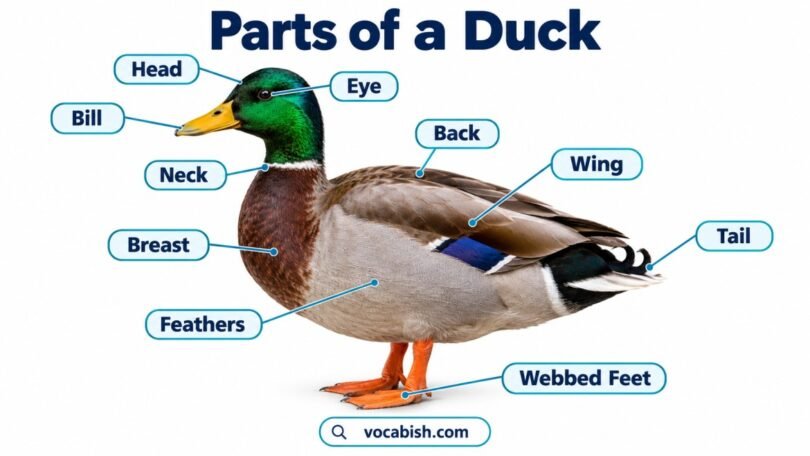

Parts of a duck include the head, bill, eyes, neck, body, wings, feathers, tail, legs, and webbed feet. Each part has a particular function that helps ducks eat, swim, fly, or stay warm. A duck’s broad bill collects food, while its webbed feet push water backward during swimming. Its wings and feathers help with flight, protection, and body temperature.
Learning duck body parts names in English also helps students describe a duck’s appearance and movement correctly. The labeled diagram below shows the main external structures, followed by their names, locations, functions, and example sentences.
Parts of a Duck with a Labeled Diagram
A duck’s external anatomy includes several visible regions, from its head and neck to its tail and feet. A side-view diagram helps identify where these structures are located.
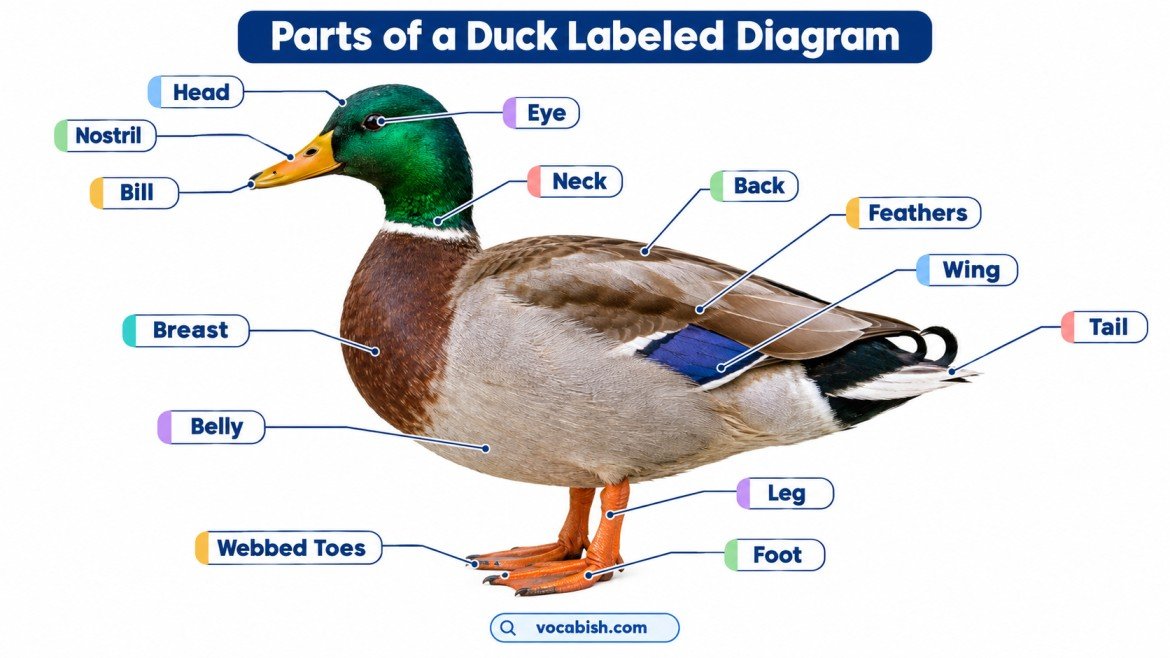
The duck’s body is divided into these main regions:
- Head: Contains the bill, eyes, and nostrils.
- Neck: Joins the head to the main body.
- Trunk: Includes the breast, belly, back, and sides.
- Wings: Extend from the sides of the body.
- Tail: Forms the rear end of the bird.
- Legs: Support the duck when standing or walking.
- Feet: Have webbed toes that help with swimming.
Most ducks share this general body structure, although their sizes, colours, and shapes differ among species.
Common Duck Body Parts Names in English
These are the most common words used to describe duck anatomy. Learning their names and basic functions makes it easier to identify the parts of a duck with pictures.
- Head: The upper part containing the eyes and bill.
- Bill: The mouth structure used to collect and handle food.
- Eye: Helps the duck see objects and nearby movement.
- Nostril: A small opening through which the duck breathes.
- Neck: Connects the head to the main body.
- Breast: The front region of the duck’s body.
- Belly: The lower region beneath the duck’s breast.
- Back: The upper surface behind the duck’s neck.
- Wing: A feathered body part mainly used for flight.
- Feathers: Cover the body and provide warmth and protection.
- Tail: The rear structure that supports the tail feathers.
- Leg: Supports the body when standing and walking.
- Foot: Helps the duck walk and move through water.
- Webbed toes: Toes connected by skin that helps with swimming.
These words describe the visible parts of most ducks, including mallards, domestic ducks, and many wild species.
Parts of a Duck’s Head and Neck
A duck’s head contains structures used for feeding, breathing, seeing, and hearing. Its flexible neck allows the head to reach food in water and helps the duck clean its feathers.
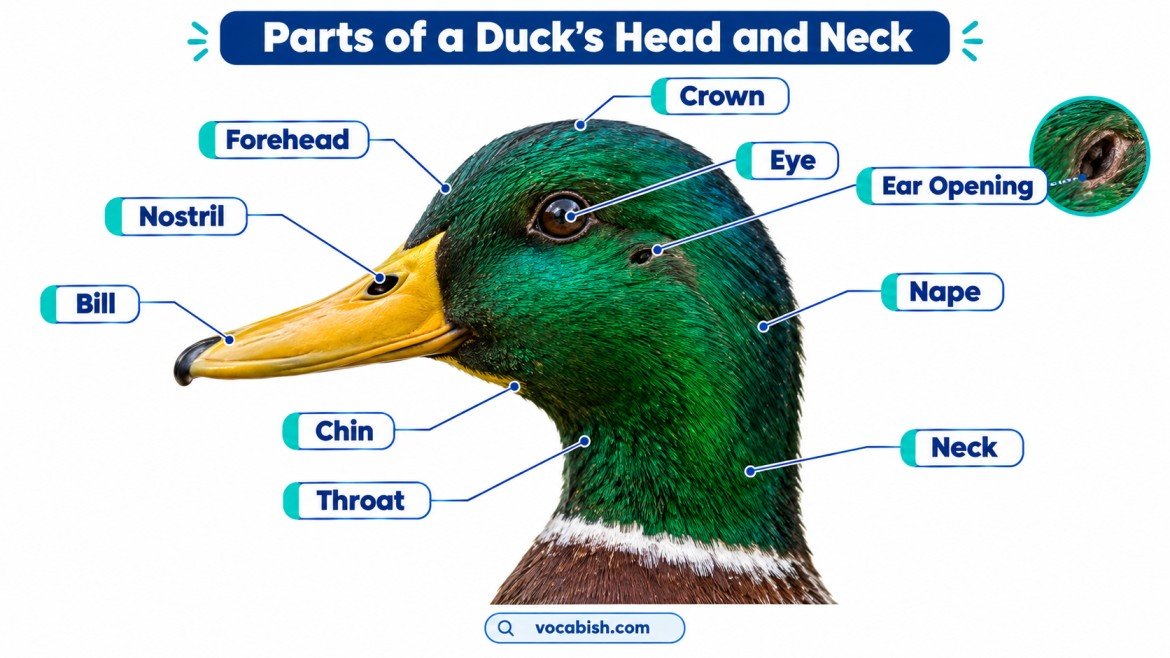
Bill, Nostrils, Eyes, and Ears
Part | Location and Function |
|---|---|
Bill | Projects from the front of the head and collects food. |
Nostrils | Two openings, usually on the upper bill, allow air to enter. |
Eyes | Located on the sides of the head, providing a wide field of vision. |
Ears | Small openings behind and slightly below the eyes, usually hidden by feathers, allow hearing. |
Example sentences:
- The duck dips its bill into the pond to find food.
- A duck’s nostrils help it breathe when its bill is above water.
- The duck uses its eyes to watch for danger.
- A duck’s ears help it hear other ducks calling.
Ducks have ears, but they do not have visible outer ear flaps like humans.
Crown, Forehead, Chin, Throat, and Nape
These terms describe specific regions of the duck’s head and neck.
Part | Position | Description |
|---|---|---|
Crown | Top of the head | The uppermost feather-covered area. |
Forehead | Front of the head | The region above the bill. |
Chin | Beneath the bill | The small area directly below the lower bill. |
Throat | Front of the neck | The region extending below the chin. |
Nape | Back of the neck | The rear neck area just below the head. |
For example, a male mallard has a glossy green head and a narrow white ring around its neck. The crown lies on top of its head, while the nape is at the back.
Duck Body Regions: Breast, Belly, Back, and Flank
The trunk is the main part of a duck’s body. Its different regions are useful when describing feather colours, markings, or physical features.
Body Part | Location | Meaning or Function |
|---|---|---|
Breast | Front of the trunk | Covers the chest muscles and forms the front body region. |
Belly | Lower body | Forms the underside behind the breast. |
Back | Upper body | Covers the upper trunk between the neck and rump. |
Flank | Side of the body | The area between the folded wing and belly, toward the rear. |
Mantle | Upper back | A region of the upper back used in bird descriptions. |
Rump | Rear upper body | The area just before the tail. |
Scapular region | Shoulder area | Contains scapular feathers that cover part of the folded wing and back. |
The mantle and scapular region are related but different. The mantle describes an upper-back region, while the scapulars are feathers associated with the shoulders.
For example, a duck may have a brown breast, pale belly, and dark back. These names help describe exactly where each colour appears.
Parts of a Duck’s Wings
A duck has two wings attached to the sides of its body. In flying ducks, the wings generate lift and help control movement through the air. Their long flight feathers form much of the wing’s surface.
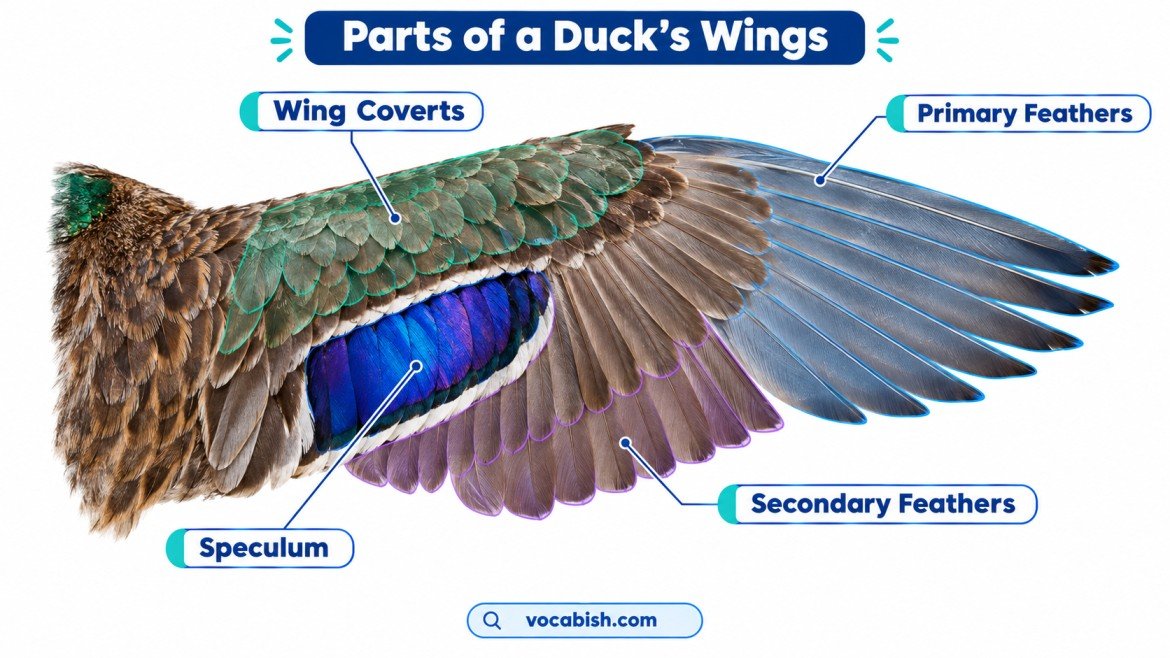
Primary, Secondary, and Coverts Feathers
Wing Part | Location | Main Function |
|---|---|---|
Primary feathers | Outer part and tip of the wing | Help produce thrust and control flight. |
Secondary feathers | Inner trailing edge of the wing | Help produce lift during flight. |
Wing coverts | Overlapping feathers covering the bases of flight feathers | Smooth and protect the wing surface. |
Speculum | On some secondary wing feathers | A coloured patch used as a distinguishing feature in many ducks. |
Primary feathers are especially important during wingbeats. Secondary feathers help support the bird in the air.
Many ducks, including mallards, have a coloured patch called a speculum on each wing. It may appear blue, green, purple, or another colour depending on the species.
Not all ducks have an equally visible speculum, and some domestic breeds have reduced flying ability.
Duck Feathers and Their Functions
Duck feathers cover much of the body and serve several purposes. Different feather types help maintain body temperature, protect the skin, and support movement through the air.
The main types of duck feathers are:
- Contour feathers: Form the smooth outer covering and give the duck its body shape.
- Down feathers: Soft feathers close to the skin that trap air and reduce heat loss.
- Flight feathers: Strong feathers on the wings that support flying.
- Tail feathers: Stiff feathers that help with balance and flight control.
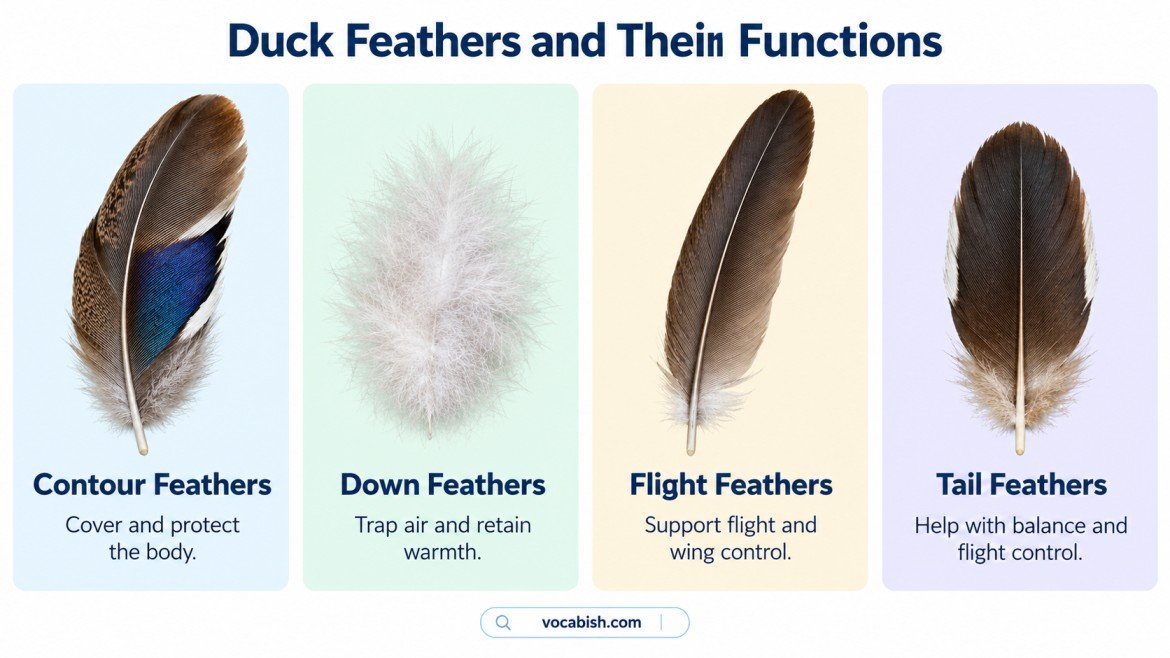
A duck’s outer feathers overlap to form a protective covering. The down underneath helps the bird retain warmth, especially in cold water.
How Ducks Keep Their Feathers Water-Resistant
Ducks regularly clean and arrange their feathers through a behaviour called preening.
During preening, a duck uses its bill to straighten feathers, remove dirt, and maintain their overlapping structure. It also spreads oily secretions from a gland near the base of its tail.
This gland is called the preen gland, or uropygial gland.
Water resistance depends on several features working together:
- Closely overlapping outer feathers help shed water.
- Preening keeps the feathers properly arranged.
- Preen gland secretions help maintain feather condition.
- Trapped air within the plumage supports insulation.
The feathers’ physical structure plays a major role in water resistance. Oil alone does not make the entire plumage waterproof.
Parts of a Duck’s Legs and Webbed Feet
Duck legs support the body on land, while their webbed feet help them move through water. Most ducks have three forward-pointing toes connected by skin and a smaller rear toe.
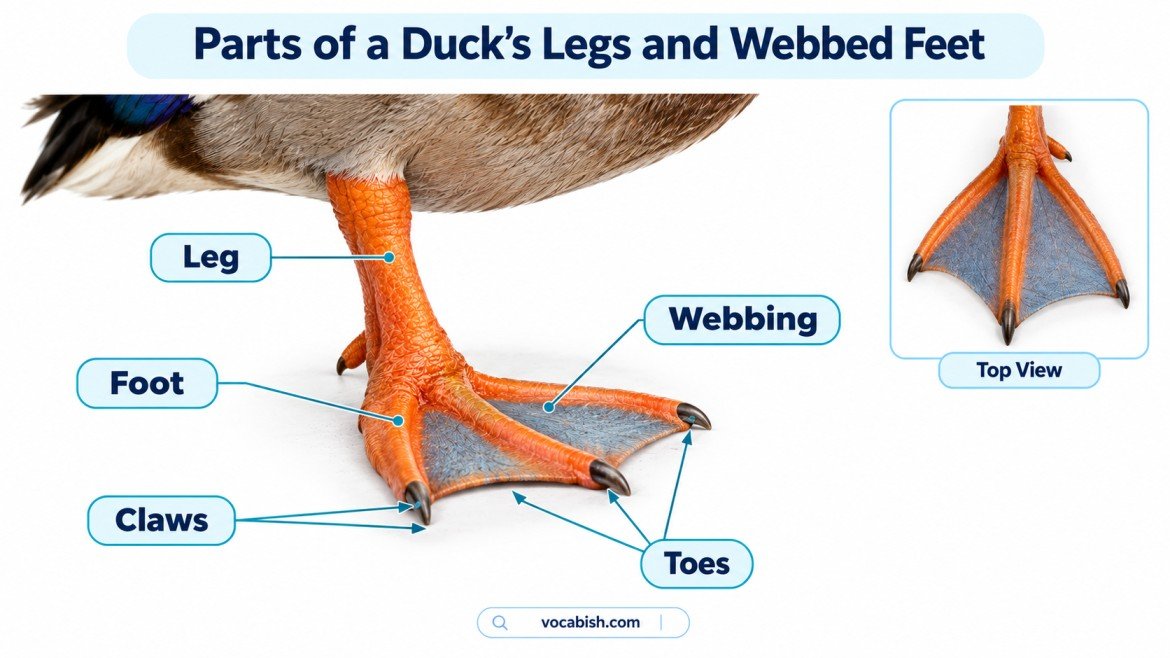
Part | Description | Function |
|---|---|---|
Leg | The limb extending beneath the body | Supports standing and walking. |
Foot | The lower part of the limb | Provides support and helps with swimming. |
Toes | The digits at the end of the foot | Help with movement and balance. |
Webbing | Skin connecting the forward toes | Creates a broad surface for pushing water. |
Claws | Hard, pointed tips of the toes | Provide grip on different surfaces. |
How Webbed Feet Help Ducks Swim
When a duck pushes its foot backward, the webbing spreads and creates a broad surface against the water. This helps move the duck forward.
As the foot moves forward for the next stroke, the toes can come closer together, reducing water resistance.
This arrangement is called a palmate foot, meaning the three forward toes are connected by webbing.
The exact size and shape of the feet vary among duck species. Some diving ducks have larger feet suited to swimming underwater.
Duck Bill Parts and How They Help with Feeding
A duck’s bill is a broad mouth structure covered by a hard outer layer. It helps the bird collect, hold, and process food, although bill shapes vary with different feeding habits.
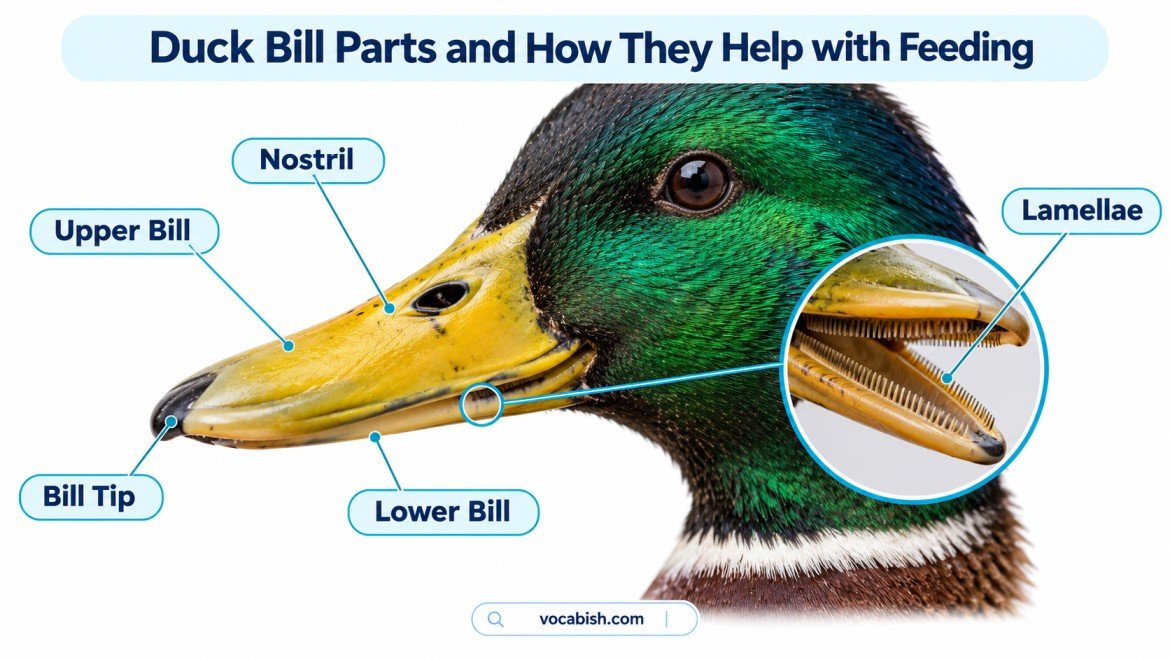
Bill Part | Location | Function |
|---|---|---|
Upper bill | Upper half of the bill | Helps collect and handle food. |
Lower bill | Movable lower half | Works with the upper bill to grasp food. |
Nostrils | Openings on the upper bill | Allow the duck to breathe. |
Bill tip | Front end of the bill | Helps pick up and investigate food. |
Lamellae | Fine ridges along the bill edges | Help some ducks strain food from water. |
The word lamellae (pronounced luh-MEL-ee) refers to small, comb-like structures along the inside edges of the bill.
Many dabbling ducks use these structures to separate food particles from water or mud. Other ducks have differently shaped bills suited to catching fish or eating plants.
Some ducks also have a small hardened area near the tip of the upper bill called the nail, sometimes called the bean.
For example, a mallard often feeds by dipping its bill into shallow water, while a merganser uses its narrower, serrated bill to grip fish.
Duck Tail, Rump, and Undertail Coverts
The rear of a duck includes the rump, tail, and several feather groups. These structures help form the bird’s shape and can provide useful clues for identifying different species.
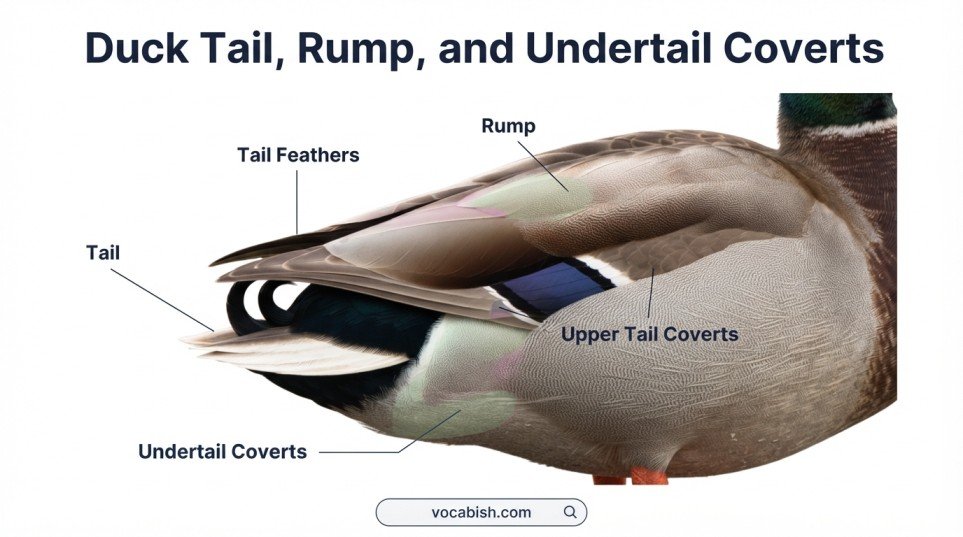
Part | Location | Description |
|---|---|---|
Tail | Rear end of the body | The structure supporting the tail feathers. |
Tail feathers | Extend backward from the tail | Help with balance and steering during flight. |
Rump | Upper rear body before the tail | A feather-covered region above the tail base. |
Upper tail coverts | Above the base of the tail feathers | Cover and protect the upper tail base. |
Undertail coverts | Beneath the tail base | Cover the underside near the base of the tail feathers. |
The tail feathers can spread or change position to help control movement in the air.
Some mature male mallards have curled feathers near the tail. These are commonly called drake curls. They are characteristic of male mallards and some domestic ducks descended from them, rather than all duck species.
How Duck Body Parts Help Them Swim, Fly, and Stay Warm
A duck’s body parts work together during everyday activities. Its feet provide propulsion in water, its feathers help control heat loss, and its wings allow many species to fly.
Body Part | Main Function | Example |
|---|---|---|
Webbed feet | Push water during swimming | A duck paddles across a pond. |
Bill | Collects and handles food | A duck searches for food in mud. |
Wings | Support flight in flying ducks | A mallard flies over a lake. |
Down feathers | Help retain body heat | A duck stays warm in cold weather. |
Tail feathers | Help control flight movement | A duck adjusts its tail in the air. |
Eyes | Detect food and surroundings | A duck notices movement nearby. |
Neck | Allows flexible head movement | A duck reaches its feathers while preening. |
Legs | Support movement on land | A duck walks along the shore. |
Ducks can also float because their bodies contain air-filled spaces, including parts of their respiratory system, while air trapped in their feathers contributes to buoyancy.
Commonly Confused Duck Body Parts
Some duck anatomy terms describe nearby regions or similar structures. Knowing the difference helps learners use the correct vocabulary when describing a duck.
Terms | Important Difference | Example |
|---|---|---|
Bill vs. beak | Both describe a bird’s mouth structure; bill is especially common for ducks. | The duck has a broad bill. |
Breast vs. belly | Breast is the front region; belly is the lower body region. | The duck has a brown breast and pale belly. |
Crown vs. nape | Crown is on top of the head; nape is at the back of the neck. | The crown is above the eyes. |
Rump vs. tail | Rump is the rear body region; tail includes the tail structure and feathers. | The rump lies before the tail. |
Foot vs. webbing | Foot is the whole structure; webbing is the skin between toes. | The foot has broad webbing. |
Tail feathers vs. undertail coverts | Tail feathers extend backward; undertail coverts cover the lower tail base. | The undertail coverts lie beneath the tail. |
Duck Body Parts in English Sentences
These sentences show how to use duck anatomy vocabulary naturally. Notice how each body part is connected to an action or visible feature.
- The duck uses its webbed feet to swim across the pond.
- A duck’s bill helps it collect food from shallow water.
- The duck stretches its neck toward the water.
- Soft down feathers help keep the duck warm.
- The duck spreads its wings before taking flight.
- A duck’s nostrils are located on its upper bill.
- The duck uses its eyes to watch other birds.
- The mallard has a dark breast and a lighter belly.
- The duck moves its tail feathers while adjusting its position.
- The duck uses its claws to grip the muddy ground.
Duck Body Parts Vocabulary Practice
Parts of a Duck Quiz
Test your knowledge of duck body parts and their functions.
Your Practice Results
Correct answers out of 6
Review Your Answers
Check your answers and read the explanations.
FAQs About Duck Body Parts
The main body parts of a duck are the head, bill, eyes, neck, breast, belly, back, wings, feathers, tail, legs, and webbed feet.
Female ducks have corkscrew-shaped reproductive tracts that may help them control mating and reduce unwanted fertilization.
Duck legs are called legs, while the lower visible section is the tarsometatarsus. Their webbed feet help them swim and walk.
Common duck terms include drake (adult male), hen (adult female), duckling (young duck), flock (group of ducks), and bill (beak).
A duck's mouth structure is called a bill or beak. The word bill is more commonly used when describing ducks and other waterbirds.
Yes, ducks have ears. Their external ear openings are usually hidden beneath feathers behind their eyes, allowing them to hear sounds without visible ear flaps.
Duck feathers include contour feathers for protection, down feathers for insulation, flight feathers for flying, and tail feathers for balance and movement control.
Ducks have webbed feet to help them swim. The skin between their toes spreads during backward strokes, allowing them to push against water.
Conclusion
The parts of a duck include its head, bill, neck, wings, feathers, body regions, tail, legs, and webbed feet. Each structure helps the duck feed, move, or protect itself. Understanding these names and functions makes it easier to describe duck anatomy accurately in English. A labeled diagram, along with examples and vocabulary practice, can help learners recognise each part and use the correct term.