
Parts of an Ant include the head, thorax, abdomen, six legs, and two antennae. Ants are small insects with a hard outer covering and a narrow waist that separates their body sections. Their antennae help them detect smells, while their strong mandibles allow them to carry food and handle objects. Ants also have compound eyes, tiny breathing openings, and jointed legs for walking and climbing. Some species have stingers for protection. Learning ant body parts helps students identify their external structures and understand their functions. This article explains ant anatomy with labeled pictures, English names, and easy descriptions of each part.
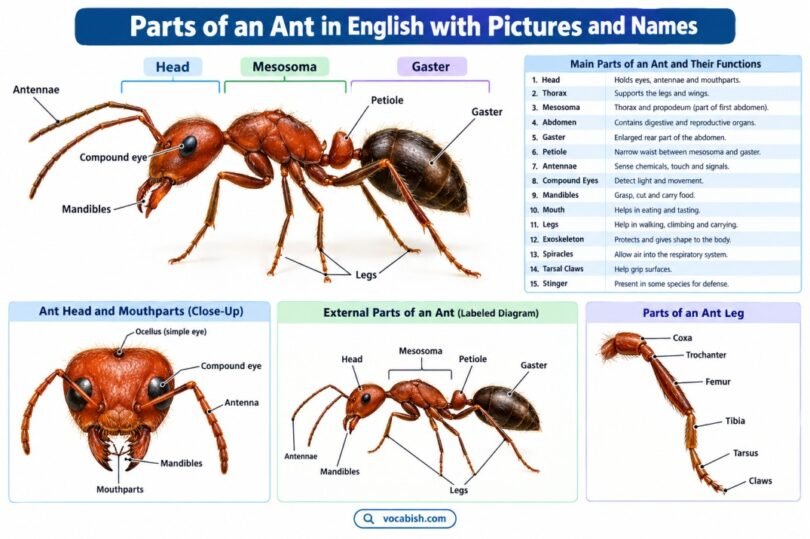
Main Parts of an Ant and Their Functions
An ant has several external body parts that help it move, find food, sense its surroundings, and protect itself. Some are large body regions, while others are smaller structures with specific functions.
The following list introduces 15 important parts of an ant.
- Head: Holds the eyes, antennae, mandibles, and mouthparts.
- Thorax: Contains the three segments that bear legs.
- Mesosoma: Includes the thorax and the first abdominal segment.
- Abdomen: Contains several segments, including the rear body region.
- Gaster: Forms the enlarged rear portion of the abdomen.
- Petiole: Connects the mesosoma to the rear abdomen.
- Antennae: Detect chemicals, touch, and signals from surroundings.
- Compound Eyes: Help ants detect light, shapes, and movement.
- Mandibles: Grasp, cut, carry objects, and defend the ant.
- Mouth: Takes in food with help from mouthparts.
- Legs: Support walking, climbing, running, and carrying objects.
- Exoskeleton: Protects internal organs and supports the body.
- Spiracles: Allow air to enter and leave breathing tubes.
- Tarsal Claws: Help ants grip surfaces while moving around.
- Stinger: Helps certain ant species defend themselves against threats.
Complete Ant Body Parts Table
This table brings together the main ant anatomy vocabulary and the function of each part.
Ant Body Part | Location | Function |
|---|---|---|
Head | Front of body | Contains sensory organs and mouthparts. |
Thorax | Middle body segments | Supports the legs and, when present, wings. |
Mesosoma | Between head and waist | Bears the legs and includes the propodeum. |
Abdomen | Behind the thorax anatomically | Contains digestive and other internal organs. |
Gaster | Enlarged rear section | Houses much of the digestive and reproductive systems. |
Petiole | Narrow waist | Connects the mesosoma and gaster. |
Antennae | Front of head | Detect chemicals and touch. |
Compound Eyes | Sides of head | Detect light and movement. |
Mandibles | Front of mouth | Grip, cut, and carry objects. |
Mouth | Lower front of head | Takes in food. |
Legs | Attached to mesosoma | Help the ant walk and climb. |
Exoskeleton | Outer body covering | Protects and supports the body. |
Spiracles | Along body sides | Allow air to enter the tracheal system. |
Tarsal Claws | Ends of legs | Grip surfaces during movement. |
Stinger | Tip of gaster, in some species | Delivers venom for defense or hunting. |
Important: The mesosoma is not exactly the same as the thorax. It includes the thorax and the propodeum, which comes from the first abdominal segment. The gaster is the enlarged rear part of the abdomen, not the entire abdomen.
Parts of an Ant Diagram
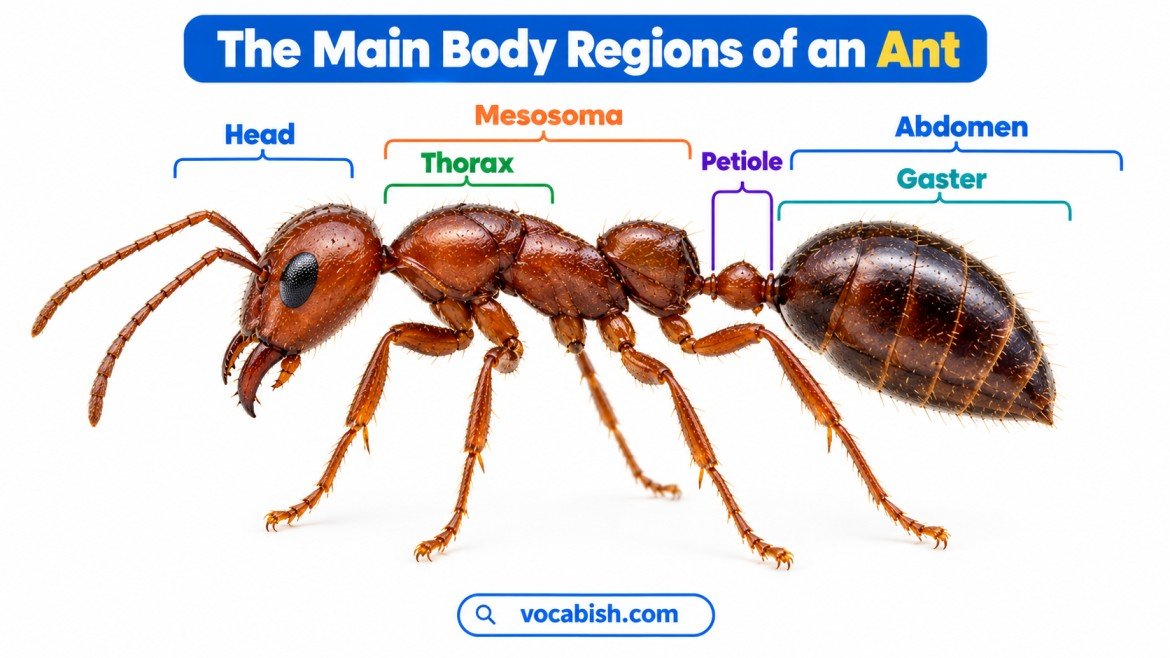
A labeled ant diagram helps students identify the position of each external body part. A side view is particularly useful because it shows the head, middle section, narrow waist, and rounded rear section.
External Parts of an Ant — Labeled Diagram
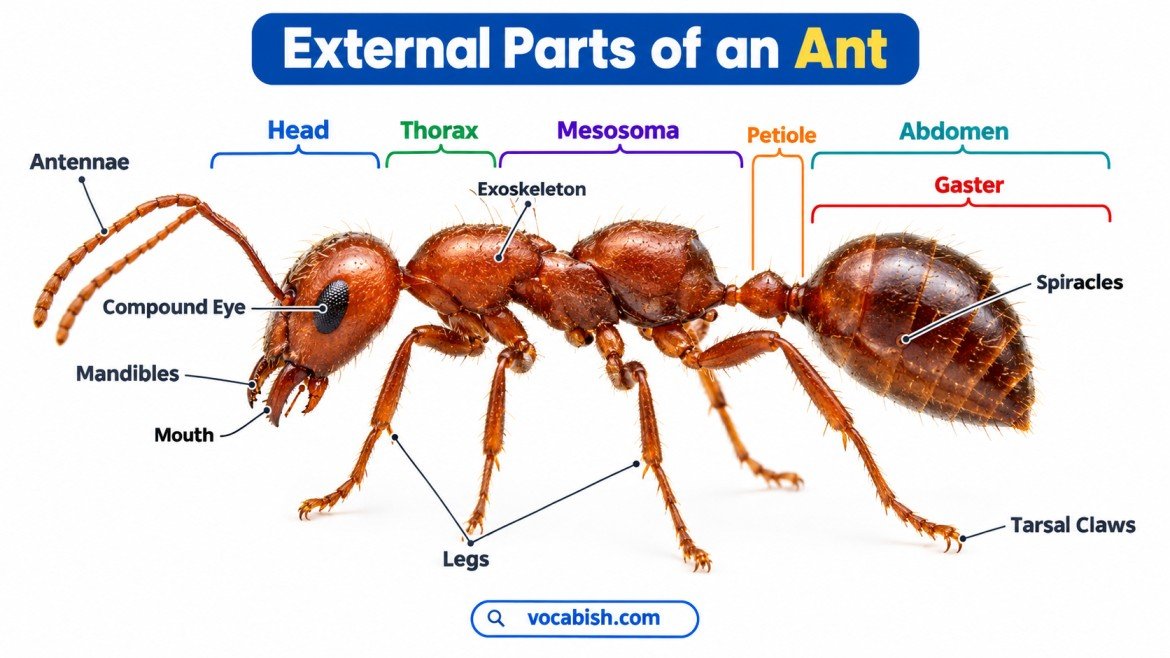
A typical worker ant has a pair of antennae on its head, three pairs of legs attached to the mesosoma, and a narrow waist before the gaster.
Look for these features in the diagram:
- Front: Head, antennae, eyes, and mandibles.
- Middle: Mesosoma and six jointed legs.
- Waist: Petiole, sometimes followed by a second waist segment.
- Rear: Gaster, which contains several internal organs.
Ant Head and Mouthparts — Close-Up Diagram
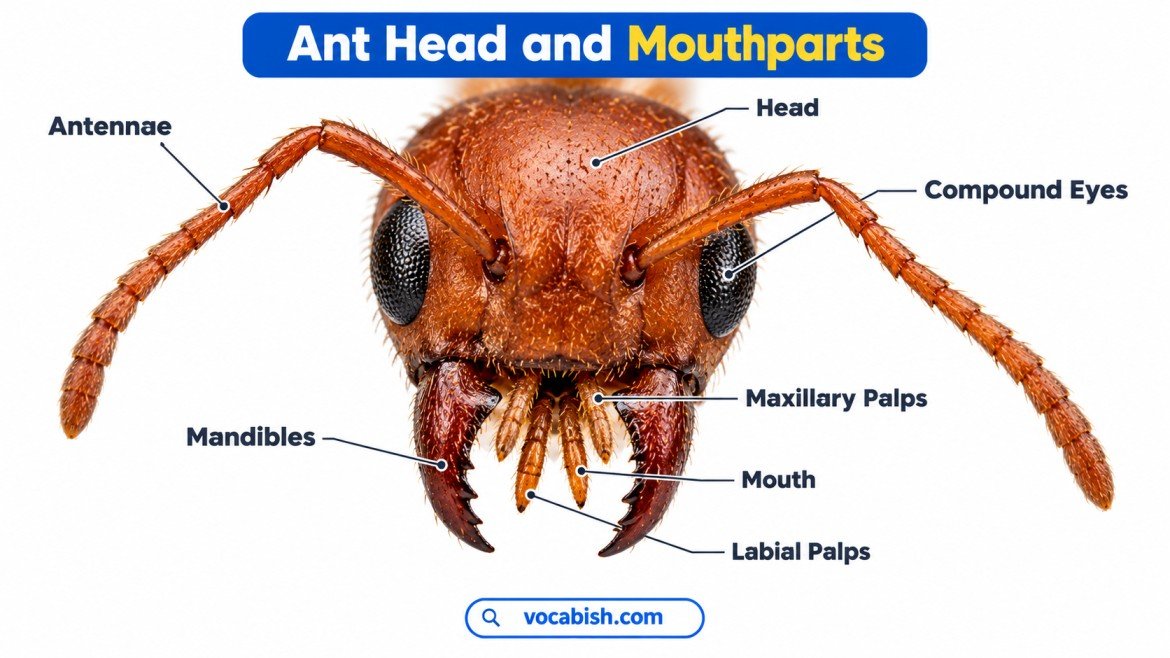
The head contains structures that help an ant sense its surroundings and handle food. Its antennae extend from the front, while the compound eyes usually appear on the sides.
The mandibles are the strong paired jaws. Smaller mouthparts help the ant handle and take in food.
The Main Body Regions of an Ant
Ants follow the basic insect body plan of a head, thorax, and abdomen. However, their specialized body structure is often described using four visible regions: the head, mesosoma, waist, and gaster.
Head
The head is the front section of an ant’s body. It contains the brain and several important sensory and feeding structures.
Its main functions include:
- Detecting food and chemical signals.
- Recognizing objects through touch and vision.
- Gripping and carrying food.
- Handling materials used in nest building.
Head size and shape vary between ant species and worker types.
Thorax and Mesosoma
The thorax consists of three segments behind the head. Each segment bears one pair of legs, giving an adult ant six legs.
In ant anatomy, the mesosoma includes the thorax and the propodeum, a segment that originally belongs to the abdomen.
All six legs attach to the thoracic portion of the mesosoma. Winged ants also have their wings attached to the thorax.
Petiole — The Narrow Waist
The petiole is a narrow segment connecting the mesosoma to the rear portion of an ant’s body.
Its shape is an important feature used to identify different ant groups.
Ants may have:
- One waist node: A single visible petiole node.
- Two waist nodes: A petiole followed by a postpetiole.
The flexible waist helps the ant move its gaster in different directions.
Gaster — The Rear Body Section
The gaster is the large rear section of an ant’s body. It forms the most noticeable part of the abdomen behind the waist.
It contains much of the digestive system and, depending on the ant’s sex and caste, reproductive organs.
Some ants also have a functional stinger at the tip of the gaster. Other species use chemical secretions for defense.
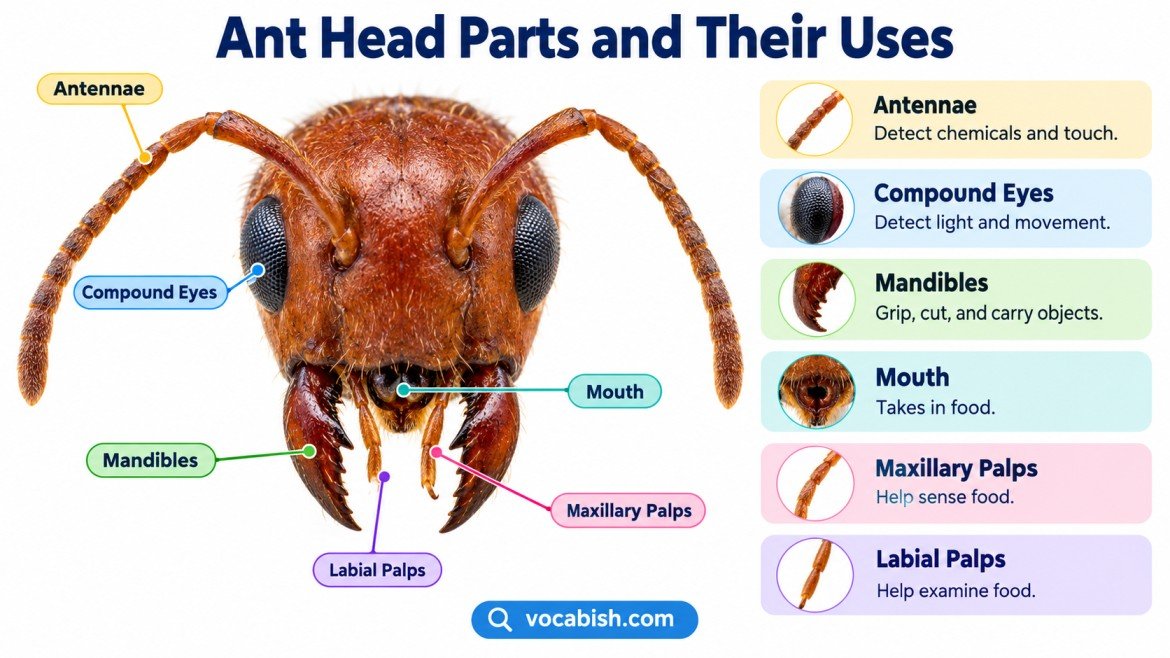
Ant Head Parts and Their Uses
The head is an important part of an ant’s sensory system. Its antennae, eyes, and mouthparts work together to help the insect locate food, communicate, and interact with its surroundings.
Antennae
An ant has two antennae attached to its head. In many ants, they have a noticeable bend that gives them an elbowed appearance.
Antennae help ants:
- Detect chemical trails left by other ants.
- Recognize colony members through chemical signals.
- Find food using chemical cues.
- Feel nearby objects and surfaces.
Ants communicate extensively through chemicals called pheromones. Their antennae contain sensory receptors that detect these signals.
Compound Eyes and Simple Eyes
Many ants have two compound eyes on the sides of their heads.
Each compound eye contains numerous small visual units called ommatidia (singular: ommatidium).
These eyes help ants detect light and movement. Vision differs considerably between species. Some underground ants have very small eyes or no functional eyes.
Certain ants also possess simple eyes called ocelli.
Ocelli are particularly common in winged queens and males. They mainly help detect light and support orientation.
Eye Type | Structure | Main Function |
|---|---|---|
Compound Eyes | Made of many visual units | Detect images, light, and movement. |
Simple Eyes (Ocelli) | Small light-sensitive organs | Help detect light and support orientation. |
Mandibles and Mouthparts
Mandibles are strong, paired jaws located at the front of an ant’s head.
Ants use them to:
- Carry food back to the nest.
- Cut or break apart food.
- Move soil and nest materials.
- Grip objects and defend themselves.
The mouth also contains smaller structures that help handle food.
Maxillary palps and labial palps are sensory appendages associated with the mouthparts. They help ants examine food and nearby materials.
Not all ant species have mandibles of the same size or shape. Some predatory ants possess long, specialized jaws for capturing prey.
Ant Legs and How They Help Ants Move
Adult ants have six jointed legs arranged in three pairs. These legs attach to the thoracic segments of the mesosoma and help ants move across soil, plants, walls, and other surfaces.
Parts of an Ant Leg
Each ant leg contains several connected segments. These joints allow the leg to bend and move in different directions.
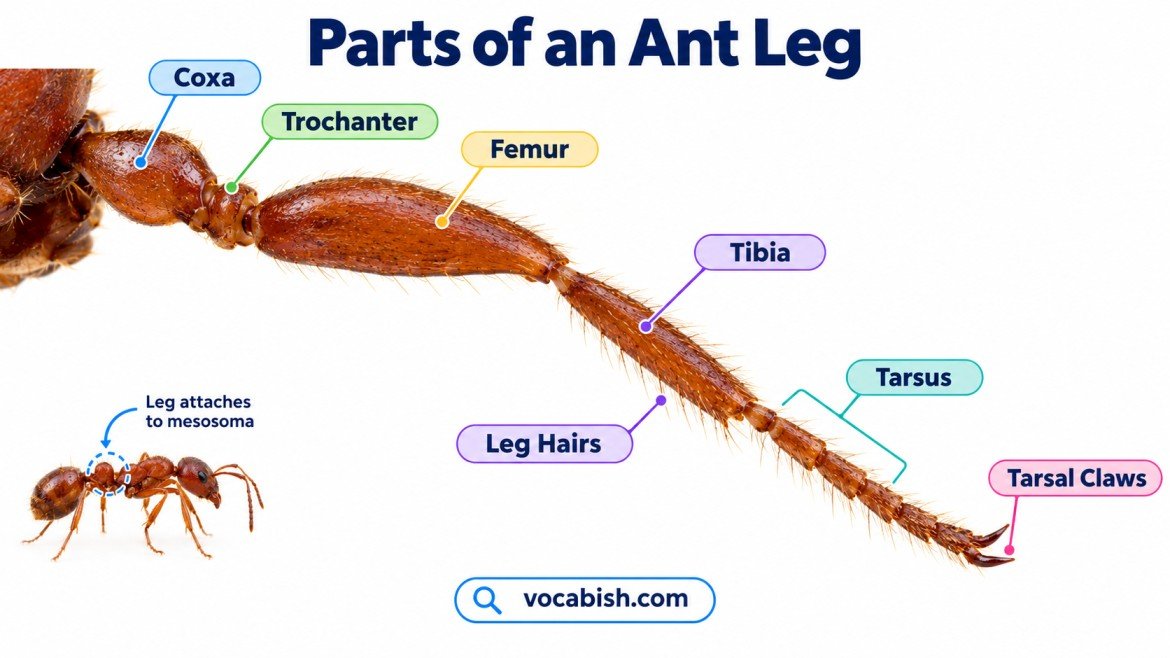
Leg Part | Position | Function |
|---|---|---|
Coxa | Base of leg | Connects the leg to the body. |
Trochanter | After coxa | Helps connect the upper leg segments. |
Femur | Upper main segment | Provides leverage for movement. |
Tibia | Between femur and tarsus | Supports walking and movement. |
Tarsus | Near end of leg | Helps the foot contact surfaces. |
Tarsal Claws | Tip of leg | Grip uneven surfaces. |
The tarsus is made of several smaller segments called tarsomeres.
Tarsal Claws and Leg Hairs
Ants have small claws at the ends of their legs. These claws help them hold onto rough surfaces, including bark and soil.
Many ants also have adhesive structures near their claws that help them move across smoother surfaces.
Fine hairs called setae occur on different parts of the legs. Some act as sensory structures, helping ants detect touch and movement.
Other hairs serve different purposes, depending on their location and structure.
Ant Wings, Stingers, and Other Special Features
Not every ant has the same external features. Wings, stingers, and certain defensive structures depend on the species, caste, and stage of development.
Wings in Queen and Male Ants
Winged ants are usually reproductive individuals.
Young reproductive queens and males commonly develop two pairs of wings before mating flights.
After mating, queens of many species shed their wings and begin establishing colonies.
Typical worker ants do not have wings. However, some ant species have wingless reproductive forms.
Stinger and Defensive Structures
Some ants have a stinger at the rear of the gaster.
A functional stinger can inject venom into prey or potential threats.
Other ants lack a functional stinger and defend themselves through biting or chemical secretions.
For example, many formicine ants have an acidopore, a specialized opening near the end of the gaster. It releases defensive chemicals, including formic acid in many species.
Therefore, a stinger should not be shown as a universal feature in an ant anatomy diagram.
Exoskeleton and Spiracles
The exoskeleton is the hard outer covering of an ant. It provides support, protects internal tissues, and offers attachment points for muscles.
Like other insects, ants do not have lungs.
Instead, they breathe through small openings called spiracles, which connect to internal air tubes.
Spiracles are located along the sides of certain body segments. They are often difficult to see without magnification.
Internal Parts of an Ant
Inside an ant’s exoskeleton are organs that process food, transport nutrients, control movement, and support reproduction. These internal systems perform different tasks while working together to keep the insect alive.
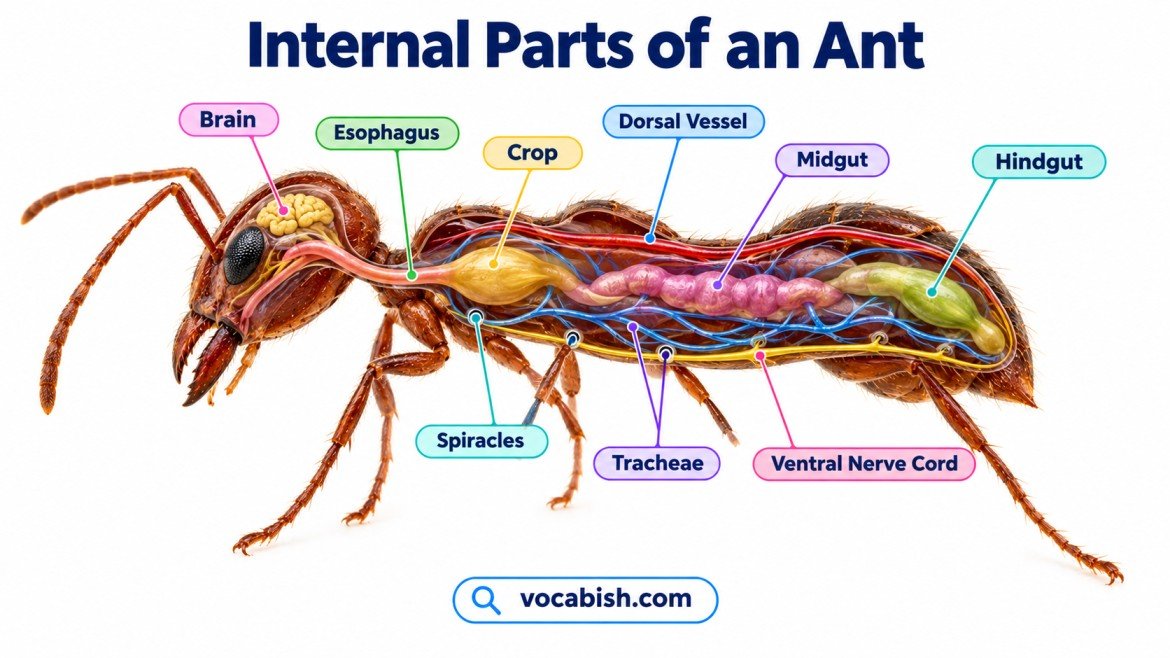
Digestive System
The digestive system breaks down food and absorbs nutrients.
Important digestive structures include:
- Esophagus: Carries swallowed food toward the digestive tract.
- Crop: Stores liquid food in many ant species.
- Midgut: Digests food and absorbs nutrients.
- Hindgut: Processes remaining material before waste leaves the body.
The crop is sometimes called a social stomach because many ants can share stored liquid food with colony members through a process called trophallaxis.
Respiratory System
Ants breathe through a network of air-filled tubes called the tracheal system.
Air enters through spiracles and moves through branching tracheae that deliver oxygen to body tissues.
This system also helps remove carbon dioxide.
Unlike humans, ants do not rely on blood to transport most of their oxygen.
Nervous and Circulatory Systems
The nervous system controls movement, sensation, and behavior.
It includes the brain, ventral nerve cord, and connected nerve centers called ganglia.
Ants also have a circulatory system with a tube-like organ called the dorsal vessel.
Their circulatory system is open, meaning the circulating fluid, called hemolymph, moves through the body cavity rather than remaining entirely inside blood vessels.
Reproductive System
Reproductive organs differ between queens, males, and workers.
Queen ants generally have developed ovaries that produce eggs. Male ants produce sperm for reproduction.
Most worker ants have reduced reproductive ability, although workers of some species can lay eggs.
The reproductive system is mainly located within the abdomen.
Differences Between Worker, Queen, and Male Ants
An ant colony may contain workers, queens, and males. These groups have different roles and often show noticeable differences in body size, wing development, and reproductive organs.
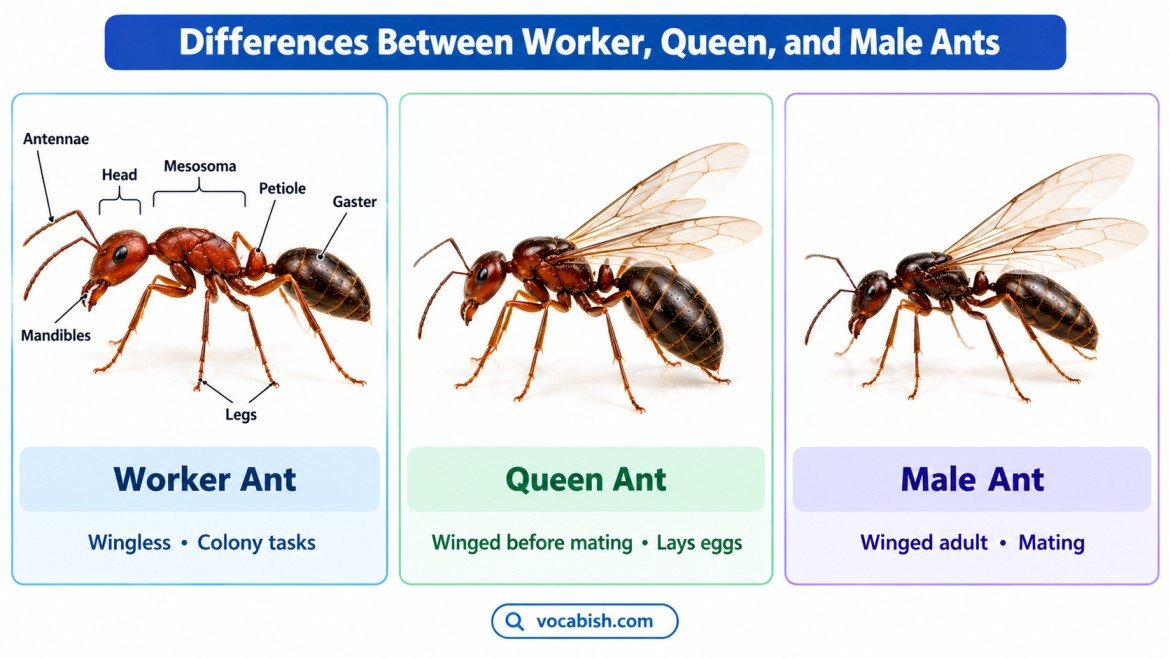
Feature | Worker Ant | Queen Ant | Male Ant |
|---|---|---|---|
Typical Role | Colony tasks | Reproduction | Mating |
Body Size | Varies by species | Often larger than workers | Varies by species |
Wings | Usually absent | Often present before mating | Usually present as adults |
Reproduction | Usually limited | Primary egg layer | Produces sperm |
Main Duties | Finds food, builds nests, cares for young | Lays eggs | Mates with queens |
Body Structure | Adapted for colony work | Often has a larger thorax | Often has distinctive eyes and antennae |
These differences are general patterns. Some species have multiple worker sizes, wingless queens, or unusual reproductive arrangements.
How Ant Body Parts Work Together
An ant depends on several body parts to perform everyday activities. Its sensory organs help it locate food, while its mandibles and legs allow it to collect and transport materials.
Activity | Body Parts Involved | How They Work |
|---|---|---|
Finding Food | Antennae and sensory organs | Detect chemical and environmental cues. |
Carrying Food | Mandibles and legs | Grip objects and transport them. |
Following Scent Trails | Antennae | Detect pheromones left by other ants. |
Walking and Climbing | Legs and tarsal claws | Support movement and grip surfaces. |
Breathing | Spiracles and tracheae | Deliver oxygen to body tissues. |
Defending the Colony | Mandibles and defensive structures | Bite, sting, or release chemicals. |
For example, when a worker ant finds food, its antennae help detect chemical cues. Its mandibles grip the food, and its legs carry it toward the nest.
Parts of an Ant Vocabulary Chart
An ant vocabulary chart helps English learners connect anatomical names with their positions on the body.
The following chart groups common terms by their functions, making the vocabulary easier to review.
Vocabulary Group | Body Part | Meaning |
|---|---|---|
Body Regions | Head | Front body section. |
Body Regions | Mesosoma | Middle section bearing the legs. |
Body Regions | Petiole | Narrow waist segment. |
Body Regions | Gaster | Enlarged rear body section. |
Sensory Structures | Antennae | Detect chemicals and touch. |
Sensory Structures | Compound Eyes | Detect light and movement. |
Sensory Structures | Ocelli | Detect light in certain ants. |
Mouthparts | Mandibles | Grip and cut objects. |
Mouthparts | Maxillary Palps | Sense food and nearby materials. |
Movement Structures | Legs | Help ants walk and climb. |
Movement Structures | Tarsal Claws | Grip surfaces. |
Protective Structures | Exoskeleton | Covers and supports the body. |
Breathing Structures | Spiracles | Openings for air exchange. |
Defensive Structures | Stinger | Injects venom in some ants. |
When studying these words, pay attention to the difference between the body regions and the smaller structures attached to them.
Parts of an Ant in English Sentences
Using ant anatomy words in short sentences helps students practise their spelling and meaning.
- An ant has six legs.
- The ant uses its antennae to detect smells.
- Its head contains the eyes and mouthparts.
- The mandibles help the ant carry food.
- An ant can walk across the ground.
- The petiole forms part of the narrow waist.
- The gaster is at the rear of the ant.
- Compound eyes help many ants detect movement.
- The exoskeleton protects the ant’s body.
- Ants breathe through tiny openings called spiracles.
- A queen ant can lay eggs.
- Some ants use their stingers to protect themselves.
Vocabulary tip: Antenna is singular, while antennae is plural. An ant has two antennae, not two antenna.
FAQs About Ant Body Parts
An ant has a head, thorax, and abdomen. Its specialized external structure includes the mesosoma, narrow waist, and enlarged rear section called the gaster.
An adult ant has six legs arranged in three pairs. All six legs attach to the thoracic portion of the mesosoma.
Ants use their antennae to detect chemical signals, touch objects, locate food, and recognize colony members through chemical cues.
The waist includes the petiole. Some ants have one visible waist node, while others have two segments called the petiole and postpetiole.
No. Most worker ants are wingless. Reproductive queens and males commonly develop wings, and many queens shed them after mating.
No. Some ants have functional stingers that inject venom. Other species defend themselves by biting or releasing chemicals from specialized glands.
The abdomen includes segments incorporated into the mesosoma and waist. The gaster is the enlarged rear portion of the abdomen, located behind the waist.
Ants breathe through small body openings called spiracles. Air travels through branching tracheal tubes that deliver oxygen directly to their tissues.
Conclusion
The parts of an ant include the head, mesosoma, petiole, gaster, antennae, mandibles, eyes, and six legs. Each structure has a particular function, from detecting food to walking and defending the colony. Some ants also have wings, stingers, or other specialized features. By studying labeled ant diagrams, body part names, and example sentences, English learners can recognize these structures and use the correct vocabulary when describing an ant.