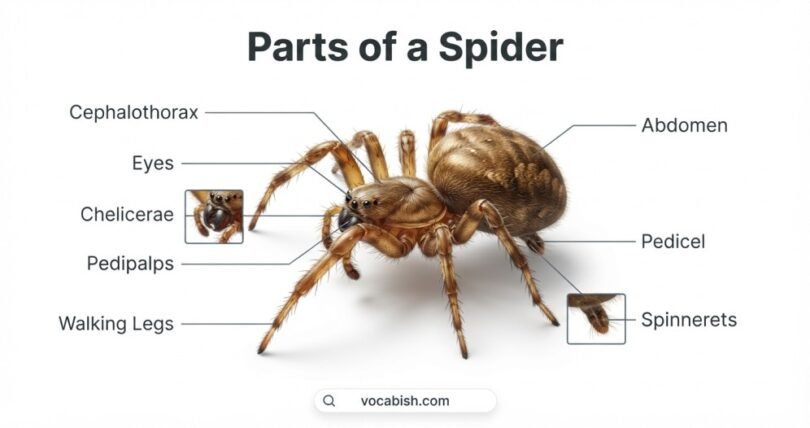

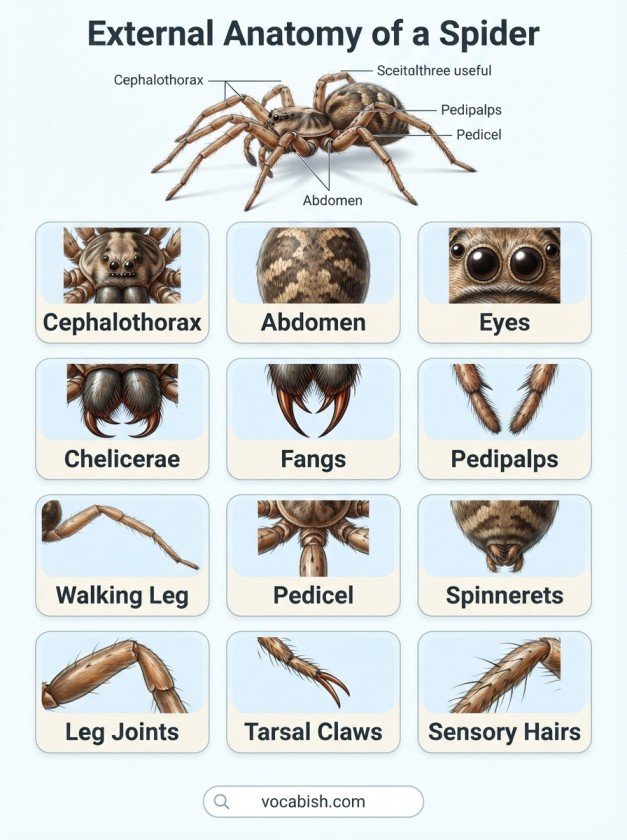
Parts of a Spider include two main body regions, eight walking legs, eyes, fangs, pedipalps, and spinnerets. Unlike insects, spiders have a cephalothorax at the front and an abdomen at the back, connected by a narrow stalk. Each body part has a particular function, from sensing movement and catching prey to producing silk.
Learning spider body parts helps English learners recognise anatomical names and describe how spiders move, feed, and survive. The labeled diagrams, vocabulary lists, and short explanations below show where each part is located and what it does. You will also learn the seven segments of a spider’s leg and their correct names.
Parts of a Spider with Names and Meanings
A spider has two main body regions and several specialised appendages. The following external structures are useful for identifying spider anatomy and learning their English names.
Spider Part | Location | Short Meaning |
|---|---|---|
Cephalothorax (Prosoma) | Front body region | Carries the eyes, mouthparts, and walking legs. |
Abdomen (Opisthosoma) | Rear body region | Contains major internal organs and silk glands. |
Eyes | Front or upper cephalothorax | Detect light, movement, and sometimes detailed shapes. |
Chelicerae | Front of the mouth | Paired appendages that carry the fangs. |
Fangs | Ends of chelicerae | Pierce prey and usually deliver venom. |
Pedipalps | Near the mouth | Help sense surroundings and handle food. |
Walking Legs | Attached to cephalothorax | Four pairs used for walking and climbing. |
Pedicel | Between main body regions | Narrow stalk connecting the cephalothorax and abdomen. |
Spinnerets | Near rear of abdomen | Appendages that release silk from tiny openings. |
Leg Joints | Between leg segments | Allow the legs to bend and move. |
Tarsal Claws | Tips of walking legs | Help grip surfaces and silk threads. |
Sensory Hairs | On legs and body | Detect touch, vibrations, and air movement. |
The cephalothorax and abdomen are the two major body regions. Leg joints and sensory hairs are smaller anatomical features, not separate body regions.
Parts of a Spider Diagram
A labeled spider diagram helps students identify external body parts by their position. A top or three-quarter view is useful for showing the two body regions, eight legs, eyes, pedipalps, and narrow pedicel.
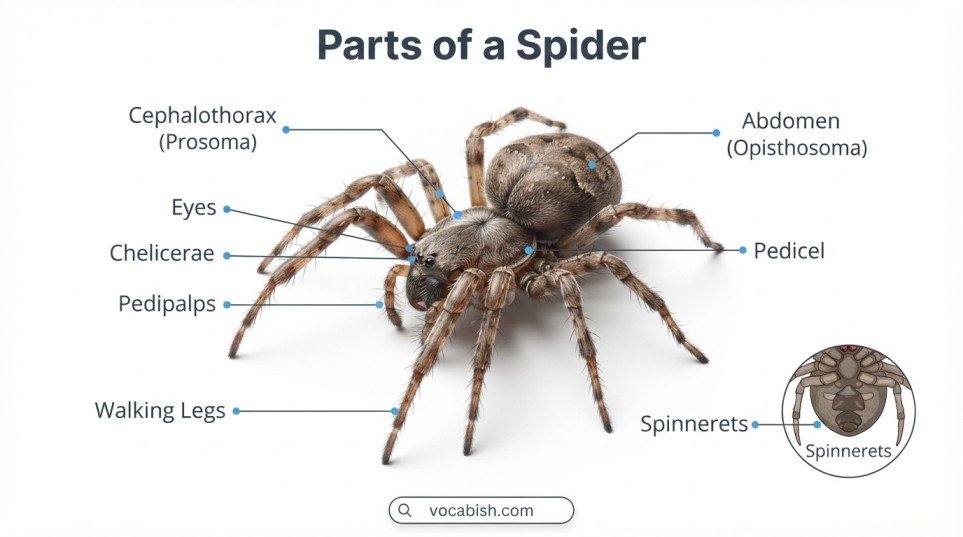
Some structures, especially the fangs and spinnerets, are difficult to see from above. Close-up views show their positions more accurately.
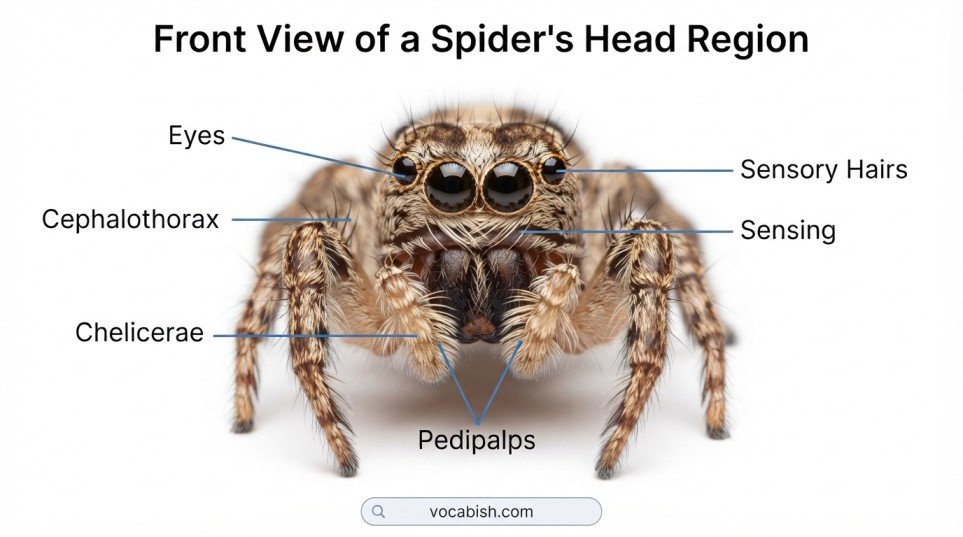
Front View of a Spider’s Head Region
The front of the cephalothorax contains the eyes, chelicerae, fangs, and pedipalps. These structures help spiders detect and handle prey.
Two Main Body Regions of a Spider
A spider’s body is divided into the cephalothorax and abdomen. These regions are joined by the pedicel, a narrow connection that allows the abdomen to move relative to the front body region.
1. Cephalothorax (Prosoma)
The cephalothorax (pronounced sef-uh-loh-THOR-aks) is the front body region of a spider. Scientists also call it the prosoma.
It includes the head region, but spiders do not have a separate head like insects.
The cephalothorax carries:
- Eyes: Detect light and movement.
- Chelicerae: Carry the fangs used in feeding.
- Pedipalps: Help with sensing and handling food.
- Walking legs: Support movement on different surfaces.
A firm outer covering called the carapace protects the upper surface of the cephalothorax.
2. Abdomen (Opisthosoma)
The abdomen (pronounced AB-duh-men) is the rear body region. Its scientific name is opisthosoma.
It contains important digestive, reproductive, and respiratory organs. Silk-producing glands are also found inside the abdomen.
Spinnerets are usually located near its rear end. The abdomen may appear round, oval, or elongated, depending on the spider species.
3. Pedicel
The pedicel is the narrow stalk connecting the cephalothorax to the abdomen.
It allows the abdomen to move relative to the cephalothorax, which is useful when spiders position their spinnerets during silk production.
Body Structure | Position | Main Function |
|---|---|---|
Cephalothorax | Front | Supports eyes, mouthparts, and legs. |
Abdomen | Rear | Houses major organs and silk glands. |
Pedicel | Between regions | Connects the two regions and permits movement. |
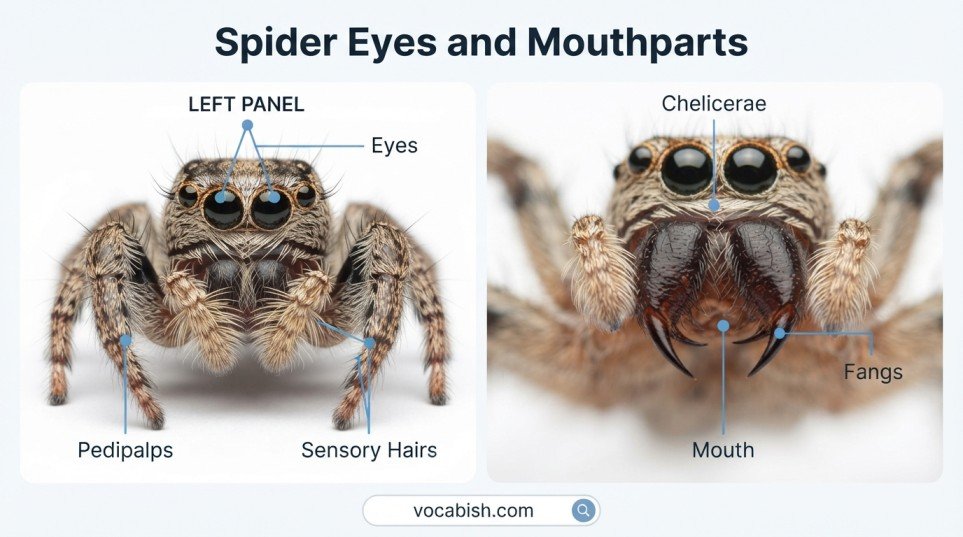
Spider Eyes and Mouthparts
A spider uses its eyes and specialised mouth appendages to sense and capture prey. These structures are located on the front region of its body, although their appearance varies among species.
Eyes
Many spiders have eight simple eyes, usually arranged in groups on the cephalothorax. However, some species have six, fewer, or no eyes.
Spider eyesight also varies. Jumping spiders can see detailed shapes, while many web-building spiders rely more heavily on vibrations.
Unlike the compound eyes of many insects, spider eyes generally have a single lens each.
Chelicerae
Chelicerae (pronounced kuh-LISS-uh-ree) are two appendages at the front of a spider’s mouth.
Each chelicera bears a fang. Together, these structures help the spider grasp, pierce, and control prey.
The chelicerae are not the same as the pedipalps, which sit nearby.
Fangs
Fangs are pointed structures attached to the chelicerae.
Most spiders use their fangs to inject venom into prey. The venom helps immobilise prey, making it easier to feed.
A fang is therefore a part of a chelicera, not a separate pair of appendages.
Pedipalps
Pedipalps (pronounced PED-ih-palps) are a pair of short, leg-like appendages beside the mouth.
They help spiders sense their surroundings and handle food. In mature male spiders, the tips of the pedipalps are modified to transfer sperm during mating.
Pedipalps may look like small legs, but they are not counted among a spider’s eight walking legs.
Spider Legs and Their Seven Segments
Spiders have eight walking legs arranged in four pairs. All eight legs attach to the cephalothorax, and each leg has seven main segments connected by movable joints.
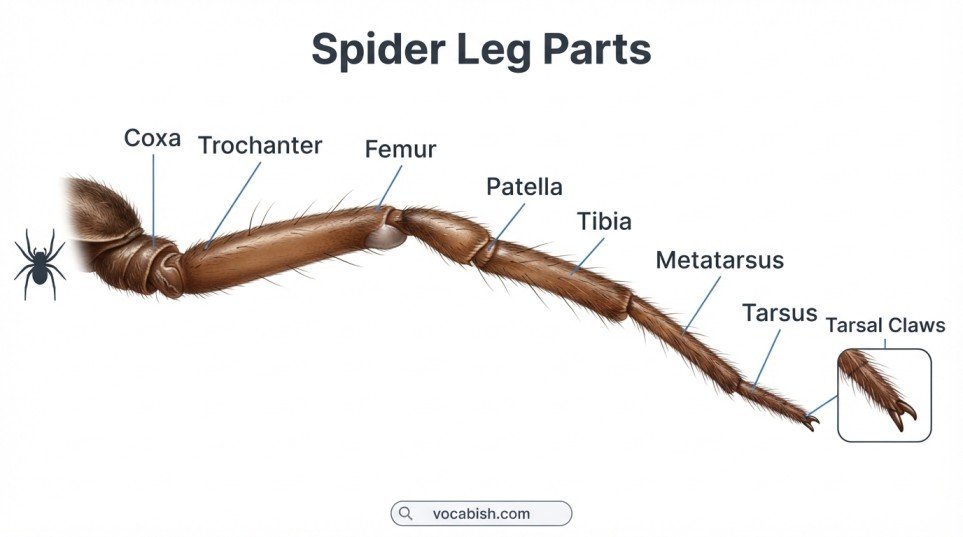
Seven Parts of a Spider Leg
From the body outward, the segments appear in this order:
- Coxa: Connects the leg to the body.
- Trochanter: Short segment between coxa and femur.
- Femur: Long segment following the trochanter.
- Patella: Short segment between femur and tibia.
- Tibia: Segment between patella and metatarsus.
- Metatarsus: Segment between tibia and tarsus.
- Tarsus: Final main segment, bearing the claws.
Tarsal Claws
Tarsal claws are small, curved structures at the tips of spider legs.
They help spiders grip rough surfaces and hold silk threads. Some spiders also have specialised adhesive hairs that help them climb smooth surfaces.
Sensory Hairs
Spiders have specialised sensory hairs on their legs and other body surfaces.
These hairs help them detect touch, vibrations, and nearby air movement. Some hairs are particularly sensitive to changes in air currents.
This sensory system helps spiders notice prey and possible danger even when they cannot see clearly.
Spinnerets and Silk Production
Spinnerets are specialised appendages usually found near the rear underside of a spider’s abdomen. They contain tiny openings through which silk produced by internal glands is released.
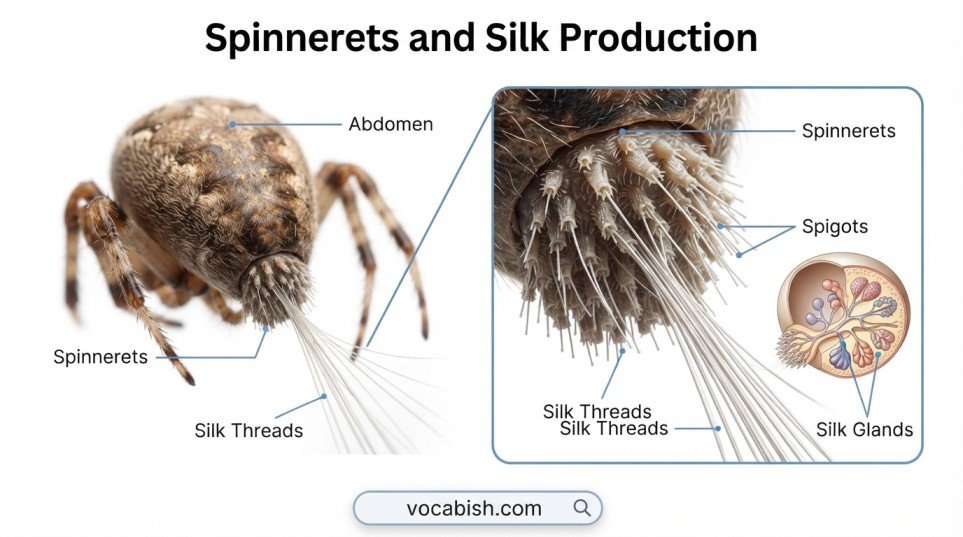
Close-up of the spinnerets near the rear of a spider’s abdomen.
How Do Spinnerets Work?
Silk glands inside the abdomen produce liquid silk material. As the material passes through tiny silk-producing openings called spigots, it forms threads.
Spiders can use different kinds of silk for different purposes.
Common uses include:
- Webs: Capture flying or crawling prey.
- Egg sacs: Protect developing eggs.
- Shelters: Create protected resting places.
- Safety lines: Reduce the risk of falling.
- Prey wrapping: Help secure captured prey.
Not all spiders build webs to catch food. Wolf spiders and jumping spiders usually hunt actively, but they still produce silk.
How Spider Body Parts Work Together
Spider anatomy becomes easier to recognise when each body part is connected to an action. Walking, detecting prey, feeding, and producing silk involve different structures working together.
Activity | Body Parts Involved | How They Work |
|---|---|---|
Walking and climbing | Legs, tarsal claws | Move the body and grip surfaces. |
Detecting movement | Eyes, sensory hairs | Notice movement and vibrations. |
Handling prey | Chelicerae, fangs, pedipalps | Grip, pierce, and manipulate prey. |
Producing silk | Silk glands, spinnerets | Produce and release silk threads. |
Reproduction | Reproductive organs, male pedipalps | Support mating and sperm transfer. |
For example, a jumping spider uses its eyes to locate prey, its legs to approach or jump, and its chelicerae and fangs to capture it.
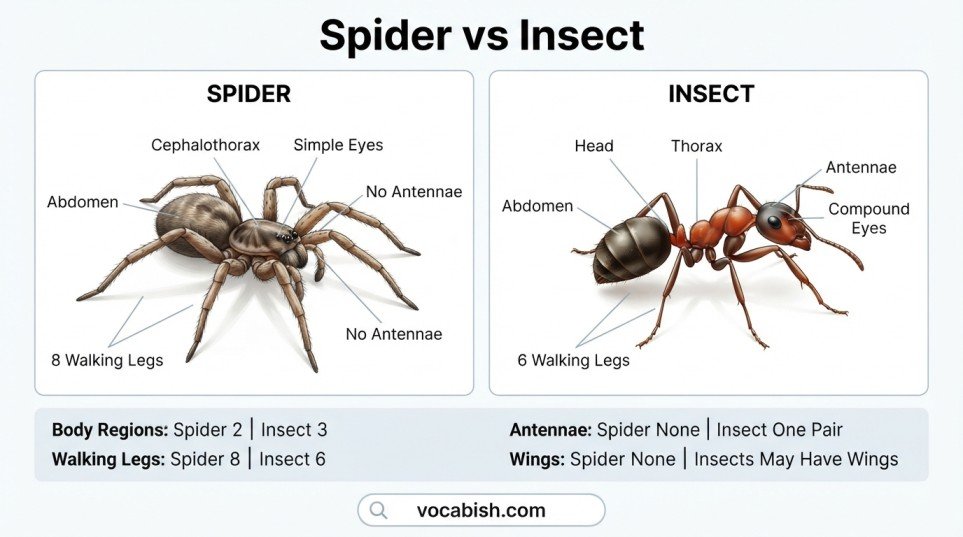
Difference Between a Spider and an Insect
Spiders and insects are both arthropods, but they belong to different animal groups. Spiders are arachnids, while insects belong to the class Insecta.
Feature | Spider | Typical Adult Insect |
|---|---|---|
Main body regions | 2 | 3 |
Walking legs | 8 | 6 |
Antennae | Absent | One pair |
Wings | Absent | May be present |
Eyes | Simple eyes | Often compound eyes |
Animal group | Arachnid | Insect |
A spider’s eight legs and two body regions are useful features for distinguishing it from most insects.
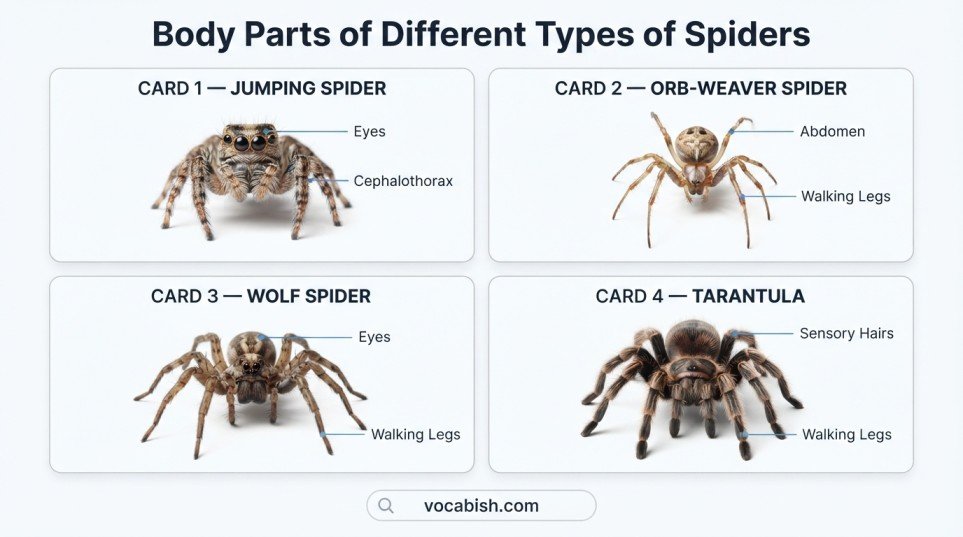
Body Parts of Different Types of Spiders
Most spiders share the same basic body plan, but their external appearance can differ. Eye size, abdomen shape, leg length, and body hair vary among spider groups.
1. Jumping Spider
Jumping spiders have compact bodies and prominent front-facing eyes. Their strong eyesight helps them locate prey and judge distances before jumping.
2. Orb-Weaver Spider
Many orb-weavers have rounded abdomens and long legs suited to moving across silk webs. They often detect trapped insects through web vibrations.
3. Wolf Spider
Wolf spiders have sturdy bodies, strong walking legs, and a distinctive arrangement of eight eyes. Most hunt prey on the ground rather than using capture webs.
4. Tarantula
Tarantulas generally have large, robust bodies, thick legs, and noticeable body hairs. These hairs can serve sensory or defensive functions.
Spider Body Parts Vocabulary Chart
A spider vocabulary chart can group related structures by their position and function. This helps learners revise anatomical names without confusing body regions with smaller features.
Vocabulary Group | Body Parts | What to Remember |
|---|---|---|
Main body regions | Cephalothorax, Abdomen | Front and rear regions |
Connecting structure | Pedicel | Joins the body regions |
Sensory structures | Eyes, Sensory Hairs | Detect light and movement |
Feeding appendages | Chelicerae, Fangs, Pedipalps | Help capture and handle prey |
Walking structures | Legs, Joints, Tarsal Claws | Support movement and gripping |
Silk-producing structures | Spinnerets | Release silk from glands |
Example Sentences Using Spider Body Parts
These short sentences show how spider anatomy vocabulary appears in English. Each example uses a body part in a natural sentence.
- A spider has eight walking legs.
- The cephalothorax is the front part of a spider.
- Its abdomen is behind the cephalothorax.
- The pedicel connects the two body regions.
- A jumping spider has large front-facing eyes.
- Spiders use their chelicerae to hold prey.
- The fangs of most spiders can inject venom.
- The pedipalps are near the spider’s mouth.
- Each walking leg has seven main segments.
- Tarsal claws help spiders grip surfaces.
- Sensory hairs detect movement and vibrations.
- Spiders release silk through their spinnerets.
Common Mistakes About Spider Anatomy
Some spider body parts look similar or have unfamiliar scientific names. These points help learners avoid common mistakes.
- Head vs. cephalothorax: Spiders do not have a separate head region like insects.
- Legs vs. pedipalps: A spider has eight walking legs, plus two pedipalps.
- Chelicerae vs. fangs: Fangs are structures attached to the chelicerae.
- Eyes: Not every spider has exactly eight eyes.
- Spinnerets: Spiders produce silk, but not all build prey-catching webs.
FAQs About Spider Body Parts
The main parts include the cephalothorax, abdomen, eight walking legs, eyes, chelicerae, fangs, pedipalps, pedicel, and spinnerets used for releasing silk.
They are called the cephalothorax, or prosoma, and the abdomen, or opisthosoma. A narrow stalk called the pedicel connects these regions.
A typical spider has eight walking legs arranged in four pairs. All legs attach to the cephalothorax and contain seven main segments.
Many spiders have eight eyes, but some species have six, fewer, or none. Eye arrangement and visual ability vary between spider groups.
Chelicerae are paired mouth appendages that carry the fangs. Fangs pierce prey and usually deliver venom, while chelicerae help control captured food.
Spinnerets release silk produced by glands inside the abdomen. Spiders use silk to make webs, egg sacs, shelters, safety lines, and prey wrappings.
No, spiders do not have antennae. They use their eyes, sensory hairs, pedipalps, and other sensory structures to detect changes around them.
A spider has two main body regions, eight walking legs, and no antennae. A typical adult insect has three body regions and six legs.
Conclusion
Learning the Parts of a Spider helps students identify its external structures and describe their functions in English. The cephalothorax supports the eyes, mouthparts, and eight walking legs, while the abdomen contains major organs and silk-producing glands. The pedicel connects these two regions.
Labeled diagrams, vocabulary charts, and example sentences help learners recognise spider body parts and use their names correctly.