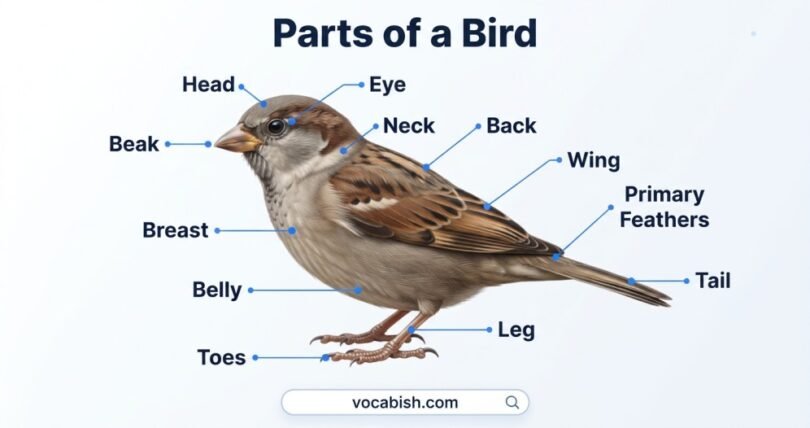

The parts of a bird include the head, beak, eyes, neck, body, wings, feathers, tail, legs, and feet. Each part has a particular function. The beak helps a bird eat food, the wings support flight, and the feet help it walk, perch, or catch prey. Birds also have smaller body parts, such as the crown, nape, breast, belly, rump, and claws.
Learning these bird body parts names helps students identify different features and describe birds correctly in English. The labeled diagrams, vocabulary tables, short explanations, and example sentences below show where each part is located and what it does.
Parts of a Bird with a Labeled Diagram
A bird’s external anatomy includes the body parts visible from the outside. These parts form different regions, including the head, neck, trunk, wings, tail, and legs. A labeled diagram helps you recognize their positions and learn the correct English names.
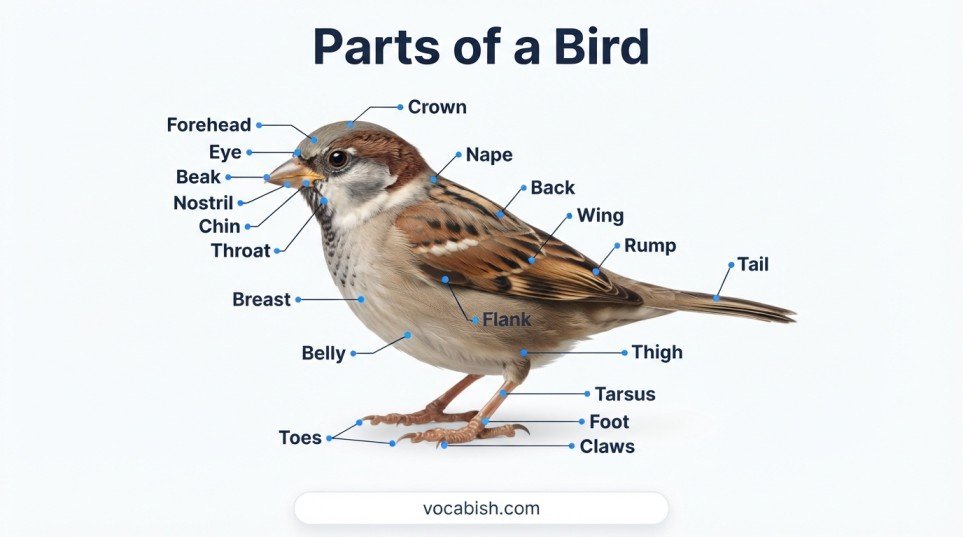
Reference illustration of external bird anatomy. Individual labels should be checked against the vocabulary below.
The head contains the eyes and beak, while the body supports the wings and tail. The legs and feet provide support and movement. Smaller regions, such as the crown, breast, and rump, help describe a bird’s appearance more precisely.
Names of Bird Body Parts in English
Bird body parts have different names according to their location and function. Some words, such as wing and tail, are used in everyday English. Others, such as tarsus and nape, are useful when describing bird anatomy.
Here are 25 useful bird body parts with short meanings.
Bird Part | Location | Short Meaning |
|---|---|---|
Head | Top front | Contains the brain, eyes, and beak. |
Beak | Front of head | Helps birds pick up and handle food. |
Eye | Side of head | Helps birds see their surroundings. |
Neck | Below head | Connects the head to the body. |
Body | Main central region | Contains and supports the bird’s internal organs. |
Wing | Side of body | Modified forelimb used for flight or movement. |
Feathers | Body surface | Cover the body and provide insulation. |
Tail | Rear of body | Helps with balance, steering, and display. |
Leg | Lower body | Supports the bird and helps it move. |
Foot | End of leg | Helps birds stand, walk, and grip. |
Toe | Part of foot | Helps birds balance and hold surfaces. |
Claw | End of toe | Hard, pointed covering used for gripping. |
Crown | Top of head | Upper region of the bird’s head. |
Forehead | Front of crown | Area above the beak and eyes. |
Chin | Under beak | Small area directly beneath the beak. |
Throat | Front of neck | Area below the chin and head. |
Nape | Back of neck | Rear part of the bird’s neck. |
Back | Upper body | Region between the neck and rump. |
Breast | Front of body | Upper front region below the throat. |
Belly | Lower front | Lower underside behind the breast. |
Flank | Side of body | Side region below and behind the wing. |
Rump | Lower back | Region immediately before the tail. |
Thigh | Upper leg | Upper leg section, often covered by feathers. |
Tarsus | Lower leg | Segment between the ankle and toes. |
Nostril | On or near beak | Opening through which the bird breathes. |
These names are useful for describing a bird’s size, shape, colors, and movements.
Parts of a Bird’s Head and Beak
A bird’s head contains several features used for seeing, feeding, breathing, and hearing. The head also has named feather regions that help people recognize different bird species.
Head, Face, and Neck Parts
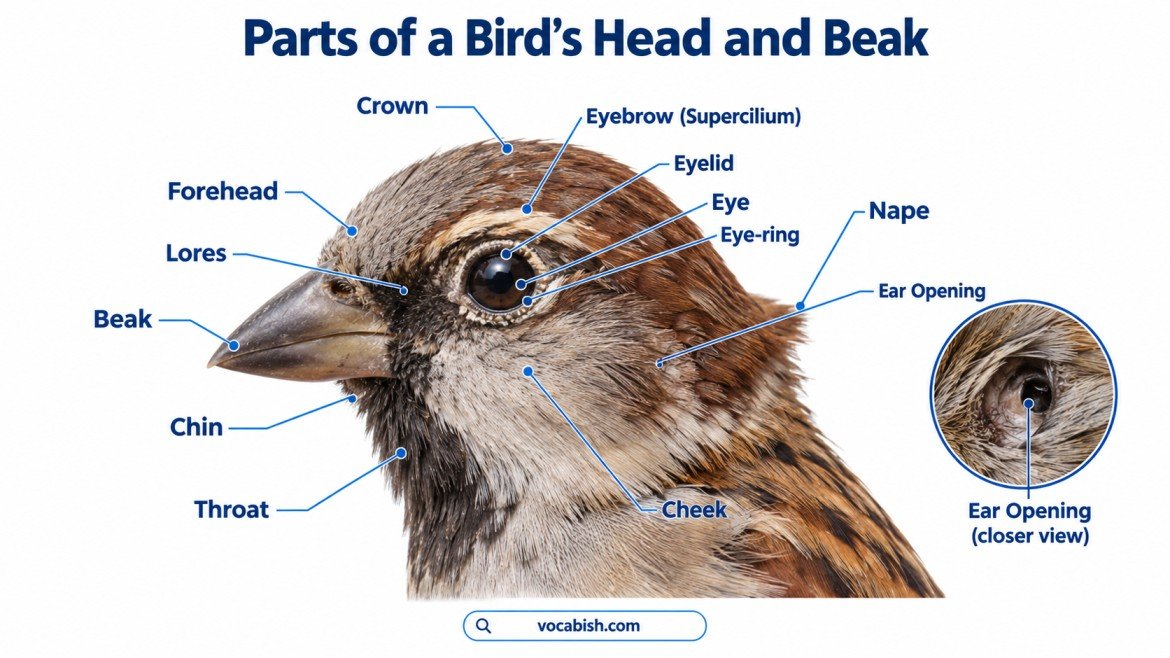
The following names describe the main regions of a bird’s head.
Head Part | Location | Description |
|---|---|---|
Crown | Top of head | The upper feathered area of the head. |
Forehead | Front of head | Area between the crown and beak. |
Eye | Side of head | Organ that detects light and movement. |
Eyelid | Around eye | Protects the eye and helps keep it moist. |
Cheek | Side of face | Feathered region below and behind the eye. |
Chin | Under beak | Small area immediately below the lower beak. |
Throat | Below chin | Front region extending down the neck. |
Nape | Back of neck | Area where the head meets the upper neck. |
Ear opening | Behind eye | Hearing opening usually hidden beneath feathers. |
Some birds also have visible markings around their eyes and faces.
- Eye-ring: A ring-shaped marking around the eye.
- Eyebrow (supercilium): A stripe or band above the eye.
- Lores: The area between the eye and the base of the beak.
- Crest: Longer head feathers that may stand upright.
These markings and features differ among species. Not every bird has a noticeable eyebrow or crest.
Beak and Its Parts
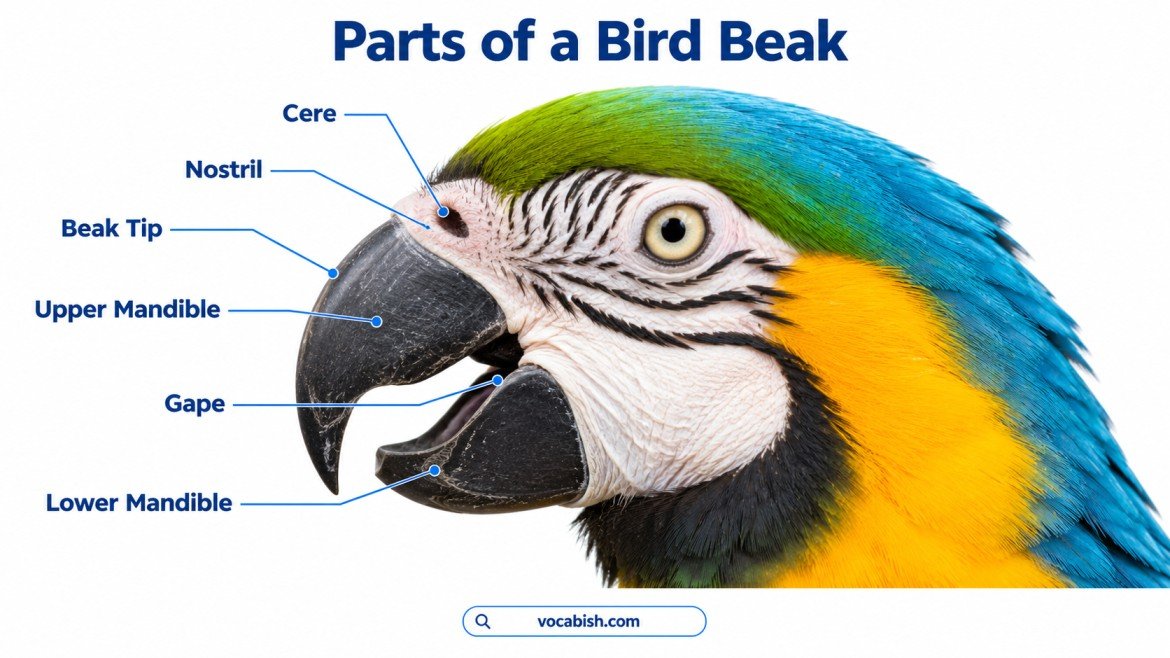
A bird’s beak, also called its bill, is a hard structure used mainly for feeding. Birds also use their beaks for cleaning feathers, building nests, and handling objects.
Beak Part | Description | Function |
|---|---|---|
Upper mandible | Upper part of the beak | Helps grip, cut, or handle food. |
Lower mandible | Lower part of the beak | Moves during feeding and opening the mouth. |
Beak tip | Front end of the beak | Helps pick, probe, or tear food. |
Nostrils | Small openings near the beak base | Allow air to enter the respiratory system. |
Gape | Corner where the mandibles meet | Allows the mouth to open. |
Cere | Fleshy area at the upper beak base in certain birds | Surrounds the nostrils in some species. |
Bird beaks have different shapes depending on their feeding habits. Eagles have hooked beaks for tearing meat, ducks have broad bills for handling food in water, and many seed-eating birds have short, strong beaks for cracking seeds.
Body, Neck, Back, Breast, and Belly
The central body of a bird is called the trunk. It contains major internal organs and supports the wings, neck, tail, and legs. Different regions of the trunk have their own names, which are especially useful when describing feather colors.
Body Region | Location | Description |
|---|---|---|
Neck | Between head and trunk | Allows the head to move in different directions. |
Back | Upper side of trunk | Extends behind the neck toward the rump. |
Mantle | Upper back near shoulders | Feathered area across the upper back. |
Breast | Upper front of trunk | Area directly below the throat. |
Belly | Lower underside | Region below the breast. |
Flank | Side of trunk | Area beneath and behind the folded wing. |
Rump | Rear of back | Area immediately before the tail feathers. |
The breast and belly are different regions. The breast is higher on the front of the body, while the belly lies farther down and toward the rear.
For example, a bird may have a white breast, a pale belly, and a brown back. These terms help describe its feather pattern accurately.
Birds’ Wings and Their Parts
Bird wings are modified forelimbs supported by bones, muscles, and feathers. Most birds use their wings for flying, but some use them for swimming, balance, or display. Penguins, for example, have flipper-like wings adapted for swimming.
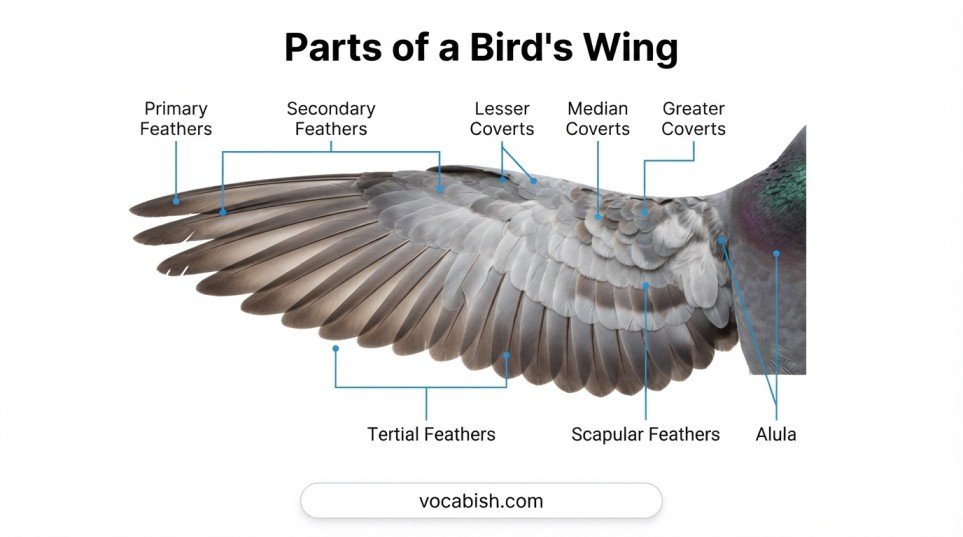
A wing contains several groups of feathers, each with a different position and role.
Primary, Secondary, and Tertiary Feathers of a Bird
These feather groups occupy different parts of a bird’s wing.
Feather Group | Location | Main Role |
|---|---|---|
Primary feathers | Outer wing, attached to hand region | Important for thrust and flight control. |
Secondary feathers | Inner wing, attached to forearm | Provide much of the wing’s lift. |
Tertial feathers | Inner wing near the body | Help cover and shape the folded wing. |
Primary feathers are especially noticeable when a bird spreads its wings. They form much of the outer wingtip.
Secondary feathers are closer to the body and form much of the inner trailing edge of the wing.
Tertials are the innermost flight feathers, often visible along the folded wing.
Wing Coverts, Shoulder Feathers, and Alula of a Bird
Wing coverts are smaller feathers that cover the bases of larger flight feathers. They help create a smooth wing surface.
Wing Part | Description | Purpose |
|---|---|---|
Lesser coverts | Small feathers near the wing’s leading edge | Cover and protect the upper wing. |
Median coverts | Middle row of covering feathers | Cover part of the greater coverts. |
Greater coverts | Larger feathers above the flight feathers | Cover the bases of flight feathers. |
Scapulars | Feathers around the shoulder region | Cover the area where wing meets body. |
Alula | Small feathered structure near the wing’s front edge | Helps control airflow at low speeds. |
The alula is sometimes called the bird’s thumb. It is a specialized part of the wing, not a separate finger used like a human thumb.
Bird Feathers and Their Types
Feathers cover most of a bird’s body and perform several jobs. They help maintain body temperature, protect the skin, provide color patterns, and support flight.
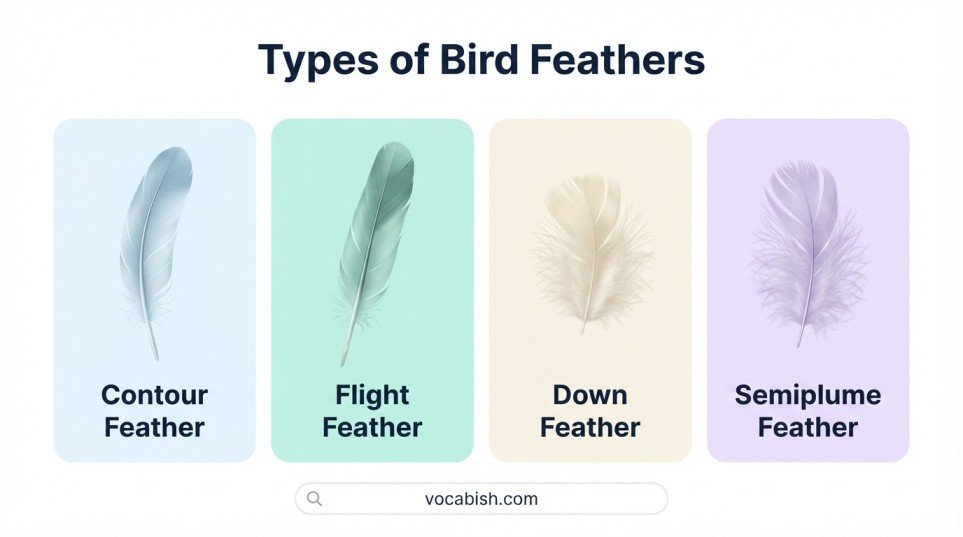
Different bird feather types have different structures.
Feather Type | Appearance | Main Function |
|---|---|---|
Contour feathers | Smooth feathers forming the outer covering | Shape and protect the body. |
Flight feathers | Long, strong feathers on wings and tail | Support flight and steering. |
Down feathers | Soft, fluffy feathers beneath outer covering | Trap air and provide insulation. |
Semiplume feathers | Loose, fluffy feathers with a central shaft | Help provide insulation and body shape. |
Contour feathers give birds their familiar outer appearance. Their overlapping surfaces help protect the body.
Flight feathers are strong and usually have firm, connected barbs that form a broad surface.
Down feathers are soft and fluffy. They trap air close to the skin, helping birds stay warm.
Semiplume feathers have a more flexible structure than typical contour feathers. They contribute to insulation and help fill out the body covering.
Not every feather type is easily visible from the outside. Down and semiplumes are often hidden beneath the outer feathers.
Tail of a Bird and Its Parts
A bird’s tail extends from the rear of its body. The long tail feathers can help with steering, slowing down, balancing, and displaying during courtship.
The tail region includes several distinct feather groups.
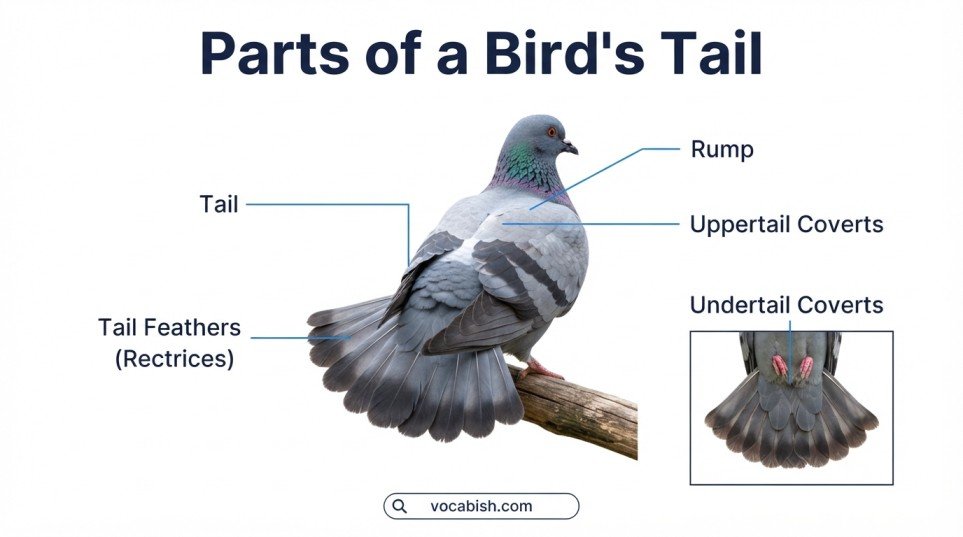
Tail Part | Location | Function |
|---|---|---|
Tail | Rear end of body | Supports steering, balance, and display. |
Tail feathers (rectrices) | Extend backward from the tail | Help control direction during flight. |
Rump | Lower back before the tail | Forms the feathered region above the tail base. |
Uppertail coverts | Above the bases of tail feathers | Cover and protect the upper tail bases. |
Undertail coverts | Beneath the bases of tail feathers | Cover the underside of the tail base. |
Birds have different tail shapes. Swallows often have forked tails, peacocks have long ornamental upper tail coverts, and many sparrows have relatively short tails.
A peacock’s large, colorful display is formed mainly by elongated upper tail coverts rather than the true tail feathers.
Legs, Feet, Toes, and Claws of a Bird
Birds use their legs and feet for standing, walking, running, swimming, perching, and catching food. Their leg and foot structures vary according to how they live.
A bird’s upper leg is often hidden beneath body feathers, while the lower sections are more visible.
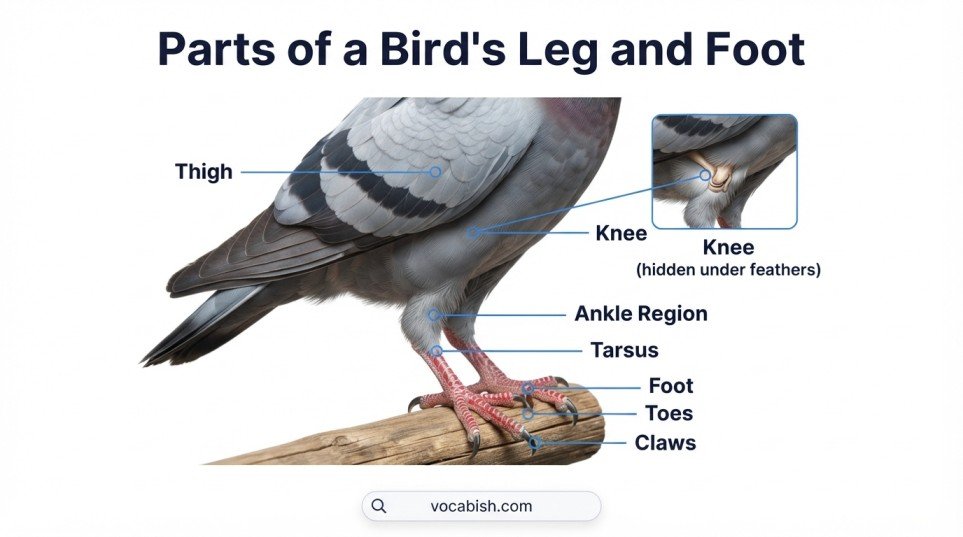
Leg or Foot Part | Location | Function |
|---|---|---|
Thigh | Upper leg near body | Contains muscles that help move the leg. |
Knee | Joint between thigh and lower leg | Allows the leg to bend. |
Ankle region | Joint above the visible tarsus | Helps the foot and lower leg move. |
Tarsus | Between ankle and toes | Supports the foot and helps with movement. |
Foot | Lower end of leg | Provides support and grip. |
Toes | Extend from the foot | Help with walking, perching, or swimming. |
Claws | Tips of toes | Help grip surfaces and handle prey. |
A common mistake is calling the backward-bending joint on a bird’s visible leg its knee. This joint is actually in the ankle region. The true knee is higher up, often hidden beneath feathers.
Different Types of Bird Feet
Bird feet are adapted to different activities. Some birds grip branches, while others swim, climb trees, or capture prey.
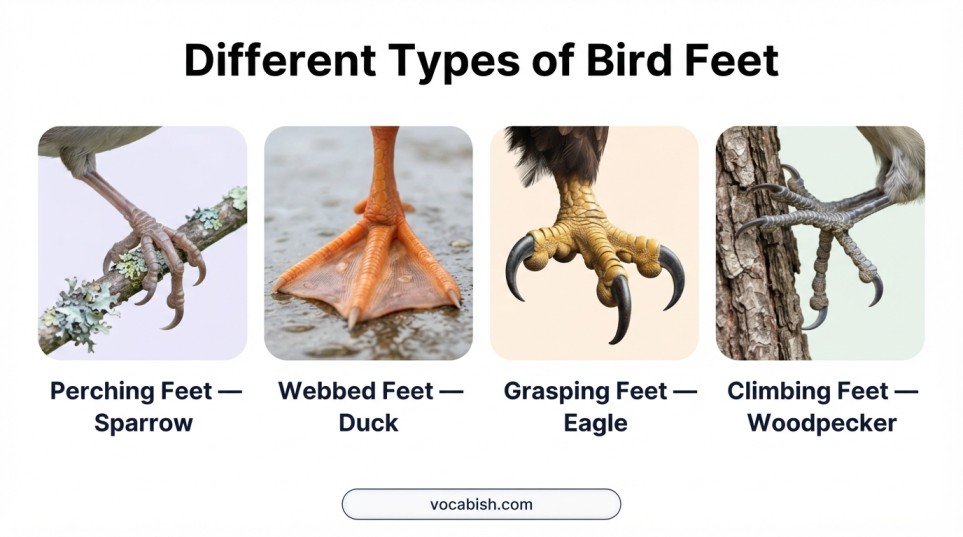
Foot Type | Bird Example | Main Use |
|---|---|---|
Perching feet | Sparrow | Gripping branches and narrow surfaces. |
Webbed feet | Duck | Pushing against water while swimming. |
Grasping feet | Eagle | Catching and holding prey. |
Climbing feet | Woodpecker | Gripping tree bark while climbing. |
Many perching birds have three toes facing forward and one facing backward. Woodpeckers commonly have two toes pointing forward and two backward, which helps them grip tree trunks.
Eagles have powerful feet with sharp, curved claws called talons. Ducks have webbing between their toes that helps them move through water.
Functions of the Main Bird Body Parts
Each major body part helps a bird perform everyday activities. The following chart connects common bird vocabulary with its main function.
Body Part | Main Function | Example |
|---|---|---|
Beak | Picking up and handling food | A parrot cracks seeds with its beak. |
Eyes | Seeing objects and movement | An eagle spots prey from far away. |
Wings | Flying or other movement | A pigeon flaps its wings to fly. |
Feathers | Insulation, protection, and flight | A duck’s feathers help protect its body. |
Tail | Steering and balancing | A swallow uses its tail during flight. |
Legs | Supporting the body and moving | An ostrich runs on its strong legs. |
Feet | Walking, swimming, or gripping | A duck paddles with its webbed feet. |
Claws | Gripping surfaces or prey | An owl grips prey with its claws. |
These functions can overlap. For example, a bird may use its beak for eating, cleaning its feathers, and carrying nesting material.
Commonly Confused Bird Anatomy Terms
Some bird body parts have similar names or appear close together. Knowing the difference helps learners use the correct vocabulary.
- Breast vs. Belly: The breast is the upper front of the body, while the belly is the lower underside.
- Crown vs. Crest: The crown is the top of the head. A crest is a group of longer head feathers found in some birds.
- Beak vs. Bill: Both words refer to the same structure. Bill is often used for birds such as ducks, while beak is common in general descriptions.
- Wing vs. Flight Feathers: A wing is a complete forelimb. Flight feathers are the long feathers attached to its wing structure.
- Rump vs. Tail: The rump is part of the lower back. The tail extends behind it and includes the tail feathers.
Also remember that toes are parts of the feet, while claws are the hard coverings at the ends of the toes. Tail coverts cover the bases of the long tail feathers rather than forming the main tail fan.
Bird Body Parts in English Sentences
Using bird vocabulary in sentences helps you describe appearance, movement, and behavior. These examples use familiar birds and common English sentence patterns.
- The sparrow has a small head and a short beak.
- The eagle uses its sharp eyes to find prey.
- The parrot has colorful feathers on its body.
- The pigeon spreads its wings before flying.
- The duck uses its webbed feet to swim.
- The owl turns its head to look around.
- The peacock displays its long, colorful feathers.
- The eagle catches prey with its strong talons.
- The sparrow grips the branch with its toes.
- The swallow uses its tail to change direction.
- The robin has a reddish-orange breast.
- The ostrich uses its powerful legs to run.
You can also describe a bird using the pattern “The bird has + adjective + body part.”
For example, “The bird has a long neck” or “The parrot has a curved beak.”
Bird Body Parts Vocabulary Chart
This bird vocabulary chart groups common body parts according to their location. It can be used for quick revision, picture labeling, or classroom practice.
Body Region | Vocabulary | Where to Find It |
|---|---|---|
Head | Crown | Top of the head |
Head | Forehead | Front of the head |
Head | Eye | Side of the head |
Head | Beak | Front of the face |
Head | Chin | Under the beak |
Neck | Throat | Front of the neck |
Neck | Nape | Back of the neck |
Body | Back | Upper side of the body |
Body | Breast | Upper front of the body |
Body | Belly | Lower underside |
Body | Flank | Side below the wing |
Wing | Primary feathers | Outer wing |
Wing | Secondary feathers | Inner wing |
Tail | Rump | Lower back before the tail |
Tail | Tail feathers | Rear of the bird |
Legs | Thigh | Upper leg |
Legs | Tarsus | Above the toes |
Feet | Toes | Extending from the foot |
Feet | Claws | Ends of the toes |
These 19 terms provide a useful foundation for recognizing and describing the external anatomy of a bird.
Parts of a Bird Quiz
Identify bird body parts, their locations, and functions.
Your Score
FAQs About Bird Body Parts
The names of the parts of a bird are the head, beak, neck, body, wings, feathers, tail, legs, and feet. Each performs specific functions.
Beak and bill are two English names for the same structure. Both describe the hard mouthparts birds use for feeding and other activities.
Bird anatomy is the structure of a bird’s body, including external parts such as wings, feathers, and beak, and internal organs such as the heart and lungs.
The rump is the lower part of a bird’s back, just before the tail. Its feather color can be useful for bird identification.
The main wing flight feathers are called primaries and secondaries. The long tail flight feathers are called rectrices, which help with steering and balance.
A bird’s knees are high on its legs, usually hidden beneath body feathers. The visible joint bending backward is actually in the ankle region.
A bird’s lower underside includes the belly and vent region. The vent is the external opening of the cloaca, located beneath the tail.
A bird’s main tail feathers are called rectrices. They extend from the rear of the body and help with steering, balance, and flight control.
Conclusion
Learning the parts of a bird helps you recognize and describe bird anatomy correctly. Common parts include the head, beak, wings, feathers, tail, legs, and feet, while terms such as crown, nape, breast, rump, and tarsus describe more specific regions.
Use the labeled pictures, vocabulary chart, and practice quiz to remember each part’s name, location, and function.