
Have you ever described an idea as potent when you actually meant potential? The words look and sound similar, but they express very different meanings.
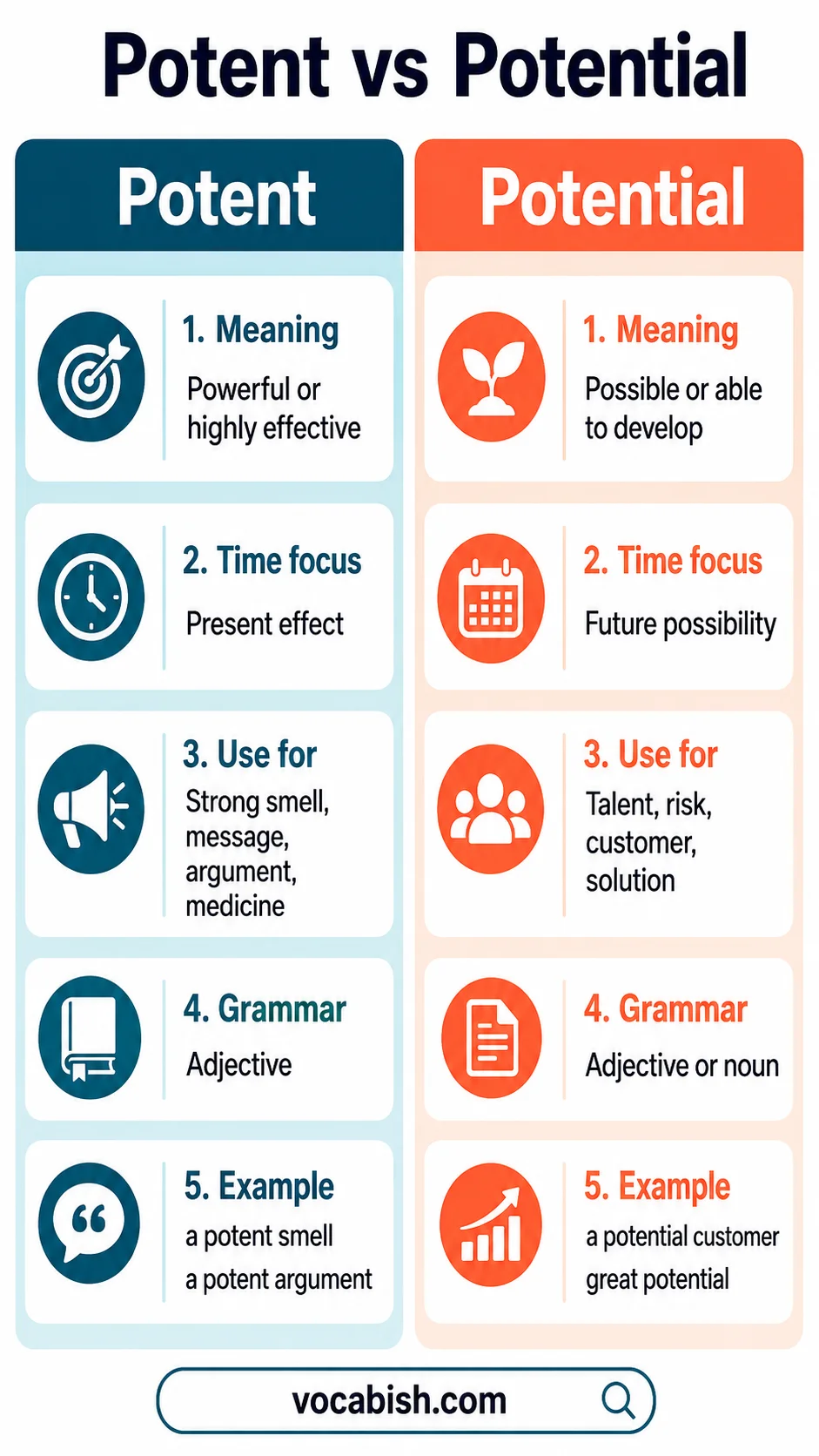
The main difference in potent vs potential is straightforward: potent describes something that is already powerful or effective, while potential describes something that may develop, happen, or become successful in the future.
Understanding their meanings, grammar roles, and common sentence patterns will help you choose the correct word with confidence.
Potent vs Potential: The Quick Difference
Although both words relate to strength or ability, they describe different stages. Potent refers to power that already exists, while potential refers to a possibility that has not yet been fully developed.
Word | Part of Speech | Main Meaning | Example |
|---|---|---|---|
Potent | Adjective | Powerful, strong, or highly effective | This is a potent cleaning product. |
Potential | Adjective or noun | Possible in the future; an ability that may develop | She has the potential to become a leader. |
Quick answer
- Use potent for something that has a strong effect now.
- Use potential for something that may happen or improve later.
Compare:
- The medicine is potent.
It has a powerful effect. - The medicine has potential.
It may prove useful or successful in the future.
What Does Potent Mean?
Potent is an adjective meaning powerful, strong, or highly effective. It is commonly used for substances, arguments, emotions, symbols, smells, medicines, chemicals, and other things that produce a noticeable effect.
Pronunciation of potent
Potent is pronounced:
- British English: /ˈpəʊ.tənt/
- American English: /ˈpoʊ.tənt/
The stress falls on the first syllable: PO-tent.
Definition of potent
Something is potent when it has enough strength or power to cause a strong result.
Potent means having a powerful influence, effect, smell, quality, or ability.
Examples of potent in sentences
- The flowers produced a potent smell.
- His speech was a potent reminder of the importance of freedom.
- This cleaning liquid is extremely potent.
- The image became a potent symbol of hope.
- Fear can be a potent motivator.
- The herbs created a potent mixture.
- She presented a potent argument against the proposal.
- Social media can be a potent communication tool.
In each example, the subject already has a strong effect or influence.
Common meanings of potent
The exact meaning of potent changes slightly according to context.
Context | Meaning of Potent | Example |
|---|---|---|
Substance | Strong or concentrated | The drink contains a potent ingredient. |
Smell | Very strong and noticeable | A potent smell filled the room. |
Medicine | Producing a powerful effect | The doctor prescribed a potent medicine. |
Argument | Highly convincing | She made a potent argument. |
Symbol | Having strong emotional influence | The dove is a potent symbol of peace. |
Person or group | Powerful or influential | They became a potent political force. |
Emotion | Strong enough to affect behaviour | Jealousy can be a potent emotion. |
Common sentence patterns with potent
Potent + noun
- a potent smell
- a potent force
- a potent symbol
- a potent argument
- a potent drug
- a potent mixture
- a potent reminder
- a potent weapon
Linking verb + potent
- The chemical is potent.
- The message was especially potent.
- These substances can be highly potent.
Common adverbs used before potent include:
- highly potent
- extremely potent
- particularly potent
- unusually potent
- politically potent
- emotionally potent
What Does Potential Mean?
Potential describes something that is possible but has not happened or fully developed yet. It can also refer to a natural ability, future capacity, or opportunity for growth.
Unlike potent, the word potential can function as both an adjective and a noun.
Pronunciation of potential
Potential is pronounced:
- British and American English: /pəˈten.ʃəl/
The stress falls on the second syllable: po-TEN-tial.
Potential as an adjective
As an adjective, potential means possible or likely to happen, exist, or become true in the future.
A potential person, event, or result is possible, but not yet certain or confirmed.
Examples:
- She is a potential candidate for the position.
- Heavy rain is a potential cause of flooding.
- The police questioned a potential witness.
- We discussed several potential solutions.
- This mistake could create a potential problem.
- They are looking for potential customers.
- The company identified a potential market in Europe.
- Lack of sleep is a potential risk to concentration.
The people, events, or results in these examples are possible, not definite.
Potential as a noun
As a noun, potential means the ability or capacity to develop, improve, succeed, or achieve something.
Examples:
- The student has great potential.
- This building has the potential to become a community centre.
- She has not yet reached her full potential.
- The idea shows considerable potential.
- He recognised the potential of online learning.
- The project has commercial potential.
- Every child should have the opportunity to fulfil their potential.
Common sentence patterns with potential
Potential + noun
- potential problem
- potential customer
- potential danger
- potential solution
- potential buyer
- potential employer
- potential benefit
- potential result
- potential cause
- potential risk
Have the potential to + verb
- She has the potential to succeed.
- The plan has the potential to save money.
- This technology has the potential to change education.
Potential for + noun or -ing form
- There is potential for growth.
- The area has potential for tourism.
- The system has the potential for improving communication.
Possessive adjective + potential
- her potential
- his potential
- their potential
- its potential
- your potential
Adjective + potential
- great potential
- full potential
- enormous potential
- commercial potential
- future potential
- creative potential
- untapped potential
Potent and Potential Compared
The easiest way to understand potent and potential is to compare power that already exists with power that may develop later.
Point of Comparison | Potent | Potential |
|---|---|---|
Core idea | Existing power | Possible future ability or result |
Time focus | Present effect | Future possibility |
Grammar role | Adjective only | Adjective and noun |
Common meaning | Strong or effective | Possible, capable, or promising |
Typical nouns | smell, force, medicine, argument | problem, customer, talent, solution |
Example | It is a potent tool. | It has the potential to be useful. |
Compare these sentence pairs
1. A person
- He is a potent leader.
He is already powerful and influential. - He is a potential leader.
He may become a leader in the future.
2. A product
- This is a potent product.
The product already produces a strong effect. - This is a potential product.
It may be developed, sold, or considered as a product later.
3. A danger
- The gas is potent.
The gas has a strong effect. - The gas is a potential danger.
The gas may cause harm under certain conditions.
4. An idea
- The idea carries a potent message.
The message has a strong emotional or intellectual effect. - The idea has great potential.
The idea could become successful or useful.
5. A player
- She is a potent attacking player.
She already has a strong effect during games. - She is a potential international player.
She may play at international level in the future.
When to Use Potent
Use potent when the subject already possesses strength, influence, effectiveness, or intensity. The word often suggests that the effect is stronger than usual.
Use potent for powerful substances
- a potent chemical
- a potent medicine
- a potent poison
- a potent cleaning agent
- a potent mixture
Example:
- The laboratory stores the potent chemical in a secure container.
Here, the chemical already has a powerful effect.
Use potent for strong smells or tastes
- a potent smell
- a potent aroma
- a potent flavour
- a potent drink
Examples:
- The cheese had a surprisingly potent aroma.
- The sauce was too potent for some guests.
Use potent for convincing ideas or messages
- a potent argument
- a potent message
- a potent example
- a potent reminder
Examples:
- The photograph offered a potent reminder of the disaster.
- Her personal story was more potent than a long list of statistics.
Use potent for strong influence
- a potent force
- a potent influence
- a potent symbol
- a potent weapon
- a potent combination
Examples:
- Education can be a potent force for social change.
- Humour is a potent communication tool.
- The colours formed a potent symbol of national identity.
Use potent for abilities already being demonstrated
In sports and business, potent can describe a person, team, or strategy that is already producing strong results.
- The club has a potent attack.
- The company created a potent marketing strategy.
- She remains a potent competitor.
Do not use potent merely because someone may become successful. Use it when their strength or effectiveness is already visible.
When to Use Potential
Use potential when discussing possibility, future development, natural ability, possible risks, or outcomes that have not yet been confirmed.
Use potential for future possibilities
- a potential change
- a potential delay
- a potential result
- a potential opportunity
Examples:
- The manager warned us about a potential delay.
- They are considering several potential locations.
- The discovery could have potential benefits for farmers.
Use potential for people who may take a role
- a potential employee
- a potential customer
- a potential buyer
- a potential partner
- a potential candidate
Examples:
- The company contacted several potential customers.
- She met a potential business partner at the conference.
- Each potential candidate must complete an interview.
Calling someone a potential customer does not mean that the person has already bought something. It means that they may become a customer.
Use potential for ability or talent
When used as a noun, potential often describes an ability that may grow with time, education, practice, or opportunity.
Examples:
- The young musician has remarkable potential.
- His teachers encouraged him to fulfil his potential.
- The team has not reached its full potential.
- She showed artistic potential at an early age.
Use potential for risks and problems
The phrase potential risk refers to something that may cause a problem, even if the problem has not happened.
Examples:
- Loose wires are a potential safety risk.
- The report identifies several potential problems.
- Poor communication can become a potential source of conflict.
A potential risk is possible. An actual risk is already present or clearly identified.
Use potential with “to”
The structure have the potential to + verb is common in formal and everyday English.
- This method has the potential to reduce waste.
- She has the potential to become an excellent teacher.
- The decision has the potential to affect thousands of workers.
- Small changes have the potential to produce meaningful results.
After to, use the base form of the verb:
- Correct: potential to improve
- Incorrect: potential to improving
- Incorrect: potential to improved
Can Potent and Potential Appear Together?
Yes. The two words can appear in the same sentence because they describe different ideas. One can describe existing strength, while the other describes future possibilities.
Examples:
- The plant contains a potent substance with the potential to damage nearby crops.
- She is already a potent speaker and has the potential to become a national leader.
- The campaign used a potent message with the potential to influence public opinion.
- The team has a potent attack and the potential to win the competition.
- Artificial intelligence is a potent tool with enormous potential for education.
Consider this sentence:
The young athlete has the potential to become a potent competitor.
Here, potential refers to future ability. Potent describes the powerful competitor the athlete may eventually become.
Common Mistakes to Avoid
Most mistakes happen because the words share several letters and both relate loosely to ability or strength. Checking whether you mean “powerful now” or “possible later” usually solves the confusion.
1: Using potent for undeveloped ability
Incorrect:
- The student has a lot of potent.
Correct:
- The student has a lot of potential.
Potent cannot normally function as a noun. Use potential when referring to undeveloped ability.
2: Using potential for an existing strong effect
Incorrect:
- This perfume has a very potential smell.
Correct:
- This perfume has a very potent smell.
The smell is already strong, so potent is the correct adjective.
3: Confusing a possible leader with a powerful leader
- A potential leader may become a leader.
- A potent leader already has considerable power or influence.
The choice changes the time and meaning of the sentence.
4: Saying “potential to becoming”
Incorrect:
- She has the potential to becoming a doctor.
Correct:
- She has the potential to become a doctor.
Use the base verb after potential to.
5: Treating potential as certainty
A potential problem is possible, not guaranteed.
- There is a potential problem with the system.
This sentence means a problem may exist or develop. It does not confirm that the system has already failed.
6: Using potent for every kind of strength
Although potent means powerful, it does not replace strong in every sentence.
Natural:
- strong muscles
- a strong table
- a strong friendship
- a strong person
Less natural:
- potent muscles
- a potent table
- a potent friendship
Use potent mainly when something produces a powerful effect, influence, reaction, smell, or result.
Word Forms and Related Vocabulary
Looking at the word families can make the distinction clearer. Each word has related nouns and adverbs used in different grammatical positions.
Word family of potent
Word | Part of Speech | Meaning | Example |
|---|---|---|---|
Potent | Adjective | Powerful or effective | It is a potent symbol. |
Potency | Noun | Strength or effectiveness | Heat may reduce its potency. |
Potently | Adverb | In a powerful manner | The image speaks potently. |
Impotent | Adjective | Lacking power or effectiveness | They felt impotent against the system. |
Omnipotent | Adjective | Having unlimited power | The term describes an all-powerful being. |
Potency is especially common when discussing the strength of a substance or the effectiveness of an influence.
Examples:
- The product gradually loses its potency.
- Scientists measured the potency of the substance.
- The speech gained potency because of its timing.
Word family of potential
Word | Part of Speech | Meaning | Example |
|---|---|---|---|
Potential | Adjective | Possible in the future | He is a potential buyer. |
Potential | Noun | Ability or capacity | She has great potential. |
Potentially | Adverb | Possibly | The situation is potentially dangerous. |
Potentiality | Noun | A possibility or capacity | The design has several potentialities. |
Potentially means “possibly” or “in a way that may happen.”
Examples:
- The road is potentially dangerous during heavy rain.
- The change could be potentially beneficial.
- This error may be potentially costly.
Avoid using potentially when the situation is already confirmed.
- Possible danger: potentially dangerous
- Confirmed danger: dangerous
- Strong existing danger: a serious or powerful threat
An Easy Way to Remember the Difference
Think of the words as answering two different questions:
Potent: How strong is it now?
- Is the smell strong?
- Is the argument powerful?
- Is the substance highly effective?
- Does the message have a strong impact?
When the answer concerns present strength, use potent.
Potential: What could happen later?
- Could the person become successful?
- Could the idea develop?
- Could the situation cause a problem?
- Could the project produce good results?
When the answer concerns future possibility, use potential.
Memory sentence
Potent means powerful; potential means possible.
Both key words begin with p, which makes this sentence easier to remember.
Another useful contrast is:
Potent power exists now. Potential power may develop later.
Practice: Choose Potent or Potential
Complete each sentence with potent or potential.
- The young designer has enormous ________.
- The spray produces a ________ smell.
- We interviewed three ________ employees.
- Her speech became a ________ call for change.
- The plan has the ________ to create new jobs.
- The company warned customers about a ________ security problem.
- This combination can be extremely ________.
- He is a ________ future captain of the team.
- The photograph remains a ________ symbol of loss.
- Every learner should be encouraged to reach their full ________.
Answers
- potential
- potent
- potential
- potent
- potential
- potential
- potent
- potential
- potent
- potential
FAQs About Potent and Potential
Potent means powerful or highly effective now, while potential describes an ability, person, event, or result that may develop later.
Potential can be an adjective or noun. Potent is normally an adjective, while its related noun form is potency.
No. A person with potential has the ability to become successful, but that ability may still require time, effort, training, or opportunity.
No. Potent can describe smells, arguments, symbols, emotions, chemicals, messages, people, forces, or anything that produces a powerful effect.
Full potential means the highest level of ability, achievement, or development that a person, organisation, idea, or system may possibly reach.
Yes. A potential risk is a possible source of harm or difficulty that has not necessarily caused an actual problem yet.
Yes, especially when the person is powerful, influential, or highly effective. However, “powerful” is often more natural in everyday conversation.
Depending on context, common synonyms include powerful, strong, effective, influential, concentrated, convincing, intense, and forceful.
Conclusion
The difference in potent vs potential depends on whether the power exists now or may develop later. Potent means powerful, strong, or highly effective, while potential means possible or capable of future development.
Use potent for a strong smell, powerful argument, effective substance, or influential message. Use potential for possible problems, future customers, undeveloped talent, or opportunities for growth.
Remember the key rule: potent means powerful now; potential means possible later.
You May Also Like
