

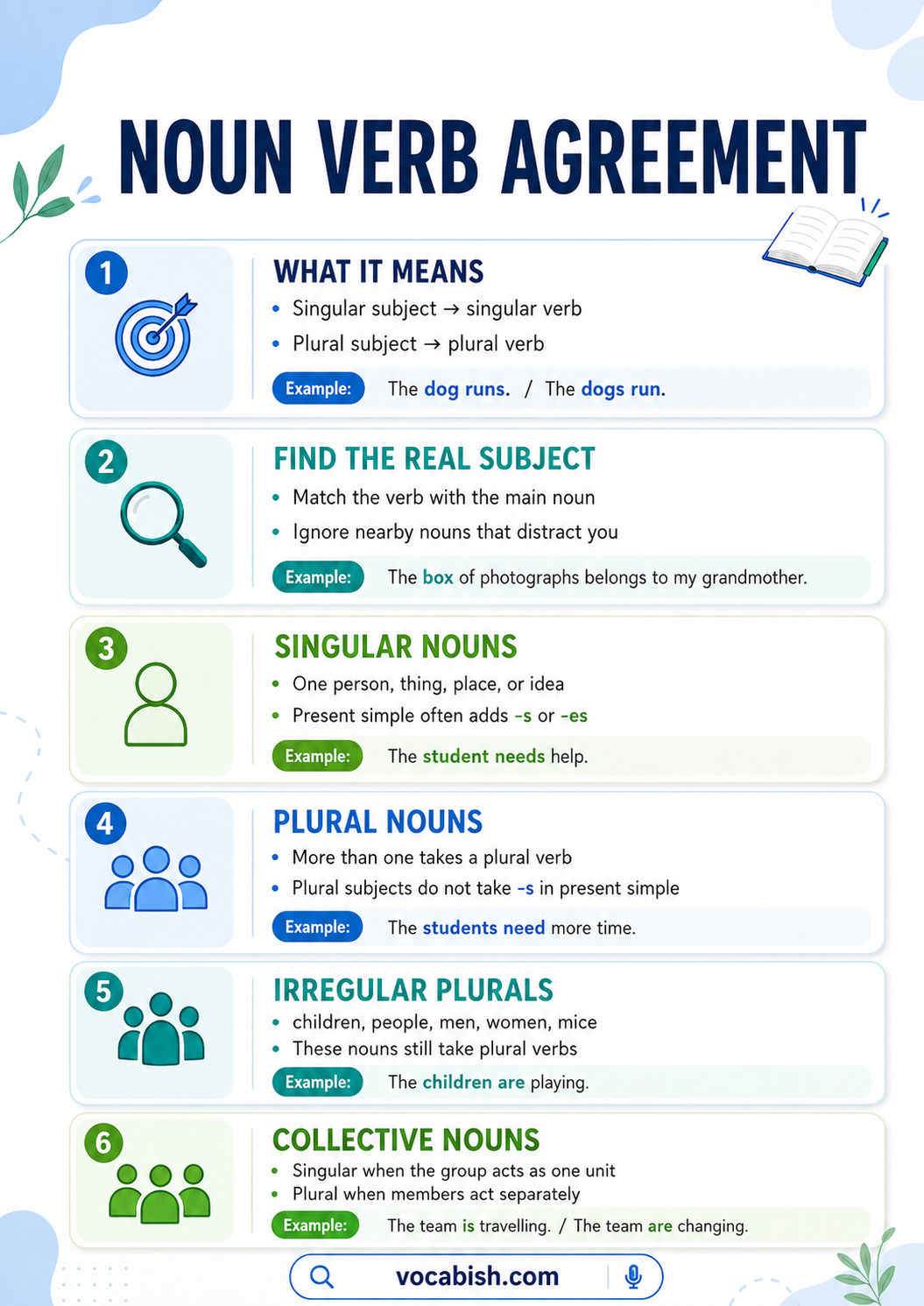
A sentence sounds natural when its subject and verb work together correctly. A singular subject normally needs a singular verb, while a plural subject needs a plural verb.
In simple terms, noun verb agreement means choosing a verb form that matches the number of the noun acting as the subject.
- The dog runs across the garden.
- The dogs run across the garden.
This difference is most noticeable in the present simple tense. However, learners must also watch for irregular plurals, collective nouns, uncountable nouns, compound subjects, and nouns ending in -s.
Subject-Verb Agreement with Nouns
The verb must agree with the main noun or noun phrase performing the action.
Subject | Correct Verb | Example |
|---|---|---|
Singular noun | Singular verb | The teacher explains the lesson. |
Plural noun | Plural verb | The teachers explain the lesson. |
Singular noun + be | is/was | The room is quiet. |
Plural noun + be | are/were | The rooms are quiet. |
In the present simple tense, singular verbs often end in -s or -es. Plural verbs usually use the base form.
- A bird flies.
- Birds fly.
- The machine works.
- The machines work.
Singular Nouns with Singular Verbs
A singular noun refers to one person, animal, place, object, or idea. It normally takes a singular verb.
- The student needs help.
- My brother lives in Manchester.
- The computer has a new keyboard.
- Her idea sounds practical.
- The child is asleep.
For most present simple verbs, add -s or -es with a third-person singular subject.
Base Verb | Singular Form | Example |
|---|---|---|
work | works | The nurse works at night. |
watch | watches | The baby watches the lights. |
study | studies | Maria studies English. |
have | has | The house has two entrances. |
do | does | The machine does the job quickly. |
Do not choose the verb by looking at a nearby plural noun. Find the actual subject.
- The box of old photographs belongs to my grandmother.
- The colour of the curtains matches the carpet.
- The manager of those shops visits every Friday.
Plural Nouns with Plural Verbs
A plural noun refers to more than one person, animal, place, object, or idea. It takes a plural verb.
- The students need more time.
- My brothers live in Manchester.
- The computers have new keyboards.
- Their ideas sound practical.
- The children are asleep.
Plural subjects do not normally take verbs ending in -s in the present simple.
Incorrect | Correct |
|---|---|
The players trains daily. | The players train daily. |
Those books belongs to me. | Those books belong to me. |
The windows needs cleaning. | The windows need cleaning. |
My friends has a car. | My friends have a car. |
Some nouns are always treated as plural:
- The scissors are on the desk.
- Her trousers look new.
- These glasses belong to my father.
- The police are investigating the incident.
When referring to one item, use a pair of with a singular verb:
- This pair of scissors is sharp.
- A pair of trousers was hanging near the door.
Irregular Plural Nouns
Irregular plural nouns do not form their plurals simply by adding -s or -es. They still take plural verbs.
Singular | Plural | Example |
|---|---|---|
child | children | The children are playing. |
person | people | Many people work remotely. |
man | men | The men have arrived. |
woman | women | The women lead the project. |
mouse | mice | The mice hide under the floor. |
foot | feet | His feet feel cold. |
tooth | teeth | Her teeth look healthy. |
goose | geese | The geese fly south. |
Some nouns have the same singular and plural form. The meaning determines the verb.
- One sheep is missing.
- Several sheep are missing.
- This fish lives in fresh water.
- These fish live in fresh water.
Collective Nouns and Verb Agreement
A collective noun names a group, such as team, family, committee, staff, audience, or government.
Use a singular verb when the group acts as one unit:
- The team is travelling by coach.
- The committee has approved the proposal.
- Our family owns a small farm.
- The audience was silent.
A plural verb may be used when the members act separately:
- The team are changing into their uniforms.
- The committee are expressing different opinions.
- The family are arguing among themselves.
British English commonly allows singular or plural agreement depending on meaning. American English generally prefers the singular form for collective nouns.
Meaning | Verb Choice | Example |
|---|---|---|
Group acting together | Singular | The staff is attending a meeting. |
Members acting separately | Plural | The staff are checking their individual schedules. |
Keep the agreement consistent within the sentence.
- Correct: The team is confident that it can win.
- Correct: The team are confident that they can win.
- Inconsistent: The team is confident that they can win.
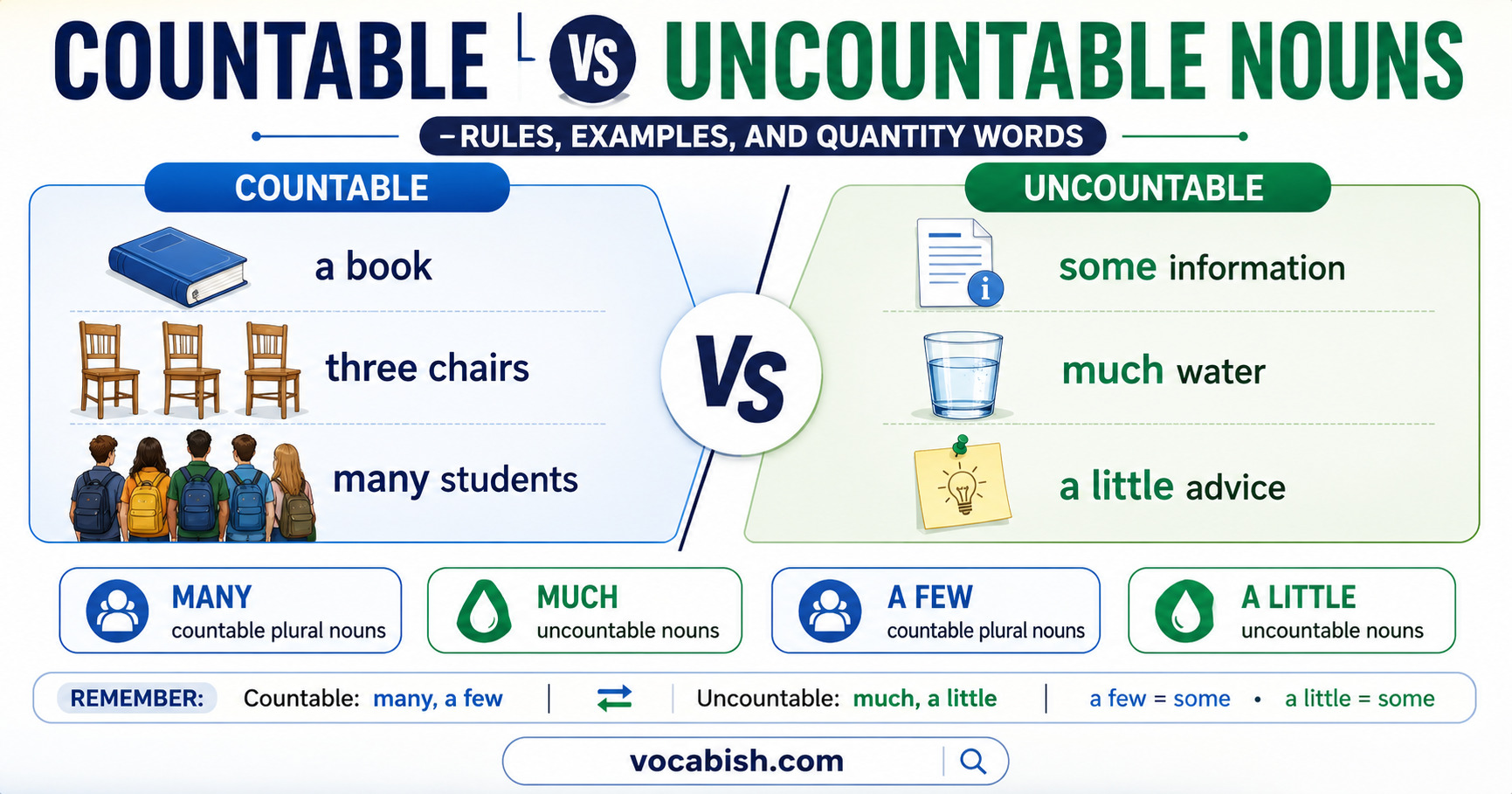
Uncountable Nouns with Singular Verbs
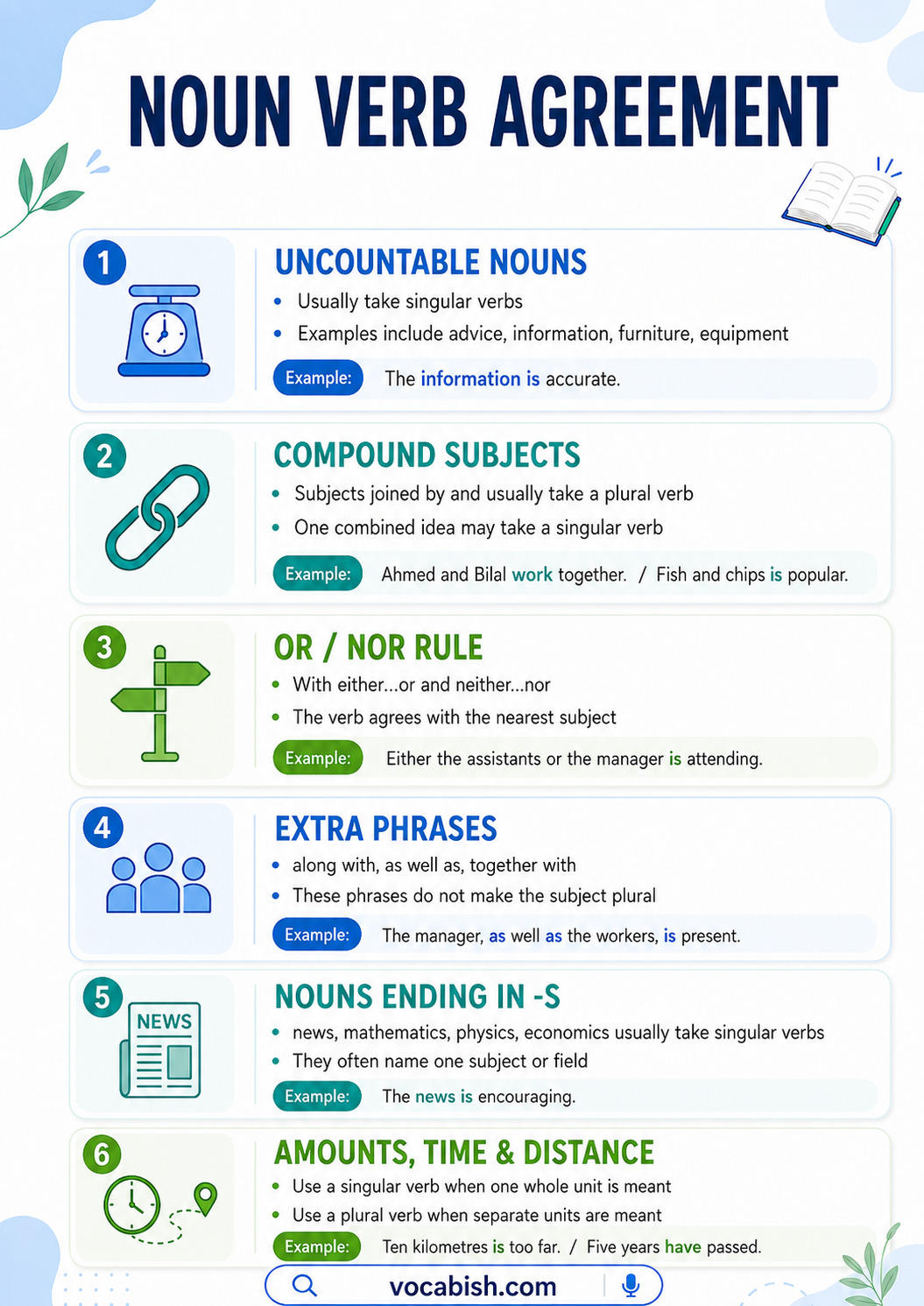
Uncountable nouns usually represent substances, information, qualities, or general ideas that are not counted individually. They take singular verbs.
- The information is accurate.
- Your advice helps me.
- This furniture looks expensive.
- The equipment needs repair.
- Her research shows promising results.
- The traffic was heavy.
Uncountable Noun | Correct Agreement |
|---|---|
advice | The advice is useful. |
information | The information comes from a reliable source. |
furniture | The furniture has arrived. |
luggage | Your luggage weighs too much. |
homework | The homework takes an hour. |
equipment | The equipment works properly. |
progress | Her progress is noticeable. |
Do not add -s to these nouns or use a plural verb with them.
- Incorrect: The informations are helpful.
- Correct: The information is helpful.
- Correct: The pieces of information are helpful.
Compound Subjects
A compound subject contains two or more subjects.
Subjects Joined by “And”
Two subjects joined by and normally take a plural verb.
- Ahmed and Bilal work together.
- The teacher and the assistant are preparing the room.
- A laptop and a printer were delivered.
Use a singular verb when the two words describe one person, one item, or one combined idea.
- Fish and chips is a popular meal.
- Bread and butter was his usual breakfast.
- The owner and manager is attending the meeting.
In the final example, one person is both the owner and the manager.
Subjects Joined by “Or” or “Nor”
With or, either…or, neither…nor, the verb usually agrees with the subject closest to it.
- Either the manager or the assistants are attending.
- Either the assistants or the manager is attending.
- Neither the teacher nor the students were ready.
- Neither the students nor the teacher was ready.
Phrases That Do Not Create a Compound Subject
Expressions such as along with, together with, as well as, and in addition to do not make the subject plural.
- The manager, along with two assistants, is attending.
- My brother, as well as my cousins, lives nearby.
- The teacher, together with her students, has arrived.
Nouns Ending in “-s” with Singular Verbs
Some nouns end in -s but express one subject, field, activity, or condition. They usually take singular verbs.
- Physics is difficult for some learners.
- Measles is a contagious illness.
- Athletics requires regular training.
- The United States has fifty states.
News
News always takes a singular verb, even though it ends in -s.
- The news is encouraging.
- This news comes as a surprise.
- The evening news starts at six.
Do not use a news. Use a piece of news or a news report.
- A piece of news was shared with the staff.
- Several news reports were published.
Mathematics
Mathematics is the name of one academic subject, so it normally takes a singular verb.
- Mathematics is my strongest subject.
- Mathematics requires careful thinking.
- Applied mathematics has many practical uses.
The shortened form maths in British English and math in American English also takes a singular verb.
- Maths is taught every morning.
- Math is useful in daily life.
Economics
Economics takes a singular verb when it refers to the academic subject or field of study.
- Economics is becoming more popular.
- Economics examines how resources are used.
- International economics covers trade between countries.
When economics means financial conditions or practical financial factors, the meaning may sometimes be plural.
- The economics of the project are difficult to justify.
Here, economics refers to several financial considerations rather than one academic field.
Related Resources: Nouns That Are Always Singular or Plural
Amounts, Distances, and Time Expressions
An amount, distance, period, or measurement usually takes a singular verb when considered one complete unit.
- Ten kilometres is too far to walk.
- Five years is a long time.
- Twenty pounds is enough.
- Three litres of water is sufficient.
- Two hours was needed to finish the task.
Use a plural verb when the individual units are being considered separately.
- Ten kilometres were marked with signs.
- Five years have passed since graduation.
- Twenty pounds were scattered across the floor.
- Two hours were spent on different activities.
Meaning | Agreement | Example |
|---|---|---|
One total amount | Singular | Fifty dollars is the full price. |
Separate units | Plural | Fifty dollars were placed in separate envelopes. |
One period | Singular | Six months is enough time. |
Individual periods | Plural | The six months were very different. |
Common Agreement Errors
- Choosing the verb according to the nearest noun
Incorrect: The box of tools are heavy.
Correct: The box of tools is heavy. - Using a singular verb with an irregular plural
Incorrect: The children plays outside.
Correct: The children play outside. - Treating an uncountable noun as plural
Incorrect: The furniture are expensive.
Correct: The furniture is expensive. - Treating “news” as a plural noun
Incorrect: The news are surprising.
Correct: The news is surprising. - Ignoring the closest subject with “either…or”
Incorrect: Either the teachers or the principal are speaking.
Correct: Either the teachers or the principal is speaking. - Making “as well as” subjects plural
Incorrect: The manager, as well as the workers, are present.
Correct: The manager, as well as the workers, is present. - Using a plural verb for one amount
Incorrect: Ten minutes are enough.
Correct: Ten minutes is enough. - Forgetting that plural-only nouns need plural verbs
Incorrect: These scissors is blunt.
Correct: These scissors are blunt.
Practice Exercise of Noun Verb Agreement
Choose the correct verb in each sentence.
- The collection of old coins (belongs/belong) to my uncle.
- Several children (plays/play) near the gate.
- The information (is/are) available online.
- Neither the manager nor the employees (was/were) informed.
- Neither the employees nor the manager (was/were) informed.
- Mathematics (requires/require) regular practice.
- The team (is/are) travelling together on one bus.
- The team (is/are) putting on their individual uniforms.
- Fifteen kilometres (is/are) too far to walk today.
- The scissors (needs/need) cleaning.
- My sister, along with her friends, (is/are) organising the event.
- The men and women (works/work) in separate departments.
- Fish and chips (is/are) served every Friday.
- The news about the road closures (was/were) unexpected.
- A pair of glasses (was/were) left on the table.
Answer Key
- belongs — The subject is the singular noun collection.
- play — Children is an irregular plural noun.
- is — Information is uncountable.
- were — The nearest subject, employees, is plural.
- was — The nearest subject, manager, is singular.
- requires — Mathematics is one academic subject.
- is — The team is acting as one unit.
- are — The members are acting individually.
- is — The distance is considered one complete amount.
- need — Scissors is a plural-only noun.
- is — Along with does not create a plural subject.
- work — Two subjects joined by and take a plural verb.
- is — Fish and chips describes one meal.
- was — News takes a singular verb.
- was — The subject is the singular phrase a pair.
FAQs About Noun Verb Agreement
Subject-verb agreement means the verb form must match whether the sentence subject is singular or plural, especially in the present tense.
A singular noun usually takes a singular verb, such as “The student writes,” while a plural noun takes “The students write.”
Uncountable nouns take singular verbs because they are treated as single quantities, even when they describe large amounts of something.
Collective nouns may take singular verbs when acting as one unit and plural verbs when members act separately, especially in British English.
Nouns such as news, mathematics, and economics end in “-s” but usually take singular verbs because they name single subjects or fields.
With subjects joined by either…or or neither…nor, the verb usually agrees with the subject placed closest to it in the sentence.
Time, money, distance, and measurement expressions usually take singular verbs when the speaker considers the whole amount one unit rather than separate items.
Summary on Noun Verb Agreement
- Singular nouns normally take singular verbs.
- Plural and irregular plural nouns take plural verbs.
- Uncountable nouns generally use singular verbs.
- Collective nouns may be singular or plural depending on meaning and variety of English.
- Subjects joined by and are usually plural.
- With either…or and neither…nor, the verb agrees with the closest subject.
- News, mathematics, and economics usually take singular verbs.
- Amounts, distances, and time expressions are singular when treated as one complete unit.
- Always identify the true subject before choosing the verb.
You May Also Like