
Have you ever daydreamed about winning the lottery? You probably thought to yourself, “If I won a million dollars, I would buy a house.” Or maybe you’ve looked at dark clouds forming and told a friend, “If it rains, I’ll stay inside.”
These are conditional sentences in action. We use them every day in English to talk about cause and effect, hopes, dreams, advice, and regrets. At their core, they tell us that one specific thing depends on another.
Let’s break down exactly how these sentences work, step by step, so you can start using them naturally and confidently in everyday conversations.
Quick Answer: What are Conditional Sentences?
At their core, conditional sentences show that one action depends on another. They always contain two parts: a condition (usually starting with if or unless) and a result.
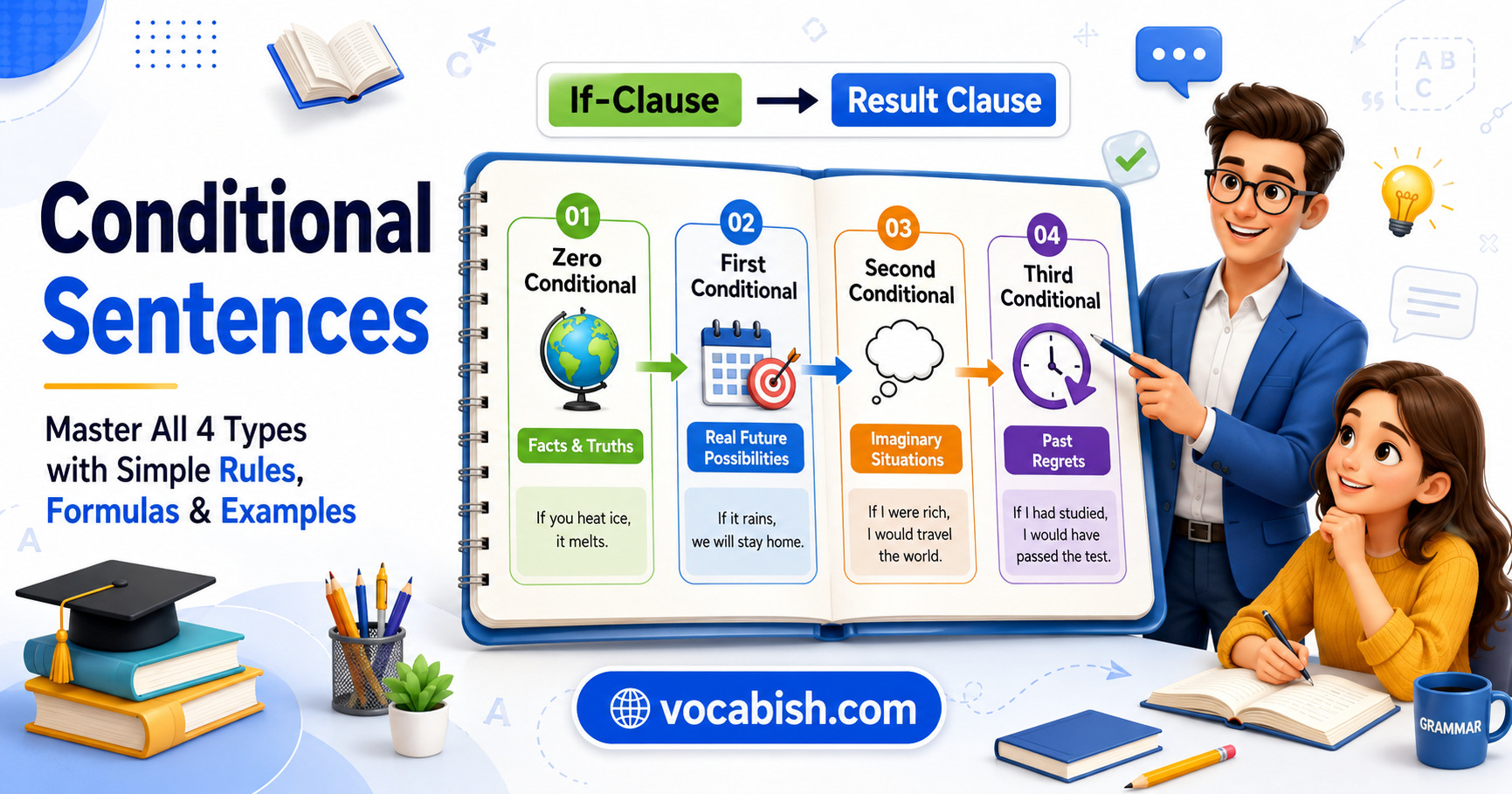
We use four main types of conditional sentences in English to express different levels of reality:
- Zero Conditional (Facts and Rules): Used for general truths that always happen. Example: If water reaches 100°C, it boils.
- First Conditional (Real Possibilities): Used for likely future events. Example: If you exercise regularly, you will feel healthier.
- Second Conditional (Imagined Situations): Used for unlikely or hypothetical scenarios. Example: If I won a million dollars, I would travel the world.
- Third Conditional (Unreal Past): Used to talk about past situations that cannot be changed. Example: If they had prepared better, they would have won the match.
What are Conditional Sentences?
A conditional sentence is made up of two parts (also called clauses):
- The condition: This is the “if” clause. It sets up the situation.
- The result: This is the main clause. It tells us what happens as a result of that condition.
Example: If it rains (condition), I will bring an umbrella (result).
You can flip the order of these two parts, and the meaning stays exactly the same: I will bring an umbrella if it rains.
A quick punctuation rule: When the “if” clause comes first, put a comma in the middle of the sentence. When the result clause comes first, you do not need a comma.
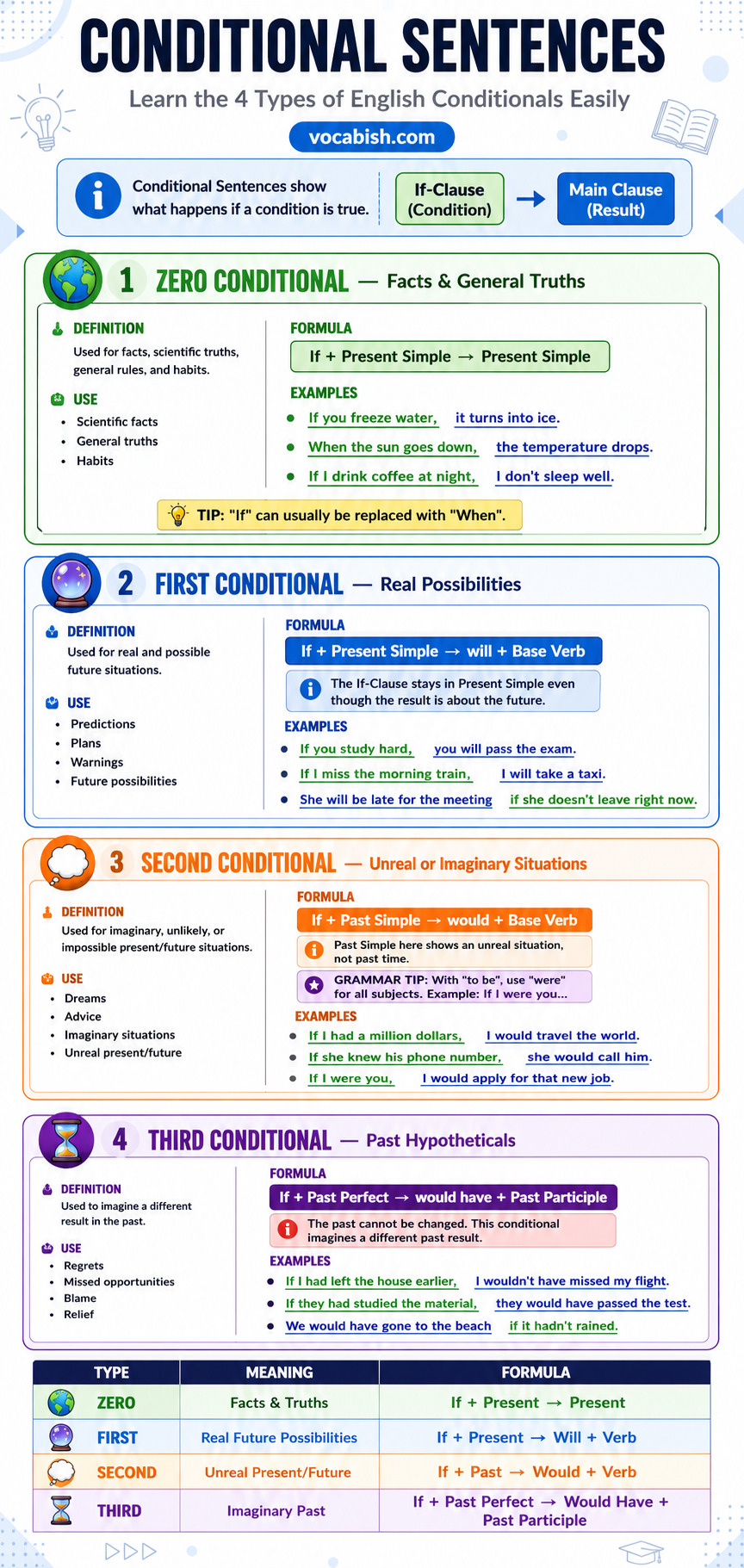
Conditional Types in English: Comparison Table
English grammar traditionally organizes these situations into four types of conditional sentences. Here is a quick overview of how they compare before we look at the specific rules for each one.
Type | When to use it | “If” Clause Tense | Main Clause Tense |
Zero | Facts, rules, and daily habits | Present Simple | Present Simple |
First | Likely or realistic future events | Present Simple | Will + Verb |
Second | Imagined, unlikely, or impossible situations | Past Simple | Would + Verb |
Third | Regrets or completely changed past events | Past Perfect | Would have + Past Participle |
Zero Conditional Sentences: Facts and General Truths
We use the zero conditional to talk about things that are always 100% true. This includes scientific facts, general truths, and personal habits. You aren’t talking about a specific event; you are stating a fact about the world.
Formula: If + Present Simple, Present Simple
In zero conditional sentences, you can almost always replace the word “if” with “when,” and the meaning doesn’t change at all.
Examples in sentences:
- If you leave milk on the kitchen counter all day, it goes bad.
- When water reaches 100 degrees Celsius, it boils.
- If I read a book in a moving car, I get a headache.
- Plants die if they do not receive enough sunlight.
- When the sun sets, the city streetlights turn on automatically.
Related Resources: Simple Present Tense
First Conditional Sentences: Real Possibilities
Use the first conditional when you are talking about real, possible situations in the future. You are making a prediction based on a realistic condition.
Formula: If + Present Simple, will + base verb
Even though we are talking about a future result, notice that the “if” part of the sentence stays in the present tense.
Examples in sentences:
- If you study hard, you will pass the exam.
- If I miss the morning train, I will take a taxi.
- She will be late for the meeting if she doesn’t leave right now.
You May Also Like: How to Use Modal Verbs in English
Second Conditional Sentences: Unreal or Improbable Situations
This is the “daydream” conditional. We use the second conditional for imaginary, highly unlikely, or completely impossible situations in the present or future.
Formula: If + Past Simple, would + base verb
This type confuses many learners because we use the past tense to talk about the present or future. Just remember that the past tense here doesn’t mean time has passed; it means the situation is distanced from reality.
Special Rule: When using the verb to be in the second conditional, it is grammatically correct to use “were” for all subjects (I, he, she, it).
Examples in sentences:
- If I had a million dollars, I would travel the world. (Reality: I don’t have the money.)
- If she knew his phone number, she would call him. (Reality: She doesn’t know his number.)
- If I were you, I would apply for that new job. (Reality: I am giving advice by imagining I am in your shoes.)
Read More: Simple Past Tense
Third Conditional Sentences: Past Hypotheticals
The third conditional is for looking back at the past and imagining a different outcome. Because the past already happened, the condition is impossible to fulfill. We use this type heavily to express regrets, relief, or blame.
Formula: If + Past Perfect (had + past participle), would have + past participle
Examples in sentences:
- If I had left the house earlier, I wouldn’t have missed my flight. (Reality: I left late, and I missed it.)
- If they had studied the material, they would have passed the test. (Reality: They didn’t study, so they failed.)
- We would have gone to the beach if it hadn’t rained. (Reality: It rained, so we stayed home.)
Related: Past Perfect Tense
Exceptions and Special Cases
Real life doesn’t always fit neatly into four simple categories. Sometimes, time frames overlap.
Mixed Conditional Sentences
What happens when a past event affects your present situation? You can mix the second and third conditionals together to accurately express what you mean.
- If I had learned to play the guitar as a kid, I could join your band today. (Past action affecting present reality)
- She wouldn’t be so exhausted right now if she had gone to bed earlier last night. (Past action affecting present reality)
- If I weren’t terrified of spiders, I would have helped you catch that one yesterday. (Ongoing trait affecting a past result)
- If he were a more careful driver, he wouldn’t have crashed his car last week. (Ongoing trait affecting a past result)
- We would be relaxing at the beach right now if we hadn’t missed our morning flight. (Past action affecting present reality)
Inverted Conditionals
In formal writing or professional English, you can drop the word “if” entirely by changing the word order. This makes your English sound highly advanced.
- Had I known the restaurant was this expensive, I would have eaten at home. (Formal alternative to: If I had known…)
- Were she to accept the promotion, she would need to relocate to London. (Formal alternative to: If she were to accept…)
- Should you require further information, please do not hesitate to contact our office. (Formal alternative to: If you require…)
- Had we booked the flight tickets a month ago, we would have saved a lot of money. (Formal alternative to: If we had booked…)
- Should the weather worsen this afternoon, the outdoor concert will be canceled. (Formal alternative to: If the weather worsens…)
Tips to Use the 4 Types of Conditional Sentences
Here are five practical tips to help you master these conditional sentences in your everyday English:
- Think about reality first. Before you speak or write, ask yourself: Is this a fact, a real possibility, a daydream, or a regret? Choosing the right conditional is less about memorizing formulas and more about deciding how likely the situation is to actually happen.
- Memorize examples, not just formulas. Instead of trying to remember math-like grammar equations, memorize one perfect example for each type (like, “If I won the lottery, I would buy a car”). Use that single sentence as a mental template for everything else you want to say.
- Keep “will” and “would” away from “if”. A very common learner mistake is putting future or conditional verbs inside the condition itself (like saying, “If I will go…”). Remember that “will” and “would” belong in the result clause, not next to the word “if.”
- Watch your commas. Punctuation here is simple but strictly followed in written English. Always use a comma to separate the two parts if you start the sentence with the “if” clause. If you put the result first, the comma completely disappears.
- Swap “if not” for “unless” to sound natural. Native speakers love using “unless” in the first conditional. Saying, “I will stay home unless it stops raining” sounds much smoother and more conversational than saying, “I will stay home if it does not stop raining.”
FAQs About Conditional Sentences
There are four main types of conditional sentences in English: Zero, First, Second, and Third. Beyond these four basics, advanced English speakers also use Mixed conditionals, which blend the rules of the second and third types to describe complex situations involving both the past and the present.
A type 2 conditional sentence describes an imaginary, impossible, or highly unlikely situation in the present or future. To form it, you use the past simple tense in the “if” clause, and “would” plus a base verb in the main result clause.
You write a conditional sentence by combining two parts: an “if” clause (the condition) and a main clause (the result). If you start your sentence with the “if” clause, you must put a comma in the middle. If you put the main result clause first, you drop the comma entirely.
Yes! Using different modal verbs changes the exact meaning of the result. Using “might” shows a possibility, while “could” shows ability. Example: If I had more free time, I could learn French. (I would have the ability to do it).
No. You only need a comma if the sentence starts with the “if” clause. If the result clause begins the sentence, you drop the comma completely.
You May Also Like: