
You can see a person smile, but you cannot see the happiness itself. You may watch someone return a lost wallet, yet the honesty behind that action has no physical shape. Feelings, qualities, ideas, and conditions are real, but we experience them differently from objects such as chairs, phones, and trees.
The words happiness and honesty are abstract nouns.
Abstract nouns help us talk about the inner and non-physical parts of life. Without them, it would be difficult to discuss emotions, relationships, personal qualities, education, health, freedom, progress, or change.
What Is an Abstract Noun?
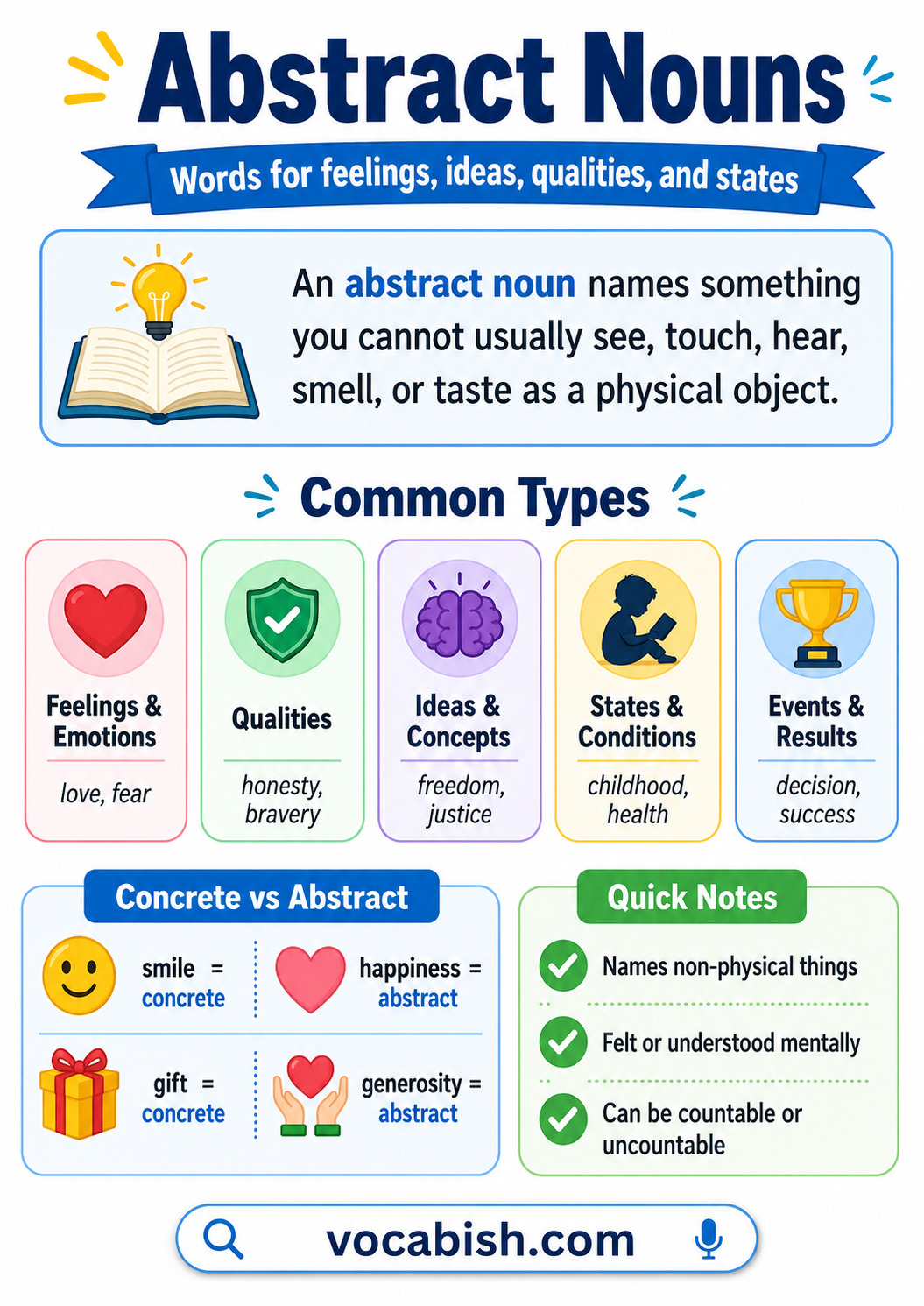
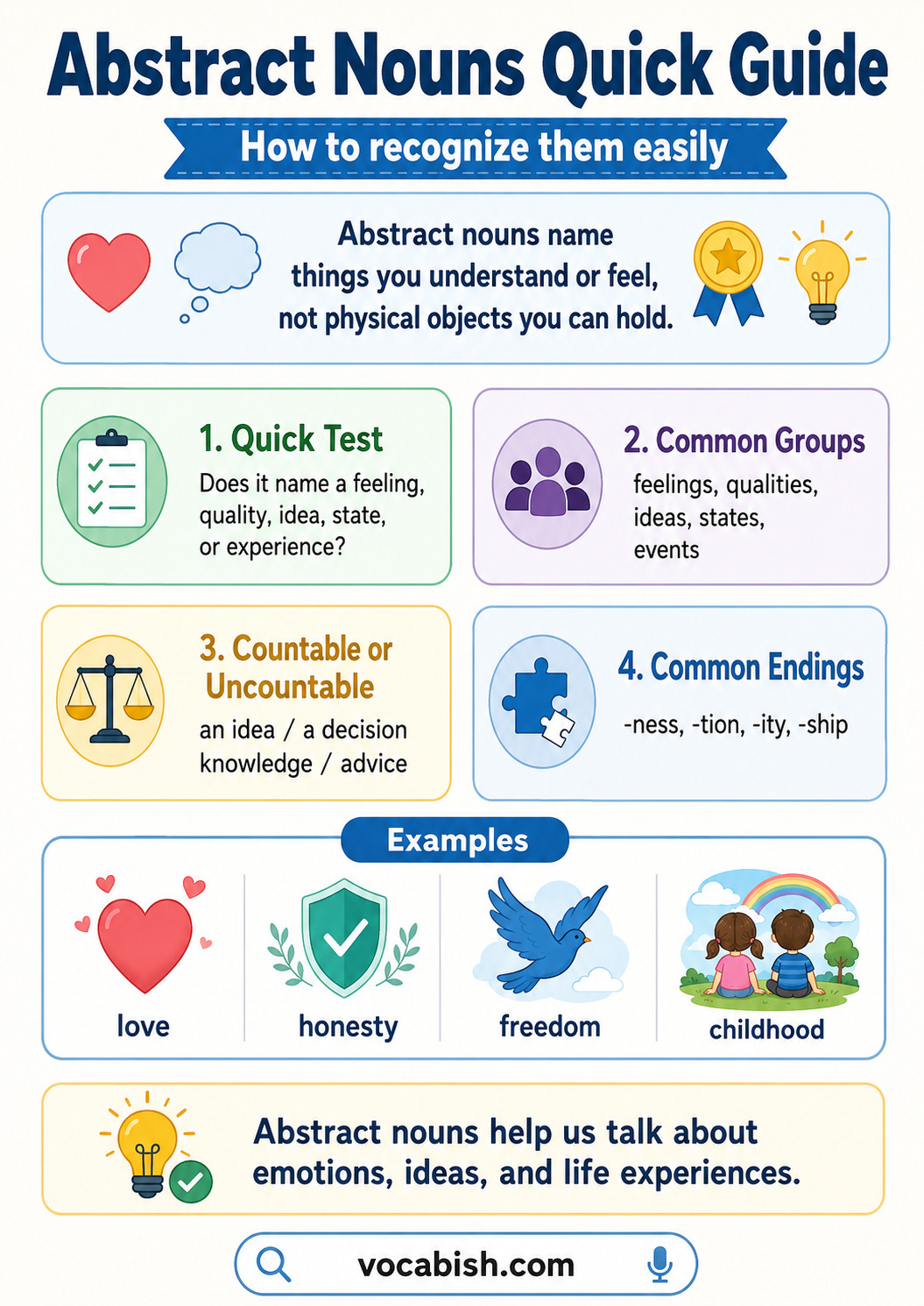
An abstract noun is a noun that names a feeling, quality, idea, state, condition, experience, or concept that cannot normally be experienced as a physical object through the five senses.
Examples include:
- love
- anger
- courage
- freedom
- wisdom
- childhood
- poverty
- friendship
- success
- knowledge
You cannot physically touch courage or place friendship on a table. You may see actions that show courage or friendship, but the qualities themselves are not physical objects.
Consider this sentence:
Her kindness gave the child hope.
The abstract nouns are:
- kindness — a personal quality
- hope — a feeling or expectation
The word child is not abstract. It names a person who can be seen and touched, so it is a concrete noun.
A Useful Way to Recognize Abstract Nouns
When you are unsure about a noun, ask what it names.
Does it name:
- an emotion?
- a quality?
- an idea?
- a relationship?
- a state or condition?
- a process or result?
- a period or experience?
If it does, the word may be an abstract noun.
Be careful, though. The question is not simply, “Can I see evidence of it?”
You can see someone crying, but you cannot see sadness itself. You see the tears and facial expression that communicate sadness.
- tears — concrete noun
- sadness — abstract noun
In the same way:
- smile — concrete noun
- joy — abstract noun
- gift — concrete noun
- generosity — abstract noun
- medal — concrete noun
- achievement — abstract noun
What Do Abstract Nouns Name?
Abstract nouns cover several areas of meaning. Understanding these groups is often more helpful than memorizing one long list.
Feelings and Emotions
Many abstract nouns name emotional experiences.
Examples:
- love
- happiness
- sadness
- anger
- fear
- jealousy
- excitement
- disappointment
- pride
- anxiety
- relief
- affection
In sentences:
- The children shouted with excitement.
- She felt great relief after the exam.
- His voice showed anger.
- They welcomed the puppy with affection.
- A feeling of anxiety kept her awake.
Emotions may produce physical signs, but the emotional state remains abstract.
For example:
His hands shook with fear.
- hands — concrete noun
- fear — abstract noun
The shaking is physical. The fear is emotional.
Qualities and Characteristics
Abstract nouns can name qualities found in people, actions, objects, or situations.
Examples:
- honesty
- bravery
- patience
- kindness
- beauty
- intelligence
- strength
- generosity
- loyalty
- politeness
- creativity
- confidence
Examples in context:
- Good teachers need patience.
- Her honesty earned everyone’s respect.
- The rescue required great bravery.
- His creativity improved the project.
- The speaker answered with confidence.
Many of these nouns are formed from adjectives:
- honest → honesty
- patient → patience
- kind → kindness
- brave → bravery
- creative → creativity
- confident → confidence
The adjective describes someone or something:
- She is patient.
The abstract noun names the quality:
- Her patience helped the class.
Ideas and Concepts
Some abstract nouns name ideas that people discuss, defend, study, or believe in.
Examples:
- freedom
- justice
- equality
- democracy
- truth
- education
- knowledge
- peace
- culture
- responsibility
- language
- morality
In sentences:
- Everyone deserves equality before the law.
- Education gives people access to knowledge.
- The community hoped for lasting peace.
- The lesson encouraged a discussion about responsibility.
- Different societies may have different ideas about justice.
These nouns are often common in academic, political, social, and professional writing. They allow us to discuss ideas without referring to one physical object.
States and Conditions
An abstract noun may describe the state or condition of a person, place, object, or situation.
Examples:
- childhood
- adulthood
- poverty
- wealth
- health
- illness
- sleep
- silence
- safety
- danger
- unemployment
- loneliness
Examples:
- She spent her childhood near the coast.
- Regular exercise can improve your health.
- The village faced high unemployment.
- The sudden silence made everyone uncomfortable.
- The travellers reached safety before dark.
Some of these nouns are connected to physical experiences. Illness, for example, may cause visible symptoms, but the word names a condition rather than a physical object.
Likewise, you may hear no sound during silence, but silence names a state in which sound is absent.
Events, Processes, and Experiences
Abstract nouns may also name actions, developments, events, or results.
Examples:
- arrival
- departure
- growth
- development
- movement
- discussion
- decision
- celebration
- discovery
- improvement
- failure
- success
Examples in sentences:
- Their arrival surprised us.
- The company announced a major development.
- After a long discussion, the group reached a decision.
- The medicine led to a clear improvement.
- The team celebrated its success.
Many nouns in this group come from verbs:
- arrive → arrival
- decide → decision
- develop → development
- improve → improvement
- discover → discovery
- fail → failure
Although some events have physical parts, the noun often names the event as a complete idea rather than a single physical object.
For example:
The celebration lasted until midnight.
You may see food, guests, lights, and dancing. The word celebration, however, names the event as a whole.
Common Abstract Noun Examples
Here are useful abstract nouns grouped by meaning.
Feelings | Qualities | Ideas | States | Events or results |
|---|---|---|---|---|
joy | honesty | freedom | childhood | decision |
fear | kindness | justice | health | arrival |
love | bravery | knowledge | poverty | success |
anger | patience | equality | safety | improvement |
pride | loyalty | peace | loneliness | discovery |
hope | wisdom | education | silence | failure |
A word may fit more than one group. Hope, for instance, may be described as a feeling, belief, or expectation.
Grammar categories are useful tools, but real language does not always fit into perfectly separate boxes.
Abstract Nouns in Sentences
Abstract nouns can perform the same grammatical roles as other nouns.
As the Subject
An abstract noun can be the subject of a sentence.
- Patience takes time to develop.
- Knowledge opens new opportunities.
- Fear can affect decision-making.
- Honesty builds trust.
As the Object of a Verb
- Everyone values freedom.
- The experience increased her confidence.
- We discussed education.
- He finally found peace.
After a Preposition
- She spoke with great confidence.
- They acted out of kindness.
- The children screamed with excitement.
- He succeeded through hard work and determination.
After a Linking Verb
- Her greatest strength is patience.
- The main problem was communication.
- Their goal is equality.
- His biggest fear is failure.
In a Noun Phrase
Abstract nouns often appear with adjectives and other modifiers.
- deep sadness
- complete freedom
- great courage
- childhood memories
- personal responsibility
- economic growth
- social equality
- valuable experience
These combinations are common in both spoken and written English.
Abstract Nouns vs Concrete Nouns
A concrete noun names something physically experienced through sight, hearing, touch, smell, or taste. An abstract noun names something understood mentally or felt emotionally.
Abstract noun | |
|---|---|
child | childhood |
friend | friendship |
smile | happiness |
tears | sadness |
soldier | bravery |
judge | justice |
school | education |
doctor | health |
book | knowledge |
gift | generosity |
Compare these sentences:
The soldier received a medal for bravery.
- soldier — concrete
- medal — concrete
- bravery — abstract
Her smile showed happiness.
- smile — concrete
- happiness — abstract
The students entered the school to continue their education.
- students — concrete
- school — concrete
- education — abstract
A concrete object may represent an abstract idea. A national flag, for example, is a physical object, while patriotism is an abstract feeling or belief.
- flag — concrete
- patriotism — abstract
The Sign Is Not the Same as the Quality
Learners sometimes classify an abstract noun as concrete because they can see its effects.
When a person helps someone, you can see the action, but kindness itself remains unseen.
A confident speech may be heard, yet confidence is still a quality.
People can be observed voting, but democracy is an idea and a system.
A helpful distinction is:
- physical evidence can be observed
- the quality, feeling, or idea is understood
For example:
The crowd’s applause showed its appreciation.
- crowd — concrete collective noun
- applause — concrete because it can be heard
- appreciation — abstract because it names a feeling or attitude
How Abstract Nouns Are Formed
Some abstract nouns are basic words that do not clearly come from another modern English word.
Examples include:
- love
- fear
- hope
- peace
- truth
- joy
Many others are formed from adjectives, verbs, or nouns. This process is sometimes called noun formation or nominalization.
Knowing common word families can improve both vocabulary and sentence building.
Compare:
- The child was curious.
- The child showed curiosity.
- They decided to leave.
- They made a decision.
- The two women were close friends.
- Their friendship lasted for years.
The meaning remains connected, but the grammatical role changes.
Abstract Nouns Formed from Adjectives
An adjective describes a person, object, place, or situation. An abstract noun names the quality or condition itself.
Adjective | Abstract noun |
|---|---|
kind | kindness |
happy | happiness |
brave | bravery |
honest | honesty |
patient | patience |
intelligent | intelligence |
confident | confidence |
possible | possibility |
equal | equality |
strong | strength |
wise | wisdom |
free | freedom |
Examples:
- The nurse was kind.
- The nurse treated everyone with kindness.
- He is confident.
- He answered with confidence.
- The task is possible.
- There is a strong possibility of success.
The spelling may change when the noun is formed:
- happy → happiness
- curious → curiosity
- strong → strength
- long → length
- wise → wisdom
Because the changes are not always predictable, learners should study related words as families rather than assuming one suffix works every time.
Abstract Nouns Formed from Verbs
A verb describes an action, process, or state. An abstract noun may name that action, its process, or its result.
Verb | Abstract noun |
|---|---|
decide | decision |
improve | improvement |
develop | development |
educate | education |
arrive | arrival |
fail | failure |
grow | growth |
know | knowledge |
choose | choice |
believe | belief |
perform | performance |
discover | discovery |
Examples:
- The committee decided quickly.
- The committee made a quick decision.
- Her English improved.
- We noticed a clear improvement.
- Scientists discovered a new species.
- The discovery attracted international attention.
Sometimes the verb and noun have the same form:
- change → change
- hope → hope
- love → love
- help → help
- work → work
The sentence structure tells you how the word is functioning.
Compare:
- They hope to win.
Hope is a verb. - They still have hope.
Hope is an abstract noun.
Abstract Nouns Formed from Common Nouns
An abstract noun can also develop from another noun, especially when it names a relationship, period, system, condition, or quality connected with that noun.
Common noun | Abstract noun |
|---|---|
friend | friendship |
child | childhood |
leader | leadership |
member | membership |
owner | ownership |
citizen | citizenship |
partner | partnership |
hero | heroism |
scholar | scholarship |
neighbour | neighbourhood |
Examples:
- They became close friends.
- Their friendship grew over time.
- She is an effective leader.
- Her leadership improved the team.
- He became a citizen last year.
- He applied for citizenship.
Not every noun-to-noun change creates a purely abstract meaning. Neighbourhood, for example, can name a physical area, so it may be concrete in some sentences.
- Their neighbourhood has three parks.
Here, it refers to a physical area.
This shows why meaning in context is more reliable than the word ending alone.
Common Abstract Noun Suffixes
A suffix is a group of letters added to the end of a word. Several suffixes are frequently used to form abstract nouns.
Recognizing them can help, but a suffix is a clue rather than a perfect rule. Not every word ending in one of these patterns is abstract, and spelling changes are common.
Words Ending in “-ness”
The suffix -ness often turns an adjective into a noun that names a quality or state.
Examples:
- kind → kindness
- happy → happiness
- dark → darkness
- weak → weakness
- lonely → loneliness
- polite → politeness
- aware → awareness
- careless → carelessness
In sentences:
- Her kindness made the guest feel welcome.
- The room was hidden in darkness.
- Long periods of loneliness can affect health.
- His carelessness caused the mistake.
Spelling Note
When an adjective ends in consonant + y, the y often changes to i:
- happy → happiness
- lonely → loneliness
- lazy → laziness
However:
- shy → shyness
English spelling does not follow one pattern in every word.
Ending in “-tion” and “-sion”
The suffixes -tion and -sion often create nouns from verbs. They may name an action, process, or result.
Examples:
- educate → education
- communicate → communication
- protect → protection
- invite → invitation
- decide → decision
- conclude → conclusion
- expand → expansion
- revise → revision
Examples:
- Good communication prevents confusion.
- The walls provide protection from the wind.
- We received an invitation to the ceremony.
- Their final decision surprised everyone.
- The report ended with a short conclusion.
The spelling change must often be learned with the word:
- decide → decision
- explain → explanation
- permit → permission
- admit → admission
It is safer to learn the complete word family than to add a suffix without checking the spelling.
Words Ending in “-ment”
The suffix -ment often forms a noun from a verb.
Examples:
- improve → improvement
- develop → development
- achieve → achievement
- encourage → encouragement
- agree → agreement
- arrange → arrangement
- employ → employment
- entertain → entertainment
In sentences:
- Her pronunciation showed clear improvement.
- The town has experienced rapid development.
- Finishing the course was a major achievement.
- The teacher offered encouragement.
- Both sides reached an agreement.
Not every verb takes -ment. For example, the noun from decide is decision, not decidement.
Words Ending in “-ity”
The suffix -ity often forms nouns from adjectives, especially words ending in -able, -ible, -al, or -ous.
Examples:
- equal → equality
- possible → possibility
- responsible → responsibility
- active → activity
- creative → creativity
- curious → curiosity
- secure → security
- available → availability
Examples:
- The law should support equality.
- There is a possibility of rain.
- Parents have a responsibility to protect their children.
- The lesson encouraged creativity.
- Please check the room’s availability.
Spelling can change noticeably:
- curious → curiosity
- responsible → responsibility
- able → ability
- real → reality
Ending in “-ance” and “-ence”
The suffixes -ance and -ence often form nouns naming a state, quality, action, or result.
Examples:
- important → importance
- patient → patience
- confident → confidence
- different → difference
- present → presence
- absent → absence
- perform → performance
- exist → existence
- depend → dependence
- resist → resistance
Examples:
- The teacher explained the importance of revision.
- Good language learning requires patience.
- Her confidence increased with practice.
- We noticed a clear difference.
- His sudden absence worried the team.
There is no dependable sound rule that always tells learners whether to use -ance or -ence. These nouns are best learned with their related adjectives or verbs.
- confident → confidence
- patient → patience
- important → importance
- independent → independence
Other Useful Abstract Noun Endings
Abstract nouns also appear with several other endings.
“-ship”
- friendship
- leadership
- membership
- citizenship
- partnership
“-hood”
- childhood
- adulthood
- motherhood
- brotherhood
“-dom”
- freedom
- wisdom
- boredom
- kingdom
Be careful with kingdom: it usually names a country or realm, so it may be concrete rather than abstract in many sentences.
“-al”
- arrival
- refusal
- approval
- survival
“-ure”
- failure
- pleasure
- pressure
- exposure
Some words do not follow a clear suffix pattern:
- strong → strength
- true → truth
- proud → pride
- wise → wisdom
- know → knowledge
- choose → choice
These irregular forms must be learned individually.
Do Suffixes Always Identify Abstract Nouns?
No. A word ending may suggest an abstract noun, but it does not prove it.
For example:
- building can name a physical structure
- painting can name a physical work of art
- kingdom can name a geographical territory
- department can name a group or part of an organization
- neighbourhood can name a physical area
Always examine what the noun means in the sentence.
The building has ten floors.
Here, building is concrete because it names a physical structure.
Building takes several months.
Here, building names a process and may be treated as an activity noun or gerund.
Word endings are useful guides, but context makes the final decision.
Are Abstract Nouns Countable or Uncountable?
Abstract nouns may be uncountable, countable, or both.
Their countability depends on their meaning.
Uncountable Abstract Nouns
Many abstract nouns describe general qualities, feelings, states, or concepts. They are usually uncountable.
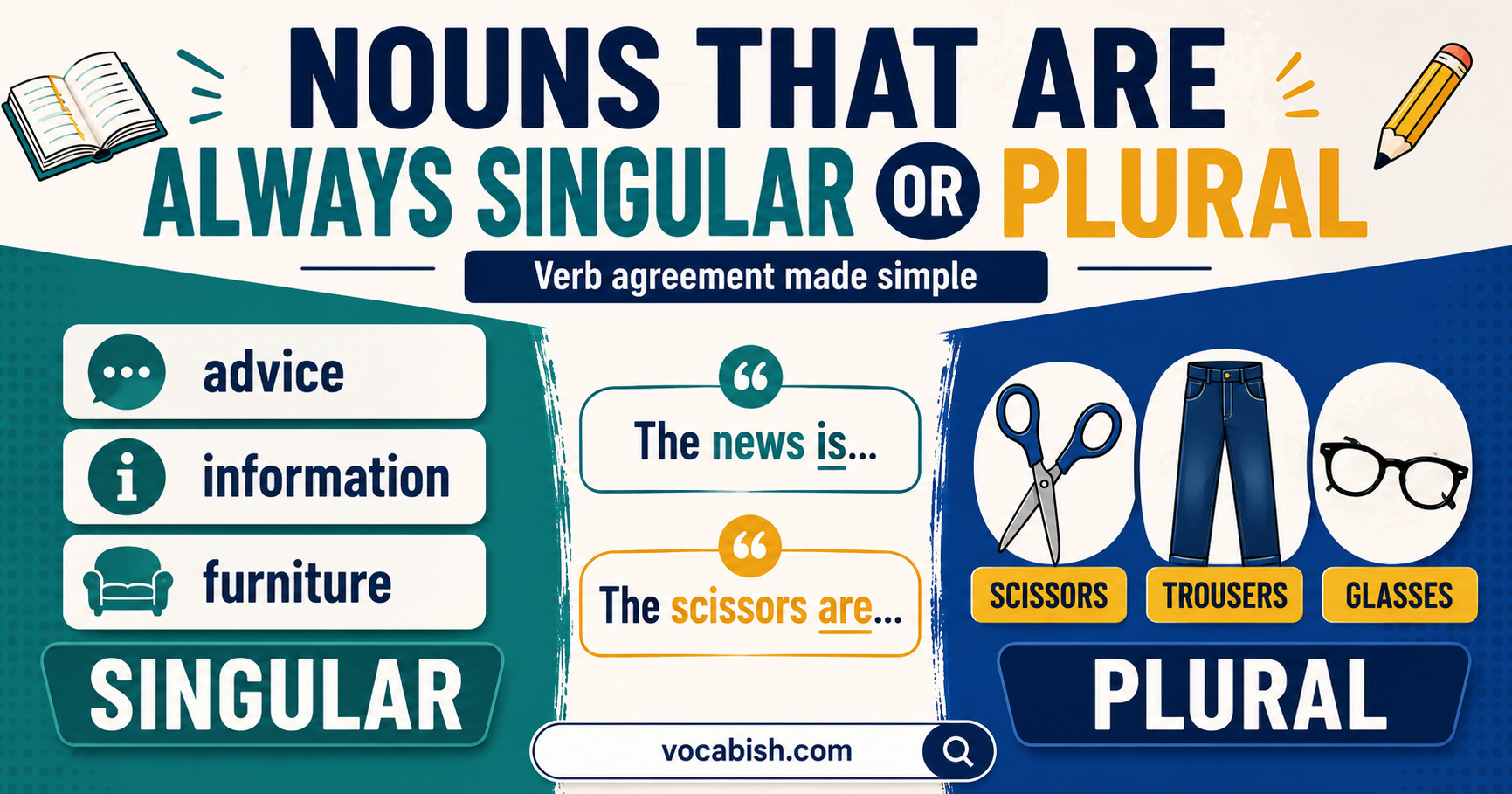
Examples:
- honesty
- courage
- patience
- information
- knowledge
- freedom
- happiness
- advice
- education
- progress
We normally say:
- great courage
- useful information
- enough patience
- some advice
- a little progress
We do not normally say:
- a courage
- three informations
- many patiences
- two advices
- several progresses
Examples:
- She showed great courage.
- We need more information.
- He gave me useful advice.
- The class made good progress.
Countable Abstract Nouns
Some abstract nouns can refer to separate ideas, events, experiences, decisions, or occasions.
Examples:
- an idea
- a decision
- a hope
- a fear
- a dream
- an experience
- a success
- a failure
- a belief
- a difficulty
In sentences:
- She shared three interesting ideas.
- We made an important decision.
- He described several childhood experiences.
- The project faced many difficulties.
- Her first book was a great success.
These nouns can be counted because English treats each idea, event, or experience as a separate unit.
Abstract Nouns That Can Be Both
The same abstract noun may be countable in one meaning and uncountable in another.
Experience
- She has teaching experience.
Uncountable: knowledge gained through work. - The trip was an unforgettable experience.
Countable: one particular event.
Success
- Hard work does not always guarantee success.
Uncountable: success in general. - The event was a great success.
Countable: one successful result.
Fear
- Fear can prevent people from taking action.
Uncountable: the emotion in general. - She has a fear of heights.
Countable: one particular type of fear.
Knowledge
Knowledge is usually uncountable:
- He has extensive knowledge of history.
We do not usually say knowledges in everyday English. In specialized academic contexts, the plural may appear when discussing different systems or kinds of knowledge, but ESL learners should normally treat knowledge as uncountable.
Education
- Education should be available to everyone.
Uncountable: the general process or system. - He received a good education.
Countable with an article: a particular kind or period of education.
The word does not normally have a plural in everyday use, although educations may appear in rare specialized contexts.
Articles with Abstract Nouns
General uncountable abstract nouns often appear without an article.
- Honesty is important.
- Knowledge takes time to build.
- Freedom matters to everyone.
Use the when the noun refers to a specific form, case, or situation already identified.
- We appreciated the honesty of her answer.
- The knowledge he gained abroad helped him.
- They celebrated the freedom they had finally achieved.
Use a or an with countable abstract nouns:
- an idea
- a decision
- a fear
- a possibility
- an achievement
Some normally uncountable nouns can take a when they are modified and refer to a particular type or example:
- a deep sadness
- a great love of music
- a good education
- a strong understanding of grammar
This use does not mean the noun is freely countable in every situation.
Common Errors with Abstract Nouns
1. Using the Adjective Instead of the Noun
Incorrect:
- Her kind helped everyone.
- We admired his brave.
- She answered with confident.
Correct:
- Her kindness helped everyone.
- We admired his bravery.
- She answered with confidence.
2. Using the Noun Instead of the Adjective
Incorrect:
- She is very confidence.
- He is an honesty man.
- The children were excitement.
Correct:
- She is very confident.
- He is an honest man.
- The children were excited.
3. Adding Plural Endings to Uncountable Nouns
Incorrect:
- She gave me useful advices.
- We need more informations.
- The students made several progresses.
Correct:
- She gave me useful advice.
- We need more information.
- The students made good progress.
To count advice or information, use:
- a piece of advice
- two pieces of advice
- an item of information
- several pieces of information
4. Using “A” or “An” with General Uncountable Nouns
Incorrect:
- She showed a courage.
- He has a good knowledge about computers.
- I need an advice.
Better:
- She showed courage.
- He has good knowledge of computers.
- I need advice.
- I need a piece of advice.
However, a modified noun may sometimes take an article naturally:
- He has a good knowledge of computers.
5. Choosing the Wrong Preposition
Some abstract nouns commonly appear with particular prepositions.
- interest in
- fear of
- respect for
- solution to
- reason for
- increase in
- difference between
- relationship with
- knowledge of
- confidence in
Examples:
- She has an interest in art.
- He has a fear of dogs.
- We need a solution to the problem.
- There was a clear difference between the two results.
Abstract Nouns in a Short Passage
Read this paragraph:
After months of preparation, Lina entered the competition with confidence. She felt some anxiety, but her determination remained strong. Winning brought her happiness, although the greatest reward was the experience itself.
The abstract nouns are:
- preparation — a process
- competition — an event
- confidence — a quality or state
- anxiety — a feeling
- determination — a quality
- happiness — an emotion
- reward — depending on context, it may be abstract or concrete
- experience — an event or personal experience
The word reward deserves attention. It can name a physical prize:
- She received a cash reward.
It can also refer to a non-physical benefit:
- The greatest reward was personal growth.
This is another example of context changing a noun’s classification.
Abstract Noun Formation Exercise
A: Form an Abstract Noun
Change each word into an abstract noun.
- kind
- decide
- brave
- improve
- honest
- possible
- arrive
- patient
- free
- choose
- strong
- educate
- friend
- confident
- responsible
B: Choose the Correct Word Form
- Her kind / kindness made everyone comfortable.
- The students were excited / excitement about the trip.
- His decide / decision surprised the team.
- She answered the question with confident / confidence.
- The new system brought a clear improve / improvement.
- Good leaders accept responsible / responsibility.
- We admired the firefighter’s brave / bravery.
- The children need more independent / independence.
- Their friend / friendship began at school.
- The doctor explained the important / importance of sleep.
C: Abstract or Concrete?
Write abstract or concrete for the bold noun.
- The baby laughed loudly.
- Her laughter filled the room.
- The team showed great determination.
- He placed the trophy on a shelf.
- Their friendship lasted for decades.
- A friend waited at the gate.
- Everyone hopes for peace.
- The white flag moved in the wind.
- His anger was difficult to control.
- He closed the door quietly.
D: Countable or Uncountable?
Identify how the bold abstract noun is being used.
- She has teaching experience.
- The holiday was a wonderful experience.
- The group made an important decision.
- We need more information.
- He has a deep fear of water.
- Fear can affect the body.
- The event was a complete success.
- Hard work can lead to success.
- She offered useful advice.
- They discussed several ideas.
E: Correct the Errors
- She gave me an useful advice.
- His honest impressed the interviewers.
- We noticed many improvements in her writing.
- The children were full of excited.
- He has several knowledges about computers.
- Her confident grew after the presentation.
- They made a decision after a long discuss.
- The team showed great braveness.
- We need more informations before deciding.
- She is known for her kind and patient.
Answer Key
A
- kind → kindness
- decide → decision
- brave → bravery
- improve → improvement
- honest → honesty
- possible → possibility
- arrive → arrival
- patient → patience
- free → freedom
- choose → choice
- strong → strength
- educate → education
- friend → friendship
- confident → confidence
- responsible → responsibility
Notice that several forms require spelling changes rather than a simple added ending.
B
- Her kindness made everyone comfortable.
- The students were excited about the trip.
- His decision surprised the team.
- She answered the question with confidence.
- The new system brought a clear improvement.
- Good leaders accept responsibility.
- We admired the firefighter’s bravery.
- The children need more independence.
- Their friendship began at school.
- The doctor explained the importance of sleep.
C
- baby — concrete
- laughter — concrete when it refers to an audible sound
- determination — abstract
- trophy — concrete
- friendship — abstract
- friend — concrete
- peace — abstract
- flag — concrete
- anger — abstract
- door — concrete
Some classroom systems may classify laughter as an action or abstract event noun. When it refers directly to a sound that can be heard, treating it as concrete is reasonable.
D
- experience — uncountable; knowledge gained through teaching
- experience — countable; one particular event
- decision — countable
- information — uncountable
- fear — countable; a particular fear
- fear — uncountable; the emotion in general
- success — countable; one successful event
- success — uncountable; success in general
- advice — uncountable
- ideas — countable
E
- She gave me useful advice.
Or: She gave me a useful piece of advice. - His honesty impressed the interviewers.
- We noticed many improvements in her writing.
This sentence is already correct because it refers to several separate improvements. - The children were full of excitement.
- He has extensive knowledge of computers.
- Her confidence grew after the presentation.
- They made a decision after a long discussion.
- The team showed great bravery.
- We need more information before deciding.
- She is known for her kindness and patience.
Or: She is known for being kind and patient.
FAQs About Abstract Nouns
An abstract noun names a feeling, idea, quality, state, condition, or experience that does not exist as a physical object. Examples include love, courage, freedom, and childhood.
Ten common examples are: happiness, honesty, fear, courage, friendship, knowledge, freedom, patience, success, childhood.
Yes. Love names a feeling or emotional connection, so it is an abstract noun.
Their love grew stronger over time.
The word can also function as a verb:
They love travelling.
Yes. Beauty names a quality.
Everyone admired the beauty of the landscape.
The landscape is concrete, while beauty is the quality being admired
No. Many are uncountable, such as honesty, knowledge, and patience. Others are countable, including idea, decision, belief, and experience.
Some can be either:
experience in general
an interesting experience
Yes. A proper noun may name a specific abstract concept, event, period, or belief system. For example, the official name of a historical movement or event may be both proper and abstract in meaning.
Many are formed by adding suffixes to adjectives, verbs, or nouns:
kind → kindness
decide → decision
improve → improvement
equal → equality
friend → friendship
Some forms are irregular:
strong → strength
proud → pride
wise → wisdom
Learning Abstract Nouns as Word Families
Abstract nouns become easier when you learn them with their related verbs and adjectives.
Instead of memorizing only decision, learn the complete family:
- decide — verb
- decisive — adjective
- decision — noun
Another example:
- succeed — verb
- successful — adjective
- successfully — adverb
- success — noun
And:
- create — verb
- creative — adjective
- creatively — adverb
- creativity — noun
This method helps you select the correct form when writing.
Compare:
- She gave a creative answer.
- Her creativity impressed the teacher.
- She answered creatively.
- She created a new design.
Each word carries a related meaning, but its grammatical job is different.
Abstract nouns allow English speakers to discuss what cannot be picked up, seen directly, or placed in a room: feelings, beliefs, relationships, qualities, processes, and states. To use them accurately, focus on meaning, learn common word families, and pay attention to whether the noun is countable or uncountable.
The more you notice abstract nouns in real sentences, the easier it becomes to distinguish kind from kindness, decide from decision, and confident from confidence.
You May Also Like