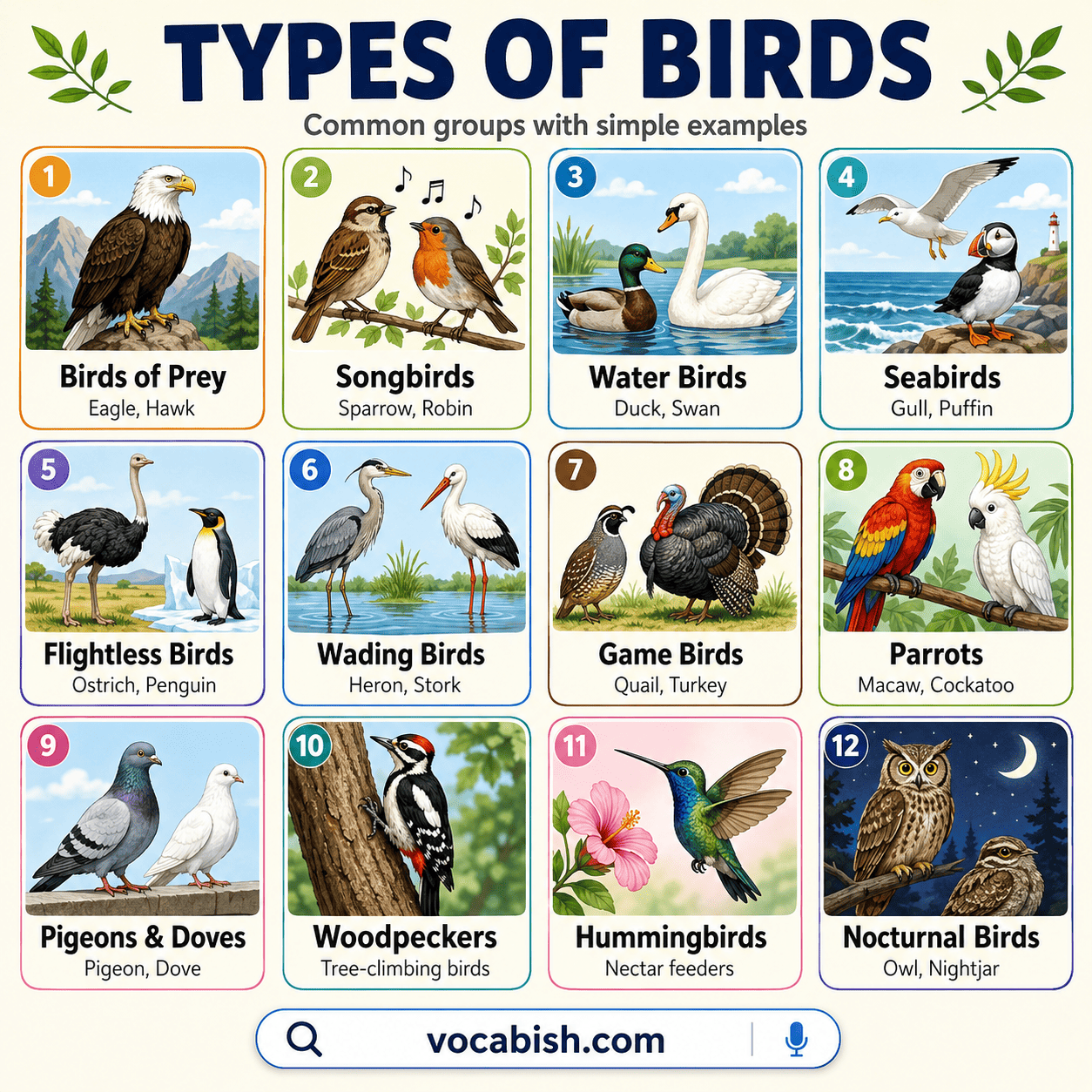

Birds come in many shapes, sizes, and colors. Some soar high above mountains, some swim beneath the sea, and others spend most of their lives walking on the ground. The main types of birds include birds of prey, songbirds, water birds, seabirds, flightless birds, wading birds, game birds, parrots, pigeons, woodpeckers, hummingbirds, and nocturnal birds.
We can also group birds by where they live, what they eat, and how they move. A penguin, for example, is both a flightless bird and a swimming bird. This means that one bird can belong to more than one group.
What Are Birds?
Birds are warm-blooded animals with feathers, wings, beaks, and two legs. They are vertebrates, which means they have backbones. All birds lay eggs, but not all of them can fly.
Most birds use their wings for flight. However, penguins use their wings like flippers in the water, while ostriches depend on their powerful legs for running.
Common Characteristics of Birds
Although bird species can look very different, they share several basic features:
- Their bodies are covered with feathers.
- They have beaks instead of teeth.
- They have two wings and two legs.
- They lay eggs.
- They are warm-blooded.
- They have backbones.
- Many birds have lightweight bones that support flight.
Feathers are the feature that truly separates birds from other living animals. They help birds fly, stay warm, attract mates, and protect their skin.
How Are Different Types of Birds Classified?
Birds can be classified in several ways. Scientists group them by their biological relationships, body structures, and evolutionary history. Learners often use simpler categories based on visible features and behavior.
Common ways to classify birds include:
- Habitat: forests, wetlands, deserts, mountains, grasslands, or cities
- Diet: seeds, fruit, insects, fish, nectar, or meat
- Body structure: beak shape, feet, wings, legs, and body size
- Flying ability: flying, flightless, swimming, or diving
- Behavior: hunting, singing, migrating, or feeding at night
- Scientific order: a formal group used by bird experts
These categories often overlap. A heron can be described as a water bird, a wading bird, and a fish-eating bird at the same time.
Major Types of Birds with Examples
The following bird groups are easy to recognize because they share common features, habitats, or behaviors.
1. Birds of Prey
Birds of prey are strong birds that hunt animals or feed on animal remains. They usually have excellent eyesight, hooked beaks, and powerful feet with sharp claws called talons.
Eagles and hawks often catch mammals, reptiles, fish, or other birds. Falcons are fast hunters that can catch prey in the air. Owls usually hunt at night and depend on sharp hearing as well as vision.
Vultures are also commonly placed in this group, although they usually feed on carrion rather than killing healthy prey.
Examples: Eagles, hawks, falcons, vultures, and owls.
2. Songbirds
Songbirds are usually small or medium-sized birds known for their calls and songs. They belong mainly to the order Passeriformes, which contains more species than any other bird order.
Not every songbird produces a musical song. Some make whistles, clicks, chirps, or simple calls. Birds use these sounds to attract mates, protect territory, warn others, and communicate with their young.
Many songbirds have feet that help them grip branches securely.
Examples: Robins, sparrows, finches, blackbirds, and nightingales.
3. Water Birds
Water birds live in or around lakes, rivers, ponds, marshes, and wetlands. Many have features that help them swim, float, dive, or find food in water.
Ducks, geese, and swans have webbed feet that push against the water. Their feathers also contain natural oils that help keep them from becoming completely soaked.
Not all water birds swim. Some remain near the water’s edge and search for food in mud or shallow areas.
Examples: Ducks, geese, swans, pelicans, and flamingos.
4. Seabirds
Seabirds spend much of their lives near oceans, islands, and coastlines. Many are powerful long-distance fliers and can travel far from land while searching for food.
Albatrosses use their long wings to glide over the ocean with little effort. Puffins dive underwater to catch fish, while gulls have flexible diets and often live near coastal towns.
Seabirds usually return to land to rest, nest, and raise their young.
Examples: Gulls, albatrosses, puffins, petrels, and terns.
5. Flightless Birds
Flightless birds have wings but cannot fly. Over time, their bodies adapted to other forms of movement, such as running or swimming.
Ostriches and emus have strong legs that allow them to run quickly. Penguins have dense bodies and wing-like flippers that make them excellent swimmers. Kiwis have very small wings and spend most of their time on the ground.
Most flightless birds live in places where running, swimming, hiding, or having a large body became more useful than flight.
Examples: Ostriches, emus, cassowaries, kiwis, and penguins.
6. Wading Birds
Wading birds walk through shallow water while searching for food. They often have long legs, long toes, and narrow beaks.
Their long legs keep most of their bodies above the water. Herons and egrets may stand still before quickly striking at a fish. Ibises use curved beaks to search through wet mud, while storks catch a variety of small animals.
Not every long-legged water bird is closely related, but they share similar feeding habits.
Examples: Herons, storks, cranes, ibises, and egrets.
7. Game Birds
Game birds are mostly ground-living birds with rounded bodies, short beaks, and strong legs. Many can fly, but they usually move by walking or running.
The term “game bird” is based partly on human use because some of these species have traditionally been hunted or raised for food. However, they are also important wild birds with their own natural behaviors and habitats.
Quails and partridges often hide in grass, while turkeys and pheasants search the ground for seeds, insects, and plant material.
Examples: Pheasants, quails, turkeys, grouse, and partridges.
8. Parrots and Similar Birds
Parrots are intelligent birds with strong, curved beaks and gripping feet. Many species have bright feathers, although some are mainly green, grey, white, or black.
They use their beaks to crack seeds, open fruit, climb branches, and explore objects. Their feet can hold food almost like hands.
Some parrots can copy human speech, but imitation is only one part of their natural ability. In the wild, they use complex calls to communicate with their flock.
Examples: Parrots, macaws, cockatoos, parakeets, and lovebirds.
9. Pigeons and Doves
Pigeons and doves belong to the same bird family. The names are often based on size or common usage rather than a strict scientific difference.
These birds usually have compact bodies, small heads, short beaks, and strong flight muscles. They eat seeds, fruit, and other plant material.
Pigeons are highly adaptable and can live in cities, farmland, rocky areas, and forests. Many doves are known for their soft calls and gentle appearance.
Examples: Rock pigeons, mourning doves, wood pigeons, and fruit doves.
10. Woodpeckers
Woodpeckers are tree-climbing birds with strong beaks. They tap or drill into bark to find insects, create nesting holes, or communicate.
Their feet help them grip tree trunks, and their stiff tail feathers provide extra support while they climb. Their bodies also have special adaptations that help them handle repeated pecking.
Not all woodpeckers spend the entire day drilling wood. Some also eat fruit, seeds, sap, and insects found on the ground.
Examples: Great spotted woodpeckers, pileated woodpeckers, and green woodpeckers.
11. Hummingbirds
Hummingbirds are tiny birds famous for their rapid wingbeats and hovering flight. They can remain almost still in the air while feeding from a flower.
Their long beaks and tongues help them reach nectar. However, nectar is not their only food. They also eat small insects and spiders for protein.
As hummingbirds move between flowers, they carry pollen and support plant reproduction. This makes them important pollinators in many habitats.
12. Nocturnal Birds
Nocturnal birds are active mainly at night. They often have special features that help them find food in darkness.
Owls have sensitive hearing, large eyes, and feathers that support quiet flight. Nightjars have wide mouths that help them catch insects in the air. Frogmouths use excellent camouflage and often remain still on branches during the day.
Some kiwi species are also most active after dark, using smell and touch to search for food on the forest floor.
Examples: Owls, nightjars, frogmouths, and kiwis.
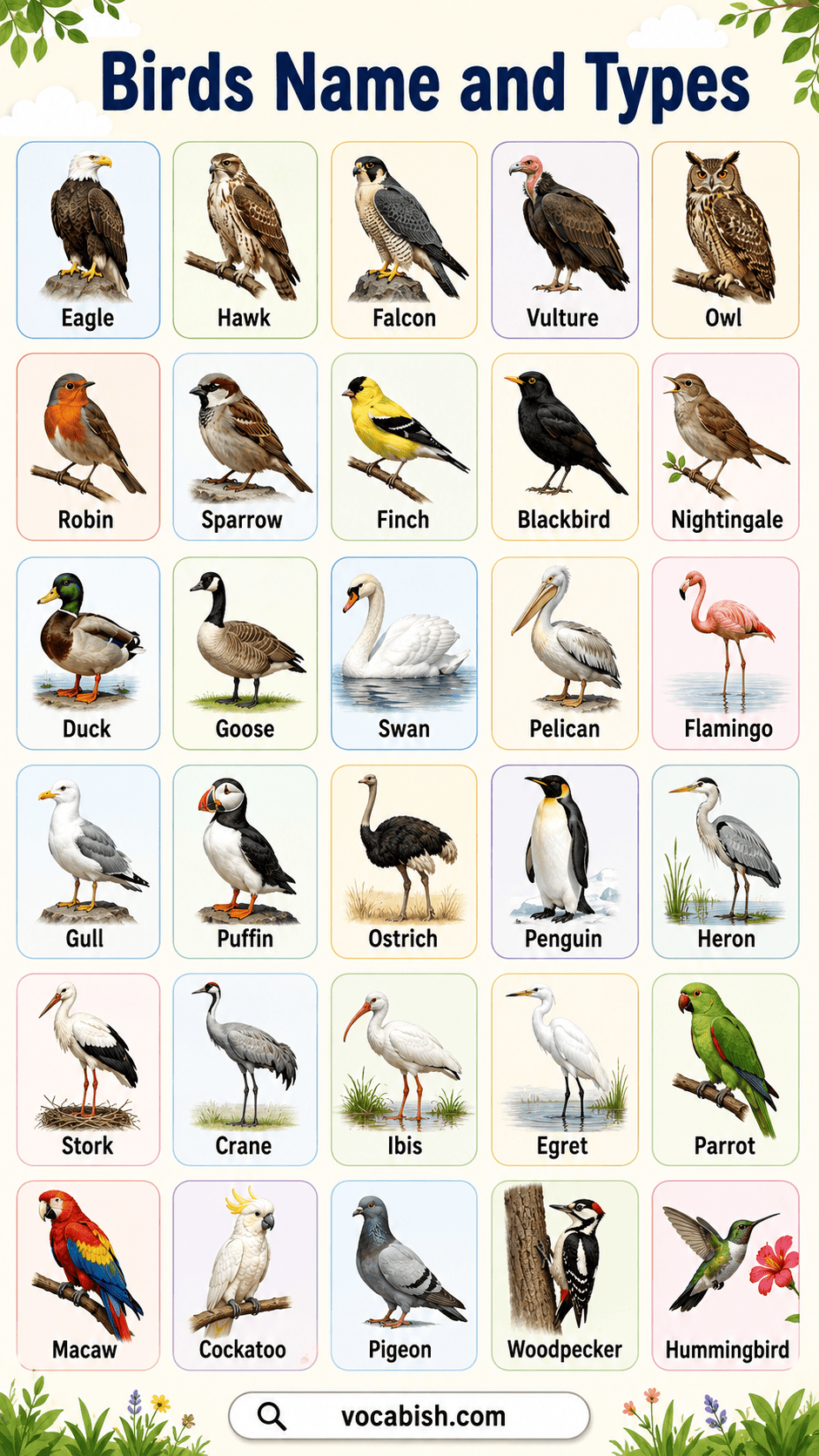
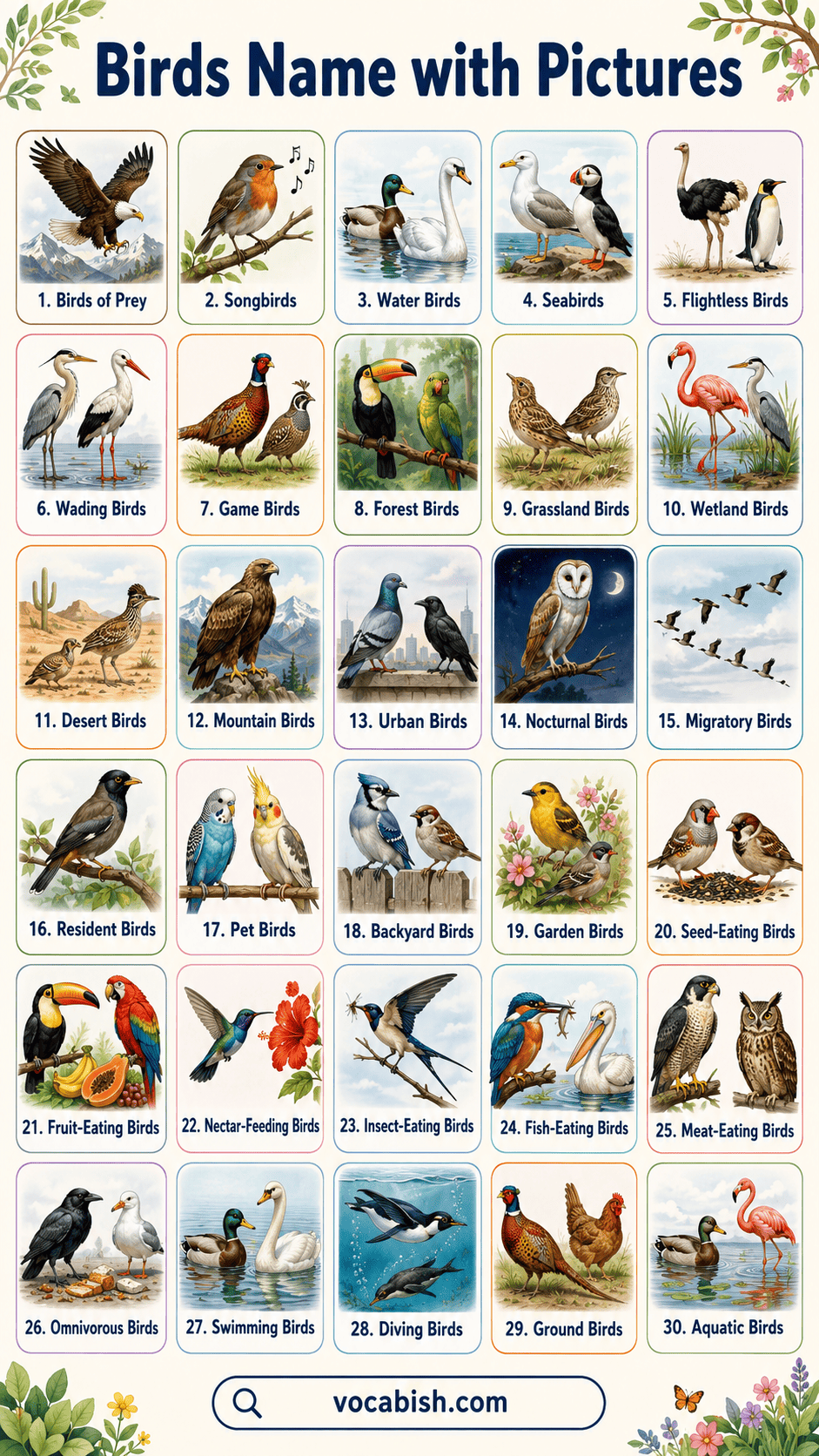
List of All Birds Name in English
Birds of Prey | Songbirds | Water Birds |
Seabirds | Flightless Birds | Wading Birds |
Game Birds | Forest Birds | Grassland Birds |
Wetland Birds | Desert Birds | Mountain Birds |
Urban Birds | Nocturnal Birds | Migratory Birds |
Resident Birds | Pet Birds | Backyard Birds |
Garden Birds | Seed-Eating Birds | Fruit-Eating Birds |
Nectar-Feeding Birds | Insect-Eating Birds | Fish-Eating Birds |
Meat-Eating Birds | Omnivorous Birds | Swimming Birds |
Diving Birds | Ground Birds | Aquatic Birds |
Eagles | Hawks | Falcons |
Vultures | Owls | Robins |
Sparrows | Finches | Blackbirds |
Nightingales | Ducks | Geese |
Swans | Pelicans | Flamingos |
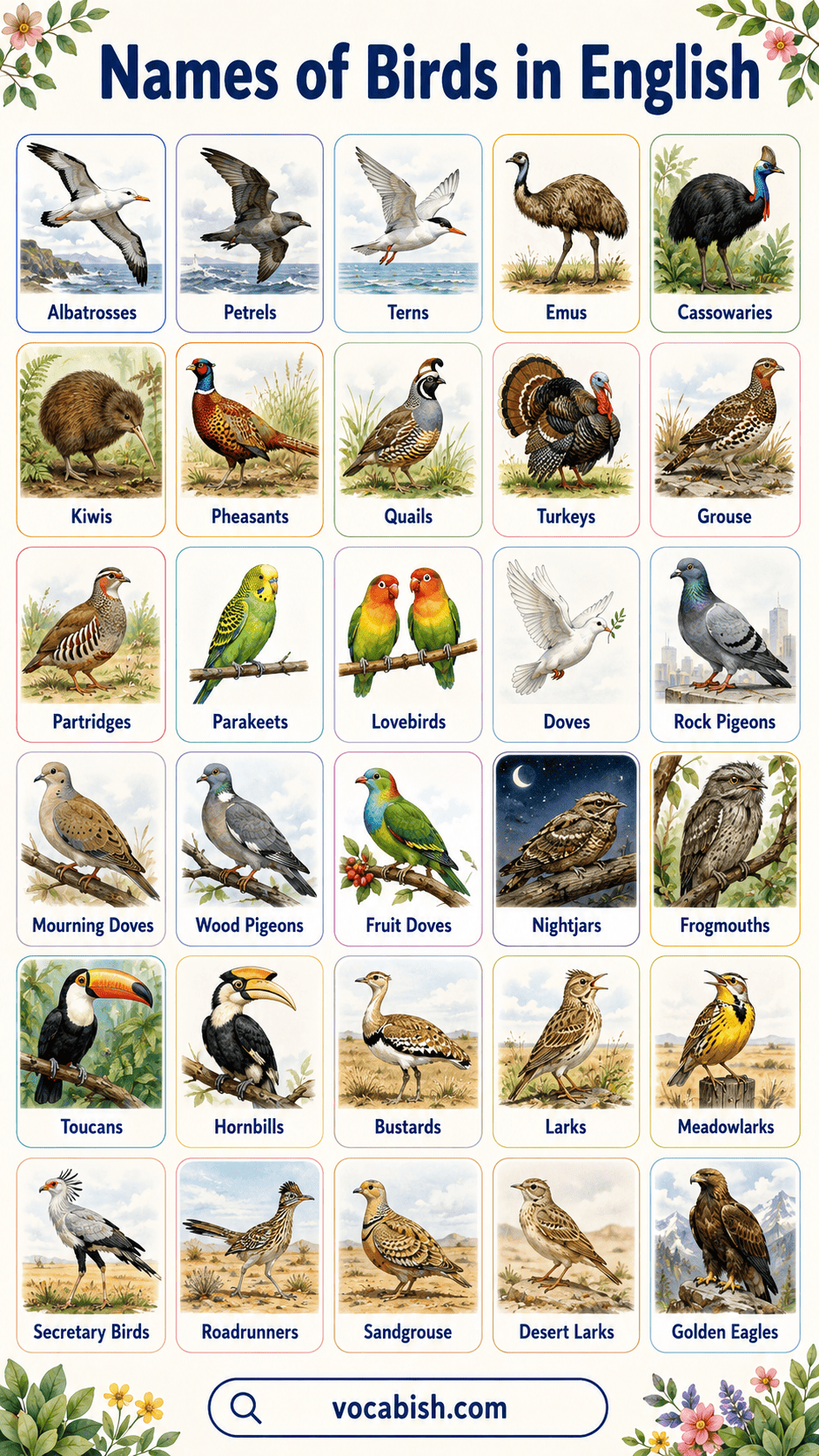
Gulls | Albatrosses | Puffins |
Petrels | Terns | Ostriches |
Emus | Cassowaries | Kiwis |
Penguins | Herons | Storks |
Cranes | Ibises | Egrets |
Pheasants | Quails | Turkeys |
Grouse | Partridges | Parrots |
Macaws | Cockatoos | Parakeets |
Lovebirds | Pigeons | Doves |
Rock Pigeons | Mourning Doves | Wood Pigeons |
Fruit Doves | Woodpeckers | Hummingbirds |
Nightjars | Frogmouths | Toucans |
Hornbills | Bustards | Larks |
Meadowlarks | Secretary Birds | Roadrunners |
Sandgrouse | Desert Larks | Golden Eagles |
Condors | Snowcocks | Alpine Choughs |
Starlings | Canaries | Sunbirds |
Honeyeaters | Swallows | Flycatchers |
Warblers | Kingfishers | Ospreys |
Cormorants | Ravens | Chickens |
Loons | Grebes | Budgerigars |
Cockatiels | Blue Jays | Great Spotted Woodpeckers |
Pileated Woodpeckers | Green Woodpeckers | Arctic Terns |
Types of Birds by Habitat
A bird’s habitat provides food, shelter, nesting places, and protection. Different bird species have developed features that help them survive in particular environments.
Forest Birds
Forest birds live among trees, shrubs, and thick plant growth. Some stay high in the canopy, while others search for food on trunks or on the forest floor.
Parrots use strong feet and beaks to climb branches. Woodpeckers search inside tree bark, and toucans use their large beaks to reach fruit. Owls may rest in tree holes, while hornbills nest inside natural cavities.
Examples: Parrots, woodpeckers, toucans, owls, and hornbills.
Grassland Birds
Grassland birds live in open areas covered mainly with grass. Because there are fewer trees, many nest on the ground or hide among tall plants.
Ostriches use speed to escape danger. Larks and meadowlarks rely on camouflage and open-air flight. Secretary birds walk through grasslands while hunting insects, reptiles, and other small animals.
Examples: Ostriches, bustards, larks, meadowlarks, and secretary birds.
Wetland Birds
Wetlands include marshes, swamps, ponds, river edges, and shallow lakes. These areas provide fish, insects, plants, frogs, and many other food sources.
Ducks swim across open water, herons wait in shallow areas, and flamingos filter small organisms from the water. Swans feed on aquatic plants, while storks search for small animals.
Examples: Ducks, herons, flamingos, swans, and storks.
Desert Birds
Desert birds must survive high temperatures, limited water, and little plant cover. Many avoid the hottest part of the day or travel long distances to find water.
Sandgrouse can fly to distant water sources. Roadrunners spend much of their time on the ground and eat insects, reptiles, and other small animals. Desert larks often have pale feathers that match the sandy environment.
Examples: Roadrunners, sandgrouse, desert larks, and some vultures.
Mountain Birds
Mountain birds live on rocky slopes, cliffs, high valleys, and alpine grasslands. They must cope with strong winds, cold weather, and lower oxygen levels.
Golden eagles use rising air to soar above mountain landscapes. Condors glide across large areas while searching for carrion. Snowcocks and alpine choughs are well adapted to cold, rocky environments.
Examples: Golden eagles, condors, snowcocks, and alpine choughs.
Urban Birds
Urban birds live near people in towns and cities. They find food and nesting places in parks, gardens, bridges, rooftops, and buildings.
Pigeons nest on structures that resemble natural cliffs. Sparrows feed around houses and outdoor spaces. Crows are intelligent and can use many different food sources, while gulls often move between cities and coastal areas.
Examples: Pigeons, sparrows, crows, starlings, and gulls.
Some birds can live in several habitats. A crow, for example, may be found in forests, farms, parks, and city centers.
Bird Types Based on Food Habits
A bird’s diet is often connected to the shape of its beak. Thick beaks can crack seeds, hooked beaks can tear meat, and long narrow beaks can reach nectar or catch food in water.
Seed-Eating Birds
Seed-eating birds often have short, strong beaks that help them break hard shells. Many also eat grains, buds, and small pieces of plant material.
Examples: Finches, sparrows, pigeons, and canaries.
Fruit-Eating Birds
Fruit-eating birds help plants by carrying and spreading seeds. Some swallow small fruits whole, while others tear pieces from larger fruit.
Toucans use their long beaks to reach fruit on branches. Hornbills, fruit doves, and many parrots also depend heavily on fruit.
Examples: Toucans, hornbills, fruit doves, and some parrots.
Nectar-Feeding Birds
Nectar-feeding birds drink the sweet liquid found inside flowers. Their beaks and tongues are shaped to reach deep floral tubes.
These birds often support pollination as they move from flower to flower.
Examples: Hummingbirds, sunbirds, and honeyeaters.
Insect-Eating Birds
Insect-eating birds help control insect populations. Different species catch insects in different ways.
Swallows catch flying insects in the air. Flycatchers wait on branches before making a quick flight. Woodpeckers search inside bark, while warblers look among leaves and small branches.
Examples: Swallows, flycatchers, woodpeckers, and warblers.
Fish-Eating Birds
Fish-eating birds often live close to rivers, lakes, wetlands, or seas. Their bodies are adapted for catching fish from the air, water surface, or underwater.
Kingfishers dive from branches. Pelicans scoop fish with their large bills. Ospreys catch fish with their feet, while cormorants chase them underwater.
Examples: Kingfishers, pelicans, ospreys, and cormorants.
Meat-Eating Birds
Meat-eating birds feed on mammals, reptiles, fish, insects, or other birds. Many have hooked beaks and strong talons.
Some hunt living prey, while others may also eat carrion when it is available.
Examples: Eagles, hawks, falcons, and owls.
Omnivorous Birds
Omnivorous birds eat both plant and animal matter. Their flexible diets allow them to survive in changing environments.
Crows may eat fruit, seeds, insects, eggs, or leftover food. Gulls also feed on fish, small animals, and many other available foods.
Examples: Crows, ravens, gulls, and chickens.
Types of Birds Based on Movement and Behavior
Birds can also be grouped by how they travel, find food, and respond to seasonal changes.
Flying Birds
Most bird species can fly. Flight helps them escape predators, search for food, migrate, and reach safe nesting places.
Wing shape affects how a bird flies. Falcons have pointed wings for speed, while eagles have broad wings for soaring. Swallows have narrow wings that support quick turns in the air.
Flightless Birds
Flightless birds cannot lift their bodies into the air, even though they have wings.
Instead, they have developed other strengths. Ostriches run, penguins swim, and kiwis move through thick forest vegetation. Emus and cassowaries also rely on powerful legs.
Migratory Birds
Migratory birds travel between different regions during the year. They may migrate to find food, reach breeding grounds, or avoid difficult weather.
Some journeys cover short distances, while others cross continents and oceans. Birds may navigate by using the sun, stars, landmarks, Earth’s magnetic field, and learned routes.
Examples: Arctic terns, swallows, geese, and cranes.
Resident Birds
Resident birds remain in the same general area throughout the year. They do not make regular long-distance seasonal journeys.
However, they may still move locally to find food, water, shelter, or safer weather conditions. Whether a species is resident can also depend on the region. A bird may migrate in one part of its range but remain year-round in another.
Swimming and Diving Birds
Swimming birds move across the water’s surface, while diving birds go underwater to catch food.
Ducks paddle with webbed feet. Penguins use their wings as flippers. Loons, grebes, and cormorants have bodies that help them move efficiently underwater.
Examples: Penguins, ducks, loons, grebes, and cormorants.
Common Types of Pet Birds
Pet birds differ greatly in size, personality, noise level, intelligence, and care needs. A small bird is not automatically an easy pet, and every species needs proper food, space, social contact, and veterinary care.
Common pet bird types include:
- Budgerigars: Small, active parrots that can learn sounds and enjoy social interaction
- Cockatiels: Gentle birds known for their crests, whistles, and expressive behavior
- Canaries: Popular for their singing, especially among males
- Finches: Small, active birds that often do well with companions of their own kind
- Lovebirds: Energetic parrots that need attention, enrichment, and safe space
- Parrots: Intelligent, social birds with complex emotional and physical needs
- Cockatoos: Highly social parrots that can be loud and require experienced care
Before keeping any bird, consider its lifespan, cage size, diet, noise, social needs, daily exercise, and access to an avian veterinarian. Some parrots can live for several decades, so owning one can be a long-term responsibility.
Wild birds should not be taken from nature and kept as pets. Local laws may also control which bird species people can legally own.
Common Backyard and Garden Birds
Backyards, gardens, balconies, parks, and feeders can attract many bird species. The birds you see will depend on your country, climate, season, and local habitat.
Common garden and backyard birds may include:
- Sparrows
- Robins
- Pigeons
- Doves
- Crows
- Blackbirds
- Finches
- Starlings
- Blue jays
- Hummingbirds
You can learn a great deal by watching how these birds move and feed. Sparrows often search on the ground, finches may gather around seeds, and hummingbirds visit nectar-rich flowers.
When feeding wild birds, use suitable food and keep feeders clean. Dirty feeders can spread disease. Fresh water and bird-friendly plants can also help local species.
Difference Between Major Bird Groups
This table compares five well-known bird groups:
Bird Group | Main Feature | Common Habitat | Food | Examples |
|---|---|---|---|---|
Birds of prey | Sharp talons and hooked beaks | Forests, mountains, and open land | Meat or carrion | Eagles and hawks |
Water birds | Bodies adapted to aquatic environments | Lakes, rivers, and wetlands | Plants, fish, and insects | Ducks and swans |
Wading birds | Long legs for walking through shallow water | Marshes, riverbanks, and wetlands | Fish and small animals | Herons and storks |
Songbirds | Strong vocal communication and gripping feet | Forests, gardens, grasslands, and cities | Seeds, fruit, and insects | Robins and finches |
Flightless birds | Wings that do not support flight | Grasslands, forests, islands, and polar areas | Varies by species | Ostriches and penguins |
These groups are useful for learning, but they are not always completely separate. A bird may fit into several categories based on its habitat, diet, and behavior.
How to Identify Different Bird Names and Types
You do not need to be an expert to begin identifying birds. Start by observing a few clear features instead of trying to remember every species name.
- Look at its size and shape. Is it small and round, tall and thin, or large with broad wings?
- Notice its colors and markings. Look for stripes, spots, wing bars, eye rings, or patches of color.
- Study the beak. A thick beak may suggest seed-eating, while a hooked beak may belong to a bird of prey.
- Check the legs and feet. Webbed feet suggest swimming, while long legs may suit wading.
- Watch its movement. Does it hop, walk, climb, glide, hover, or dive?
- Listen to its sound. Calls and songs can be more useful than color.
- Notice the habitat. A bird beside the sea is likely to differ from one living deep in a forest.
- Observe its feeding behavior. Watch whether it searches flowers, catches insects, cracks seeds, or hunts from above.
Do not depend on color alone. Males and females may look different, and young birds may not have adult markings. Feather colors can also change with age or season.
Why Are There So Many Bird Names and Types?
There are many types of birds because species have adapted to different climates, habitats, foods, and ways of life.
Over many generations, birds developed body features that helped them survive in their environments. These adaptations explain why their beaks, feet, wings, and behaviors vary so widely.
For example:
- Webbed feet help ducks push through water.
- Sharp talons help eagles catch and hold prey.
- Long legs help herons walk through shallow water.
- Long beaks help hummingbirds reach nectar.
- Strong legs help ostriches run across open land.
- Narrow wings help swallows turn quickly while catching insects.
Different environments create different challenges. A bird living on a windy ocean coast needs different skills from one living in a dense tropical forest.
Importance of Birds in Nature
Birds do much more than fill the environment with color and sound. They perform jobs that help ecosystems remain healthy.
- They pollinate flowers. Hummingbirds and other nectar-feeding species carry pollen between plants.
- They spread seeds. Fruit-eating birds carry seeds to new places through their droppings.
- They control insects. Swallows, flycatchers, and many other birds eat large numbers of insects.
- They clean the environment. Vultures remove dead animals before decay and disease can spread.
- They support food chains. Birds can act as predators, prey, and competitors within ecosystems.
- They help scientists study environmental health. Changes in bird populations may show that a habitat is being damaged.
Birds also have cultural, educational, and economic value. People study them, photograph them, watch them in nature, and protect the habitats they need.
Quick Facts About Different Bird Species
- The ostrich is the largest living bird and cannot fly.
- Hummingbirds can hover while feeding from flowers.
- Penguins use their wings like flippers when swimming.
- Owls have strong low-light vision and highly sensitive hearing.
- Arctic terns make exceptionally long seasonal migrations.
- Woodpeckers use stiff tail feathers for support on tree trunks.
- Parrots can hold food with their feet.
- Albatrosses can glide over the sea for long distances.
- Flamingos feed by filtering small organisms from water.
- Crows can solve problems and learn from experience.
FAQs About Bird Names and Types
The main types of birds include birds of prey, songbirds, water birds, seabirds, flightless birds, wading birds, game birds, parrots, pigeons, woodpeckers, hummingbirds, and nocturnal birds. They can also be grouped by habitat, diet, movement, and behavior.
There are thousands of bird species living around the world. Scientists organize them into orders, families, genera, and species.
Some of the most familiar groups are songbirds, water birds, birds of prey, pigeons and doves, parrots, and game birds. Songbirds form an especially large and varied group and live in many different habitats.
Birds that cannot fly are called flightless birds. Examples include ostriches, penguins, emus, cassowaries, and kiwis.
Penguins are both water birds and flightless birds. They cannot fly through the air, but their bodies are highly adapted for swimming and diving. They use their wings as flippers underwater.
An eagle is a bird of prey, also known as a raptor. It has strong talons, sharp eyesight, broad wings, and a hooked beak that helps it tear food.
Water birds are broadly adapted to living in or around aquatic habitats. They may swim, float, dive, or feed near water. Wading birds usually have long legs that allow them to walk through shallow water without covering most of their bodies.
Common pet birds include budgies, cockatiels, canaries, finches, lovebirds, parrots, and cockatoos.
Conclusion
Birds can be grouped by their body features, habitats, diets, movement, and behavior. Common bird categories include birds of prey, songbirds, water birds, seabirds, wading birds, parrots, and flightless birds.
These groups often overlap. A penguin is both aquatic and flightless, while a heron can be a water bird, a wading bird, and a fish-eating bird.
The easiest way to learn different types of birds is to observe their beaks, feet, wings, sounds, food, and surroundings. The next time you see a bird, look closely at how it moves and where it lives. Those small details can help you understand exactly what kind of bird it may be.
Explore More Related Resources