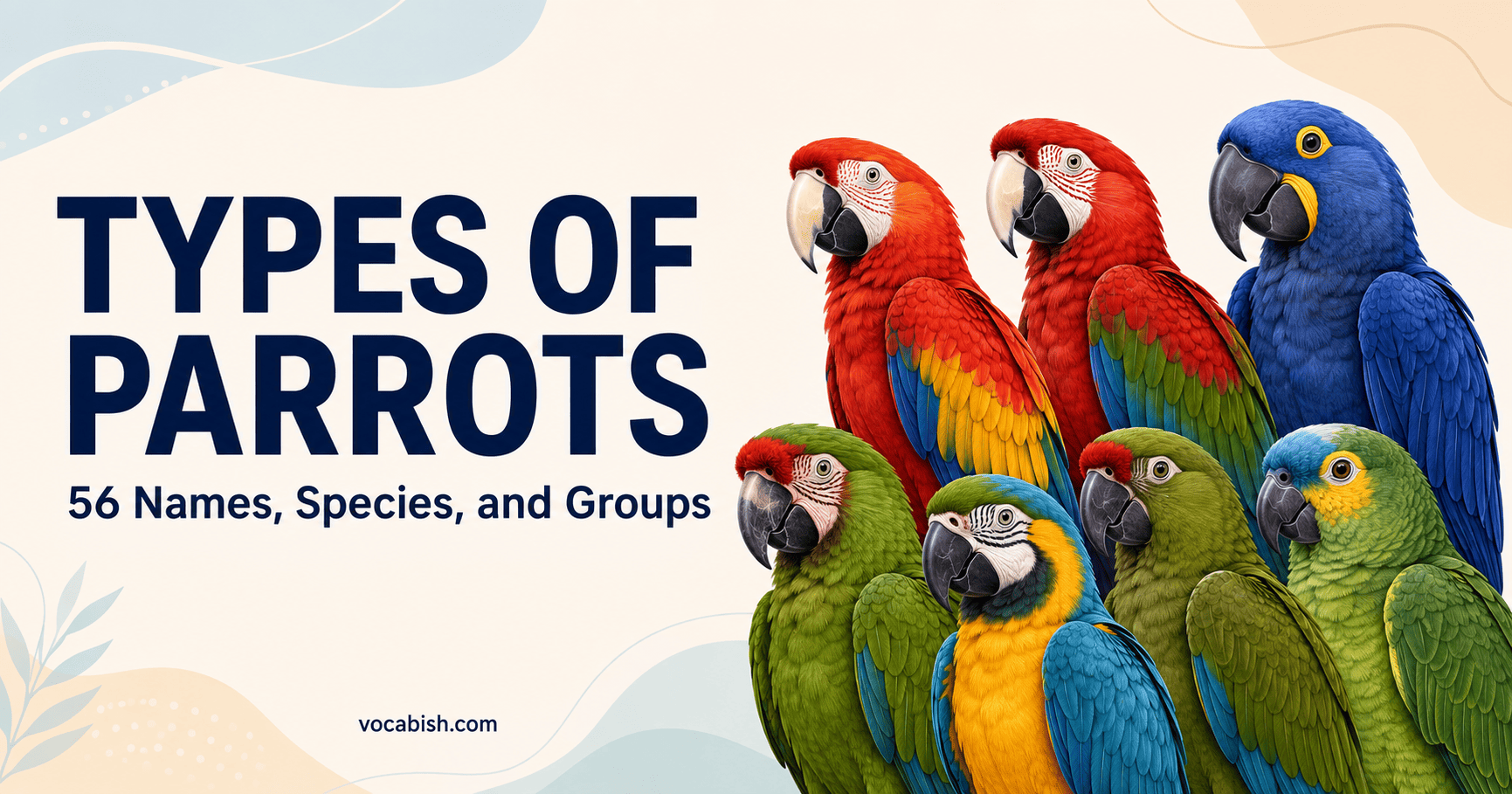

Parrots are a diverse group of birds that includes more than 400 living species. Familiar types of parrots include macaws, cockatoos, Amazons, conures, lovebirds, lorikeets, parakeets, and African parrots. Some names identify scientific groups, while others are practical or informal labels based on appearance, size, or geographical origin.
In this blog post, you will explore 56 representative parrot species organised into clear groups. You will also learn how these birds differ, how to identify major categories, and why parrot totals and common names sometimes vary between sources.
What Are Parrots?
Parrots are birds belonging to the scientific order Psittaciformes. Most have strong hooked bills, upright bodies, and zygodactyl feet, meaning two toes point forwards and two point backwards. These feet help parrots climb, hold food, and manipulate objects.
In this context, “types” refers mainly to individual species arranged within familiar groups, including macaws, cockatoos, Amazons, and lorikeets. These group names do not always represent the same scientific rank.
For scientific consistency, this article follows the AviList classification, which recognises 406 living parrot species in 94 genera and four families. Different checklists may show slightly different totals because taxonomists do not always accept species splits, combinations and name changes simultaneously.
The four recognised parrot families are:
- Strigopidae: New Zealand parrots
- Cacatuidae: Cockatoos and cockatiels
- Psittacidae: African and New World parrots
- Psittaculidae: Old World and Australasian parrots
This article covers 56 representative living species rather than every recognised species. Extinct parrots, captive hybrids, subspecies, and domestically developed colour mutations are not included.
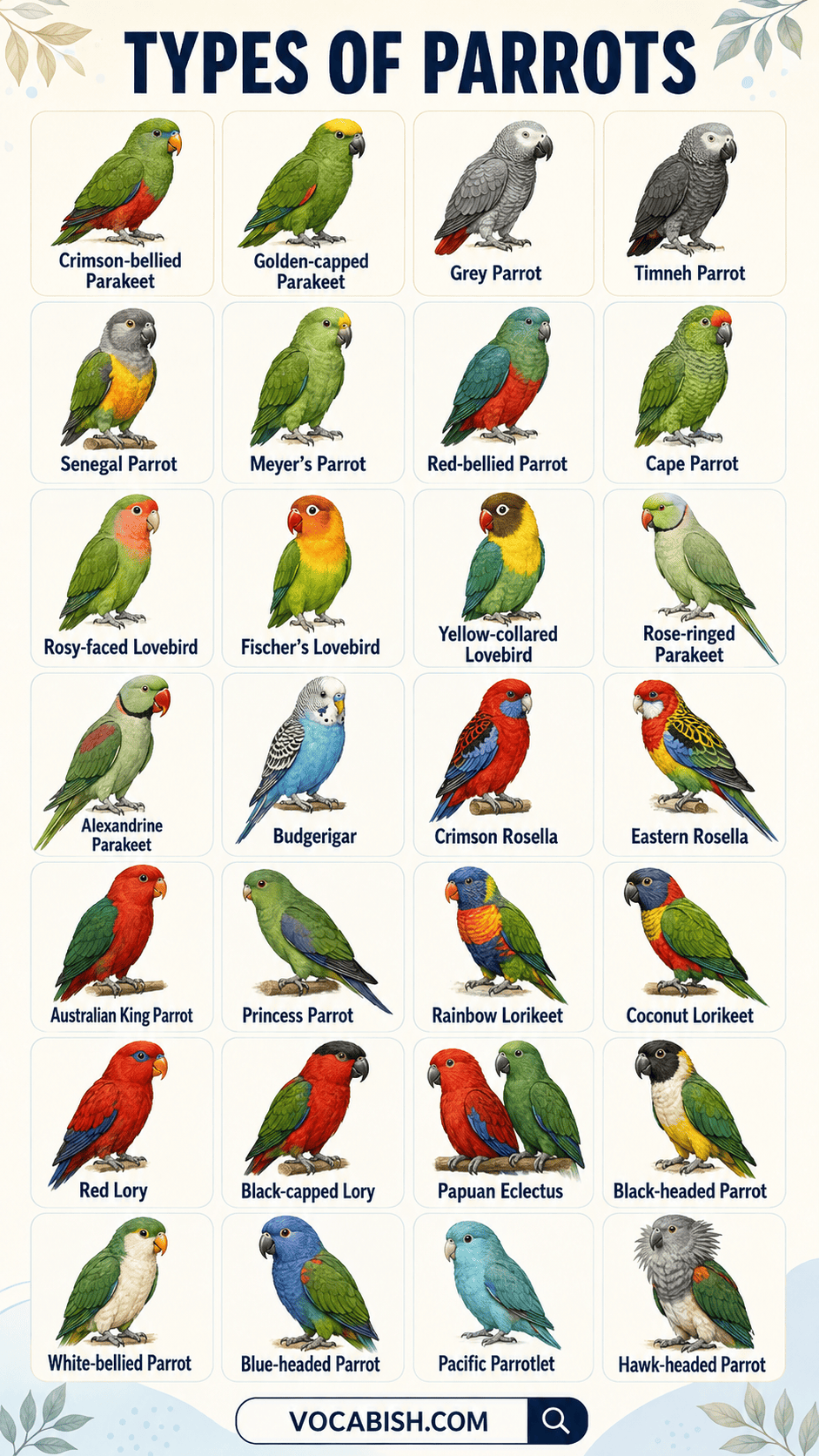
Complete List of 56 Types of Parrots
Kakapo | Kea | North Island Kaka |
South Island Kaka | Sulphur-crested Cockatoo | Galah |
Palm Cockatoo | Pink Cockatoo | Gang-gang Cockatoo |
Cockatiel | Blue-and-yellow Macaw | Scarlet Macaw |
Red-and-green Macaw | Hyacinth Macaw | Great Green Macaw |
Blue-throated Macaw | Military Macaw | Blue-fronted Amazon |
Yellow-naped Amazon | Orange-winged Amazon | Red-lored Amazon |
Lilac-crowned Amazon | Puerto Rican Amazon | Sun Parakeet |
Green-cheeked Parakeet | Blue-crowned Parakeet | Monk Parakeet |
Nanday Parakeet | Crimson-bellied Parakeet | Golden-capped Parakeet |
Grey Parrot | Timneh Parrot | Senegal Parrot |
Meyer’s Parrot | Red-bellied Parrot | Cape Parrot |
Rosy-faced Lovebird | Fischer’s Lovebird | Yellow-collared Lovebird |
Rose-ringed Parakeet | Alexandrine Parakeet | Budgerigar |
Crimson Rosella | Eastern Rosella | Australian King Parrot |
Princess Parrot | Rainbow Lorikeet | Coconut Lorikeet |
Red Lory | Black-capped Lory | Papuan Eclectus |
Black-headed Parrot | White-bellied Parrot | Blue-headed Parrot |
Pacific Parrotlet | Hawk-headed Parrot |
Main Types of Parrots by Category
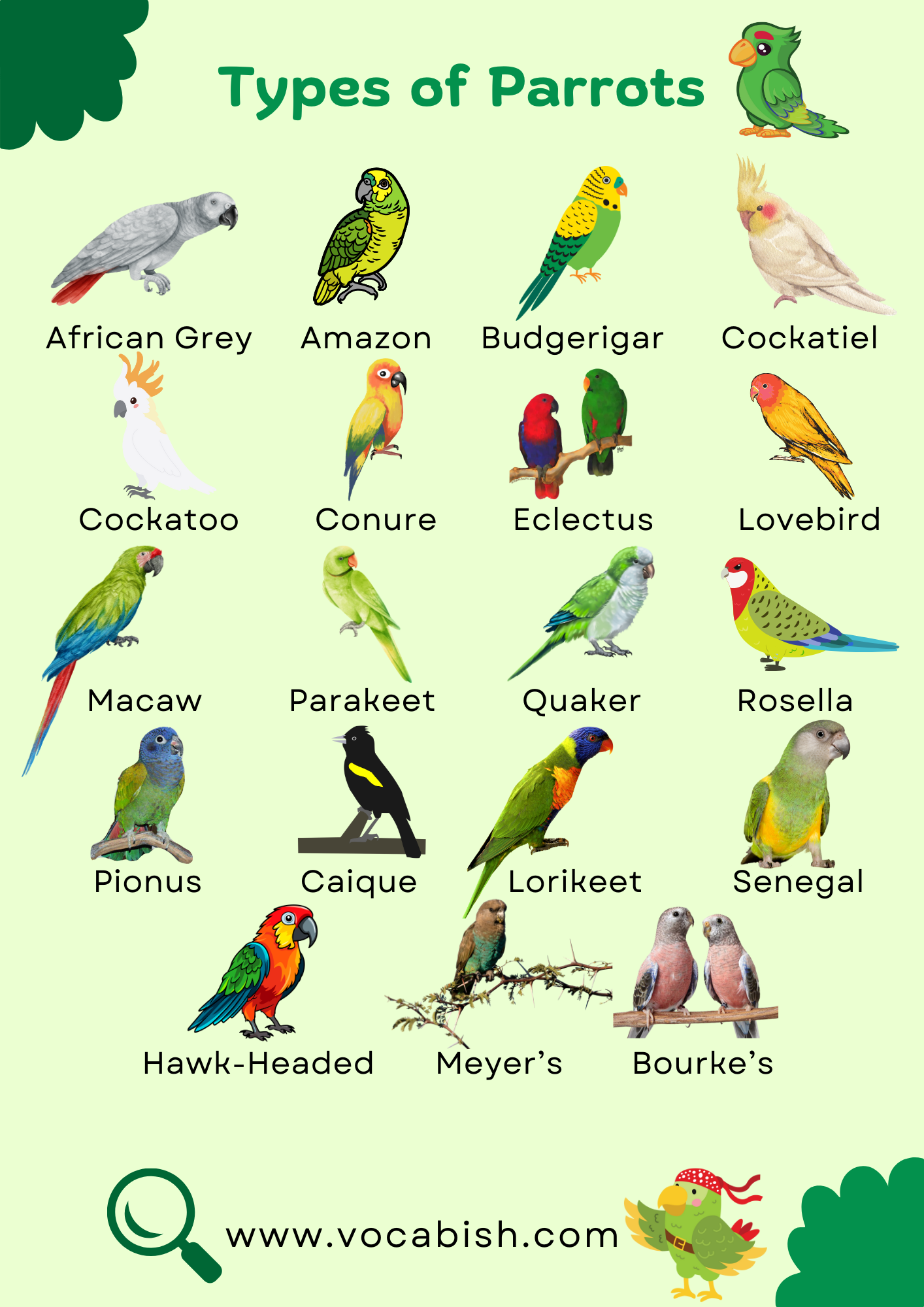
The following categories combine formal scientific families with familiar common-name groups. Categories such as macaw, conure and parakeet are useful for identification, but they do not all represent official taxonomic ranks.
New Zealand Parrots
New Zealand parrots form the family Strigopidae. The group contains four living species, including unusual flightless, alpine and forest-dwelling parrots.
- Kakapo: A nocturnal, flightless New Zealand parrot with soft moss-green camouflaged plumage.
- Kea: An alpine New Zealand parrot with olive plumage and orange underwings.
- North Island Kaka: A forest parrot with brown plumage, crimson underwings, and curved bill.
- South Island Kaka: A forest parrot showing brown plumage, reddish underparts, and strong bill.
Cockatoos and Cockatiels
Cockatoos belong to the family Cacatuidae. Most have movable head crests, robust bills and compact bodies. The smaller cockatiel belongs to this family despite its parakeet-like appearance.
- Sulphur-crested Cockatoo: A large white cockatoo displaying a vivid yellow erectile head crest.
- Galah: An Australian cockatoo recognised by pink underparts and contrasting grey wings.
- Palm Cockatoo: A dark cockatoo distinguished by massive bill and red facial patch.
- Pink Cockatoo: A pale cockatoo featuring pink underparts and a banded colourful crest.
- Gang-gang Cockatoo: A compact grey cockatoo whose adult male develops a red head.
- Cockatiel: A small Australian cockatoo with long tail, crest, and orange cheeks.
The Pink Cockatoo was traditionally called Major Mitchell’s Cockatoo. Both names may still appear in older books, regional references and aviculture.
Macaws
Macaws are New World parrots recognised for their substantial bills, long tails and often brightly coloured plumage. Most occur naturally in Central or South America.
- Blue-and-yellow Macaw: A large blue-backed macaw with golden underparts and green forehead.
- Scarlet Macaw: A brilliant red macaw displaying yellow and blue panels across wings.
- Red-and-green Macaw: A red macaw identified by green wing bands and blue feathers.
- Hyacinth Macaw: A huge cobalt-blue macaw with yellow skin beside eyes and bill.
- Great Green Macaw: A mostly green macaw with reddish forehead and blue lower back.
- Blue-throated Macaw: A Bolivian macaw marked by blue throat and rich golden underparts.
- Military Macaw: A green macaw featuring red forehead, blue wings, and powerful bill.
Amazon Parrots
Amazon parrots are stocky, mainly green birds belonging to the genus Amazona. Coloured forehead, crown, cheek, shoulder, and wing markings help distinguish individual species.
- Blue-fronted Amazon: A stocky green Amazon with a blue forehead and yellow facial markings.
- Yellow-naped Amazon: A green Amazon recognised by a yellow patch across its nape.
- Orange-winged Amazon: A green Amazon showing orange wings, blue crown, and yellow cheeks.
- Red-lored Amazon: A green Amazon with a red forehead, yellow cheeks, and a blue crown.
- Lilac-crowned Amazon: A Mexican Amazon distinguished by a lilac crown and maroon forehead.
- Puerto Rican Amazon: A rare Caribbean Amazon with green plumage and red forehead.
Conures and Neotropical Parakeets
“Conure” is an informal avicultural name applied to several genera of small and medium-sized parrots from the Americas. Scientific checklists often use “parakeet” for the same birds.
- Sun Parakeet: A bright orange-yellow parakeet with green-blue wings and a black bill.
- Green-cheeked Parakeet: A small parakeet with a maroon tail and distinctly scalloped breast feathers.
- Blue-crowned Parakeet: A mostly green parakeet recognised by its broad blue head.
- Monk Parakeet: A green parakeet building large communal stick nests around urban areas.
- Nanday Parakeet: A green parakeet with a black head, blue chest, and red thighs.
- Crimson-bellied Parakeet: A small green parakeet displaying a crimson belly and blue wing feathers.
- Golden-capped Parakeet: A colourful Brazilian parakeet with a golden crown and reddish-orange belly.
African Parrots and Lovebirds
This category includes Grey and Timneh parrots, members of the genus Poicephalus and lovebirds belonging to Agapornis. They occupy varied African forests, woodlands and savannas.
- Grey Parrot: A grey African forest parrot with red tail and pale face.
- Timneh Parrot: A darker West African parrot with maroon tail and pale bill.
- Senegal Parrot: A compact African parrot with grey head and yellow-orange belly.
- Meyer’s Parrot: A dusky African parrot with yellow shoulders and blue-green underparts.
- Red-bellied Parrot: A grey-headed African parrot whose adult male shows orange underparts.
- Cape Parrot: A large southern African parrot with massive bill and olive-gold head.
- Rosy-faced Lovebird: A small African lovebird with green body and rosy-pink face.
- Fischer’s Lovebird: A Tanzanian lovebird with orange face, yellow collar, and green body.
- Yellow-collared Lovebird: A Tanzanian lovebird recognised by black head and bright yellow collar.
Asian and Australasian Parakeets
This practical category includes Asian ring-necked species and several long-tailed Australian parrots. They belong to multiple genera within the family Psittaculidae.
- Rose-ringed Parakeet: A slender green parakeet whose males develop rose-and-black neck rings.
- Alexandrine Parakeet: A large green parakeet with maroon shoulder patch and heavy bill.
- Budgerigar: A small Australian grass parrot with barred head and long tail.
- Crimson Rosella: An Australian rosella with crimson body, blue cheeks, and wings.
- Eastern Rosella: A colourful Australian rosella with red head and scalloped yellow back.
- Australian King Parrot: A long-tailed forest parrot whose males show brilliant red underparts.
- Princess Parrot: A slender Australian desert parrot with pastel colouring and pink throat.
Lories and Lorikeets
Lories and lorikeets are closely related Australasian parrots. They possess specialised brush-tipped tongues that help them collect nectar and pollen from flowers.
- Rainbow Lorikeet: A nectar-feeding lorikeet with blue head, orange chest, and green wings.
- Coconut Lorikeet: A vividly coloured lorikeet with blue head and scarlet breast.
- Red Lory: A predominantly scarlet lory with blue wing and facial markings.
- Black-capped Lory: A red-bodied New Guinea lory with black crown and blue belly.
Other Distinctive Types of Parrots
These parrots belong to several separate evolutionary lineages. They include eclectus parrots, caiques, pionus parrots, parrotlets and the unusual Hawk-headed Parrot.
- Papuan Eclectus: A strongly dimorphic parrot; males appear green while females appear red-blue.
- Black-headed Parrot: A stocky caique with black crown, orange neck, and white belly.
- White-bellied Parrot: A stocky caique with orange-yellow head, green wings, and white belly.
- Blue-headed Parrot: A medium green parrot with cobalt-blue head and red undertail feathers.
- Pacific Parrotlet: A tiny green parrotlet whose males usually show blue wing markings.
- Hawk-headed Parrot: A South American parrot with an expandable red-and-blue neck feather fan.
The former broadly defined Eclectus Parrot has been divided into multiple recognised species. This article includes Papuan Eclectus as one representative of that group.
Major Parrot Groups Compared
Group | Classification | Key Feature | Main Difference |
|---|---|---|---|
Parrot | Broad common term | Hooked bill and grasping feet | Includes every bird in Psittaciformes |
Cockatoo | Scientific family | Usually has a movable crest | Forms the separate family Cacatuidae |
Macaw | Common-name group | Long tail and exposed facial skin | Generally larger than most conures |
Amazon | Scientific genus | Stocky body and mainly green plumage | Belongs principally to Amazona |
Conure | Informal common term | Small or medium long-tailed body | Includes species from several genera |
Parakeet | Informal descriptive term | Usually slender with long tail | Does not identify one scientific lineage |
Lovebird | Scientific genus | Compact body and short tail | Belongs to the African genus Agapornis |
Lory or lorikeet | Related parrot group | Brush-tipped nectar-feeding tongue | Names do not define separate families |
Parrotlet | Informal size-based name | Very small body and short tail | Applied to several small parrot genera |
How to Identify Different Types of Parrots
- Compare body size: Parrotlets are tiny, while many macaws are considerably larger.
- Examine the tail: Macaws and parakeets generally have long, tapered tails.
- Look for a crest: A movable crest strongly suggests a cockatoo.
- Study head markings: Crowns, cheek patches, collars and forehead colours separate species.
- Check the bill: Large macaws and cockatoos usually possess especially substantial bills.
- Consider location: Native range helps distinguish similar green or red parrots.
Colour should not be used alone. A parrot’s age, sex, subspecies, lighting conditions and captive colour mutation can all affect its appearance.
Common Confusions and Terms About Types of Parrots
- Parakeets are parrots: Parakeet is an informal term for certain slender, long-tailed parrots.
- Cockatiels are cockatoos: Their crests and anatomy place them within Cacatuidae.
- Conure is not a scientific rank: The name covers several Neotropical parrot genera.
- Grey and Timneh are separate species: “African grey” is sometimes used for both.
- Indian ringneck is not a separate broad group: It usually refers to a Rose-ringed Parakeet form.
- Colour mutations are not species: Blue, lutino, pied and cinnamon birds remain their original species.
Summary of the Main Parrot Categories
Category | Key Characteristic | Common Examples | Principal Native Region |
|---|---|---|---|
New Zealand parrots | Ancient lineage with unusual adaptations | Kakapo, Kea, Kaka | New Zealand |
Cockatoos | Movable crests and robust bodies | Galah, Cockatiel, Palm Cockatoo | Australasia |
Macaws | Long tails and powerful bills | Scarlet, Hyacinth, Blue-and-yellow | Central and South America |
Amazons | Stocky, mainly green bodies | Blue-fronted, Yellow-naped | Americas and Caribbean |
Conures | Long-tailed Neotropical parrots | Sun, Nanday, Green-cheeked | Central and South America |
African parrots | Diverse forest and woodland birds | Grey, Senegal, Cape | Sub-Saharan Africa |
Lovebirds | Small, compact Agapornis parrots | Fischer’s, Rosy-faced | Africa |
Asian parakeets | Slender bodies and pointed tails | Rose-ringed, Alexandrine | Southern Asia |
Australian parrots | Grassland, woodland and forest species | Budgerigar, Rosellas | Australia |
Lories and lorikeets | Specialised nectar-feeding tongues | Rainbow Lorikeet, Red Lory | Australasia and Pacific islands |
Other New World parrots | Several smaller evolutionary lineages | Caiques, parrotlets, pionus | Central and South America |
FAQs About Types of Parrots
There are 406 currently recognised living parrot species under the AviList classification. Other sources may give slightly different totals because scientific authorities sometimes accept species splits, combinations, and revised names at different times.
The main familiar groups include cockatoos, macaws, Amazons, conures, parakeets, lovebirds, lorikeets, African parrots, and New Zealand parrots. However, these names represent a mixture of families, genera and informal categories.
The four families are Strigopidae, Cacatuidae, Psittacidae and Psittaculidae. They contain New Zealand parrots, cockatoos, African and New World parrots, and the diverse Old World and Australasian parrots.
A parakeet is a type of parrot. The term usually describes a relatively small or medium bird with a slender body and long tail, rather than one formally recognised scientific family.
Yes, cockatoos are parrots belonging to the order Psittaciformes. They form the separate family Cacatuidae, whose members commonly possess movable crests, strong bills, and powder-producing feathers.
The Hyacinth Macaw is generally regarded as the longest-living parrot, reaching approximately one metre in length. The flightless Kakapo is often identified as the heaviest living parrot.
The Buff-faced Pygmy Parrot is generally recognised as the smallest parrot species. It measures roughly eight centimetres and lives in forests on New Guinea and nearby islands.
No, not every parrot learns human speech. Vocal ability varies considerably between species and individuals, and even birds from groups known for mimicry may never reproduce recognisable words.
Key Points You Should Know About Parrots Types
- Current scientific classification recognises 406 living species in four families.
- This article covers 56 representative parrot species across nine practical categories.
- Cockatoo identifies a family, while conure and parakeet are informal terms.
- Crests, tails, bills, facial markings and native ranges support identification.
- Scientific totals may change when species are divided, combined or renamed.
- Captive colour mutations, hybrids and subspecies are not separate parrot species.
Conclusion
The many types of parrots range from flightless Kakapos and alpine Keas to crested cockatoos, powerful macaws, compact lovebirds, and nectar-feeding lorikeets. Although these birds all belong to the order Psittaciformes, familiar labels such as “parakeet,” “conure,” “Amazon,” and “cockatoo” represent different classification levels.
Understanding these categories makes it easier to recognise parrots by their body shape, tail length, crest, bill, colouring and geographical range. It also prevents species, regional names, and captive colour forms from being confused. The 56 types of parrots covered here provide a practical introduction to the wider diversity of more than 400 living species.
You May Also Like