
Many familiar English names have roots that are more than a thousand years old. Old English Names often combined words connected with nobility, prosperity, friendship, battle, protection, animals, and strength.
Names such as Ælfræd, Eadweard, Eadgyth, Æthelthryth, Godgifu, and Wulfstan were used in early medieval England. Many were formed from two meaningful name elements. Some later developed into familiar names such as Alfred, Edward, Edith, Edmund, Edgar, and Godiva. Old English was spoken and written in England roughly between the fifth and eleventh centuries.
The pronunciations below are learner-friendly approximations. Exact historical pronunciation could vary by period and dialect.
What Are Old English Names?
Old English names are personal names used by people who spoke Old English in early medieval England. They are also commonly described as Anglo-Saxon names.
Many surviving names contain recognizable Germanic name elements. Historical name lists record forms such as Ælfræd, Æthelræd, Cynewulf, Eadgar, Eadweard, Godwine, Leofric, Wulfstan, Ælfgyfu, Eadgyth, and Godgifu.
Unlike many modern names, these names were often compounds.
For example:
- Ælf + ræd → Ælfræd = elf + counsel
- Ead + weard → Eadweard = prosperity + guardian
- God + gifu → Godgifu = God + gift
- Wulf + stan → Wulfstan = wolf + stone
- Sige + beorht → Sigeberht = victory + bright
These translations help learners understand the components. However, an Old English compound name should not always be treated as a literal phrase or description of the person who carried it. Historical personal-name compounds followed naming traditions as well as ordinary vocabulary patterns.
How Old English Names Were Formed
A large number of Old English personal names were dithematic, meaning that they contained two name elements.
One element came first and another came second. Different elements could be combined to create related names within families or naming traditions. Historical sources contain recurring components such as Ælf-, Æthel-, Ead-, God-, Leof-, Sige-, Wulf-, -ræd, -ric, -stan, -weard, -wine, -gifu, -gyth, and -thryth.
Consider these examples:
First Element | Meaning | Second Element | Meaning | Example |
|---|---|---|---|---|
Ælf | elf | ræd | counsel | Ælfræd |
Æthel | noble | stan | stone | Æthelstan |
Ead | prosperity, happiness | gar | spear | Eadgar |
Ead | prosperity | weard | guardian | Eadweard |
God | God | wine | friend | Godwine |
Leof | dear, beloved | ric | rule, power | Leofric |
Sige | victory | beorht | bright | Sigeberht |
Wulf | wolf | stan | stone | Wulfstan |
Old English vocabulary sources confirm meanings such as gār “spear,” giefu “gift,” friþ “peace,” mund “protection,” ræd “advice,” sige “victory,” stān “stone,” and weard “guardian.”
Old English Name Elements and Their Meanings
Learning a few common elements makes many Old English names much easier to understand.
The same elements appear again and again in historically recorded male and female names.
Old English Element | Basic Meaning | Example Name |
|---|---|---|
Ælf | elf | Ælfræd |
Æthel / Æþel | noble | Æthelstan |
Beorht | bright, splendid | Cūþbeorht |
Burh / Burg | fortress, fortified place | Æthelburh |
Cyne | royal | Cynewulf |
Ead | prosperity, happiness, blessing | Eadweard |
Gar | spear | Eadgar |
Gifu / Gyfu | gift | Godgifu |
God | God | Godwine |
Hild | battle | Wulfhild |
Leof | dear, beloved | Leofric |
Mund | protection | Eadmund |
Ræd | advice, counsel | Ælfræd |
Ric | rule, power | Godric |
Sige | victory | Sigeberht |
Stan | stone | Wulfstan |
Þryth / Thryth | strength, power | Æthelthryth |
Weard | guardian | Eadweard |
Wine | friend | Eadwine |
Wulf | wolf | Æthelwulf |
Wyn / Wynn | joy | Ælfwynn |
For example, beorht could mean “bright,” “brilliant,” or “splendid,” while mund could express protection and weard meant a guardian or keeper.
Old English Male Names with Meanings
Many male names contained elements linked with counsel, leadership, protection, friendship, prosperity, victory, weapons, or powerful animals.
The historical spellings below are found among recorded Saxon and Old English personal names. Pronunciations are approximate and designed for modern learners rather than as exact IPA reconstructions.
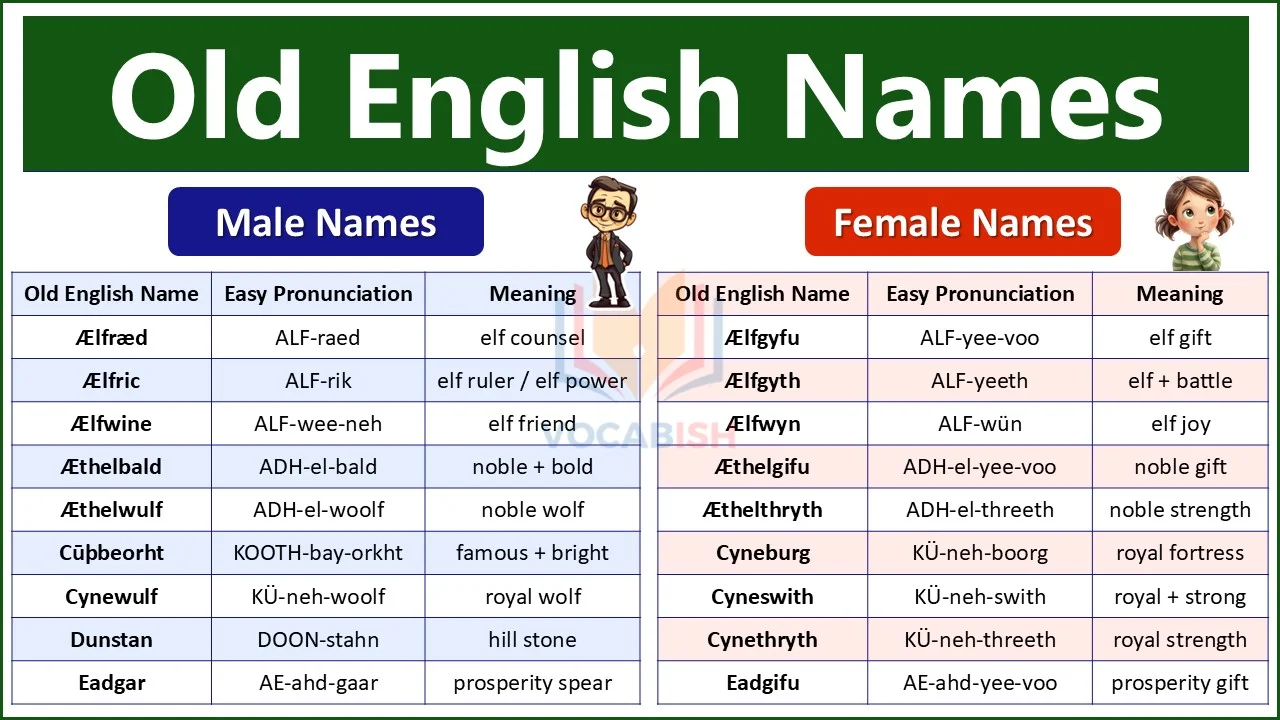
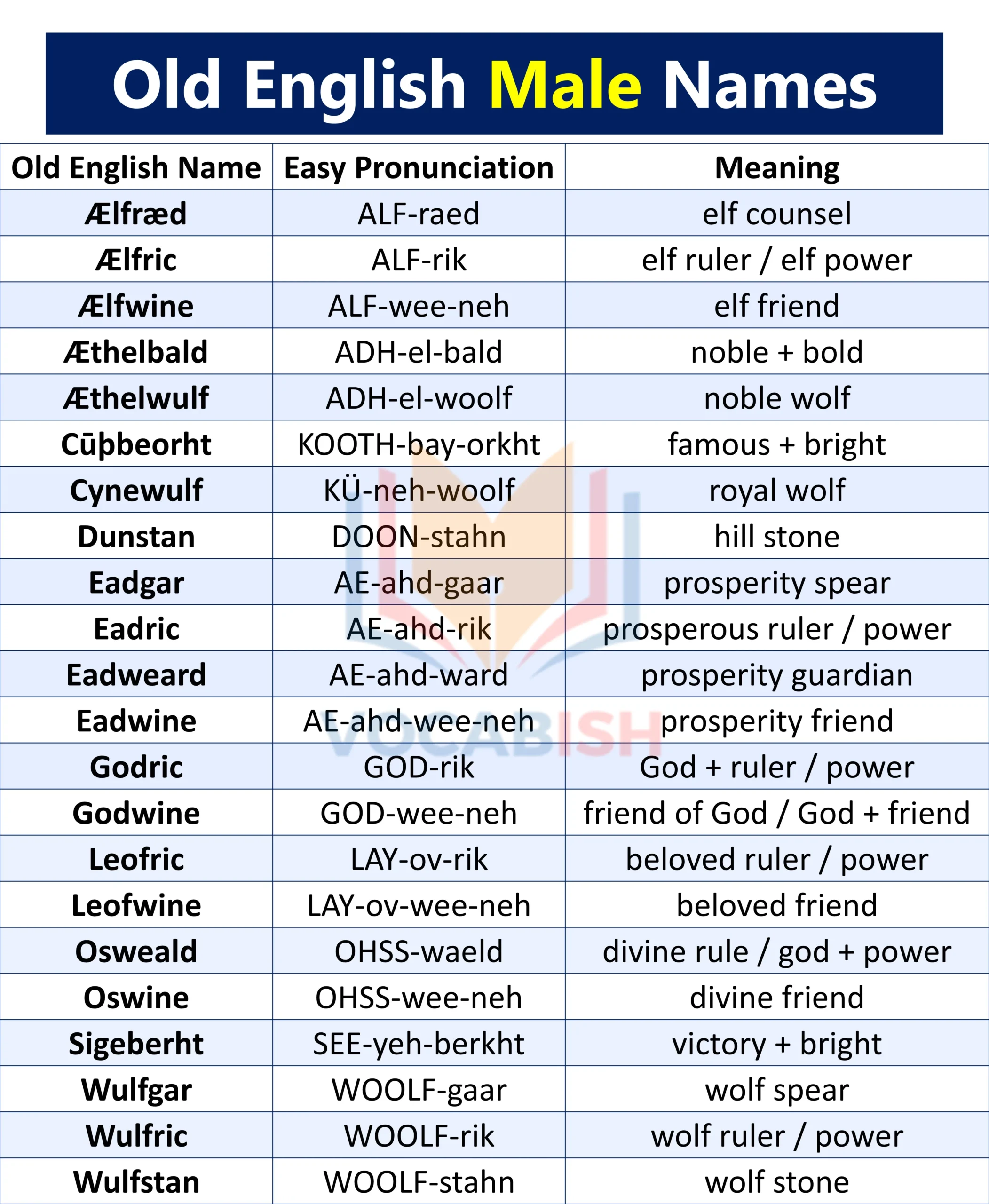
Old English Name | Easy Pronunciation | Meaning |
|---|---|---|
Ælfræd | ALF-raed | elf counsel |
Ælfric | ALF-rik | elf ruler / elf power |
Ælfstan | ALF-stahn | elf stone |
Ælfweard | ALF-ward | elf guardian |
Ælfwine | ALF-wee-neh | elf friend |
Æthelbald | ADH-el-bald | noble + bold |
Æthelberht | ADH-el-berkht | noble + bright |
Æthelræd | ADH-el-raed | noble counsel |
Æthelstan | ADH-el-stahn | noble stone |
Æthelweard | ADH-el-ward | noble guardian |
Æthelwine | ADH-el-wee-neh | noble friend |
Æthelwulf | ADH-el-woolf | noble wolf |
Cūþbeorht | KOOTH-bay-orkht | famous + bright |
Cyneric | KÜ-neh-rik | royal ruler / royal power |
Cynewulf | KÜ-neh-woolf | royal wolf |
Dunstan | DOON-stahn | hill stone |
Eadgar | AE-ahd-gaar | prosperity spear |
Eadmund | AE-ahd-moond | prosperity protection |
Eadred | AE-ahd-red | prosperity counsel |
Eadric | AE-ahd-rik | prosperous ruler / power |
Eadweard | AE-ahd-ward | prosperity guardian |
Eadwine | AE-ahd-wee-neh | prosperity friend |
Godric | GOD-rik | God + ruler / power |
Godwine | GOD-wee-neh | friend of God / God + friend |
Leofric | LAY-ov-rik | beloved ruler / power |
Leofwine | LAY-ov-wee-neh | beloved friend |
Osweald | OHSS-waeld | divine rule / god + power |
Oswine | OHSS-wee-neh | divine friend |
Sigeberht | SEE-yeh-berkht | victory + bright |
Wulfgar | WOOLF-gaar | wolf spear |
Wulfric | WOOLF-rik | wolf ruler / power |
Wulfstan | WOOLF-stahn | wolf stone |
Several elements in these names remain recognizable through related English words. Stān is “stone,” weard is related to “ward,” and wulf corresponds to modern “wolf.”
Famous Old English Male Names
A few names became especially well known because they were carried by kings, churchmen, nobles, or writers.
Ælfræd
This became modern Alfred. Its elements are ælf, “elf,” and ræd, “counsel” or “advice.”
Æthelstan
The name combines the idea of nobility with stān, meaning “stone.”
Eadweard
This is the ancestor of Edward. The two elements express prosperity or good fortune and guardianship.
Eadgar
Modern Edgar comes from this name. Gar means “spear.”
Wulfstan
A strong compound of wulf, “wolf,” and stan, “stone.”
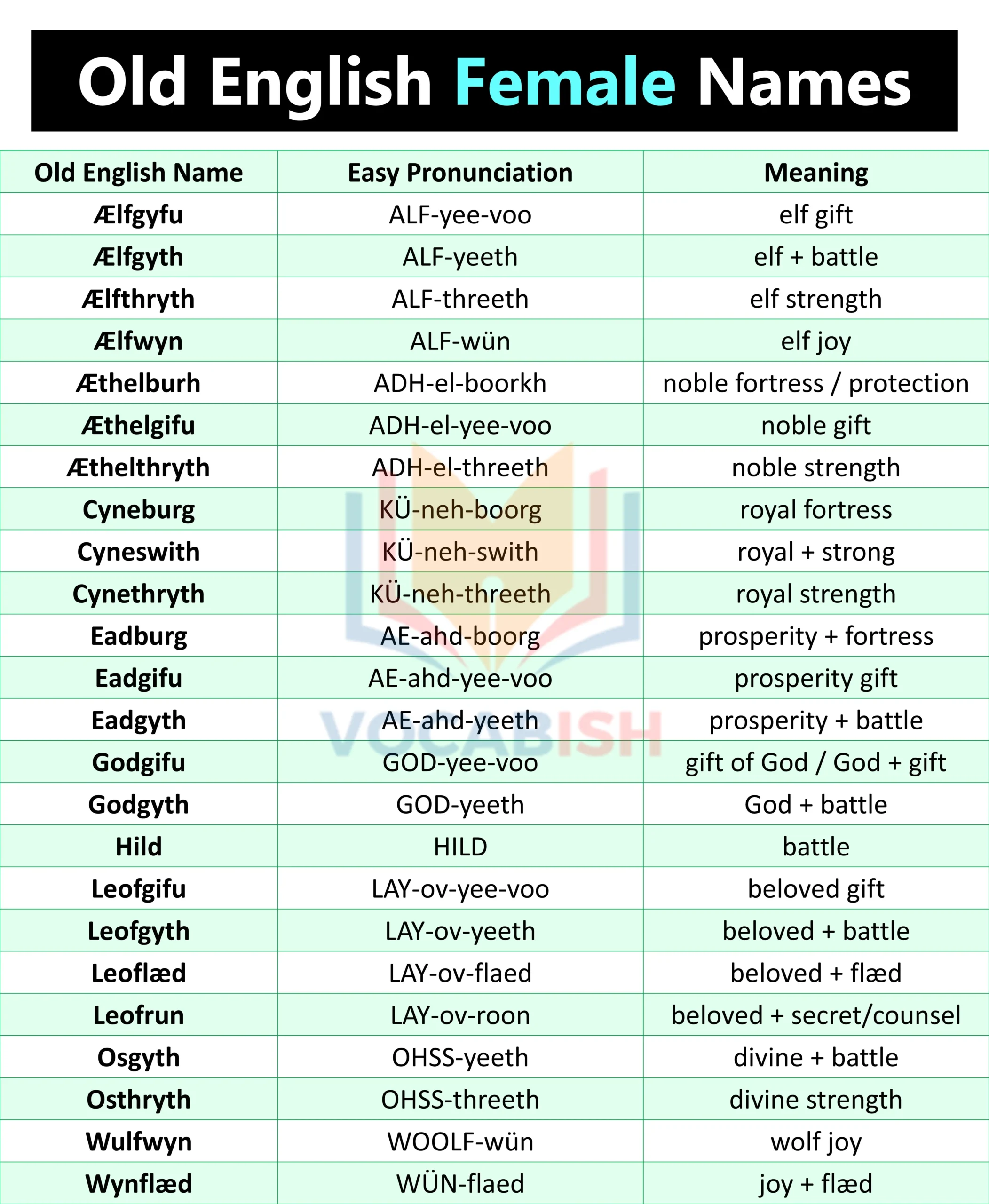
Old English Female Names with Meanings
Old English female names used many of the same first elements as male names. Common second elements included -burh, -flæd, -gifu, -gyth, -hild, -thryth, and -wyn.
Many express ideas connected with gifts, strength, battle, nobility, joy, prosperity, and protection.
Old English Name | Easy Pronunciation | Meaning |
|---|---|---|
Ælfgyfu | ALF-yee-voo | elf gift |
Ælfgyth | ALF-yeeth | elf + battle |
Ælflæd | ALF-flaed | elf + flæd, traditionally associated with beauty |
Ælfthryth | ALF-threeth | elf strength |
Ælfwyn | ALF-wün | elf joy |
Æthelburh | ADH-el-boorkh | noble fortress / protection |
Æthelflæd | ADH-el-flaed | noble + flæd; often interpreted “noble beauty” |
Æthelgifu | ADH-el-yee-voo | noble gift |
Æthelthryth | ADH-el-threeth | noble strength |
Cyneburg | KÜ-neh-boorg | royal fortress |
Cyneswith | KÜ-neh-swith | royal + strong |
Cynethryth | KÜ-neh-threeth | royal strength |
Eadburg | AE-ahd-boorg | prosperity + fortress |
Eadgifu | AE-ahd-yee-voo | prosperity gift |
Eadgyth | AE-ahd-yeeth | prosperity + battle |
Godgifu | GOD-yee-voo | gift of God / God + gift |
Godgyth | GOD-yeeth | God + battle |
Hild | HILD | battle |
Leofgifu | LAY-ov-yee-voo | beloved gift |
Leofgyth | LAY-ov-yeeth | beloved + battle |
Leoflæd | LAY-ov-flaed | beloved + flæd |
Leofrun | LAY-ov-roon | beloved + secret/counsel |
Osgyth | OHSS-yeeth | divine + battle |
Osthryth | OHSS-threeth | divine strength |
Wulfwyn | WOOLF-wün | wolf joy |
Wynflæd | WÜN-flaed | joy + flæd |
Historical lists record forms such as Ælfgyfu, Ælfthryth, Ælfwyn, Æthelburh, Æthelflæd, Æthelgifu, Æthelthryth, Cyneberg, Cynethryth, Eadgifu, Eadgyth, Godgifu, Leofgifu, Osgyth, Osthryth, Wulfwyn, and Wynflæd.
Famous Old English Female Names
Æthelflæd
This name was famously borne by Æthelflæd, Lady of the Mercians. Its first element means “noble.” The interpretation of flæd is less straightforward than elements such as gifu or ræd, although the whole name is often rendered figuratively as “noble beauty.”
Eadgyth
This name developed into modern Edith. It contains ead, associated with prosperity or good fortune, and gyth, connected with battle.
Godgifu
The name combines God and gifu, “gift.” Its later Latinized form Godiva became much more familiar.
Æthelthryth
The elements can be understood as “noble” and “strength.” The name eventually contributed to the later English name Audrey through centuries of sound and spelling change.
Strong Old English Names
Strength and protection appear frequently in Old English naming vocabulary.
Names involving wolves, warriors, weapons, guardians, fortresses, victory, and power often sound especially strong to modern readers.
Strong Male Names
- Æthelwulf — noble wolf
- Cynewulf — royal wolf
- Eadmund — prosperity + protection
- Eadweard — prosperity + guardian
- Sigeberht — victory + bright
- Wulfgar — wolf spear
- Wulfric — wolf ruler
- Wulfstan — wolf stone
Strong Female Names
- Ælfthryth — elf strength
- Æthelburh — noble fortress
- Æthelthryth — noble strength
- Cynethryth — royal strength
- Eadgyth — prosperity + battle
- Osthryth — divine strength
Words relating to battle and strength were normal elements of Germanic naming traditions. For example, Old English hild and guþ could mean “battle,” while þryþ expressed strength or power.
Old English Names Connected with Nature and Animals
Animal imagery appears in several Old English personal names, especially through the element wulf, meaning “wolf.”
The wolf could form part of both male and female compound names.
Examples include:
- Æthelwulf — noble wolf
- Beorhtwulf — bright wolf
- Cynewulf — royal wolf
- Eadwulf — prosperity wolf
- Wulfgar — wolf spear
- Wulfric — wolf ruler
- Wulfstan — wolf stone
- Wulfwyn — wolf joy
Other names contain elements connected with the physical world.
Dunstan, for example, combines an element associated with a hill or upland with stan, “stone.”
Names did not necessarily describe the person’s appearance or personality. The components belonged to a traditional Germanic system of personal-name formation.
Old English Names Still Recognizable Today
The Norman Conquest and later changes in English naming habits caused many native names to decline. However, several Old English names survived or developed into forms that remain familiar.
Their spelling and pronunciation often changed greatly.
Old English Form | Modern Form | Traditional Element Meaning |
|---|---|---|
Ælfræd | Alfred | elf + counsel |
Cūþbeorht | Cuthbert | famous + bright |
Eadgar | Edgar | prosperity + spear |
Eadmund | Edmund | prosperity + protection |
Eadweard | Edward | prosperity + guardian |
Eadwine | Edwin | prosperity + friend |
Eadgyth | Edith | prosperity + battle |
Godgifu | Godiva | God + gift |
Osweald | Oswald | divine + rule |
Dunstan | Dunstan | hill + stone |
Old English sources preserve spellings such as Eadgar, Eadmund, Eadweard, Eadwine, Eadgyth, Godgifu, Osweald, and Dunstan, alongside later forms that became more familiar in English.
What About Ethel and Audrey?
Ethel is connected with the Old English element Æthel-, meaning “noble.” In Old English, however, Æthel normally appeared as part of longer compound names rather than functioning exactly like the later standalone name Ethel.
Audrey has a more indirect history. It developed from forms associated with Æthelthryth, so the modern spelling looks very different from its Old English ancestor.
How to Pronounce Old English Names
Old English spelling was generally more closely connected to pronunciation than Modern English spelling. Most written letters were intended to be pronounced, including letters that might look unfamiliar today.
Pronunciation still varied across dialects and centuries, so modern reconstructions cannot represent every speaker in early medieval England.
Useful Old English Pronunciation Rules
Letter or Combination | Approximate Sound | Example |
|---|---|---|
æ | a in cat | Ælfræd |
a / ā | a similar to father | stan / stān |
þ / ð | th in thin or this | Æþel |
sc | often “sh” | Old English scip |
c | k or sometimes ch | depends on surrounding sounds |
g | g, y, or another softer sound | varies by position |
f | f, sometimes v between voiced sounds | gifu |
s | s, sometimes z-like between voiced sounds | varies |
ƿ | w | historic manuscripts |
h | h initially; stronger sound elsewhere | varies |
Old English also used letters such as þ (thorn), ð (eth), æ (ash), and ƿ (wynn). Thorn and eth represented the sounds now normally written th, while wynn represented w.
Why “Æthel” Does Not Begin Like Modern “Ethel”
The letter æ represented a vowel closer to the a in cat than the modern long ee sound.
So an Old English-style pronunciation of Æthel begins closer to:
ADH-el
rather than:
EE-thel
Modern forms developed their own pronunciations after centuries of language change.
How Should Æ Be Read?
For learners, read æ approximately like the a in:
- cat
- hat
- map
The Old English vowel system was not identical to modern English, but this is a useful starting point.
Old English Names vs Modern English Names
Old and modern English names can look similar while being pronounced very differently.
Centuries of sound change, spelling reform, French influence, Latinization, and changing naming traditions transformed many early forms.
Old English | Modern English | Main Difference |
|---|---|---|
Ælfræd | Alfred | simplified spelling and pronunciation |
Eadgar | Edgar | old Ead- reduced |
Eadmund | Edmund | Ead- became Ed- |
Eadweard | Edward | spelling and vowel sounds changed |
Eadwine | Edwin | final element shortened |
Eadgyth | Edith | -gyth changed greatly |
Godgifu | Godiva | later Latinized form |
Osweald | Oswald | spelling simplified |
Æthelthryth | Audrey | major historical sound changes |
This is why pronouncing an Old English spelling exactly like its modern descendant can produce a misleading result.
Choosing an Old English Name by Meaning
If you are studying names for history, fiction, vocabulary, or personal interest, looking at the elements is often more useful than choosing by modern appearance alone.
You can group names by the ideas they contain.
Names Associated with Wisdom and Counsel
- Ælfræd — elf counsel
- Æthelræd — noble counsel
- Eadred — prosperity counsel
Names Associated with Friendship
- Ælfwine — elf friend
- Eadwine — prosperity friend
- Godwine — God + friend
- Leofwine — beloved friend
- Oswine — divine friend
Associated with Prosperity
- Eadgar
- Eadmund
- Eadred
- Eadric
- Eadweard
- Eadwine
- Eadgifu
- Eadgyth
The recurring Ead- element is associated with happiness, prosperity, blessing, or good fortune.
Names Associated with Nobility
- Æthelbald
- Æthelberht
- Æthelburh
- Æthelflæd
- Æthelgifu
- Æthelræd
- Æthelstan
- Æthelthryth
- Æthelwulf
Names Associated with Protection
- Eadmund — prosperity + protection
- Eadweard — prosperity + guardian
- Æthelburh — noble fortress
- Cyneburg — royal fortress
Common Confusions About Old English Names
A few mistakes can make historical name lists misleading.
- Old English and “old-fashioned English” are not the same. Victorian names are not automatically Old English.
- Not every medieval English name is Anglo-Saxon. Norse, Norman French, Latin, Celtic, and biblical names were also used.
- Modern pronunciation should not automatically be applied to Old English spellings.
- Name meanings are usually based on individual elements. The complete compound was not always understood as a literal descriptive phrase.
- Modern letters may replace historic ones. For example, Æthelred may also appear as Aethelred or Ethelred.
FAQs About Old English Names
Old English names are personal names used in early medieval England, often formed from Germanic elements expressing ideas such as nobility, prosperity, friendship, strength, or protection.
Famous examples include Ælfræd, Æthelstan, Eadgar, Eadweard, Eadmund, Wulfstan, Æthelflæd, Eadgyth, Godgifu, and Æthelthryth.
The element Æthel- or Æþel- means “noble.” It appears in names such as Æthelstan, Æthelræd, Æthelthryth, and Æthelwulf.
Wulf means “wolf” and appears in names such as Wulfstan, Wulfric, Wulfgar, Æthelwulf, Cynewulf, and the female name Wulfwyn.
Ead- expresses ideas such as prosperity, happiness, blessing, or good fortune. It appears in Edward, Edmund, Edgar, Edwin, and Edith.
The letter æ, called ash, can be approximated by learners with the vowel in cat or hat, rather than modern English “ay.”
Yes. Alfred comes from Old English Ælfræd, traditionally analyzed as ælf, meaning “elf,” plus ræd, meaning “counsel” or “advice.”
No. Old English and Old Norse naming traditions share Germanic features, but they belong to different languages and should not automatically be treated as identical.
Conclusion
Old English Names preserve an important part of early English language and culture. Names such as Ælfræd, Eadweard, Æthelstan, Godgifu, Eadgyth, and Wulfstan become much easier to understand once their individual elements are recognized.
Words for nobility, prosperity, counsel, friendship, gifts, victory, protection, strength, wolves, spears, and stones were repeatedly used to form personal names. Some disappeared, while others slowly developed into familiar names such as Alfred, Edward, Edgar, Edmund, Edwin, Edith, Oswald, and Godiva.
Learning their meanings and pronunciation does more than provide a list of unusual names. It also shows how the vocabulary and sounds of Old English continue to leave traces in English today.
Explore More Helpful Resources
- Old English Numbers 1–100
- Old English Pronouns
- How to Speak Old English
- A to Z Alphabet in Old English
- 120+ Old English Words with Meanings