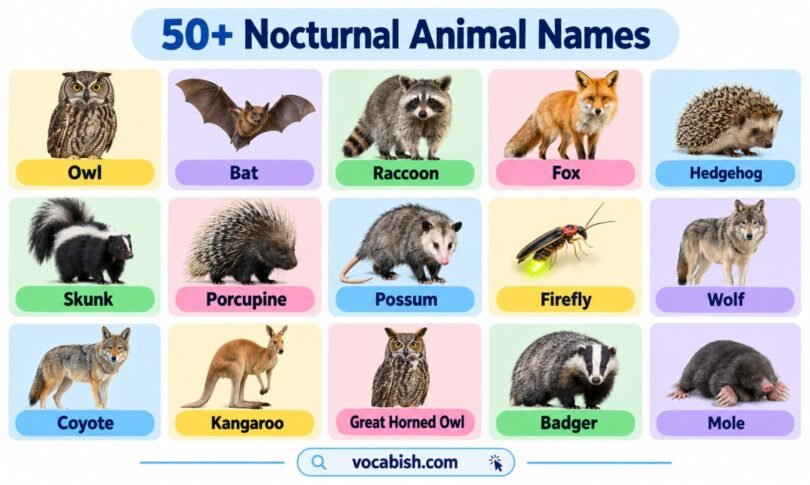

Nocturnal animal names describe animals that are mainly active at night rather than during the day. These animals include bats, owls, foxes, raccoons, hedgehogs, and scorpions. Many nocturnal animals have special features that help them survive in darkness. Sharp hearing, strong smell, sensitive eyes, camouflage, and echolocation are common adaptations. Some search for food at night, while others hunt, travel, or communicate after sunset. In this article, you will find common nocturnal animal names in English with pictures, useful facts, animal categories, and easy vocabulary examples.
What Are Nocturnal Animals?
Nocturnal animals are animals that are mainly active during the night. Many sleep or rest during the day and search for food, move around, hunt, or communicate after dark.
The word nocturnal means “active at night.” The opposite word is diurnal, which means “active during the day.” Some animals are crepuscular, meaning they are most active around sunrise and sunset.
Nocturnal, Diurnal, and Crepuscular
Term | Meaning | Example |
|---|---|---|
Nocturnal | Active mainly at night | Owl |
Diurnal | Active mainly during the day | Eagle |
Crepuscular | Active mainly at dawn or dusk | Rabbit |
Nocturnal behaviour is common in many groups, including mammals, birds, reptiles, amphibians, insects, and other invertebrates. The exact activity pattern can vary between species and may also change with season, temperature, predators, and food availability.
Common Nocturnal Animal Names
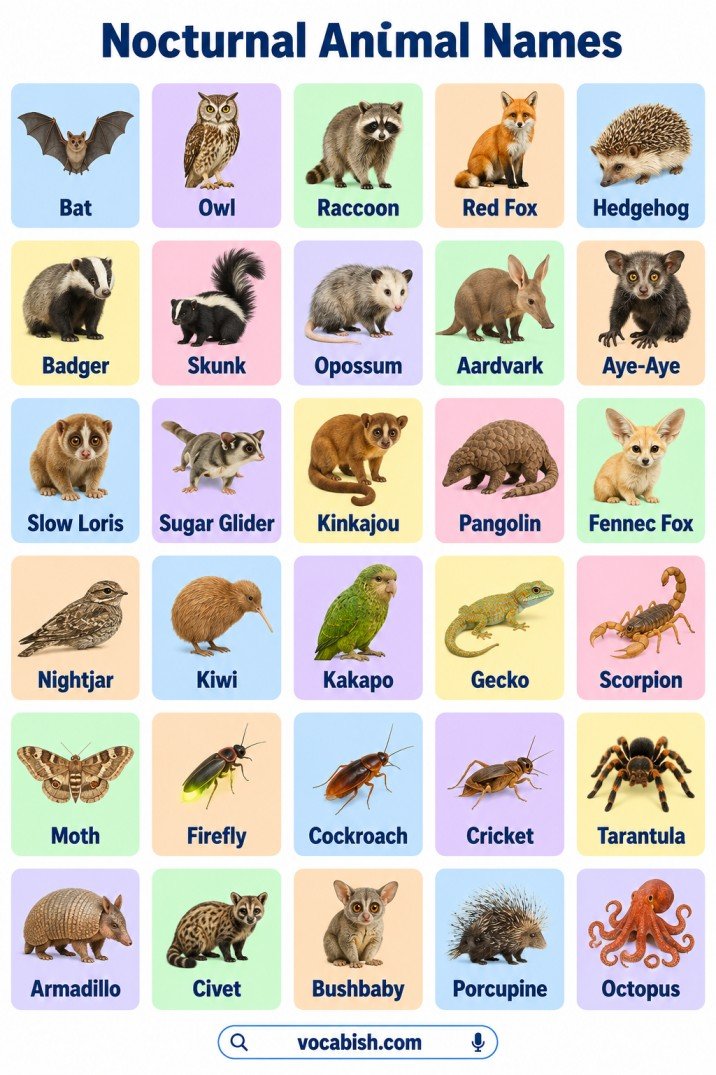
Here are some of the most familiar nocturnal animals in English. These names are especially useful for animal vocabulary, school lessons, reading practice, and picture-based learning.
1. Bat
Pronunciation: /bæt/
A bat is a small mammal that is usually active at night. Many bats fly after sunset to catch insects, while some species eat fruit, nectar, or other foods. Bats use echolocation to detect objects and find their way in darkness. They rest during the day in places such as caves, trees, and buildings.
2. Owl
Pronunciation: /aʊl/
An owl is a bird known for being active mainly at night. It has large eyes, excellent hearing, and specially adapted feathers that help many species fly quietly. Owls hunt animals such as mice, insects, and small birds. Different owl species live in forests, grasslands, wetlands, and other habitats.
3. Raccoon
Pronunciation: /ræˈkuːn/
A raccoon is a mammal that is mainly active at night. It has a distinctive dark mask across its face and a ringed tail. Raccoons use their sensitive paws and strong sense of smell to find food. They can live in forests as well as towns and cities.
4. Fox
Pronunciation: /fɒks/
Many foxes are most active at night, although some may also move around during the day. Foxes have strong hearing and smell, which help them locate prey. They commonly eat small mammals, birds, insects, fruit, and other available foods. Fox species live in a wide range of environments.
5. Hedgehog
Pronunciation: /ˈhedʒ.hɒɡ/
A hedgehog is a small mammal that usually comes out at night. Its back is covered with protective spines, which help defend it from danger. Hedgehogs search the ground for insects, worms, and other small foods. During the day, they normally rest in sheltered places.
6. Badger
Pronunciation: /ˈbædʒ.ər/
A badger is a sturdy mammal that is often active during the night. It has strong claws that help it dig burrows and search for food. Badgers may eat insects, worms, small animals, roots, and fruit. They spend much of the daytime inside their underground homes.
7. Skunk
Pronunciation: /skʌŋk/
A skunk is a small mammal that is usually active after dark. It has black-and-white fur and is famous for releasing a strong-smelling spray when threatened. Skunks eat insects, worms, small animals, fruit, and plants. They often search for food on the ground at night.
8. Opossum
Pronunciation: /əˈpɒsəm/
An opossum is a nocturnal mammal found mainly in the Americas. It has a long, narrow face, a pointed nose, and a mostly hairless tail. Opossums are opportunistic feeders and eat many kinds of food, including insects, fruit, and small animals. They usually rest in sheltered places during daylight.
9. Aardvark
Pronunciation: /ˈɑːrd.vɑːrk/
An aardvark is a nocturnal mammal native to Africa. It has a long snout, large ears, powerful claws, and a strong tongue. Aardvarks mainly feed on ants and termites. They often leave their underground burrows after sunset to search for food.
10. Aye-Aye
Pronunciation: /ˈaɪ aɪ/
An aye-aye is a rare nocturnal primate from Madagascar. It has large eyes, large ears, and an unusually long middle finger. It uses this finger to help find and collect food from trees. Aye-ayes spend much of their active time at night.
11. Slow Loris
Pronunciation: /sloʊ ˈlɔːrɪs/
A slow loris is a small primate that is active at night. It has large forward-facing eyes that help it see in low light. Slow lorises move carefully through trees and feed on insects, fruit, nectar, and other foods. Several species are native to South and Southeast Asia.
12. Sugar Glider
Pronunciation: /ˈʃʊɡər ˌɡlaɪdər/
A sugar glider is a small Australian marsupial that is mostly active at night. It has a membrane between its legs that allows it to glide from tree to tree. Sugar gliders eat nectar, sap, fruit, and insects. They often live in groups and rest together during the day.
13. Kinkajou
Pronunciation: /ˈkɪŋkəˌdʒuː/
A kinkajou is a nocturnal mammal related to raccoons. It lives in tropical forests and spends much of the night moving through trees. Its long tongue helps it feed on fruit and nectar. Kinkajous have a strong tail that can help them balance while climbing.
14. Pangolin
Pronunciation: /ˈpæŋɡəlɪn/
A pangolin is a mammal covered with hard protective scales. Many pangolin species are mainly nocturnal and search for ants and termites at night. Their strong claws help them open nests and dig into the soil. Pangolins curl into a ball when they feel threatened.
15. Fennec Fox
Pronunciation: /ˈfenek fɒks/
The fennec fox is a small desert fox that is mainly active at night. Its very large ears help release body heat and detect sounds. It eats insects, small animals, fruit, and other available foods. Its nocturnal habits help it avoid some of the extreme daytime heat of the desert.
16. Nightjar
Pronunciation: /ˈnaɪt.dʒɑːr/
A nightjar is a bird that is usually active at dusk and during the night. It has patterned feathers that help it blend into the ground and vegetation. Nightjars feed mainly on flying insects. Their wide mouths are well suited to catching insects in the air.
17. Kiwi
Pronunciation: /ˈkiːwiː/
The kiwi is a flightless bird from New Zealand and is mostly nocturnal. It has a long bill with nostrils near the tip, which helps it locate food by smell. Kiwis search the ground for insects, worms, berries, and other small foods. They usually become active after dark.
18. Kakapo
Pronunciation: /ˌkɑːkəˈpəʊ/
The kakapo is a large, flightless parrot from New Zealand. It is nocturnal and uses the darkness to search for plants and other food. Its soft green feathers provide camouflage in forest habitats. The kakapo is also known for being unable to fly.
19. Gecko
Pronunciation: /ˈɡekoʊ/
Many gecko species are nocturnal and become active after sunset. They use their eyes and other senses to locate insects and other small prey. Some geckos can climb smooth surfaces because of special structures on their toes. Nocturnal geckos occur in many warm parts of the world.
20. Scorpion
Pronunciation: /ˈskɔːrpiən/
Many scorpions are nocturnal and hide during the hottest part of the day. They usually emerge at night to hunt insects, spiders, and other small animals. Scorpions use their pincers to catch prey and a stinger at the end of the tail for defence and hunting. They are found in many dry and warm regions.
Nocturnal Mammal Names
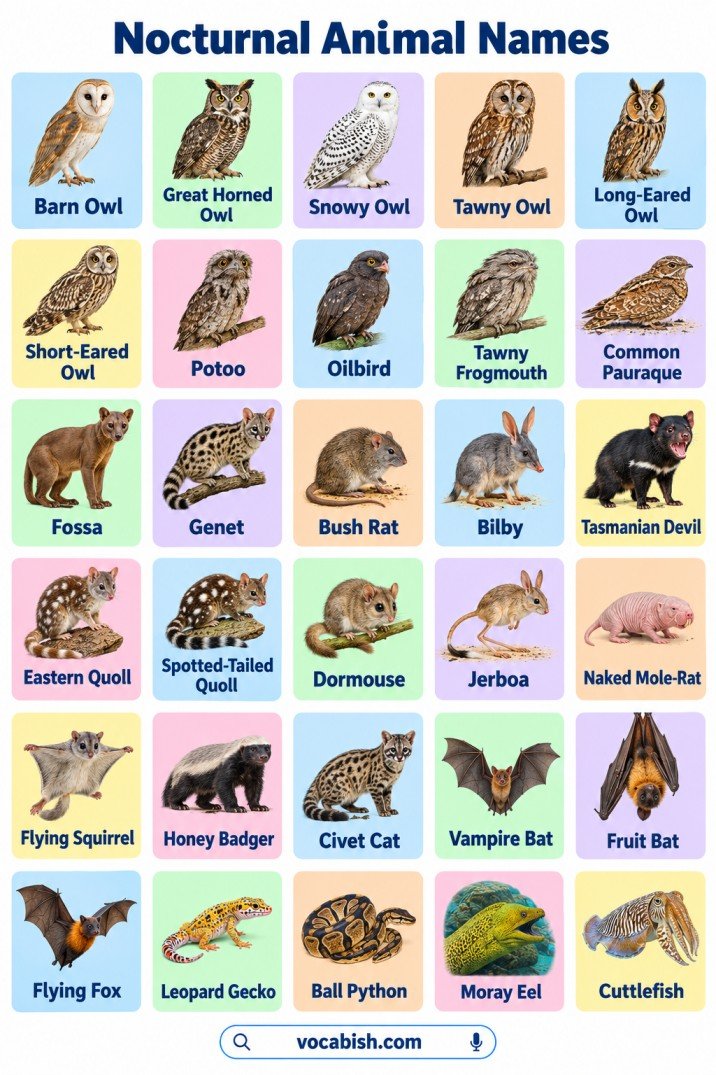
The following names include nocturnal or mainly nocturnal mammals. Activity patterns can vary between species and habitats.
- Bat
- Raccoon
- Red Fox
- Arctic Fox
- Fennec Fox
- Gray Fox
- Badger
- Honey Badger
- Skunk
- Opossum
- Hedgehog
- Aardvark
- Aye-Aye
- Slow Loris
- Pygmy Slow Loris
- Kinkajou
- Sugar Glider
- Flying Squirrel
- Pangolin
- Maned Wolf
- Civet
- Genet
- Bushbaby
- Galago
- Jerboa
- Dormouse
- Porcupine
- Armadillo
- Bilby
- Bilby
- Greater Mouse-Deer
- Common Brushtail Possum
- Common Ringtail Possum
- Eastern Quoll
- Spotted-Tailed Quoll
- Tasmanian Devil
- Fossa
- Potto
- Bush Rat
- Naked Mole-Rat
Nocturnal Bird Names
Many birds are active at night, especially owls and several bird groups adapted for night feeding or movement.
- Barn Owl
- Snowy Owl
- Great Horned Owl
- Tawny Owl
- Little Owl
- Burrowing Owl
- Long-Eared Owl
- Short-Eared Owl
- Eagle Owl
- Scops Owl
- Nightjar
- European Nightjar
- Common Pauraque
- Potoo
- Oilbird
- Kiwi
- Little Spotted Kiwi
- Southern Brown Kiwi
- Kakapo
- Tawny Frogmouth
- Australian Owlet-Nightjar
- Night Heron
Nocturnal Reptile Names
Many reptiles become active at night, especially in regions where daytime temperatures are high.
- Leopard Gecko
- Tokay Gecko
- Crested Gecko
- Flying Gecko
- Fat-Tailed Gecko
- House Gecko
- African Fat-Tailed Gecko
- Boa Constrictor
- Ball Python
- Burmese Python
- Reticulated Python
- Green Tree Python
- Children’s Python
- Carpet Python
- Night Snake
- Cat-Eyed Snake
- Banded Krait
- Common Krait
- Western Diamondback Rattlesnake
- Sidewinder
- Crocodile
- American Alligator
- Night Lizard
Nocturnal Amphibian Names
Several frogs, toads, and salamanders are most active at night, particularly in damp or cooler conditions.
- Tree Frog
- Green Tree Frog
- Red-Eyed Tree Frog
- White’s Tree Frog
- Gray Tree Frog
- Barking Tree Frog
- Bullfrog
- American Bullfrog
- Cane Toad
- Common Toad
- Spadefoot Toad
- Fire-Bellied Toad
- Glass Frog
- Poison Dart Frog
- Salamander
- Tiger Salamander
- Spotted Salamander
- Marbled Salamander
- Red Salamander
- Hellbender
Nocturnal Insect Names
Many insects use the night for feeding, mating, migration, or avoiding daytime heat and predators.
- Moth
- Luna Moth
- Hawk Moth
- Atlas Moth
- Silk Moth
- Clothes Moth
- Noctuid Moth
- Firefly
- Glowworm
- Mosquito
- Cockroach
- Cricket
- Mole Cricket
- Katydid
- Earwig
- June Beetle
- Click Beetle
- Rhinoceros Beetle
- Stag Beetle
- Longhorn Beetle
- Mayfly
- Caddisfly
- Silverfish
- Camel Cricket
- Assassin Bug
Nocturnal Arachnid Names
Many arachnids are active at night, especially in warm and dry habitats.
- Scorpion
- Emperor Scorpion
- Bark Scorpion
- Deathstalker Scorpion
- Tarantula
- Wolf Spider
- Huntsman Spider
- Fishing Spider
- Trapdoor Spider
- House Spider
- Camel Spider
- Vinegaroon
- Whip Scorpion
- Harvestman
Nocturnal Marine and Freshwater Animal Names
Night activity is also common among many aquatic animals, particularly animals that hunt or feed in darker conditions.
- Octopus
- Common Octopus
- Giant Pacific Octopus
- Cuttlefish
- Squid
- Bobtail Squid
- Vampire Squid
- Moray Eel
- Conger Eel
- Catfish
- Walking Catfish
- Bullhead Catfish
- Eel
- Sea Cucumber
- Brittle Star
- Sea Urchin
- Lobster
- Crayfish
- Shrimp
- Krill
Nocturnal Animal Vocabulary with Meanings
These words are useful when talking or writing about animals that are active at night.
Word | Meaning |
|---|---|
Nocturnal | Active mainly at night |
Diurnal | Active mainly during the day |
Crepuscular | Active mainly at dawn or dusk |
Night-active | Active during the night |
Echolocation | Using sound echoes to locate objects |
Camouflage | Colours or patterns that help an animal blend into its surroundings |
Predator | An animal that hunts other animals |
Prey | An animal hunted by another animal |
Habitat | The natural place where an animal lives |
Circadian rhythm | A roughly 24-hour body cycle that affects sleep and activity |
Useful Example Sentences:
- The owl is a nocturnal bird.
- A bat often flies after sunset.
- The raccoon searches for food at night.
- The hedgehog sleeps during much of the day.
- Some geckos are active after dark.
- Many scorpions hunt at night.
Quiz for Nocturnal Animals
Choose the correct answers and complete the animal names. Check your score when you finish.
Practice Questions
Read each question carefully. There is only one correct answer for each question.
Which nocturnal animal can fly and often uses echolocation?
Which bird is best known for hunting at night?
Which small mammal has a back covered with protective spines?
Which animal is known for releasing a strong-smelling spray when threatened?
Which nocturnal mammal is recognised by a dark mask across its face and a ringed tail?
Complete the sentence: An ________ is a nocturnal bird with large eyes.
Complete the sentence: A ________ is a mammal that can fly.
Complete the sentence: A ________ has a strong sense of smell and hearing.
Which reptile is often active after sunset?
Which arachnid often comes out at night to hunt insects?
Which nocturnal fox has very large ears and lives in desert regions?
Which flightless bird from New Zealand is mainly nocturnal?
Complete the sentence: A ________ uses strong claws to dig burrows.
Which nocturnal mammal has a body covered with hard protective scales?
What word describes animals that are mainly active during the night?
Common Spelling and Meaning Confusions
- Nocturnal means active at night; it does not mean an animal can see perfectly in complete darkness.
- Owl is the animal name; owlet means a young owl.
- Bat is a mammal, not a bird, even though it can fly.
- Fox is a general animal name, while fennec fox and Arctic fox name particular types of fox.
- Night animal is understandable English, but nocturnal animal is the standard biological term.
Interesting Facts About Nocturnal Animals
- Bats use echolocation: Many bats send out high-frequency sounds and listen for echoes. This helps them locate insects and avoid obstacles in darkness.
- Owls can hear extremely well: An owl can use its excellent hearing to locate prey, even when the animal is hidden under grass or snow.
- Some nocturnal animals have large eyes: Animals such as owls, bushbabies, and some geckos have large eyes that help them gather more light at night.
- Night can help animals avoid heat: Some desert animals, such as fennec foxes and scorpions, become active at night when temperatures are much lower.
- Nocturnal animals are not always awake all night: Their activity can change because of weather, food availability, predators, seasons, and human disturbance.
- Many nocturnal animals rely on smell: Foxes, opossums, and other night-active mammals use strong senses of smell to locate food and recognise their surroundings.
- Some frogs become active after sunset: Warm and humid nighttime conditions can make it easier for many frogs and toads to feed, move, and call.
- Nighttime protects some animals from predators: Being active after dark can reduce encounters with predators that mainly hunt during daylight.
FAQs
Nocturnal animal names are names of animals that are mainly active at night, such as bats, owls, raccoons, foxes, and hedgehogs.
Bats and owls are among the best-known nocturnal animals, while raccoons, foxes, and hedgehogs are also widely recognised examples.
Yes. Most owl species are nocturnal, although some species may also hunt during daylight at certain times.
The opposite of nocturnal is diurnal, which describes animals that are mainly active during the daytime.
No. Many foxes are nocturnal or crepuscular, but their activity can change with habitat, food availability, season, and human activity.
No. Nocturnal species occur among mammals, birds, reptiles, amphibians, insects, arachnids, fish, and many other animals.
Conclusion
Nocturnal Animal Names include many familiar species, from the bat, owl, fox, and raccoon to less familiar animals such as the aye-aye, kakapo, kinkajou, and fennec fox. Learning these names with pictures makes animal vocabulary easier to recognise, remember, spell, and use in English sentences.